
 Blog PDF for offline reading
Quick answer: Zigpac's advice on how to choose a folding carton manufacturer is to run six checks before you send artwork: confirm the exact board grade and caliper, find out who builds and verifies the dieline, follow a clear proof and sample sequence, choose the print route and quantity break that fits your run, require written QC evidence, and compare landed cost rather than unit price. Two quotes can only be compared when they describe the same board, structure, finish, quantity and delivery terms. At Zigpac, folding cartons are quoted with price tiers from 50 pcs, final MOQ on your quote, a free eProof with every order, and physical samples from US$5–30. Approve a physical sample before bulk production, whichever folding carton manufacturer you choose.
Most carton sourcing problems start before production, in the quote request itself. A buyer asks three suppliers for "a printed tuck box, 2 x 2 x 6 inches, 1,000 pcs" and gets three prices. One is for 14 pt recycled board with a grey back, one for 18 pt bleached board with aqueous coating, and one for a matte-laminated sample run. On paper, the cheapest supplier looks like the winner.
The price gap that results can be huge. In one buyer discussion, a small brand reported custom box quotes ranging from $8.95 to $150[1] for similar requests. Other small sellers say that despite claims about digital printing, many suppliers still ask for 500–1,000+ units[2]. Timing adds more risk. An industry buying guide puts overseas packaging lead time, including freight to the nearest port, at 6–12 weeks[3]. If you pick a supplier on unit price alone, you can end up with the wrong board, a reprint, and a missed launch.
The fix is a standard checklist. Use it to make every supplier answer the same questions, in writing, before you compare prices.
What a Folding Carton Manufacturer Actually Does
A folding carton manufacturer converts paperboard into printed cartons that ship flat. The work runs in sequence: printing, then coating or lamination, then die-cutting and creasing, then stripping waste, then folding and gluing, then counting and packing. A rigid box maker wraps chipboard and builds a set-up box. A corrugated plant makes shipping cases. A folding carton plant works mainly with single-ply or multi-ply paperboard, sometimes with micro-flute. Corrugated styles are catalogued in the FEFCO Code[4], including the 07xx ready-glued cases. Paperboard carton styles follow the parallel ECMA code. When a supplier says "ECMA A20.20" or "FEFCO 0713", you can check the structure being quoted against a published reference.
Demand for these cartons keeps growing because online retail keeps growing. Census estimates put e-commerce at roughly one in six U.S. retail dollars (U.S. Census Bureau[5]). Small firms, which make up most U.S. businesses[6], increasingly need short printed runs rather than truckloads. That is why MOQ and print route now carry as much weight as plant capacity.
Step 1: How to Choose a Folding Carton Manufacturer by Board Grade and Caliper
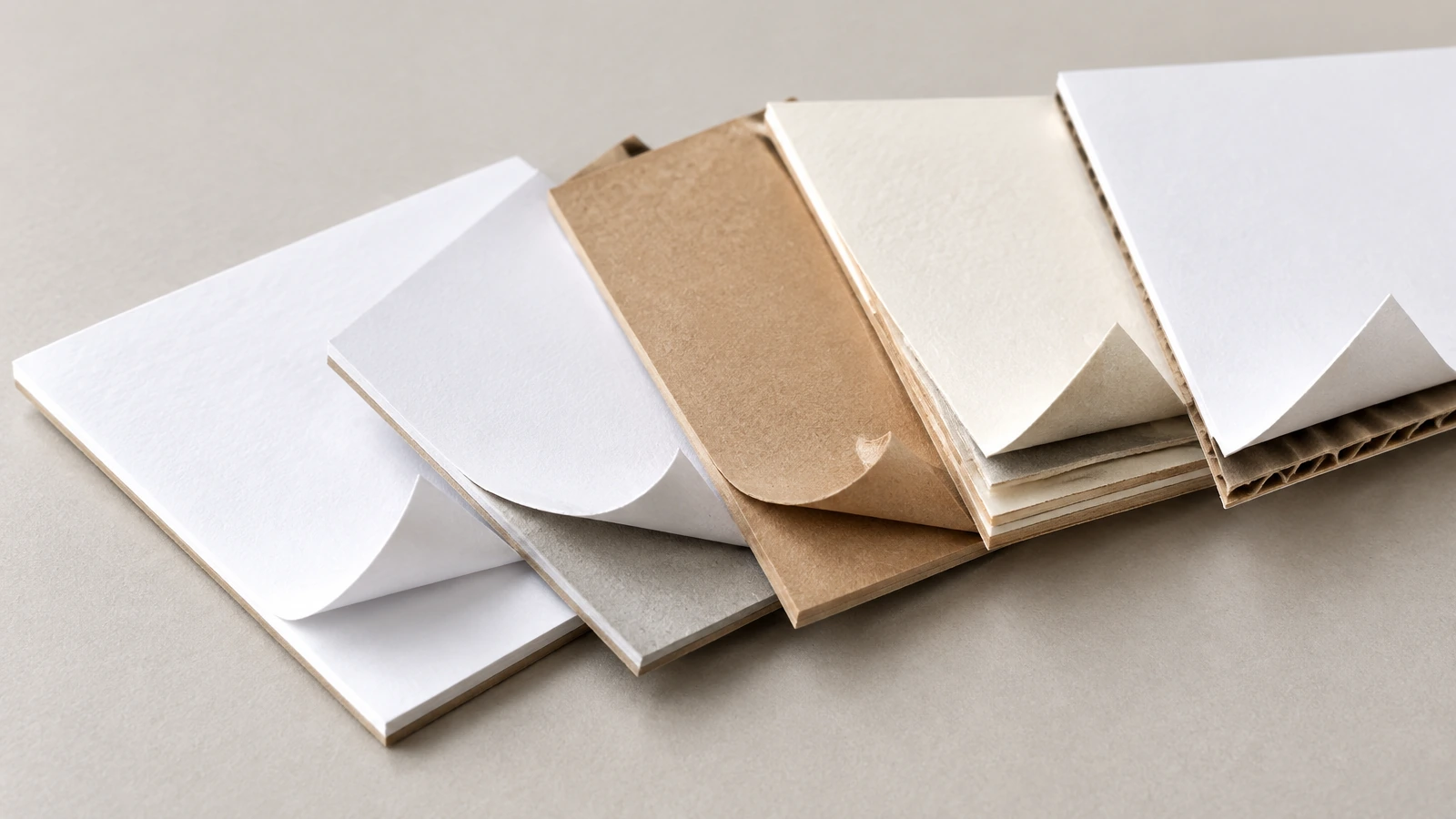
Board is usually the largest single cost line, and it is also where quotes most often disagree. Caliper (thickness) in North America is stated in points: 1 pt = 0.001 in = 0.0254 mm, so 18 pt is about 0.46 mm. If one quote gives caliper and another gives grams per square metre (gsm), they are not comparable until the supplier converts one into the other. The table below explains the common grades in general industry terms.
| Board grade | Surface and structure | Print result | Typical uses | Cost tendency | What to ask |
|---|---|---|---|---|---|
| SBS (solid bleached sulfate) | Bleached virgin fibre, white through the whole sheet, clay-coated top | Sharpest images and cleanest whites; edges stay white when cut | Cosmetics, supplements, pharma-style cartons, premium retail | Higher | Caliper in pt, coated one side or two, coating or lamination |
| CCNB (clay-coated news back) | Recycled fibre, coated white top, grey back | Good on the coated side; the inside and cut edges show grey | Dry food, household goods, price-driven retail | Lower | Recycled content percentage, how the inside looks, stiffness at the same caliper |
| Kraft / unbleached (SUS/CUK) | Brown virgin fibre, strong and tear-resistant | Muted colours; white ink or a coated top is needed for bright art | Natural-look brands, heavier items | Mid | Uncoated or coated, whether white ink is included |
| FBB (folding boxboard) | Multi-ply board with a mechanical pulp middle; light and stiff | Very good on the coated top; back is often cream | Food, confectionery, personal care | Mid | Basis weight, back colour, food-contact documentation if relevant |
| E/F-flute micro-flute | Printed liner laminated to a small flute | Good, but flute lines can show through under heavy solid ink | Heavier retail packs, mailer-style cartons | Higher per unit | Flute type, liner grade, crush and stacking requirements |
Questions to put to every supplier:
- What is the exact grade, caliper in pt and/or gsm, and the mill or origin of the board?
- Which direction does the grain run relative to the carton's main score? Getting this wrong causes bowed panels and cracked folds.
- What is the recycled content, and can you document it if you plan to make an environmental claim?
- Is the coating aqueous, UV, varnish or film lamination? Each one changes how the board scores and how it can be recycled.
Zigpac's Custom Straight Tuck End Boxes are listed in SBS or kraft paperboard. The auto-lock carton is listed in paperboard or corrugated, with the final material confirmed on the quote. If you need another grade, ask any supplier to confirm it in writing before you compare prices.
Step 2: Confirm Structure and Dieline Ownership
Carton style matters less to supplier choice than one practical question: who draws the dieline, and who is responsible when it is wrong? Straight tuck end, reverse tuck, snap-lock (1-2-3) and auto-lock bottoms each have different glue points, panel allowances and costs. If your product is heavy or your packing line is fast, review the pre-glued option on our custom auto-lock bottom folding cartons page rather than here.
- Will the supplier build the dieline from your internal L × W × D and product weight, or do you have to supply it?
- Does the dieline account for board caliper in tuck depth, dust flaps and glue-flap width?
- Are inserts, windows, hang tabs and tamper areas drawn on the same file, so the print artwork lines up with them?
- If the structural sample does not fit, who pays for the revision?
Step 3: Follow a Proofing Ladder
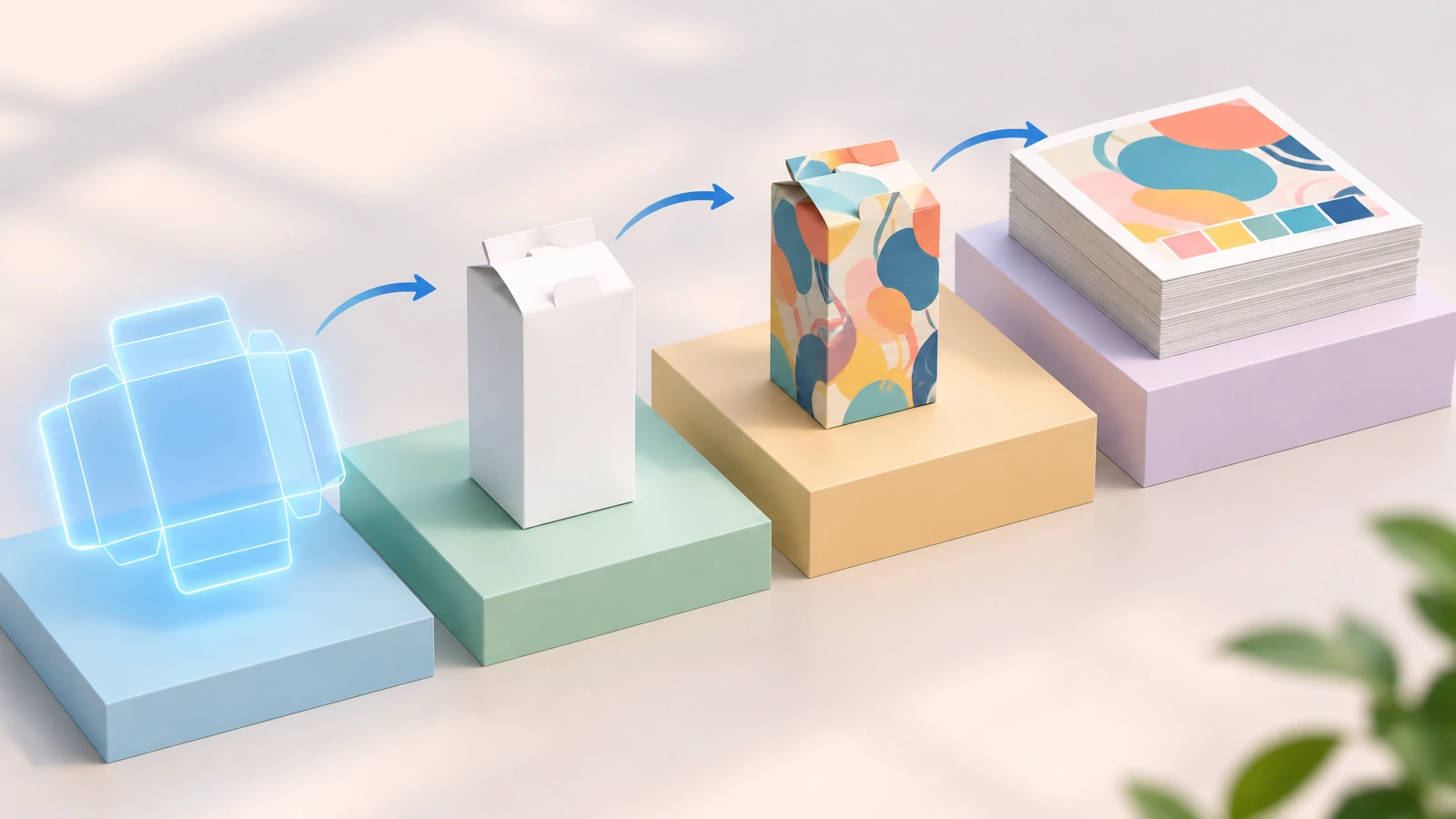
Each proofing stage proves something specific and leaves something unproven. Buyers get caught when they treat a screen proof as if it were a color approval.
| Stage | What it proves | What it does not prove |
|---|---|---|
| eProof (digital proof) | Artwork placement on the dieline, bleed, safe zones, copy, barcode position | Color on the real board, fit, fold quality |
| White structural sample | Product fit, tuck tension, how the bottom locks, insert fit | Print, color, finish behaviour on creases |
| Printed sample | Color and finish on the real board, cracking at folds, overall shelf look | Whether the production press holds that result across the full run |
| Press check | Color on the production press, checked against an approved standard; ISO 12647-2 sets process targets for offset | Gluing and packing quality, which come later in production |
At Zigpac, every order gets a free eProof, and physical samples ship for US$5–30. That makes a printed sample cheap insurance compared with reprinting a full run. A press check usually means travelling to the plant, or a live video session if the supplier offers it. Ask for one when brand color is critical, for example a PMS (Pantone) spot color on uncoated kraft. Ask every supplier which of these four stages they offer and what each one costs.
Step 4: Match MOQ to the Print Route (Low MOQ Folding Cartons)
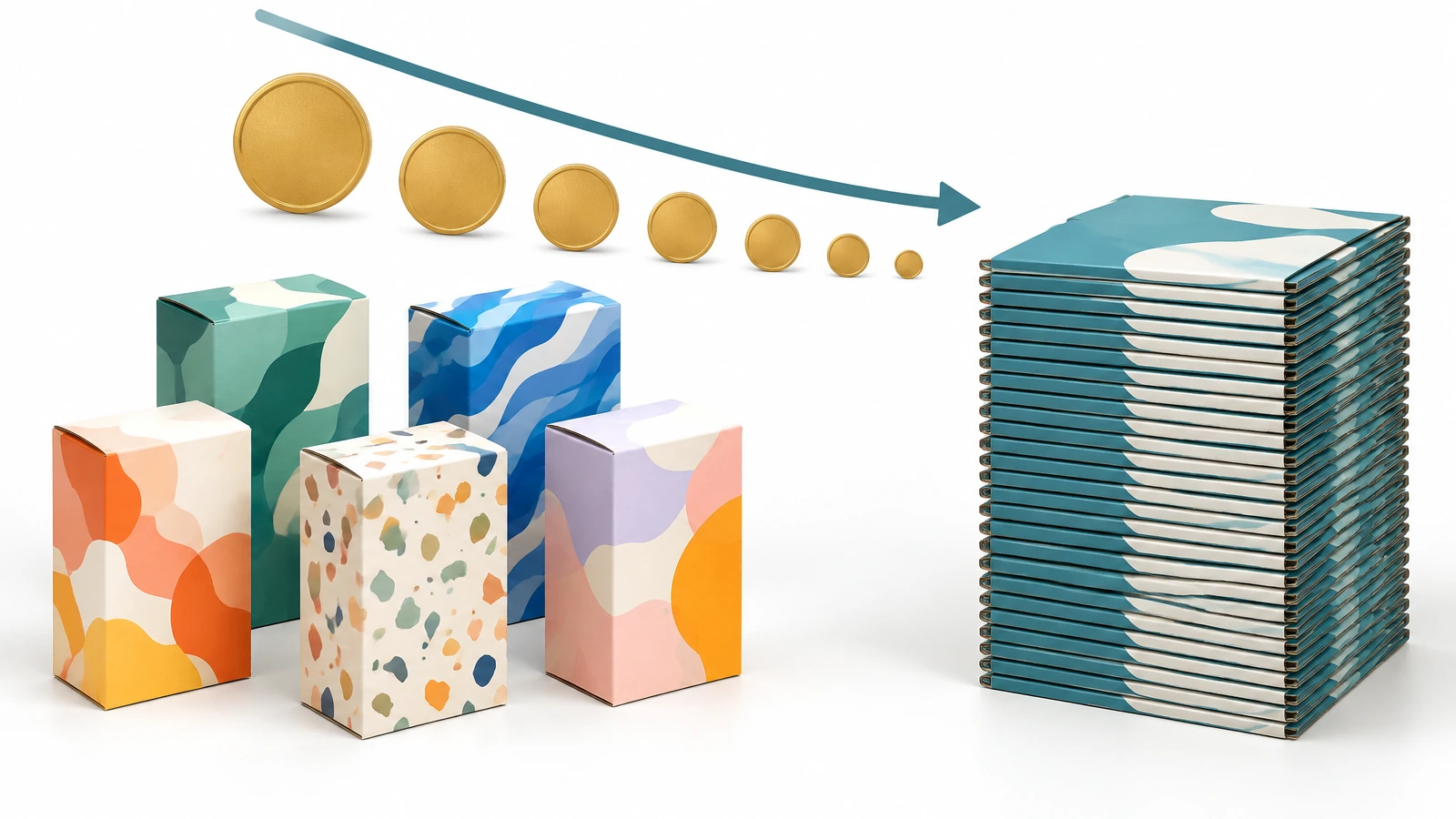
Low MOQ folding cartons depend on how setup cost is spread across the run. Digital printing needs no plates and little makeready, so it suits short runs, test launches and multi-SKU orders where each design is printed only a few hundred times. Offset printing has plate and makeready costs, but its unit cost falls faster at volume and it holds spot colors tightly. The crossover quantity depends on the press, the carton size and how many cartons fit on a sheet. That is why you need matched quotes at several quantities rather than a single price.
At Zigpac, folding cartons have price tiers from 50 pcs, final MOQ on your quote. The per-piece price tiers listed on zigpac.com in November 2026 for the standard quote configuration were:
| Quantity tier | Listed unit price | Order value at tier minimum |
|---|---|---|
| 50+ pcs | US$1.90 | US$95 |
| 200+ pcs | US$0.98 | US$196 |
| 500+ pcs | US$0.62 | US$310 |
| 1,000+ pcs | US$0.44 | US$440 |
Moving from 50 to 1,000 pieces cuts the unit price by about 77%, while the total spend rises only about 4.6×. The final price depends on size, board, print and finish, and is confirmed on your quote. Apply the same test to every supplier. Request quotes at three or four identical quantities, state the quantity per artwork version, and ask whether several SKUs can share one production run.
Step 5: Demand QC and Inspection Evidence
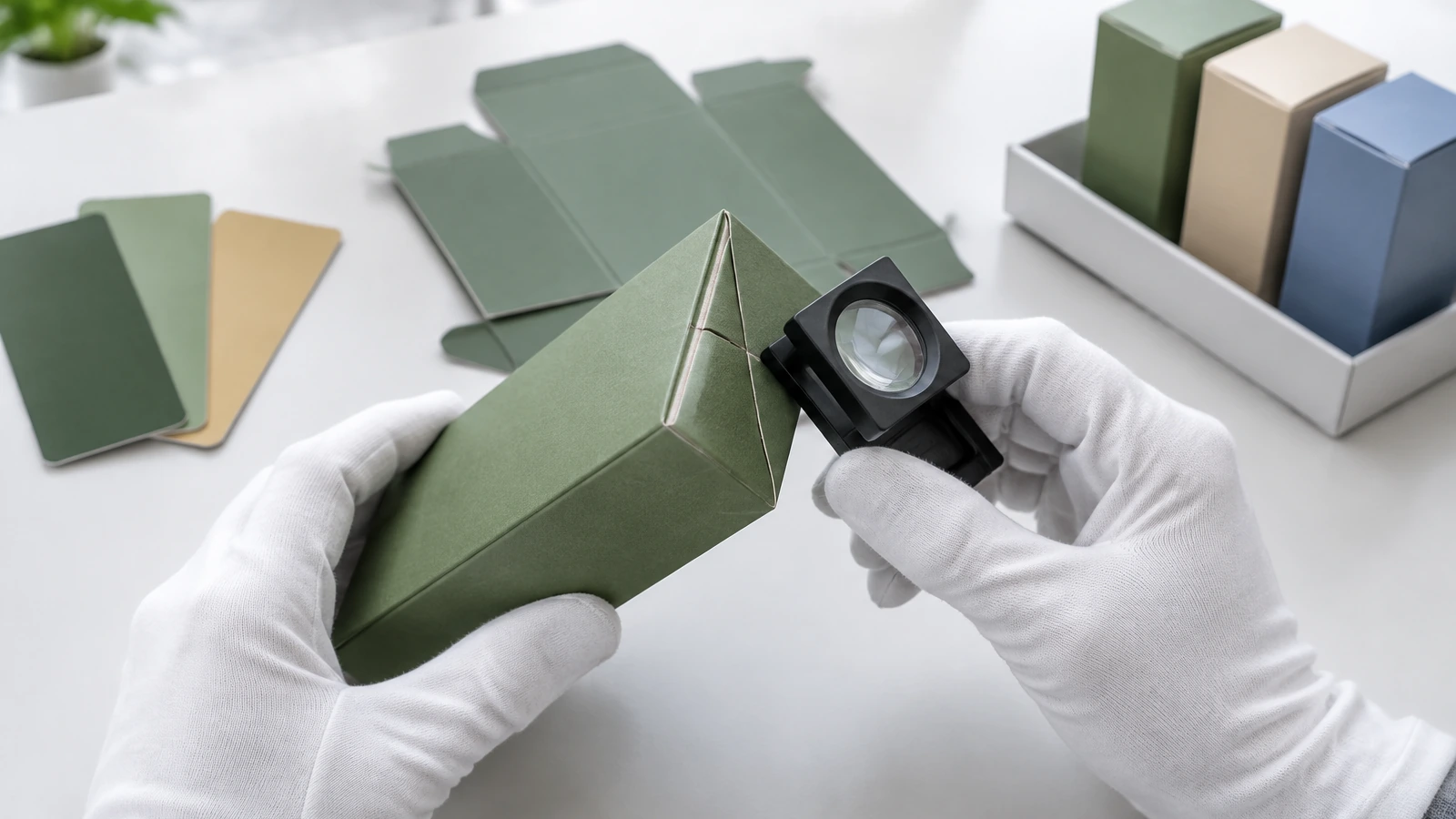
"We check quality" is not evidence. A capable folding carton manufacturer should be able to tell you what it measures, how many cartons it samples, and what you will receive in writing.
| Inspection field | Measurable evidence | Failure it prevents |
|---|---|---|
| Dimensions | Measured L × W × D against the dieline, with the agreed tolerance | Loose or unpackable cartons |
| Registration | Print-to-cut alignment on sampled sheets | Shifted logos, white slivers at the edges |
| Color | Comparison with the approved printed sample under standard lighting | Off-brand color between batches |
| Score cracking | Inspection of folds on coated and laminated areas | Cracked ink at edges, weak folds |
| Glue joint | Peel or fibre-tear check on the side seam and pre-glued bottom | Pop-open seams, bottoms that blow out |
| Count and packing | Cartons per bundle, per master case, and labelled cases | Short shipments, crushed flats |
AQL (acceptance quality limit) sampling under ISO 2859-1 sets how many cartons are pulled from a lot and how many defects are allowed before the lot is rejected. Buyers usually set separate limits for critical, major and minor defects. Agree the inspection level and AQL values before production, not after the goods arrive. If cartons have to survive transit inside shippers, ask whether the packed system has been tested to a recognised method such as ASTM D4169[7]. Board strength tests such as ECT and burst come from TAPPI methods.
Step 6: Separate Lead Time from Delivery Time and Landed Cost
Production lead time and delivery time are two different numbers. Zigpac lists standard production of 7–10 days for auto-lock cartons and 3–10 days for its straight tuck end boxes, with the final schedule on your quote. Production starts within 2 hours after payment confirmation. Freight comes on top of that. To compare landed cost, add up the unit price, sample fees, freight, duties and any third-party inspection. Confirm the Incoterm on every quote (EXW, FOB or DDP), because the same carton price can mean very different total costs. Trade press such as Packaging Digest[8] tracks the material and freight shifts that move these numbers.
Supplier Comparison Table and Red Flags
Fill in one row per supplier. Leave a cell blank if the supplier will not answer that question.
| Criterion | Supplier A | Supplier B | Zigpac (listed facts) |
|---|---|---|---|
| Board grade and caliper stated | SBS or kraft (STE); paperboard or corrugated (auto-lock), confirmed on quote | ||
| Dieline and structural sample | Ask on quote | ||
| Proof stages and cost | Free eProof; physical samples US$5–30 | ||
| MOQ and quantity tiers | Price tiers from 50 pcs, final MOQ on your quote | ||
| QC documentation | Ask on quote | ||
| Quote turnaround | 1–6 hours; 6–24 hours for complex engineering review | ||
| Production time | 3–10 days (STE), 7–10 days (auto-lock) | ||
| Quality remedy | Full refund for quality issues, no return needed; 30-day money back per policy |
Red flags to watch for:
- A quote that names "cardboard" or "premium paper" instead of a grade and a caliper.
- No physical sample offered before bulk production, or samples made on a different board from the bulk order.
- One price with no quantity breaks, or setup fees that only appear after you approve the proof.
- "Matches your color" with no approved reference and no stated tolerance.
- Lead time quoted without saying whether it covers production only or door-to-door delivery.
- No written answer on defect remedies: reprint, credit or refund.
Quote Request Checklist: What to Send
- Internal dimensions (L × W × D) and packed product weight.
- Carton style, plus any inserts, windows or hang tabs.
- Preferred board grade and caliper, or the performance you need from it.
- Print: CMYK or spot colors, inside printing, finishes (matte, gloss, soft-touch, foil, embossing, spot UV).
- Quantity per artwork version, plus 2–3 comparison quantities.
- Required proof stages and the QC documents you expect.
- Destination, preferred Incoterm and target in-hand date.
FAQ
FAQ: What is the most important question to ask a folding carton manufacturer?
Ask for the exact board grade and caliper in writing, because it drives price, print quality and carton strength. Without it, two quotes cannot be compared. Follow up with how they handle grain direction and coating.
FAQ: Can I get low-MOQ straight tuck end boxes from a Chinese manufacturer?
Yes. Zigpac, based in Wenzhou, Zhejiang, lists its Custom Straight Tuck End Boxes with price tiers from 50 pcs, final MOQ on your quote. The listed unit price was US$1.90 at 50+ pcs, falling to US$0.44 at 1,000+ pcs for the standard quote configuration in November 2026, with standard production of 3–10 days. Freight and duties are additional, so compare landed cost.
FAQ: Do I need a press check for a short run?
Usually not. An approved printed sample is enough for most short runs. Reserve press checks for brand-critical spot colors or large offset runs, and ask each supplier whether they offer one and what it costs.
FAQ: Is digital or offset printing better for folding cartons?
Digital is usually better for short runs and multi-SKU orders, and offset for high volumes and tight spot-color control. The crossover point depends on carton size and press, so request matched quotes at several quantities.
FAQ: What QC records should come with a carton order?
At minimum, ask for dimension checks, a color comparison against the approved sample, glue-joint checks and packing counts. For larger orders, agree AQL sampling under ISO 2859-1 before production starts.
Key Takeaways
- Quantity tiers change unit economics more than haggling does — listed unit price falls from US$1.90 at 50+ to US$0.44 at 1,000+ pcs, about 77% lower (Source)
- Physical samples are cheap insurance — US$5–30 per sample, compared with the cost of reprinting a full run (Source)
- Quotes vary wildly when specs are vague — buyers report custom box quotes from $8.95 to $150 for similar requests (Source)
- High MOQs have not disappeared — many suppliers still ask for 500–1,000+ units (Source)
- Freight time can exceed production time — overseas packaging lead time is cited at 6–12 weeks including freight to port (Source)
Conclusion
Choosing a folding carton manufacturer comes down to making every supplier describe the same carton. That means the same board and caliper, the same dieline, the same proof sequence, the same quantities and the same delivery terms, followed by written QC evidence. Zigpac recommends approving a physical sample before bulk production with any supplier. To get an eProof and quote, send your internal L × W × D, packed weight, board preference, quantity per artwork version, print and finish requirements and destination. Zigpac confirms the unit price and the final MOQ on the quote.
Footnotes
- Reddit r/Packaging, "How did you end up choosing your custom box vendor?" (2025). https://www.reddit.com/r/Packaging/comments/1ml84gy/how_did_you_end_up_choosing_your_custom_box_vendor/ ↩
- Reddit r/smallbusiness, "Is finding custom packaging with low MOQs still a…" (January 2026). https://www.reddit.com/r/smallbusiness/comments/1qaxe6i/is_finding_custom_packaging_with_low_moqs_still_a/ ↩
- HowToBuyPackaging, "Packaging Lead Time – Time May Not Be On Your Side." https://www.howtobuypackaging.com/packaging-lead-time/ ↩
- FEFCO, "FEFCO Code" (international fibreboard case code). https://www.fefco.org/technical-information/fefco-code ↩
- U.S. Census Bureau, Quarterly Retail E-Commerce Sales. https://www.census.gov/retail/ecommerce.html ↩
- U.S. Chamber of Commerce, "Small Business by the Numbers." https://www.uschamber.com/small-business/small-business-by-the-numbers ↩
- ASTM International, ASTM D4169, Standard Practice for Performance Testing of Shipping Containers and Systems. https://www.astm.org/Standards/D4169.htm ↩
- Packaging Digest (trade publication). https://www.packagingdigest.com/ ↩







The information below is required for social login
Sign In
Create New Account