
 Blog PDF for offline reading
Quick answer: You can get custom enamel pins made in bulk factory-direct from Zigpac. Zigpac makes hard enamel, soft enamel and die struck pins with price tiers from 50 pcs, final MOQ on your quote, a free eProof and physical samples for US$5–30. Whatever supplier you choose, compare five things: who actually makes the pins, whether the mold or tooling charge is itemized and who keeps the mold, how the proof and physical sample are approved, how backing cards and packaging are specified, and which inspection standard and remedy apply to the bulk lot. At Zigpac, every quote is itemized, and mold terms, final price and schedule are confirmed on the quote before tooling starts.
A brand, HR, event or retail buyer ordering custom enamel pins made in bulk usually needs a few hundred to several thousand identical pieces per design, and needs them on a fixed date. The problem is that pin quotes rarely line up. One supplier lists the mold fee separately, another hides it in the unit price, and a third charges a new setup fee on every reorder. Small gaps like these become expensive in bulk. One buyer in a pin-maker community reported that 3 of the 5 pins in a small order had filling issuesfilling issues[1]. At 2,000 pieces, an unclear defect rule turns that kind of problem into a dispute. A backing card with its post holes in the wrong place can also stop a retail launch. This guide compares the supplier routes and walks through each approval gate so that your quote, sample and inspection all refer to the same specification.
What a Bulk Enamel Pin Order Involves
In a bulk enamel pin order, one engraved steel mold is made for each design, and that mold then produces many identical pins. The mold is a one-time cost. Unit price, plating, colors, backs and packaging repeat on every piece. Because of this, quantity per design matters more than total quantity: ten designs of 100 pieces each cost far more per pin than one design of 1,000.
Choose the process before you request quotes, because it changes the mold, the price tier and the defect list. The comparison below is deliberately short. Specification fields such as size, metal and color matching are covered on our custom hard enamel pins page.
| Process | Surface | Typical bulk use | Zigpac product |
|---|---|---|---|
| Hard enamel | Enamel overfilled and polished flush with the metal lines | Brand logos, retail collections, recognition pins | Custom Hard Enamel Pins |
| Soft enamel | Raised metal lines with recessed color | High-volume giveaways and events with tighter budgets | Custom Soft Enamel Pins |
| Die struck | All-metal relief with no enamel fill | Formal, monochrome or heritage designs | Custom Die Struck Pins |
Collector communities often prefer the flush look of hard enamelflush look of hard enamel[2]. Soft enamel, however, keeps finer raised lines. Choose the process that suits your use, not the one that sounds more premium.

The Bulk Order Workflow, Gate by Gate
Each stage ends with something you approve. If you skip an approval, the cost of fixing the problem moves to a later and more expensive stage.
- Quote brief. Send vector artwork, finished size, quantity per design, plating, back type, packaging, in-hands date and delivery country. You approve: the itemized quote, including mold, unit price, packaging, freight terms and schedule.
- Process choice. The supplier confirms hard enamel, soft enamel or die struck, and flags lines or text too fine for that process. You approve: any simplification of the artwork.
- Mold and tooling terms. You approve: the mold charge, ownership, retention and reorder setup terms, in writing and before tooling starts.
- Digital proof. You approve: outline, size, color callouts, plating, post position, back stamp and backing card artwork.
- Physical sample. You approve: the actual colors, polish, plating hue and clutch fit. This sample becomes the reference for inspection.
- Production. Changing the artwork after this point usually means a new mold.
- Inspection. You approve: the lot against the defect catalogue and sampling plan.
- Packing and shipping. You approve: carton count, pack quantity, labels and the Incoterm, which decides who pays duty and clearance.
- Reorder. Quote against the same mold, sample and specification.
At Zigpac, quotes are returned in 1–6 hours, or 6–24 hours for complex projects that need engineering review. Production starts within 2 hours after payment confirmation, and bulk buyers can request a dedicated manager by email. Zigpac recommends approving a physical sample before bulk production whenever brand colors, plating hue or retail presentation matter.
Mold and Tooling: The Fixed Cost and Who Keeps It
The mold, also called the die, is a steel block engraved with your design. It stamps or casts every pin blank. Engraving it takes the same work whether you order 100 pieces or 5,000, so the cost is spread across the quantity. On a small run it can be a large share of the total. On a large run it almost disappears from the unit cost.
That is why you should ask every supplier to list the mold or tooling charge as a separate line. A low unit price with a separate mold fee can work out cheaper than a "no mold fee" quote that builds tooling into each piece, and the reverse can also happen. Comparing quotes only works when each one shows both numbers.
Agree four points in writing before tooling starts:
- Ownership: Does paying the mold fee transfer ownership of the die, or only the right to have it used for your orders? Zigpac's die struck page states that paying a mold fee does not automatically transfer die ownership, and the same question applies to every supplier.
- Storage: Where is the mold kept, and can it be moved to another factory?
- Retention: How long is the mold kept after the last order?
- Reorder setup: Does a repeat order with no artwork changes carry a new setup charge?
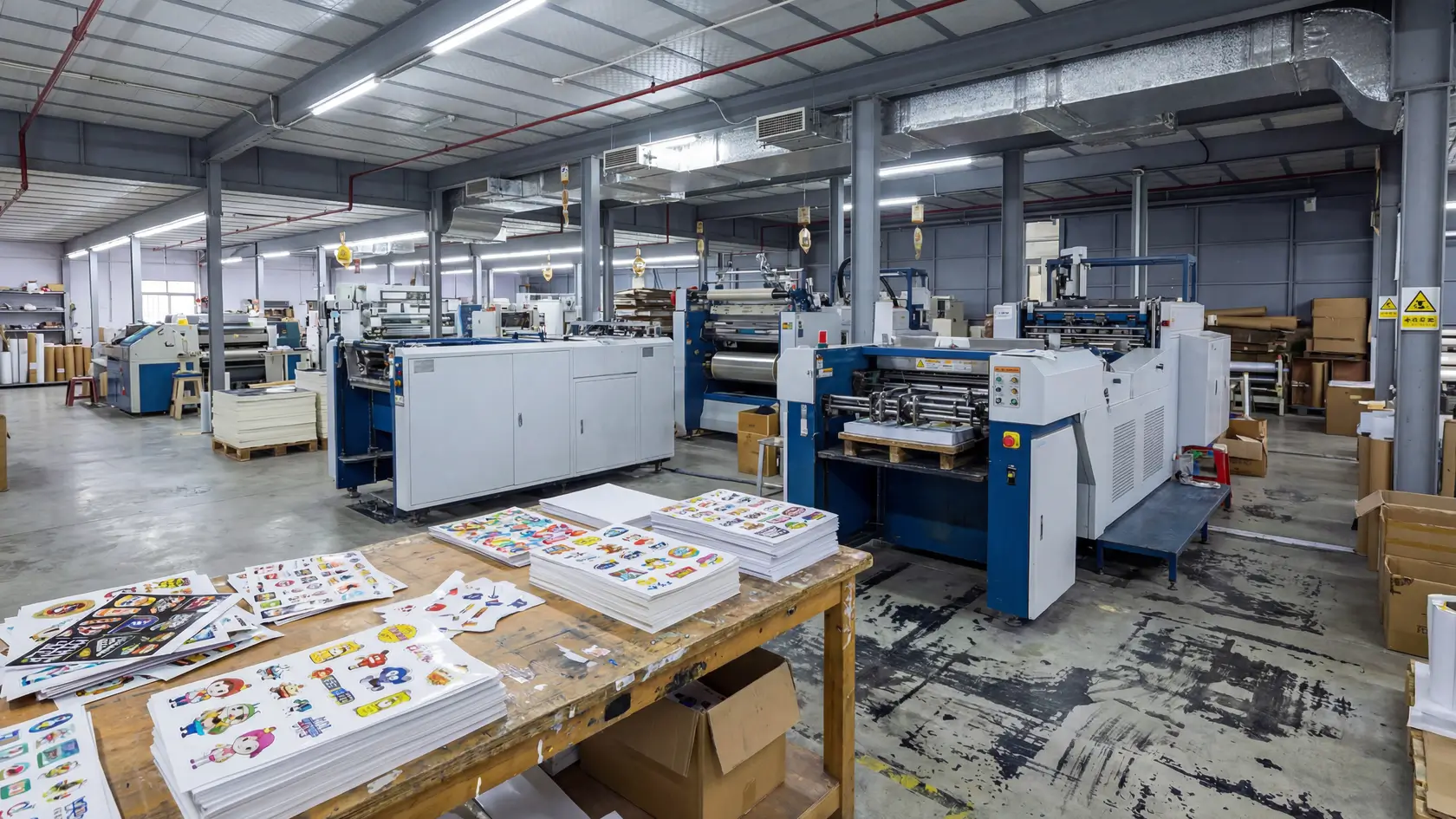
Zigpac's factory engraves the steel mold, casts the pin blanks, plates them, fills the enamel colors and finishes the pins, as shown in the product video. Zigpac's hard enamel page advises buyers to ask how long the mold is retained and whether a repeat order carries a new setup charge. Those terms are confirmed on the itemized quote rather than as a fixed published fee.
MOQ, Price Tiers and Landed Cost
The MOQ is the lowest quantity a supplier will produce. A price tier is the quantity at which the unit price drops. The two are different: a low MOQ means you can place the order, not that the price per piece will be low. First-time buyers often want only 15 or 20 pieces per design15 or 20 pieces per design[3]. Bulk buyers are better served by comparing the total cost at two or three tiers.
At Zigpac, all three pin processes use price tiers from 50 pcs, final MOQ on your quote. The live tier tables below are for early budgeting only. Size, metal, plating, colors, backs and packaging change the price, and the final price is on your quote.
| Per piece, November 2026 | 50+ | 200+ | 500+ | 1,000+ |
|---|---|---|---|---|
| Custom Hard Enamel Pins | US$3.20 | US$1.75 | US$1.30 | US$1.05 |
| Custom Soft Enamel Pins | US$1.50 | US$0.85 | US$0.62 | US$0.48 |
| Custom Die Struck Pins | US$2.45 | US$1.30 | US$0.92 | US$0.70 |
Worked example: 500 hard enamel pins at US$1.30 cost US$650. 1,000 pins at US$1.05 cost US$1,050. Doubling the quantity therefore raises pin spend by about 62% but cuts the unit price by about 19%. The same 1,000 pieces in soft enamel cost US$480, and in die struck US$700. Schedules are standard 10–15 days for hard enamel and 7–10 days for soft enamel and die struck pins, final schedule on your quote.
The quoted unit price depends on finished size, base metal (iron, brass, copper or zinc alloy), plating, color count, back type, packaging and destination. Freight and import duty come on top. Have a customs broker confirm the tariff classification, because the right code depends on the materials and the design.
The number that really protects your margin is the landed cost per accepted unit:
(pin spend + itemized tooling/setup + packaging + freight + duty and clearance) ÷ pieces that pass inspection
If 1,000 pieces arrive and 20 fail inspection with no replacement agreed, every cost is divided by 980, not 1,000. This is why the remedy terms belong in the quote.
Backing Cards and Retail Packaging
For retail and gift programs, buyers notice the backing card first and the pin second. Specify it in the same quote brief as the pin, and approve the card proof at the same time as the pin proof. A card designed separately often ends up with post holes that do not match the pin.
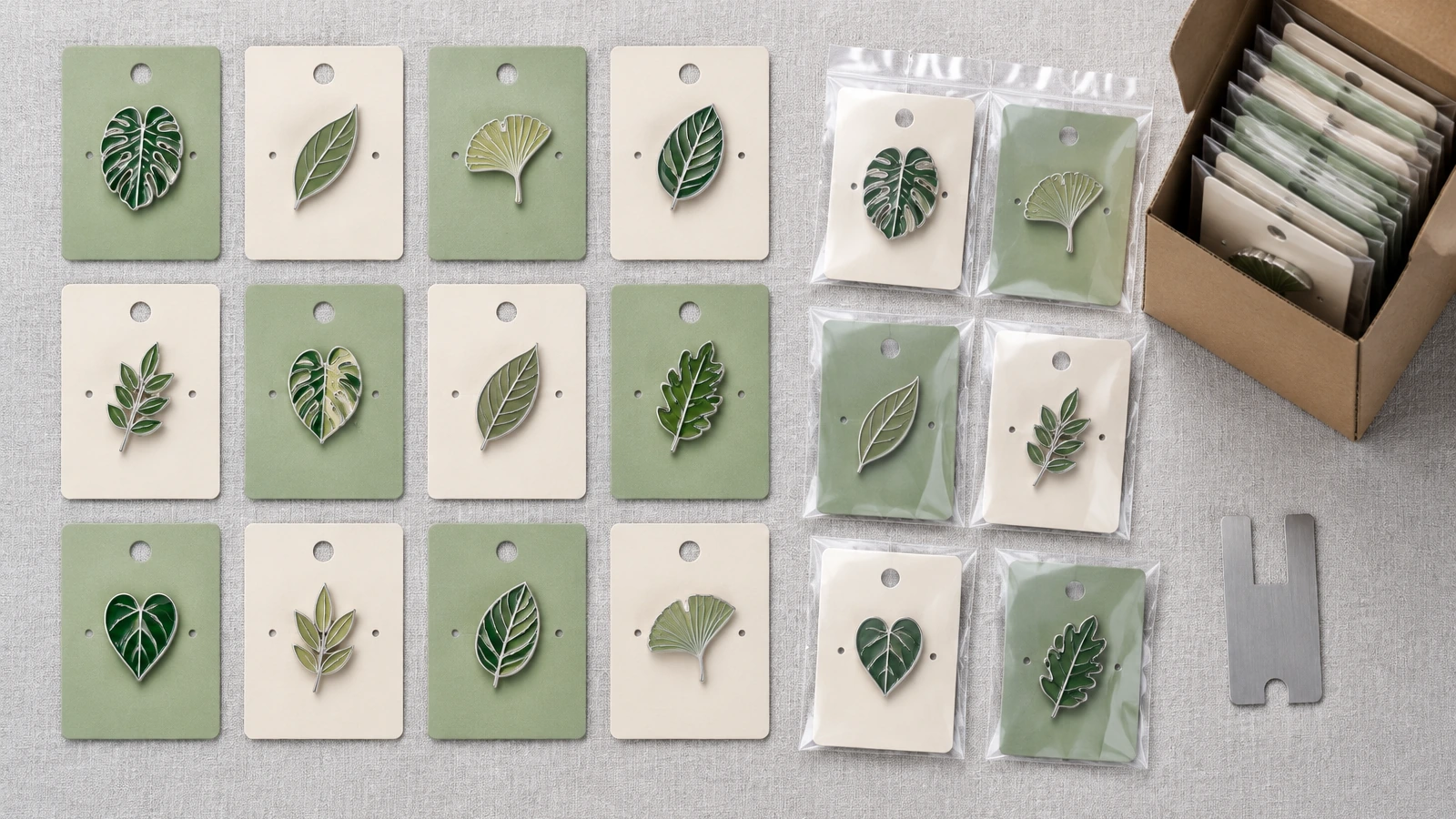
- Card size and stock: Choose the finished dimensions, paper weight or thickness, and coated or uncoated finish.
- Print sides: Decide whether you need front only or front and back. The back usually carries the barcode, brand and warning text.
- Hang hole or tab: Choose a round hole or a slot to fit your retailer's pegs, and place it so the card hangs straight.
- Post holes: Space them to match the pin's actual post positions from the approved sample, not from the digital drawing. Two-post pins need two holes.
- Barcode: Use the format your retailer requires, with enough quiet space around it. Test-scan a printed proof.
- Warning text and origin marking: Add any age or sharp-point warnings your market requires, plus country-of-origin marking for imported goods. Confirm the wording with your compliance advisor or customs broker.
- Individual poly bag and carton pack: Specify whether each carded pin is bagged, how many units go in each inner pack and carton, and what the carton label must show.
At Zigpac, back options include clutch, locking back, magnet or two posts, plus back stamp, backing card and bag. The quote form asks for backing-card or retail packaging needs, and packaging is confirmed on your quote.
QC: Inspecting a Bulk Lot Before Acceptance
"Good quality" cannot be inspected. A defect catalogue can. Build the catalogue from the approved physical sample and sort each defect into a class before production starts.
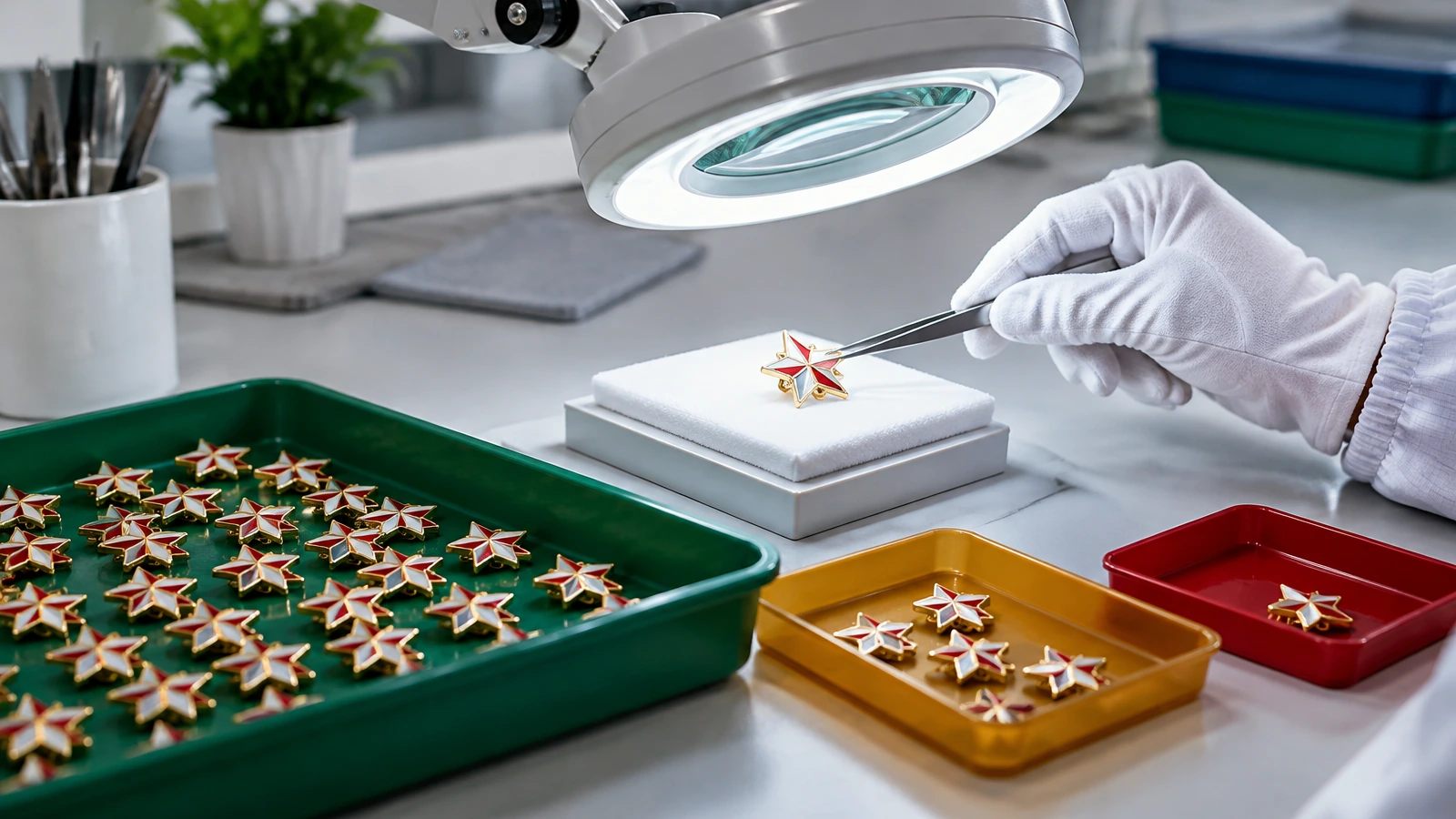
| Class | Examples | Usual handling |
|---|---|---|
| Critical | Sharp burr that can cut, missing or snapped post, wrong design, wrong barcode on retail cards | Zero acceptance; the lot is held |
| Major | Color cell differs from the proof, visible enamel underfill or overfill, plating hue off the sample, clutch that will not hold | Counted against a strict acceptance limit |
| Minor | Small pit or polishing mark visible only up close, slight card scuff | Counted against a looser limit |
Sampling plan. Checking every pin in a large lot is slow, so most buyers use attribute sampling under ISO 2859-1 or its US counterpart ANSI/ASQ Z1.4. In both standards, the lot size and inspection level determine how many pieces to pull at random. An agreed acceptable quality limit (AQL) for each defect class then sets how many defects are allowed before the lot is rejected. Agree on the standard, the inspection level and the AQL for each class with your supplier in writing. Zigpac does not publish a fixed AQL, so these are terms to set for each order.
What to check on each sampled piece:
- Front face: Check every color cell against the proof, enamel overfill and underfill, pits and bubbles, plating hue against the sample, and burrs on edges and cut-outs.
- Construction: Check that posts are firmly attached and do not bend under light pressure, that clutches or locking backs grip without sliding, and that the back stamp is correct.
- Back and packaging: Check the backing card artwork, hole position against the posts, barcode readability, poly bag sealing, and pack quantity per inner and carton.
- Quantity reconciliation: Compare ordered, shipped, accepted and rejected counts for each design, and record them with photos before you sign off.
Pins for children. If the pins are designed primarily for children aged 12 or under, US rules limit total lead to 100 ppm in accessible substrate material100 ppm in accessible substrate material[4] and to 90 ppm in paint and surface coatings. Toys can also trigger further testing and certification dutiesfurther testing and certification duties[5]. Decide whether your pins count as children's products before you request quotes, and ask any supplier for third-party test evidence. Do not accept a verbal assurance.
Zigpac's site footer states "Quality issue? Full refund, no return needed." Even with that promise in place, recording defects against the agreed catalogue makes any claim fast and clear.
Where to Get Custom Enamel Pins Made in Bulk: Four Supplier Routes Compared
Most buyers come across four kinds of supplier. All four can deliver pins. What differs is who controls the mold and the inspection, and how many hands your specification passes through.
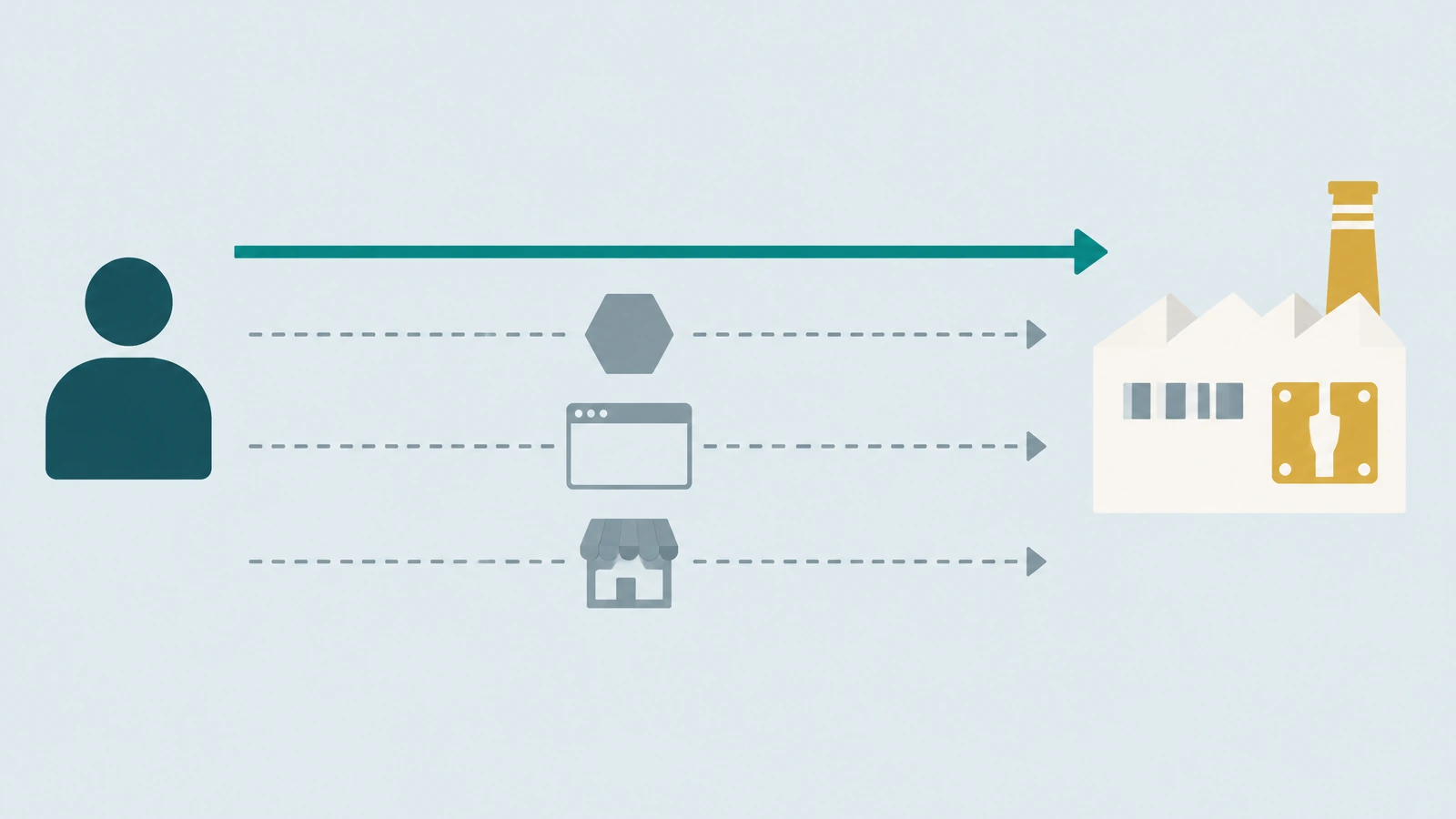
| Route | Who controls tooling and QC | Communication path | Typical fit by quantity | Buyer's spec control |
|---|---|---|---|---|
| Factory-direct manufacturer | The factory that engraves the mold and makes the pins | Buyer to factory sales or project manager | From small tiers up to thousands per design | High: mold terms, sample and defect catalogue are set directly |
| Trading company or broker | A subcontracted factory, often not named | Buyer to broker to factory | Buyers sourcing many product categories in one place | Medium: depends on how open the broker is about mold ownership and the factory |
| Marketplace or online pin studio | The studio's own or partner production | Web form, chat or design portal | Small runs and creators | Lower: preset sizes, options and packaging |
| Local promotional distributor | An upstream supplier the distributor sources from | Buyer to local rep to supplier | Companies buying many promotional items with event deadlines | Medium: convenient account service, with spec details passed along |
Promotional distributors are a large, organized channel with their own trade associationtheir own trade association[6] and annual industry sales reportingannual industry sales reporting[7]. That route works well when pins are one item among many. Market reports on pin buttonspin buttons[8] and specialty pinsspecialty pins[9] describe a growing category. They define it broadly, though, so use them as background rather than as a sizing estimate for enamel pins. Whatever the route, ask who physically engraves the mold. If the answer is vague, the route probably has an extra intermediary in it.
Supplier Checklist and Quote Brief Template
Ask every candidate supplier the same questions:
- Do you engrave the mold and make the pins yourselves, and if not, who does?
- Is the mold or tooling charge a separate line on the quote?
- Who owns the mold, where is it stored, and how long is it kept?
- Does a reorder with no changes carry a new setup charge?
- Is the digital proof free, and what does a physical sample cost?
- Which details in my artwork will be simplified for this process?
- Can the backing card proof be approved together with the pin proof?
- Which sampling standard and AQL will you accept for each defect class?
- What is the remedy for defective pieces: replacement, refund or credit, and within what claim window?
- Which Incoterm applies, and who pays duty and clearance?
Quote brief template: "We need [quantity] pieces per design of [number] designs in [hard enamel / soft enamel / die struck], [width × height] finished size, [base metal] with [plating], [number] enamel colors matched to the attached vector artwork, [clutch / locking back / magnet / two posts] with [back stamp yes/no], packed on [card size, stock, print sides, hole type] backing cards with [barcode and warning text], individually poly-bagged, [pack quantity] per carton, delivered to [country/postcode] by [in-hands date]. Please itemize mold or tooling, unit price by tier, packaging, sample and freight, and state your mold ownership, retention and reorder terms."
FAQ
FAQ: Where can I get custom enamel pins made in bulk for my brand?
Order factory-direct from a pin manufacturer such as Zigpac if you want direct control of the mold, sample and inspection. Zigpac offers hard enamel, soft enamel and die struck pins with price tiers from 50 pcs, final MOQ on your quote. Brokers, online studios and promotional distributors also work, but each adds a step between your specification and the factory.
FAQ: Who owns the mold after I pay the mold fee?
It depends on the written terms, because paying a mold fee does not automatically transfer die ownership. Before tooling starts, agree ownership, storage location, retention period and any reorder setup charge.
FAQ: How long does a bulk enamel pin order take?
At Zigpac, the schedule is standard 10–15 days for hard enamel and 7–10 days for soft enamel and die struck pins, final schedule on your quote. Shipping and customs clearance are added on top, so count from proof approval to your in-hands date.
FAQ: Do I need a physical sample, or is the digital proof enough?
Get a physical sample whenever brand colors, plating hue or retail presentation matter. A digital proof cannot show polish, plating tone or clutch fit, and the approved sample becomes your inspection reference.
FAQ: What AQL should I use to inspect a pin order?
Choose one AQL for each defect class rather than a single number for the whole lot, and apply it under ISO 2859-1 or ANSI/ASQ Z1.4. Critical defects are commonly set at zero acceptance, with stricter limits for major defects than for minor ones.
FAQ: Do enamel pins for children need lead testing?
Yes. Children's products sold in the US must meet a 100 ppm total lead limit in substrates and a 90 ppm limit in surface coatings, which generally requires third-party testing. Ask the supplier for test evidence before you order.
Key Takeaways
- Quantity per design drives unit cost more than total quantity does. — Hard enamel falls from US$3.20 at 50+ to US$1.05 at 1,000+ (November 2026, final price on your quote) (Source)
- Itemize the mold and agree ownership in writing before tooling. — 4 terms: ownership, storage, retention, reorder setup (Source)
- Treat the physical sample as the inspection reference. — 3 of 5 pins in one buyer's small order had filling issues (Source)
- Children's pins carry hard US lead limits. — 100 ppm substrate, 90 ppm surface coatings (Source)
- Use broad market reports only as background. — The pin buttons market is sized at about US$2.8B, a category much wider than enamel pins (Source)
Conclusion
Where you buy bulk enamel pins matters less than whether your quote, mold terms, sample, packaging and inspection all point to one written specification. Send your artwork, finished size, quantity per design, plating, back type, backing card or packaging needs, in-hands date and delivery country to get an itemized quote. Zigpac confirms the process, final MOQ, price, mold terms and schedule on the quote, with a free eProof before production and physical samples for US$5–30.
Footnotes
- Reddit r/EnamelPins: buyer discussion of pin manufacturers and filling defects (2025) ↩
- Reddit r/EnamelPins: "Do you prefer hard or soft enamel?" (2024) ↩
- Reddit r/EnamelPins: "Less than 50 MOQ for enamel pins" ↩
- U.S. Consumer Product Safety Commission: Total Lead Content ↩
- U.S. Consumer Product Safety Commission: Toy Safety business guidance ↩
- PPAI: Promotional Products Association International ↩
- PPAI: 2024 Sales Volume Report (PDF) ↩
- DataIntelo: Global Pin Buttons Market report summary ↩
- Verified Market Reports: Specialty Pins Market summary ↩




The information below is required for social login
Sign In
Create New Account