


 Blog PDF for offline reading
Quick answer: Yes, in most cases. In the US, nail products meant to beautify are generally regulated as cosmetics under FD&C Act section 201(i). Retail nail wraps therefore need an ingredient list, any necessary warnings, permitted color additives and, for most brands, MoCRA registration and product listing. In the EU, wraps fall under Regulation (EC) No 1223/2009. That adds a Responsible Person, a safety report and CPNP notification. Gel wraps also face HEMA restrictions and a ban on TPO.
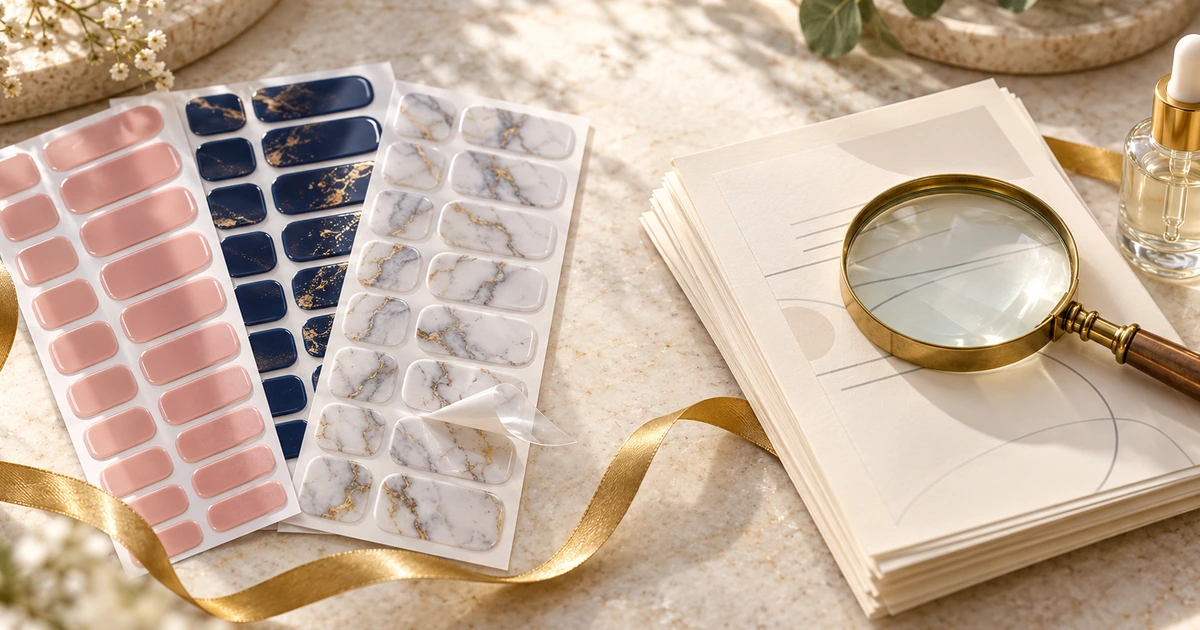
Many brands ask "are nail wraps regulated as cosmetics" only after the artwork is approved and the first sample sheets arrive. By then, it is easy to treat a wrap as "just a sticker" and ship it without an ingredient list, an adverse-event contact or a market-specific warning. Regulators do not see it that way. A wrap is a film of polish, ink and adhesive pressed onto the nail plate for hours or days. Both the FDA and the European Commission treat products like that as cosmetics, with the paperwork that follows.
The cost of getting this wrong is concrete. A 2026 Dutch government screening found that 9 of 40 nail products (22.5%) still lacked the mandatory "for professional use only" warning required for HEMA-containing nail products in the EU. Since 1 September 2025, cosmetics containing the photoinitiator TPO can no longer be placed or made available on the EU market, and there was no sell-off period. In the US, the FDA has said publicly that a MoCRA registration number is not an approval and cannot be marketed as one.
This guide explains how adhesive nail wraps are classified in the US and EU. It also lists the ingredient disclosure, labeling, safety documentation and supplier paperwork a private-label brand should have on file before launch.
Are nail wraps regulated as cosmetics in the US?
The FDA's own guidance on nail products is direct. The agency states that, under the Federal Food, Drug, and Cosmetic Act, nail products "are generally regulated as cosmetics [FD&C Act, section 201(i)]" (FDA nail care products guidance[1]). Section 201(i) covers articles applied to the human body to beautify, promote attractiveness or alter appearance. A decorative film pressed onto the nail plate fits that purpose, so dried-polish strips, printed adhesive wraps and semi-cured gel wraps all start from the cosmetic baseline.
Two points on the same FDA page shape a brand's risk. First, intended use can turn a wrap into a drug. The FDA states that "nail products intended to treat medical problems, such as nail fungus, are drugs." Copy such as "antifungal," "strengthens damaged nails" or "treats brittle nails" can move a product out of the cosmetic category and into drug regulation. Second, cosmetics do not need FDA approval before sale, "with the exception of most color additives." Every colorant in the printed layer and the polish film must be permitted for that use. A wrap is not exempt from color additive rules because it looks like a sticker.
For retail sale, the label must declare ingredients by their common or usual names in descending order of predominance under 21 CFR 701.3. Salon-only products that are never sold at retail can be exempt. If the same product is also sold to consumers, an ingredient list is still required, even if the label says "For professional use only" (FDA labeling summary[2]). Separately, 21 CFR 740.1[3] requires a warning statement "whenever necessary or appropriate to prevent a health hazard." For nail wraps, that usually means guidance on removal, allergy and when to stop wearing them.
The Modernization of Cosmetics Regulation Act of 2022 (MoCRA) added post-market duties. Facilities that manufacture or process cosmetics generally must register with the FDA and renew every two years. The responsible person must list each product and its ingredients, update the listing annually, keep safety substantiation records and report serious adverse events (FDA registration and listing[4]). A small-business exemption exists but has category exceptions, so check the current FDA guidance rather than assuming your brand is exempt. On 9 September 2026, the FDA also clarified that registration and listing are "neither a cosmetic approval program nor a promotional tool" (FDA statement on certificates[5]). A supplier or listing that advertises "FDA certified nail wraps" is making a claim the agency rejects.
How the EU classifies nail wraps
The EU's parent law is Regulation (EC) No 1223/2009[6]. It defines cosmetics as substances or mixtures placed in contact with external parts of the body, nails included, mainly to change their appearance. Polish strips made of dried nail lacquer and semi-cured gel wraps are mixtures applied to the nail, and they are handled as cosmetics. A plain printed plastic decal with a pressure-sensitive adhesive is more of a borderline case. Classification depends on composition and function, not on whether the product name says "wrap" or "sticker." Have your safety assessor confirm the classification in writing before you assume a decal sits outside the regulation.
Once a wrap is a cosmetic, the regulation requires five things. There must be an EU-based Responsible Person. A Cosmetic Product Safety Report must be written by a qualified safety assessor, and a Product Information File must be kept available for authorities. The product must be notified through the CPNP portal before it is placed on the market. Manufacturing must follow good manufacturing practice, which in practice means the guidelines in ISO 22716:2007[7]. ISO 22716 covers production, control, storage and shipment of cosmetics. It is a process guideline, not a product certificate, and no ISO or ASTM standard specifically covers nail wraps.
Two EU-specific restrictions matter most for gel wraps:
- HEMA and Di-HEMA TMHDC. Commission Regulation (EU) 2020/1682[8] limits both to nail products for professional use only. The label must carry "For professional use only" and "Can cause an allergic reaction." Non-compliant products could not be placed on the market after 3 June 2021 or supplied after 3 September 2021. This is a restriction, not a ban, and it applies only when the formula contains these monomers. The scientific basis is SCCS opinion SCCS/1592/17[9]. It found both substances to be weak-to-moderate sensitisers, low risk only when kept on the nail plate and away from surrounding skin.
- TPO. Since 1 September 2025, cosmetics containing Trimethylbenzoyl Diphenylphosphine Oxide cannot be placed or made available on the EU market. The European Commission confirmed there is no sell-off period, and that salons cannot use existing stock on clients (European Commission TPO Q&A[10]). A semi-cured wrap that relies on TPO to cure under a lamp must be reformulated for EU sale. Gel polish in general is not banned, only this photoinitiator.
Enforcement is uneven, which is a risk for a new brand. In its 2026 screening report, the Dutch national institute RIVM found that 22.5% of sampled nail products lacked the professional-use warning (RIVM KN-2026-0024[11]). Seeing competitors without the warning does not show that the warning is optional.
Why the wrap type changes your compliance file
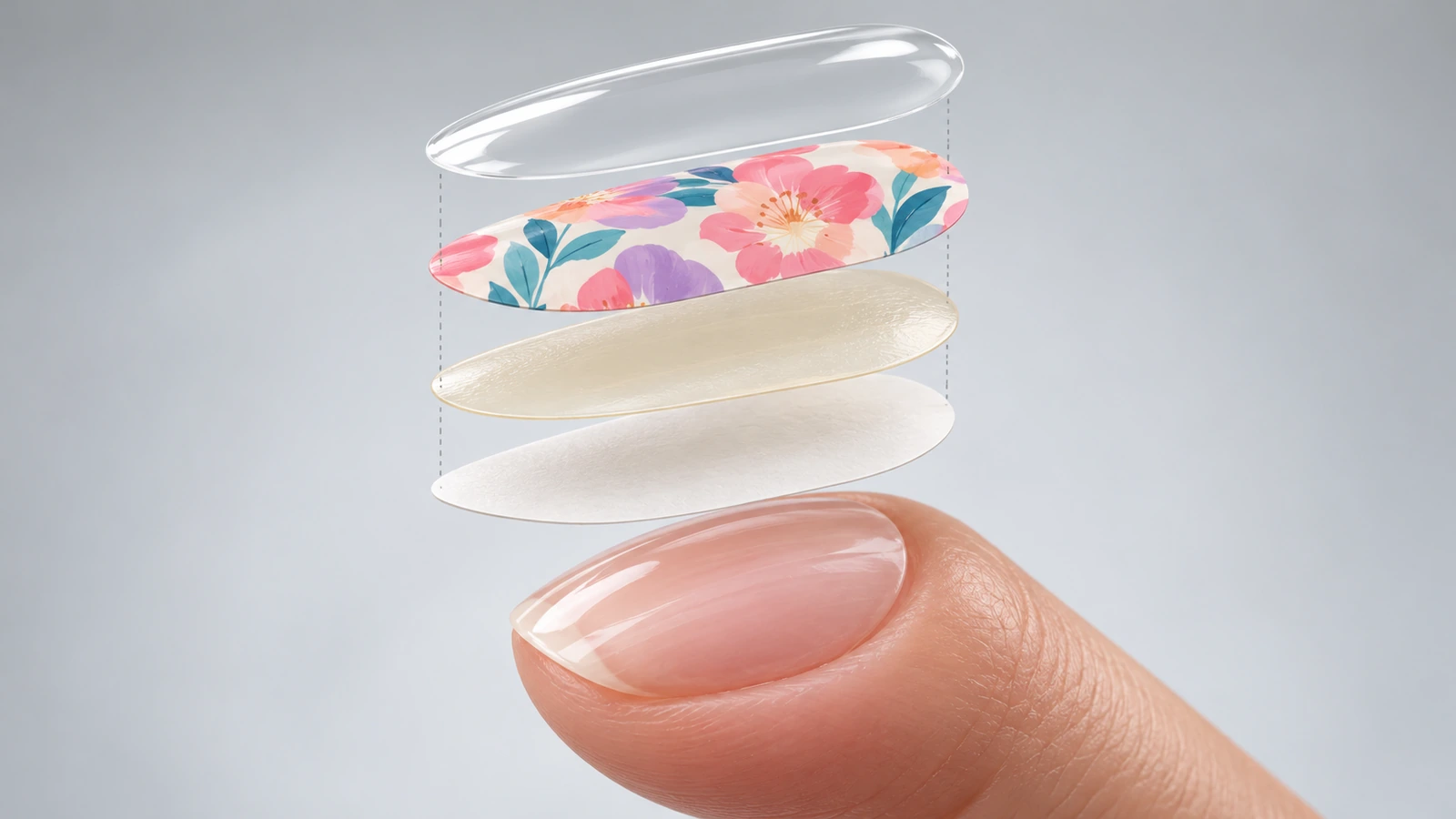
"Nail wrap" covers at least three constructions, and each one raises different questions for your safety assessor:
| Wrap type | What touches the nail | Main compliance questions |
|---|---|---|
| Dried-polish strips | Lacquer film (film formers, plasticisers, pigments) with adhesive | Full ingredient list; color additive status; residual solvents |
| Printed adhesive film / decal | Plastic film, printing ink, pressure-sensitive adhesive | Classification confirmation; ink colorants; adhesive chemistry |
| Semi-cured gel wraps | Partially cured (meth)acrylate gel, cured under UV/LED | HEMA and Di-HEMA status; TPO-free photoinitiator for EU; allergy warnings; lamp instructions |
The adhesive deserves its own line in the file. A 2019 dermatology review in Cutis reported that ethyl cyanoacrylate and isopropyl-2-cyanoacrylate have been identified in nail wrap adhesives. It also notes that HEMA is a common nail acrylate allergen screened in patch testing (Cutis review, 2019[12]). Cyanoacrylates do not usually cross-react with other acrylates, but they can sensitise on their own. A wrap is therefore not automatically a "safe swap" for consumers with gel allergies, and your label should not say it is. For construction, sizing and finish options, see our overview of custom nail wraps. This article covers only the regulatory side.
How to prepare a private-label wrap line for launch
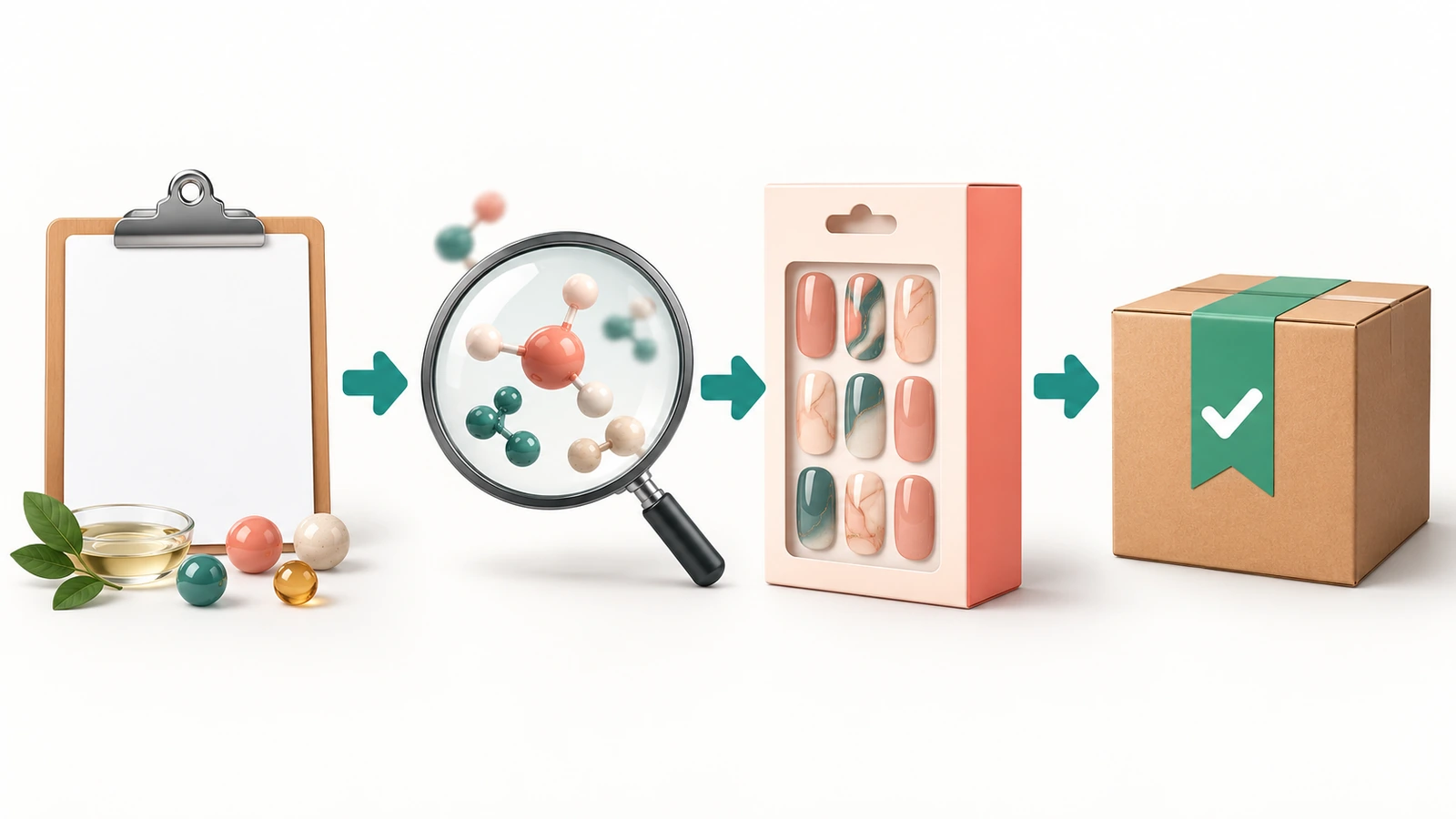
Private-label brands are usually the "responsible person" (US) or work through an EU Responsible Person. That means the brand, not only the factory, owns most of these obligations. A practical order of work:
- Get the full formula, not a marketing sheet. Ask the supplier for a quantitative formula covering every layer, including film, ink, adhesive and any top coat, with INCI names and CAS numbers. Also request safety data sheets for raw materials. Without this, nobody can write a US ingredient declaration, a CPSR or a MoCRA product listing. If the supplier will only share it confidentially, have it sent directly to your safety assessor.
- Screen the formula against each target market. For the EU, check every substance against the annexes of 1223/2009, including the TPO prohibition and the HEMA/Di-HEMA restriction. For the US, check that every colorant is a permitted color additive for that use. If you sell in California, screen for Proposition 65 listed substances, especially in UV-cured systems.
- Commission a safety assessment. In the EU, a qualified assessor signs the CPSR. In the US, MoCRA requires records showing adequate safety substantiation. For wraps, ask the assessor which adhesive safety testing they need. Depending on the formula, that may include sensitisation data on the adhesive, compatibility with commonly recommended top coats, and stability of the printed layer. Do not put "dermatologist tested" or "hypoallergenic" on the pack unless that testing actually exists and is documented.
- Write the label from the regulation outward. In the US: identity, net quantity, the manufacturer, packer or distributor, an ingredient list in descending order, MoCRA adverse-event contact details and appropriate warnings. In the EU: Responsible Person name and address, nominal content, durability or period-after-opening marking, batch number, precautions, function and ingredient list. If the formula contains HEMA or Di-HEMA TMHDC, add both mandatory warning sentences. Plan separate US and EU packaging rather than one compromise box.
- Check marketing claims. Remove treatment claims ("fixes fungus," "repairs nails") unless you intend to sell a drug. Remove "FDA approved" or "FDA registered" as a badge. Wear-time claims should match the removal and stop-wearing guidance on your own insert.
- Verify the factory's quality system. Ask for evidence of GMP aligned with ISO 22716, such as an audit report, batch records and how deviations are handled. For the US, confirm who will register the manufacturing facility with the FDA.
- Register, list and notify before the first sale. Complete MoCRA product listing (and facility registration where it applies) in the US, and CPNP notification in the EU. Then set up an adverse-event inbox that someone actually monitors.
Supplier paperwork to request before you place a production order
| Document | Why you need it |
|---|---|
| Quantitative formula with INCI and CAS (all layers) | Ingredient declaration, CPSR, MoCRA listing |
| Raw-material safety data sheets | Hazard review by the safety assessor |
| Written statement on TPO, HEMA and Di-HEMA TMHDC content | EU market eligibility and warning requirements |
| Colorant list with color index numbers | US color additive and EU Annex IV checks |
| GMP evidence (ISO 22716-based audit or procedures) | EU GMP obligation; supplier due diligence |
| Stability and compatibility data, if available | Supports the safety assessment and wear and removal instructions |
| Batch coding method | Traceability for complaints and recalls |
US vs. EU requirements side by side
| Topic | United States | European Union |
|---|---|---|
| Legal basis | FD&C Act §201(i); MoCRA 2022 | Regulation (EC) No 1223/2009 |
| Pre-market approval | None, except most color additives | None, but CPSR and CPNP notification are required first |
| Who is accountable | Responsible person (manufacturer, packer or distributor on the label) | EU-established Responsible Person |
| Ingredient list | Required for retail (21 CFR 701.3) | Required (INCI names) |
| Facility and product filing | Facility registration renewed every 2 years; product listing updated annually | CPNP notification per product |
| HEMA / Di-HEMA TMHDC | No equivalent professional-only rule | Professional use only, plus two mandatory warnings |
| TPO | No equivalent cosmetic ban | Prohibited since 1 September 2025 |
| Treatment claims | Make the product a drug | Not allowed for cosmetics; may reclassify the product |
The practical conclusion is that a gel wrap formula that is legal in a US retail box may be unsellable in the EU. A product that is compliant in the EU still needs US-specific color additive and MoCRA steps.

FAQ
FAQ: Do nail wraps need FDA approval before they go on sale?
No. The FDA does not approve cosmetics before sale, except for most color additives. Brands still have to use permitted colorants, label correctly, keep safety substantiation and, in most cases, complete MoCRA listing. A registration or listing number is not an approval and should not appear as a badge.
FAQ: What are the nail sticker labeling requirements in the US?
A retail nail sticker or wrap needs a statement of identity, net quantity, the name and place of business of the responsible firm, an ingredient declaration in descending order of predominance, and any warning necessary to prevent a health hazard. MoCRA also requires contact information for adverse-event reports.
FAQ: Is nail wrap ingredient disclosure needed if the wrap is only a printed film?
If the product is sold to consumers as a cosmetic, yes. That includes the film, ink and adhesive. The safe route is a full formula from the supplier, reviewed by your safety assessor, with any decision that the product falls outside cosmetic rules documented in writing.
FAQ: Does the EU HEMA rule apply to every nail wrap?
No. Regulation (EU) 2020/1682 applies only when the formula contains HEMA or Di-HEMA TMHDC, which is typical of some semi-cured gel wraps. A standard adhesive wrap without these monomers does not trigger the professional-only warning, but it still has to comply with the rest of the cosmetics regulation.
FAQ: What nail wrap adhesive safety testing should a brand ask for?
There is no wrap-specific ISO or ASTM test method. Ask your safety assessor which data they need for the specific adhesive chemistry, often cyanoacrylate-based or acrylic pressure-sensitive systems. That may include sensitisation information and compatibility checks with the top coats your instructions recommend.
FAQ: Can I market wraps as safe for people with gel allergies?
Not without careful evidence. Wrap adhesives can contain cyanoacrylates, which may sensitise on their own even though they rarely cross-react with acrylates. Gel wraps contain (meth)acrylates. Advise consumers with known allergies to stop use if a reaction appears and to seek medical advice.
Key takeaways
- US nail wraps start from the cosmetic baseline, and treatment claims turn them into drugs — FD&C Act section 201(i) (Source)
- MoCRA filings are recurring, not one-time — facility registration renewed every 2 years, product listing updated annually (Source)
- EU gel wraps with HEMA or Di-HEMA TMHDC need two mandatory warnings — supply of non-compliant products ended 3 September 2021 (Source)
- TPO-cured gel wraps cannot be sold in the EU — prohibited from 1 September 2025 with no sell-off period (Source)
- Do not rely on competitors' labels as proof of compliance — 9 of 40 nail products (22.5%) lacked the required warning in a 2026 Dutch screening (Source)
- The adhesive needs its own safety review — 2 cyanoacrylates identified in nail wrap adhesives (Source)
Conclusion
Nail wraps are regulated as cosmetics in both the US and the EU. The real work for a private-label brand is matching each wrap construction to the right documents. Polish strips and printed films mostly need complete ingredient disclosure, permitted colorants and honest removal warnings. Semi-cured gel wraps add a monomer and photoinitiator review that can rule out EU sale or force reformulation. Start with the full formula from your supplier, put the safety assessment ahead of label design, and file registrations before the first unit ships. If you are scoping a line and need to discuss formulas, documentation or quantities, request a quote for your custom wrap project and include your target markets so the paperwork can be planned from the start.
Regulatory references were checked as of October 2026. This article is general information, not legal advice. Confirm classification and labeling with a qualified safety assessor or regulatory counsel for each market.
Sources
- U.S. Food and Drug Administration, "Nail Care Products." https://www.fda.gov/cosmetics/cosmetic-products/nail-care-products ↩
- U.S. Food and Drug Administration, "Summary of Cosmetics Labeling Requirements." https://www.fda.gov/cosmetics/cosmetics-labeling-regulations/summary-cosmetics-labeling-requirements ↩
- Electronic Code of Federal Regulations, 21 CFR 740.1, "Establishment of warning statements." https://www.ecfr.gov/current/title-21/chapter-I/subchapter-G/part-740/subpart-A/section-740.1 ↩
- U.S. Food and Drug Administration, "Registration and Listing of Cosmetic Product Facilities and Products." https://www.fda.gov/cosmetics/registration-listing-cosmetic-product-facilities-and-products ↩
- U.S. Food and Drug Administration, "FDA Clarifies It Does Not Provide Certificates or Other Documents to Verify Compliance of a Cosmetic Product," 9 September 2026. https://www.fda.gov/cosmetics/cosmetics-news-events/fda-clarifies-it-does-not-provide-certificates-or-other-documents-verify-compliance-cosmetic-product ↩
- European Parliament and Council, Regulation (EC) No 1223/2009 on cosmetic products. https://eur-lex.europa.eu/legal-content/EN/TXT/?uri=CELEX:32009R1223 ↩
- ISO 22716:2007, Cosmetics — Good Manufacturing Practices (GMP) — Guidelines on Good Manufacturing Practices. https://www.iso.org/obp/ui/#iso:std:iso:22716:ed-1:v2:en ↩
- European Commission, Commission Regulation (EU) 2020/1682 amending Annex III to Regulation (EC) No 1223/2009. https://eur-lex.europa.eu/legal-content/EN/TXT/HTML/?uri=CELEX:32020R1682 ↩
- Scientific Committee on Consumer Safety, SCCS/1592/17, "The safety of cosmetic ingredients HEMA and Di-HEMA Trimethylhexyl Dicarbamate," 2018. https://health.ec.europa.eu/publications/safety-cosmetic-ingredients-hema-and-di-hema-trimethylhexyl-dicarbamate-submission-i_en ↩
- European Commission, "TPO in nail products: questions and answers," 2025. https://single-market-economy.ec.europa.eu/sectors/cosmetics/tpo-nail-products-questions-answers_en ↩
- RIVM (Dutch National Institute for Public Health and the Environment), report KN-2026-0024, 3 April 2026. https://www.rivm.nl/bibliotheek/rapporten/KN-2026-0024.pdf ↩
- Atwater AR, Reeder M. "Trends in Nail Services May Cause Dermatitis." Cutis, 2019;103(6):315. https://cdn.mdedge.com/files/s3fs-public/CT103006315.PDF ↩













The information below is required for social login
Sign In
Create New Account