We use cookies to enable our websites to remember information, to help some website functionalities to work properly, to understand how you interact with and use our websites and to display you content and ads that are relevant and engaging for you.
By clicking Accept All you consent to the use of these cookie.
The store will not work correctly when cookies are disabled.
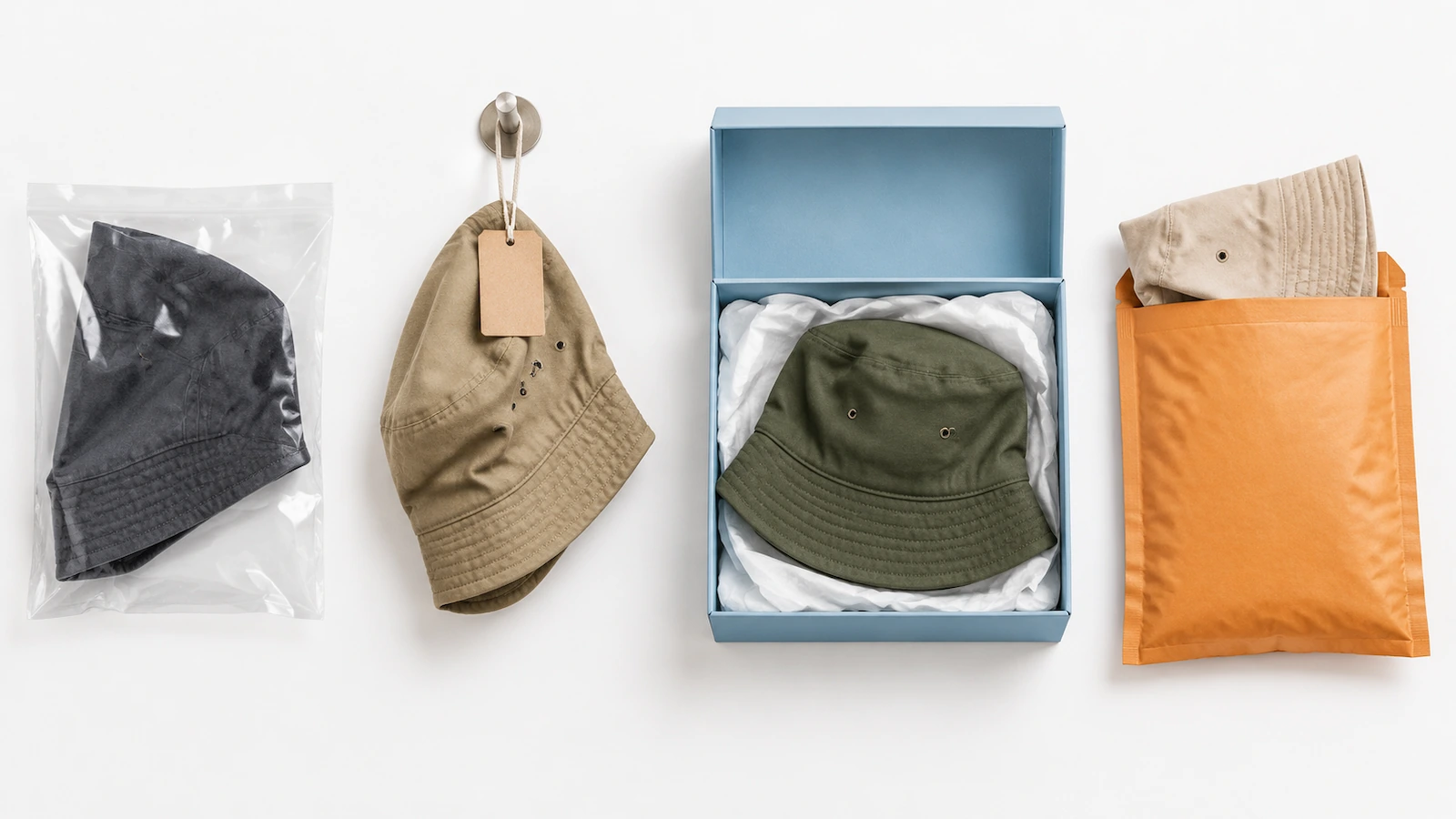
Quick answer: Choose bucket hat packaging by channel. Retail shelves need a hang tag plus a clean polybag or header card. Merch drops and premium gifts justify a branded box with tissue. Event kits should be packed flat and sorted by size. E-commerce orders ship well in a padded mailer because a soft bucket hat folds. Lock the fold method, label copy, and every custom-printed component before production starts, because each printed part adds its own proof cycle and adds to unit cost.
Bucket hat packaging is usually the last line item on a custom headwear order, and it often causes the most avoidable problems. A hat with clean embroidery arrives creased through the logo. A retail buyer rejects a carton because the hang tags carry no barcode or origin line. A merch drop sits in the warehouse because the custom boxes were ordered after the hats were approved. None of these failures comes from the hat itself. Each one comes from a packaging decision that was never written into the order.
This guide covers the packaging side only: how soft-crown hats should be folded, which primary and secondary packs suit each sales channel, what belongs on a hang tag under US labeling rules, how cartons should be packed out, and how each choice affects unit cost and lead time. For the hat itself, including decoration routes and quote checks, see our page on custom bucket hats for teams, events, and brands.
What Is Bucket Hat Packaging, and Why Does It Differ From Cap Packaging?
Bucket hat packaging is the set of components that protect, identify, and present a finished hat between the decoration line and the end user: the fold or nesting method, the primary pack (polybag, header card, or box), the identification layer (hang tag, sticker, or printed insert), and the shipping pack (mailer or master carton).
The structural difference from baseball caps drives most decisions. A structured cap has a buckram-backed front and a pre-curved bill, so it needs a rigid box or a nested stack to keep its shape. A bucket hat has an unstructured crown and a soft, downward brim. It can fold flat, which saves space and freight, but folding introduces a new risk: a crease that runs through the decoration. Dense embroidery holds a fold line, and printed or heat-transferred artwork can crack or lift along a repeated crease. Suppliers in the category consistently point to fold lines and sun exposure as factors that shorten the life of printed artwork. So the packaging question for bucket hats is less about crush protection and more about where the hat bends.
Where Packaging Goes Wrong on Custom Hat Orders
Across buyer reviews and supplier guides for custom bucket hats, the complaints that are not about the decoration itself cluster around three packaging-adjacent gaps.
The fold was never specified. The decorator packs hats the fastest way, often folded straight through the front panel. A logo that passed approval arrives with a hard crease across it, and steaming 200 hats at the event venue is not a plan.
The label copy was improvised. Hang tags go to print with sun-protection wording copied from a marketplace listing, or with a "Made in USA" line on a hat whose blank was imported. Both claims carry regulatory exposure, covered below.
The packaging schedule ran behind the hat schedule. Stock polybags are on the shelf. Custom-printed boxes, woven labels, and printed tissue each need their own artwork, proof, and print run. When they are ordered after the hat proof is approved, they become the critical path, and the drop date moves.
The fix in each case is the same: treat packaging as part of the specification, approved at the same time as the decoration proof.
How to Plan Bucket Hat Packaging in Seven Steps
Step 1: Define the channel and who opens the package
Write down who handles the hat first. A retail associate needs a hang tag with a scannable identifier and a pack that hangs or stacks cleanly. A merch fan opening a drop box cares about presentation and the first look at the logo. An event volunteer handing out kits needs hats pre-sorted by size so the line moves. An e-commerce customer needs the hat to survive a parcel network and, ideally, a bag that can be resealed for returns. One order can serve several channels; in that case, split the pack-out by channel rather than averaging the packaging.
Step 2: Decide fold, flat, or nest
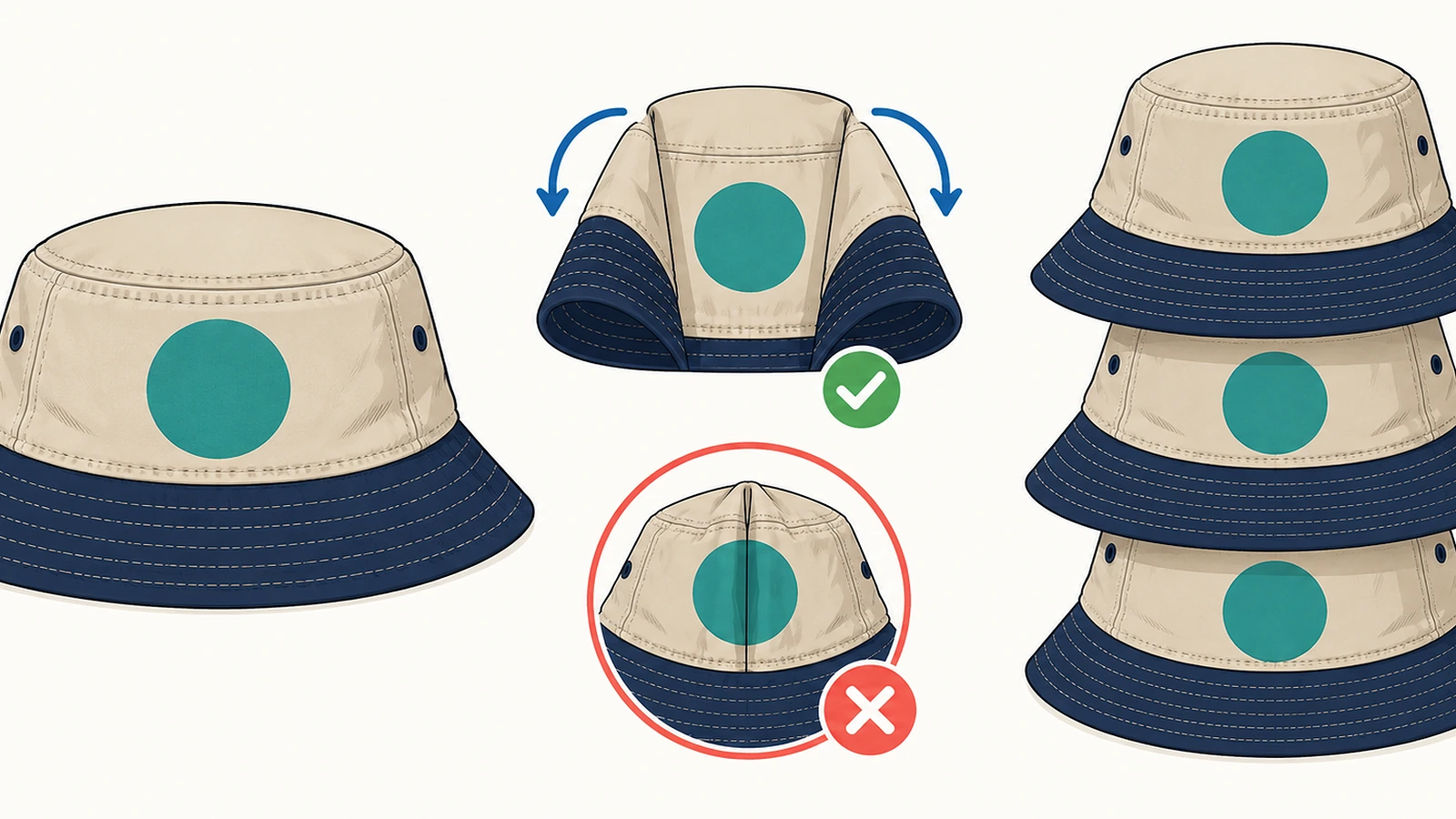
There are three practical methods for soft-crown hats, and the decoration placement should decide among them.
Flat, unfolded: the crown pressed down, brim flat around it. Best protection for front decoration, but the largest footprint. Suits boxes and premium retail.
Side fold: folded in half along the side seams so the front panel lies flat on the outside, uncreased. A good default for polybags and mailers when the logo is on the front.
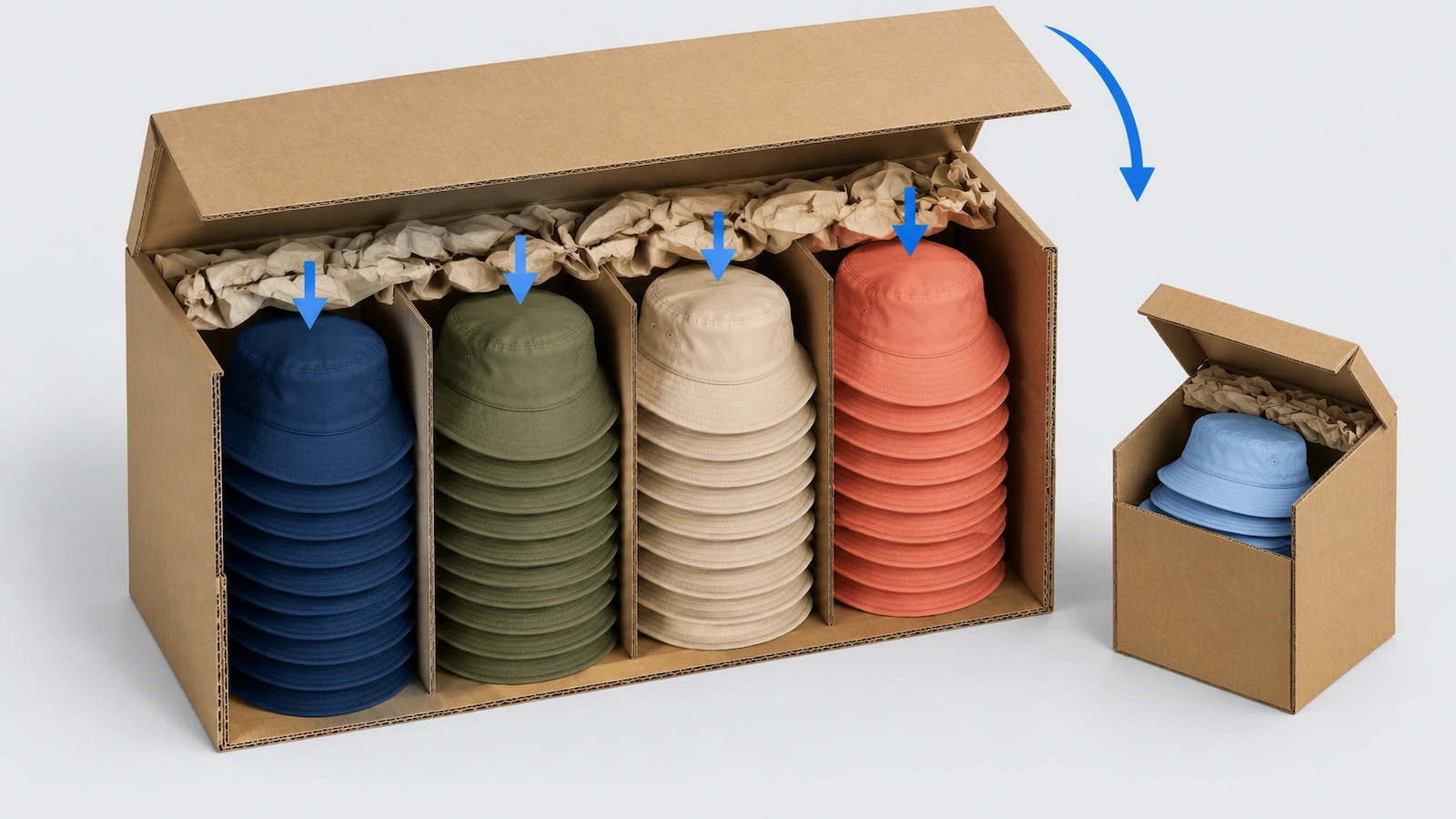
Nested: hats stacked crown-into-crown in the same size and color. Efficient for master cartons and event bulk, and it keeps the shape of heavier canvas or twill hats.
Avoid any fold that crosses the decoration, and avoid tight rolling for printed panels. If artwork wraps around the crown or covers the brim, as with all-over print or reversible hats, pack flat or nested rather than folded. Put the chosen method in writing, ideally with a reference photo of the approved pack from the pre-production sample.
Step 3: Choose the primary pack
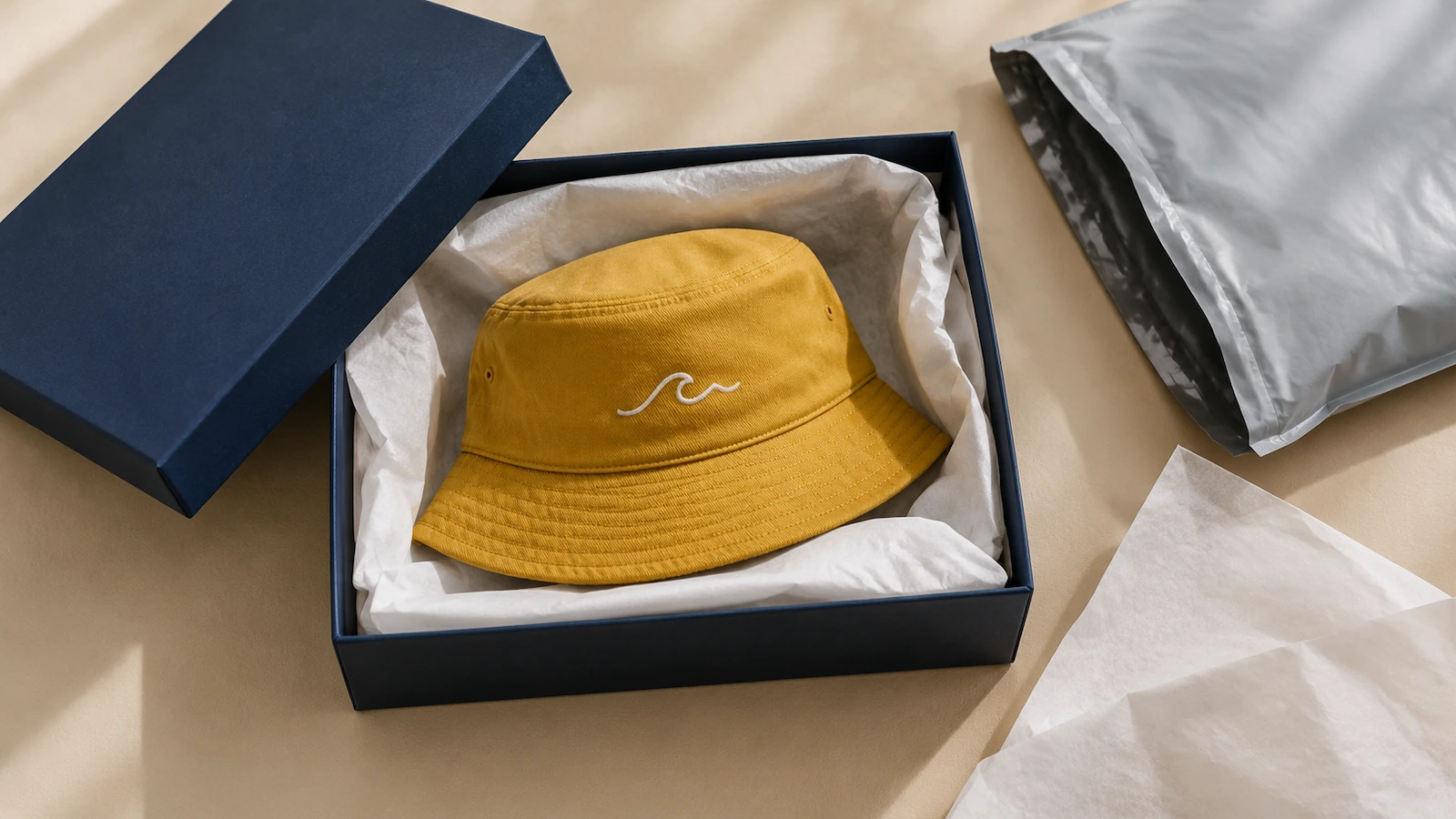
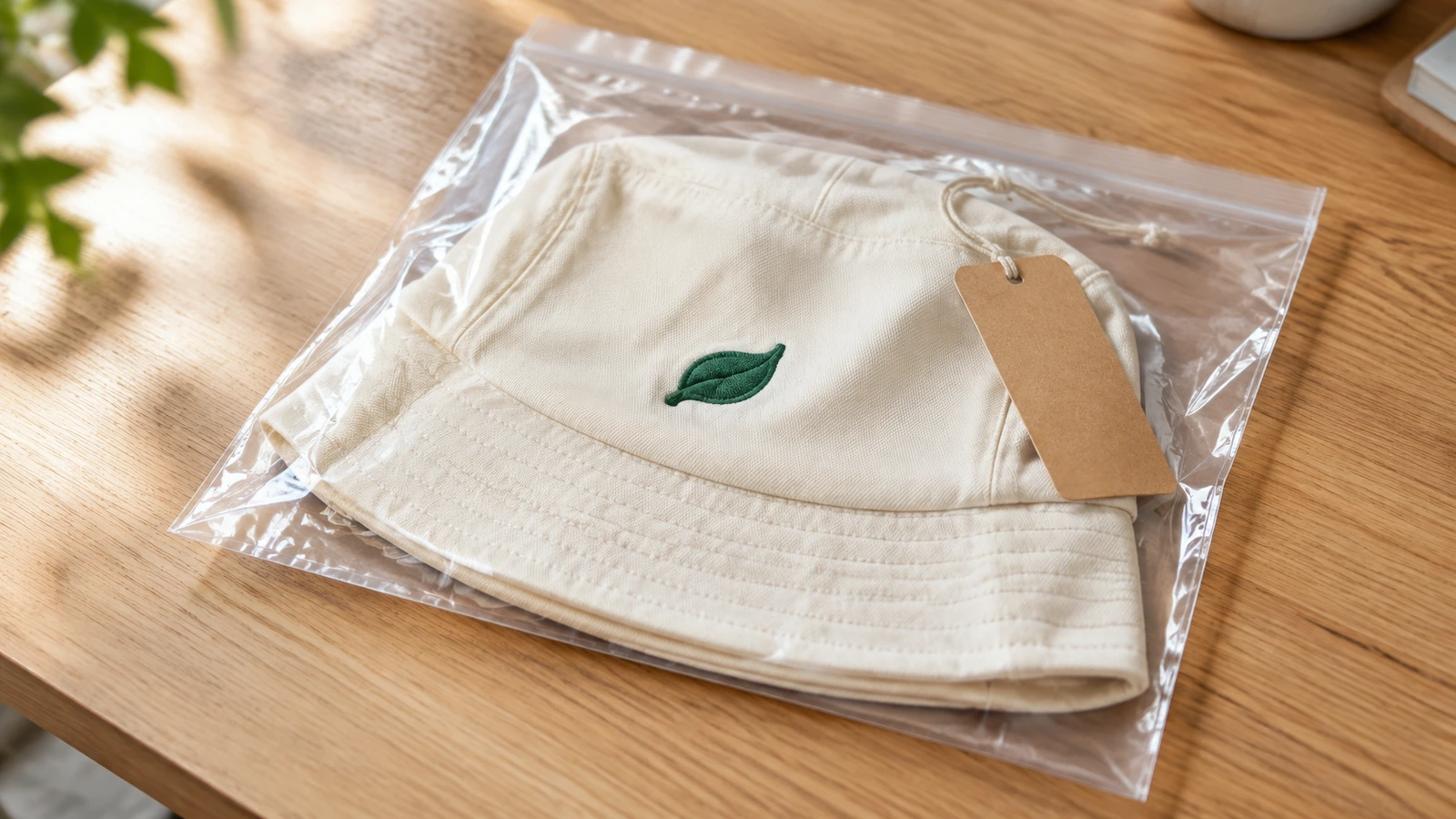
The primary pack touches the hat. Clear polybags protect against dust and moisture and let the buyer see the color, which matters for retail and fulfillment. Resealable bags help e-commerce returns. A tissue interleaf between hats, or between the decoration and the bag, reduces abrasion where embroidery rubs against a neighboring hat's print. A header card stapled or looped over the polybag turns a soft hat into a pegboard item. A rigid or folding box is the premium tier: it presents the hat flat and protects it, but it adds cost, cube, and a separate print run if branded.
Step 4: Write the identification layer
The hang tag, bag sticker, or box insert carries size, color, an identifier such as an SKU or a barcode if a retailer requires one, care guidance, and any origin or material claims. Bucket hats have no rigid front to clip into, so tags are usually attached through the sweatband or an interior label with a plastic fastener or a string loop. Specify the attachment point: a fastener shot through the crown fabric leaves a visible hole. The legal content of the tag is detailed in the next section.
Step 5: Add secondary packaging only where it earns its cost
Branded mailers, printed boxes, stickers, and inserts make sense when the hat is the product, as in a merch drop, a retail gift set, or a corporate welcome kit where the unboxing is part of the brand impression. They make less sense for giveaway hats that will be handed out of a bin at a festival gate. A useful test: if the recipient never sees the outer pack, put the budget into the hat or the hang tag instead.
Step 6: Pack out cartons for the route, not just the count
Soft hats rarely crush in the structural sense, but they deform. A carton that is too tall lets nested stacks lean, which bends brims; a carton packed too tight flattens the crown and sets creases during long transit. Pack cartons so stacks stand upright and fill the void, separate sizes and colors into their own cartons or clearly divided layers, and mark cartons by size run so event teams and warehouses can pick without opening every box. For long or humid transit, line cartons or bag hats to keep cotton twill dry. Children's sizes should never share a carton with adult sizes, both for picking accuracy and because children's products carry their own labeling obligations.
Step 7: Budget the packaging line by line
Packaging changes the landed cost of a hat in four places: materials, labor, freight cube, and schedule. Stock clear polybags and plain cartons add little to either cost or lead time. Every custom-printed component, whether a hang tag, box, sticker, or tissue, adds artwork, a proof round, a print run, and inbound shipping to the decoration site. Hand-folding, tagging, and kitting add labor per unit, which matters more on large event orders than on short retail runs. Boxes add cube, which raises freight cost, especially under dimensional-weight pricing for parcel shipments. Ask for packaging to be quoted as separate line items so you can see what each choice adds, and request a quote on your exact mix rather than relying on a generic per-unit figure.
What Must a Bucket Hat Hang Tag or Box Say?
Packaging is where most product claims live, so it is where most labeling exposure lives. The points below are a buyer's checklist, not legal advice; confirm specifics with your customs broker or compliance counsel.
Country of origin. Under US customs rules, every article of foreign origin, or its container, must be marked in English with the country of origin in a conspicuous place, as legibly, indelibly, and permanently as the article allows, so the ultimate purchaser can see it (19 CFR 134.11[1]). If a hat ships inside a sealed retail box that hides the sewn label, ask whether the box also needs an origin mark.
"Made in USA" wording. An unqualified Made in USA claim on a hang tag, box, or insert must meet the FTC's "all or virtually all" standard (FTC Made in USA guidance[2]). An imported blank decorated in the US does not qualify; use a qualified phrase such as "Embroidered in USA" instead. The FTC has acted on headwear specifically: a 2018 settlement with a hat company addressed origin claims on products, many of which were imported as finished goods (FTC Bollman Hat settlement[3]).
Fiber content and processing. Where a product falls under the Textile Act rules, imported items must disclose the country of processing or manufacture, and US-made items with imported materials must say so, for example "Made in USA of imported fabric" (16 CFR 303.33[4]). Keep the hang tag consistent with the sewn label.
Care instructions. The FTC Care Labeling Rule defines textile wearing apparel to exclude hats used exclusively to cover the head (16 CFR Part 423[5]). Care guidance on a standard bucket hat's tag is therefore voluntary, but it is still worth printing: telling recipients to avoid the dryer and hard creasing protects printed artwork. Variants with neck flaps need a separate review.
Sun-protection claims. Avoid "UPF 50+" or "full sun protection" on tags unless the fabric has been tested to a recognized method. Australia's radiation protection agency estimates that a bucket hat gives a protection factor of about 15 to the forehead but only about 2 to the cheeks and neck, and rarely provides enough protection on its own (ARPANSA[6]). A peer-reviewed study concluded that UPF claims for hats sold online in the US are not a reliable indicator of sun protection (PMC study on hat UPF claims[7]).
California Proposition 65. Packaging and labels are where Prop 65 warnings appear. In December 2025, a civil complaint filed in San Francisco alleged that bucket hats were sold in California without a required warning for PFOA exposure; this is an allegation, not a ruling (California Attorney General filing[8]). If hats with water-repellent finishes or coated components will sell in California, settle the warning question before tags go to print.
Children's sizes. Hats designed primarily for children 12 and under are children's products. They need permanent tracking information identifying the manufacturer or private labeler, production location, date, and batch on the product and, where practicable, on its packaging (CPSC tracking label FAQ[9]). The federal total lead limit for children's products has been 100 ppm since August 14, 2011 (CPSC lead limit release[10]), so metal tag fasteners or snaps on youth packs deserve a question. Keep drawstrings off youth hats entirely: in 2007, the CPSC announced a recall of about 500 toddler and youth nylon bucket hats because the drawstring posed a strangulation hazard (CPSC recall notice[11]).
Certification marks. If a tag mentions a chemical-safety certification, the certificate must cover the article as sold. OEKO-TEX STANDARD 100 (Edition 01.2025) requires every component of a certified article to comply and assigns Class I to items for children up to 3 and Class II to items with skin contact (OEKO-TEX STANDARD 100 factsheet[12]). A fabric certificate alone does not extend to the embroidery thread, patch, or sweatband.
Packaging Options Compared by Cost, Lead Time, and Channel
Cost and lead-time impact below are relative to a baseline of a loose, bulk-packed hat. Actual figures depend on quantity and supplier, so request a quote on your specific mix.
Packaging option
Protects decoration
Shelf / unboxing appeal
Unit cost impact
Lead-time impact
Best fit
Bulk nested in carton, no individual pack
Medium if nested by size and color
Low
Lowest
None
Event giveaways, team distribution
Stock clear polybag, side-folded
Good, if fold avoids the logo
Medium
Low
Minimal
E-commerce, event kits, warehouse stock
Polybag plus custom hang tag
Good
Medium to high
Low to medium
Adds tag proof and print run
Retail shelves, wholesale accounts
Header card on polybag
Good
High on pegboards
Medium
Adds card proof and print run
Gift shops, resort and venue retail
Padded or branded mailer
Good in transit
Medium to high
Medium
Adds mailer print run if branded
Direct-to-consumer drops
Rigid or folding branded box with tissue
Best, hat lies flat
Highest
Highest; also raises freight cube
Longest; often the critical path
Premium merch, corporate gifts, influencer kits
Mapped by channel, the defaults look like this:
Channel
Recommended pack
Must-have details
Common mistake
Retail shelf
Polybag or header card plus hang tag
Identifier the retailer can scan, origin line, size visible without opening
Tag fastener shot through the crown fabric
Merch drop
Branded box or mailer, tissue, flat pack
Packaging delivered to pack-out before hats finish
Ordering boxes after the hat proof is approved
Event kit
Side-folded polybag or nested bulk, sorted by size
Cartons marked by size run; youth sizes separated
One "one size" carton for a mixed crowd
E-commerce
Resealable polybag inside a mailer
Fold that keeps the front panel smooth
Box sized for caps, which inflates dimensional weight
FAQ
FAQ: Do bucket hats need a box, like structured caps do?
Usually not. An unstructured crown has no front panel to crush, so a polybag inside a mailer protects most hats in transit. A box is a presentation choice for merch drops and gifts, or a protection choice for hats with all-over print or stiff canvas that should not be folded.
FAQ: How should an embroidered bucket hat be folded?
Fold along the side seams so the front panel stays flat and uncreased on the outside, or nest hats crown-into-crown. Never fold through dense stitching, which can hold the crease. Approve the fold on the pre-production sample.
FAQ: Can a hang tag say "Made in USA" if the hat was embroidered in the US?
Not if the blank was imported. An unqualified claim must meet the FTC's "all or virtually all" standard. Use qualified wording such as "Embroidered in USA" and keep the imported origin visible as customs marking rules require.
FAQ: Is a care label required on a bucket hat?
The FTC Care Labeling Rule excludes hats worn exclusively on the head, so it is not mandatory for a standard bucket hat. It is still useful on the hang tag, especially for printed hats that should avoid the dryer and tight creasing.
FAQ: Should a hang tag mention sun protection?
Only describe what is tested. Without a UPF test report, avoid UPF numbers and "full protection" wording. Regulators estimate that a bucket hat brim protects the cheeks and neck far less than the forehead.
FAQ: What changes for youth-size hats in event kits?
Youth hats designed for children 12 and under need CPSIA tracking information and must meet the children's lead limit. Pack them in separate, clearly marked cartons, and do not include adjustable drawstrings.
FAQ: Which packaging choice adds the most lead time?
Custom-printed boxes and header cards, because each needs its own artwork, proof, print run, and delivery to the pack-out site. Order them when you approve the hat decoration, not after.
Key Takeaways
Origin marking applies to the article or its container, visible to the ultimate purchaser. — 1 marking rule, 19 CFR 134.11 (Source)
Unqualified "Made in USA" on tags or boxes requires "all or virtually all" US content. — FTC action against a hat company in 2018 (Source)
Care labels are optional for standard hats but still worth printing. — 16 CFR Part 423 excludes hats worn exclusively on the head (Source)
Keep sun-protection claims off tags unless tested. — protection factor about 15 on the forehead, about 2 on cheeks and neck (Source)
Youth hats carry children's product obligations. — 100 ppm total lead limit since August 14, 2011 (Source)
No drawstrings on youth bucket hats. — about 500 youth hats recalled in 2007 for strangulation risk (Source)
Certification claims must cover every component. — OEKO-TEX STANDARD 100, Edition 01.2025, Class II for skin contact (Source)
Conclusion
Good bucket hat packaging starts from the channel, protects the decoration by controlling where the hat folds, keeps label copy within what the hat can legally and factually support, and schedules every custom-printed component alongside the hat proof. Polybags and nested cartons keep event and fulfillment orders lean; hang tags and header cards make soft hats shelf-ready; branded boxes belong where the unboxing is part of the product.
If you are planning an order, share your channel mix, quantities, and packaging preferences with us and we will quote the hats and each packaging component as separate lines, so you can see exactly how packaging affects unit cost and timing. Start with our custom bucket hats page to request a quote.
Hi there! I'm Bruce, proud dad to my amazing son. I'm the founder of Zigpac, a printing and packaging company empowering small and medium-sized businesses with custom solutions. Let's create something great together!



 Blog PDF for offline reading












The information below is required for social login
Sign In
Create New Account