We use cookies to enable our websites to remember information, to help some website functionalities to work properly, to understand how you interact with and use our websites and to display you content and ads that are relevant and engaging for you.
By clicking Accept All you consent to the use of these cookie.
The store will not work correctly when cookies are disabled.
Quick answer: Custom iron on patches for clothes use a thermoplastic heat-seal film that bonds well to cotton, denim, twill and poly-cotton, and poorly to nylon, water-repellent coatings, fleece and leather. For retail apparel, a commercial heat press works well. For uniforms that go through industrial laundering, add a perimeter stitch or switch to sew-on. For swappable insignia, use hook-and-loop.
Most brand teams order custom iron on patches for clothes because heat-seal backing promises fast, needle-free application across hundreds of garments. The order often goes wrong at the garment, not the patch. One reviewer in 2026 said patches "peeled right off after 24 hours" even though they had used both a heat press and an iron. Another buyer said patches "cracked" after two washes. This guide covers how heat-seal backing works, which fabrics it bonds to, how it handles home and industrial laundering, when sew-on or hook-and-loop is the better choice, and how to run a repeatable heat-press line for a branded apparel program.
Why Do Heat-Seal Patch Programs Fail After Rollout?
The problem: A patch can pass the proof stage and the first press test and still fail during wear. Buyer complaints from the past 12 months keep showing three patterns. Patches lift on thick hoodies and caps. They pop off synthetic fabric the first time the garment is worn. They crack or curl after a handful of washes.
Why it hurts: In a uniform or merchandise program, one failed bond means a full reorder. That includes re-pressing labor, shipping, and in some cases a missed event date. Supplier warranties often run 30 days from delivery, which ends before most wash failures show up. One buyer said a supplier invoked exactly that window to refuse a claim.
The fix: Choose the attachment method based on garment fabric and laundering regime before choosing artwork. Lock heat-press settings per garment SKU. Validate durability with a short wash test on the real garment, not a scrap of cotton. The rest of this guide covers each step.
What Is Heat-Seal (Iron-On) Backing?
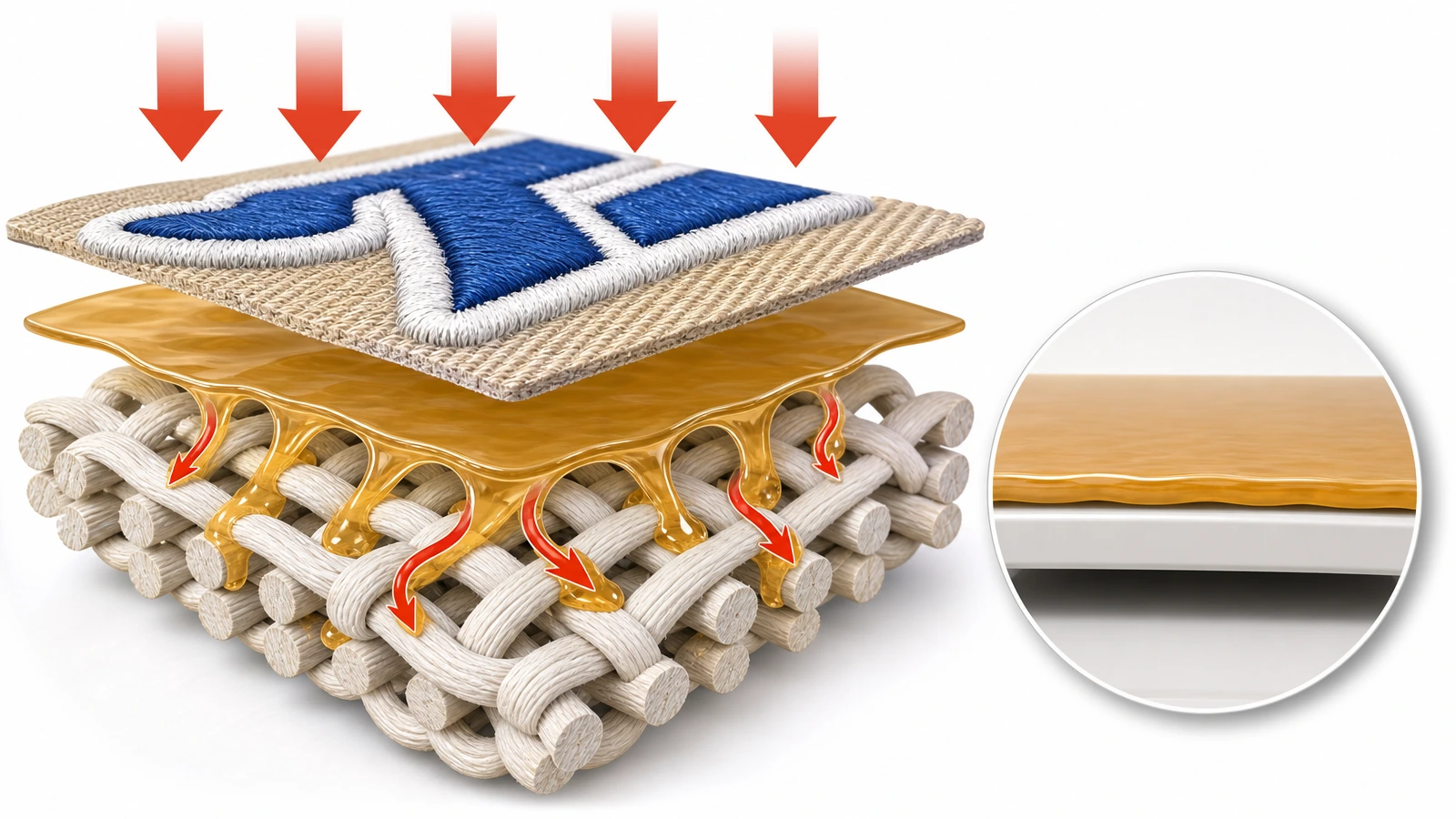
Heat-seal backing is a thermoplastic adhesive film laminated to the back of an embroidered, woven or printed patch. It stays solid at room temperature. When heat and pressure are applied, it softens, flows into the gaps between the garment's yarns, and grips the fibers mechanically as it cools. The patch's construction (thread, twill base, border) is a separate decision, and the product page covers it in detail for custom embroidered patches.
The physics matter for three reasons:
Porosity is everything. The adhesive needs open weave or fiber texture to flow into. Tight, coated or slick surfaces give it nothing to grip.
Heat that bonds can also release. The film is thermoplastic, so repeated high-temperature washing and tumble drying soften it again. That is why heat-seal performs differently in home and industrial laundering.
The adhesive is a component part. For children's apparel, the glue layer falls under the same lead limits as the thread and base fabric (see compliance notes below).
Embroidery is largely an imported category. In 2024 the United States imported about $118M of embroidery and exported $8.78M, according to the Observatory of Economic Complexity[1]. In practice, the adhesive spec usually travels across borders on a spec sheet. Write it down; don't assume it.
Which Garment Fabrics Will Custom Iron On Patches for Clothes Actually Bond To?
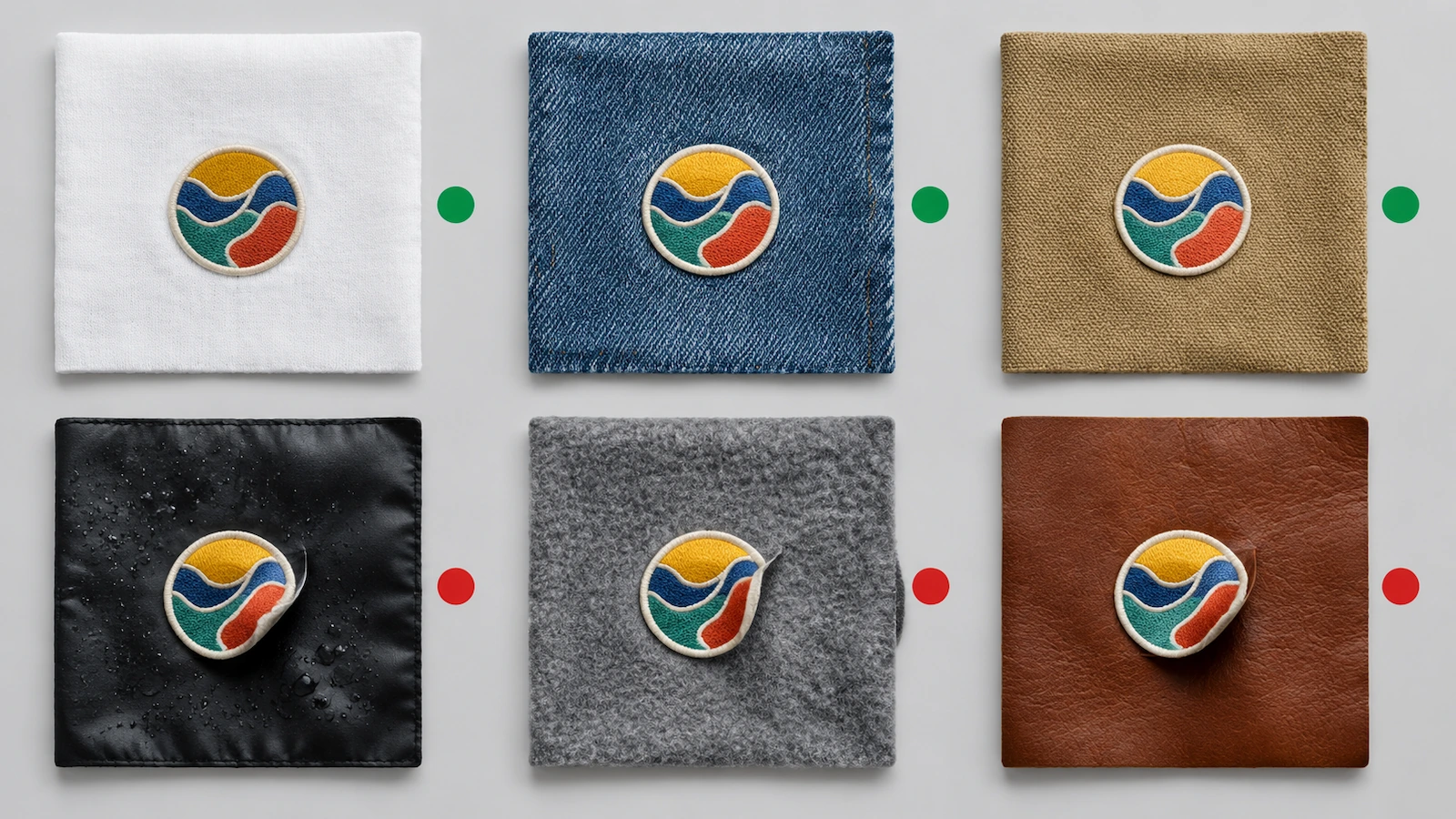
Fabric compatibility is the biggest predictor of success. Published guidance from patch makers recommends heat-seal only for fabrics that tolerate roughly 320°F (160°C). It also advises against heat-sensitive materials and "weather-treated" fabrics, because water-repellent finishes block the adhesive. The table below groups typical apparel substrates.
Garment fabric
Heat-seal bond
Why
Recommended attachment
100% cotton tees, cotton twill shirts
Strong
Open weave, tolerates press heat
Heat-seal; add perimeter stitch for daily-wash uniforms
Denim, canvas, poly-cotton workwear
Strong
Heavy texture gives deep adhesive penetration
Heat-seal or heat-seal + stitch
Cotton-rich fleece hoodies
Moderate
Thick pile insulates the glue line; needs longer dwell
Heat-seal with tested dwell, or sew
Polyester performance knits
Variable
Smooth filament, risk of scorch and dye migration at high heat
Test first; sew-on is safer
Nylon shells, DWR/waterproof jackets
Poor
Coatings and low melt tolerance block the bond
Sew-on or hook-and-loop
Wool, leather, silk, polar fleece
Poor
Heat damage or surface that the adhesive cannot penetrate
Sew-on
Structured caps
Variable
Curved crown, buckram, uneven pressure
Hat press with curved platen, or sew
Size matters too. Supplier guidance commonly puts the practical limit for adhesive-only attachment at about 4 × 5 inches. Larger heat-sealed patches tend to lift at the corners, where garment flex concentrates stress. Large back patches should be sewn.
How Does Heat-Seal Backing Hold Up to Home and Industrial Laundering?
No standard defines "wash cycles to failure" for iron-on patches, so published figures are supplier claims, and they vary widely:
Patches applied with a household iron are commonly rated at about 20–30 home washes before the bond weakens.
Patches applied on a commercial press at about 150–160°C, 15 seconds, 4–5 bar are claimed by one factory to survive 50+ household washes. Other makers quote 50–80 cycles, and premium-adhesive claims reach 50–100.
The same sources that publish the higher numbers still recommend a perimeter lock-stitch for industrial laundering.
Industrial laundering behaves differently because commercial programs run hotter wash and dry cycles, use stronger chemistry and apply more mechanical action than home machines. Each hot cycle partially re-softens the thermoplastic film, and flexing peels it from the edges inward. Makers themselves are blunt about it. One embroiderer wrote that heat-activated glue "will break down over time if it's being washed regularly," and that patches "should be sewn in place after being glued down for long term stability."
A simple validation protocol before you scale
Press 10 patches onto the actual production garment, with the same fabric lot and color.
Wash per the garment care label. For a home-wash reference, US flammability rules cite the AATCC LP1 home laundering procedure. For uniforms, use your laundry partner's real cycle.
Inspect at 5, 10 and 25 cycles for edge lift, corner curl and adhesive bleed-through.
If you need colorfastness data, specify a method in the purchase order (ISO 105-C06 is a common choice) rather than accepting "won't fade."
Ask your supplier to state a peel-strength target in writing. One published factory spec uses 25 N/cm as a minimum.
Don't make durability claims you haven't tested. "Permanent" and "waterproof" do not belong on an iron-on embroidered patch spec.
When Is Sew-On or Hook-and-Loop the Better Choice?
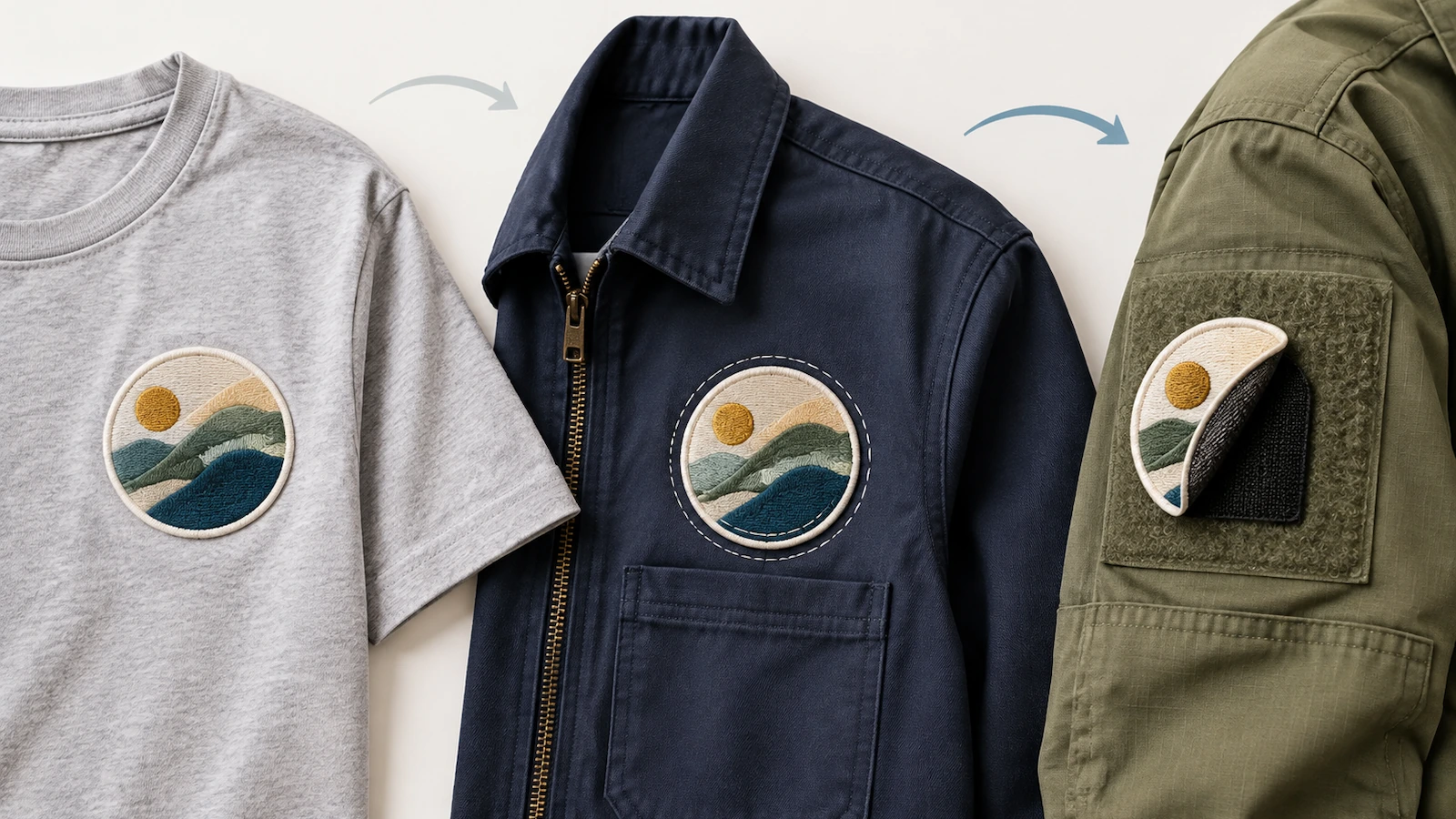
Heat-seal saves labor. It is not the default for every program. The comparison below covers attachment methods only. For patch types such as woven, PVC or chenille, see the product page's type comparison.
Factor
Heat-seal (iron-on)
Heat-seal + perimeter stitch
Sew-on
Hook-and-loop
Application speed at volume
Fastest
Moderate
Slowest
Fast once loop panel is sewn
Industrial laundering
Not recommended alone
Good
Best
Good (remove patch to wash)
Nylon, coated, wool, leather
No
Limited
Yes
Yes (loop panel sewn)
Swappable rank, name or unit
No
No
No
Yes
Flame-resistant garments
Avoid adhesive
Avoid adhesive
Yes, within area guidance
Check garment maker
Best fit
Retail tees, totes, caps, events
Hoodies and staff wear washed at home
Daily-wash uniforms, jackets, large back patches
Tactical, security, rotating crews
Compliance checks that override convenience
Children's apparel (12 and under). Every accessible component, including the adhesive layer, must meet the total lead limit of 100 ppm under CPSIA Section 101, as explained in CPSC total lead content guidance[2]. The limit is restated in 16 CFR 1252.1[3]. Whether a part counts as "accessible" is defined in 16 CFR 1500.87[4], and coatings cannot be used as barriers. Plasticized adhesives also fall under the 0.1% phthalate limit. Require third-party test reports for the specific backing film.
Children's sleepwear. If the garment is sleepwear, or loungewear that CPSC treats as sleepwear, the stricter sleepwear flammability standards (16 CFR 1615/1616) apply to the whole garment, as listed among CPSC's common e-commerce violations[5].
General clothing flammability. Apparel textiles fall under 16 CFR Part 1610[6]. The rule treats embellished areas as places where burn behavior can change. Some items, including certain hats, are exempt according to CPSC clothing guidance[7]. The patch alone is not a separately regulated product.
Flame-resistant (FR) and arc-rated workwear. A thermoplastic adhesive that melts is the wrong attachment for FR garments, so sew patches on. The ASTM F1506 appendix and NFPA 2112 annex recommend that non-FR emblems stay at or below 16 in² each and 40 in² in total, and NFPA suggests no more than five. These are guidelines, not automatic compliance. Confirm with the garment manufacturer's current certification.
Sustainability claims. If you market "recycled" thread, note that the 2026 edition of OEKO-TEX STANDARD 100[8] excludes pre-consumer PET bottles as a recycled source and bars the "recycled" label below 20% recycled content. A thread certificate does not certify the adhesive or the finished patch.
How to Apply Custom Embroidery Patches Iron On at Volume with a Heat Press
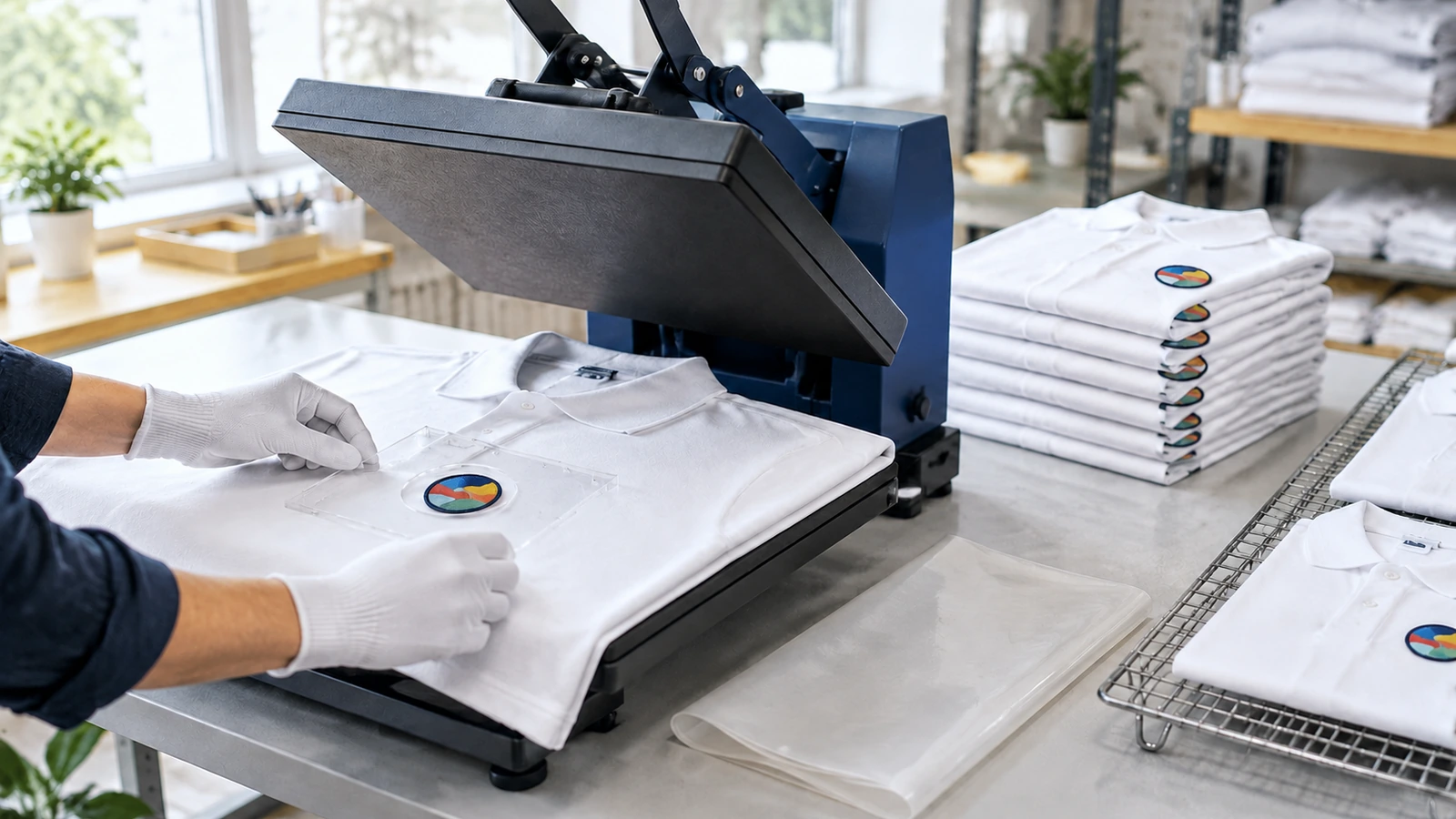
A household iron can't hold consistent temperature, pressure or dwell across 300 garments. A calibrated press with locked settings can. Use this sequence to set up a line.
Build a settings card per garment SKU. Record temperature, dwell time, pressure, platen type and peel method (hot or cold) for each fabric. Published supplier ranges cluster around 150–175°C (300–350°F) and 15–30 seconds. Start from your patch supplier's figure and adjust only after a test.
Verify platen temperature independently. Press dial readings drift, and cold spots at platen edges are a common cause of corner lift. Check across the whole platen surface at the start of every shift.
Pre-press the garment for 3–5 seconds. This removes moisture and flattens seams and fleece pile, so the adhesive meets a dry, level surface.
Position with a fixture, not by eye. Use a placement template or alignment guide that fixes the logo to a set offset from the collar seam or placket. On left-chest programs, a few millimeters of drift is visible when staff stand side by side.
Use a cover sheet. A PTFE or silicone sheet protects embroidery thread sheen and stops adhesive squeeze-out from marking the platen.
Press, then reverse-press if needed. On thick garments, a short second press from the inside drives heat straight into the glue line instead of through the embroidery.
Cool before handling. The bond sets as the film solidifies. Folding or stacking warm garments shears the adhesive before it has gripped.
Run first-article and interval checks. Peel-test the first piece of every batch, then check at fixed intervals, edges first. Log failures against the settings card so fixes stay with the SKU.
Stitch where the laundering regime requires it. For uniform programs, the press holds placement and the perimeter stitch provides durability.
If your patches have a merrowed or overlocked border, the stitch type falls in the 500-class overedge family under ISO 4915[9] and ASTM D6193[10]. These standards classify stitch structure. They do not test adhesive bonds, so wash durability still needs its own clause in your order.
FAQ
FAQ: Can I use a household iron instead of a heat press?
For a few garments, yes. Use a dry iron (no steam) with firm pressure and a press cloth. Supplier guidance is typically 15–20 seconds per area, then cool completely. Household irons vary by several tens of degrees across the soleplate, so expect lower durability. Supplier estimates for home-ironed patches run around 20–30 washes. Use a calibrated press for any program over a few dozen pieces.
FAQ: Why did my patch fall off a nylon or waterproof jacket?
Durable water-repellent finishes and tight nylon weaves give the adhesive nothing to flow into, and nylon can't safely take full press temperature. Sew the patch, or sew a loop panel and use hook-and-loop backing.
FAQ: Can iron-on patches go on hats?
Flat, unstructured caps work with a curved hat platen. Structured caps with buckram fronts often lift at the edges because pressure across the curve is uneven. Many decorators sew cap patches or use a heat-seal tack plus stitching.
FAQ: Can I remove an iron-on patch later?
Usually. Reheating softens the adhesive so the patch can be peeled off while warm, but residue and a shadow on dyed fabric are common. If staff names or roles change often, choose hook-and-loop from the start.
FAQ: Are iron-on patches safe for children's clothing?
They can be, as long as every accessible component, adhesive included, meets the 100 ppm total lead limit and the 0.1% phthalate limit, backed by third-party testing and a Children's Product Certificate. Thread being "safe" doesn't cover the glue layer.
FAQ: What should I put in the purchase order about the backing?
Include backing type, recommended press settings, compatible fabric list, the wash test you will run, the peel-strength expectation and what happens if the bond fails within that test. Artwork and proof sign-off are covered on the embroidered logo patch product page.
Key Takeaways
Heat-seal is a mechanical bond, so fabric porosity decides success. Imports of $118M against exports of $8.78M in 2024 mean most US embroidery arrives with a spec sheet you should read closely (Source).
Children's apparel adhesives must pass the same lead test as the thread. Total lead limit is 100 ppm per accessible component (Source).
Coatings can't make a part "inaccessible" for lead purposes. Paints, coatings and plating are not barriers under 16 CFR 1500.87 (Source).
Clothing flammability rules apply to the garment, not the patch alone. 16 CFR Part 1610 governs apparel textiles, with exemptions such as certain hats (Source).
"Recycled" thread claims need real certificates. The 2026 OEKO-TEX edition bars the label below 20% recycled content (Source).
Stitch standards classify borders, not bonds. ISO 4915 groups overedge stitching in the 500 class, so adhesive durability needs its own test clause (Source).
Conclusion: Match the Backing to the Laundry, Then Lock the Press
Iron-on backing works well for cotton, denim and poly-cotton garments that are washed at home and pressed on calibrated equipment. It is the wrong choice for nylon shells, coated jackets, FR workwear and large back patches, and it shouldn't be the only attachment for uniforms sent to industrial laundries. Pick the attachment method by fabric and wash regime, keep a settings card for each garment SKU, and run a 25-cycle test on the real garment before rollout.
When your attachment plan is set, look at our stitched fabric logo patches for uniforms, teams and brands and send us your garment list and laundering details. We will quote the right backing for each SKU. Minimums, pricing and lead times are confirmed per quote.
Footnotes
The Observatory of Economic Complexity (OEC), "Embroidery" trade profile for the United States, 2024–2025 data. oec.world↩
U.S. Consumer Product Safety Commission, "Total Lead Content," business guidance (page updated 2026-10-10). cpsc.gov↩
eCFR, 16 CFR 1252.1, lead content limit of 100 ppm for children's products. ecfr.gov↩
Hi there! I'm Bruce, proud dad to my amazing son. I'm the founder of Zigpac, a printing and packaging company empowering small and medium-sized businesses with custom solutions. Let's create something great together!



 Blog PDF for offline reading












The information below is required for social login
Sign In
Create New Account