


 Blog PDF for offline reading
Quick answer: Soft enamel pins have color filled into recessed cells that sit below raised metal lines. Because there is no grinding and polishing step, they usually cost less per unit and move through production faster than hard enamel. That makes them the practical choice for large event giveaways, employee recognition tiers and promotional runs. An optional clear epoxy dome adds a smooth, protected surface.
If you are ordering soft enamel pins for a conference, a staff milestone program or a brand campaign, the decision usually comes down to three things: how many you need, when they must be in hand, and how good they must look at arm's length. Collector forums tend to say hard enamel is "better." For a business buyer, that answer is often the wrong one.
The problem: Most enamel pin advice is written for artists selling a few hundred pieces at a convention table. The promotional products channel tracked by the Promotional Products Association International (PPAI)[1] works differently. Volumes are larger, deadlines are fixed by event dates, and the budget is set per attendee or per employee rather than by retail margin.
Why it hurts: If you choose the premium finish by default, you can spend budget on polishing that nobody notices on a lanyard. You may also lose schedule buffer before a trade show. If you choose the cheapest option without a specification, you can receive scratched recesses, missing backs or colors that don't match your brand guide.
The fix: Treat soft enamel as a deliberate engineering choice. Understand how it is built, where it beats hard enamel, how unit cost behaves across quantity breaks, and which add-ons, such as epoxy, change the result. This guide walks through each step. Searches like "soft enamel pins custom" or "cheap enamel pins custom" usually start with price, but the strongest orders start with use case.
What Are Soft Enamel Pins? Construction Explained
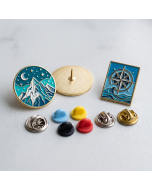
A soft enamel pin starts as a die-struck metal blank. A steel mold stamps the outline and the raised metal lines into a base metal, typically zinc alloy, iron, brass or copper. The stamping leaves recessed cells between the lines. The blank is plated first, for example in gold, silver, black nickel or antique tones. Colored enamel is then dropped into each recess and heat-cured.
The defining detail is what happens next: nothing. The enamel cures slightly below the top of the metal ridges and stays there. You can feel the raised lines with a fingertip, and light catches the ridges and the recessed color differently. That contrast is why soft enamel designs often read clearly from a distance.
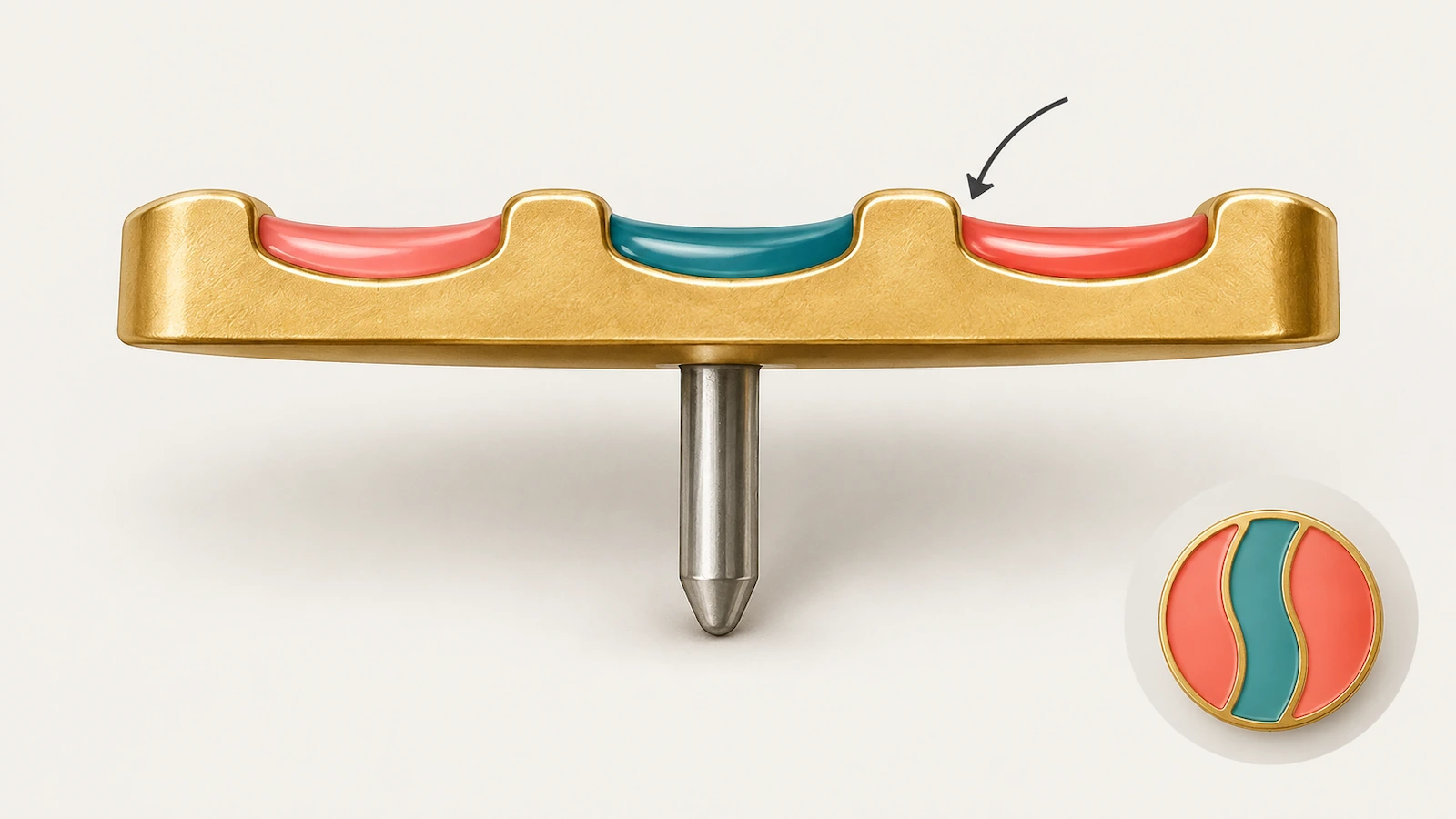
Hard enamel follows a different sequence. The cells are overfilled, then ground and polished flush with the metal, then plated after polishing. That extra grinding and second finishing pass is the main source of its cost and time premium. For a full breakdown of the hard enamel process, see our page on custom hard enamel pins.
Because soft enamel skips polishing, it also keeps fine line work that grinding can soften. Collectors on the r/EnamelPins preference thread[2] note that soft enamel can hold thinner lines and more detail for exactly this reason. The same thread offers a quality ranking that many buyers repeat: hard enamel first, soft enamel with epoxy second, plain soft enamel third.
Epoxy Coating Options and Their Trade-offs
Epoxy is a clear resin dome applied over the finished soft enamel face and cured. It sits on top of the pin and does not replace the enamel. In practice you have three choices, and each one changes a different variable.
- No epoxy. This keeps the full ridge-and-recess texture and the sharpest metal highlights. It is the lowest-cost configuration. The trade-off is that recessed cells can collect dust, and enamel at the cell edges is exposed to direct abrasion.
- Full clear epoxy dome. This gives a smooth, glossy surface that feels closer to hard enamel. It protects the fill from scratches and makes cleaning easier. The trade-off is that you lose the tactile texture. A dome can also be dented by sharp impact, and clear resins may discolor over long periods of strong sunlight.
- Epoxy as a functional requirement. Glitter enamel and some special-effect fills are commonly sealed under epoxy so the particles stay locked in place. If your design uses glitter, ask whether epoxy is included or required.
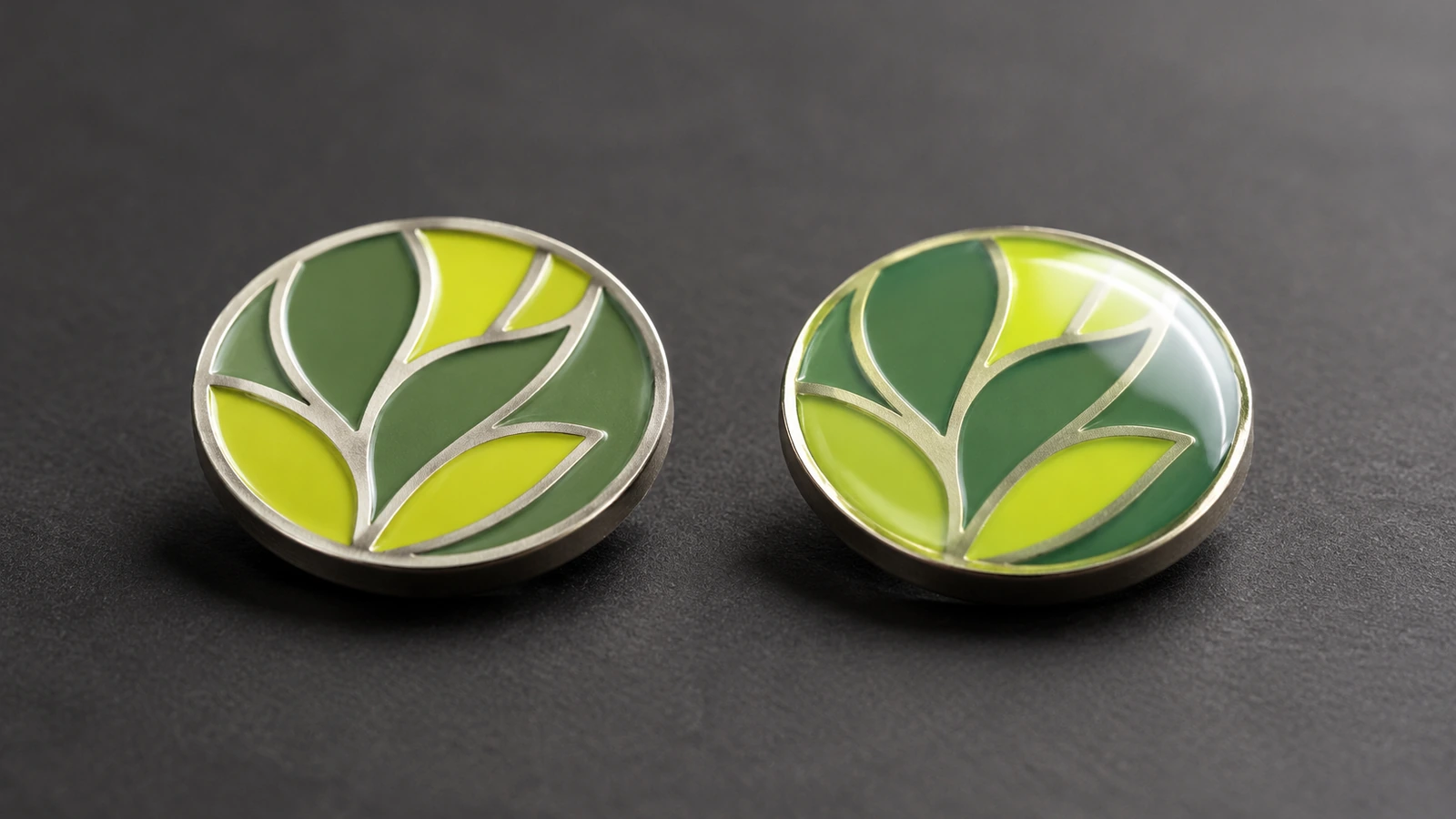
A simple rule for business orders: skip epoxy for one-day event giveaways where texture and cost matter most. Add epoxy for pins that will be worn repeatedly on uniforms, lanyards or bags, where protection matters more than texture.
Where Soft Enamel Pins Beat Hard Enamel on Budget and Lead Time
Soft enamel wins whenever the pin's job is reach, recognition or identification rather than collectible luxury. These are the situations where the cost and schedule advantage translates directly into business value.
High-volume event giveaways
Trade shows, conferences, charity runs and product launches need many identical units by a fixed date. The polishing step that soft enamel skips is labor applied to every single pin. At volume, removing it reduces both unit cost and the number of production stages that can slip. Attendees see the pin at badge distance, where raised metal lines often look crisper than a flat polished face.
Employee recognition and service-year programs
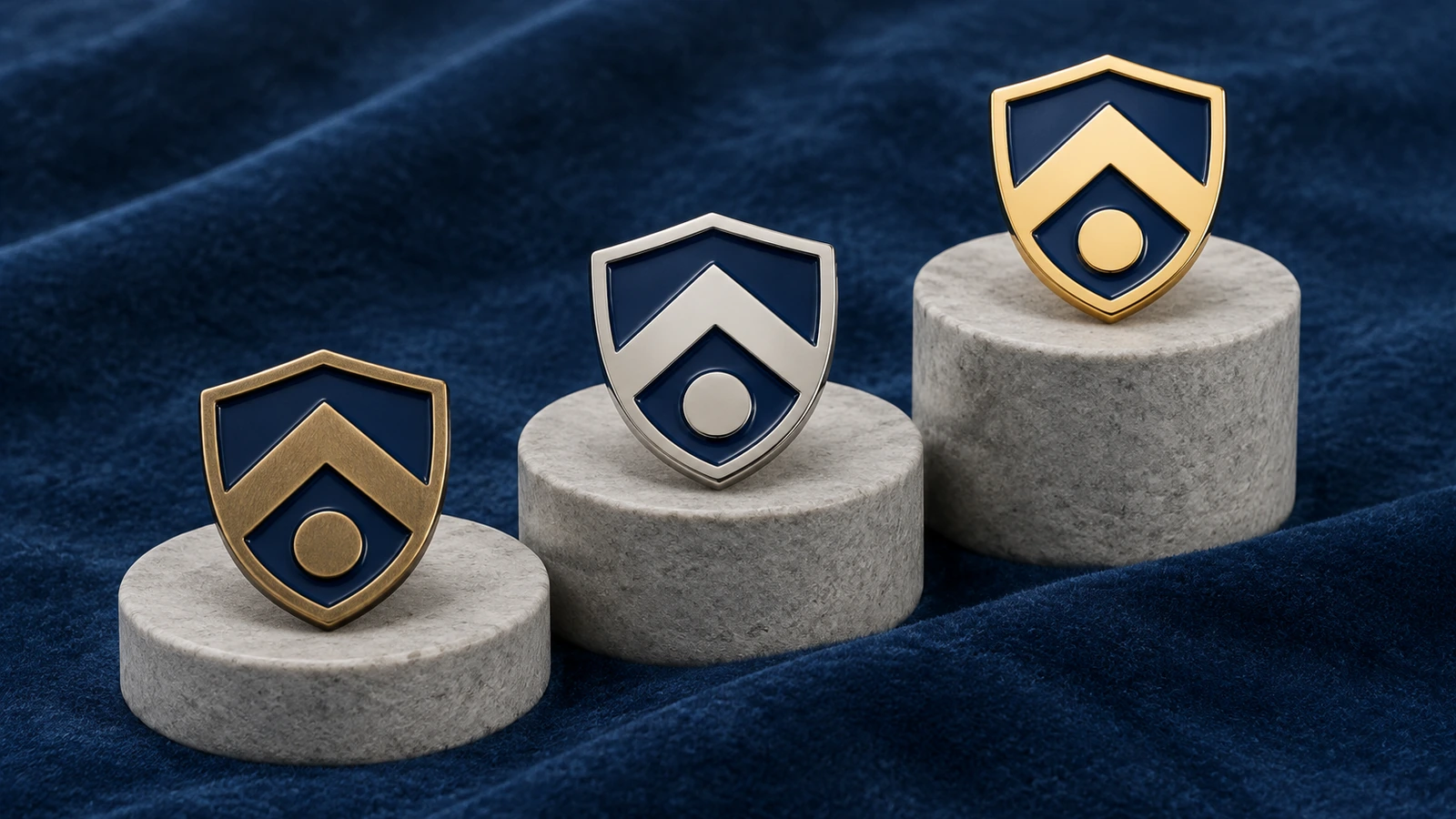
Recognition programs usually need one design in several variants, such as one-, five- and ten-year tiers or department colors. With soft enamel, a single mold can usually serve several variants by changing the plating or the enamel fill colors. That spreads the tooling cost across the whole program. Confirm with your supplier which changes reuse the existing mold and which require new tooling.
Promotional runs and multi-design sets
Campaigns that release several designs at once, such as a city series, a mascot set or seasonal editions, multiply the number of molds. The lower per-design production cost of soft enamel matters most here. Buyer threads show how sensitive smaller orders are to this. One first-time buyer on a minimum-order discussion[3] wanted only "15 or 20 for each design." That is a reminder to quote each design separately and confirm how tooling is charged per design.
Special plating and textured effects
Black nickel lines, dual plating and antique finishes show best when the metal stands proud of the color. That is the native shape of soft enamel. Hard enamel's flush surface can make the same plating look flatter.
Hard enamel still wins in other situations. It suits executive gifts, retail collectibles and any product where the buyer will judge the pin in hand and up close. Collectors describe hard enamel as looking "more luxurious" and lasting longer in a perceived-value discussion[4]. Not everyone agrees the price gap is large. One maker in a detail-focused thread[5] called it "negligible," which is why matched quotes matter more than assumptions.
How Per-Unit Cost Changes With Quantity
Pin pricing has two layers, and understanding them explains why quotes drop steeply at first and then flatten.
Fixed costs are paid once per design: mold or tooling, setup, and artwork or proof preparation. Variable costs are paid per pin: base metal, plating, each enamel color, epoxy if used, the attachment back, backing card or bag, packing labor, freight and any import duties.
Unit cost works out as:
Unit cost = (mold + setup) ÷ quantity + variable cost per pin + (freight + duties) ÷ quantity

At low quantities the fixed share dominates, so doubling the order cuts unit cost sharply. At higher quantities the fixed share becomes small, and the variable cost per pin sets the floor. Past that point, your savings come from the specification rather than the quantity. Fewer enamel colors, a standard plating, a smaller footprint, a rubber clutch instead of a locking back, or bulk bagging instead of individual cards will lower the floor.
Use these practices when requesting quotes:
- Request a quantity ladder, not a single number. Ask for total landed cost at each quantity you might realistically order, for example your attendee count, your attendee count plus a buffer, and a year's supply for an ongoing program. Then compare totals, not just unit prices.
- Separate the line items. Mold, production, packaging, freight and duties should be listed individually so two suppliers can be compared like for like.
- Ask about mold retention. Recognition programs reorder. If the supplier keeps the mold on file, later runs can skip the tooling charge.
- Price the add-ons separately. Epoxy, glitter, extra colors and backing cards each change the variable cost. Knowing each one lets you decide which to keep.
We don't publish standard soft enamel pricing because quantity, size, colors and delivery terms change it materially. Send your design and target quantities and we will return a line-itemed quote. For a complete landed-cost checklist, see the cost model section of our hard enamel pin buyer's page. The same cost categories apply to soft enamel.
How to Specify a High-Volume Soft Enamel Run
These steps cover what is specific to soft enamel at volume. For general proof review and inspection standards, refer to the product page linked above.
- Lock the in-hands date and work backward. Ask suppliers for production time and transit time as separate figures, both counted from proof approval rather than from the order date. Then add a buffer. Distribution events can't move, so a local fallback giveaway is cheap insurance.
- Adapt the artwork to recessed fill. In soft enamel, raised metal lines separate the colors, so two adjacent colors need a metal line between them. Standard enamel can't render gradients or photographs. If your logo depends on a gradient, ask about printed or screen-printed elements, or simplify the gradient into flat color steps. Provide vector files (AI, EPS or PDF) and Pantone references for brand colors.
- Decide plating and epoxy together. Plating color sets the line color, and epoxy changes how that line reads. Approve both on the same proof.
- Choose backs for the wearer, not the budget line. Rubber clutches are economical for single-day giveaways. Locking backs suit uniforms and daily-wear programs. Buyers report sharp-pin injuries when backs go missing, so confirm that every pin ships with its back attached.
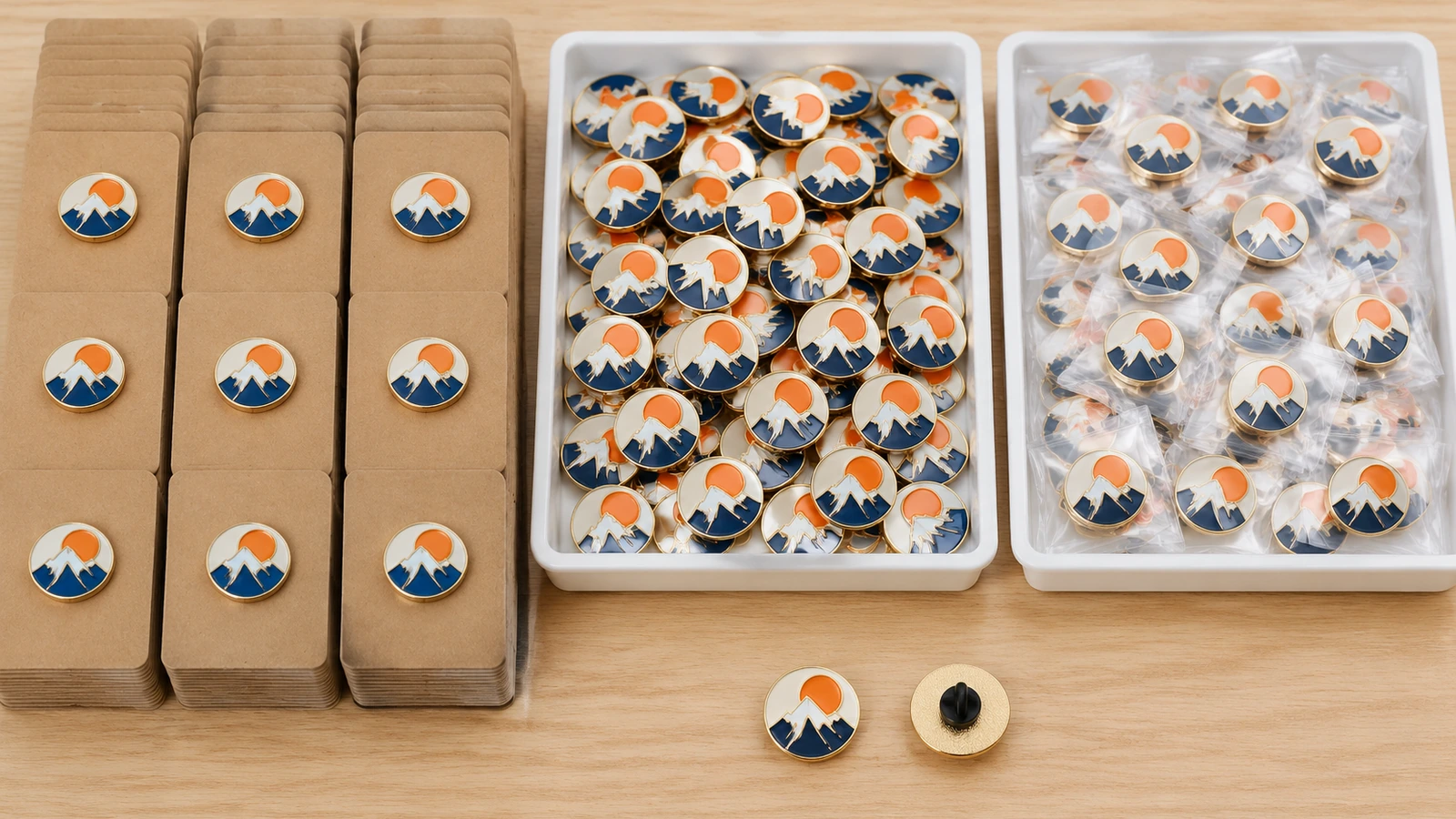
- Specify packing for the distribution method. Bulk bags suit swag tables. Individual bags or backing cards suit mailers and retail. Presentation boxes suit service awards. Kitting by event, office or tier saves internal sorting time.
- Request a pre-production sample on large runs. Check enamel fill level, color match against your Pantone references, plating evenness and back attachment before the full quantity is produced.
- Write down your defect tolerance. Small orders can still show problems. One buyer in a manufacturer discussion[6] reported that 3 of 5 pins had filling issues. Agree on acceptable versus rejectable defects, inspection sampling and remedies before production starts.
- Check the audience for compliance. Pins handed out at school events, family days or children's programs may be treated as children's products. Under the CPSC's total lead content rules[7], children's product substrates are limited to 100 ppm lead. Items classified as toys fall under the CPSC's toy safety requirements[8], including ASTM F963. For EU and UK distribution, EU and UK pin safety guidance[9] points to nickel release limits and lead- and cadmium-free metals. Forum claims that "all pins" contain lead, as in this materials-safety thread[10], are unverified opinions. The reliable answer is a test report for your specific materials, so ask for one.
Soft vs Hard Enamel by Business Use Case
The table below is organized by business scenario rather than by process. For a process-by-process comparison of finishes, see our hard enamel pin page.
| Use case | Recommended finish | Why | What to confirm in the quote |
|---|---|---|---|
| Conference or trade-show giveaway | Soft enamel, no epoxy | Lowest variable cost, fewest production stages, and raised lines read well at badge distance | Production and transit dates from proof approval; bulk packing |
| Employee service-year tiers | Soft enamel with epoxy | One mold can serve several plating or color tiers, and epoxy protects pins worn daily | Which variants reuse the mold; mold retention for reorders |
| Uniform or safety-program pins | Soft enamel with epoxy and locking backs | Durable surface, secure attachment and easy cleaning | Back type; plating structure; inspection sampling |
| Multi-design promo series | Soft enamel | Tooling is charged per design, so lower production cost per design scales across the set | Tooling charge per design; per-design quantity breaks |
| Glitter or special-effect campaign pins | Soft enamel with epoxy | Epoxy locks glitter and effect fills in place | Whether epoxy is required; sample approval |
| Executive gifts or retail collectibles | Hard enamel | Flush, polished surface carries a higher perceived value when examined up close | Polishing loss on fine lines; color match |
| Photo-realistic or gradient artwork | Printed or screen-printed elements | Standard enamel can't reproduce gradients | Print protection layer; color accuracy |
For market context: broad pin-category research, such as DataIntelo's pin buttons market report[11], sizes the wider pin buttons category, which also includes tin and campaign buttons, at roughly $2.8B. That figure does not isolate enamel pins. Treat it as a signal of category demand, not a forecast for your order.
FAQ
FAQ: Are soft enamel pins always cheaper than hard enamel pins?
Usually, but not always by a large margin. Soft enamel skips grinding and polishing, which lowers labor per pin. Adding epoxy, extra colors or special plating narrows the gap. The only reliable comparison is two quotes with identical size, quantity, colors, back type and packing.
FAQ: Will soft enamel pins hold up for employees who wear them every day?
Yes, if you specify for daily wear. Add an epoxy dome to protect the recessed enamel, choose locking backs, and ask the supplier to describe the base metal and plating structure. Uncoated soft enamel can show surface scratches and collect dirt in the recesses over time.
FAQ: Does epoxy make soft enamel look like hard enamel?
It makes the surface smooth and glossy, which narrows the visual gap. It doesn't replicate hard enamel exactly. The resin sits on top as a slight dome rather than being polished flush with the metal, and you lose the raised-line texture.
FAQ: Can soft enamel reproduce gradients or photographs?
Standard enamel can't. Each color fills a separate cell bounded by metal lines. For gradients, ask about printed or screen-printed elements combined with enamel, or redraw the gradient as flat color steps.
FAQ: How can one design serve several employee tiers without new tooling each time?
Keep the outline and metal lines identical across tiers and vary only the plating color or enamel fill colors. Suppliers can often reuse the same mold for these variants. Confirm this in writing, along with how long the mold is kept for reorders.
FAQ: How far ahead should we order pins for an event?
Plan backward from your in-hands date. Ask each supplier for production time and transit time separately, both counted from proof approval, and add a buffer for proof revisions and shipping delays. Share your event date in your quote request and we will confirm a realistic schedule.
FAQ: Are soft enamel pins safe to hand out at children's or family events?
They can be, but children's products in the U.S. must meet CPSC lead limits, and toys must meet ASTM F963. Request material test reports that match your pin's actual base metal and coatings before distributing to children.
Key Takeaways
- Buyers commonly rank pin finishes in a three-step quality order, so soft enamel with epoxy is a credible middle option for worn programs — 3 tiers: hard, soft plus epoxy, plain soft (Source)
- Small per-design quantities are common, so quote each design and its tooling separately — one buyer wanted just 15–20 pieces per design (Source)
- Defect tolerance must be written into the order, regardless of order size — 3 of 5 pins in one reported order had filling issues (Source)
- Pins given to children are regulated on substrate lead content — 100 ppm total lead limit for children's product substrates (Source)
- Pins classified as toys must meet the mandatory U.S. toy safety standard — ASTM F963 (Source)
- Category demand is real, but broad market figures don't isolate enamel pins — about $2.8B for the wider pin buttons market (Source)
Conclusion: Match the Finish to the Job
Soft enamel pins aren't the budget compromise that collector forums sometimes suggest. They are the right tool when a pin must reach many people, by a fixed date, at a controlled cost per head. The recessed construction removes the polishing step, supports multi-tier programs from a single mold, and shows off special plating. Epoxy gives you a dial between texture and protection.
Choose soft enamel for giveaways, staff programs and promotional runs. Add epoxy and locking backs when pins will be worn daily. Reserve hard enamel for executive gifts and products that will be judged up close. When you are ready, send us your artwork, quantity ladder and in-hands date for a line-itemed quote. If your project leans premium, start with our guide to custom hard enamel pins.
Footnotes
- Promotional Products Association International, "2024 PPAI Sales Volume Report." https://www.ppai.org/wp-content/uploads/2025/02/2024-PPAI-Sales-Volume-Report.pdf ↩
- Reddit r/EnamelPins, "Do you prefer hard or soft enamel?" (2024). https://www.reddit.com/r/EnamelPins/comments/1ezvowi/do_you_prefer_hard_or_soft_enamel/ ↩
- Reddit r/EnamelPins, "Less than 50 MOQ for enamel pins." https://www.reddit.com/r/EnamelPins/comments/1ab5po0/less_than_50_moq_for_enamel_pins/ ↩
- Reddit r/EnamelPins, "What is everyone's preference/perceived value of hard vs soft enamel" (2025). https://www.reddit.com/r/EnamelPins/comments/1i4qa4q/what_is_everyones_preferenceperceived_value_of/ ↩
- Reddit r/EnamelPins, "Soft or hard enamel for details" (2025). https://www.reddit.com/r/EnamelPins/comments/1metx4f/soft_or_hard_enamel_for_details/ ↩
- Reddit r/EnamelPins, "Any good websites for making enamel pins?" (2025). https://www.reddit.com/r/EnamelPins/comments/1mldsli/any_good_websites_for_making_enamel_pinsthinking/ ↩
- U.S. Consumer Product Safety Commission, "Total Lead Content." https://www.cpsc.gov/Business--Manufacturing/Business-Education/Lead/Total-Lead-Content ↩
- U.S. Consumer Product Safety Commission, "Toy Safety Business Guidance." https://www.cpsc.gov/Business--Manufacturing/Business-Education/Toy-Safety ↩
- EUVerify, "EU and UK Safety Regulations for Enamel Pins." https://euverify.com/resource/eu-uk-safety-regulations-for-enamel-pins/ ↩
- Reddit r/EnamelPins, "How safe are enamel pins' materials?" https://www.reddit.com/r/EnamelPins/comments/1g7khmn/how_safe_are_enamel_pins_materiale/ ↩
- DataIntelo, "Global Pin Buttons Market Report." This covers the broad pin buttons category, not enamel pins alone. https://dataintelo.com/report/global-pin-buttons-market ↩












The information below is required for social login
Sign In
Create New Account