


 Blog PDF for offline reading
Quick answer: A coaster with wood printing (UV direct-to-wood ink) is the only one of the three methods that reproduces full-color logos, gradients, and photos. Painting suits bold artwork in one to three spot colors. Laser engraving leaves the most wear-proof mark, but only in burnt brown-to-black tones. Pick the method based on your artwork's color count, the wood tone, and how hard the coasters will be used.
Most decoration problems with branded wood coasters start before production, when the method is chosen. A marketing team sends a six-color logo and gets back an engraving that renders every color as the same shade of brown. An event planner orders a coaster with wood printing and finds the ink scuffed at the rim after one season of beer glasses. A wedding client picks dark walnut, and the couple's names disappear into the grain. All three outcomes come from matching the artwork to the wrong method, not from poor workmanship.
The cost shows up later. Branded coasters sit on tables for months or years, so every scuffed edge or unreadable name keeps undermining the brand. Buyer reviews on major marketplaces repeat the same complaints: "contrast not as shown," lettering lost on dark wood, ink that runs once a cold drink sweats. One high-volume personalized coaster listing showed 31 reviews mentioning color, and 25 of them were negative, mostly about engraving that could not be read against dark stain.
This guide compares the three common decoration methods on color fidelity, logo detail, wear resistance, minimums, and relative per-unit cost, so you can choose a finish that suits your artwork rather than one the artwork has to be forced into.
What Is a Coaster with Wood Printing, and How Is It Different from Painted or Engraved Wood?
All three methods put artwork on the same blank, but they put it in different places relative to the wood surface. That one difference explains most of what follows about color, detail, and durability.
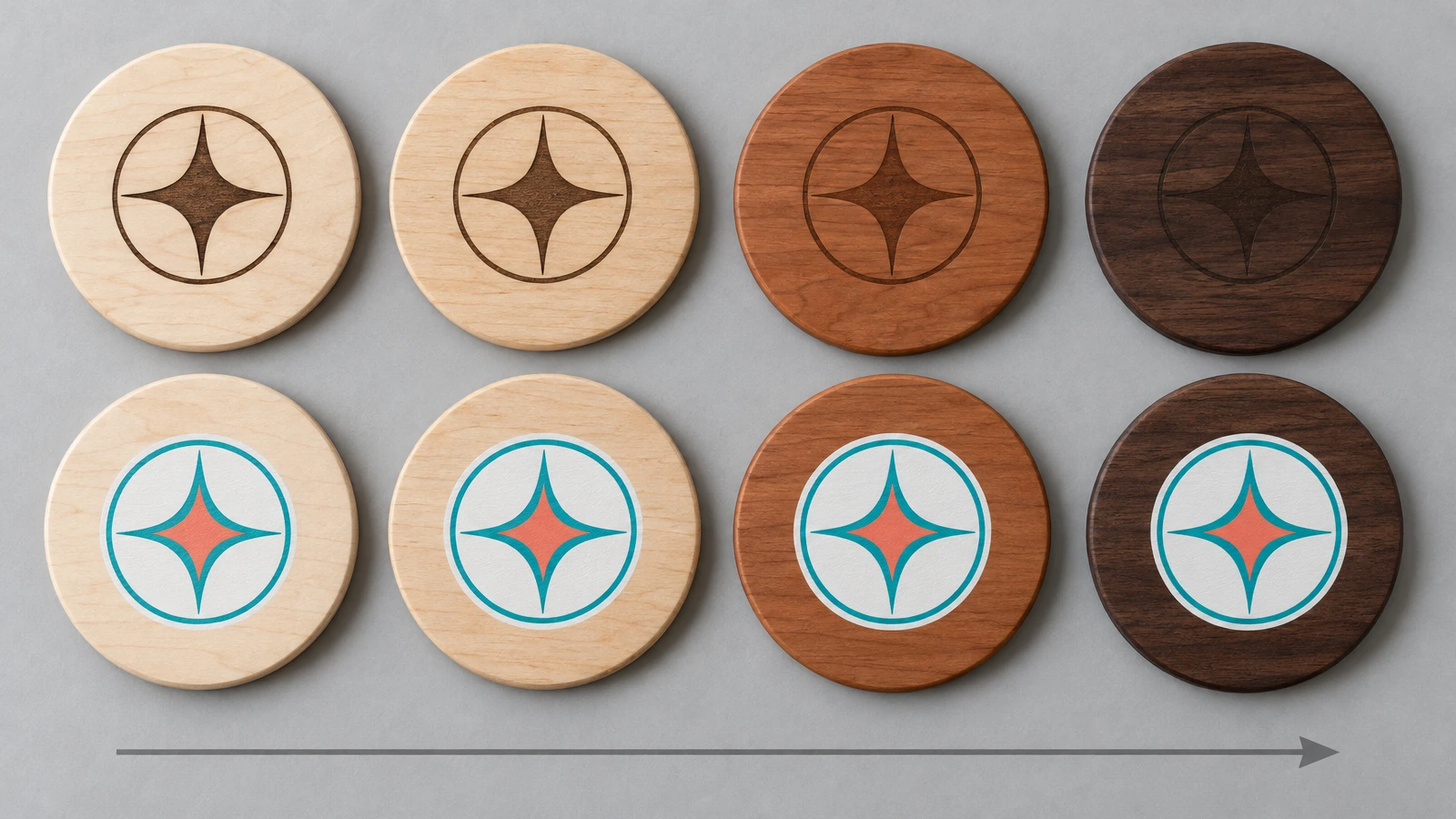
Full-color wood printing usually means UV flatbed printing. An inkjet head deposits UV-curable CMYK ink straight onto the wood, and a UV lamp cures it within seconds. Because wood is not white, printers lay down a white underbase beneath the colors on mid-tone and dark species, or let the grain show through on purpose for a natural look. The ink forms a thin film on top of the wood, which is why it needs a clear protective coat to resist abrasion.
Painted wood coasters cover several techniques. Screen printing pushes opaque paint through one mesh screen per color. Stenciling and masking suit simple shapes. Hand painting suits one-off gifts. Color-fill engraving, a hybrid, cuts the design first and then floods the recess with paint. Paint is more opaque than UV ink and can be mixed to a spot color, but every added color usually means another screen, mask, or pass.
Laser engraving uses a CO₂ laser to vaporize and char the top layer of wood fibers. Nothing is applied, so nothing can peel. The trade-off is color: the mark is always a shade of brown or black, and its contrast depends on the species and its density. Wood is a natural material whose properties vary considerably even in clear stock, as the USDA Forest Products Laboratory notes[1], so the burn depth and color will shift slightly from piece to piece within one order.

A note on sublimation, which buyers often confuse with wood printing: dye sublimation needs a polymer-coated surface to bond with, so "sublimation wood coasters" are usually coated hardboard or MDF rather than solid wood. If you choose a composite core, ask the supplier for the composite wood compliance labeling that the EPA's TSCA Title VI formaldehyde standard[2] has required on regulated panels and finished goods since 2019. Solid wood blanks generally fall outside that panel rule.
How to Choose a Finish for Your Artwork in Six Steps
The steps below follow the order of decisions that actually constrain each other. Settle them before you ask for a quote.
- Count the colors and check for gradients. Open the logo file and list every distinct color, including tints. Gradients, drop shadows, and photographic elements rule out painting and engraving, so printing becomes the only faithful option. A one-color mark works with all three methods. Two or three flat spot colors suit screen-painting or a print.
- Decide how strict your brand color rule is. If brand guidelines require a specific Pantone match, plan on UV printing with a white underbase, and expect the wood tone to pull colors slightly warm unless it is fully covered. If the brand is happy with a tone-on-tone look, engraving reads as premium and will never drift off-color, because it has no color to drift.
- Find the thinnest line in the artwork. Fine serifs, small taglines, and hairline outlines behave differently on each method. Open-grain woods such as oak can swallow very small engraved text, and brushed paint bleeds along the grain. For a round wood coaster, also keep the critical elements inside a comfortable margin from the edge, where the base of a glass and the hand that wipes the coaster both cause the most wear.
- Match the wood tone to the method. Pale, close-grained species such as maple, birch, and cherry give the highest engraving contrast and the cleanest print color. Walnut and dark stains suit printing with a white underbase or color-fill engraving, while plain engraving on them tends to produce the illegible results described earlier. Wood is hygroscopic, meaning it absorbs and releases moisture; the USDA Wood Handbook[3] explains how it swells and shrinks with ambient humidity. That movement stresses surface films (ink and paint) more than recessed marks (engraving).
- Specify the protective finish together with the decoration. Ink and paint both need a clear topcoat, and every coaster should be sealed on all faces, not just the decorated one. Single-sided sealing is a common cause of cupping. Woodworkers who make coasters report that shellac softens around 140°F (60°C), which makes it a poor topcoat under hot mugs, and that even well-cured polyurethane can feel slightly tacky under a near-boiling glass. Ask what topcoat is used and how long it cures before packing.
- Approve a physical proof on the same wood. Screen renderings flatter every method. Ask for a sample on the species you ordered, ideally showing the darkest and the lightest blank in the batch side by side, so natural variation is settled before production rather than argued about afterwards. The ordering workflow for our own engraved wooden coasters for weddings, gifts, and logo orders includes this proof stage.
If the coasters will be shipped to events or clients in the EU, wood products remain within scope of the EU Deforestation Regulation, with large operators due to comply from 30 December 2026, according to Wood Central's reporting on the 2026 scope revision[4]. Ask your supplier early which species and harvest origin they can document.
How Does a Coaster with Wood Printing Compare to Painting and Engraving?
The table compares the methods on the five factors corporate and event buyers usually weigh. Costs and minimums are relative, because they depend on artwork, quantity, and species. Request a quote for actual figures.
| Factor | UV wood printing | Painting (screen, stencil, hand, color-fill) | Laser engraving |
|---|---|---|---|
| Color fidelity | Full CMYK, gradients, and photos; close Pantone approximation with a white underbase | Opaque, mixable spot colors; practical limit of a few colors | None: tones of brown to black only |
| Logo detail | High; limited by printer resolution and grain texture | Medium; edges soften on open grain and with brushwork | High on close-grained species; small text can be lost on open-grain oak |
| Wear resistance | Surface film; depends on topcoat and cure | Surface film (color-fill paint is protected inside the recess) | Highest; the mark is part of the wood, so there is nothing to peel |
| Best wood tones | Any; dark woods need a white underbase | Any, with opaque paint | Pale, dense species for strongest contrast |
| Artwork file | High-resolution raster or vector, CMYK | Vector, separated by color | Vector, single color, high contrast |
| Setup and minimums | Digital setup; short runs practical; color proofing adds a step | Screens or masks per color favor larger runs; hand painting scales with labor | Digital setup; short runs practical |
| Relative per-unit cost | Medium; rises with white underbase and topcoat | Low per unit at volume for screen work; highest for hand painting | Low to medium; rises with engraving area and depth |
| Best fit | Multicolor brand logos, photos, sponsor panels | Bold one-to-three-color marks, rustic or handmade looks | Monograms, one-color logos, keepsakes meant to last |
Color fidelity: printing wins, with a caveat
Printing is the only route to a recognizable multicolor brand palette. The caveat is the substrate. Without a white underbase, the wood acts as a tinted background, so a cool blue shifts toward teal on cherry and a white element disappears altogether. Ask for an underbased proof whenever exact color matters.
Logo detail: engraving and printing tie, painting trails
Engraving and printing both hold fine lines on dense species. Painting loses detail as paint wicks along the grain, which is why color-fill engraving is often the better way to get a "painted" look with sharp edges: the laser defines the edge and the paint only fills the recess.
Wear resistance: where the mark sits decides how long it lasts
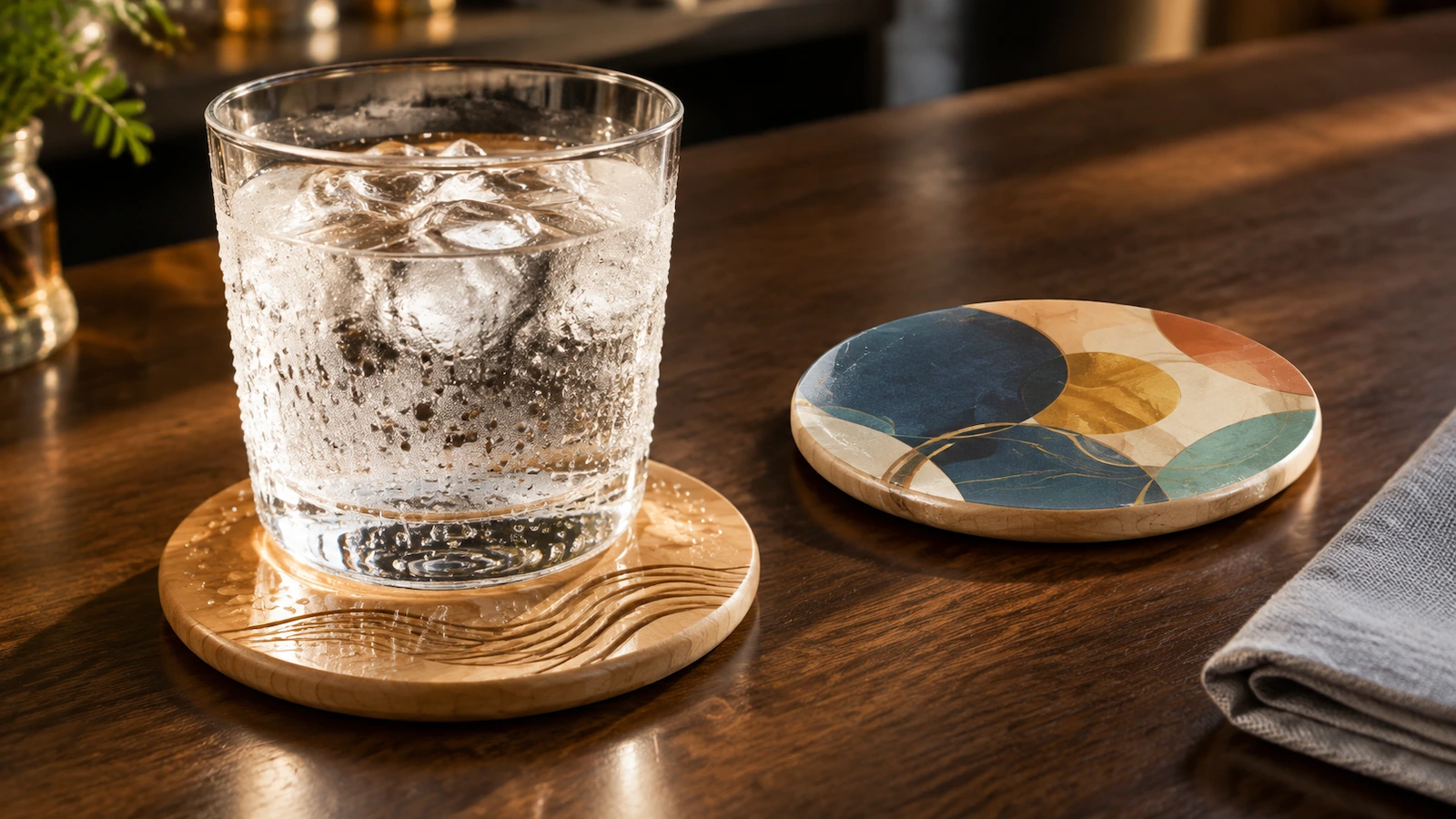
A coaster endures glass bases sliding across it, condensation, and repeated wiping. An engraved mark keeps its shape even after the topcoat wears, because the image is recessed into the fibers. Printed and painted marks last only as long as the film protecting them. Moisture that gets under a finish is the most common failure woodworkers report, ahead of mechanical scratching. If you want an objective benchmark rather than a promise, labs measure liquid water uptake of coated wood with ASTM D5795[5], and a cross-hatch tape adhesion check (ASTM D3359) is a common way to test whether printed ink stays bonded. Ask whether your supplier runs either test.
Minimums and per-unit cost: setup drives the curve
Engraving and UV printing both start from digital files, so short runs and per-name personalization add little setup. Screen-painting front-loads cost into screens, one per color, so it becomes economical only as quantity grows. Hand painting has almost no setup but the highest labor per piece, so it suits small, premium gift runs rather than event giveaways in the hundreds. Because pricing depends on artwork area, color count, and species, request a quote with your actual file rather than relying on a generic rate card.
Safety claims belong to the topcoat, not the decoration
Coasters only touch drinks incidentally, but suppliers sometimes advertise them as "FDA approved." The FDA does not approve coasters. The relevant rule, 21 CFR 175.300[6], covers coatings that form a continuous film between food and substrate, built from listed substances. Fine Woodworking[7] adds that fully cured finishes are generally inert, so the cure time matters more than the label. For painted wood coasters sold as children's items, the CPSC's lead limits for paint and surface coatings[8] also apply.
Frequently Asked Questions
FAQ: Can a full-color logo be printed directly on a wood coaster?
Yes. UV flatbed printing applies CMYK ink directly to the wood and cures it instantly. On anything darker than pale maple or birch, ask for a white underbase under the colored areas; without one, the wood tone will shift your brand colors and any white elements will vanish.
FAQ: Will printed or painted designs rub off over time?
They can if the topcoat is thin, under-cured, or applied only to the top face. Both ink and paint sit on the surface, so their life depends on the clear coat above them and on sealing every face of the coaster against moisture. Engraving has no film to lose, which is why it is the safer choice for coasters used daily in bars and offices.
FAQ: How do I make a logo readable on dark walnut?
Plain engraving on walnut often produces dark-on-dark marks. Two reliable alternatives are color-fill engraving, where a light paint fills the engraved recess, and UV printing with a white underbase. Approve a proof on the darkest blank in your batch, not the lightest.
FAQ: Is sublimation the same as wood printing?
No. Sublimation dye bonds to polymer, so sublimation coasters are usually coated hardboard or MDF with a wood-look surface. They print vivid photos but are not solid wood. UV printing works on real wood and keeps the grain visible.
FAQ: Can engraving and color be combined on one coaster?
Yes. The most common hybrid is color-fill: the laser cuts a crisp recess and paint fills it, combining the sharp edges of engraving with a brand color that sits below the wear surface. Another option is to engrave a monogram and print a small full-color logo beside it.
FAQ: Which wood species are easiest to decorate?
Dense, close-grained, light species such as maple, birch, and cherry engrave with strong contrast and print cleanly. Open-grain oak adds texture but can swallow small text. Dark woods look premium but need an underbase or color-fill for legibility.
Key Takeaways
- Branded coasters sit inside a large, growing promotional products market, so finish quality is a visible brand touchpoint. — North American promo sales grew 4.2% to a record $27.7 billion in 2025 (Source)
- Physical giveaways like coasters can carry a lower carbon cost per impression than digital ads. — up to 8 times less carbon impact per memorized impression (Source)
- Composite coaster cores need formaldehyde compliance labeling; solid wood generally does not. — TSCA Title VI labeling required after 22 March 2019 (Source)
- "Food-safe" claims must point to a specific coating regulation, not a generic FDA approval. — 21 CFR 175.300 governs resinous and polymeric food-contact coatings (Source)
- Wood bound for EU clients needs documented origin under the deforestation rules. — large-operator compliance starts 30 December 2026 (Source)
Conclusion
Choose the method from the artwork outward. If your logo depends on a color palette, gradients, or a photo, a coaster with wood printing on a pale or underbased surface is the only method that reproduces it faithfully. If it is bold and limited to a few flat colors, painted wood coasters or color-fill engraving give opaque color with a handmade feel. If the mark is one color and the coasters will see daily use, laser engraving gives the longest-lasting result. Whichever you choose, specify the topcoat, seal every face, and approve a proof on the real wood.
When you have your artwork ready, send it with your quantity and preferred species through our custom wooden coaster order page, and we will recommend a decoration method and confirm pricing, minimums, and timing in a written quote.
References
- Senalik, C.A.; Farber, B. (2021). Chapter 5: Mechanical properties of wood. Wood Handbook, FPL-GTR-282. USDA Forest Service, Forest Products Laboratory. https://research.fs.usda.gov/treesearch/62244 ↩
- U.S. Environmental Protection Agency. Formaldehyde Emission Standards for Composite Wood Products (TSCA Title VI, 40 CFR Part 770). https://www.epa.gov/formaldehyde/formaldehyde-emission-standards-composite-wood-products ↩
- Glass, S.V.; Zelinka, S.L. (2021). Chapter 4: Moisture relations and physical properties of wood. Wood Handbook, FPL-GTR-282. USDA Forest Products Laboratory. https://research.fs.usda.gov/fpl/wood-handbook ↩
- Ross, J. (2026-05-05). EUDR cuts leather, adds coffee; wood and paper stay in scope. Wood Central. https://woodcentral.com.au/eudr-cuts-leather-adds-coffee-wood-paper-stay-scope/ ↩
- ASTM International. ASTM D5795-16(2024): Standard Test Method for Determination of Liquid Water Absorption of Coated Wood and Wood Based Products Via "Cobb Ring" Apparatus. https://www.astm.org/d5795-16r24.html ↩
- U.S. Food and Drug Administration. 21 CFR 175.300, Resinous and polymeric coatings (eCFR, current text). https://www.ecfr.gov/current/title-21/chapter-I/subchapter-B/part-175/subpart-C/section-175.300 ↩
- Fine Woodworking (2024-10-10). The best food-safe finish may be none at all. https://www.finewoodworking.com/2024/10/10/the-best-food-safe-finish-may-be-none-at-all ↩
- U.S. Consumer Product Safety Commission. Business Guidance: Lead in children's products, paint, and surface coatings. https://www.cpsc.gov/Business--Manufacturing/Business-Education/Business-Guidance/Lead ↩












The information below is required for social login
Sign In
Create New Account