


 Blog PDF for offline reading
Quick answer: Choose custom embroidered New Era hats when you want a premium, structured crown and a recognizable retail name, and you can manage fitted sizes and the visible side flag. Choose a Richardson 112 for a casual mesh-back trucker in one adjustable size, with embroidery limited to the front panels. Choose a private-label OEM cap when you need your own labels, no third-party marks, or a custom spec.
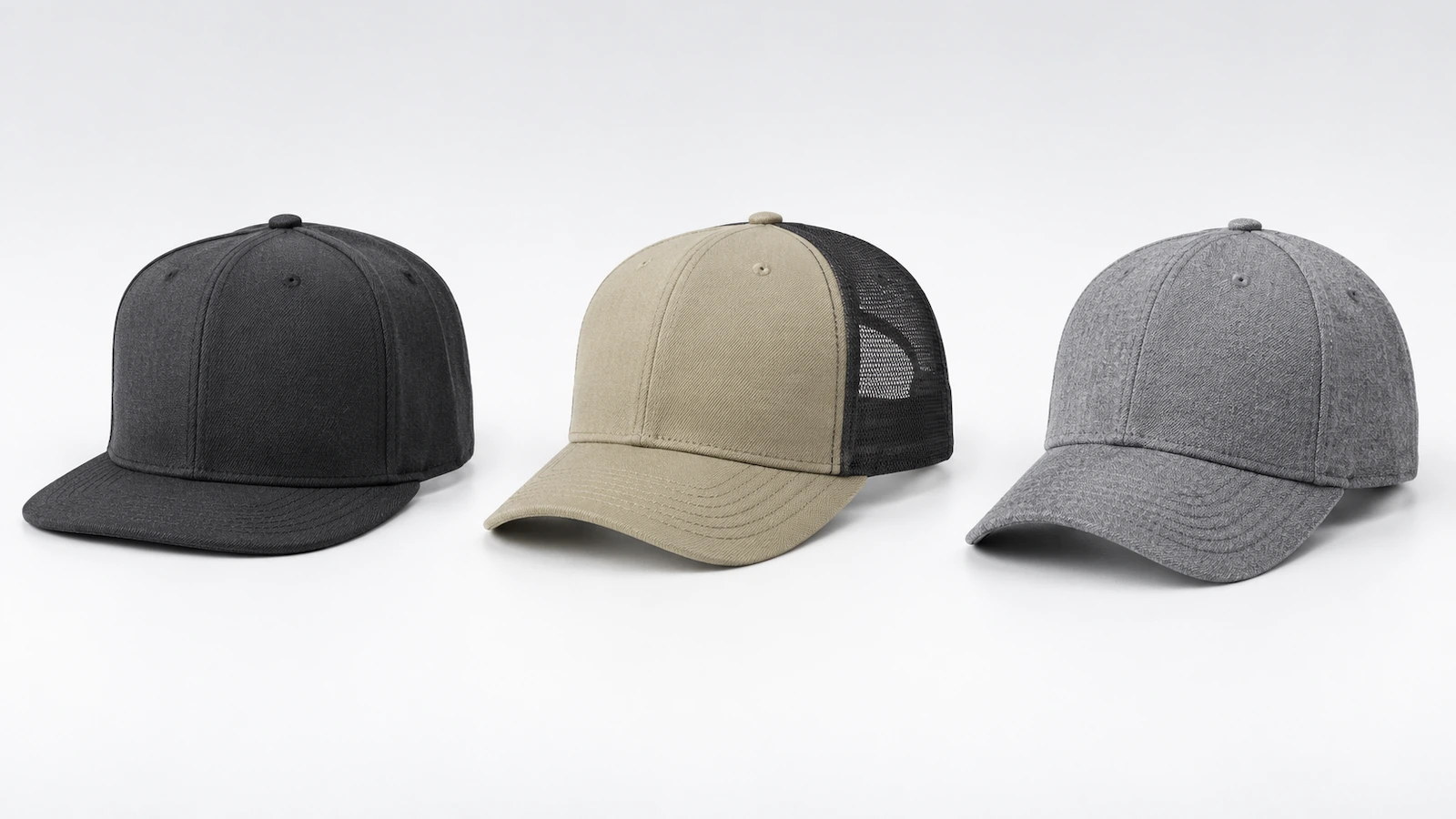
Most buyers searching for custom embroidered New Era hats already have a logo and a deadline. What they often lack is a clear way to compare blanks. Picking a cap by brand name alone causes predictable problems. A fitted 59FIFTY needs a full size run. The New Era flag occupies one side panel. The mesh rear of a Richardson 112 will not hold side text. A low, unstructured crown can shrink a wide logo until it becomes hard to read.
These problems matter because recipients judge quality in seconds. In PPAI's consumer study, more than 60% of people said they would immediately reject a promotional item made with poor materials or workmanship, and 57% remembered a brand because its logo was clear (PPAI Research, "The 5-Second Impact"[1]). The blank you choose determines how much room your logo gets, how the cap fits a mixed team, and whose brand sits next to yours. This guide compares the main New Era silhouettes, the Richardson 112, and a private-label OEM cap on exactly those points.
What Are Custom Embroidered New Era Hats?
The term describes a branded blank: a genuine New Era cap bought as finished stock and then decorated with your logo by a contract embroiderer. You are not commissioning a new cap. You are adding stitching to an existing product that keeps its own maker's identity, including the embroidered New Era flag on the side panel and the brand's interior labels.
A custom embroidered 112 hat follows the same model on a different blank. The Richardson 112 is a six-panel trucker with a structured cotton-blend front, a mesh rear, a pre-curved visor, and a plastic snap closure. Both routes differ from a private-label OEM cap, which a factory builds to your specification and labels with your brand. With OEM, you control the fabric, the crown height, the front construction, the closure, and the inside tags. If you are new to cap anatomy, our custom embroidered baseball caps page explains the standard six-panel build. This article focuses only on the blank decision.
Why the Blank Matters More Than It Used To
Headwear is now a front-line promotional category, not an add-on. Caps and hats rose from 7.2% of U.S. promotional product distributor sales in 2023 to 9.0% in 2024, passing bags and travel goods for third place (PPAI Magazine, April 2025[2]). PPAI's report on that year credits part of the rise in cap demand to election-related promotion and nonprofit sourcing, within a total market of $26.78 billion (PPAI 2024 Sales Volume Report[3]). The channel reached $27.1 billion in 2025, though growth slowed under tariff and budget pressure (PPAI, January 2026[4]).
Buyer taste is also moving toward caps that look like retail goods. PPAI's August 2026 headwear feature reports that brands increasingly prefer tonal embroidery and small, dense marks over large logos, and describes headwear as a "statement piece" rather than a billboard (PPAI, "Retail-Quality Headwear"[5]). This trend explains why named blanks such as New Era attract corporate buyers. It also explains why a small, refined logo makes the choice of crown and panel more important, not less.
How to Choose Custom Embroidered New Era Hats or a Richardson 112
Work through these steps in order. Each one removes options before you spend money on samples.
Step 1: Decide on a sizing model before choosing a style
Sizing is the first fork. A New Era 59FIFTY is a true fitted cap, sold in individual head sizes. It looks and feels premium, and some wearers see sized caps as the higher-end choice. The cost is complexity: you must collect head sizes, order a size curve, and accept leftover stock in sizes nobody claimed. The 39THIRTY uses a stretch band in a few size ranges, which is a compromise. The 9FIFTY snapback, the 9TWENTY strapback, and the Richardson 112 snapback each come in one adjustable size. For giveaways, new-hire kits, or event staff whose sizes you do not know, an adjustable closure is almost always the practical choice.
Step 2: Match crown profile to logo shape
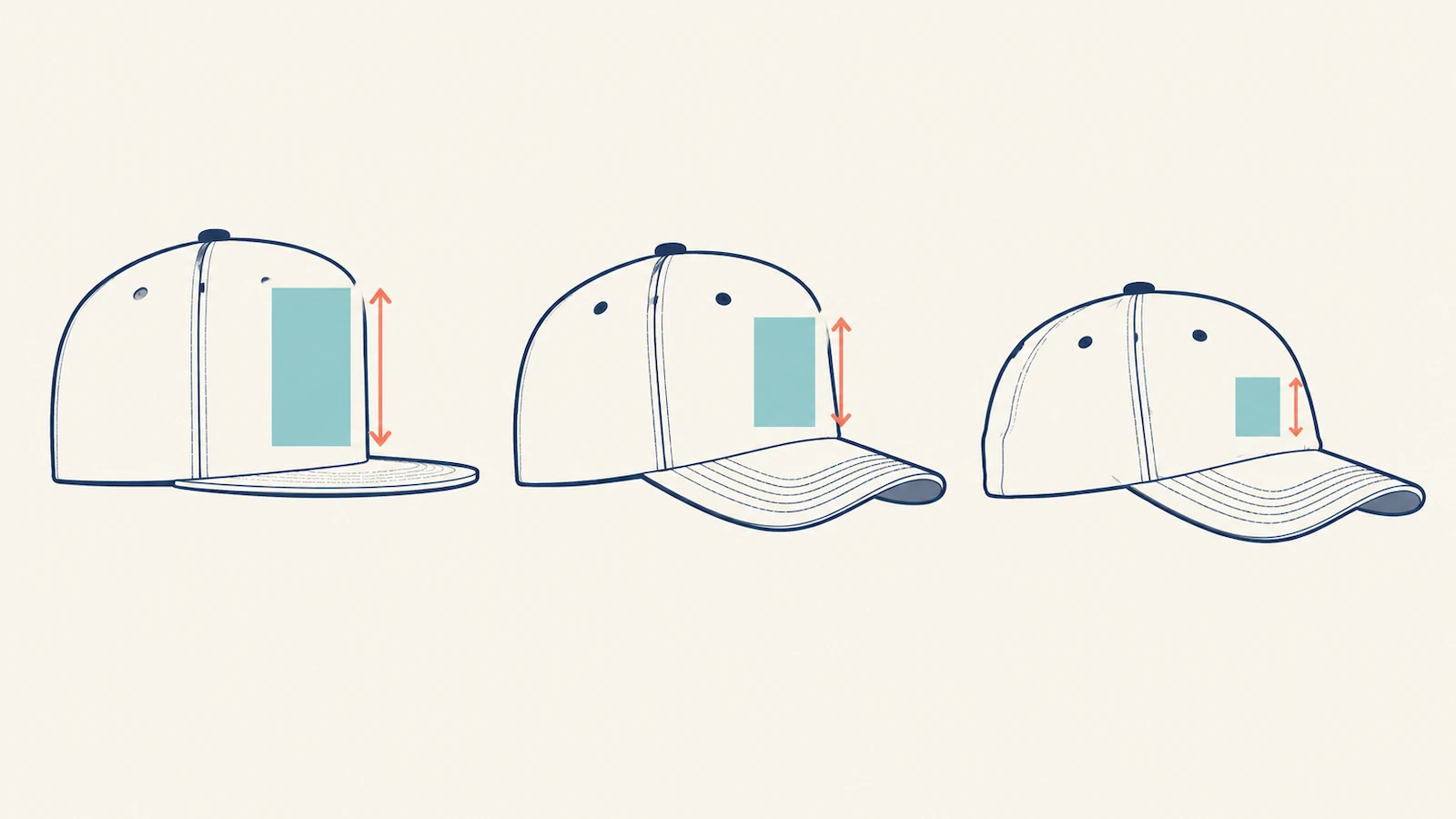
Crown height determines how much vertical space the front panels offer.
- High-crown, structured (59FIFTY, 9FIFTY): These caps have a tall, flat-faced front that suits stacked or square marks. The look is bold and streetwear-leaning, especially with a flat visor.
- Mid-profile, structured (39THIRTY, Richardson 112): These caps have a shorter, more curved front. Wide horizontal wordmarks work well. Tall crests usually need to be scaled down.
- Low-profile, unstructured (9TWENTY): This dad-hat shape has a soft front with no stiff backing. Dense, text-heavy logos can pucker or pull the panel inward. Simple, low-stitch marks look best.
Decorators commonly cite a front embroidery window of roughly 4 inches wide by 2 inches high on standard caps, and recommend lettering no smaller than about 0.25 inch (6 mm). Treat these as rules of thumb and confirm them against the exact blank. On lower crowns, the usable height shrinks further.
Step 3: Choose mesh or full structured panels
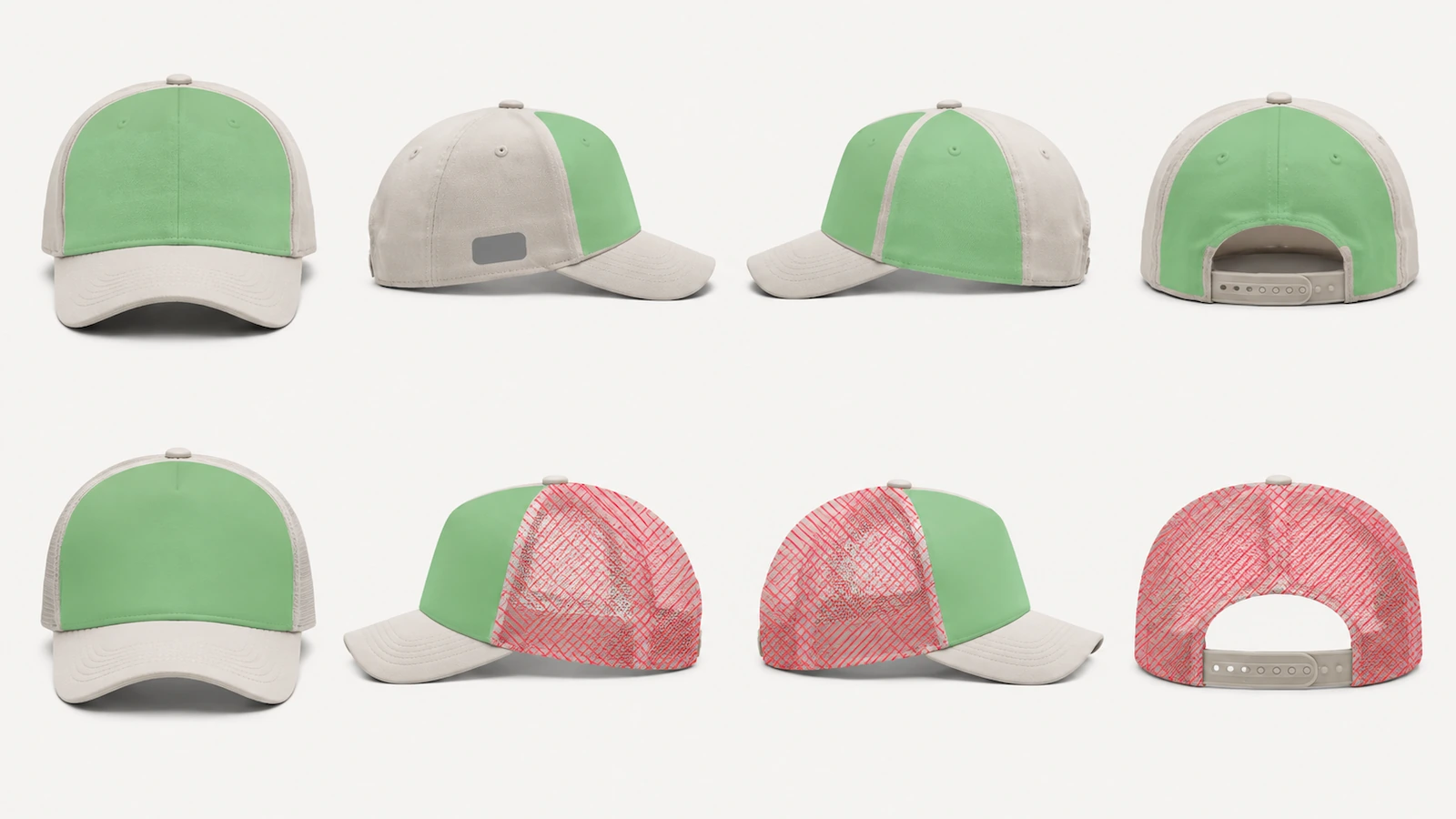
The Richardson 112's mesh rear keeps the cap cool for outdoor crews, farmers' markets, and summer events. Mesh also limits decoration. Most embroiderers avoid stitching on open mesh, or will only stitch very small marks there, because the open weave distorts and gives the stitches little to grip. On a 112, plan for front-panel embroidery only. All-twill New Era silhouettes offer solid fabric on every panel, so side and back marks become possible. That matters for programs that want a front logo plus a website, slogan, or team name elsewhere.
Step 4: Map the open embroidery zones, including the flag
Most New Era caps carry the brand's flag embroidered on the wearer's left side panel. That panel is effectively reserved, so secondary marks go on the right side, or on the back above the closure where the cap design allows. A snapback or strapback leaves only a narrow arch above the opening. A fitted 59FIFTY has an uninterrupted rear panel, which is useful for a tagline or city name. Both the New Era structured caps and the Richardson 112 have a center seam on the front, so the logo must be digitized to cross it cleanly. In practice, very fine lettering is where 112 orders most often fail: embroiderers report that small words become illegible on that crown even when the main logo stitches well.
Step 5: Check licensing and branding rules before you approve art
A branded blank means co-branding. Your logo will sit beside New Era's or Richardson's mark on every cap. For many corporate gifts, that is the point, because the recipient recognizes a quality name. The arrangement causes problems in four situations:
- Brand exclusivity: Your brand guidelines may forbid third-party logos on company merchandise, or you may sell caps as your own retail product.
- Licensed marks: Pro and college team logos are trademarks. New Era's officially licensed caps are made under separate agreements, and buying a blank does not give a decorator the right to stitch a team mark. The licensed side of the market is large, about $124 billion of the $174 billion U.S. branded merchandise total in PPAI and Oxford Economics' estimate (PPAI × Oxford Economics[6]). Brand owners enforce their marks accordingly.
- Implied endorsement: If you resell decorated caps, describe the blank truthfully. Do not write product copy that suggests the cap maker sponsors or co-produced your line.
- Removing labels: Stripping a maker's tags to pass a branded blank off as your own private label raises labeling and trademark concerns. If you want your own labels, OEM is the cleaner route.
When this article refers to trademark points, it is giving general guidance, not legal advice. Have counsel review any resale or licensed-logo program.
Step 6: Approve a sew-out on the exact blank
A logo approved on a 112 will not stitch the same way on a 9TWENTY. Always sign off on a physical sample made on the final cap, in the final thread colors. Our cap ordering guide covers the full approval workflow, so this guide does not repeat it.
Step 7: Know when a private-label OEM cap is the better choice
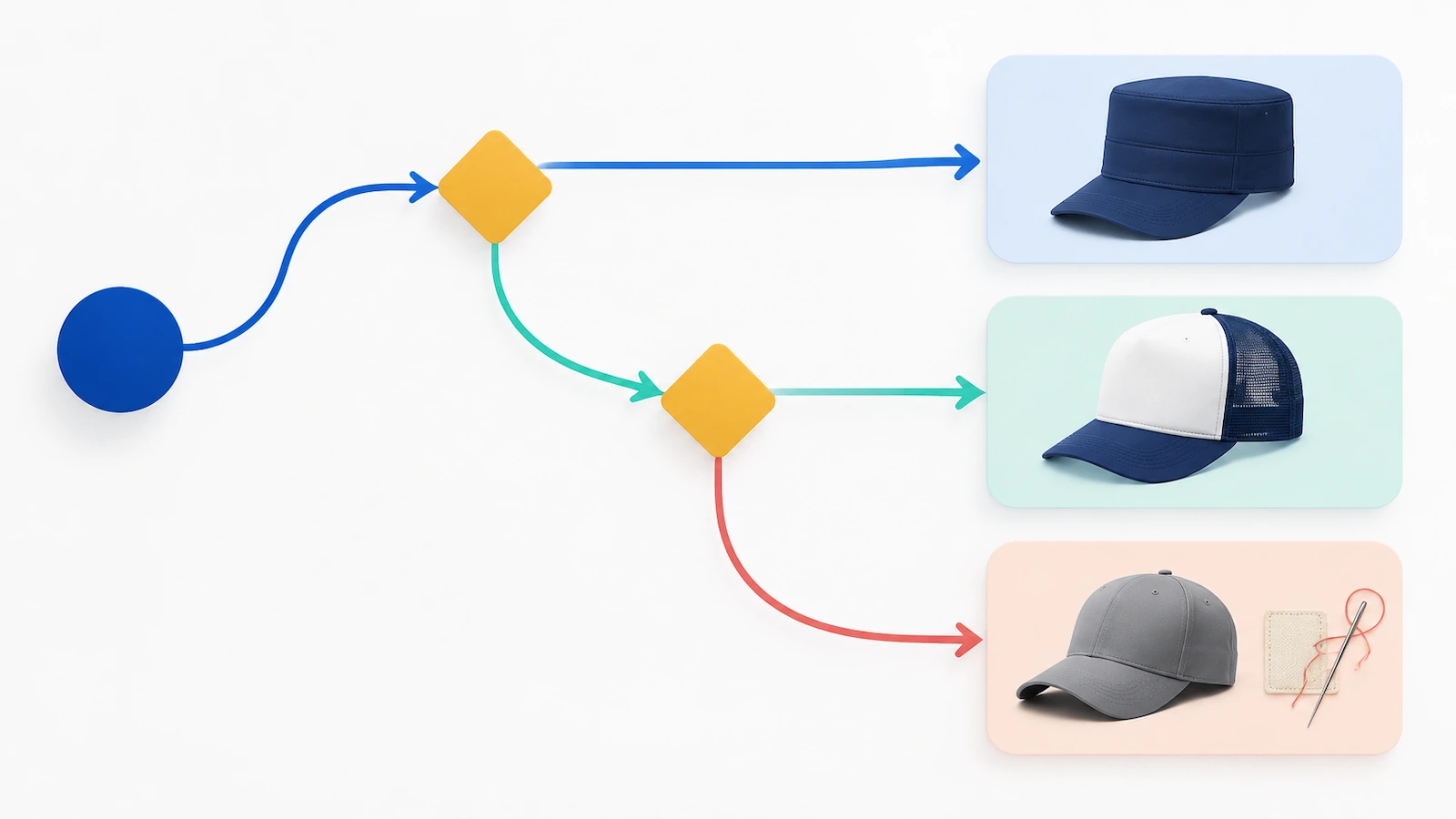
Move to an OEM cap when at least one of these applies:
- You need your own woven label, printed taping, or custom sweatband with no third-party marks.
- Your logo needs a seamless or stiffer front panel, a specific crown height, or a fabric that no catalog blank offers.
- You plan repeat reorders and want a spec that will not change when a catalog color is discontinued.
- You are building a retail line and need packaging and labels to match your brand.
The trade-off is planning time. Unlike catalog stock, an OEM cap is developed and sampled before bulk production, so schedule accordingly. Speed already dominates promotional buying: 68.8% of top distributors say their end buyers prioritize faster turnaround and rush service (PPAI Research, October 2025[7]). An OEM program works best for a planned launch or a standing uniform, not for a cap needed next week.
A private-label cap also makes you responsible for what appears on the label. If you choose to state a fiber content, embroidery that covers no more than 15% of the surface can be disclosed with the phrase "exclusive of decoration" (16 CFR § 303.12[8]). Cotton caps also need fiber-to-finished-goods records, because the Department of Homeland Security lists cotton and apparel as high-priority sectors for forced-labor import enforcement (DHS UFLPA FAQ[9]). The full rule set is summarized on our product page.
Side-by-Side Comparison: New Era Silhouettes, Richardson 112, and OEM
| Blank | Crown and structure | Sizing and closure | Rear panels | Open embroidery zones | Third-party branding | Best fit |
|---|---|---|---|---|---|---|
| New Era 59FIFTY | High, structured, flat visor | Fitted, individual sizes | Solid twill | Front, right side, full back | New Era flag on left side | Retail-style merch, premium staff caps where sizes are known |
| New Era 9FIFTY | High, structured, flat visor | Snapback, one size | Solid twill | Front, right side, small back arch | New Era flag on left side | Streetwear-leaning giveaways, mixed groups |
| New Era 39THIRTY | Mid, structured, curved visor | Stretch-fit size ranges | Solid twill | Front, right side, back | New Era flag on left side | Corporate and golf programs that want a clean back |
| New Era 9TWENTY | Low, unstructured | Strapback, one size | Solid fabric | Front (simple marks), right side, small back arch | New Era flag on left side | Relaxed lifestyle caps with small, low-stitch logos |
| Richardson 112 | Mid, structured front | Snapback, one size | Mesh | Front panels only, in practice | Maker's labels inside | Outdoor crews, summer events, casual trucker look |
| Private-label OEM | Built to spec | Any closure | Your choice | Planned at the pattern stage | Your labels only | Own-brand retail, standing uniforms, exclusive programs |
Cost per exposure explains why the extra planning can pay off. ASI's 2026 Ad Impressions Study estimates that a $13 baseball cap delivers an average cost per impression of about three-tenths of a cent (ASI, March 2026[10]). That figure only holds if people actually wear the cap. Fit, crown shape, and a readable logo do more for that outcome than the brand name on the side.
FAQ
FAQ: Can the New Era flag be removed or stitched over?
Generally, no. The flag is part of the finished cap and identifies its maker. Covering or removing it creates an altered branded product and can raise trademark questions. If you need a cap with no third-party mark, specify a private-label OEM cap.
FAQ: Is a custom embroidered 112 hat a good choice for logos with small text?
Only if you simplify the text. The 112's mid-height front and center seam leave limited room, and embroiderers often report fine taglines becoming unreadable on it. Enlarge the wordmark, drop the secondary line, or move it to a solid-panel cap that allows side or back embroidery.
FAQ: Fitted or snapback for a staff uniform?
Choose fitted (59FIFTY) only when you can collect head sizes and reorder by size. For rotating staff, events, or unknown recipients, a snapback such as the 9FIFTY or 112, or a stretch-fit 39THIRTY, avoids leftover size stock.
FAQ: Can I add a pro or college team logo to a New Era blank?
Not without permission from the rights holder. Team marks are licensed separately from the cap itself, and buying a blank does not include those rights. Use your own organization's logo, or work through a licensed channel.
FAQ: Does a mesh back make embroidery wear out faster?
Front embroidery on a 112 sits on a backed cotton-blend panel, so mesh does not shorten its life. The limitation is placement: open mesh is a poor base for stitching, so plan any secondary marks for solid panels.
FAQ: When should I request an OEM quote instead of buying branded blanks?
Request an OEM quote when you need your own labels, an exclusive spec, a seamless or stiffer front, or a cap you will reorder over several seasons. For a one-off event that needs fast delivery, decorated catalog blanks are usually the faster route.
Key Takeaways
- Caps are now a core promotional category, so blank choice is a brand decision. — Caps rose from 7.2% to 9.0% of U.S. distributor sales between 2023 and 2024 (Source).
- A readable logo drives recall, which favors crowns with enough front height. — 57% of consumers remembered a brand because its logo was clear (Source).
- Poor construction cancels the premium of a brand-name blank. — More than 60% of consumers would immediately reject an item made with poor materials or workmanship (Source).
- Team and league marks need a license; the blank alone grants no rights. — Licensed goods account for about $124 billion of $174 billion in U.S. branded merchandise (Source).
- A cap people actually wear is one of the cheapest impressions in marketing. — A $13 baseball cap averages about 0.3 cents per impression (Source).
Conclusion
Start with the wearers, not the brand. If sizes are known and a premium, co-branded look helps your message, a New Era silhouette is the right blank. Use the 59FIFTY or 9FIFTY for a bold front and the 39THIRTY for a cleaner, mid-height profile. If the cap will be worn outdoors by a mixed crowd and your logo is simple and horizontal, the Richardson 112 does the job at a casual price point, provided you keep embroidery on the front panels. If your logo program needs your own labels, an exclusive spec, or a stable reorder, skip branded blanks and build the cap itself.
If you are weighing that last option, send us your logo and target use through our custom embroidered baseball caps page. We will tell you which crown, front construction, and closure suit the artwork, and quote quantity and timing for your specific program.
Footnotes
- PPAI Research, "The 5-Second Impact," October 3, 2025. https://www.ppai.org/media-hub/ppai-research-the-5-second-impact/ ↩
- PPAI Magazine, April 2025, category share of U.S. distributor sales. https://flipbook.ppai.org/2025-04-01/38 ↩
- PPAI, 2024 Distributor Sales Volume Report (PDF), February 2025. https://www.ppai.org/wp-content/uploads/2025/02/2024-PPAI-Sales-Volume-Report-2.pdf ↩
- PPAI, "Sales Volume Estimate: Promo Reaches New Height," January 12, 2026. https://www.ppai.org/media-hub/ppai-sales-volume-estimate-promo-reaches-new-height-but-hampered-by-external-volatility/ ↩
- PPAI, "How Retail-Quality Headwear Is Reshaping Branded Merch," August 1, 2026. https://www.ppai.org/media-hub/how-retail-quality-headwear-is-reshaping-branded-merch/ ↩
- PPAI with Oxford Economics, "Inside the $174 Billion US Branded Merchandise Market," September 22, 2026. https://www.ppai.org/media-hub/inside-the-174-billion-us-branded-merchandise-market/ ↩
- PPAI Research, "Distributors Balancing Speed and Creativity for End-Buyer Priorities," October 27, 2025. https://www.ppai.org/media-hub/ppai-research-distributors-balancing-speed-and-creativity-for-end-buyer-priorities/ ↩
- Electronic Code of Federal Regulations, 16 CFR § 303.12, Trimmings of textile fiber products. https://www.ecfr.gov/current/title-16/chapter-I/subchapter-C/part-303/section-303.12 ↩
- U.S. Department of Homeland Security, UFLPA Frequently Asked Questions. https://www.dhs.gov/uflpa-frequently-asked-questions ↩
- ASI, "ASI's 2026 Ad Impressions Study: 5 Compelling Takeaways," March 30, 2026. https://members.asicentral.com/news/strategy/march-2026/asi-s-2026-ad-impressions-study-5-compelling-takeaways/ ↩












The information below is required for social login
Sign In
Create New Account