We use cookies to enable our websites to remember information, to help some website functionalities to work properly, to understand how you interact with and use our websites and to display you content and ads that are relevant and engaging for you.
By clicking Accept All you consent to the use of these cookie.
The store will not work correctly when cookies are disabled.
Quick answer: In the cork vs pulpboard coasters decision, choose pulpboard when the coaster leaves with the drink or the guest, as in busy draft bars, festivals and one-night promotions. It absorbs heavy condensation, prints sharp full color and is thrown away after use. Choose cork when one coaster will serve many drinks or go home as a keepsake, as in lounges, hotel rooms, weddings and corporate gifts, because its cost per use falls with every reuse.
Most buyers settle cork vs pulpboard coasters by comparing unit prices on two quotes. That is the wrong comparison. A coaster is a consumable in one venue and a durable fixture in another, and the material that looks cheap on the invoice can be the expensive one by the end of the season. Branded merchandise is a large and closely watched budget line. US promotional products distributors reported $27.1 billion in 2025 sales[1], so procurement teams are asked to justify even small items.
Choosing on unit price alone causes predictable failures. Public buyer reviews describe both materials failing in the wrong setting. One event buyer wrote that a batch of cork-board coasters "warped horribly and were unusable after," and switched to paper. Another said thin printed coasters "just curl up when you put a wet glass on them." In the opposite direction, bars that hand out pulpboard in a slow cocktail lounge end up replacing soggy, torn mats several times a night, which costs both money and table presentation. These are not quality defects. The material was matched to the wrong job.
This guide gives you a repeatable way to decide. It compares the two materials on absorbency, reuse cycles, print quality, hygiene, storage and true cost per use, maps each to common venue types, and ends with a sample test you can run before committing to a bulk order.
What Exactly Are Cork and Pulpboard Coasters?
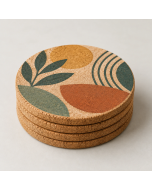
Cork has a formal definition. ISO 633:2019[2] defines it as the protective bark layer harvested periodically from the trunk and branches of the cork oak (Quercus suber L.). Coasters are cut either from natural cork sheet or from agglomerated cork, which is granules bonded with a binder. Harvesting does not fell the tree. According to the Portuguese cork association, a cork oak is first stripped at around 25 years of age, then roughly every nine years for more than 150 years[3].
Pulpboard (often called a beer mat) is compressed paper fiber board. It is engineered to absorb a lot of liquid quickly and to be thrown away after one use or a few uses. Its smooth, bright surface is what makes it a strong full-color print substrate.
Watch for hybrids. "Cork-backed" coasters are usually a printed hard top bonded to a thin cork base. They behave like a hard coaster with a non-slip bottom, not like solid cork. Ask suppliers which construction they are quoting, because absorbency, cleaning and reuse life all change with it.
How to Choose: A Six-Step Decision Method
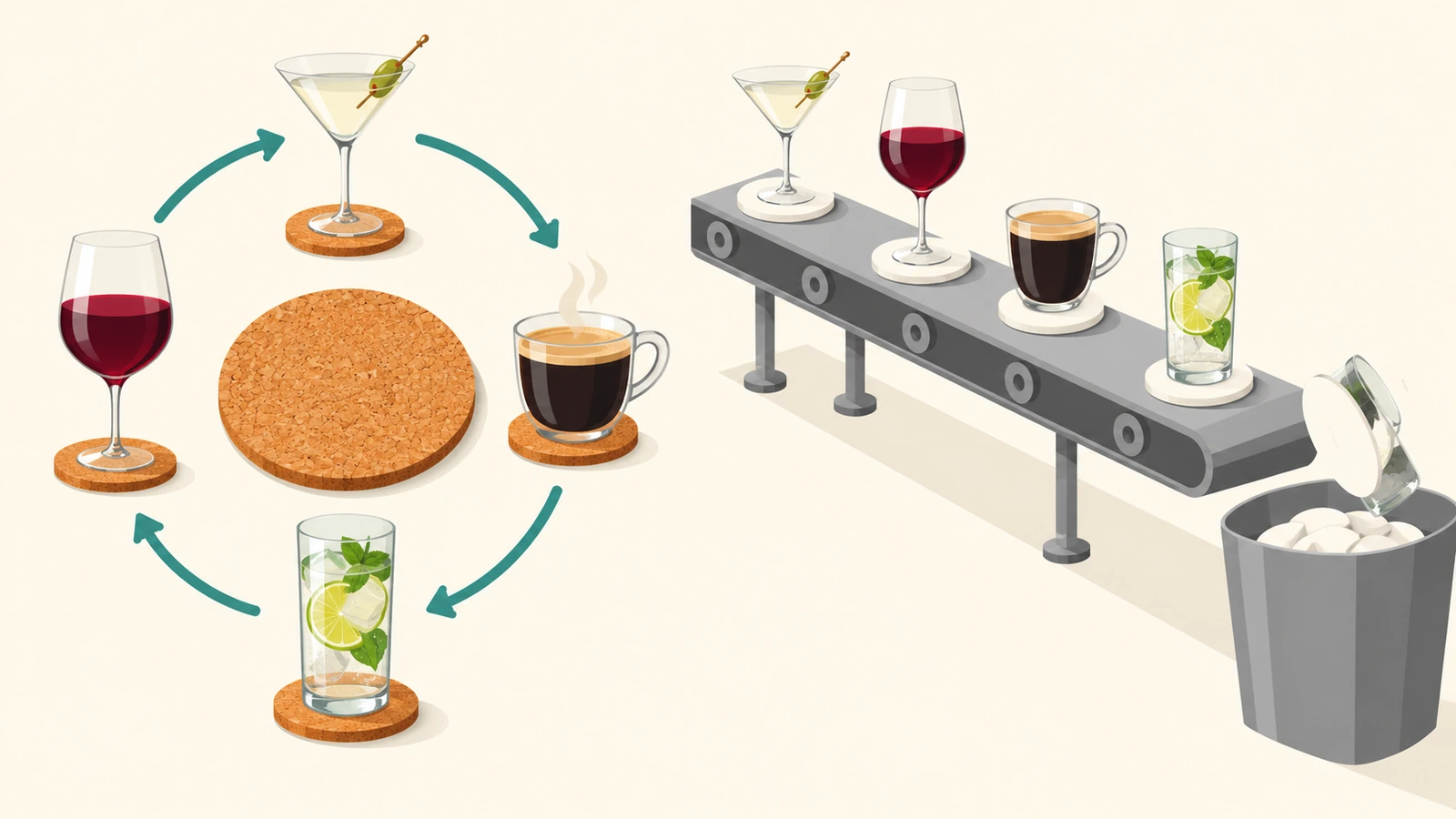
Estimate uses per coaster. Count how many drinks one coaster will sit under before it is binned, damaged or taken home. A cocktail lounge that reuses coasters across a shift is in a different category from a festival where most coasters walk away with the first drink. If guests keep coasters as souvenirs, count that as a planned loss, not a defect.
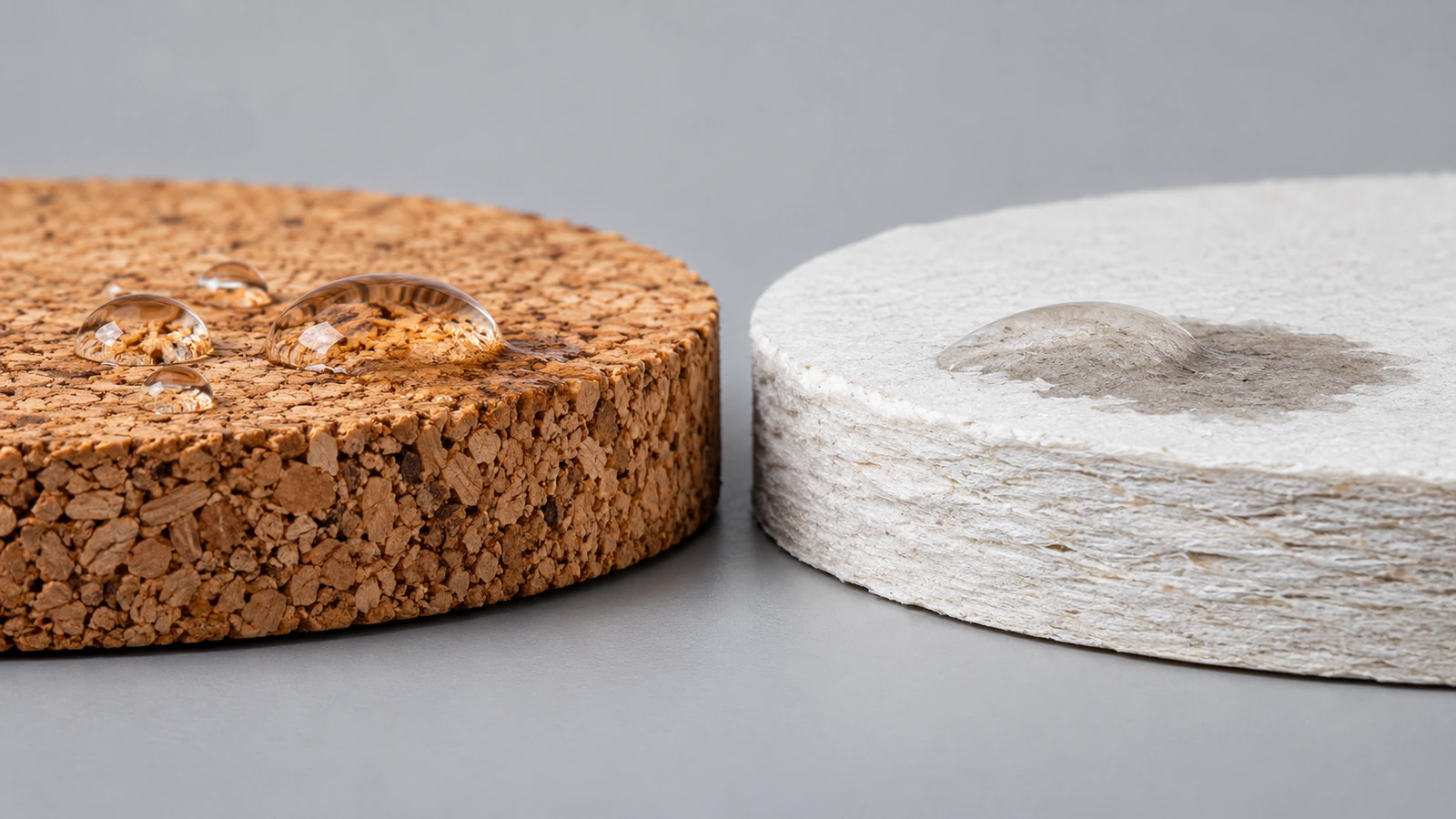
Map the moisture load. Iced cocktails and draft beer produce sustained condensation and spills. Hot coffee produces heat and little water. Pulpboard handles heavy, short-term soaking best. Cork handles moderate condensation and recovers if it dries between uses, but no coaster should be described as waterproof.
Decide what the artwork must do. Photographic, full-color or fine-line artwork reproduces most faithfully on pulpboard's smooth surface. Cork's porous grain mutes ink and can break thin strokes, while bold logos and engraved marks suit it well. Method-by-method trade-offs are covered on our custom cork coasters guide, so this article does not repeat them.
Price the full cost per use with the formula below, not the unit quote.
Plan hygiene and labor. Pulpboard needs no cleaning: one coaster per drink, then the bin. Cork needs wiping with a damp cloth and time to air-dry. A University of Lisbon study of cork products in use recorded wine and coffee darkening cork edges with slight deformation[4], along with a distinct odor from dark cork granules. Budget for rotation and retirement, not just washing.
Plan storage and reorders. Pulpboard is consumed continuously, so it needs regular reorders and dry storage, because damp stockrooms can warp paper board before it ever reaches a table. Cork is a less frequent purchase, but it should also be stored dry and flat, and a spare stock should be kept for replacements so the design stays consistent.
How to Calculate True Cost per Use
Cost per use (CPU) makes the two materials comparable:
CPU = (unit price + setup share + freight per piece + cleaning cost over life) ÷ effective uses
Here, effective uses = planned uses × (1 − loss rate). Pulpboard's effective uses are usually 1 to a few. Cork's depend on retention: a hotel room where coasters stay put may see dozens of uses, while a beer garden where guests pocket them may see one.
A fast shortcut is the break-even ratio. Divide your cork quote by your pulpboard quote. If cork costs R times as much, it wins once each cork coaster delivers more than R effective uses after cleaning labor. To illustrate with hypothetical units rather than real prices: if pulpboard costs 1 unit and cork costs 8 units, a lounge where each cork coaster serves 3 drinks a night is past break-even within the first week. A street festival with an 80% walk-away rate never reaches it, so pulpboard is the right choice there.
Two adjustments are commonly missed. First, a coaster guests take home is a brand impression that keeps working. Industry research for PPAI and ASI found promotional products carry a carbon impact per memorized impression about eight times smaller than digital advertising[5]. The study did not measure coasters specifically, but it explains why keepsake loss is not always a cost. Second, compliance work is part of the cost. Paper-based items are increasingly affected by state packaging EPR programs, which PPAI warned members about after several state registration deadlines had already passed[6]. Whether a coaster falls under a given state's definition has to be checked case by case.
Cork vs Pulpboard Coasters: Side-by-Side Comparison
Factor
Cork
Pulpboard
Absorbency
Moderate. Takes up condensation and small spills; not waterproof under prolonged soaking.
High. Built to soak up heavy condensation and drips quickly.
When saturated
Recovers if allowed to dry; thin or low-density sheets can curl or swell.
Softens, can tear or warp; generally not reused once soaked through.
Reuse cycles
Many, depending on density, thickness and drink type. Confirm with a sample test.
One to a few.
Print quality
Warm, slightly muted color; fine lines and gradients can break on the grain. Bold logos and engraving suit it best.
Crisp, bright full color and photographic detail.
Hygiene model
Wipe clean, air-dry, rotate; retire stained or swollen pieces.
Single-use by default; no cleaning labor.
Storage
Keep dry and flat; lower reorder frequency.
Keep dry; damp storage can warp stock; frequent reorders.
Brand dwell time
Long. Stays on tables or goes home as a keepsake.
Short. One drink, sometimes one evening.
Sustainability story
Renewable bark harvest, tree left standing; claims still need qualification.
Paper-based and often recyclable where local systems accept it; inks and coatings matter.
Regulatory watch
Binders, coatings and inks need their own documentation.
PFAS limits on food-contact paper and board and US packaging EPR are tightening.
Best fit
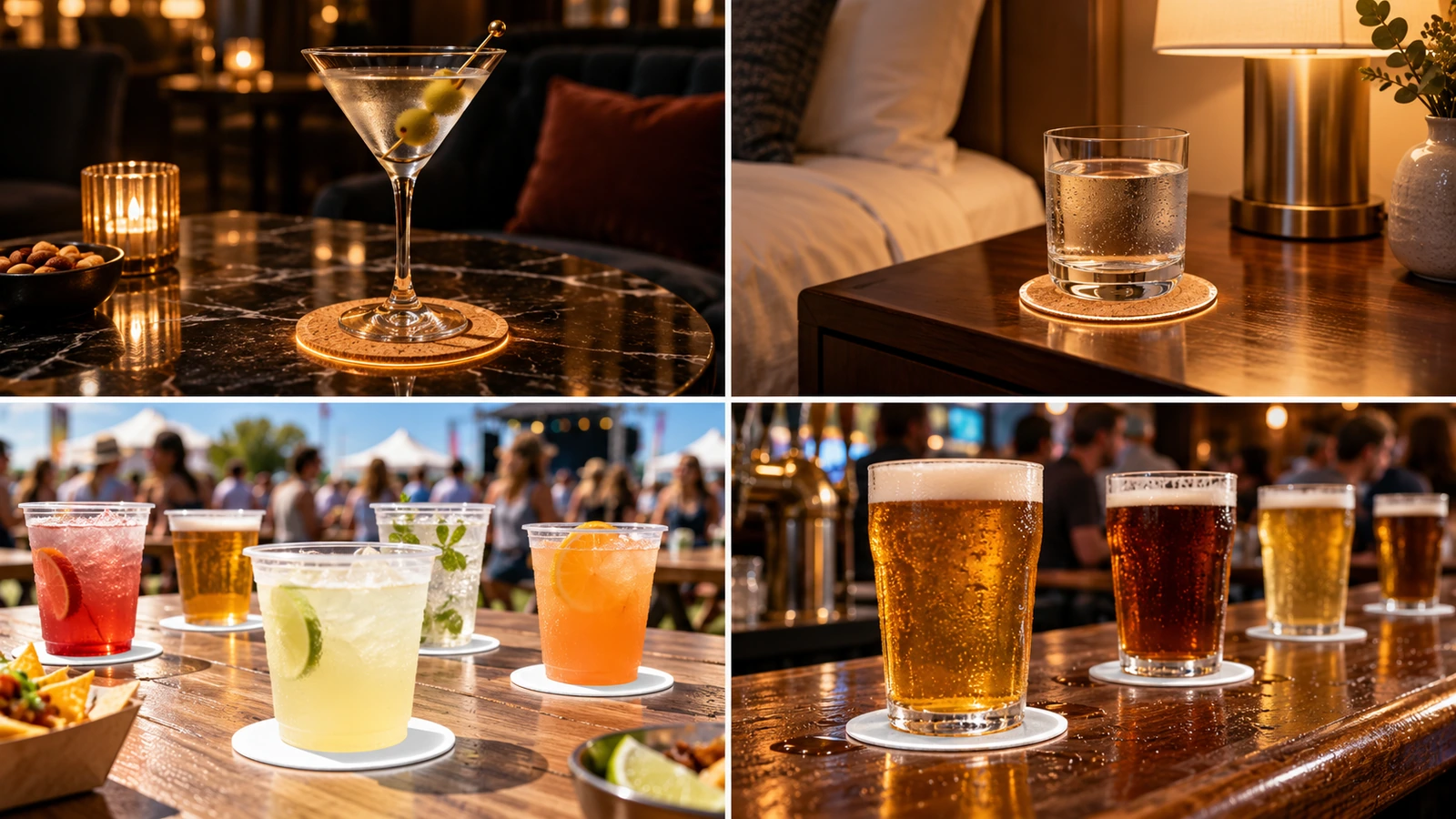
Lounges, hotel rooms, table-service restaurants, weddings, corporate gifts.
The regulatory row matters most for buyers who export or answer ESG questionnaires. In the EU, REACH limits on PFHxA in food-contact paper and board apply from 10 October 2026, at 25 ppb for the substance and its salts[7]. A bar coaster is not automatically a food-contact article, but procurement teams increasingly send PFAS questionnaires anyway, so ask paper-board suppliers for a "no intentionally added PFAS" statement covering coatings and inks.
On the cork side, avoid unqualified environmental language. Under the FTC Green Guides, 16 CFR § 260.16[8] requires a "made with renewable materials" claim to be qualified unless the whole product, excluding minor components, is renewable. A cork coaster with a synthetic binder, coating or rubber base needs that qualification. Our product guide covers what you can honestly claim about cork coasters in more detail.
Which Material Fits Which Venue?
Venue or use
Recommended
Why
High-volume sports or draft bar
Pulpboard
Heavy condensation, fast turnover, one coaster per pour keeps tables clean.
Cocktail lounge or hotel bar
Cork
Coasters stay on the table across a shift; presentation matters.
Hotel rooms and suites
Cork
Low moisture load, many reuses, housekeeping can wipe and rotate.
Table-service restaurant
Cork
Protects tables, reduces glass noise, reused across covers.
Brewery taproom
Both
Pulpboard for the pour line; cork as retail merchandise or a take-home item.
Festival, trade show, launch night
Pulpboard
Most coasters leave or are binned the same day; full-color campaign art.
Wedding favors and corporate gifts
Cork
Designed to be kept; a durable keepsake reads as a gift, not a disposable.
Many venues end up using both: pulpboard where volume and spills peak, cork where dwell time and image matter. That split also simplifies reordering, with pulpboard on a regular replenishment cycle and cork bought in planned batches.
Run a sample test before you commit
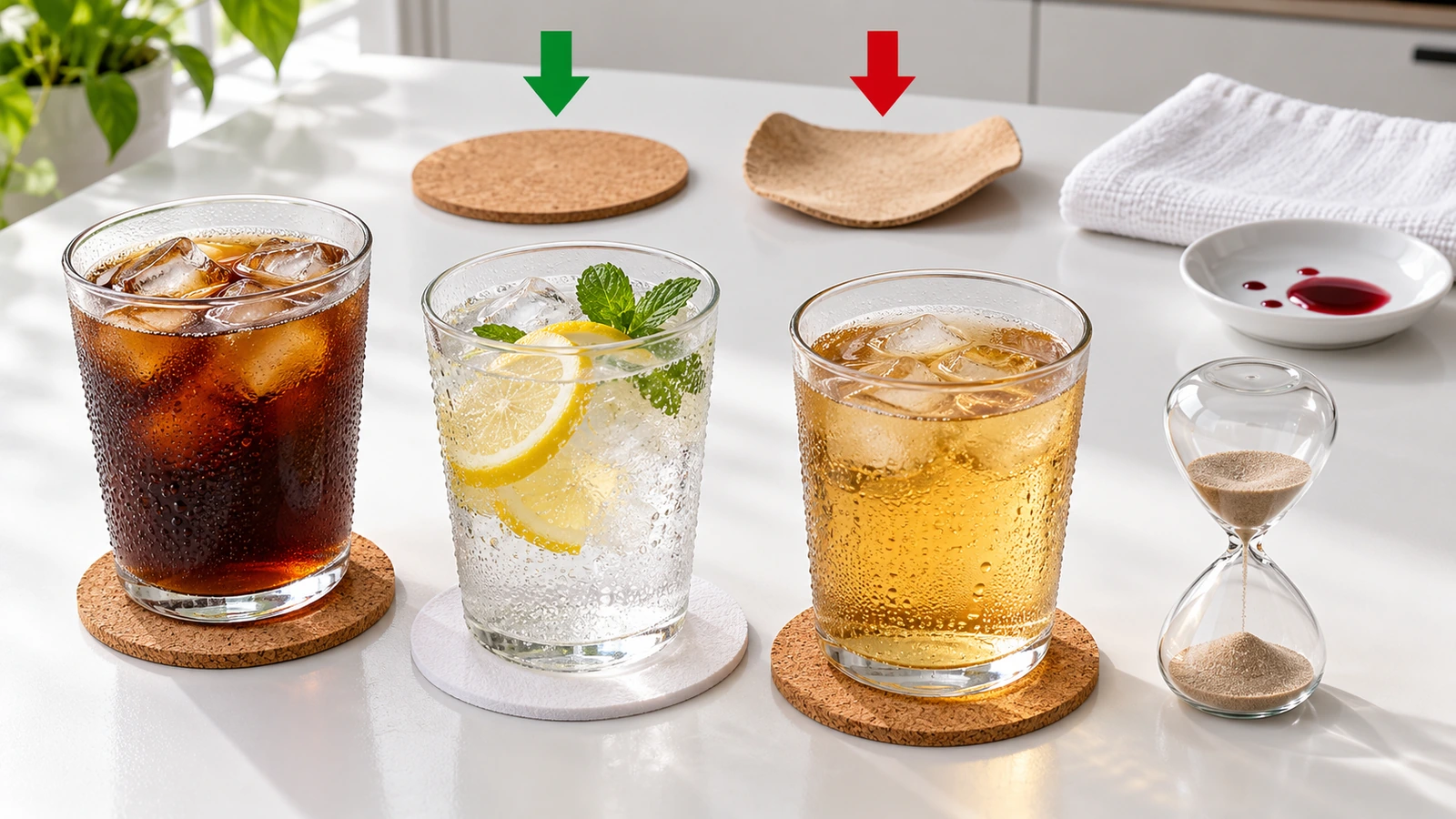
Ask for blank or printed samples of both materials at the thickness you intend to order, then test them under your real conditions:
Condensation test: place your house iced drink on each sample for 45 minutes, remove it, and check flatness after it dries.
Repeat-cycle test: repeat the condensation test 10 times on the same cork sample, wiping and air-drying between cycles. Note any curling, swelling or print wear.
Stain test: drip red wine, coffee and a sugary mixer onto the edges, wipe after 10 minutes, and photograph the results.
Grip test: lift a wet glass and see whether the coaster sticks to the glass base, a common complaint with very light coasters.
Record results in a simple pass/fail sheet. Doing this before any bulk order turns "durable" from an adjective into evidence. If cork passes and you are ready to proceed, our guide on ordering custom cork coasters without surprises covers proofing and QC.
FAQ
FAQ: Is pulpboard more absorbent than cork?
Yes, for short, heavy loads. Pulpboard is engineered to soak up a lot of liquid fast, which is why draft bars use it. Cork absorbs moderately and recovers when dried, which suits reuse rather than flood-level spills.
FAQ: How many times can a cork coaster be reused?
There is no universal number. Reuse life depends on cork density, thickness, the drinks served and how quickly coasters dry between uses. Run the 10-cycle condensation test above on your actual sample and plan retirement for stained or swollen pieces.
FAQ: Can cork coasters go in a dishwasher?
Avoid it. Wipe cork with a damp cloth, use mild soap for deeper cleaning, and let it air-dry flat. Prolonged soaking and high heat shorten the life of both the cork and any printed surface.
FAQ: Are cork coasters food-safe?
A coaster normally touches the outside of a glass, not the drink. Regulators address cork in food contact through specific frameworks: the EDQM's technical guide on cork materials for food contact[9] in Europe, and in the US 21 CFR § 177.1210[10], which covers cork in container sealing gaskets, not coasters. Neither makes every printed coaster "FDA approved," so ask for documentation on inks, binders and coatings if a client requires it.
FAQ: Can I mix cork and pulpboard in one venue?
Often that is the best answer. Use pulpboard at the bar rail and on high-turnover tables, and cork in lounge seating, private rooms or as take-home merchandise. Keep the artwork consistent across both so the brand reads as one system.
FAQ: Which is better for an event giveaway?
If the goal is a one-day impression at high volume, pulpboard. If the goal is a keepsake that stays on a desk or coffee table afterward, cork. Decide by asking whether you want the coaster used once or kept.
Key Takeaways
Cork is renewable bark, not timber. — Cork oaks are harvested roughly every 9 years over a productive life of 150+ years (Source)
Define the material before comparing quotes. — ISO 633:2019 (third edition) defines cork as Quercus suber bark; cork-backed hybrids are a different product (Source)
Kept coasters keep working as advertising. — Promo carbon impact per memorized impression is about 8× smaller than digital advertising (Source)
Paper-based coasters face tightening chemical rules. — EU PFHxA limit of 25 ppb for food-contact paper and board from 10 October 2026 (Source)
"Renewable" claims for cork need qualification. — 16 CFR § 260.16 applies when binders, coatings or rubber are present (Source)
Coaster budgets sit inside a large, scrutinized channel. — US promo distributor sales reached $27.1 billion in 2025 (Source)
Conclusion
The cork vs pulpboard question is not about which material is better. It is about how many uses one coaster will deliver in your venue. Estimate effective uses, divide your cork quote by your pulpboard quote, and the break-even ratio usually settles it: pulpboard for volume, spills and one-day campaigns, cork for dwell time, reuse and keepsakes. Confirm the choice with a sample test, and keep sustainability language as precise as the materials themselves.
Hi there! I'm Bruce, proud dad to my amazing son. I'm the founder of Zigpac, a printing and packaging company empowering small and medium-sized businesses with custom solutions. Let's create something great together!



 Blog PDF for offline reading












The information below is required for social login
Sign In
Create New Account