We use cookies to enable our websites to remember information, to help some website functionalities to work properly, to understand how you interact with and use our websites and to display you content and ads that are relevant and engaging for you.
By clicking Accept All you consent to the use of these cookie.
The store will not work correctly when cookies are disabled.
Quick answer: Businesses that print fridge magnets in volume usually choose one of four routes. UV direct print on wood suits full-color art on a natural substrate. Printed paper or vinyl laminated to flexible magnet sheet is the lowest-cost, full-coverage option. Epoxy-domed prints add a glossy, moisture-tolerant lens. Acrylic inserts give a framed, premium look. Pick the route by color fidelity, run size, unit cost and kitchen durability, then confirm on a physical sample.
If you need to print fridge magnets for a souvenir shop, a client gift program or an event, the hard part is not finding a printer. It is choosing a production process that still looks right after six months on a kitchen door. This guide compares the four main processes and explains what each one means for color, minimum runs, cost and durability. It also lists what to put in your brief before you create custom magnets in bulk.
Why the Wrong Process Turns a Giveaway Into a Complaint
The problem. Most buyers start from a mockup on a screen. A mockup does not show how ink sits on a substrate, how humid air from a kettle behaves near the door, or how much the magnet on the back can hold. Buyer reviews of decorative magnets keep returning to the same few failures. Magnets are too weak to hold a single greeting card. Backings detach after a few weeks. Print edges show a thin line of base color. Unsealed plywood feels rough to the touch.
The pain. Each of these failures lands on your brand rather than on the factory. A real estate agent's closing gift that slides off the fridge sends a message, and so does a museum souvenir whose ink rubs away. The stakes are rising because buyers now expect material claims to be backed up. U.S. promotional products distributor sales reached $27.1 billion in 2025, and sustainable products made up an estimated $3.8 billion of that, or 14%, according to the PPAI 2025 sales volume estimate[1]. A "natural wood" magnet that warps or smells of solvent undermines exactly the story it was bought to tell.
The solution. Match the process to the artwork and the environment before you approve a price. The sections below define each process, give a step-by-step selection method, and compare the options side by side.
The Four Main Ways to Print Fridge Magnets
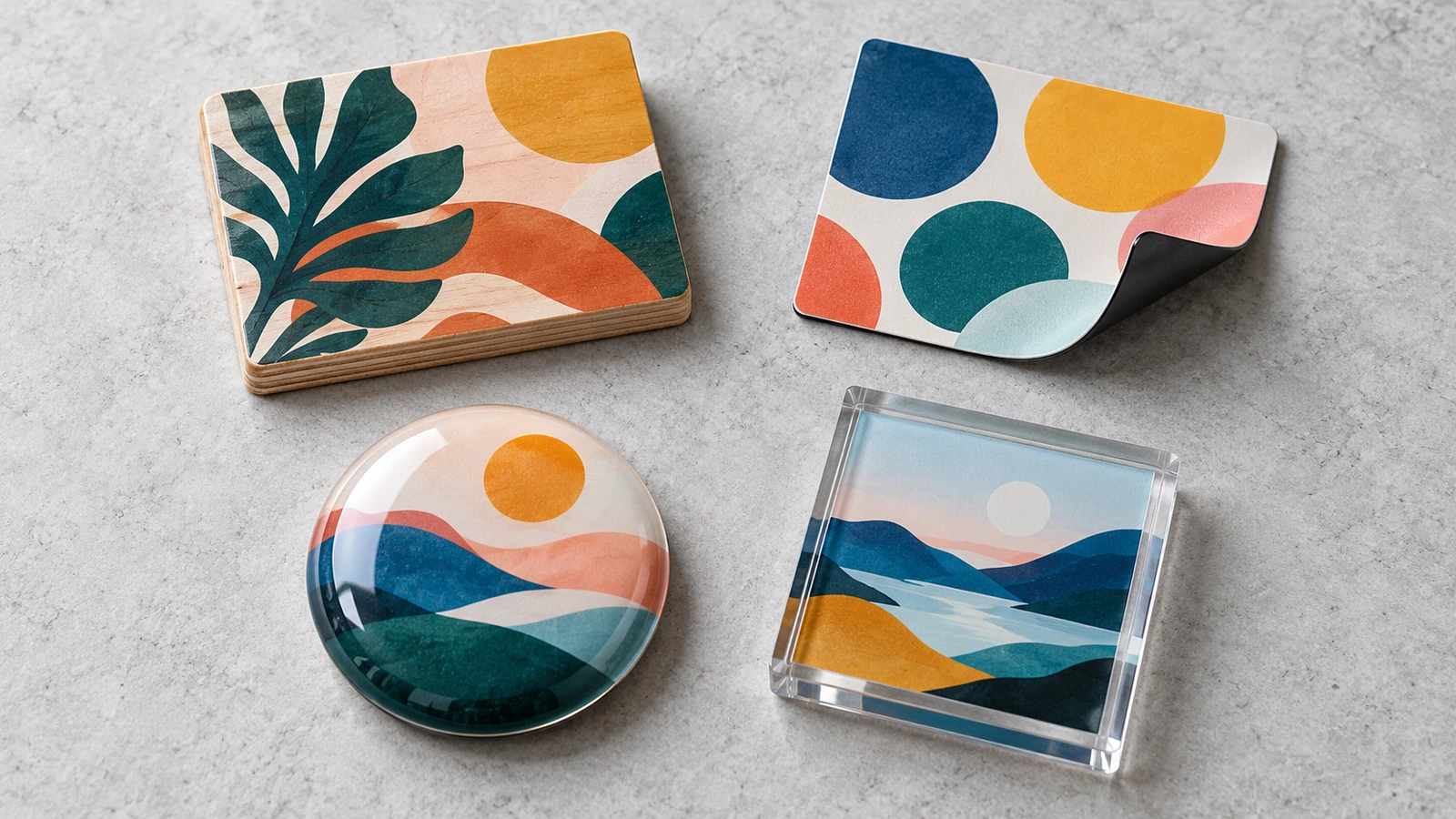
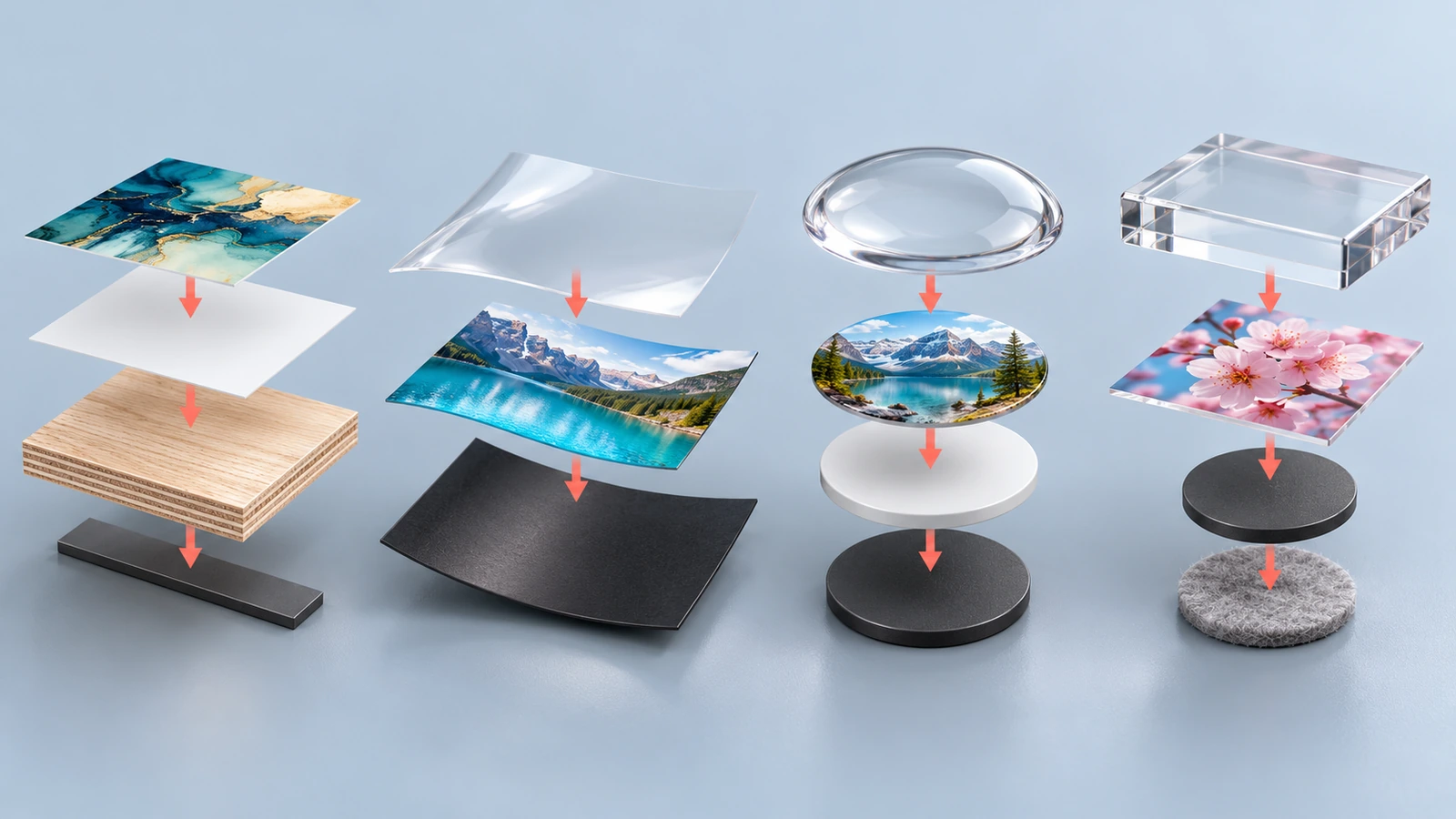
A printed fridge magnet has three layers: a decorative face, a substrate that carries the face, and a magnetic backing. The four processes differ mainly in how the face is applied and protected.
1. UV direct print on wood
A flatbed UV inkjet printer jets ink straight onto a cut wood blank, and ultraviolet light cures the ink instantly. Common substrates are birch plywood, MDF and HDF, all forms of engineered wood[2] made by bonding veneers or fibers with adhesive. Most printers lay a white underbase first so the wood color does not dull the inks. The magnet is usually a strip or disc bonded to the back. This route gives you full color on a material buyers recognize as wood. The trade-off is that wood grain can telegraph through thin ink, and unsealed edges absorb moisture.
2. Printed paper or vinyl laminated to flexible magnet
Artwork is printed digitally or by offset onto paper or vinyl, laminated, and bonded to a sheet of flexible ferrite magnet. The sheet is then die-cut or kiss-cut to shape. Because the magnet covers the whole back, holding power is spread evenly, which suits menus, calendars and business-card magnets. Cost per piece falls quickly with volume. The look is flat and thin, though, and it will not carry a "natural material" story.
3. Epoxy-domed print
A printed sticker or plate is topped with a dome of clear resin. The resin cures into a raised, glossy lens that magnifies the color and protects the print from splashes and scratches. Domed faces can sit on flexible magnet, metal or wood bases. The dome adds a curing step and makes thin outlines harder to control. Very intricate shapes also cost more, because resin has to be dispensed to an even edge.
4. Acrylic insert
A printed photo or paper insert sits inside a clear acrylic frame, or is printed in reverse on the back of an acrylic block, with a magnet attached behind. Photos and gradients come out deep and clear, and the acrylic shields the print. Acrylic is rigid and heavier than flexible sheet, so it needs a stronger magnet to stay put. Hard edges can also scratch glossy appliance finishes unless the back is padded.
A fifth route, laser engraving, burns the design into the wood instead of adding ink. It suits names, logos and line art in a single charcoal tone. Our laser-cut and engraved plywood fridge magnets page covers that option in detail, so this guide does not repeat it.
How to Choose a Process to Print Fridge Magnets: A Six-Step Method
This sequence keeps the decision tied to evidence rather than to the most attractive mockup.
Classify the artwork. Photos, gradients and many brand colors point to UV print, epoxy dome or acrylic. Two-tone logos and text work with any process, including engraving. If exact brand color matching matters, ask whether the supplier can print a color patch on the actual substrate. Wood tone shifts color even under a white underbase.
Test the target surface. Magnets only stick to ferromagnetic steel. Many austenitic stainless steel doors, such as grade 304, attract a magnet weakly or not at all. Before you blame the magnet, ask a few recipients, or your own team, to test a fridge with any existing magnet. If your audience has mostly modern stainless appliances, favor light faces with full-coverage backing.
Map the environment. Wood is hygroscopic. The USDA Wood Handbook[3] explains that moisture left in wood tends toward equilibrium with the surrounding air. Purdue Extension[4] notes that interior hardwood is usually kiln-dried to 6–8% moisture content, with equilibrium near 6.9% at 70°F and 35% relative humidity. Kitchens swing above that near kettles, dishwashers and freezer vents. If your magnets will live in humid homes, specify sealed faces and edges, or choose epoxy or acrylic.
Size the magnet to the weight. A thick wood or acrylic face acts as a lever on a small magnet disc. Write a functional requirement into the brief, for example: "hangs by its own weight on a standard steel door and holds two sheets of copy paper without sliding." Then test against it. Avoid vague promises like "strong magnet."
Define the run and reorder pattern. Processes with setup work, such as die tooling for flexible sheet or resin dispensing programs, reward large single runs. Digital UV printing has little setup, so it handles many designs in shorter runs and easy reorders. Ask each supplier to break setup costs out from unit costs so you can compare like for like.
Specify the checks. Ask for a physical pre-production sample made from the production substrate. Request a cross-hatch tape adhesion check on printed faces (the method in ASTM D3359), a vertical hang test on a steel panel, and a humidity exposure check on edges. Record the results with the approved sample so reorders can be held to the same standard.
Process Comparison: Color, Minimum Runs, Unit Cost and Durability
The table uses relative ratings because prices, minimums and lead times vary with size, shape, magnet type and origin. Request current quotes for your exact specification rather than relying on published price bands.
Factor
UV direct print on wood
Laminated flexible magnet
Epoxy-domed print
Acrylic insert
Color fidelity
High with white underbase; grain may show through
High; flat finish
High; dome deepens color
Very high for photos
Setup and minimum run
Low setup; suits short runs and many designs
Tooling for custom shapes; favors larger runs
Moderate setup per design
Moderate; standard frame sizes are easiest
Relative unit cost
Mid
Lowest at volume
Mid to high
Mid to high
Moisture tolerance
Depends on sealing of face and edges
Good if laminated
Good; resin protects face
Good on the face; check the insert edge
Scratch and wear
Cured ink is scratch-resistant but surface-level
Laminate protects; edges can lift
Strong face protection
Face is protected; acrylic can scuff
Magnet coverage
Strip or disc, partial
Full back
Depends on base
Disc or strip, partial
Risk to appliance finish
Low if back is smooth
Lowest
Low to moderate
Moderate without a pad
Material story
Natural wood, can be certified
Neutral
Neutral to decorative
Premium, framed
Two patterns stand out. First, full-coverage flexible magnet solves most holding complaints but gives up the tactile, gift-like feel. Second, every rigid face (wood, resin or acrylic) depends on the bond between the face and the magnet. If you choose a rigid format, make the backing adhesive and its test part of the specification. Do not leave it to the factory's default.
Safety and Material Rules That Affect the Process Choice
Loose magnets. The U.S. CPSC magnet guidance[5] explains the Safety Standard for Magnets (87 FR 57756). The rule applies to covered products made after October 21, 2022. Under it, a loose or separable magnet that fits entirely inside the small-parts cylinder must have a flux index below 50 kG²mm². The full text is in 16 CFR Part 1262[6]. The rule covers products designed or marketed for entertainment, jewelry, mental stimulation or stress relief. A fridge magnet is not automatically in or out of scope; that depends on how it is marketed and whether the magnet can separate. In September 2026, the CPSC magnet safety center[7] listed a recall of bear-shaped refrigerator magnets with loose magnets that could appeal to children. That case shows how a fridge magnet can fall under the rule.
Children's products. If a design is aimed at children under 14, the CPSC toy safety guidance[8] requires toys made after April 20, 2024 to meet ASTM F963-23, which includes its own magnet section. Third-party testing and a Children's Product Certificate are also required. For untreated, unfinished particleboard, hardwood plywood and MDF, 16 CFR Part 1252[9] determines that the wood itself does not exceed the relevant lead and element limits. Printed inks, sealers, resins and adhesives are not covered by that determination and still need testing.
Composite wood emissions. Hardwood plywood, MDF and particleboard entering U.S. commerce fall under the EPA formaldehyde emission standards[10] (TSCA Title VI, 40 CFR Part 770). Ask for the supplier's third-party certifier documentation rather than accepting a generic "E0/E1" label.
Sustainability claims. An FSC claim is valid only when an organization holds chain-of-custody certification. The standard in current use is FSC-STD-40-004 V3-1, as described on the FSC chain-of-custody page[11]. A supplier saying its wood is certified does not let you print the FSC label. Buyer pressure is what drives these requirements. A PPAI study with WAP Sustainability[12] published in July 2026 found that customer demand is the largest sustainability driver for both distributors and suppliers.
For the documents to request for engraved plywood specifically, see the compliance notes on the custom wood fridge magnets product page.
FAQ
FAQ: What is the cheapest way to print fridge magnets in large quantities?
Printed paper or vinyl laminated to flexible magnet sheet usually has the lowest unit cost at high volume. The magnet covers the whole back and the materials are thin. Custom shapes may need cutting tooling, so the advantage grows with run size. Compare quotes with setup and unit costs listed separately.
FAQ: Can UV printing reproduce photos on wood magnets?
Yes, especially when the printer lays a white underbase first. Expect the wood tone and grain to affect light areas and skin tones. Approve a printed sample on the actual substrate rather than relying on a screen proof.
FAQ: Which process holds up best in a humid kitchen?
Epoxy-domed and acrylic faces protect the print from splashes. Laminated flexible magnets also tolerate moisture well. Wood is hygroscopic, so wood magnets need sealed faces and edges and should be kept away from vents, kettles and dishwashers.
FAQ: Why do some printed magnets slide off the fridge?
There are usually two causes. Either the door is a weakly magnetic stainless steel, or a heavy rigid face is backed by a small magnet. Test the target surface first. Then write a hang-and-hold requirement into your order and test the sample against it.
FAQ: Do printed fridge magnets fall under U.S. magnet safety rules?
It depends on marketing and construction. 16 CFR Part 1262 covers products with separable magnets marketed for uses such as entertainment or stress relief. Toys for children must meet ASTM F963. A magnet bonded firmly behind a decorative face for adults is treated differently from a child-appealing design with a magnet that can come loose. Confirm the classification with a testing lab before launch.
FAQ: Is a wood magnet automatically more sustainable than plastic?
No. Wood is renewable, but a credible claim depends on certified sourcing, compliant adhesives and how long the product stays in use. Use FSC language only with valid chain-of-custody coverage, and avoid lifecycle claims you cannot document.
Key Takeaways
Material claims now carry commercial weight in promotional orders. — 14% of 2025 U.S. promo distributor sales were sustainable products (Source)
Kitchen humidity drives wood movement, so wood faces need sealing. — interior hardwood is dried to 6–8% moisture content (Source)
Separable small magnets face a strict U.S. limit. — flux index below 50 kG²mm² under 16 CFR 1262 (Source)
Child-appealing designs move into toy compliance. — toys made after April 20, 2024 must meet ASTM F963-23 (Source)
Buyers, not suppliers, set the sustainability agenda. — customer demand ranked as the #1 driver in the July 2026 PPAI study (Source)
Conclusion
There is no single best way to print fridge magnets. Choose UV print on wood for full color with a natural material story. Choose laminated flexible magnet for the lowest cost and full-back holding power. Use epoxy domes when the face needs splash protection, and acrylic inserts when photos must look framed and premium. Whichever route you take, test the target surface, size the magnet to the face, specify sealing and adhesion checks, and approve a physical sample before production.
If your design is a logo, name or line illustration and you want a tactile, gift-like piece, compare these printed routes with our engraved plywood fridge magnets. Send your artwork and target market, and we will recommend a specification and quote it.
Hi there! I'm Bruce, proud dad to my amazing son. I'm the founder of Zigpac, a printing and packaging company empowering small and medium-sized businesses with custom solutions. Let's create something great together!



 Blog PDF for offline reading













The information below is required for social login
Sign In
Create New Account