We use cookies to enable our websites to remember information, to help some website functionalities to work properly, to understand how you interact with and use our websites and to display you content and ads that are relevant and engaging for you.
By clicking Accept All you consent to the use of these cookie.
The store will not work correctly when cookies are disabled.
Quick answer: In the polyester felt vs wool felt decision, polyester is usually the better choice for branded die-cut stickers that need low unit cost, repeatable colour and stability in damp conditions. Pure wool felt gives the cleanest edges, the richest hand-feel and natural flame resistance, because it chars instead of melting. Acrylic is a bright, budget craft option that pills more readily. Wool-blend felt sits between the two. Choose the fiber based on edge detail, where the sticker will be used and any fire requirements, then confirm the choice with a sample and a test report before you request quotes.
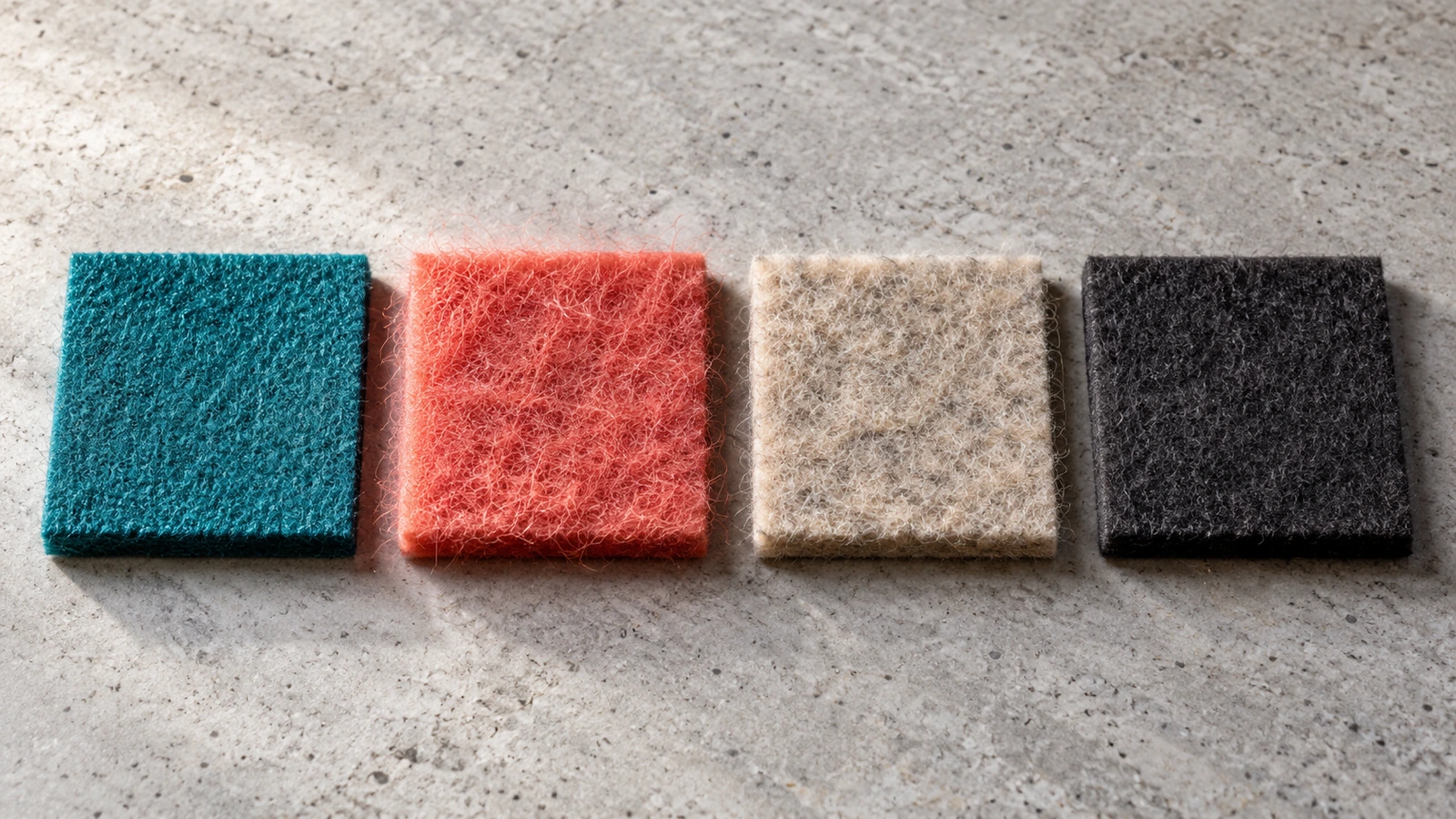
Most felt sticker requests arrive with one word in the material field: "felt." That word covers at least four fibers and two construction methods, and they behave very differently under a cutting die, in sunlight and in a flame. If you compare quotes without naming the fiber, you are not comparing like with like. The polyester felt vs wool felt question is really a question about which trade-offs your brand can accept.
Buyers usually discover the trade-offs after the order arrives. Logo counters have filled in with fuzz. Laptop-corner stickers pill within a few weeks. A reorder comes back half a shade off. Edges that one craft buyer described in a public review as feeling "like burnt plastic" are the result of a synthetic felt that was laser-cut with the wrong settings. The cause in each case is a fiber choice that nobody wrote down.
This guide compares polyester, acrylic, wool-blend and pure wool felt one fiber at a time. It explains what each fiber does to edge sharpness, pilling, colour fastness, fire behaviour and relative cost, so you can specify the base material before you ask anyone for a price.
What Separates Polyester, Acrylic, Wool-Blend and Wool Felt?
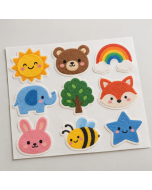
A self-adhesive felt sticker has three layers: a felt face, a pressure-sensitive adhesive and a release liner. The product page explains this construction in full, so if you need it, read our overview of custom felt stickers. This article covers only the top layer, the felt itself, because that layer decides how the sticker looks on day one and on day ninety.
Polyester felt is made from PET fiber, often from recycled bottles. It is hydrophobic, with a typical textbook moisture regain of about 0.4%. That means it barely changes size or stiffness in humid air, which suits stickers on drinkware sleeves, packaging and anything that gets handled. It is thermoplastic and melts at roughly 250–260 °C, which affects both laser cutting and fire behaviour.
Acrylic felt is the classic craft-store sheet. The fiber is soft and takes very bright dyes. It is also known in outdoor fabrics for good sunlight resistance. Its weak points are surface fuzz and pilling, and the low-density sheets sold for crafts are the ones buyers describe as "more like textured paper."
Wool-blend felt combines wool with rayon or polyester. The wool content adds body and a warmer surface. The other fiber lowers cost and improves dimensional stability. Wool-blend felt durability depends heavily on the blend ratio and the density, so treat the label "wool blend" as the start of a question, not an answer.
Pure wool felt is the premium option. Wool's scaled fibers lock together tightly, so the sheet can be very dense, and that density produces the crispest die-cut edges of the four. Wool absorbs moisture (typical regain is around 15–16%) without feeling wet. In a flame it chars and tends to self-extinguish rather than drip. On the downside, it costs the most. It can also shrink further if exposed to heat, moisture and agitation together, so it is a poor choice for anything that will be machine-washed.
Pressed Felt vs Needle Felt: Why Construction Matters as Much as Fiber
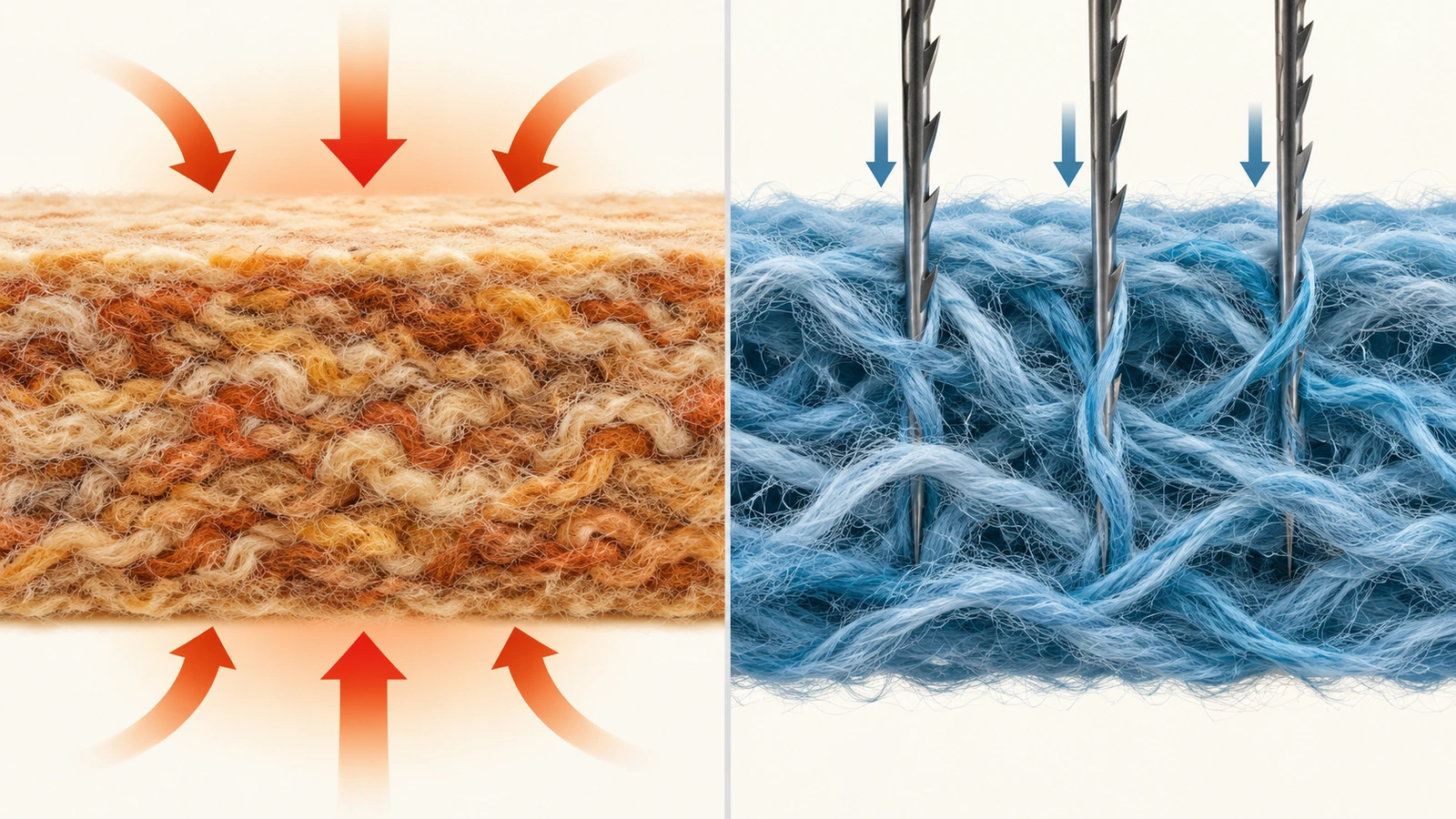
Two sheets of the same fiber can cut very differently depending on how they were made. Pressed felt is made by applying heat, moisture, pressure and agitation until the fibers interlock. This works with wool because wool fibers have surface scales that grip each other. The result is a dense, uniform sheet with very little loft. Needle felt (also called needle-punched felt) is made by repeatedly punching a loose fiber web with barbed needles that tangle the fibers mechanically. This method works with any fiber, which is why almost all polyester and acrylic felt is needle-punched. Many needle felts are then heat-set or calendered to flatten the surface.
This matters for stickers in a practical way. Needle felt has a more open surface, so loose fibers can lift at cut edges and hide fine lines. Pressed and heavily calendered felts hold a cleaner edge and give the adhesive a more even surface to bond to. When you compare pressed felt vs needle felt for a logo with small counters (the enclosed spaces in letters such as "e" or "a"), density usually decides the result more than fiber type does.
How to Specify the Felt Fiber for a Die-Cut Sticker in Six Steps
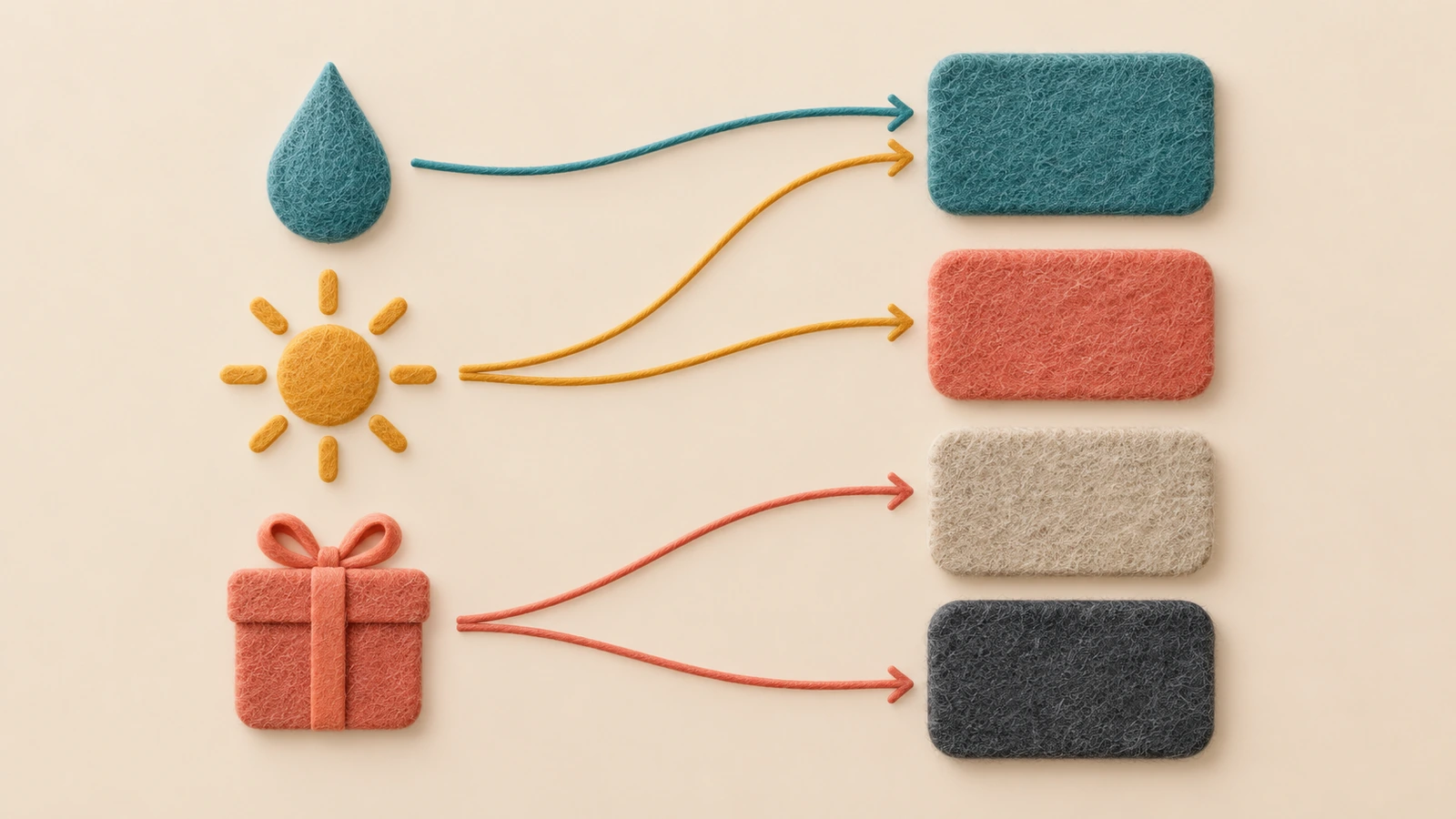
Step 1: Define the environment before the look. Write down where the sticker will be used. Indoor display, handled packaging, damp or refrigerated surfaces, sunlit windows and children's products each point toward a different fiber. For damp surfaces, polyester's low moisture uptake is a structural advantage. For a premium boxed gift that will never get wet, wool's feel may be worth the extra cost.
Step 2: Match felt thickness to the smallest detail in your artwork. When choosing felt thickness for die cutting, the rule is simple: thicker felt compresses under a steel-rule die, and that compression pinches and rounds small features. A practical starting point is to keep line widths and gaps no thinner than the felt itself and then confirm on a physical sample. Very thin felt creates a different problem. A technical guide on felt bonding notes that for felt under about 1 mm, adhesive should go on the substrate rather than the felt (thin-felt bonding guidance[1]). The same open structure that makes this necessary can let a sticker's adhesive strike through to the visible face of the felt.
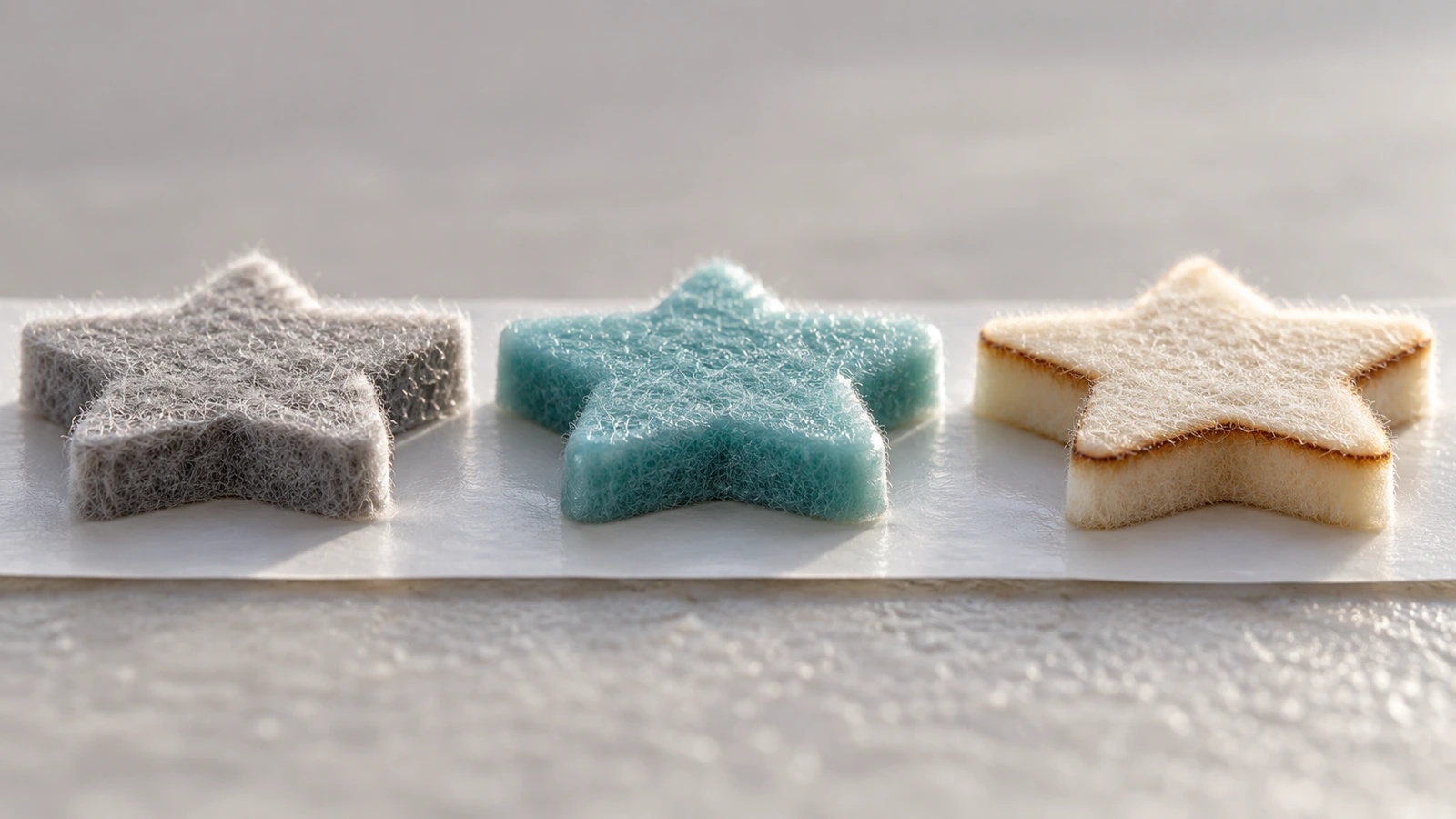
Step 3: Choose the cutting method for the fiber. Steel-rule dies give the cleanest result on dense pressed wool and on calendered polyester. Laser cutting fuses polyester and acrylic edges, which stops fraying but can leave a hard, glassy bead. On wool, a laser chars the edge to brown, which shows on light colours. If you want a soft, sealed edge on a synthetic felt, ask the supplier to show laser samples at production power, not just die-cut samples.
Step 4: Ask for colour fastness evidence for each colour. Light fastness is measured with ISO 105-B02:2014[2], a xenon-arc test that simulates daylight and grades fading against a blue wool reference scale. A supplier claim of "grade 4" is meaningless unless it refers to your actual colour on your actual fiber. Pale tints and some bright shades fade faster than navy or black, whichever fiber you choose. The standard is maintained by ISO's textiles committee, ISO/TC 38[3], which also publishes the other parts of the ISO 105 series if you need rub or water fastness data.
Step 5: Check the finish and the adhesive, not just the fiber. Felt sold as "water-repellent" or "stain-resistant" may carry a fluorinated finish. In the EU, a REACH restriction applies from 10 October 2026 to PFHxA at 25 ppb or more in textiles for apparel and related accessories (Textile School summary[4]). The legal basis is Regulation (EC) No 1907/2006[5]. In the US, trade coverage of 2026 PFAS rules notes that adhesives used in textile assembly are increasingly in scope as well (Adhesives & Sealants Industry[6]). For California, OEHHA added a developmental-toxicity endpoint for bisphenol S on 8 December 2025 and stated that product stickers can be a source of consumer exposure (OEHHA notice[7]). For the full material-check list, see the compliance section on the felt sticker product page.
Step 6: Test the sample the way it will be used. Rub the face with a thumbnail 20 times and look for fuzz. Stick a sample to the real substrate, press it firmly, leave it overnight and peel it. Put one sample in a sunny window next to an unexposed control sample. These simple checks will not replace lab reports, but they will show quickly whether you have a needle felt that pills or an acrylic that lifts at the edges. Once you know which fiber passed, write the fiber, construction and thickness into your request for quote.
Polyester Felt vs Wool Felt, Plus Acrylic and Wool Blend: Side-by-Side Comparison
The table below summarises typical behaviour. Moisture-regain and flammability values are standard textbook figures for each fiber type, not test results for a specific sheet. Ask your supplier for data on the exact felt being quoted.
Criterion
Polyester felt
Acrylic felt
Wool-blend felt
Pure wool felt
Typical construction
Needle-punched, often heat-set or calendered
Needle-punched, often low density
Needle-punched or pressed
Pressed or needle-punched
Edge sharpness (die cut)
Good when calendered; fuzz on low-density grades
Fair; fine lines soften
Good
Best on dense pressed grades
Pilling and surface fuzz
Moderate; strong fibers anchor pills that do form
Highest of the four
Low to moderate
Low on dense grades
Colour range
Very wide; solution-dyed options are very consistent
Limiting oxygen index (LOI) is the minimum oxygen concentration a material needs to keep burning. Air contains about 21% oxygen, so a fiber with an LOI around 25 tends to go out once the flame source is removed, while a fiber below 21 tends to keep burning. This is why wool has a reputation for being naturally flame resistant. However, the adhesive layer, any finishes and the surface the sticker is applied to all change how the whole assembly behaves. Never describe a felt sticker as "fire resistant" unless the finished product has been tested to the standard your customer requires.
Acrylic Felt vs Polyester Felt: The Budget Decision
At the low end of the price range, the choice is usually acrylic felt vs polyester felt. Acrylic offers brighter colours and a softer, more wool-like feel. Polyester offers better abrasion resistance, better dimensional stability and, in recycled grades, a sustainability story you can document. For anything that will be touched every day, such as laptops, phone cases or cup sleeves, polyester's lower pilling usually outweighs acrylic's colour advantage. Acrylic works well for single-use event giveaways, where the sticker only needs to look bright for a short time.
Wool Blend Felt Durability: Where the Middle Ground Breaks Down
Blends are meant to combine wool's surface with a synthetic fiber's stability and lower cost, and at high density they usually succeed. The problem is that the same blend name can describe very different products. A low-wool, low-density blend can pill as much as acrylic, while a dense blend can approach pure wool for edge quality. To evaluate wool blend felt durability, ask for three numbers: the fiber percentages, the weight in g/m² and the thickness in mm. Two sheets with the same blend ratio but different weights will not perform the same.
Where Pure Wool Earns Its Price
Pure wool is worth the cost when the sticker is part of the product experience: on a gift box lid, a candle label or a heritage-style retail tag. In these uses the customer touches the felt, and a dense pressed edge shows quality in a way synthetics cannot match. Wool is a poor choice for stickers on items that are regularly washed, for very pale colours that need to stay unchanged in direct sun, and for projects where the budget per piece is very tight.
Polyester Felt vs Wool Felt: Frequently Asked Questions
FAQ: Is wool felt always better than polyester felt for stickers?
No. Wool produces better edges and a richer feel, but polyester is more stable in humidity, more consistent in colour from one reorder to the next and cheaper. For handled packaging or high-volume merchandise, polyester is often the better engineering choice. Wool is better when the felt surface itself is part of the brand experience.
FAQ: Does wool felt make a sticker fireproof?
No. Wool fiber chars and tends to self-extinguish, with a typical LOI around 25, but the adhesive and any finishes are also part of the sticker. Only a test on the finished product against a named standard supports a fire claim. Without that test report, describe the material and make no performance claim.
FAQ: What felt thickness works best for die cutting detailed logos?
Thinner, denser felt holds finer detail, because thick felt compresses under the die and rounds off small features. Size line widths and gaps no thinner than the felt, then confirm on a sample. Very thin, open felt can let adhesive show through, so density matters as much as thickness.
FAQ: Can acrylic and polyester felt be laser cut?
Yes. Both fuse at the cut line, which stops fraying but can leave a hard edge. Acrylic needs effective fume extraction during cutting. Ask to see edge samples cut at production settings before you approve a laser-cut job.
FAQ: Will polyester felt fade in sunlight?
That depends on the dye and the specific colour more than on the fiber. Solution-dyed polyester is usually among the most lightfast options. Request results to ISO 105-B02 for each colour you plan to use, rather than relying on a general fiber claim.
FAQ: Do felt stickers for children need extra checks whatever the fiber?
Yes. In the US, products designed mainly for children aged 12 and under come under the CPSIA[8]. That means third-party testing, a Children's Product Certificate and permanent tracking labels[9]. Small-parts warnings may also apply under the rules listed in the CPSC labeling overview[10].
Key Takeaways
Wool is the fiber that resists burning, but only the finished sticker can be rated. — typical LOI ~25 for wool vs ~20–21 for polyester, against ~21% oxygen in air (Source)
Every lightfastness claim should name the test and the colour. — ISO 105-B02:2014 grades fading against a blue wool scale under xenon-arc light (Source)
Thin, open felt changes how adhesive behaves. — below about 1 mm, bonding guidance changes where the adhesive is applied (Source)
Water-repellent finishes now carry EU limits. — PFHxA restricted at 25 ppb in apparel-related textiles from 10 October 2026 (Source)
The adhesive layer is part of the chemical review. — OEHHA added a BPS developmental endpoint on 8 December 2025 and named product stickers as an exposure route (Source)
Children's felt stickers move into a different compliance tier. — the CPSIA applies to products for children aged 12 and under (Source)
Conclusion: Specify the Fiber, Then Ask for the Quote
There is no single winner in the polyester felt vs wool felt comparison. There is only the right fiber for the environment, level of detail and budget of a particular sticker. Polyester covers most branded, handled and high-volume uses. Wool earns its premium where the customer touches the felt and judges quality by it. Acrylic and wool blends fill the gaps, provided you specify their density. Write the fiber, construction, thickness and colour-fastness requirement into your brief, test one sample in real use, and every quote you receive will be directly comparable.
When your specification is ready, share your artwork and use case on our custom felt stickers page. We will recommend a fiber and construction for your design and quote against that specification.
Hi there! I'm Bruce, proud dad to my amazing son. I'm the founder of Zigpac, a printing and packaging company empowering small and medium-sized businesses with custom solutions. Let's create something great together!



 Blog PDF for offline reading












The information below is required for social login
Sign In
Create New Account