We use cookies to enable our websites to remember information, to help some website functionalities to work properly, to understand how you interact with and use our websites and to display you content and ads that are relevant and engaging for you.
By clicking Accept All you consent to the use of these cookie.
The store will not work correctly when cookies are disabled.
Quick answer: A corrugated box calculation has three steps. First, multiply the weight of each packed box by the number of boxes stacked above the bottom one, then divide by your combined environmental factors (humidity, storage time, pallet pattern, handling) to get the required box compression strength (BCT). Second, estimate the BCT a board can deliver with the simplified McKee formula, BCT ≈ 5.87 × ECT × √(caliper × perimeter), and pick the lowest board grade that clears the requirement. Third, calculate the blank area to estimate board use, box weight and material cost per unit before you request quotes.
Last reviewed: October 2026. All worked numbers below are illustrative engineering examples, not supplier quotes.
Most packaging specs start with someone writing "32 ECT" on a purchase order because the last box used it. A proper corrugated box calculation replaces that habit with three numbers you can defend to finance and to your supplier: how much compression the bottom box must survive, how much a given board grade can deliver, and how much board each box consumes. This guide works through all three with one example box, so you can reuse the method with your own dimensions and loads.
Why guessing the board grade costs more than doing the math
The failure pattern is predictable. A grade that holds up in a dry test room loses strength once it sits on a pallet for weeks in a humid warehouse. The bottom tier starts to bulge, then the stack leans, and the damage gets blamed on the carrier. The opposite mistake is just as expensive and harder to see. Teams that were burned once move every SKU to double-wall board. That adds board weight, wall thickness and outer dimensions, and on parcel lanes the extra outer size can push shipments into a higher dimensional-weight bracket.
Both mistakes come from the same gap: nobody wrote down the load, the environment or the board's expected capacity. The three calculations below close that gap using inputs you can measure or request from a supplier. They do not replace compression testing, but they tell you which grades are worth testing.
What does a corrugated box calculation actually cover?
For shipping and warehousing, the calculation links four measurable properties of a corrugated board box. The Fibre Box Handbook[1] published by the Fibre Box Association is the standard North American reference for how these properties relate to box design, storage and use.
Input
What it measures
Unit used in this guide
Where the number comes from
ECT (Edge Crush Test)
Edgewise compressive strength of the combined board
lb/in
Board grade from the supplier; test method per ISO 3037:2022[2] or TAPPI edge-crush methods
Caliper (h)
Thickness of the combined board
inches
Supplier data sheet or caliper gauge
Perimeter (Z)
2 × (length + width) of the box
inches
Your box dimensions
BCT (Box Compression Test)
Top-to-bottom load a finished box carries before failure
lbf
McKee estimate, then lab test (for example, TAPPI T 804)
ECT predicts stacking performance. Burst predicts puncture and rough-handling resistance. That is why the stacking math below uses ECT and never converts a burst rating into a compression value. Board and box specifications in the U.S. fall under ASTM Subcommittee D10.27[4], which covers documents such as ASTM D4727 (sheet specification) and D5118 (box fabrication practice).
The worked example used throughout is a regular slotted container (RSC) with inside dimensions of 16 × 12 × 10 in. Each packed box weighs 25 lb, and pallets are stacked five boxes high and then double-stacked in the warehouse.
Step 1: Calculate the top load on the bottom box
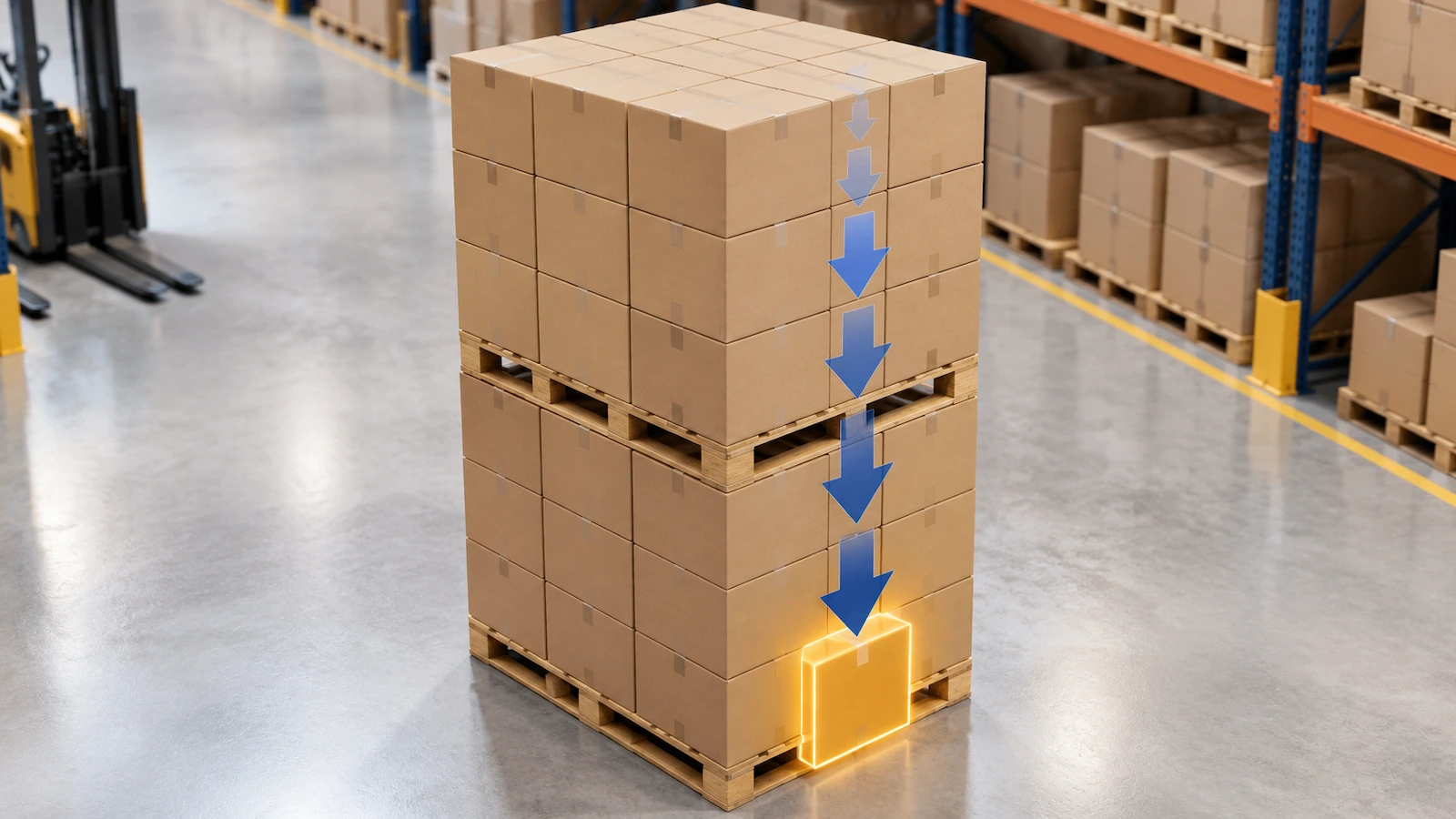
The bottom box carries every box above it in its column, not its own weight.
Top load = weight per packed box × (boxes in the column − 1)
In the example, two pallets of five layers give a 10-box column. The bottom box carries 9 × 25 lb = 225 lb. If the upper pallet's deck weight rests on the lower boxes, add its share per column. For a 40 × 48 in pallet holding six boxes per layer, divide the deck weight by six. Leaving it out makes the result look safer than it is.
Use the worst real case, not the planned one. If the receiving warehouse stacks three pallets high, the column is 15 boxes and the top load becomes 14 × 25 = 350 lb. A single question to the 3PL ("what is your maximum pallet stack height?") can change the required grade.
Step 2: Convert top load to required BCT with a safety factor
Lab BCT is measured on fresh boxes at standard conditions. Real stacks lose strength over time and with moisture. Engineers model this with loss multipliers that are each below 1.0, and combine them into a safety factor:
Safety factor = 1 ÷ (product of all loss multipliers) Required BCT = top load × safety factor
Moisture is usually the largest multiplier. Research compiled by the Georgia Tech Renewable Bioproducts Institute[5] shows box compression strength falling as board moisture content rises. In the data set behind this guide, one reference point was roughly a 32% BCT loss at 80% relative humidity, and ocean-freight references cite losses approaching 50%. These values depend on paper furnish, flute, storage time and test conditions. Treat them as planning inputs, not constants.
The multipliers below are example assumptions for the worked case. Replace them with Fibre Box Handbook guidance for your conditions, or better, with your own aged BCT tests.
Condition
Example multiplier
Why it applies
Humidity (about 80% RH warehouse)
0.68
Reflects the ~32% BCT loss reference point
Multi-week storage under load
0.60
Board creeps under sustained load
Handling and transit damage
0.90
Dents and scuffed corners reduce load-bearing edges
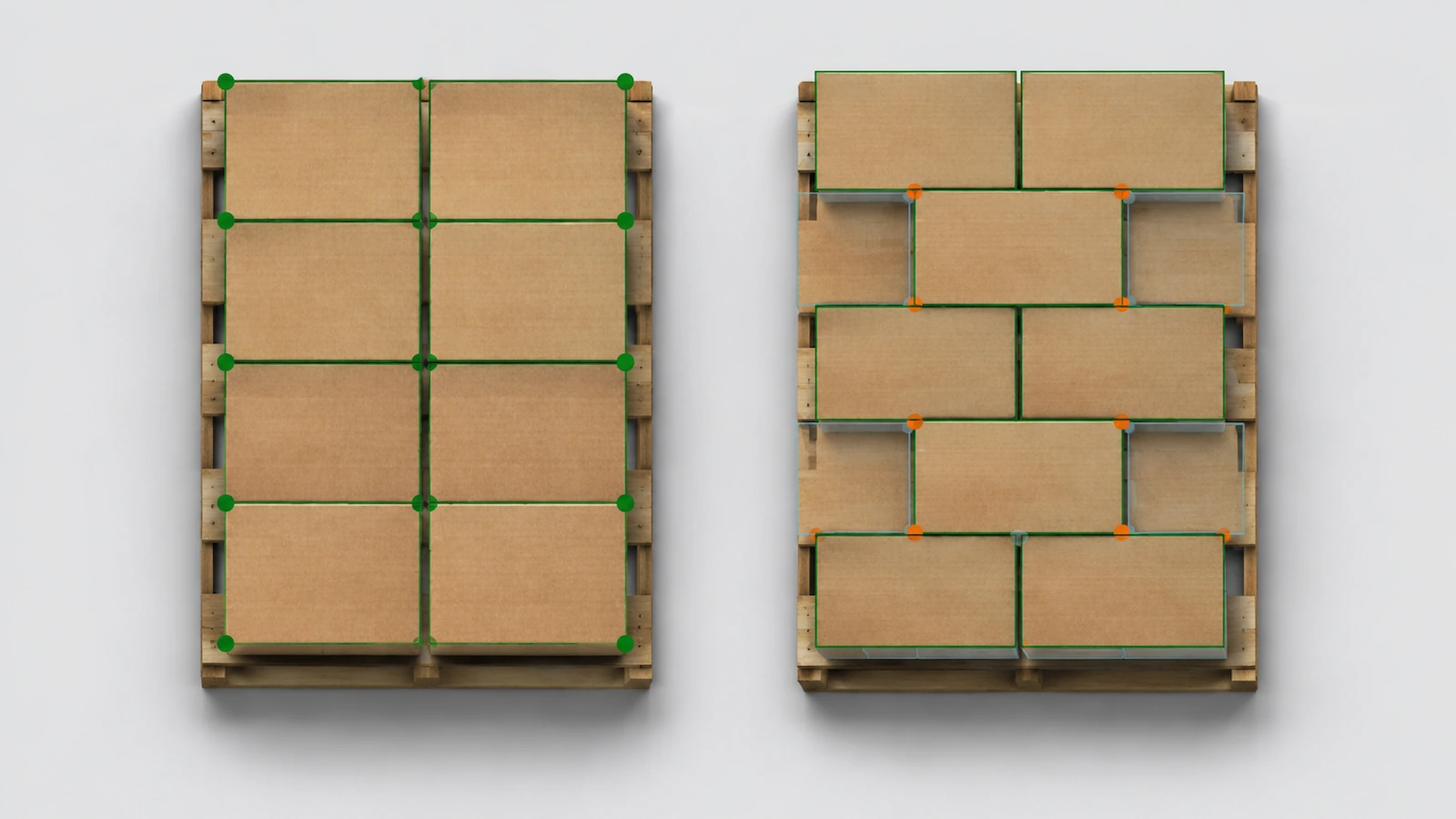
Interlocked pallet pattern
0.60
Box corners no longer sit on corners below
Column-stacked pattern
1.00
Corners align, so no pattern loss
Column-stacked: 0.68 × 0.60 × 0.90 = 0.367, so the safety factor is 2.72 and required BCT = 225 × 2.72 ≈ 613 lb. Interlocked: 0.367 × 0.60 = 0.220, so the safety factor is 4.54 and required BCT = 225 × 4.54 ≈ 1,021 lb.
The pallet pattern alone adds about 400 lb to the requirement. Before you upgrade board, check whether column stacking is possible. Column stacks trade some load stability for compression strength, so confirm that stretch wrap or corner boards can compensate.
Step 3: Estimate BCT from ECT with the McKee formula
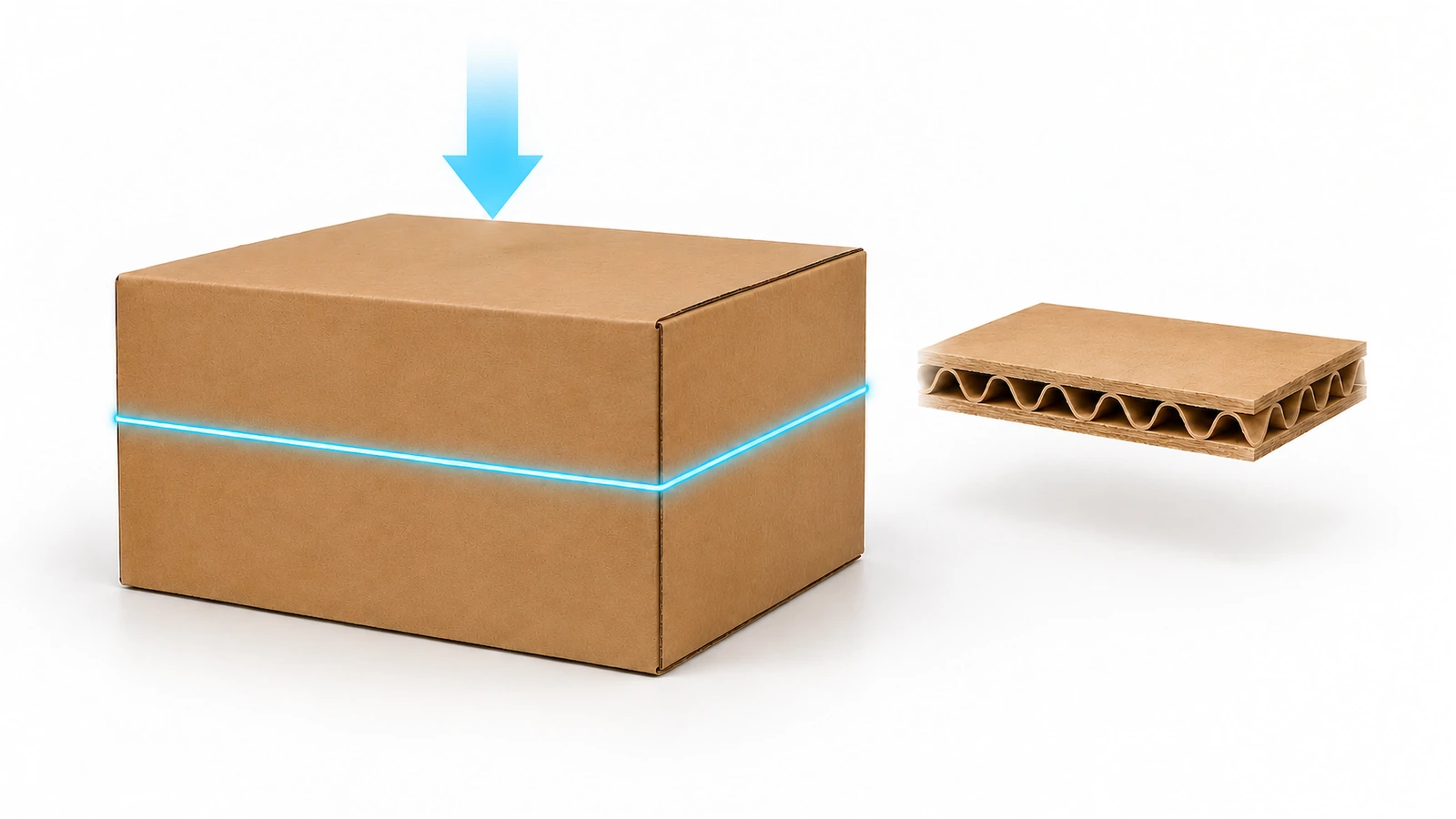
The simplified McKee formula estimates the BCT of an RSC from three inputs:
BCT ≈ 5.87 × ECT × √(h × Z)
where ECT is in lb/in, h is board caliper in inches, Z is box perimeter in inches, and BCT is in lbf.
For the example box, Z = 2 × (16 + 12) = 56 in. A single-wall C-flute board is roughly 0.16 in thick (C flute is about 3.2–4.0 mm), so h × Z = 8.96 and √8.96 ≈ 2.99.
With 32 ECT single-wall board: BCT ≈ 5.87 × 32 × 2.99 ≈ 562 lb. That falls short of both the 613 lb column requirement and the 1,021 lb interlocked requirement.
Reverse the formula to find the minimum ECT:
Required ECT = required BCT ÷ (5.87 × √(h × Z))
Single-wall (h = 0.16), column stack: 613 ÷ 17.57 ≈ 34.9, so the next common grade, 40 ECT, works.
Single-wall, interlocked: 1,021 ÷ 17.57 ≈ 58.1. That is beyond typical single-wall grades.
Double-wall BC flute (h ≈ 0.25), interlocked: √(0.25 × 56) = 3.74, so 1,021 ÷ 21.96 ≈ 46.5, which points to 48 ECT double-wall.
Thicker board helps through the square root, so doubling caliper raises BCT by only about 41%. That is why grade (ECT) and pallet pattern usually matter more than flute choice alone.
Where McKee is weak: it assumes a standard RSC with ordinary proportions, intact panels and edge-to-edge loading. Expect real BCT to fall below the estimate when boxes have hand holes, vents, perforations, heavy print coverage, die-cut mailer geometry or unusually shallow depth. Some proportions behave differently, so don't stretch the estimate there. Use McKee to shortlist grades, and use a compression test to approve one.
Step 4: Calculate blank board area
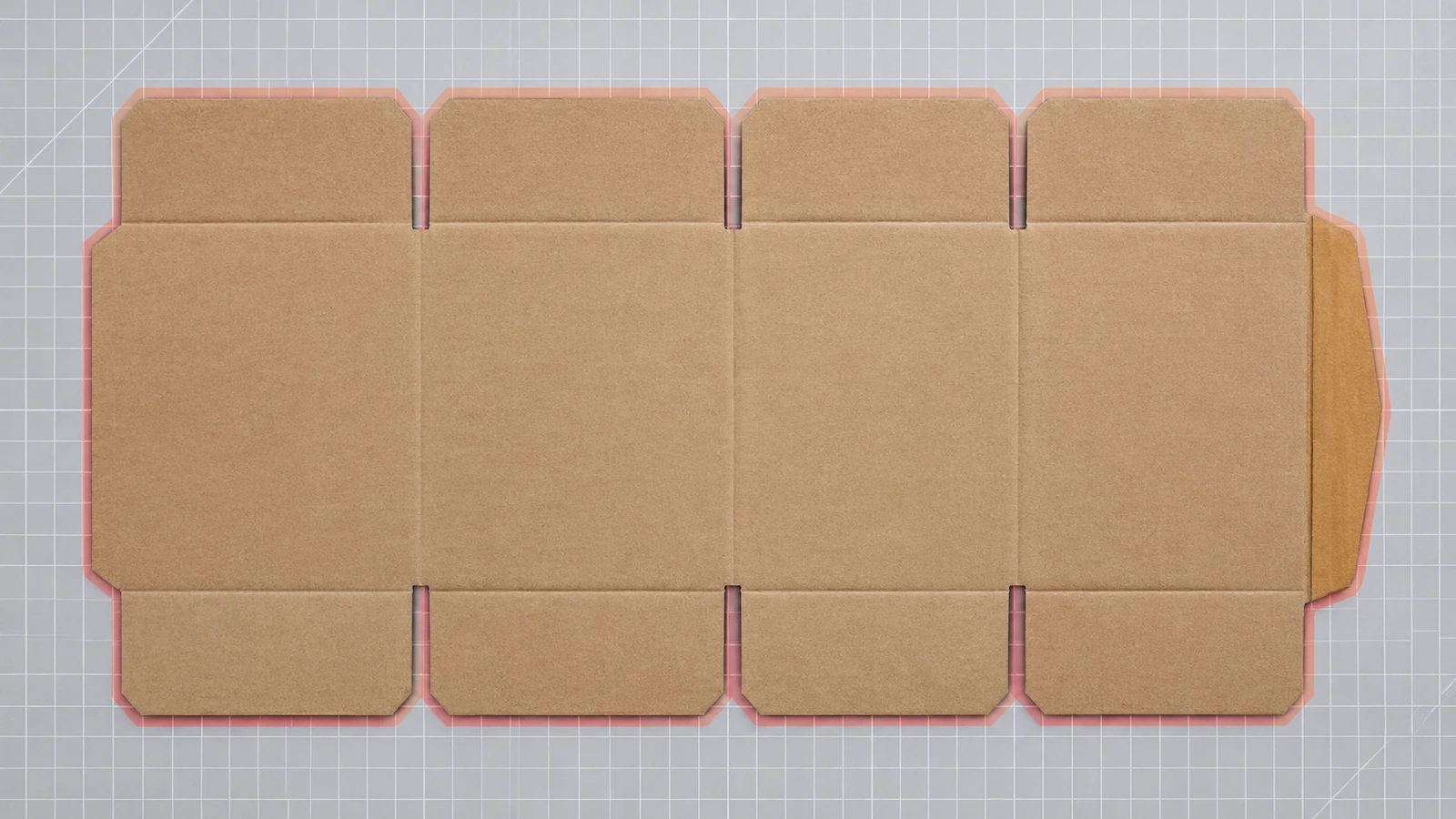
An RSC (style 0201 in the FEFCO Code[6]) is cut from one rectangular blank. Each flap is half the box width, so the top and bottom flaps together add one full width to the blank's height.
Assume a 1.5 in glue flap and about 0.5 in of combined score allowance in each direction. Actual allowances depend on caliper and the converter's scoring equipment, so ask for the real figure.
Blank length = 32 + 24 + 1.5 + 0.5 = 58 in
Blank width = 10 + 12 + 0.5 = 22.5 in
Net blank area = 58 × 22.5 = 1,305 in² ÷ 144 = 9.06 ft²
Converters also lose board to trim, setup and sheet layout. Applying an example 8% waste allowance gives a gross of about 9.79 ft² per box, or 9.79 MSF (thousand square feet) per 1,000 boxes. Ask each supplier what waste allowance they price in, because it can differ from yours.
Step 5: Turn board area into weight and per-unit material cost
Board cost per box = gross area (ft²) ÷ 1,000 × board price per MSF
For the example, board cost per box = 0.00979 × the quoted board price per MSF. This keeps the comparison honest. When two suppliers quote different unit prices for "the same box", you can check whether the difference comes from board grade, waste allowance or conversion (printing, die-cutting, gluing, labor, amortized tooling). Material is only one line. The full unit price also includes freight and any plates or dies.
Box weight = net area × combined board basis weight
If the supplier's combined board weight is about 0.11 lb/ft² (an example value; request the real number for your grade), the empty box weighs roughly 9.06 × 0.11 ≈ 1.0 lb. Moving to double-wall adds a liner and a medium, so weight rises noticeably.
That weight now feeds compliance math. U.S. state packaging EPR programs charge by material weight. A planning range used in industry discussions for paper-based packaging is about $0.01–0.03 per lb, or roughly $0.01–0.03 for this box. Rates vary by state, year and producer responsibility organization, so verify them before budgeting. For EU-bound shipments, Regulation (EU) 2025/40 (PPWR)[7] has applied generally since 12 August 2026. It pushes packaging minimization, and the European Commission's packaging waste page[8] tracks the implementing acts. Under these rules, documented box weight and void space carry real compliance weight.
Material efficiency also matters on the recovery side. The American Forest & Paper Association[9] reports that about 69%–74% of U.S. cardboard available for recovery was recycled in 2024. The often-quoted 96.5% corrugated recycling rate comes from EPA 2018 data[10] using a different method. The two figures are not a trend line, so cite each with its year and method.
Comparison: which board grades pass the worked example
All rows use the same 16 × 12 × 10 in box (Z = 56 in) and the requirements from Step 2. Margin is estimated BCT divided by requirement, minus one.
Board grade (example)
Caliper (in)
McKee BCT (lb)
Column stack (needs 613 lb)
Interlocked (needs 1,021 lb)
32 ECT single-wall C
0.16
562
Fails (−8%)
Fails (−45%)
40 ECT single-wall C
0.16
703
Passes (+15%)
Fails (−31%)
44 ECT single-wall C
0.16
773
Passes (+26%)
Fails (−24%)
48 ECT double-wall BC
0.25
1,054
Passes (+72%)
Passes, thin (+3%)
51 ECT double-wall BC
0.25
1,120
Passes (+83%)
Passes (+10%)
Three decisions come out of this table. First, the familiar 32 ECT grade is under-specified for this stack even in the best pallet pattern. Second, changing to column stacking lets a single-wall 40 ECT board do the job, which avoids the weight and thickness penalty of double-wall. Third, if interlocking is unavoidable, 48 ECT double-wall passes only on paper. A 3% margin is inside normal board and test variation, so 51 ECT, or a BCT test on 48 ECT, is the safer approval path.
The same math applies to standard corrugated boxes from stock. A stock box with a printed ECT rating either clears your required BCT or it doesn't, so this calculation also tells you whether a stock size is safe before you consider custom tooling.
Validate before you scale
The calculation narrows the choice. Testing makes the decision. Before a production order:
Run BCT on boxes conditioned to your worst humidity, not just standard lab conditions.
Compare measured BCT with the McKee estimate. If it is more than about 10–15% lower, look for weak scores, print coverage or joint quality.
Add drop and vibration tests if product damage, rather than stacking collapse, is the main risk.
Record the inputs (top load, multipliers, ECT, caliper, blank size) in the specification, so reorders can be checked against the same numbers.
When the numbers are ready, send them with your quote request. Required BCT, inside dimensions, stacking pattern and humidity let a factory quote the right grade instead of a default one. Our custom corrugated shipping boxes page explains how to submit those specifications, how quality inspection and approval work, and how to compare buying routes, so those topics aren't repeated here.
FAQ
FAQ: How do I calculate the BCT my box needs?
Multiply the packed weight of one box by the number of boxes above the bottom box to get the top load. Then divide by the product of your loss multipliers for humidity, storage time, handling and pallet pattern. In the worked example, a 225 lb top load became a 613 lb requirement for column stacking and 1,021 lb for interlocked stacking.
FAQ: Is the McKee formula accurate enough to place an order?
It is accurate enough to shortlist grades for standard RSCs, but not to approve them. Hand holes, vents, heavy print, die-cut styles and unusual proportions can push real BCT below the estimate. Confirm the final grade with a box compression test on conditioned samples.
FAQ: Can I convert a Mullen burst rating into ECT?
Not reliably. Burst (ISO 2759) measures rupture through the board face, while ECT (ISO 3037) measures edgewise compression. A 200# burst board and a 32 ECT board are often listed side by side, but they are not equivalent for stacking. Use ECT for compression math and burst for puncture risk.
FAQ: How much does humidity change the result?
Often more than any other factor. The research data used in this guide includes a reference point of about 32% BCT loss at 80% relative humidity, and ocean-freight references cite losses approaching 50%. Model your worst storage environment, then confirm with conditioned tests.
FAQ: Does a heavier box always mean a safer box?
No. In the worked example, switching from interlocked to column stacking let 40 ECT single-wall board meet the requirement. Moving to double-wall would add weight, wall thickness and, under weight-based EPR fees, cost per unit. Fix the stacking pattern before you upgrade the board.
FAQ: What numbers should I bring to a supplier?
Bring inside dimensions, packed weight, maximum stack height, pallet pattern, storage humidity and duration, required BCT, and your target blank area or board grade. With those, quotes become comparable line by line instead of grade by guesswork.
Key takeaways
Required strength is the top load times a safety factor, not the product weight. — A 225 lb top load became a 613–1,021 lb BCT requirement depending on pallet pattern (Source)
Moisture is the variable most likely to break your stack. — About 32% BCT loss at 80% RH in the reference data used here (Source)
McKee turns a measured ECT into a usable BCT estimate. — 32 ECT single-wall C-flute estimates about 562 lb on a 56 in perimeter, with ECT measured per the 2022 edition of ISO 3037 (Source)
Blank area makes material cost auditable. — The example RSC uses 9.06 ft² net and about 9.79 MSF per 1,000 boxes with an 8% waste allowance (Source)
Box weight is now compliance data. — EU PPWR has applied generally since 12 August 2026 (Source)
Cite recycling rates with their method. — 69%–74% (AF&PA, 2024) and 96.5% (EPA, 2018) are not comparable (Source)
Conclusion
A corrugated box calculation takes about fifteen minutes with a spreadsheet and replaces a default grade with a documented decision. Calculate the top load, apply honest loss multipliers, use McKee to find the lowest grade that clears the requirement, and use blank area to see what that grade costs in board and weight. Then test the shortlisted grade under your worst conditions. Arriving with numbers lets you compare quotes on substance and catch both under-specified and over-built boxes before they reach a pallet.
International Organization for Standardization, ISO 3037:2022, Corrugated fibreboard: Determination of edgewise crush resistance. https://www.iso.org/obp/ui/en/#!iso:std:80310:en (accessed October 2026). ↩
Hi there! I'm Bruce, proud dad to my amazing son. I'm the founder of Zigpac, a printing and packaging company empowering small and medium-sized businesses with custom solutions. Let's create something great together!



 Blog PDF for offline reading












The information below is required for social login
Sign In
Create New Account