We use cookies to enable our websites to remember information, to help some website functionalities to work properly, to understand how you interact with and use our websites and to display you content and ads that are relevant and engaging for you.
By clicking Accept All you consent to the use of these cookie.
The store will not work correctly when cookies are disabled.
Quick answer: Returnable poly mailers are shipping bags with two adhesive strips and a tear strip or perforated opening line. The customer opens the parcel without scissors, keeps the bag intact, and reseals it with the second strip to send an item back. For apparel and soft-goods brands with frequent fit-driven returns, the format removes the "find your own packaging" step, cuts damage from blades, and cuts the need to supply separate return packaging. A short live pilot is the best way to confirm the gain.
Why do apparel returns break down at the packaging step?
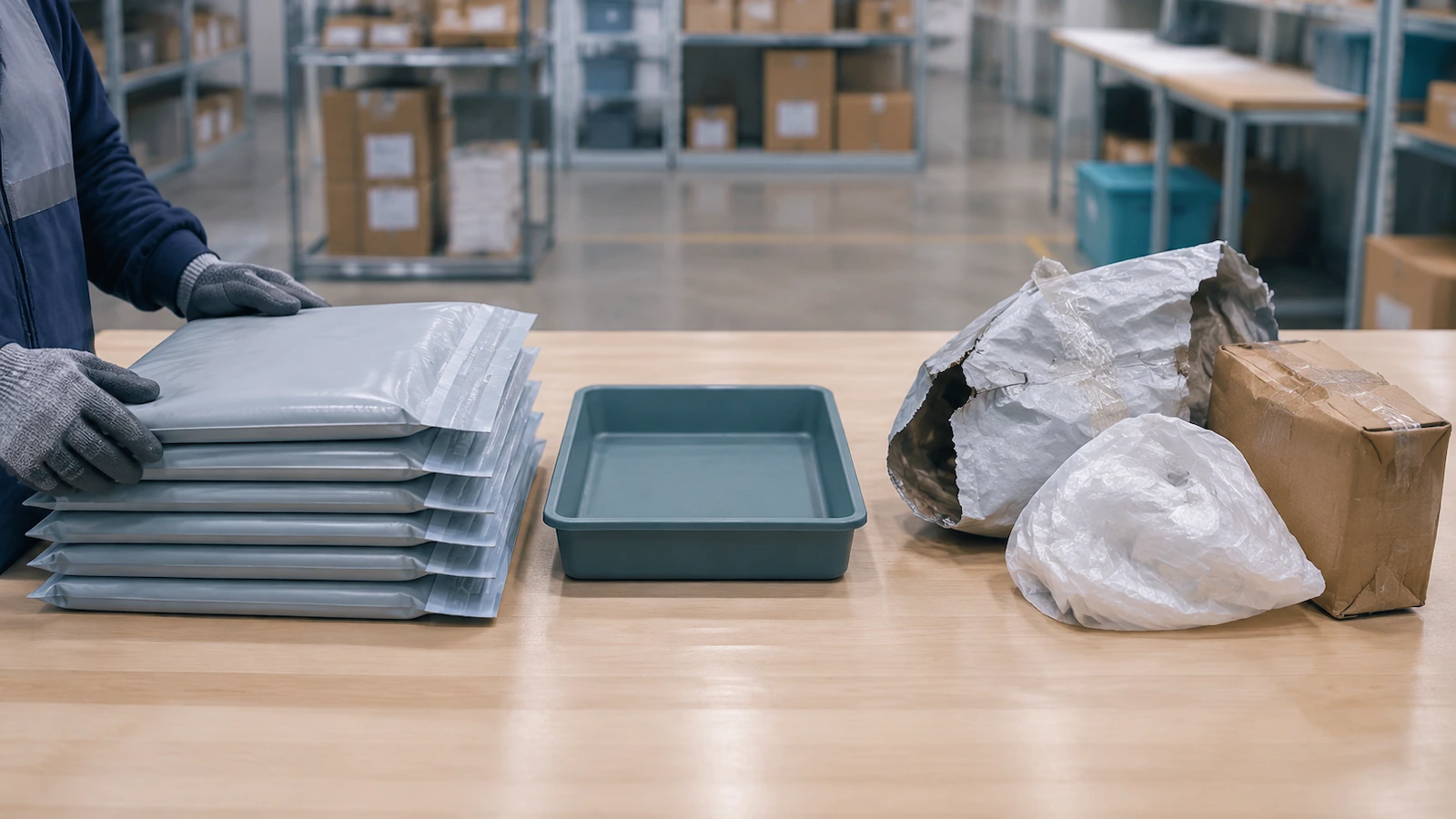
Returnable poly mailers exist because the weakest point in most apparel return flows is the moment the customer opens the original parcel. A standard single-strip mailer is built for one trip. Most customers rip it across the seal or slice it with scissors or a box cutter, and the bag cannot be used again. If that customer later decides a jacket does not fit, they have to find a grocery bag, a used box, or tape the torn mailer back together before they can start the return.
The costs of that improvisation appear in your returns center, not in your packaging budget. Items arrive in mismatched packaging that is wet, under-sealed, or labelled across creases. Support teams answer "what should I put this in?" tickets. Resale marketplace sellers report another failure: buyers cut through the mailer and the garment in one stroke, and the cut in the item lines up with the cut in the bag. The seller then has to refund an item that left the warehouse undamaged.
Pressure from outside is also changing how brands judge plastic packaging. Amazon reported that the share of its North American shipments containing single-use plastic delivery packaging fell from 65% in 2023 to 37% in 2024, according to Packaging Dive's analysis of Amazon's 2024 sustainability report[1]. That figure covers one platform's own outbound packaging, not the poly mailer market. It still points in a clear direction: if a brand keeps using film, each bag has to do more work. A mailer that completes the outbound trip and the return trip makes a stronger case than one that is discarded at the door.
The solution is not a new material. It is a closure layout that plans for a second trip from the start, and then a test of whether your customers actually use it.
What are returnable poly mailers?
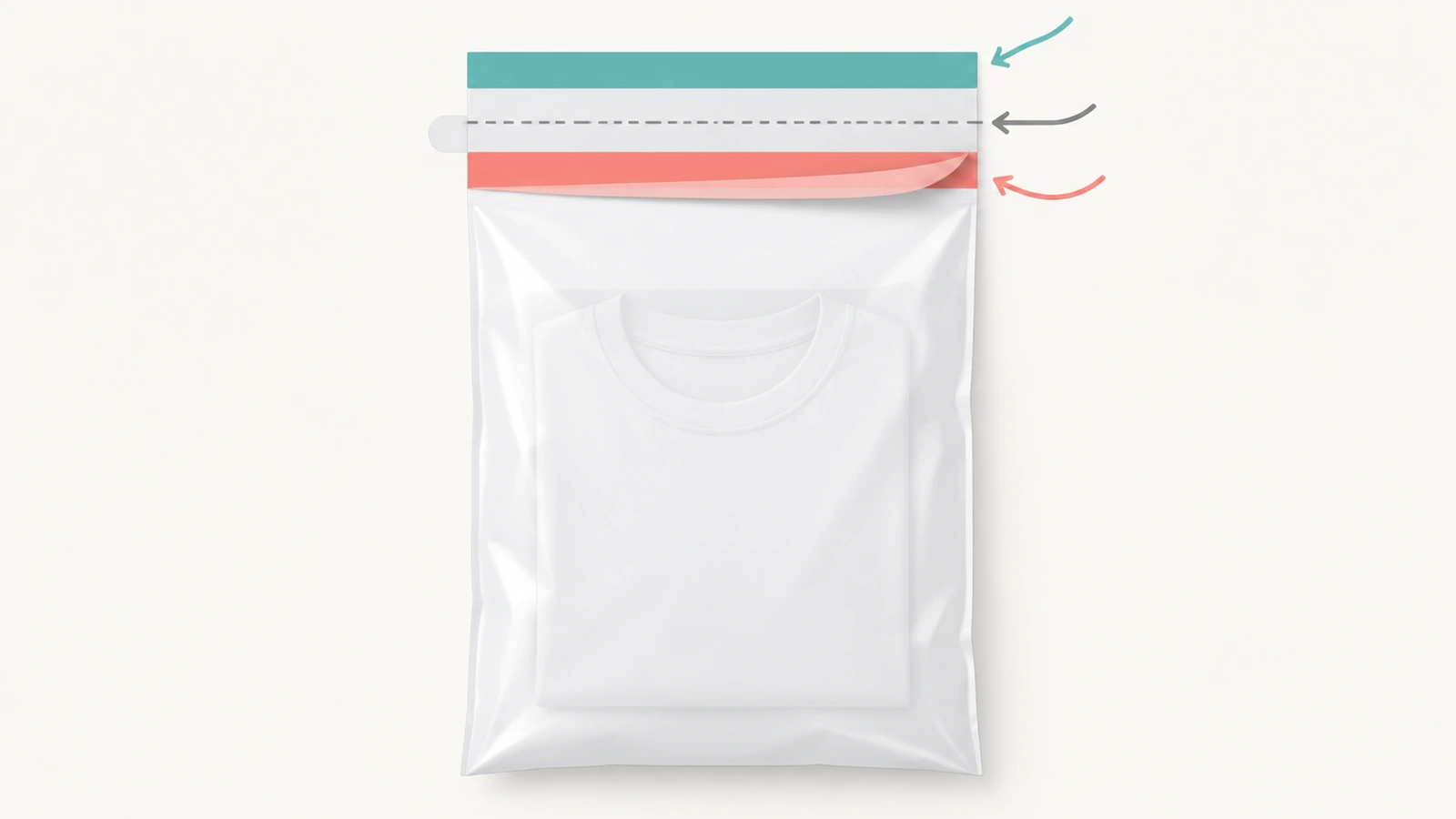
A returnable poly mailer is a polyethylene shipping envelope with three functional zones instead of one:
Outbound seal. The first peel-and-seal adhesive strip closes the bag at your packing station, the same way a standard mailer does.
Opening line. A tear strip (a pull tab that splits the film along a set path) or a row of perforations sits just below the outbound seal. Perforated poly mailers use a line of small cuts so the film parts cleanly by hand. Tear-strip versions add a tab so the customer knows where to start.
Return seal. A second adhesive strip stays covered by a release liner until the customer needs it. After opening along the tear line, the remaining bag is slightly shorter but still has a fresh closure.
The format is gaining attention in the trade. At PACK EXPO 2024, packaging machinery maker PAC Machinery presented reusable poly mailers designed to let items be returned in the same mailer, as reported by Packaging World[2]. Resale sellers describe the same behavior from the receiving side: many keep mailers that arrive in good condition and reuse them because they have a second adhesive strip.
A returnable mailer is a closure and opening design, not a different product category. Film, print, and size decisions follow the same rules as any branded mailer. Those choices are covered on our page for custom poly mailers for branded apparel and soft-goods shipping, so this article stays on the return mechanics.
How do returnable poly mailers work in a real return loop?
The loop has four hand-offs, and each one can fail in its own way.
Pack and seal (your warehouse). The packer uses only the outbound strip and leaves the return liner untouched. The usual failure is a packer who peels the wrong liner. This is more likely when both strips look the same. Color-coded liners or a print cue on the bag reduce the error.
Open (customer). The customer pulls the tear strip or tears along the perforation. If the opening line runs too close to the seal, the tear can drift into the adhesive area. If it runs too far down, it can wander into the bag body. In either case the bag cannot be resealed.
Reseal and relabel (customer). The customer refolds the item, peels the second liner, and attaches a return label. The label must sit on a flat panel, not across the fold or the old shipping label's barcode.
Receive and process (returns center). Your team opens the bag a second time, inspects the item, and decides what happens to the film. That decision is covered in the end-of-life section below.
Flexibility matters on the return trip too. The USPS Domestic Mail Manual, section 201[3] states that flat-size pieces must be flexible and that tight wrappers containing boxes are not flats. Its flexibility test asks whether a piece can bend at least 1 inch vertically without damage. A garment refolded loosely in a slightly shorter bag can end up stiffer or more overstuffed than it was outbound. Tell customers to return the item folded the way it arrived, without extra inserts.
When are returnable poly mailers worth adopting?
The format pays off when three conditions are true at once. If one is missing, a standard mailer plus clear return instructions is often enough.
1. Returns are a routine part of your business, not an exception. Fit-driven categories such as apparel, swimwear, outerwear, and multi-size orders where customers buy two sizes and return one create steady return volume. If returns are rare, most second strips go unused, and you pay for a feature few customers need. Your own order history is the best evidence: count how many orders per month result in a return and which SKUs drive them.
2. The products are soft and forgiving. The bag has to survive two trips and two openings. Garments, textiles, and folded soft goods fit that profile. Items with hard corners, rigid inner boxes, or crush risk should not ride in a poly mailer in either direction. Seller forums repeatedly connect crushed or punctured goods to the wrong packaging type, not to the bag brand.
3. Your returns process can take advantage of a known package. When most returns arrive in the same bag format, inbound staff know what to expect, how to open it, and where the item sits. That consistency is a real operational gain for a 3PL or in-house returns team. It disappears if your return policy tells customers to use any packaging they like.
Consider a different approach when your business relies on printerless return drop-off where the carrier supplies a bag, or on store returns. Also skip the format if your customer base rarely returns items by mail. In those cases a second strip adds material without changing behavior.
How to set up and test returnable poly mailers in six steps
The goal of a pilot is to measure customer behavior and returns-center outcomes, not to check print quality. Sample and print checks belong to the purchasing stage and are covered on the custom poly mailer product page.
Baseline your current return flow. Before changing anything, record for one or two months: how many returns arrive in the original mailer versus other packaging, how many arrive damaged or wet, how many support tickets ask about return packaging, and how long inbound staff take to open and triage one return. Without this baseline, a pilot result cannot be interpreted.
Choose the opening mechanism. A tear strip with a visible tab is more obvious to first-time customers. A perforated line is simpler and lies flatter. Whichever you pick, place it so the tear cannot run into either adhesive zone. Ask your supplier to show where the line sits relative to both strips before production.
Make the two strips impossible to confuse. Use different liner colors or a printed cue next to the return strip. Train packers to touch only the outbound strip. Track liner mistakes during the first week of the pilot.
Put the instructions where the customer looks. Customers read the inside of the bag when they open it and your return page when they decide to return. Print a short sequence (open here, keep the bag, peel the second strip, label the flat side) and repeat it on the returns page and in the return-authorization email. Add a reminder to remove or cover the original shipping label so the parcel does not route back to the customer.
Run a split pilot. Ship a defined share of orders in the returnable format and the rest in your current mailer, using the same SKUs and the same period. Compare the share of returns that arrive in the original bag, damage on arrival, packaging-related tickets, seal failures on the return trip, and inbound handling time. Run the pilot long enough for returns from pilot orders to come back. A return cycle is longer than the shipping cycle.
Decide with your numbers, then update the policy. If the returnable cohort clearly improves original-bag usage and reduces damage or tickets, roll it out. Rewrite your return policy to tell customers to reuse the bag. If the gain is marginal, keep the format only for high-return SKUs.
When you compare costs, include more than the price difference between bag formats. Count return packaging you no longer have to mail or include, staff time saved at inbound, and refunds avoided on items damaged by blades. Those numbers come from your own baseline, which is why step 1 matters. To price the format for your volumes, request a quotation through the product page instead of relying on generic market prices.
How does the returnable format compare with other return-packaging options?
The table compares four common approaches on operational criteria. It does not show prices. Material and print costs depend on specification and quantity and should come from a quotation.
Approach
What the customer does
Extra material per order
Packing-station impact
Main risk
Best fit
Standard single-strip mailer, customer sources return packaging
Finds a bag or box, seals it, and attaches the label
None
None
Mismatched, under-sealed, or wet returns. Items cut while opening
Low-return categories
Second empty mailer included in the parcel
Uses the spare bag
A whole second bag, unused when there is no return
Extra pick-and-insert step
Spare bags thrown away by customers who keep the item
Rare, high-value returns where packaging control matters
Dual-adhesive returnable mailer with tear strip or perforation
Opens along the line, reseals with the second strip
A second strip and opening line on the same bag
Packers must use the correct strip
Customer confusion if instructions are unclear. Tears that drift into the adhesive
Apparel and soft goods with routine fit-driven returns
Corrugated box with return tape
Reopens the box and seals it with the provided tape
Box and second tape strip
Box assembly
Higher dimensional weight for soft items
Rigid, fragile, or crush-sensitive products
The returnable mailer sits between the first two rows. It adds less material than an inserted spare bag and still gives the customer a ready-made return package. Its weakness is behavioral: it works only if customers understand the opening line. That is why the instructions in step 4 matter as much as the closure design.
What happens to the bag after its second trip?
A returnable mailer changes where the bag ends its life. A standard mailer ends at the customer's home. A returnable mailer that comes back ends at your returns center. That matters because consumer recycling of film is limited. How2Recycle states[4] that in the US, plastic bags, wraps, and films are not accepted in most curbside or drop-off programs. Plastic mailers with a compatible label are listed among the items suited to store drop-off. When returned bags collect in one warehouse, they can join a commercial film stream, if your facility or 3PL has one, instead of depending on each customer to find a drop-off point.
The second trip also adds a second label and a second adhesive liner. The Association of Plastic Recyclers' PE film design guidance[5] states that no label is ideal and that, when a film needs a label, a PE-based substrate is preferred over paper. Paper return labels and release liners should therefore be removed before returned film is baled. Build that removal step into the inbound workflow. GreenBlue's 2025 redesign of the Store Drop-off label[6] removed the chasing arrows out of caution over how California would define "recyclable", which shows how sensitive on-pack wording has become.
A second use does not make a bag automatically "recyclable" or exempt from claim rules. If you print "recyclable" on the bag, 16 CFR § 260.12 of the FTC Green Guides[7] allows an unqualified claim only when recycling facilities are available to at least 60% of the consumers or communities where the item is sold. Otherwise the claim must be qualified. A #4 resin code does not substitute for that claim. As the ANSI summary of ASTM D7611[8] notes, resin identification codes are not recycle codes. "Please reuse this bag for your return" is a behavioral instruction and is generally safer than an end-of-life promise. The evidence you need behind any recycling or material claim is listed on the product page.
State rules are tightening. California's SB 343 recycling-label requirements[9] restrict chasing arrows and recyclability statements for products made from October 4, 2026. Enforcement of the law was challenged in federal court during 2026, so confirm its current status with counsel. Separately, the SB 54 permanent regulations[10] took effect in 2026 and require covered single-use packaging sold in California to be recyclable or compostable by 2032. Do not assume that a second trip changes how a mailer is classified under either law. The risk is real: in 2025 California settled with four plastic bag makers over unsubstantiated "recyclable" labelling on shopping bags, for about $1.75 million in combined penalties and fees, as reported by Packaging Insights[11]. That case involved shopping bags, not mailers, but the same claim rules apply to anything printed on your packaging.
FAQ
FAQ: What is the difference between perforated poly mailers and tear-strip mailers?
Both give the customer a controlled way to open the bag without scissors. Perforated poly mailers use a line of small cuts in the film that parts by hand. Tear-strip mailers add a pull tab or a reinforced strip that guides the split and makes the starting point obvious. Tear strips are easier for first-time customers to find. Perforations are simpler and keep the bag flatter. Either works for returns if the opening line sits clear of both adhesive strips.
FAQ: Can a customer reuse a standard single-strip mailer for a return?
Only if they opened it carefully and are willing to tape it shut, which most do not. Once a single-strip bag is torn across the seal, there is no fresh adhesive to close it. A dual-adhesive design keeps an unused strip in reserve for the return trip.
FAQ: Do returnable mailers stop customers from cutting the item when they open the parcel?
They reduce the risk by giving customers a better option than a blade, but they cannot remove it. Combine the tear line with a visible "open here" cue printed on the bag. If a cut item still arrives, compare the cut in the garment with the bag. A cut that lines up with a slit across the bag body, rather than a tear along the opening line, suggests damage during opening rather than in transit.
FAQ: Where should the return label go on a resealed mailer?
Put it on a flat panel away from folds, the seal, and the original barcode, which should be removed or fully covered. Tell customers to fold the item as it arrived so the bag stays flexible. USPS treats tight wrappers around rigid contents differently from flexible flats.
FAQ: Is a returnable mailer more sustainable than a standard one?
It can deliver two shipments with one bag instead of two, and returned bags collect at your facility, where film recycling is easier to organize. It is not automatically "recyclable" for claim purposes. Any recyclability claim must meet FTC Green Guides requirements and applicable state rules, regardless of how many trips the bag makes.
FAQ: How long should a pilot run before deciding?
Long enough for returns from pilot orders to come back through your return window and be processed. Returns arrive weeks after the outbound shipment, so a pilot that stops when shipping stops will undercount the results. Compare the share of returns arriving in the original bag, damage rates, and packaging-related tickets against your baseline.
Key takeaways
Brands that stay with film need each bag to do more work as platforms move away from plastic. — Amazon's North American share of shipments with single-use plastic delivery packaging fell from 65% to 37% between 2023 and 2024 (Source)
A resealed return parcel still has to stay flexible to be treated as a flat. — USPS's flexibility test requires a flat to bend at least 1 inch vertically without damage (Source)
A second trip does not authorize an unqualified "recyclable" claim. — FTC rules require recycling access for at least 60% of consumers or communities where the item is sold (Source)
Returned bags should have paper labels and liners removed before film recycling. — APR guidance prefers 0 labels on PE film and PE-based labels over paper when a label is needed (Source)
California packaging rules apply regardless of how many times a bag is used. — Covered single-use packaging must be recyclable or compostable by 2032 under SB 54 (Source)
Conclusion
Returnable poly mailers solve a specific problem: the customer has no usable packaging when an apparel return begins. The fix is mechanical. A tear strip or perforated line opens the bag cleanly, and a second covered adhesive strip closes it again. Whether it pays off depends on your return frequency, your product mix, and whether customers follow the instructions. Measure your current return flow, run a split pilot long enough for returns to come back, and keep the format where the data supports it. When you are ready to price a dual-adhesive version for your volumes, use the custom poly mailers product page to request a quotation built around your return process.
Hi there! I'm Bruce, proud dad to my amazing son. I'm the founder of Zigpac, a printing and packaging company empowering small and medium-sized businesses with custom solutions. Let's create something great together!



 Blog PDF for offline reading














The information below is required for social login
Sign In
Create New Account