


 Blog PDF for offline reading
Quick answer: Custom business wall graphics work best when you treat walls as a planned brand channel rather than one-off decor. Audit and zone every wall by its job, translate your brand guidelines into wall-specific rules for color, scale, and type, place graphics along real sightlines, assign each one a refresh tier (identity, campaign, or event), lock everything into one master spec for every location, and measure results against a baseline you record before installation.
Custom business wall graphics are among the cheapest square footage your brand will ever own, yet most companies plan them the way they plan a birthday banner: one site at a time, one vendor email at a time, with no rules carried over to the next location. This guide is written for marketing and facilities teams who have to make a lobby, a sales floor, and a fourth or fortieth location all look like the same company.
Why Do Brand Walls Drift Off-Brand?
The problem: your brand guidelines were written for screens, print collateral, and packaging. Walls are a different medium. A logo that reads cleanly at 200 pixels can look timid on a 20-foot wall, and a brand blue that matches perfectly on paper can shift noticeably next to a warm grey eggshell paint under LED lighting.
The cost of ignoring it: without a wall-specific standard, each site improvises. One store manager orders a quote decal in a font your guidelines retired two years ago. Another location keeps an expired seasonal promotion up for months because nobody owns its removal date. Facilities then inherits the cleanup: repainting, patching, and scheduling labor around opening hours. Commercial use is not a niche, either. One market estimate puts commercial applications at roughly 25.2% of 2025 global wall decal revenue, against 74.8% residential (PW Consulting wall decals market report[1]). A separate report sizes the commercial share at 26.8% and expects it to grow faster than residential, at a CAGR of about 7.2% (MarketIntelo wall decal market research[2]). The two reports size the total market an order of magnitude apart, so treat these figures as directional rather than definitive. Both point the same way, though: more businesses are using their walls, and inconsistency is getting easier to notice.
The fix: plan wall graphics the way you plan a website. Start with a structure, define the components, write the rules, schedule updates, and track performance. The rest of this guide walks through that system.
What Counts as a Custom Business Wall Graphic?
A custom business wall graphic is any printed or cut adhesive graphic, usually custom wall graphics vinyl or a fabric-based film, that carries brand identity, information, or a campaign message on an interior wall of a commercial space. Common examples include a reception logo, a mission or values statement, a wayfinding band, a sales-floor zone marker, a meeting-room theme, or a floor-to-ceiling feature mural.
Function is what separates business use from home decor. Market analysts describe offices using wall decals for branding, motivational messaging, and wayfinding, and schools and daycares using them for class names and learning aids. One estimate places North America at about 36% of the 2024 custom name wall decal segment (Growth Market Reports[3]). Hospitality operators use graphics to re-theme rooms without a costly renovation, and restaurants use them for menus and atmosphere ([2]).
Buyer priorities have moved too. Research on the interior wall decoration sticker market, sized at about USD 1.68 billion in 2025, reports that purchase decisions now hinge on surface compatibility, residue, durability, safety, and removability rather than print alone (360iResearch interior wall decoration sticker study[4]). For a business, that list maps directly onto planning questions: which walls, for how long, and who removes the graphic afterward. This article focuses on those planning decisions. If you need to know what the product physically is, see the explainer on custom printed vinyl wall decals matched to your wall and paint.
How Do You Plan Custom Business Wall Graphics, Step by Step?
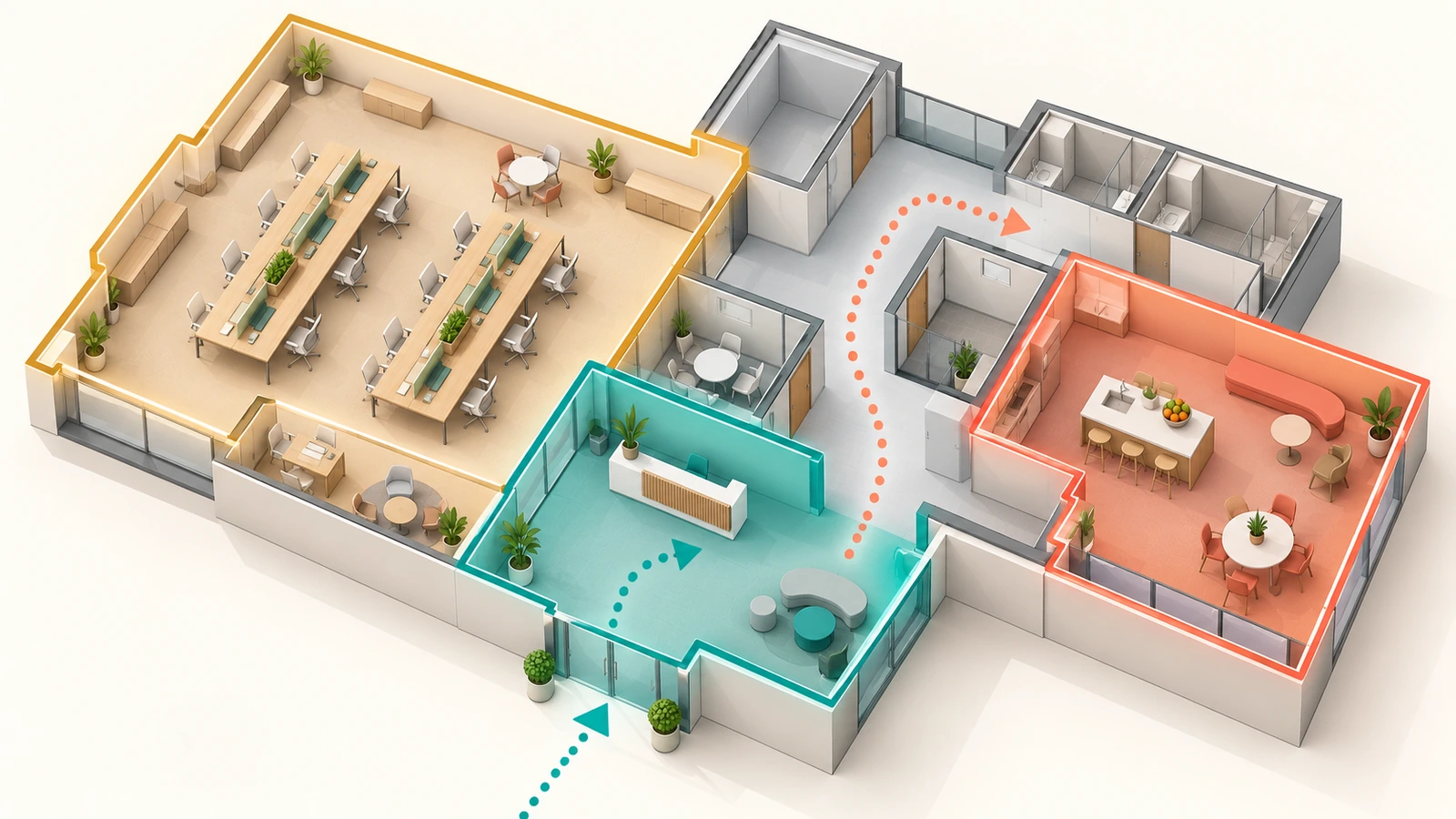
Step 1: Audit every wall and zone it by job
Walk the space with a floor plan and photograph each candidate wall straight on, with a reference object in the frame. Assign every wall one primary job:
- Arrival: reception, entry, and lobby. This is where identity matters most, so logo and brand statement belong here.
- Circulation: corridors and stair landings. Wayfinding, timelines, and culture stories work best.
- Work: open-plan and meeting rooms. Use quieter graphics such as room themes, values, or textures that do not compete with screens.
- Sales floor: retail and showrooms. Zone markers, category cues, and campaign walls go here.
- Back-of-house: break rooms and staff areas. These suit internal culture and safety reminders.
For each wall, record its surface finish, paint sheen, and the date of its last repaint. Paint deserves particular attention. US EPA architectural-coatings rules are estimated to cut about 103,000 megagrams of VOC emissions per year, and low-VOC interior paints are now the default in many fit-outs (Intel Market Research on low-VOC paint regulation[5]). Paint chemistry affects how graphics bond, so the person who specifies paint and the person who orders graphics need to talk before either order goes out. The technical reasons decals fail on certain paints are covered on the custom wall decals product page.
Step 2: Translate brand guidelines into wall rules
Add a short "environmental" appendix to your brand guidelines. It does not need to be long, but it should answer five questions a site manager will otherwise guess at:
- Logo scale and clear space. Define clear space as a proportion of logo height rather than in pixels, so it scales from a 2-foot door panel to a 12-foot feature wall.
- Color on paint. Approve brand colors against the actual wall paint, not on white paper. Keep a physical swatch board for each standard paint color you use across sites.
- Type by viewing distance. Set a minimum letter height for each zone based on where people actually stand or sit. Ornate script fonts lose legibility quickly at a distance, so reserve them for close-range accents.
- Copy length. Walls are read while walking. Cap headline statements at one short line and values at a few words each.
- Artwork source of truth. Keep one vector master file per graphic, with a version number, so every location prints from the same file.

Step 3: Place graphics along real sightlines
Placement decides whether a graphic is seen or ignored. Stand where visitors actually stand: the entry door, the queue line, the conference table chair facing the wall. A common layout rule of thumb centers focal graphics at about 57 to 60 inches from the floor and drops them a few inches lower in seated areas. Then check placement from 6 to 8 feet away using painter's tape before you approve the final position.
Also plan for what the graphic must not cover. Keep required exit and safety signage, fire extinguisher locations, thermostats, outlets, and access panels clear. Think about what will stand in front of the wall a month after opening, too. A logo hidden behind a display rack or a coat stand is wasted spend.
Step 4: Plan large-format feature walls as projects, not orders
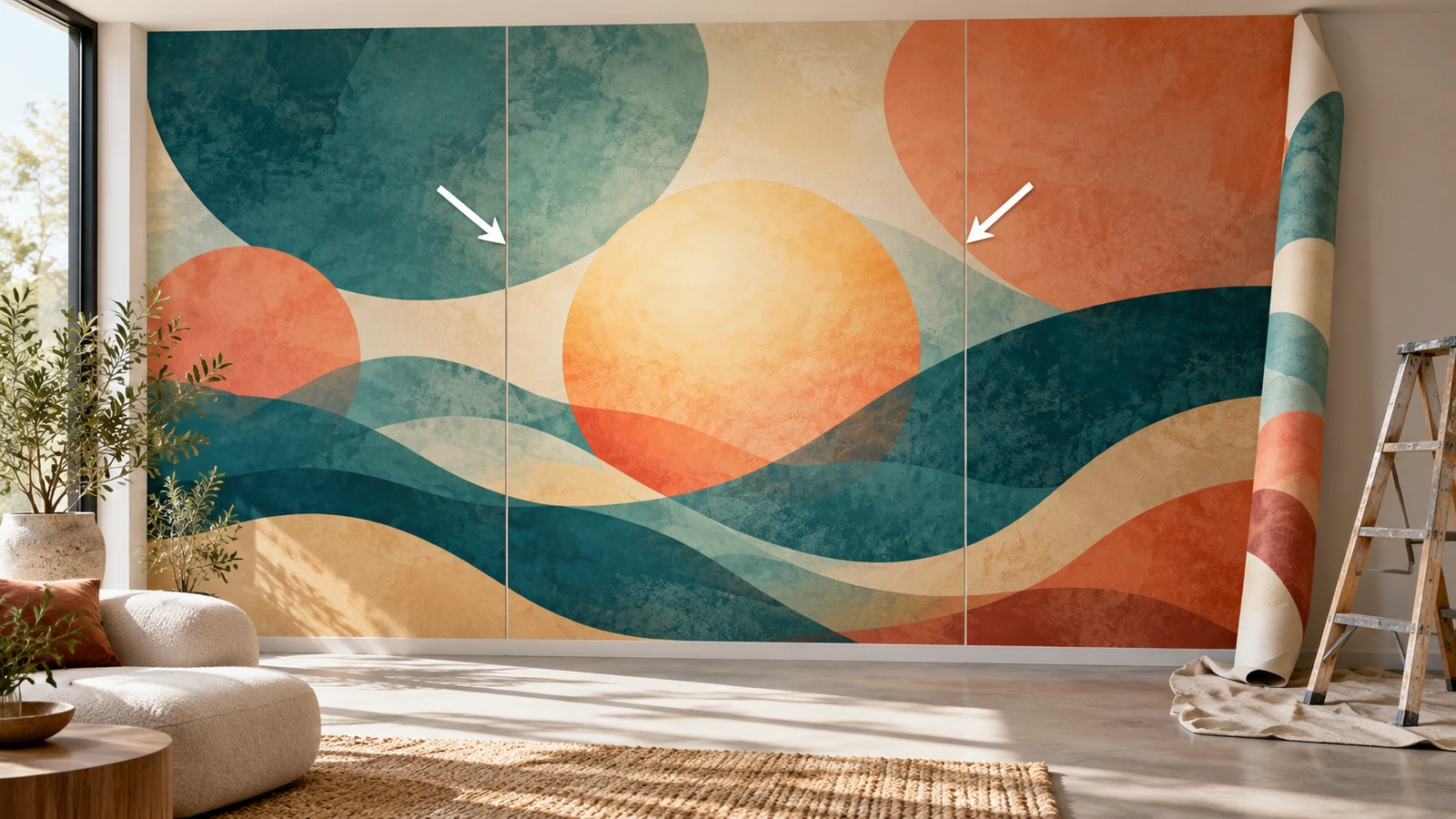
Giant custom wall decals and full-wall murals carry the most brand impact and the most coordination risk. Wide graphics are printed in panels, so decide where the seams fall before artwork is finalized. Keep seams away from faces, logo marks, and lines of small type. Schedule the paint finish early enough that the wall has fully cured before the install date, and book after-hours install windows in retail spaces. Air-release liners, which channel trapped air out during application, are now appearing on more graphic films to speed up bubble-free installs (Signs of the Times trade report[6]). Even so, a feature wall is a two-person job that deserves its own line on the opening schedule. Step-by-step sizing, prep, and installation guidance lives on the product page.
Step 5: Lock a master spec for multi-location rollouts
Wall sticker branding breaks down at scale when each site sends different information. Build one spreadsheet with a row per wall and require every location to fill it in before anything is quoted:
- Site ID and wall ID, both matching the floor plan
- Usable width and height, plus any obstructions
- Surface type, paint brand, sheen, and repaint date
- Wall photos taken straight on and at an angle
- Graphic ID, artwork version, and refresh tier (see Step 6)
- Installation owner and planned removal date
Run a pilot at one representative site first, photograph the result, and approve it as the reference install. Every later location is then audited against that photo, not against someone's memory of a rendering.
Step 6: Assign a refresh tier to every graphic
Different graphics have different life expectancies, and the adhesive choice should follow from that. Industry suppliers note that removable pressure-sensitive adhesives suit short-term events, while permanent or high-tack options suit long-term brand walls. They also report growing demand for PVC-free, fabric, and paper-based wall media (Digital Output's wall media report[7]). A three-tier model keeps planning simple:
- Identity tier: logo, mission, and core values. This content changes only with a rebrand, so review it annually.
- Campaign tier: seasonal promotions, product launches, and recruitment drives. Each graphic gets a removal date when it is ordered.
- Event tier: trade shows, pop-ups, and anniversaries. These run for days or weeks, so specify removability first.
Leased offices need extra thought, because removal at lease end becomes a facilities cost. Low-tack, fabric-style wall graphics aimed at finished drywall, plaster, and wainscoting are marketed specifically as flexible and renter-friendly (Impressions magazine coverage[8]). Confirm the lease's restoration clause before you choose a permanent option.

Step 7: Measure impact against a baseline
Record a baseline before installation, then review at a fixed interval such as 90 days. Choose metrics you can actually collect:
| Goal | Metric | How to collect it |
|---|---|---|
| Brand recall | Share of visitors who can name a brand value or tagline | Short exit or reception survey |
| Wayfinding | Number of "where is…" questions at the front desk each week | Desk tally before and after install |
| Social reach | Location-tagged photos featuring the wall | Social listening on location tags |
| Employee experience | Workplace survey score on the "feels like our brand" item | Existing engagement survey |
| Rollout consistency | Percentage of sites matching the reference install photo | Quarterly photo audit |
| Cost efficiency | Cost and labor hours per refresh compared with a repaint | Facilities work orders |
Which Graphic Format Fits Which Brand Job?
Match the format to the wall's job and refresh tier rather than to whatever was cheapest last time. Material-level selection is handled on the product page; this table is about brand role.
| Format | Best brand job | Typical zone | Refresh fit | Planning watch-out |
|---|---|---|---|---|
| Cut vinyl lettering | Logo, values, room names in solid brand colors | Arrival, meeting rooms | Identity | Not suited to photos or gradients |
| Printed die-cut decal | Full-color logo, icons, illustrations | Arrival, circulation | Identity or campaign | Color must be approved against the actual paint |
| Full-wall printed mural (giant custom wall decals) | Hero brand story, photography, immersive themes | Lobby, sales floor, break rooms | Identity | Seam placement and paint cure must be scheduled |
| Removable campaign graphic | Promotions, launches, recruitment | Sales floor, windows-adjacent walls | Campaign or event | Every graphic needs an owner and a removal date |
| Fabric low-tack graphic | Flexible themes in leased or frequently changed spaces | Leased offices, pop-ups, events | Event or campaign | Confirm suitability for the specific wall texture |
| Painted mural (alternative) | Permanent artistic statement | Owned buildings only | Rarely refreshed | Any change means a full repaint |

FAQ
FAQ: Who should own custom wall graphics, marketing or facilities?
Both, with split responsibilities. Marketing owns artwork, brand rules, and the refresh calendar. Facilities owns the wall audit, paint schedule, install windows, and removal. A shared master spec spreadsheet keeps the handoff explicit, and each graphic should list a named owner.
FAQ: How often should business wall graphics be refreshed?
Use the tier. Identity graphics are reviewed annually and replaced at a rebrand. Campaign graphics carry a removal date set when they are ordered. Event graphics come down when the event ends. Any graphic that is faded, peeling, or off-brand should be pulled early, because a damaged brand wall does more harm than a blank one.
FAQ: How do we keep 20 locations consistent?
Use one vector master file per graphic with version numbers, one site survey template, one approved reference install photographed at a pilot site, and a quarterly photo audit scored against that reference. Do not let individual sites source their own artwork.
FAQ: Are there extra requirements for schools, daycares, or healthcare lobbies?
Possibly. If a graphic is designed or marketed for children 12 and under, US rules limit total lead in children's products to 100 ppm (16 CFR 1252.1[9]). Low-emission claims for interior finishes are commonly backed by voluntary UL 2818 testing (UL GREENGUARD certification[10]). Add any documentation you need to your spec. The specific questions to ask a supplier are listed on the product page.
FAQ: Can we use wall graphics in a leased office?
Usually yes, but read the restoration clause first. Favor removable or low-tack formats for anything outside the identity tier, and record the planned removal date in your master spec so it is budgeted before move-out.
FAQ: How do we prove wall graphics were worth it?
Capture a baseline before installation, such as front-desk wayfinding questions, survey scores, and location-tagged photos, then compare at 90 days. Add cost per refresh compared with repainting to show the operational return alongside the brand return.
Key Takeaways
- Commercial walls are a meaningful share of the market — about 25.2% of 2025 global wall decal revenue (Source)
- Business use is growing faster than home use — commercial CAGR of about 7.2% on a 26.8% share (Source)
- Buyers now judge wall graphics on removability and surface fit, not print alone — interior wall decoration stickers were worth about USD 1.68 billion in 2025 (Source)
- Coordinate paint specs with graphics orders — EPA coating rules cut about 103,000 megagrams of VOC emissions per year, pushing low-VOC paints into fit-outs (Source)
- Office branding and wayfinding drive custom wall demand in North America — about 36% of the 2024 custom name wall decal segment (Source)
- Graphics for children's spaces carry federal limits — 100 ppm total lead in children's products (Source)
Conclusion
The difference between walls that build a brand and walls that quietly undermine it is rarely the print. It is the plan behind it: zoned walls, wall-specific brand rules, sightline-based placement, a master spec every site follows, a refresh tier on every graphic, and a baseline you can measure against. Build that system once and every new location becomes a repeat of a proven install rather than a fresh experiment. When you are ready to turn a specific wall into a quote, start with custom wall decals matched to your wall, paint, and timeline and share your master spec so the conversation begins with the right facts.
Sources
- PW Consulting, Wall Decals Market, updated 2026-06-13. https://pmarketresearch.com/hc/wall-decals-market/ ↩
- MarketIntelo, Wall Decal Market Research Report 2034, published 2025-08-24, updated 2026-06-11. https://marketintelo.com/report/wall-decal-market ↩
- Growth Market Reports, Custom Name Wall Decals Market. https://growthmarketreports.com/report/custom-name-wall-decals-market ↩
- 360iResearch, Interior Wall Decoration Sticker Market, report MRR-7A380DA7C38C, September 2026. https://www.360iresearch.com/library/intelligence/interior-wall-decoration-sticker ↩
- Intel Market Research, Low-VOC Regulations Put the Interior Paints…, 2026-09-18. https://www.intelmarketresearch.com/blog/1285/low-voc-regulations-put-the-interior-paints ↩
- Signs of the Times, report on semi-rigid vinyl films with air-egress liner, 2026-10-12. https://signsofthetimes.com/general-formulations-releases-new-gf-semi-rigid-vinyl-films-with-air-egress-liner/ ↩
- Digital Output, Walls That Work, 2026-05-29. https://digitaloutput.net/walls-that-work/ ↩
- Impressions Magazine, coverage of low-tack wall graphics, 2026-01-06. https://impressionsmagazine.com/news/ninja-transfers-low-tac-wall-graphics/168140/ ↩
- Electronic Code of Federal Regulations, 16 CFR § 1252.1. https://www.ecfr.gov/current/title-16/chapter-II/subchapter-B/part-1252/section-1252.1 ↩
- UL Solutions, UL GREENGUARD Certification (UL 2818). https://www.ul.com/services/ul-greenguard-certification ↩












The information below is required for social login
Sign In
Create New Account