We use cookies to enable our websites to remember information, to help some website functionalities to work properly, to understand how you interact with and use our websites and to display you content and ads that are relevant and engaging for you.
By clicking Accept All you consent to the use of these cookie.
The store will not work correctly when cookies are disabled.
Quick answer: The custom hoodie manufacturing process for small businesses runs through seven gates. First you choose a route (decorated stock blank or cut-and-sew). Then you lock the spec, set up decoration, approve a pre-production sample, and move into bulk cutting, sewing and decoration. Final QC and compliance paperwork come last. Most delays start before production, with unfinished artwork, an unapproved sample or a missing size breakdown. Most defects start at three points: the zipper placket, the print-curing step and the label. The production clock normally starts only after art, sample and payment are all confirmed.
You approved the mockup, paid the deposit, and then heard nothing for a week. For a small business that is the most stressful part of the custom hoodie manufacturing process for small businesses, because you cannot see what is happening. You also cannot tell whether your launch date is still realistic.
The silence matters because problems surface late. Buyer reviews of full-zip hoodies follow the same pattern. A zipper "broke on first day". A placket goes wavy after one wash because the cotton body shrinks and the zipper tape does not. A white zipper tape arrives that never appeared in the digital preview. A chest print cracks where it crosses the zipper teeth. None of these failures shows up on a flat mockup. Every one of them could have been caught at a specific production gate.
This guide follows a hoodie order from approval to delivery, stage by stage. At each stage you will see what the factory is doing, what it needs from you, where schedules usually slip, and where defects are born. If you are still deciding what to order rather than how it gets made, our page on custom printed full-zip hoodies specified to survive the zipper covers specs, artwork zones and channel choice.
What Does "Manufacturing" Mean for a Small Hoodie Order?
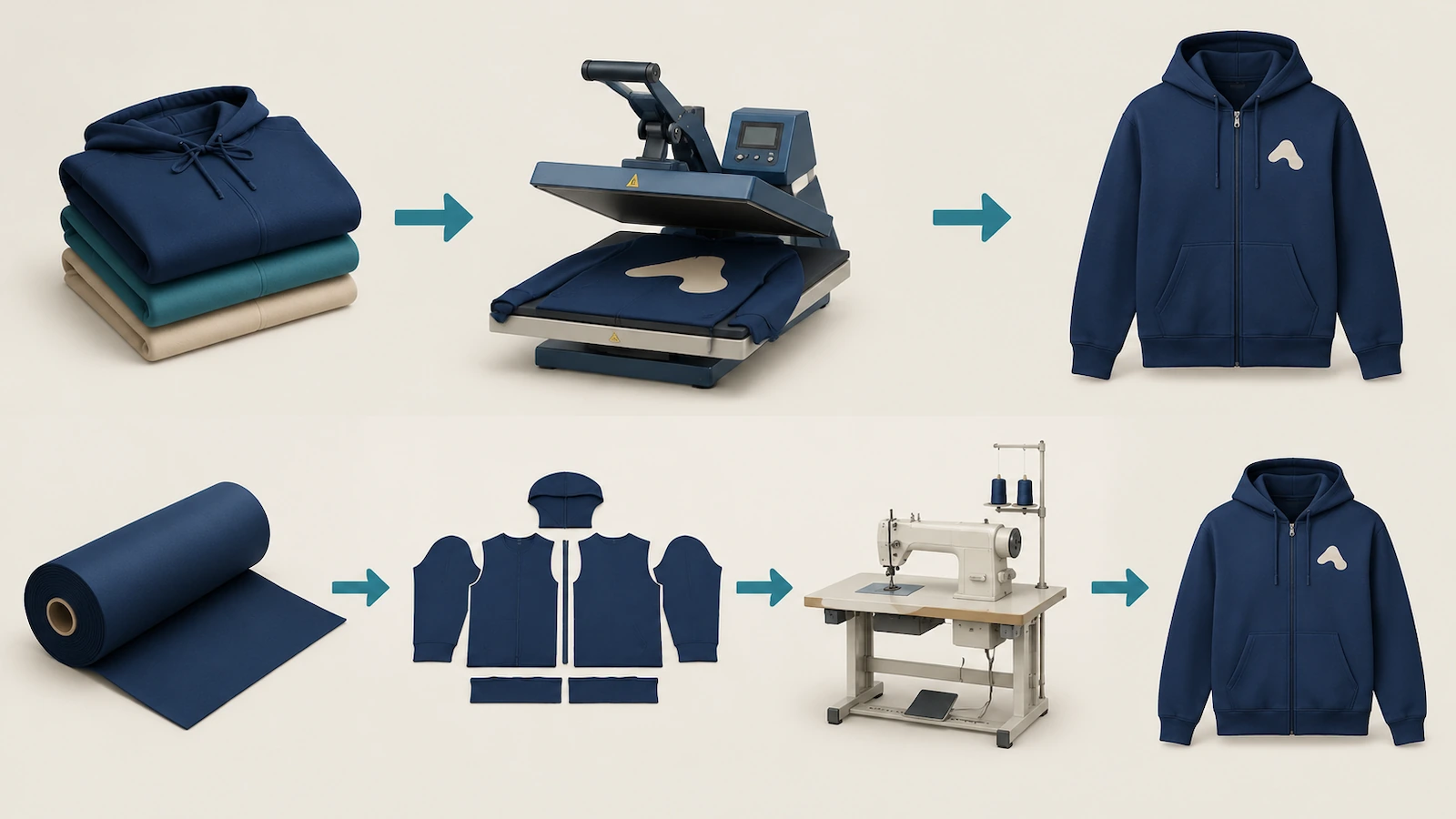
Small-business hoodie orders move through one of two routes, and each runs on a different production clock.
Decorated stock blanks. The garment already exists. A mill knitted the fleece, a sewing plant built the hoodie, and a distributor stocks it by color and size. Your order is really a decoration job: the factory pulls blanks, then prints, embroiders or transfers your artwork, inspects, and ships. You control the artwork and placement. You do not control fabric weight, zipper hardware, hood lining or fit. Most hoodies with a custom logo for staff, events and teams take this route.
Cut-and-sew. The garment is built for you. Fabric is sourced or knitted to spec, a pattern is graded across your sizes, panels are cut, and the hoodie is sewn with the zipper, pockets and trims you chose. Decoration can then happen on flat cut panels before assembly, which is the cleanest way to put artwork near a placket. You control almost everything. In exchange you take on more sampling rounds, per-color minimums and a longer schedule.
Many small brands start with blanks and move to cut-and-sew once one design has proven it sells. The stages below apply to both routes. Cut-and-sew simply runs every stage, while the blank route skips fabric and pattern work.
How the Custom Hoodie Manufacturing Process for Small Businesses Runs, Stage by Stage
Stage 1: Route decision and order intake
What happens: The factory confirms the route, the blank or fabric, the decoration method, the quantity per color, and the in-hand date you need.
What it needs from you: Five inputs, all of them firm: adult or youth sizing, the destination market, a per-color size breakdown, a target unit budget, and the real deadline. The deadline should be the event date, not "as soon as possible".
Where delays start: The most common one is a size breakdown that arrives late. Blanks are allocated by color and size. A "we'll confirm sizes next week" holds the whole order, including the colors that are already decided. On cut-and-sew, every extra color usually carries its own minimum. Splitting one quantity across many colors can push an order below the line and reopen the quote.
Stage 2: Spec lock (the tech pack)
What happens: Every variable that changes cost or schedule gets written down once. That includes fiber composition and fabric weight, preshrinking, zipper type (metal or coil, tape color, slider style, top and bottom stops), hood construction, pocket style, rib trims, label content and packaging.
Where defects start: Vague weight claims. Write fabric weight in both units, oz/yd² and g/m² (1 oz/yd² ≈ 33.9 g/m²), because U.S. distributors and overseas mills use different conventions. Marketing names are not specs. One widely sold 8.0 oz/yd² (≈271 g/m²) 50/50 full-zip is sold as a "heavy blend". Verified buyers have returned it because "it said heavy weight; it's not." If you want a heavyweight hand, specify the number.
The zipper also belongs in this document, not in a later email. A full-zip adds a placket operation that a pullover does not have. A heavy fleece body pulls on a light zipper, and a stiff zipper distorts a soft body. Changing zipper brand, tooth type or tape color after fabric has been cut changes both cost and lead time. Treat the zipper as locked once Stage 2 is signed.
Benchmark worth asking for: Zipper strength has a recognized test method, ASTM D2061[1]. It covers chain crosswise strength, stop holding strength, slider lock holding strength and pull-off resistance. If a supplier calls its zipper "durable", ask which of these tests back the claim.
Stage 3: Artwork and decoration setup
What happens: Your artwork is converted into production tooling for the chosen method. Screen printing needs one film and one screen per ink color. Embroidery needs a stitch file, which is digitized separately from the logo file and sets stitch density, underlay and stabilizer. DTG needs a print profile and usually a pretreatment step on dark garments. DTF needs printed and powdered film transfers.
Where delays start: Production artwork that is not actually production-ready. Common examples are raster files that need redrawing, fonts that were never outlined, or ink colors that were never matched. Many shops state plainly that the turnaround clock does not start until print-ready art, an approved mock and payment are all in hand. Whatever you send late at this stage moves the ship date by the same amount.
Where defects start: Placement relative to the zipper. Full-zip artwork belongs on the left chest, the back or the sleeves, kept clear of the teeth. We explain the reasons and the zones on the full-zip hoodie product page, so here is just the production consequence. Artwork that crosses the placket becomes a quoted-per-job exception with its own sample. It is not a standard line item.
Automation is shortening setup for small runs. Industry coverage of the 2026 trade-show season highlighted DTF lines in which one operator loads a garment, scans a barcode and presses, while the system prints, cures and handles the transfer (Impressions, The State of Apparel Decorating in 2026[2]). Faster setup still does not make a heat press sit flat over zipper teeth.
Stage 4: Pre-production sample and sign-off
What happens: The factory produces one or more finished hoodies on the real blank or fabric, with the real zipper, decorated with the real method. This is the last cheap moment to change anything.
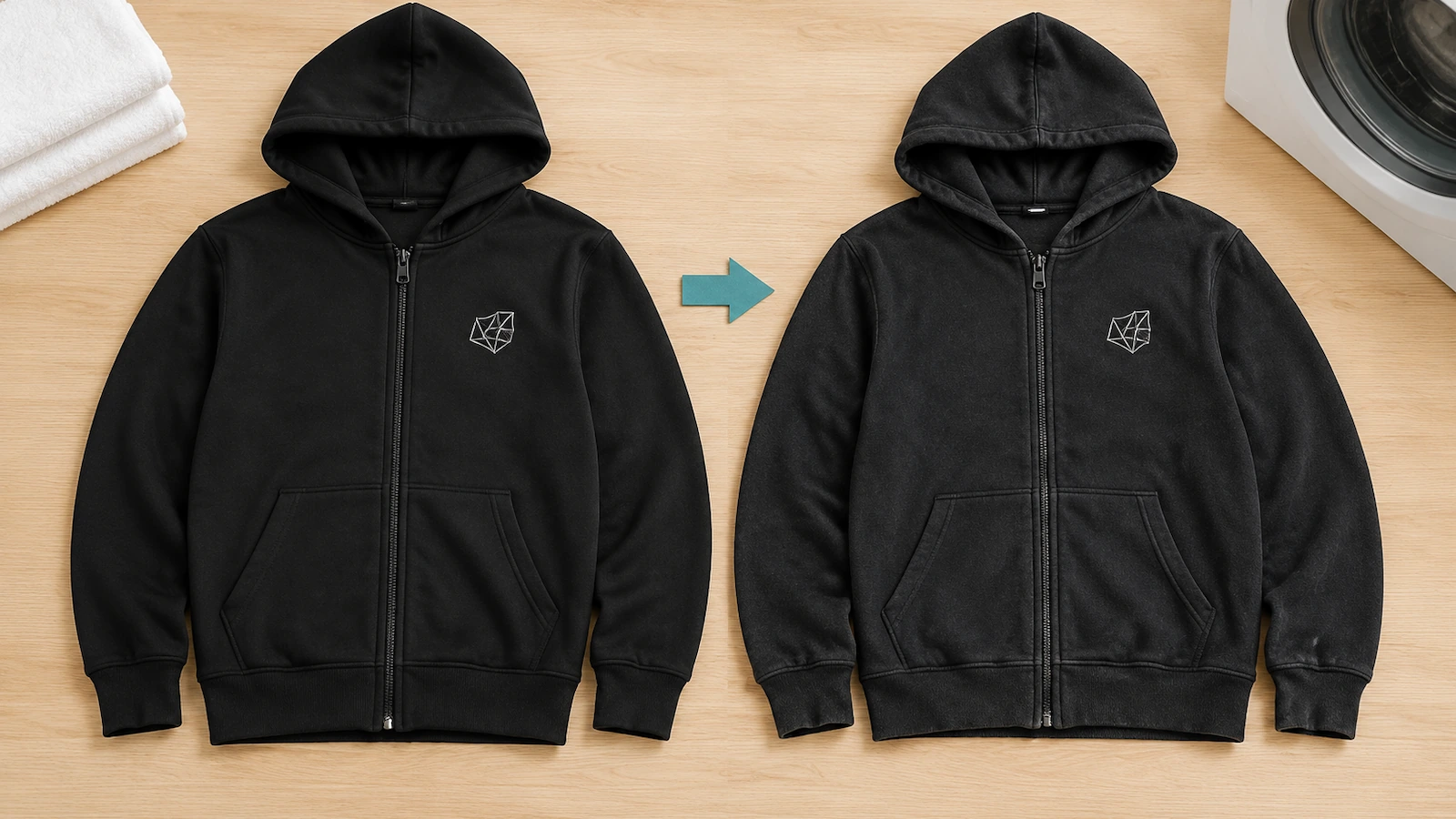
Where defects hide: A fresh sample usually looks perfect. Cracking in heavy ink areas, puckering around dense embroidery, and placket waviness often appear only after washing, stretching and repeated handling. One factory case study described a back print that looked clean on arrival and then showed fine surface cracks in the heaviest ink zones after a wash. Embroidery forums report the same pattern on 50/50 fleece: the stitching is flat before washing and puckered after the dryer. The usual fix is a cut-away stabilizer and lower stitch density.
What to test before you sign:
Wash and tumble-dry the sample at least three times, inside out, on the care label settings you plan to print.
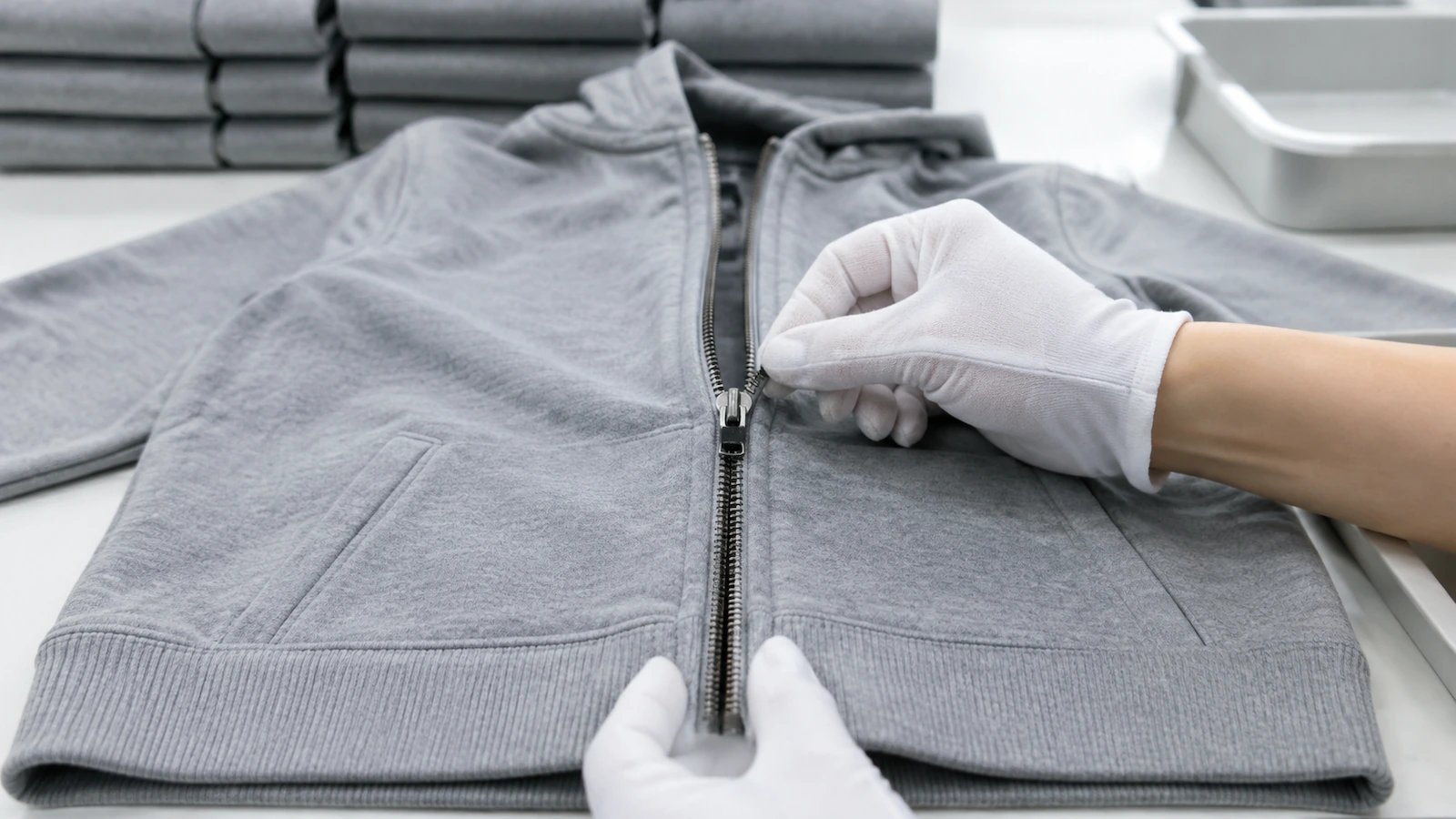
Run the zipper through its full open-and-close travel many times. Check for teeth that catch fabric, a slider that scrapes the artwork, and a placket that no longer lies flat.
Stretch the printed area by hand and look for cracks along the ink edges.
Compare color on dark and light garments separately. On dark fabric, white ink from DTG can let some base color show through in a way screen printing usually does not.
For colorfastness, ask whether the fabric or decoration has been tested to AATCC TM61 (accelerated home laundering), and which grey-scale rating it achieved.
Sign off on the washed sample, not the fresh one. Photograph it, keep it, and reference it in your purchase order as the approved standard.
Stage 5: Bulk production
What happens on the blank route: Blanks are received and counted by size and color, then decorated, cured or finished, and folded. Short counts from the distributor are the most common surprise. A good factory reports shortages before decorating, not after.
What happens on the cut-and-sew route: Fabric is inspected and relaxed, panels are cut by size, flat panels are decorated if the design calls for it, and then the body, hood, sleeves, pockets and placket are sewn. Zipper installation is the slowest operation on the line and the one most likely to create defects. If the cotton body was not preshrunk and the nylon zipper tape does not shrink, the first home wash creates the wavy placket that buyers describe as a "bacon" zipper.
Where defects start: At curing. Plastisol that is under-cured stays tacky and washes off. Over-cured ink turns brittle and cracks. DTF transfers that drift off the specified temperature, pressure or dwell time lift at the edges. The correct window comes from the ink or film maker's technical data sheet, not from a blog post. Ask the factory which data sheet it is curing to.
Stage 6: Inline and final quality control
What happens: Inspection happens twice. Inline checks during sewing and decoration catch systematic errors early. A final inspection, usually an AQL sample drawn from packed cartons, decides whether the lot ships.
A full-zip QC checklist:
Full zipper travel on every inspected piece: no skipped teeth, no fabric caught in the chain, no loose slider.
The placket lies flat when zipped, and the left and right hems line up at the bottom.
Decoration position is consistent across sizes. On larger sizes, check whether the artwork was scaled as agreed.
No print cracks after a stretch test, and no embroidery puckering or loose jump stitches.
Garment measurements by size match the agreed spec sheet.
Labels are present, legible and correct (see Stage 7).
Plan for spoilage: Decorators commonly quote a 2–3% spoilage rate on printed runs. On an event order with no room for a reprint, ask whether a few overs per size are included or should be added.
Stage 7: Compliance, labeling and shipping
This is the stage small businesses tend to skip. It is also where a finished order can be stopped at a port or pulled from sale.
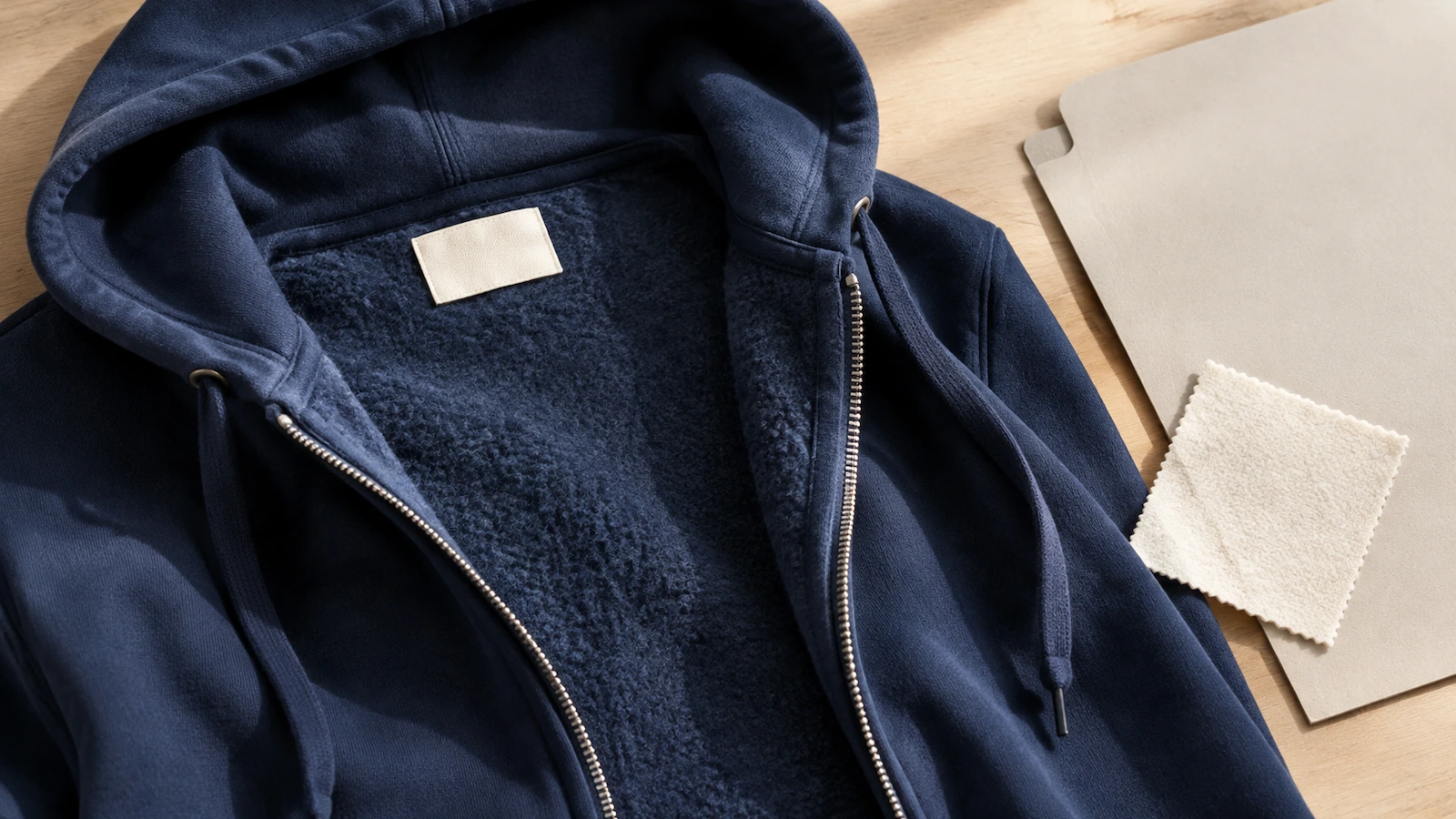
Flammability. Clothing textiles sold in the U.S. fall under 16 CFR Part 1610. Fleece is a raised-surface fabric, and raised-surface fabrics are classified differently from plain ones. A raised-surface fabric is Class 1 if its burn time exceeds 7.0 seconds, or if it only shows a surface flash that does not ignite the base fabric. Plain-surface fabrics need 3.5 seconds or more. Class 3 fabric cannot be used in clothing (16 CFR §1610.4[3]). CPSC guidance names "full-front zippered jackets" as an example of linings with exposed areas. A brushed fleece interior that shows when the hoodie is unzipped can therefore need its own testing, even if the outer face qualifies for an exemption. Adult apparel requires a written General Certificate of Conformity (CPSC clothing guidance[4]).
Labels. Each garment needs the generic name and percentage by weight of every fiber at 5% or more, the manufacturer's name or RN number, and the country of origin (16 CFR §303.16[5]). It also needs permanent care instructions under the FTC Care Labeling Rule[6]. If a decorator cuts out the blank's original label and sews in only a logo tag, the garment can end up non-compliant.
Youth sizes are a separate product. Neck and hood drawstrings on children's upper outerwear in sizes 2T–12 are treated as a substantial product hazard. Waist and bottom drawstrings in sizes 2T–16 are limited to 3 inches exposed, with no toggles or knots. CPSC staff are aware of 26 deaths and 73 nonfatal incidents tied to neck and hood drawstrings between 1985 and 2019 (CPSC drawstring guidance[7]). Children's products also need a permanent tracking label[8] and a Children's Product Certificate. Metal or plastic components such as zippers must be tested for lead. A team order that includes youth sizes cannot reuse the adult spec with smaller measurements.
Chemistry and sourcing. Two further checks apply to many orders.
PFAS: Since January 1, 2025, California and New York restrict PFAS in textiles. In independent testing reported in 2026, about 80% of roughly 115 products met state law, and some did not (The Guardian[9]). Water-repellent or stain-resistant fleece needs a total organic fluorine result from the supplier.
Cotton imports: On July 31, 2026, DHS added 43 companies to the UFLPA Entity List, bringing it to 187. CBP has denied entry to more than 24,300 shipments under the law (DHS[10]). Imported cotton-blend fleece needs traceable documentation from fiber to finished garment.
A voluntary harmful-substance certificate such as OEKO-TEX STANDARD 100[11] can support your claims. Hoodies normally fall under Product Class II (direct skin contact). A certificate held by a blank maker covers that blank, not the ink or transfer added afterward.
Where Do Delays and Defects Start? Route and Method Comparison
The first table maps each production route to its controllable variables and its most common failure points. Lead times and minimums vary by factory, blank stock and season, so confirm them in writing with your supplier.
Seasonal queues; multi-item orders ship with the slowest item
Where defects usually start
Decoration curing; placement near the zipper
Zipper installation, shrinkage mismatch, labeling
Blank quality you cannot specify; DTG white on dark fabric
Compliance burden on you
Keep original labels; check youth drawstrings
Full: 1610 testing, GCC/CPC, FTC labels, sourcing records
Shared with the platform; verify for youth sizes
Best for
Staff, events, teams, first runs
Brand drops after one design has proven it sells
Testing designs, one-off gifts
The second table compares decoration methods by how they behave in production.
Method
Setup step
Finishing step that fails
Typical defect on full-zips
Screen printing
One screen per color
Ink curing
Cracking at heavy ink areas; ink pooling in the zipper groove
Embroidery
Digitized stitch file
Stabilizer and density choice
Puckering after the first wash
DTG
Print profile and pretreatment
Pretreat and cure
Visible pretreat box; dull white on dark fleece
DTF
Printed and powdered film
Press temperature, pressure and dwell
Edge lift, especially near seams and teeth
FAQ
FAQ: When does the production clock actually start?
It starts when the last of three things is confirmed: production-ready artwork, an approved proof or sample, and payment. Ordering day does not count. Time spent revising art or waiting on sample feedback is added to the schedule, not absorbed by it. Ask your supplier to state its start trigger in writing and to quote production days and transit days separately.
FAQ: Can I change the zipper color or pocket style after approval?
On the blank route, only by switching to a different blank, which reopens stock checks and proofs. On cut-and-sew, a change after fabric is cut usually means new trims, new costs and a new schedule. Lock zipper type, tape color and pockets in the Stage 2 spec.
FAQ: How many extra pieces should I order?
Decorators commonly cite 2–3% spoilage on printed runs. If a shortfall would cause real problems, as with a dated event or a fixed staff headcount, ask whether overs are included per size or add a small buffer yourself.
FAQ: Do adult promotional hoodies need a flammability certificate?
Yes. Non-exempt adult clothing sold in the U.S. needs a General Certificate of Conformity based on 16 CFR Part 1610. For a full-zip with a brushed interior that shows when it is unzipped, confirm that the exposed lining was evaluated, not only the outer face.
FAQ: Can youth sizes use the same spec as the adult order?
No. Youth sizes need a hood without a neck drawstring, compliant waist cords, lead testing on components such as zippers, a tracking label and a Children's Product Certificate. Treat youth sizes as a separate production line within the order.
FAQ: Can the logo go across the zipper?
It can be done, but it is a quoted exception that needs its own sample. It is not a standard placement. The safe zones and the reasons behind them are covered on our custom zip-up hoodies page.
Key Takeaways
Fleece follows raised-surface flammability rules, and exposed full-zip linings count. — Class 1 requires a burn time over 7.0 seconds for raised surfaces (Source)
Labels are part of production, not decoration. — Every fiber at 5% or more must be disclosed with its percentage, along with origin and RN or name (Source)
Youth hoodies need their own spec. — 26 deaths and 73 nonfatal incidents linked to neck and hood drawstrings, 1985–2019 (Source)
Imported cotton fleece needs traceable sourcing records. — 43 companies added in July 2026, 187 on the UFLPA Entity List (Source)
PFAS-treated fleece is a live risk in California and New York. — About 80% of roughly 115 tested products met state law, so about 20% did not (Source)
Conclusion: Make Each Gate Visible
A small-business hoodie order rarely fails all at once. It slips at intake when sizes arrive late, at setup when artwork is not production-ready, and at sign-off when a fresh sample is approved without washing. Defects come from the zipper placket, the curing step and the label. Asking your supplier to report progress against these seven gates turns a week of silence into a status you can act on.
If you are planning a run of printed full-zips, tell us your quantities per color, sizes, decoration and in-hand date, and we will scope the order gate by gate. Start with our custom zip-up hoodies page and request a quote. We confirm minimums, lead times and testing in writing for your specific order, without quoting generic numbers.
Hi there! I'm Bruce, proud dad to my amazing son. I'm the founder of Zigpac, a printing and packaging company empowering small and medium-sized businesses with custom solutions. Let's create something great together!



 Blog PDF for offline reading













The information below is required for social login
Sign In
Create New Account