We use cookies to enable our websites to remember information, to help some website functionalities to work properly, to understand how you interact with and use our websites and to display you content and ads that are relevant and engaging for you.
By clicking Accept All you consent to the use of these cookie.
The store will not work correctly when cookies are disabled.
Quick answer: Wooden keychains are the right promotional choice when your brand gains from a warm, crafted, natural look and the piece will see moderate everyday use. Typical fits include real estate closings, hospitality, craft and outdoor brands, campus programs and team or fan programs. Metal is better for heavy key duty over many years. Acrylic suits clear or glossy effects, and PVC suits soft, sculpted mascots.
Wooden keychains sit in an unusual spot in the promotional mix. People carry them every day, so a branded keychain can stay in a pocket for months. Yet the category is crowded with acrylic charms, die-struck metal and soft PVC. Choosing the material is a decision about what your brand signals, how long the piece survives, and what each kept-and-carried unit really costs you.
The problem is that many buyers choose wood for the sustainability story alone, and some regret it. In the buyer reviews we analyzed, the same complaints recur. Some graphics peeled or faded within a month. Some fobs separated from their rings after a few months. Other buyers found that a thin laser-cut piece looked cheaper than they expected. One artist described wood pieces as feeling "more like a collectible than an everyday keychain." None of these failures is inherent to wood. They happen when the material does not match the use case, the shape, or the way the piece will be carried.
This guide is for B2B buyers, including marketing teams, event planners, team managers and merchandise leads. It covers where wood wins, where it does not, and how it compares with the alternatives.
What counts as a wooden keychain?
A wood keychain is a flat or contour-cut tag made from a wood-based board. It is decorated on one or both sides and fitted with a split ring, chain or clasp. Buyers often treat "wooden key chains" as a single product. In practice, the board you choose shapes most of the outcome.
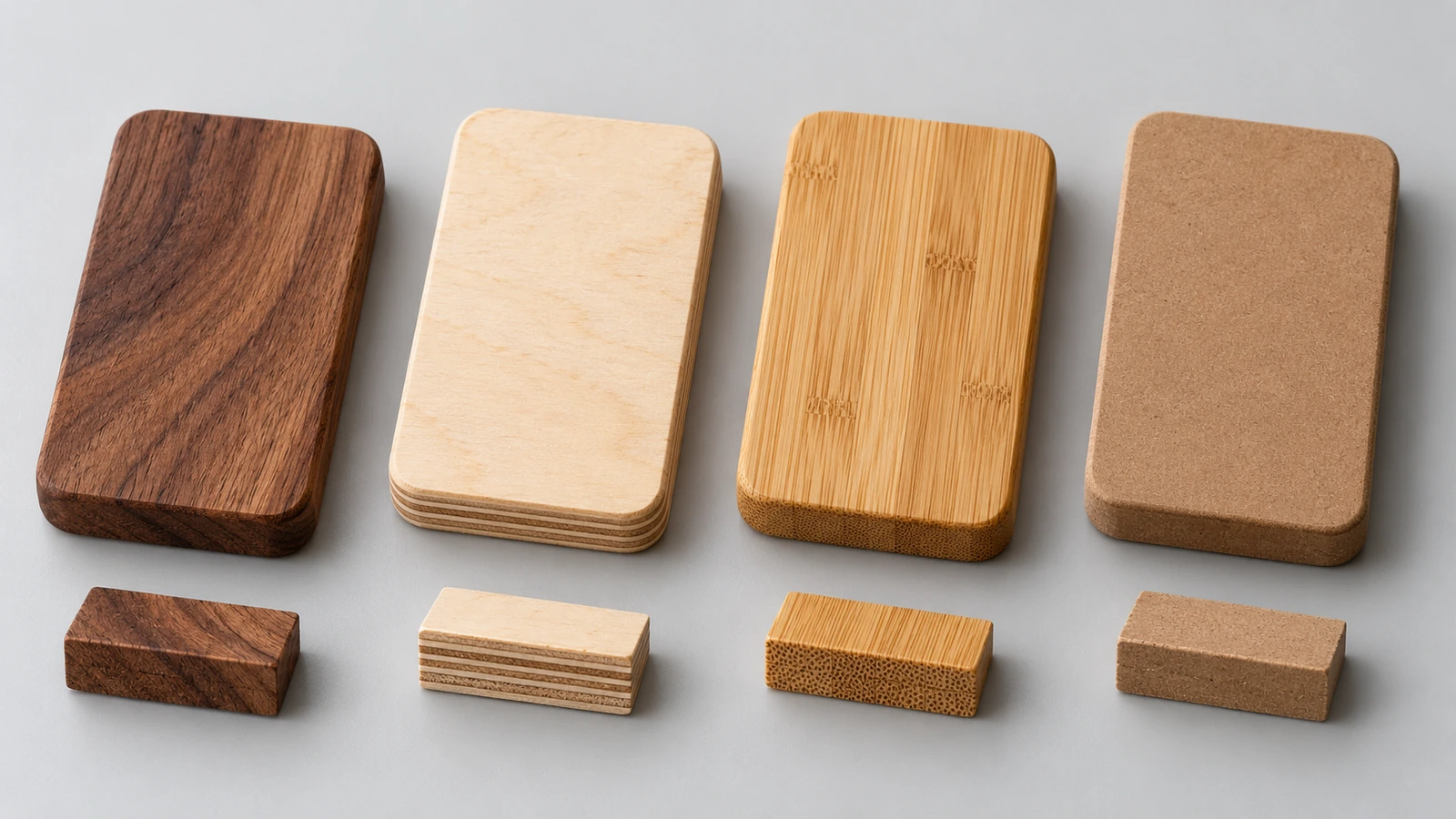
Solid hardwood (cherry, maple, walnut, beech). It shows real grain and is often chosen for laser engraving. Thin solid stock can split along the grain, especially in long, narrow shapes.
Birch plywood and bamboo. Their layered construction resists splitting better than thin solid wood. Birch offers a light, even face for printing.
MDF (medium-density fiberboard). This is an engineered panel of wood fibers bonded with resin. Its surface is uniform, so no grain shows through the artwork. Full-color designs therefore read the same from piece to piece. The trade-off is a weaker "natural grain" story, and the edges need sealing against moisture.
Decoration falls into three broad families. Laser engraving burns a tonal, tactile mark into the wood. UV printing lays down full-color ink that is cured on the surface. Sublimation needs specially coated blanks. Peer-reviewed work on UV inkjet printing for personalized wood surface decoration[1] shows that print quality depends on how the ink interacts with the prepared wood surface. That is why a uniform board such as MDF is popular for photo-like artwork. If you are weighing these methods for a specific design, our page on custom printed wooden keychains with full-color MDF artwork covers decoration choices and artwork preparation in detail.
Solid hardwood, plywood, bamboo and MDF behave differently in printing, splitting and moisture exposure.
Where wooden keychains fit: use cases by industry and event
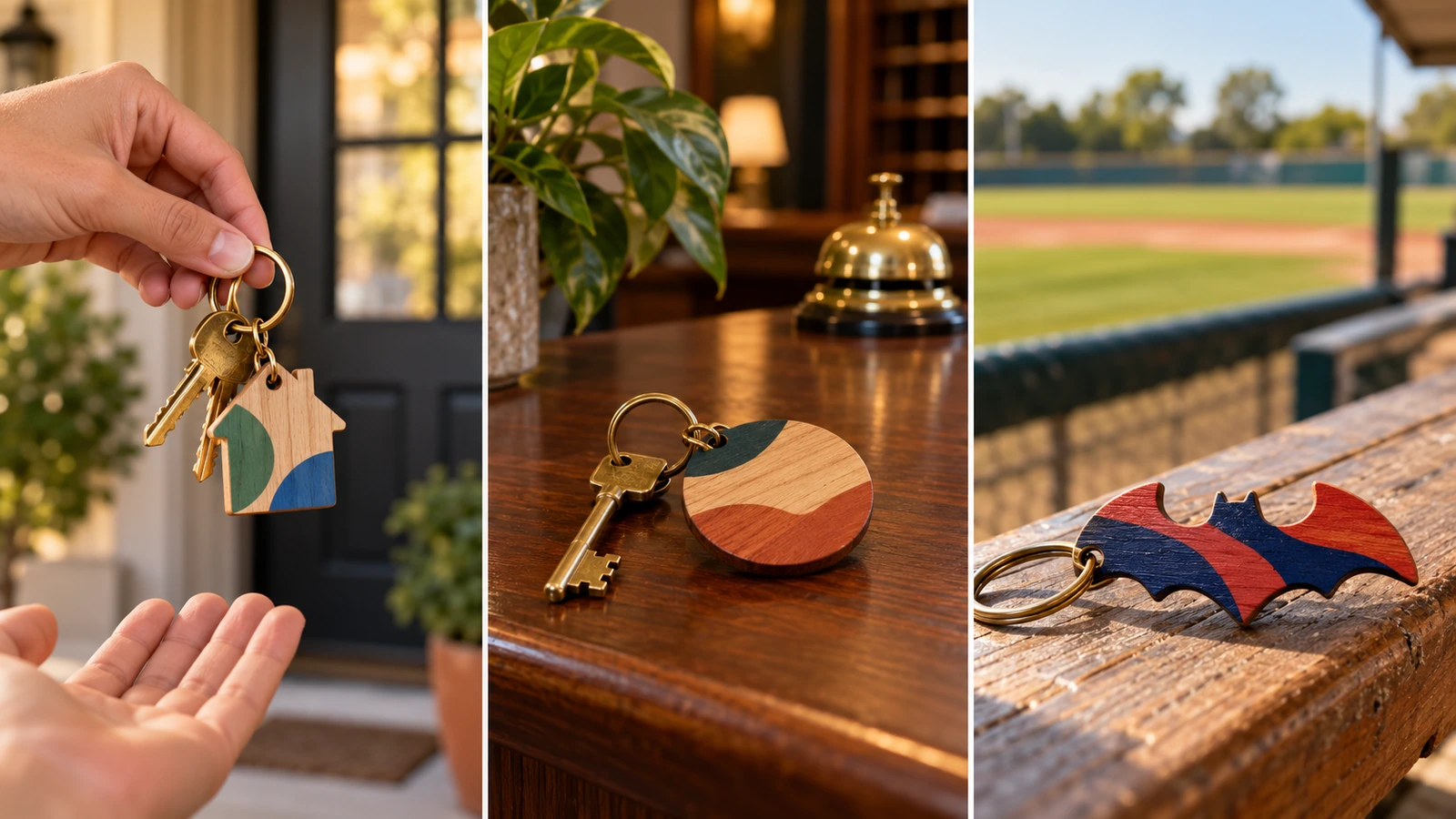
A closing gift tied to "new keys" feels personal. In buyer feedback, wood was described as more prestigious than the metal fobs it replaced.
The piece goes on a key set used daily, so choose a sturdy shape and good hardware.
Boutique hotels, inns, short-term rentals
Room key tags in wood suit design-led and rustic properties, and guests remember them.
Frequent handling and cleaning wipes. Brief contact with water is fine, but soaking is not.
Craft breweries, coffee roasters, outdoor and eco brands
The material matches the brand story without needing extra explanation.
Eco claims must hold up to scrutiny (see step 5 below).
Universities, schools, faith organizations
Crests, mascots and symbols in wood read as heritage rather than novelty.
Products aimed at young children fall under toy rules.
Sports teams and fan programs
Shaped pieces (bats, balls, jerseys) work well as giveaway-night and season-ticket items.
Long, slender shapes need stress-aware design.
Weddings, reunions, memorials
Names and dates on wood feel like a keepsake.
These are often kept rather than carried, so durability matters less than finish.
Museum, park and tourism shops
A local, natural souvenir that ships flat and light.
Retail buyers compare finish quality closely against acrylic.
Trade shows and conferences
Light, flat pieces travel easily in booth kits and stand out among plastic giveaways.
Distributed in high volumes, cost per piece dominates the decision.
Event type also matters. At a booth, a keychain competes with dozens of free items, so a distinctive shape does more work than fine print detail. At a banquet, closing or awards night, the piece is handed over personally. There, material quality and personalization such as names or numbers carry the impression.
The strongest fits are programs where the material itself reinforces the message.
When wood is the wrong call
Choose another material in three situations. The first is a heavy key set that grinds against coins and other keys for years, such as fleet, dealership or facility keys. The second is a wet environment, such as marinas, pool events or beach festivals, because sealed wood resists splashes but is not waterproof. The third is a design that depends on transparency, glitter or a raised, squeezable 3D form, which acrylic and PVC handle better.
How to decide if wood suits your program: a six-step check
Name the carry context. Will the piece live on daily keys, clip to a bag, or sit in a drawer as a keepsake? Daily keys reward thicker, compact shapes. Bag charms and keepsakes allow more delicate outlines.
Decide what the material must say. If you want the recipient to read "natural," "local" or "crafted" before they notice the logo, wood is doing marketing work that acrylic cannot. If the goal is only maximum logo exposure at the lowest cost, the material argument weakens.
Pick the board honestly. For full-color logos, photos or gradients that must match across hundreds of pieces, a uniform board such as MDF is the practical choice. For a grain-forward story, use solid hardwood or bamboo and expect each piece to look slightly different. Do not market MDF as "solid wood."
Match shape to program, then simplify it. A recognizable silhouette, such as a house, coffee bean, mascot head or bat, makes the piece memorable. Thin protrusions and narrow necks are where breaks start, so keep them chunky.
Stress-test the sustainability story. Independent observers have questioned wooden products marketed as eco-friendly when they use synthetic sealants and metal parts and have no sourcing evidence. If you claim certified wood, the claim must rest on an unbroken chain of custody under FSC's chain-of-custody standard FSC-STD-40-004[5]. Programs shipping into the EU should also know that the EU Deforestation Regulation covers wood products. It requires proof that wood was not produced on land deforested after December 31, 2020, according to the EUDR guidance published by Preferred by Nature[6]. How to document these claims for a specific order is covered on the product page.
Price per kept piece, then ask for a quote. Compare materials on how many recipients will keep and carry the item, not on unit price alone. Then request quotes on your actual shape, quantity and hardware, because those three factors move the price more than the material does.
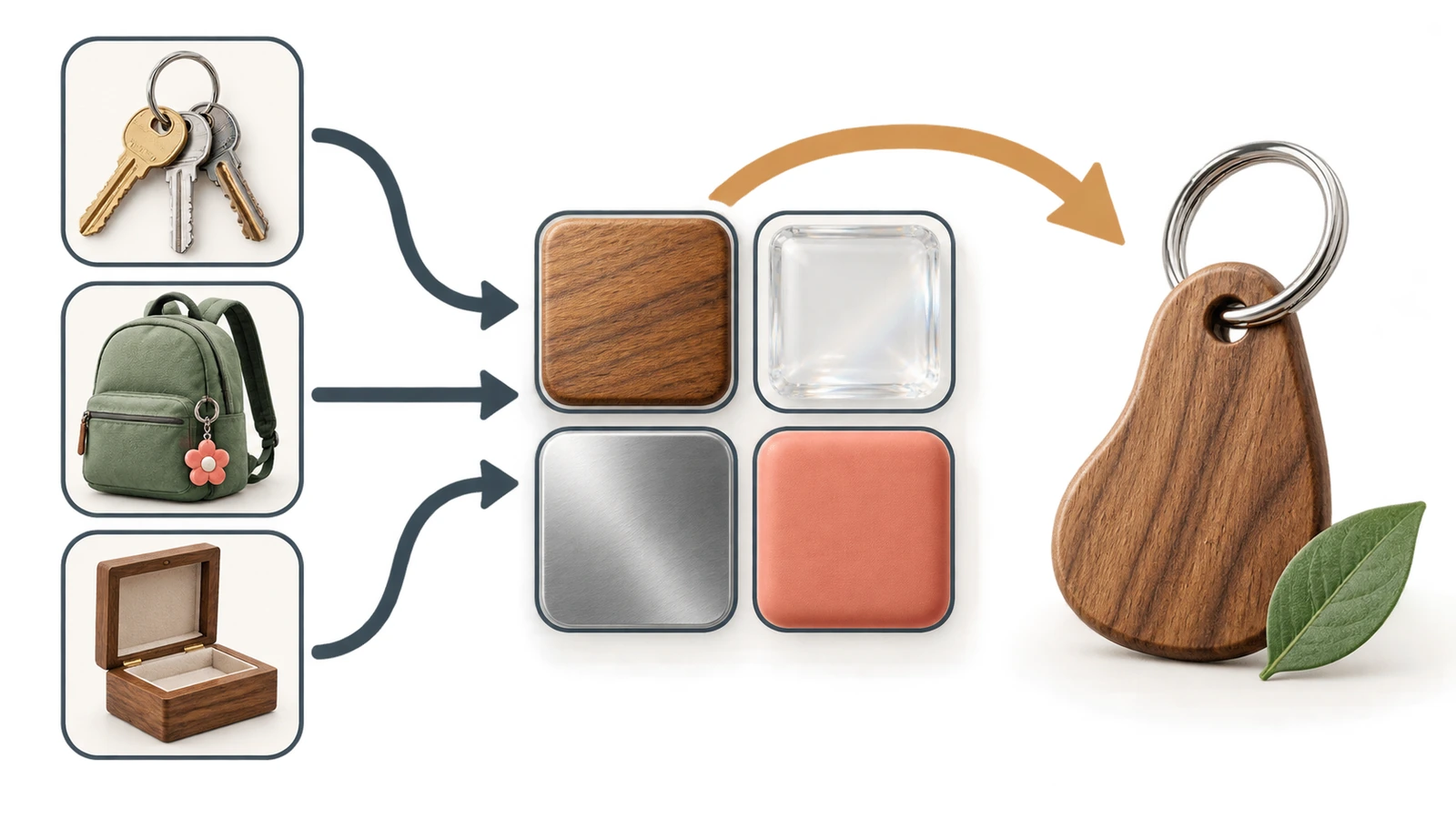
Start from how the piece will be carried, then work back to material, board and shape.
Wooden keychains vs acrylic, metal and PVC keychains
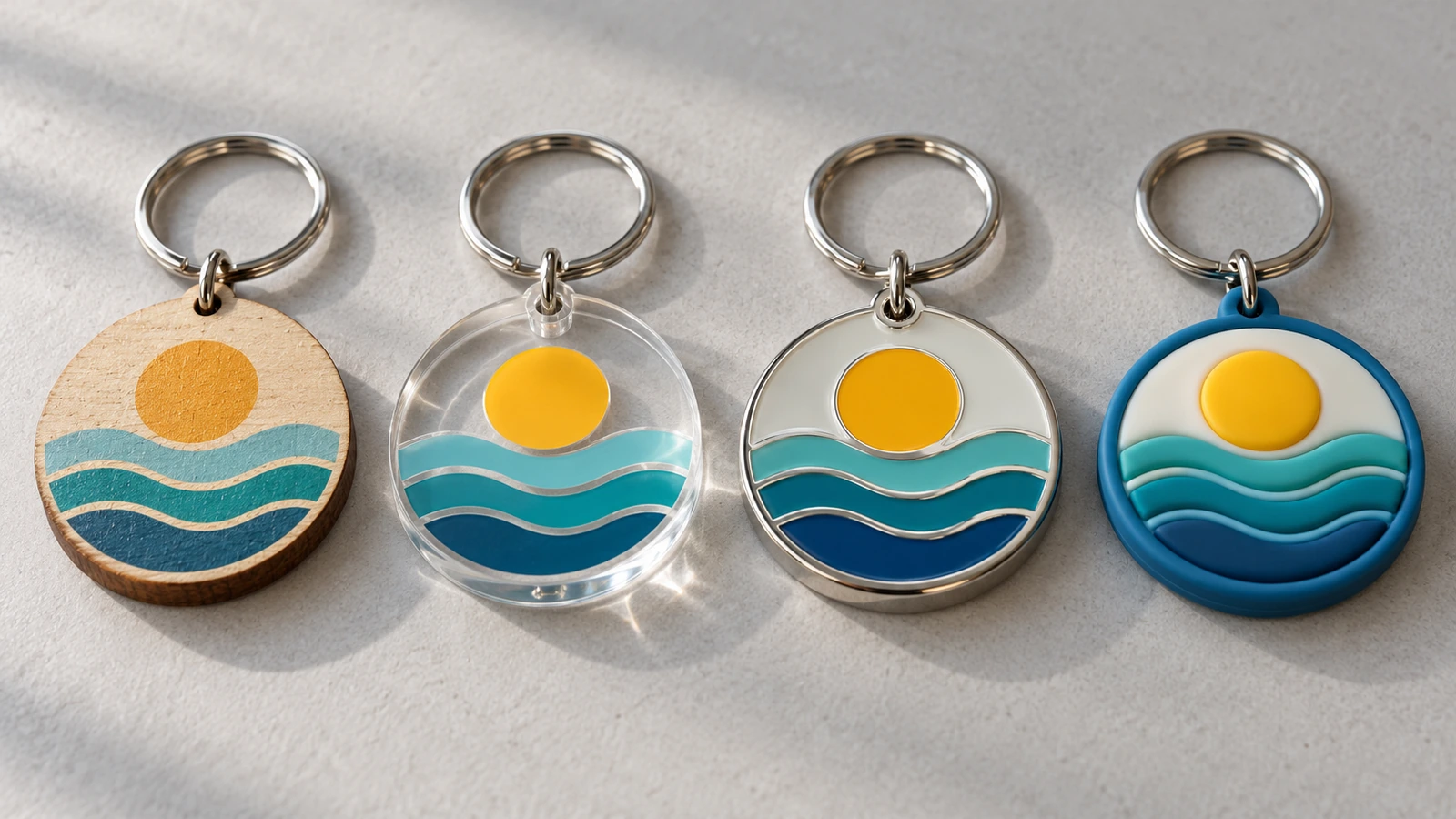
Each material wins on a different axis. The table summarizes the trade-offs B2B buyers raise most often.
Factor
Wood (solid or MDF)
Acrylic
Metal (die-struck or cast)
PVC (soft)
Brand signal
Warm, crafted, natural
Bright, playful, retail
Premium, formal, durable
Fun, casual, character-led
Color capability
Full color on MDF or birch; tonal marks with engraving
Full color, clear and glitter effects
Enamel fills and plating colors
Spot colors in molded relief
Everyday wear
Good when sealed; edges and the hole area are the weak points
Good; surface scratches show on gloss
Highest long-term wear resistance
Flexible and hard to break; can pick up dirt
Water and humidity
Water-resistant when sealed, not waterproof
Unaffected
Unaffected, though plating can wear
Unaffected
Weight and feel
Light and warm to the touch
Light and slick
Heavy and cool
Soft and rubbery
Setup logic
Digital cutting and printing usually need no mold
Usually no mold
Molds or dies needed
Molds needed
Cost behavior at scale
Flexible for multiple designs and short runs
Similar to wood
Tooling cost spread over larger runs
Tooling cost spread over larger runs
Sustainability story
Strongest, if sourcing is documented
Weak (plastic)
Moderate (recyclable metal)
Weak (plastic)
Brand perception
Wood is the only material on this list that most recipients link with craft before they see the logo. That helps brands whose story is about place, process or care. It can hurt when the finish is poor. Buyers and creators note that rough laser-cut edges look cheap, while sanded, sealed edges look deliberate. Metal still signals "premium" most reliably, which is why formal corporate gifting often defaults to it.
Durability
With wood, failures cluster in two places: the area around the attachment hole, and the print surface on unsealed pieces. Brief splashes and humidity are usually fine with a proper finish, but soaking can swell MDF edges or crack thin solid stock. Hardware is a shared risk across all materials. Rings separating from fobs is one of the most common complaints in keychain reviews, whatever the body is made of.
Metal and PVC usually need a mold or die, so their cost per piece only becomes competitive across larger runs, and every new design adds tooling. Digitally cut and printed wood and acrylic avoid most of that. This makes them practical for multi-design programs such as one shape per team, per location or per player. The better metric is cost per carried piece: a cheaper item that ends up in a drawer has a higher effective cost than a slightly pricier one that lives on someone's keys. We do not publish fixed prices here because shape, quantity, print sides and hardware change the numbers. A quote on your actual brief is the only reliable comparison.
For MDF specifically, buyers selling into Europe should know that REACH restricts formaldehyde emissions from wood-based articles. The limit is 0.062 mg/m³ from August 6, 2026, under the formaldehyde restriction published by ECHA[9]. Board selection is a compliance input, not just a cost line.
Wood, acrylic, metal and PVC each win on a different axis.
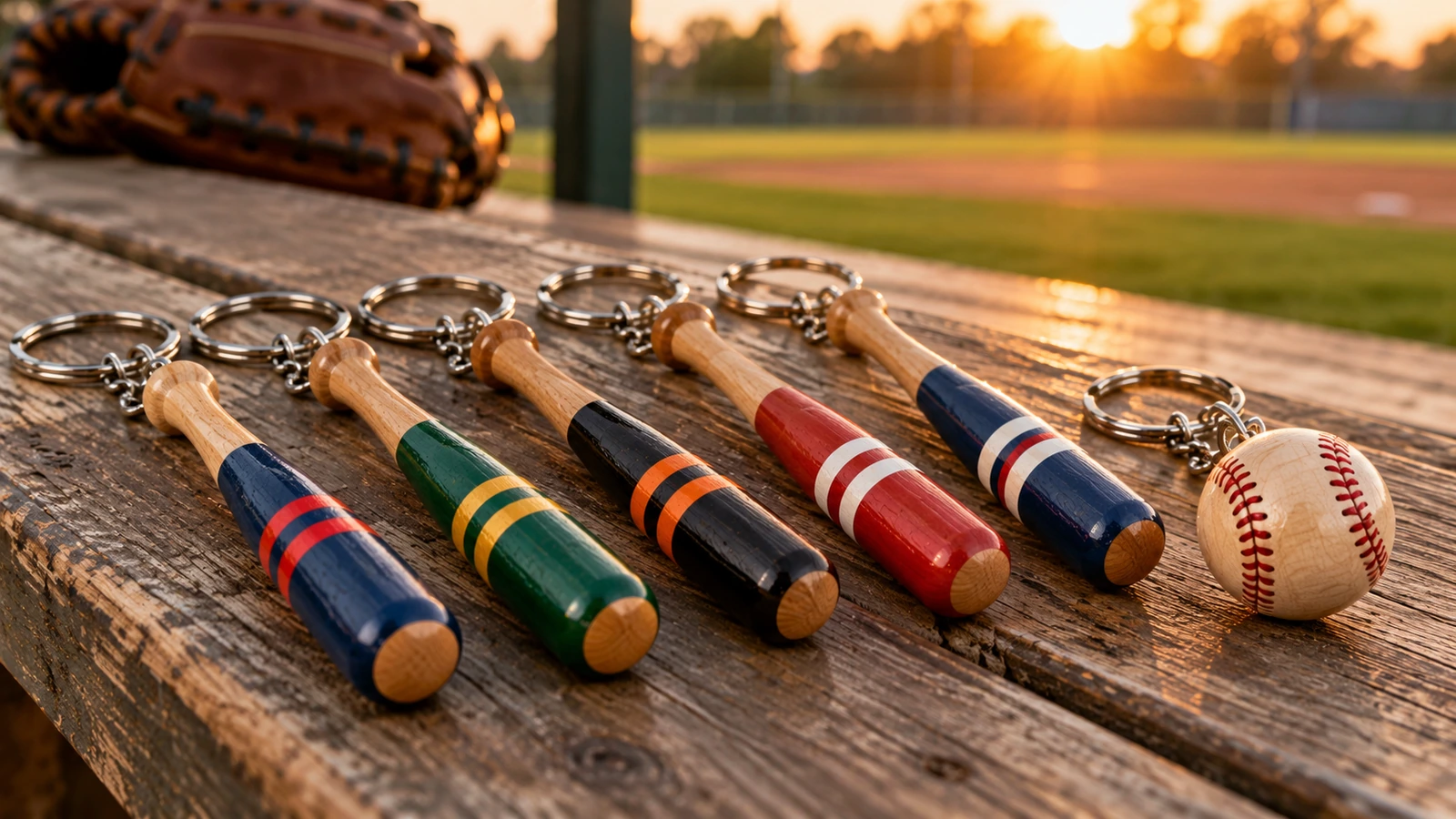
Shaped options for team and fan programs: the wooden bat keychain
A wooden bat keychain is one of the clearest cases where material and message match. Baseball, softball and cricket bats are wooden objects, so a bat-shaped wood tag needs no explanation. Teams and clubs use them as season-ticket-holder gifts, giveaway-night items, end-of-season banquet favors, coach and volunteer thank-yous, tournament souvenirs and fundraiser merchandise. Personalizing each piece with a player name or jersey number turns a giveaway into a keepsake that families keep.
The bat shape needs some engineering thought because it is long and narrow:
Put the hole in the knob end, with generous material around it. The narrow handle is the weakest section, so the ring should not pull through it.
Mind the board. Solid wood splits along the grain, so a bat cut from solid stock needs the grain running along its length. MDF has no grain direction, but its edges must be sealed against moisture.
Keep the handle from getting too thin. A slightly stylized, thicker handle reads as "bat" just as clearly and survives a pocket much better.
Pair shapes for a set. A bat with a round ball companion, or a bat in team colors on the barrel, gives fans a reason to collect more than one.
Youth leagues should apply the children's product caution above. If the item is designed or marketed mainly for children, check the toy safety requirements before finalizing the design.
Bat and ball shapes give team and fan programs a matched, collectible set.
FAQ
FAQ: Are wooden keychains durable enough for everyday keys?
Yes, for moderate daily use, if the shape is compact, the edges and print are sealed, and the hardware is solid. For heavy key sets that see years of abrasion, metal remains the more durable choice.
FAQ: Is an MDF keychain real wood?
MDF is made from wood fibers bonded with resin, so it is wood-based but not solid wood. Its advantage is a uniform surface that keeps full-color artwork consistent. Describe it accurately in your marketing rather than calling it solid wood.
FAQ: Are wooden key chains waterproof?
No. Sealed pieces resist splashes and humidity, but soaking can cause swelling or cracking. For pool, marina or beach programs, acrylic or PVC is the safer choice.
FAQ: Can we market our wooden keychains as eco-friendly?
Only with evidence. Certified-wood claims require chain-of-custody documentation, and EU-bound wood products face deforestation due-diligence rules. Sealants and metal hardware also affect any biodegradability claim.
FAQ: Can wooden keychains be given to children?
They can, but items designed or marketed for young children in the US must meet ASTM F963-23 toy requirements. Confirm the requirements before you commit to a design aimed at kids.
FAQ: What are the minimum order, price and lead time?
They depend on shape, quantity, print sides, personalization and hardware, so they are quoted per project. Share your artwork and target quantity through the product page to get a quote.
Key takeaways
Personalized accessories are an established promotional category, not a niche. — ASI named them its 2025 Product of the Year (Source)
Kid-focused programs fall under mandatory US toy rules. — ASTM F963-23 has been mandatory since April 20, 2024 (Source)
The documented keychain safety recalls involved metal parts, not wood. — about 192,000 units recalled over lead exposure (Source)
MDF pieces sold in the EU face a formaldehyde emission limit. — 0.062 mg/m³ for wood-based articles from August 6, 2026 (Source)
EU-bound wood products need deforestation-free proof. — the cutoff date is December 31, 2020 (Source)
Certified-wood claims depend on an unbroken chain of custody. — governed by standard FSC-STD-40-004 (Source)
Conclusion
Wood is not a universal upgrade over acrylic, metal or PVC. It is the best choice when the material helps tell your brand's story and the piece will be carried, not abused. That makes it a strong fit for real estate gifts, hospitality, craft and outdoor brands, campus programs, and team and fan programs built around shapes such as the wooden bat keychain. Choose the board deliberately, keep shapes robust, back any sustainability claim with documentation, and compare materials on cost per carried piece.
When wood is the right call, the next step is turning your design into a clear specification. Our full-color printed MDF keychain page covers artwork sizing, sampling and order planning, and you can request a quote based on your shape and quantity.
Hi there! I'm Bruce, proud dad to my amazing son. I'm the founder of Zigpac, a printing and packaging company empowering small and medium-sized businesses with custom solutions. Let's create something great together!



 Blog PDF for offline reading












The information below is required for social login
Sign In
Create New Account