


 Blog PDF for offline reading
Quick answer: Size huge reusable shopping bags by four numbers instead of by how big they look: usable volume in litres (width × height × gusset), a load rating backed by a carry test, a gusset deep enough for your bulkiest item, and a handle drop that fits how people actually carry the bag. Extra litres only help if the handles can carry the extra weight that space invites.
Why "Huge" Is the Wrong Spec
Most oversized-bag orders begin with one adjective. A grocery buyer asks for "jumbo," an event planner asks for "XL," and a retail team asks for "the biggest one you make." Each supplier reads that word differently, so three quotes for "huge reusable shopping bags" can describe three bags whose volumes differ by half. None of those quotes tells you whether the bag will survive the load its size encourages people to put in it.
Capacity and strength are linked, and the link works against you. One litre of water weighs about one kilogram, so liquid volume sets the theoretical weight ceiling. A bag with 40 litres of box volume, packed tight with bottled drinks or canned goods, could approach 40 kg. No hand-carried tote is designed for that. People fill a big bag to its rim, and the first thing to fail is the handle-to-body seam, not the fabric panel.
Field evidence shows how often "reusable" labels promise more than they deliver. In a CBC Marketplace durability test[1], 7 of 12 reusable bags failed, every thinner cloth bag failed before 100 trips, and one tore after about five. Oversizing magnifies that risk, because a larger bag carries a larger load on the same two stitch points.
The fix is to replace the adjective with four measurable numbers and match them to a defined use case. The rest of this guide shows how to do that.
What Counts as a Huge Reusable Shopping Bag?
No standard defines a "huge" size class. The closest thing to an official floor comes from California. Under California Public Resources Code §42281[2], a fabric reusable grocery bag, with woven or nonwoven nylon named explicitly, must have a volume of at least 15 litres. It must also be sewn, use fabric of at least 80 g/m², and be able to carry 22 lb over 175 ft for a minimum of 125 uses. New York's GreenNY reusable bag specification[3] (approved December 11, 2025) uses the same 15-litre and 80 GSM floors for state purchasing.
Those figures describe a minimum bag, not a big one. Buyers usually say "huge" when they mean several times that 15-litre floor. Because no rule draws the line, write the litre target into the spec rather than leaving it to a supplier's size chart. For a consumer reference point, an independent Wirecutter review[4] found that a popular standard-size foldable nylon tote holds about three plastic bags' worth of goods and can carry up to 50 pounds. Staff testers reported using those bags for at least five years. A bag sold as "huge" should beat that benchmark on at least one of the four numbers, or it is simply a standard bag with a larger label.
Material matters too. Lightweight foldable fabrics often fall below 80 g/m², which affects which formal benchmarks a bag can meet. This guide deals with size rather than fabric. For grade selection, see the material notes on our custom foldable nylon shopping bags page.
How to Size Huge Reusable Shopping Bags in Six Steps
Step 1: Write down the real trip, not the ideal one
List the heaviest realistic load and the bulkiest single item the bag must carry. A bulk grocery run might mean two gallon jugs plus produce. A trade-show haul might mean a boxed giveaway, a stack of catalogues and a rolled poster. A checkout program might mean whatever a customer buys in one weekly shop. The heaviest item sets the load rating. The bulkiest item sets the opening and the gusset. Volume comes last, because it is what remains once those two are fixed.
Step 2: Convert dimensions into litres, then check the opening
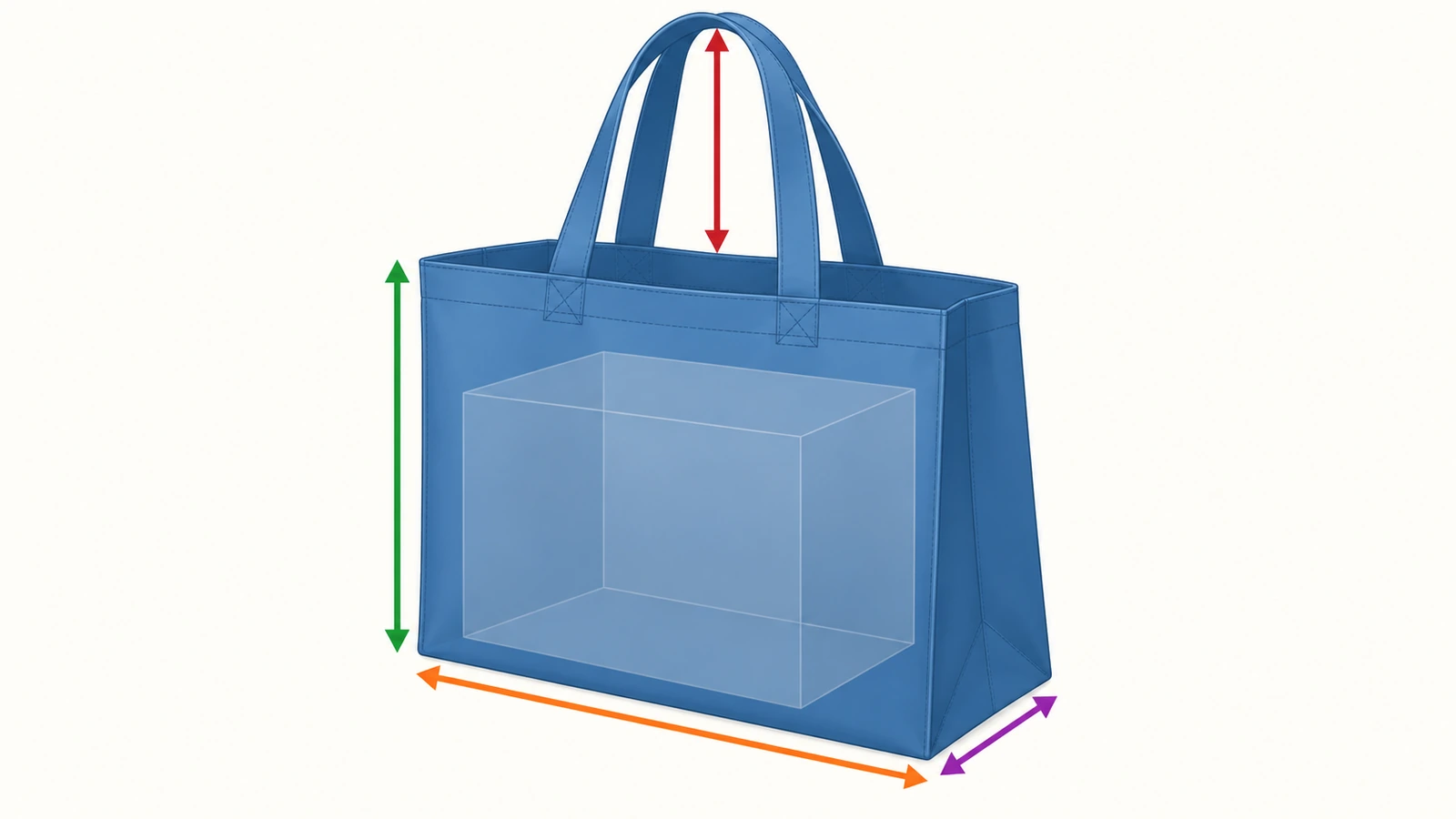
Box volume in litres equals width × height × gusset depth in centimetres, divided by 1,000. As a worked arithmetic example only (not a catalogue size), 50 cm × 40 cm × 20 cm comes to 40 litres. Usable volume is lower than this box figure. The opening sags, the corners round off, and nobody can close a bag packed to the top seam. Compare candidate bags on the same formula, and ask each supplier to quote volume, not just "XL."
| Measurement | What it controls | What goes wrong if it's wrong |
|---|---|---|
| Width | Whether flat items (folders, trays, posters) fit the opening | Collateral bends; boxes jam at the mouth |
| Height | Total volume and how far the base hangs below the hand | Bag bumps shins and catches on stairs when hand-carried |
| Gusset depth | Whether boxes and jars stand upright on a flat base | Load rolls to the centre, the bag bellies, and base seams take point loads |
| Handle drop | Hand carry versus shoulder carry | Straps won't clear a coat, or the bag drags on the floor |
| Load rating | The weight the stitched joints are tested to carry | Handles tear away once the bag is full |
For paper collateral, the standard sheet sizes give you hard minimums. US Letter is 8.5 × 11 in and A4 is 210 × 297 mm. If brochures must lie flat on the base, both the width and the gusset have to exceed the sheet. If they must stand upright, the height has to exceed the long side.
Step 3: Set a load rating and demand a carry test
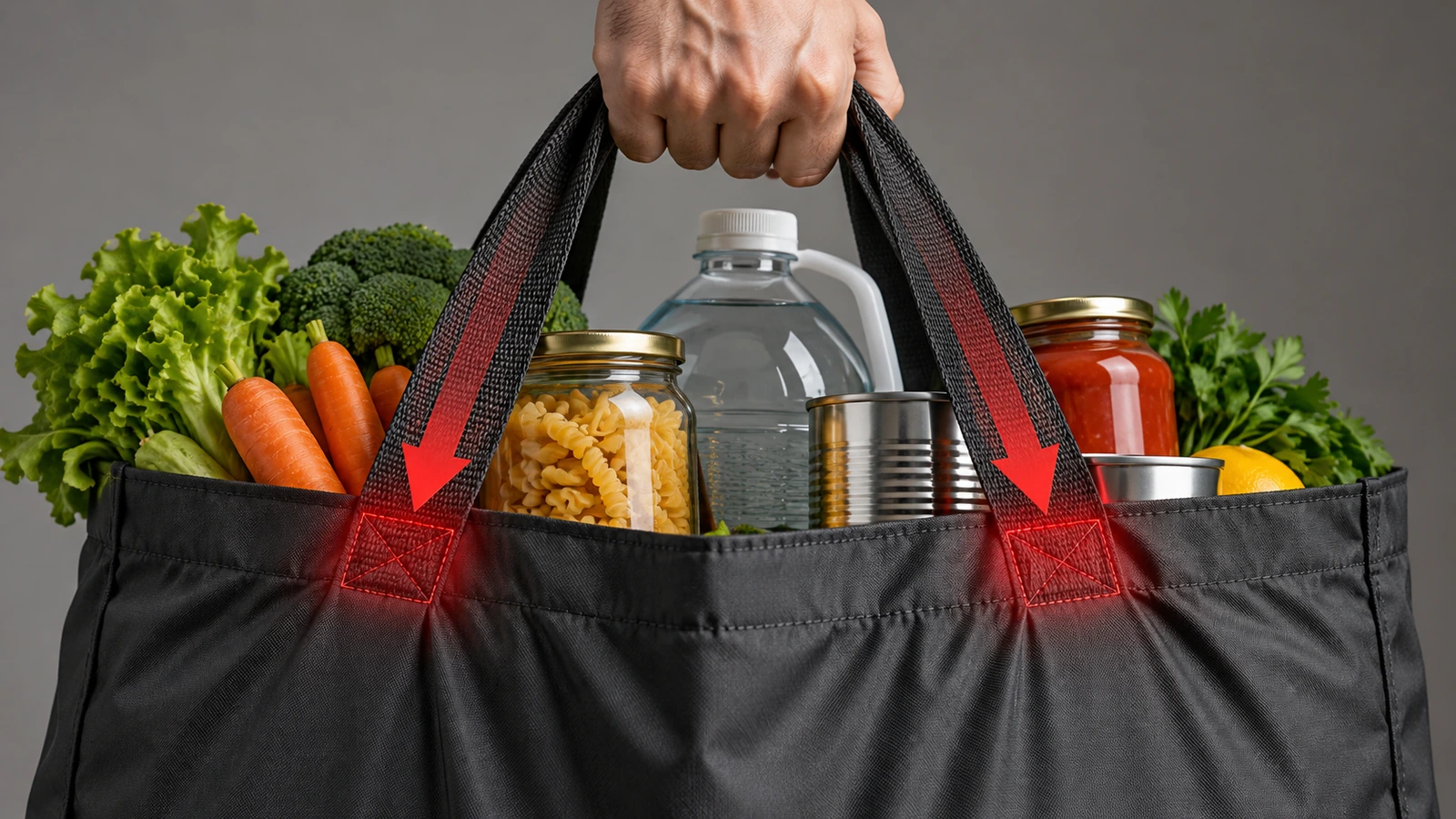
A load rating has no meaning unless a test method comes with it. The California method is a clear template: load the bag, walk it 175 ft (53 m), and repeat for 125 cycles. That protocol traces back to the Green Seal GS-16 reusable bag standard[5], which was withdrawn in 2020 but is still used as a reference. Treat it as a historical benchmark, not a live certification. For an oversized bag, run the cycle at your intended full load rather than at 22 lb, because a 22 lb pass says nothing about a bag designed to carry twice that weight.
Set the rating with some sense of scale. Even engineered textile sacks for dangerous goods under 49 CFR §178.520[6] are capped at 50 kg (110 lb) net mass. A hand-carried shopper should sit far below that. During sampling, watch where failures start. Inspect the handle-to-body joint, the base corners and the side seams after the test, not only the fabric panels. Our product page covers why branded nylon bags fail before a campaign ends, so we won't repeat it here.
Step 4: Choose the gusset for the bulkiest item
Set the gusset at least as deep as the bulkiest boxed item you want sitting flat on the base. A deep gusset lets jars, cartons and gift boxes stand upright and spreads their weight across the base. The cost is more fabric, more weight on the base seams and more sag when the bag is half full. If a deep gusset is non-negotiable, ask during sampling whether a removable base board is possible. For document-heavy loads, a moderate gusset with a wide opening often works better than a deep one.
Step 5: Fit the handle drop to the carrier, not to the bag
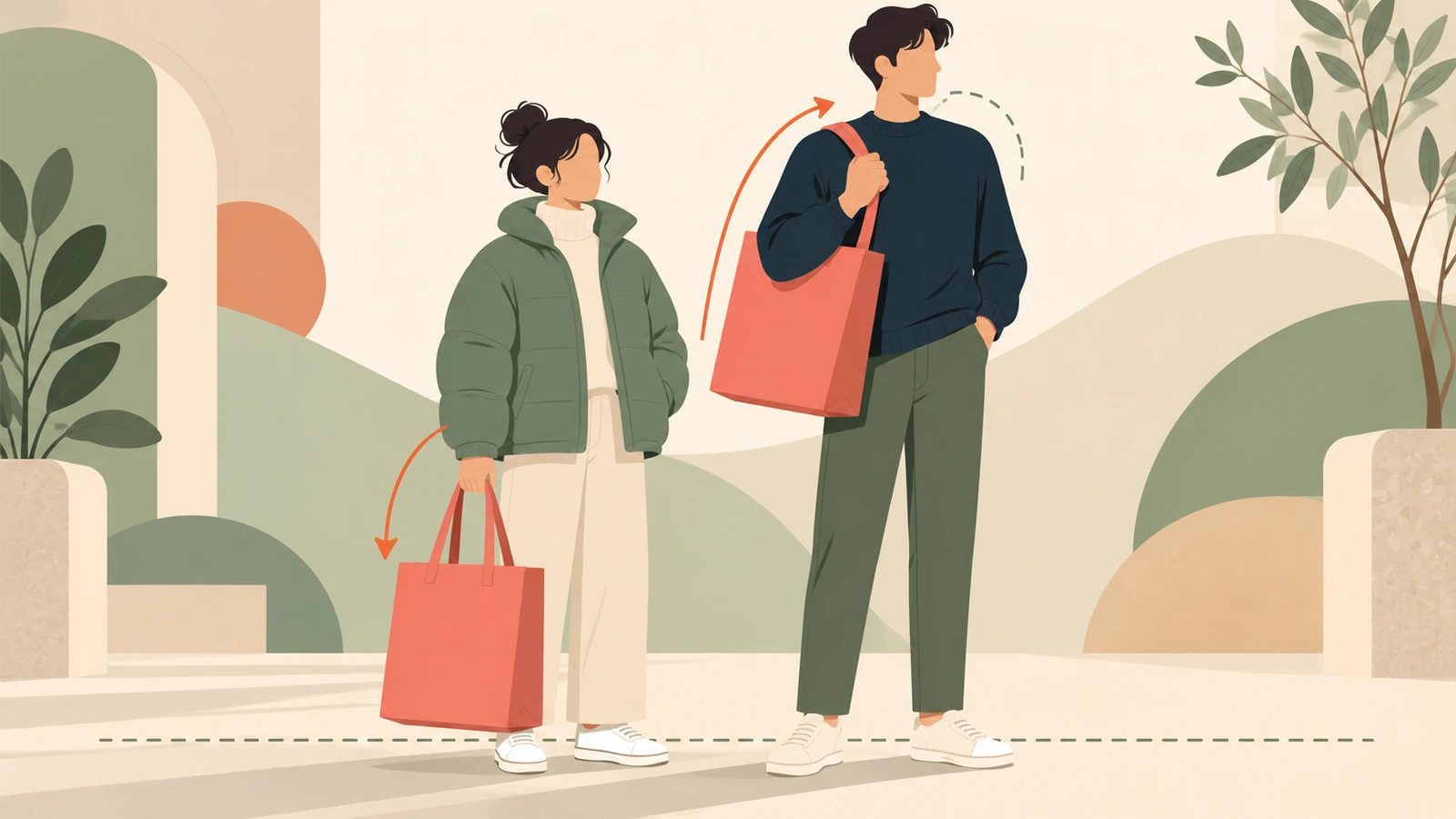
Handle drop is where huge bags most often disappoint the people who use them. Reviews of one best-selling XL nylon carry bag show both failure modes. A 5'3" buyer found the bag too long to carry comfortably, and a 5'7" buyer found the attached strap too long to use either over the shoulder or across the body. Test samples with your shortest and tallest likely carriers. For shoulder carry, check that the strap clears a winter coat. For hand carry, check that a full, tall bag does not hit the floor or the stairs. When a bag has to work both ways, two handle lengths usually beat one compromise length.
Step 6: Check pack-down size and reuse odds
A huge bag only pays its environmental cost back if people keep using it. A peer-reviewed South African life cycle assessment[7] found that reusable bags must be used about 3 to 10 times before they beat single-use bags on most indicators. Kane County, Illinois' recycling program[8] puts the break-even for polyester and nylon bags closer to 30 uses. In both cases a bag that is too bulky to keep in a car or handbag misses its reuse target. Fold the sample, judge whether it fits where your users actually store bags, and give up some volume if it doesn't.
Matching Big Shopping Bags to Real Use Cases
| Use case | Volume priority | Load priority | Gusset | Handle drop | Main watch-out |
|---|---|---|---|---|---|
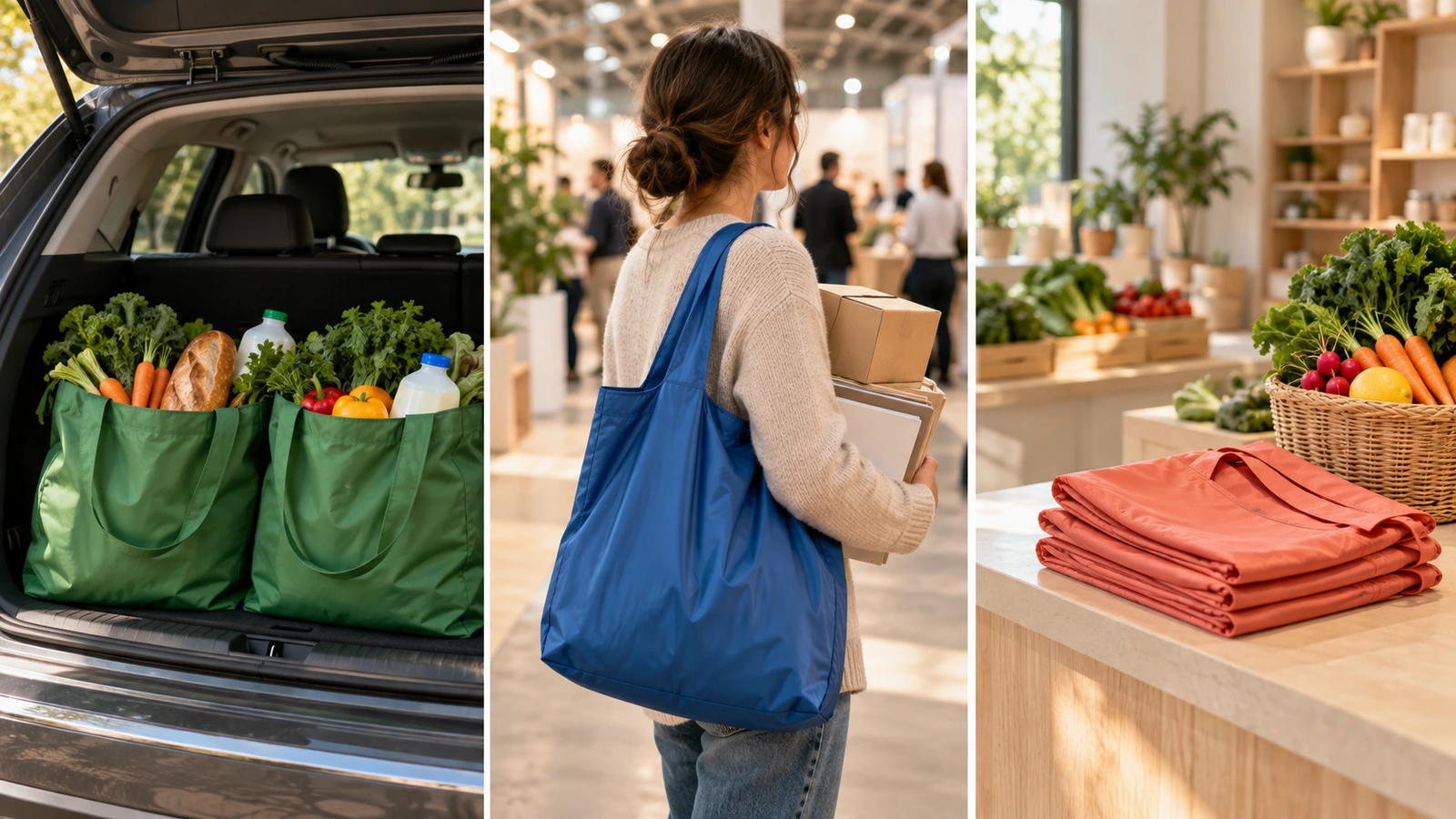
| Bulk grocery run | Medium; two mid-size bags often beat one giant | Highest | Deep, so jugs and jars stand upright | Short hand carry plus optional shoulder | Weight overload; hygiene between meat and produce |
| Trade-show swag haul | Highest | Low to medium | Moderate, with a wide opening for flat collateral | Shoulder, so hands stay free for handshakes | Bag becomes a one-day item and is never reused |
| Retail checkout program | Medium to large | Medium | Moderate | Hand carry that suits most heights | Local bag laws and procurement material rules |
| Bulky household items (bedding, laundry) | Highest | Medium | Deep | Long strap, tested on short users | Bag drags or swings when slung over a shoulder |
Bulk grocery runs
Grocery loads are dense, so this is where oversizing backfires fastest. Two medium nylon grocery bags with a tested load rating spread weight across both hands and are less likely to rip than a single giant bag. Hygiene also scales with size, because a bigger bag mixes more raw food. A Clemson University study[9] found coliform bacteria on 51% of the reusable bags tested and E. coli on 8%. According to the American Cleaning Institute[10], only 3% of reusable-bag users clean their bags regularly, and ACI advises hand-washing nylon in warm, soapy water, turning it inside out and line-drying it. Printing those care steps inside the bag costs nothing and protects the program's reputation.
Trade-show swag hauls
At a trade show, volume matters more than load. Attendees collect light but awkward items: catalogues, boxed samples and rolled posters. Size the opening for flat collateral (see Step 2), use a shoulder strap so hands stay free, and give up the deep gusset in exchange for a wide mouth. The bigger risk is the bag's life after the show. A giant bag with no folded form tends to stay in a hotel room. A large reusable shopping bag that packs flat has a better chance of reaching the reuse counts in Step 6.
Retail checkout programs
Retail programs have to fit the law before they fit the customer. Since January 1, 2026, California stores may not hand out single-use plastic carryout bags at checkout and may offer only recycled paper bags for at least $0.10 each, while customers can still bring reusable bags, as explained in a CalRecycle bulletin on SB 1053[11]. The same bulletin confirms that the SB 270 certification list ended on December 31, 2025. If you plan to position big shopping bags as a checkout alternative, have counsel confirm the current rules first. Procurement can also rule out a material entirely. New York's GreenNY specification allows only recycled PET, polypropylene or natural fibre, so a large nylon bag is excluded however well it is sized. Spec-level compliance is covered on the product page.
Bulky household items
Oversized nylon carry bags also serve as laundry and bedding haulers, and their reviews are useful for sizing. Buyers of one XL nylon laundry bag reported fitting two or more full laundry loads in a single bag. Their main complaints concerned strap length and drawstring closures, not capacity. If your "shopping" bag is likely to become a household hauler, test the strap and closure at full volume.
Once you have settled your litre target, load rating, gusset depth and handle drop, bring them to our custom nylon shopping bags team. We will quote against your exact numbers and arrange a sample you can load-test yourself.
FAQ
FAQ: How many litres is a huge reusable shopping bag?
No standard sets a number. California and New York both use 15 litres as the minimum for a reusable grocery bag, and buyers usually mean several multiples of that when they say "huge." Calculate width × height × gusset depth in centimetres ÷ 1,000, then put the litre target in your spec.
FAQ: How much weight should a large reusable shopping bag hold?
Rate the bag for its realistic full load, not its theoretical volume. The best-known benchmark is California's: 22 lb carried over 175 ft for 125 uses. Ask the supplier to run that cycle at your intended load and to report where the bag fails first.
FAQ: Is one giant bag better than two medium ones for groceries?
Usually not. Dense groceries reach a bag's weight limit long before they fill its volume, and two bags split the load between both hands. Giant bags suit bulky, light loads such as swag, bedding or boxed goods.
FAQ: Should a big shopping bag have shoulder straps or hand handles?
Match the handles to how the bag will be carried. Light, bulky loads favour shoulder straps. Heavy, dense loads favour short hand handles so the bag stays off the floor. Test samples on your shortest and tallest users, because strap length is the most common complaint about oversized carry bags.
FAQ: How should nylon grocery bags be cleaned?
The American Cleaning Institute recommends hand-washing nylon or polyester bags in warm, soapy water, turning them inside out and line-drying them. Keep raw meat separate from produce. Only 25% of users do so, according to the University of Arizona study ACI cites.
FAQ: Do bigger reusable bags have a bigger environmental payoff?
Only if they are reused. Life cycle studies put the break-even for reusable bags at roughly 3 to 10 uses, and one county program estimates about 30 for nylon and polyester. A bag too bulky to keep at hand may never reach either figure.
Key Takeaways
- The legal floor for a reusable grocery bag is small, so "huge" needs a number. — 15 litres minimum (Source)
- Load ratings mean nothing without a test cycle. — 22 lb × 175 ft × 125 uses benchmark (Source)
- Many reusable bags fail well short of their promise. — 7 of 12 failed; thin cloth bags failed before 100 trips (Source)
- Bigger bags carry more food risk if they are never washed. — coliform on 51% of bags tested (Source)
- Reuse, not size, decides the environmental result. — 3 to 10 uses to break even (Source)
- Material rules can exclude nylon from public procurement regardless of size. — GreenNY limits bags to rPET, PP or natural fibre (Source)
Conclusion
Huge reusable shopping bags work when the size comes from the job: the heaviest realistic load sets the rating, the bulkiest item sets the gusset and opening, the carrier sets the handle drop, and volume is what remains. Write those numbers down, test samples at full load, and fold them to check they fit where users keep their bags. That process turns "jumbo" from a guess into a spec you can quote, sample and verify.
References
- CBC News, "Marketplace reusable bag test." cbc.ca ↩
- California Legislature, Public Resources Code Division 30, Chapter 5.3, Article 2 (PRC §42281), Reusable Grocery Bags. leginfo.legislature.ca.gov ↩
- New York State Office of General Services, GreenNY Specification: Reusable Bags (approved 2025-12-11). ogs.ny.gov ↩
- The New York Times Wirecutter, foldable tote bag review (2023-12-04). nytimes.com ↩
- Green Seal, GS-16 Standard for Reusable Bags, Edition 2.1 (withdrawn September 2020). greenseal.org ↩
- U.S. DOT / PHMSA, 49 CFR §178.520 Standards for textile bags. ecfr.gov ↩
- Stafford et al., comparative cradle-to-grave LCA of shopping bags in South Africa, The International Journal of Life Cycle Assessment (2022). link.springer.com ↩
- Kane County, Illinois, Recycling: Reusable Bags. kanecountyil.gov ↩
- Clemson University, thesis on bacterial contamination of reusable grocery bags. open.clemson.edu ↩
- American Cleaning Institute, "ACI Shares on Proper Reusable Bag Cleaning Practices" (2021-02-24). cleaninginstitute.org ↩
- CalRecycle, "SB 270 Reusable Grocery Bag Program to End December 31, 2025" (SB 1053 implementation). content.govdelivery.com ↩












The information below is required for social login
Sign In
Create New Account