
 Blog PDF for offline reading
Quick answer: Zigpac makes custom paper shopping bags with logo printing at a low minimum: price tiers from 500 pcs, final MOQ on your quote. Brown kraft twisted-handle bags are the usual starting point at US$0.55 each for 500+ (November 2026, final price on your quote). Flat-handle kraft is the lowest-cost format, and laminated art-paper bags cost more per piece for a boutique or gift look. Ask for 500 and 1,000 pcs quotes side by side, then approve the free eProof and a physical sample (US$5–30) before bulk production.
Most people searching "custom paper shopping bags with logo low minimum" run a boutique, café, salon, pop-up shop or event, and they need a few hundred branded bags rather than a warehouse load. The obstacle is fixed cost. Plates, press setup and proofing take roughly the same effort for 500 bags as for 50,000, so many printers quote thousands of pieces per size and per design before the unit price looks reasonable.
That leaves an awkward choice. You can tie up cash and storage in bags you may redesign next season. Or you can keep handing out plain stock bags with a sticker and lose the brand moment at the door. Neither option suits a shop testing a new logo or an event with a single date.
The fix is to buy at a realistic first tier and compare quotes like for like. This guide covers what a low minimum actually includes and how bag type and handle style change the price at 500, 1,000, 3,000 and 5,000 pcs. It also explains when lamination earns its premium and what to send so that quotes can be compared.
What a low minimum means for custom paper shopping bags with a logo
A low minimum is the smallest run that spreads setup across enough bags to make each one affordable. Below that point, most of what you pay covers preparation rather than paper. At Zigpac, printed paper shopping bags are sold on price tiers from 500 pcs, final MOQ on your quote. That makes 500 the first tier at which a fully custom bag is priced. It does not promise that every specification can be produced at 500.
Three questions decide whether your order actually reaches that first tier:
- Per size: 300 small bags plus 200 large bags are usually two runs, not one 500-piece order.
- Per design: a spring logo and a holiday logo on the same bag can count as separate quantities.
- Per print version: changing ink colors, or switching from one-side to two-side printing, can create a new version even when the artwork stays the same.
Read "low MOQ" banners carefully. A tiny minimum advertised for stickers or stock items does not cover a bag printed to your size. Ask for the minimum on the exact bag type, size and print version you need. The broader trend does favor smaller buyers. An OG Analysis market outlook notes that bag conversion is moving toward short-run digital and high-definition flexo printing[1] for seasonal, regional and direct-to-consumer campaigns.
How bag type changes the price at 500, 1,000, 3,000 and 5,000 pcs
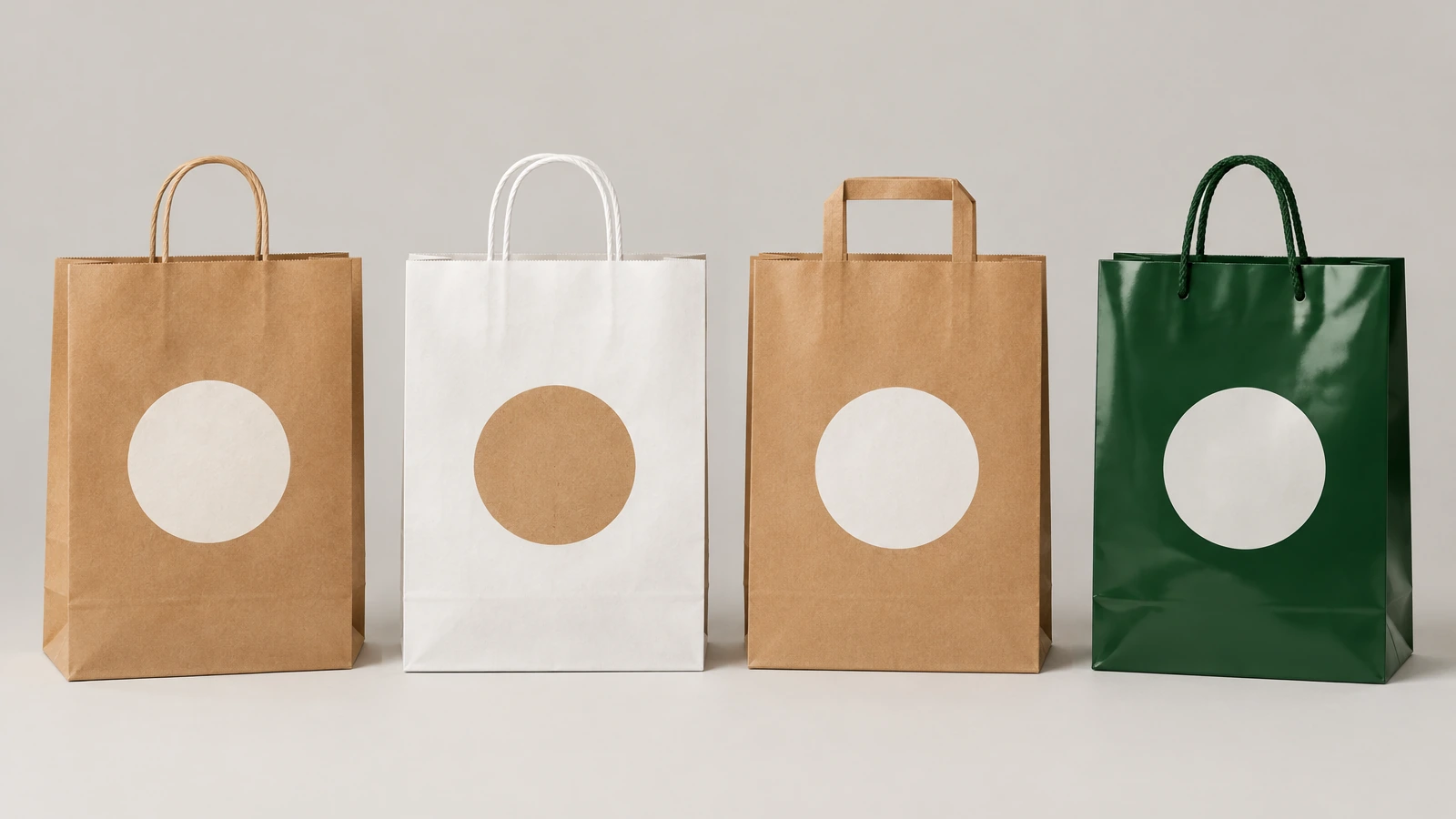
Bag type moves the unit price more than any other single choice. The table below uses the live tier tables from November 2026. Every figure is a per-piece price, and the final price is on your quote.
| Bag type | Material and look | Best use | 500+ | 1,000+ | 3,000+ | 5,000+ |
|---|---|---|---|---|---|---|
| Brown kraft with twisted handles | Brown kraft paper; natural, textured look; the base shade affects how ink reads | Boutique and retail carry, markets, café retail goods | US$0.55 | US$0.42 | US$0.30 | US$0.24 |
| Custom White Kraft Paper Bags (twisted handles) | White kraft paper; brighter print surface that also shows marks | Logos that need cleaner, brighter color | US$0.60 | US$0.46 | US$0.33 | US$0.26 |
| Custom Kraft Takeout Bags with Flat Handles | Brown kraft paper with flat paper handles | Counter pickup, carryout, delivery | US$0.32 | US$0.22 | US$0.16 | US$0.13 |
| Custom Laminated Paper Bags | Printed art paper with film lamination; gloss, matte or soft-touch | Cosmetics counters, apparel, corporate gifts, events | US$0.98 | US$0.78 | US$0.58 | US$0.48 |
Zigpac's live tier tables follow the same pattern across all four formats: the 5,000+ price is roughly 40–50% of the 500+ price. The relative gaps also hold steady. At 500+, laminated bags cost about 1.8 times as much as brown kraft, and flat-handle kraft costs about 58% as much. These are unit prices only. Ask for setup or plate charges, samples, packing and freight on the same quote so that the totals can be compared.
On color, brown kraft remains the default. Grand View Research[2] put brown kraft at more than 66.4% of kraft paper bag revenue in 2024. White kraft costs US$0.05 more per bag at 500+ and US$0.02 more at 5,000+. It gives a logo a brighter surface, but it also shows scuffs.
Worked example: order totals at 500 and 1,000 pcs
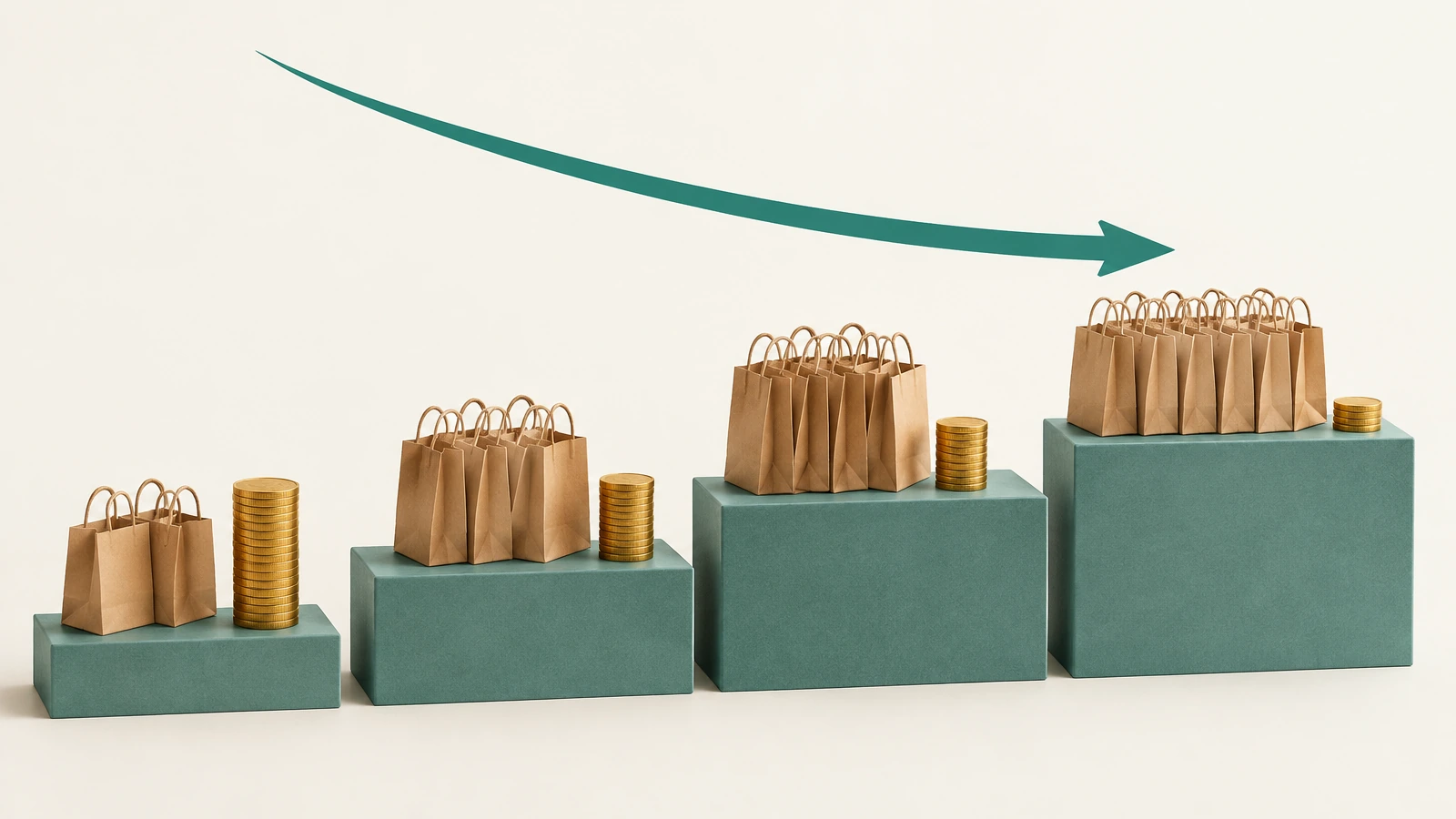
Unit prices only become useful once you multiply them out. The totals below are simple tier arithmetic based on the November 2026 prices, and the final price is on your quote.
| Bag type | 500 pcs | 1,000 pcs | Cost of the extra 500 | Effective price of the extra 500 |
|---|---|---|---|---|
| Brown kraft, twisted handle | about US$275 | about US$420 | US$145 | US$0.29 each |
| White kraft, twisted handle | about US$300 | about US$460 | US$160 | US$0.32 each |
| Kraft, flat handle | about US$160 | about US$220 | US$60 | US$0.12 each |
| Laminated art paper | about US$490 | about US$780 | US$290 | US$0.58 each |
The last column shows why moving up a tier often pays off. In brown kraft, the second 500 bags effectively cost US$0.29 each, which is about half the first-tier price. If you know you will use 800 bags within a year, 1,000 pcs costs US$145 more than 500 pcs. Two separate 500-piece reorders would cost US$550. Higher tiers keep the same pattern: 3,000 brown kraft bags come to about US$900 and 5,000 to about US$1,200.
Splitting designs can cost you too. If the minimum counts per design, two logos at 500 pcs each come to about US$550 in brown kraft. One logo at 1,000 pcs comes to about US$420. At Zigpac, size, print coverage, ink colors, finishing, handles, packing and freight are all confirmed on the quote. Treat these totals as a budgeting tool, not an invoice.
Twisted vs flat paper handles
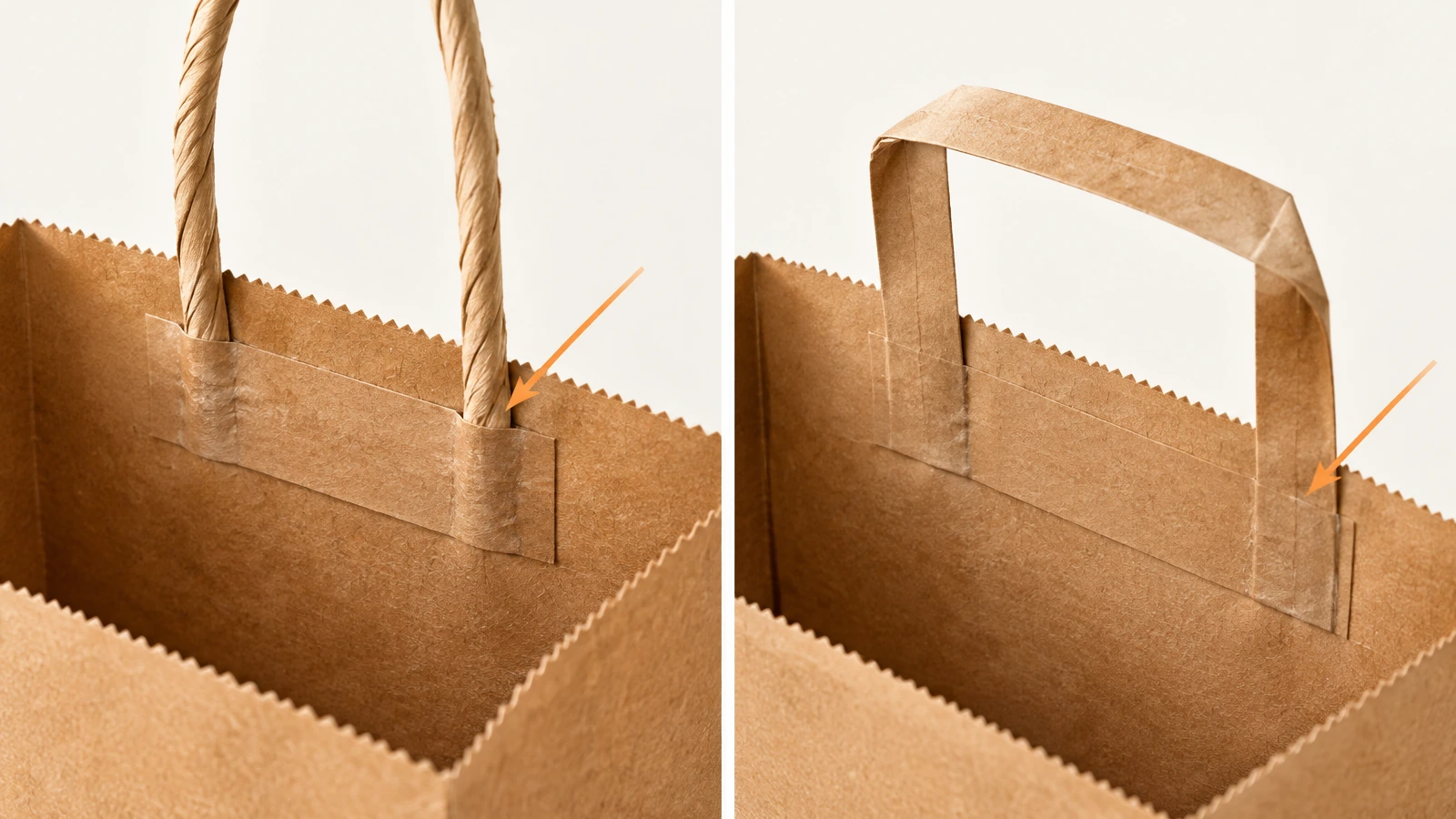
A twisted handle is a rolled paper cord glued inside the top of the bag. It is the standard choice for shopping, retail and gift carry. A flat handle is a folded paper strip glued flat to the inside of the bag. It suits takeaway, counter pickup and lighter orders, and it is the cheapest format in the tier tables.
| Twisted paper handle | Flat paper handle | |
|---|---|---|
| Typical bag | Brown or white kraft shopping bag | Kraft takeout bag |
| Price at 500+ | US$0.55 brown / US$0.60 white | US$0.32 |
| Best fit | Retail and shopping carry, gifts, events | Takeaway, counter pickup, lighter loads |
| What to inspect | Glue at the handle roots once the bag is filled | Strip attachment and bag top at real order weight |
Treat handle type as a format, not a strength claim. No tested load rating is published for these bags, because carrying capacity depends on dimensions, how the load sits and how a sample performs. Pack a sample with your real items at their real weight, including boxes or tissue. Lift it by the handles, walk with it, and set it down several times. Then check where each handle meets the bag for lifting glue or tearing paper.
Food is a separate question. Brown kraft is not a grease barrier, and this guide makes no food-contact claim. If a bag will hold unwrapped or oily food, ask for documentation. In the US, paper in contact with aqueous and fatty foods is governed by 21 CFR 176.170[3]. In February 2024 the FDA also announced that PFAS grease-proofing agents[4] are no longer sold for US food packaging.
When lamination is worth it for a boutique
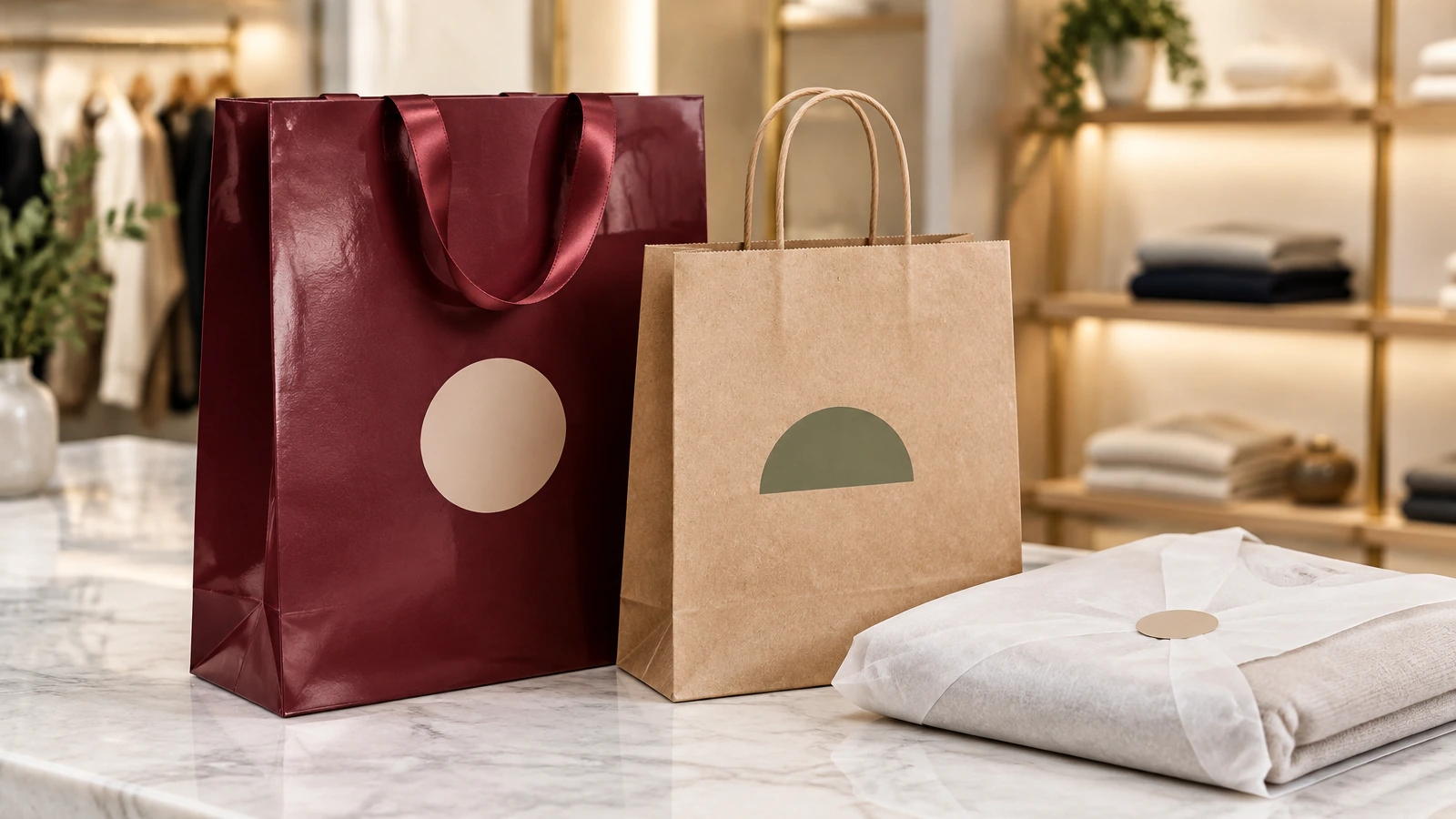
A laminated bag is printed art paper with a thin film bonded on top. It costs more because it is a different material and adds an extra process. At 500+, that means about US$490 against US$275 for brown kraft. At 5,000+, the gap narrows to US$0.24 per bag (US$0.48 vs US$0.24, November 2026, final price on your quote).
Lamination earns that premium when the bag is part of how the product is presented. Typical cases are cosmetics counters, apparel, corporate gifts and event giveaways, and full-color or dark designs that brown kraft would mute. Gloss, matte and soft-touch finishes should be compared on physical samples, and availability is confirmed on the quote. Rope, ribbon or paper handles are design requests rather than defaults. Color can shift under the film, so approve the laminated sample itself, not a print on uncoated paper.
Film changes the look and feel. It is not a waterproofing or durability rating, so do not sell it to customers as one. Lamination also turns the bag into a mixed-material item. If you sell into Europe, the EU's Packaging and Packaging Waste Regulation[5] has applied since 12 August 2026, with recyclability rules phasing in later. Choose kraft for a natural look, the lowest cost, or takeaway use.
Reuse affects the environmental story more than finish does. The New York Times[6] reported that a paper bag must be reused about three times or more to match a single-use plastic bag on climate impact. A bag that customers keep helps, but it is not proof of anything to print on the bag.
Getting the logo right on a small run
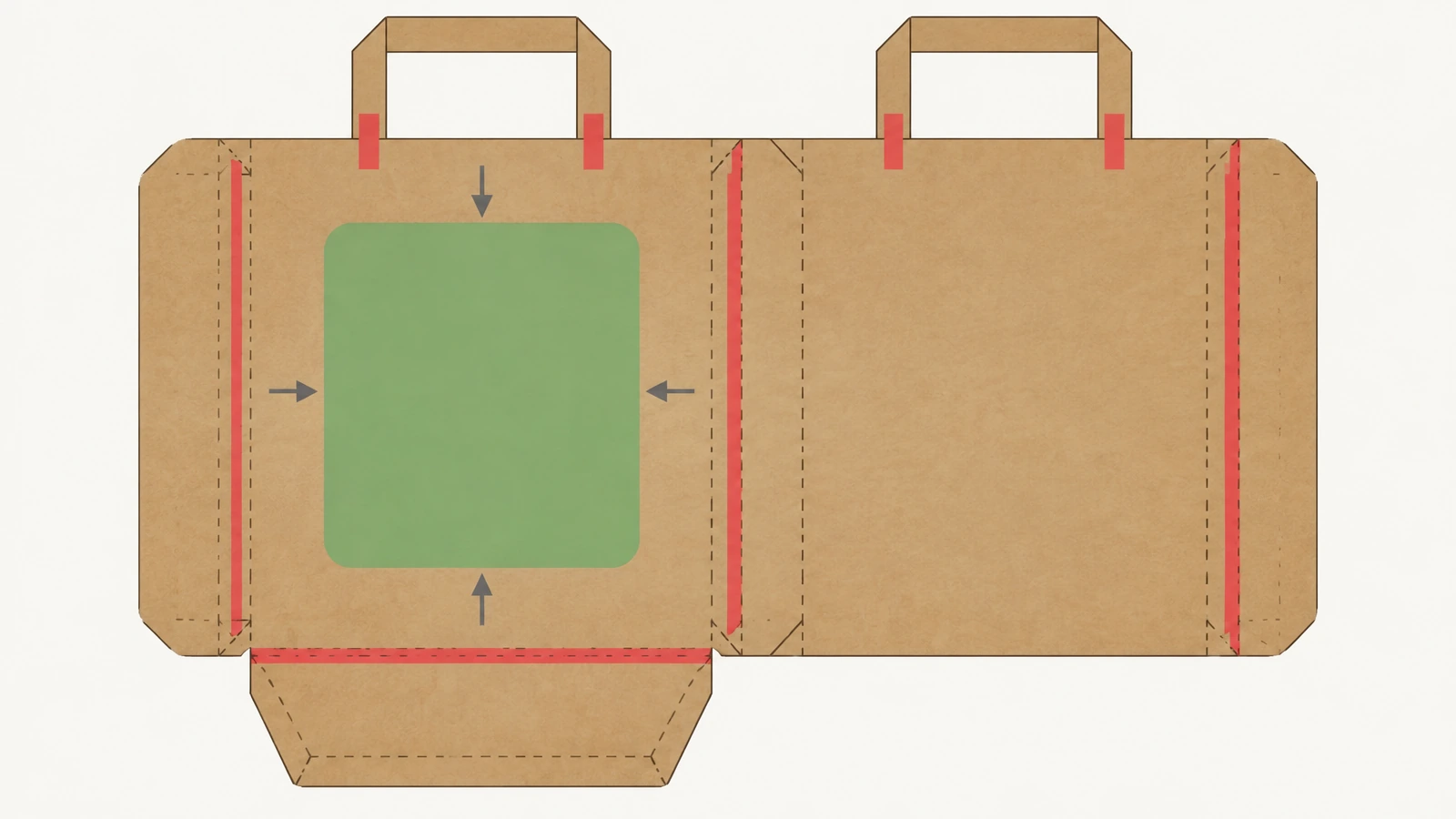
A 500-piece run leaves no spare bags to absorb a layout mistake, so most of the effort belongs before approval. The full artwork preparation steps are on the custom kraft paper bags product page. On a small run, these six checks matter most:
- Measure the packed item, including any box, tissue or insert, rather than the bare product.
- Give the finished size as width × gusset × height so that every quote prices the same bag.
- Keep the logo and any fine text clear of folds, side seams and handle roots, where print distorts or gets covered.
- On brown kraft, avoid pale, thin lines. They can fade into the base shade, so use bolder strokes or switch to white kraft.
- Use the free eProof to check layout and position, and a physical sample (US$5–30) to check color and feel.
- Check local bag rules before artwork is final, because some rules require printed information on the bag.
That last check matters in California. Since 1 January 2026, most grocery stores, retailers with a pharmacy, convenience stores, food marts and liquor stores may only hand out recycled paper carryout bags at checkout. CalRecycle[7] requires those bags to show the manufacturer name, country of manufacture and postconsumer recycled percentage. The minimum recycled content rises to 50% on 1 January 2028, up from the 40% threshold set under SB 270[8]. Boutiques outside these store types are generally not covered, but other states changed bag rules in 2026, as a Packaging Dive roundup[9] shows. Raise any requirement before quoting so that the material and print area can be confirmed.
Lead time, planning and a quote checklist
Standard production is 7–10 days, and the final schedule is on your quote. Plan for three separate clocks rather than one: sample approval, production and transit. The eProof round and any physical sample come first. Production follows. Shipping time to your door is counted separately and depends on destination and freight method.
Ask exactly what starts the production clock, whether that is eProof approval, sample sign-off or order confirmation. To plan, work backwards from the date you need bags in hand. Subtract transit, then 10 production days, then time for at least one sample round. Printed bags carrying your logo cannot be resold, so approval is the last point where a change costs nothing.
Low-minimum quote checklist
- Packed item dimensions and typical packed weight
- Bag type and handle preference (twisted, flat, or rope/ribbon for laminated)
- Finished size as width × gusset × height
- Quantity per design, per size and per print version
- Vector artwork, ink colors and print sides
- Finish preference if laminated: gloss, matte or soft-touch
- Target delivery date and delivery address
- A request for prices at 500 and 1,000 pcs side by side, with setup or plate charges, samples, packing and freight listed separately
FAQ
FAQ: What is the lowest quantity of logo paper shopping bags I can order?
Zigpac prices custom paper shopping bags on price tiers from 500 pcs, final MOQ on your quote. The first tier for brown kraft twisted-handle bags is US$0.55 per piece (November 2026, final price on your quote). Whether a given specification can run at 500 is confirmed when you send the size, bag type and artwork.
FAQ: Does the minimum count per size or per design?
It can count per size, per design or per print version, so ask before you split an order. Two logos at 500 pcs each in brown kraft come to about US$550, while one logo at 1,000 pcs comes to about US$420 (November 2026 tiers, final price on your quote).
FAQ: Which paper bag type is cheapest for a small run?
Kraft with flat handles is the cheapest, at US$0.32 per piece for 500+ and US$0.22 for 1,000+ (November 2026, final price on your quote). For retail carry, brown kraft with twisted handles at US$0.55 for 500+ is the usual starting point.
FAQ: Is a laminated bag worth it for only 500 pieces?
It is worth it only when the bag is part of the product presentation, such as cosmetics, apparel or gifts. At 500+, a laminated bag costs US$0.98 against US$0.55 for brown kraft (November 2026, final price on your quote). Compare gloss, matte and soft-touch on physical samples before you commit.
FAQ: How much weight can a paper handle carry?
No tested load rating is published, because capacity depends on bag dimensions, how the load sits and how a sample performs. Fill a physical sample with your real items at their real weight and carry-test it, then inspect the handle roots.
FAQ: How long does a small custom bag order take?
Standard production is 7–10 days, and the final schedule is on your quote. Sample approval comes before production and transit comes after it, so add both to your timeline.
FAQ: Can I check the bag before paying for bulk production?
Yes. Every order includes a free eProof for layout and placement, and physical samples ship for US$5–30 so you can check color, finish and handles in hand.
Key takeaways
- A realistic low minimum is a priced first tier, not "no minimum." — price tiers from 500 pcs, final MOQ on your quote (Source)
- Moving from 500 to 1,000 brown kraft bags roughly halves the cost of the extra bags. — about US$275 vs US$420, so the second 500 cost US$0.29 each (November 2026, final price on your quote) (Source)
- High tiers cut unit price by more than half across every bag type. — 5,000+ prices are about 40–50% of 500+ prices; brown kraft falls from US$0.55 to US$0.24 (Source)
- Brown kraft is the market default, which makes it the safe low-cost choice. — more than 66.4% of kraft bag revenue in 2024 (Source)
- California checkout bags carry printed-information and recycled-content rules. — 50% postconsumer recycled content required from 1 January 2028 (Source)
- Reuse shapes a paper bag's climate impact more than its finish does. — about 3 or more reuses to match single-use plastic on climate (Source)
Conclusion
Ordering branded paper bags at a low minimum mostly comes down to clean comparisons. Fix one size, one design and one print version. Pick the bag type that matches how customers will carry it, then price 500 against 1,000, because the second tier often costs little more in total. Send the packed item size, bag type and handle preference, quantity per design, artwork and target delivery date, and ask Zigpac to quote 500 and 1,000 pcs side by side. Zigpac confirms the final MOQ, price and schedule on the quote, with a free eProof before production and physical samples for US$5–30.
Footnotes
- Kraft Paper Bag Market Outlook 2026–2034 — OG Analysis via Research and Markets, November 2025. ↩
- Kraft Paper Bag Market Size and Share Report, 2025–2030 — Grand View Research, 2024. ↩
- 21 CFR 176.170: Components of paper and paperboard in contact with aqueous and fatty foods — Electronic Code of Federal Regulations. ↩
- FDA announces PFAS used in grease-proofing agents for food packaging no longer being sold in the U.S. — U.S. Food and Drug Administration, 28 February 2024. ↩
- EU Packaging and Packaging Waste Regulation (PPWR) — European Sealing Association, 2026. ↩
- Paper, plastic or reusable shopping bags compared — The New York Times, 24 March 2025. ↩
- Bag Requirements at Grocery and Retail Stores — California Department of Resources Recycling and Recovery (CalRecycle). ↩
- California carryout bag law consumer guide (SB 270) — Office of the California Attorney General. ↩
- State packaging laws taking effect in 2026: bags, foam, PFAS and hotels — Packaging Dive, 2026. ↩






The information below is required for social login
Sign In
Create New Account