
 Blog PDF for offline reading
Quick answer: If you are choosing between epoxy, acrylic or tin fridge magnets for a branded giveaway of 500–1,000 pieces with full-color logos or photos, Zigpac's printed epoxy-dome or UV-printed acrylic magnets are the usual choice. Both have price tiers from 50 pcs, final MOQ on your quote. Pick epoxy for a glossy, rounded dome over the print, and acrylic when a cut-to-shape silhouette or clear areas matter. Choose stamped and embossed tin (price tiers from 100 pcs, final MOQ on your quote) when a raised metal emblem should carry the brand and your schedule allows tooling and a sample. Production runs a standard 7–10 days for epoxy and acrylic and 10–15 days for tin, final schedule on your quote. At Zigpac, the November 2026 list prices at 1,000+ pieces are US$0.35 (epoxy), US$0.32 (acrylic) and US$0.35 (tin) per piece, final price on your quote.
Why this choice trips up giveaway buyers
Fridge magnets are a mainstream promotional item. HTF Market Intelligence puts the global custom fridge magnet market at about USD 450 million, growing 6.5% a year toward USD 700 million by 2033[1]. DataIntelo estimates that commercial uses accounted for 38.7% of fridge magnet demand in 2025[2].
The trouble starts when the three quotes arrive. One quotes a domed print, one a laser-cut acrylic shape, one an embossed tin emblem. Each has a different starting quantity, a different setup basis and a different schedule. Generic comparison charts online add paper-holding counts and "waterproof" labels that describe someone else's backing and materials, not your order. This guide puts all three formats on one basis: artwork fit, sample checks, magnet backing, live tier prices, tooling and time.
What are epoxy, acrylic and tin fridge magnets?
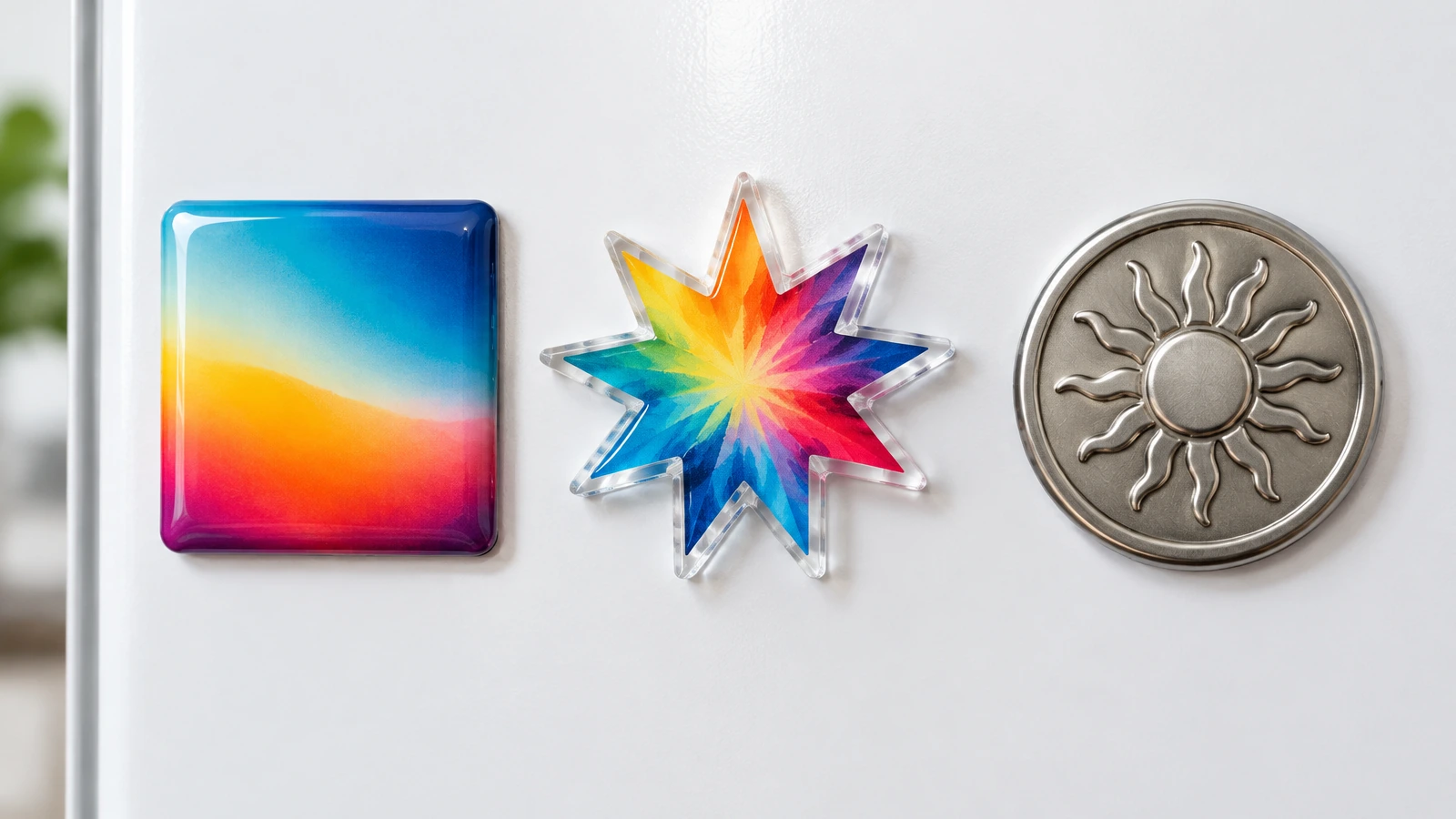
All three are flat-art formats: your logo or photo sits on the face, and a magnetic back holds it to the surface. They differ in what covers or forms that face, and that difference decides which artwork works. Rubber, polyresin, wood and die-cast metal magnets are outside this comparison.
Printed epoxy dome: glossy cover over full-color print
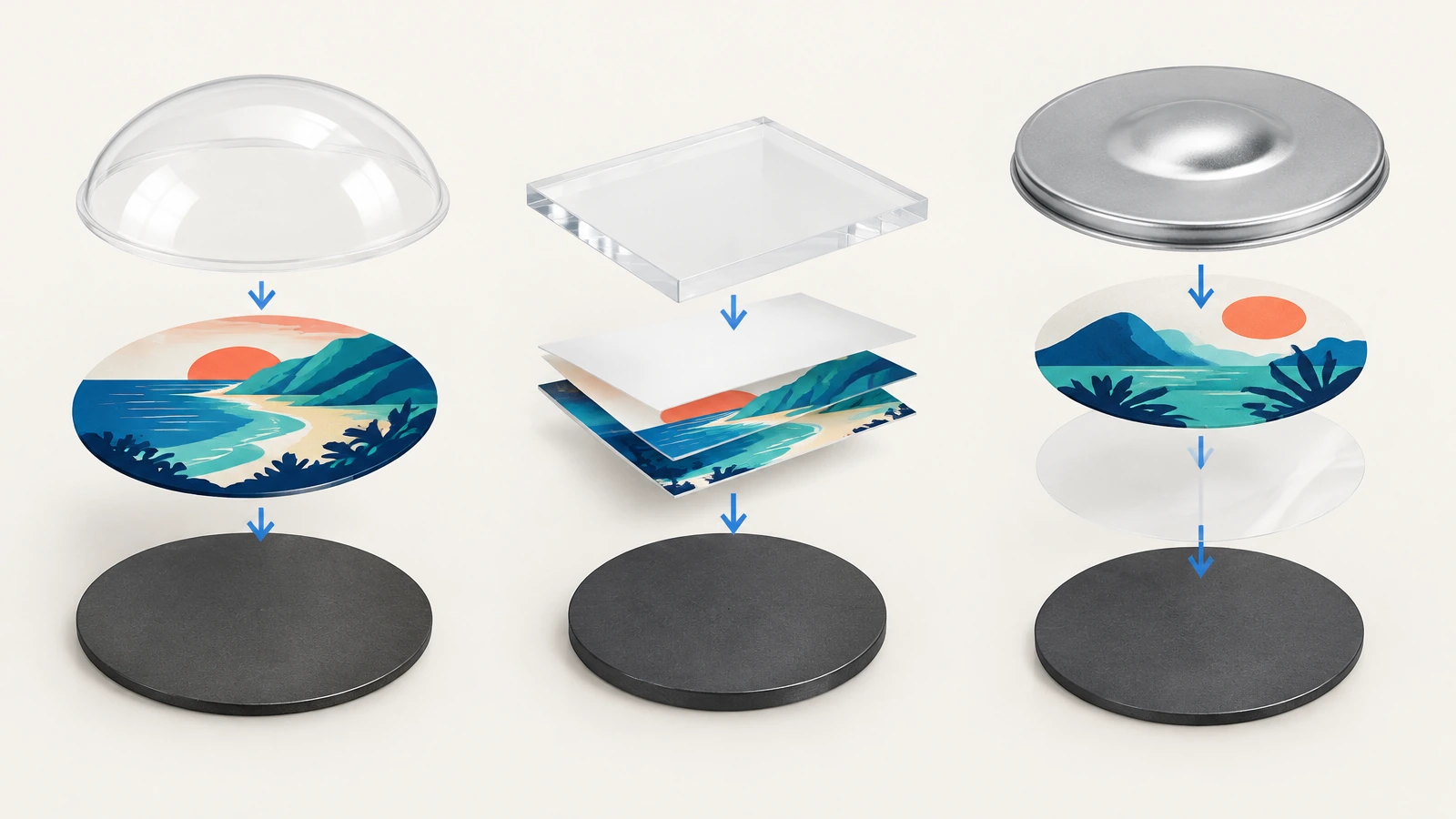
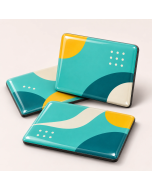
Printed artwork is sealed under a clear, raised epoxy dome, with magnetic backing on the reverse. Epoxy is a family of reactive resins that ASTM classifies for castings, coatings, potting and adhesives[3]. Here it works as a clear cover. Photos, gradients and small text stay in the print, and the dome adds a rounded, glossy look. A printed domed magnet does not need the silicone mold used for sculpted resin items, but not every outline is free of setup charges. Dome sizing and artwork preparation are covered on our custom epoxy fridge magnets page.
UV-printed acrylic: rigid clear face, cut to your silhouette
Zigpac's Custom Acrylic Fridge Magnets separate two jobs. The UV print carries the detail, and the laser-cut outline sets the silhouette. Zigpac's factory video shows a UV printer laying white ink on clear acrylic sheets. That white underprint makes colors opaque, and any area left without it stays clear and can become part of the design. Confirm which side the ink sits on, and whether the backing will hide any rear-printed artwork. Narrow projections and tight internal corners may need simplifying before cutting.
Stamped and embossed tin: metal face with raised relief
Tinplate is tin-coated steel, not solid tin. On Zigpac's Custom Tin Fridge Magnets, the face carries both print and embossed relief, and a separate magnetic back does the holding. Zigpac's factory video shows the process: a tinplate cover, a paper insert and a film are pressed in a mold, then the magnetic back is added.
Emboss outlines, emblems and borders, and keep fine detail in print. Mark raised and flat areas separately on the artwork. Borders and formed edges shrink the usable area, so keep text off the forming boundary.
Dome clarity, scratches and edges: what to check on the sample
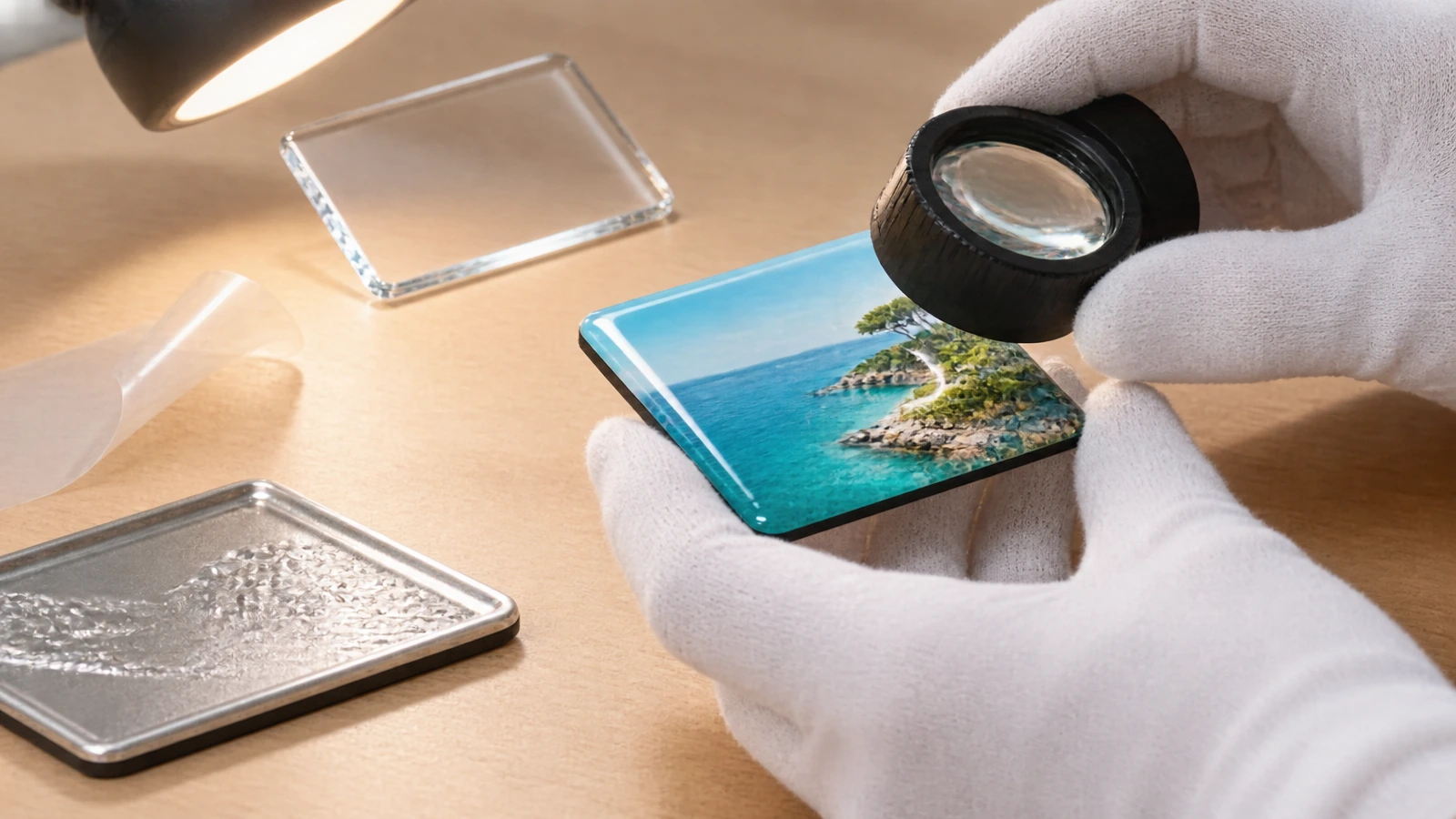
A digital proof confirms layout and wording. It cannot show how a dome, a cut edge or a formed edge will look in hand. At Zigpac, every order gets a free eProof, and physical samples ship for US$5–30. That small fee is the cheapest point at which to catch the defects below. The full approval sequence is on the product page, so this section only lists what each format's sample must show.
- Epoxy: look for bubbles, dust or marks over key artwork first. Then check the dome's look, the color beneath it, the edge finish, and any lifted edges or separation on the back. Scan QR codes on the finished domed sample, not on the proof.
- Acrylic: inspect under angled light for scratches and cracked edges. Peel any protective film, and learn to tell film marks from real defects. Check that narrow projections survived cutting and that white underprint sits behind every opaque color.
- Tin: check how sharply the relief is defined, whether the print lines up with the relief, how the formed edges look, and whether any areas feel rough.
Waterproof, scratch-proof, UV-resistant and outdoor claims are not established for any of the three formats. Treat them as indoor display items. If water or sunlight matters for your giveaway, write it into the quote as a test request rather than assuming it. For epoxy, the care guidance is gentle wiping, with no abrasive cleaners, prolonged sunlight, heat or impacts.
Magnet strength and backing: test, don't trust a rating
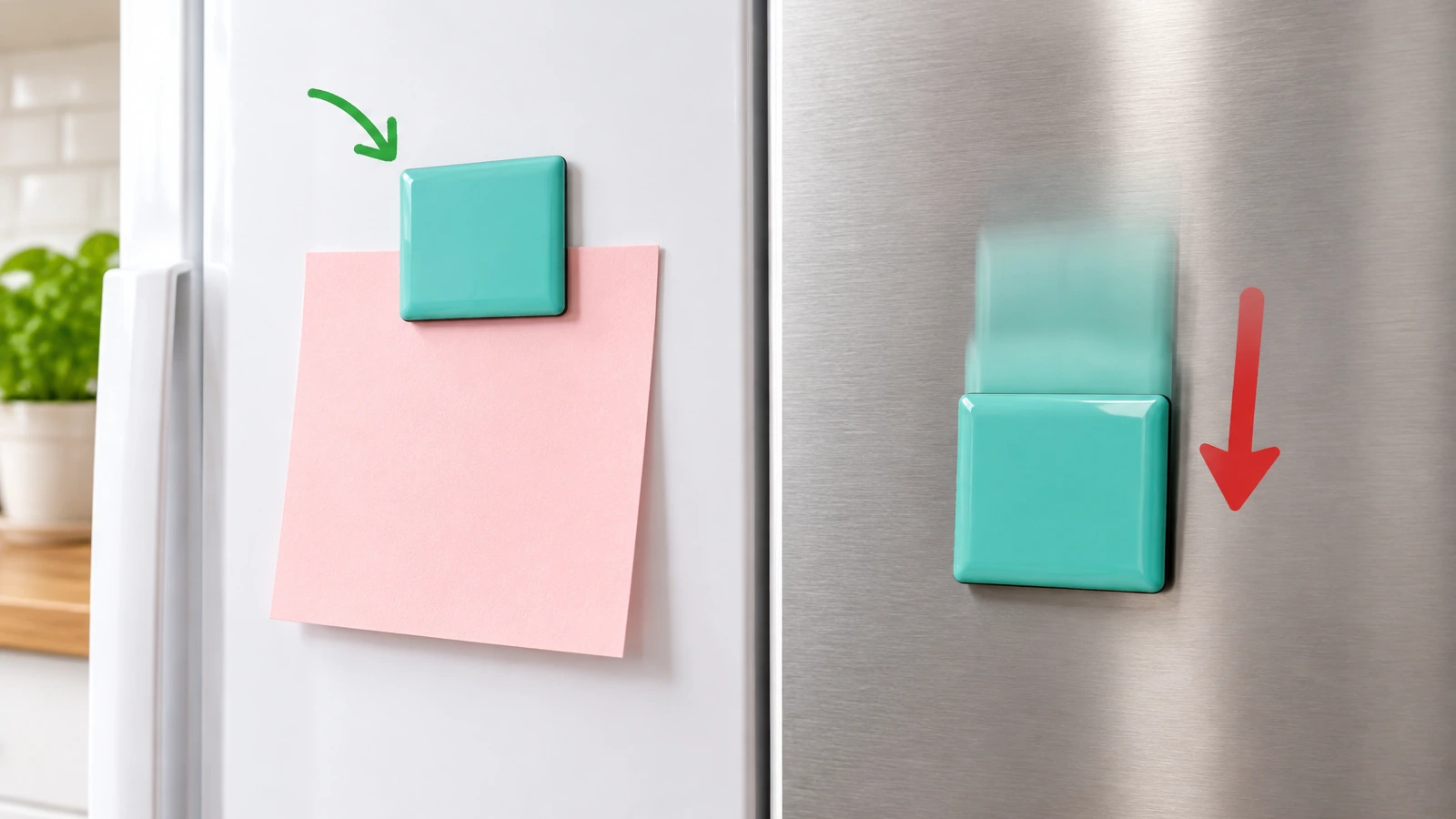
None of the three formats comes with a holding rating, and the face material does not set the strength. The backing and the weight of the finished piece do. A dome adds weight, not magnetic strength.
For acrylic, compare disc backing and sheet backing as complete assemblies, not as loose magnets. For tin, the backing should match the finished shape and weight. Test the assembled sample with the real load, such as a menu or calendar card, on the actual fridge or display surface. Not every stainless steel door is magnetic.
In the U.S., 16 CFR Part 1262[4] covers products marketed for entertainment, jewelry, mental stimulation or stress relief. It requires small loose or separable magnets in those products to have a flux index below 50 kG² mm²[5], a rule in force since October 21, 2022[6].
CPSC estimated 26,600 magnet ingestions treated in emergency departments from 2010 to 2021[7]. A September 2026 recall of about 4,640 refrigerator magnets with loose magnets[8] shows fridge magnets are not automatically outside that rule. For giveaways that may reach children, confirm the magnet stays attached and cannot be pried off.
What 500, 1,000 and 5,000 pieces cost from the live tier tables
The figures below use Zigpac's live tier tables as of November 2026, final price on your quote.
| Format | 500 pcs: unit / total | 1,000 pcs: unit / total | 5,000 pcs: ceiling reference only |
|---|---|---|---|
| Epoxy dome | US$0.42 / US$210 | US$0.35 / US$350 | ≤ US$1,750 (5,000 × US$0.35) |
| UV acrylic | US$0.40 / US$200 | US$0.32 / US$320 | ≤ US$1,600 (5,000 × US$0.32) |
| Embossed tin | US$0.45 / US$225 | US$0.35 / US$350 | ≤ US$1,750 (5,000 × US$0.35) |
Two points follow from the tiers. First, the gap between formats is small: US$25 at 500 pieces and US$30 at 1,000. Tooling, packaging and freight can easily outweigh it. Second, check the tier break before settling on a quantity. At the 500+ rate, 900 epoxy magnets list at US$378, which is more than 1,000 at US$350. Ordering 1,000 costs the same or less once you need more than about 830 epoxy, 800 acrylic or 780 tin pieces.
For small runs, the 100-piece tier lists US$0.58 for epoxy and acrylic and US$0.70 for tin.
The largest listed tier is 1,000+. The 5,000-piece figures above are a ceiling built from that list price, not a quote. At Zigpac, volume pricing far above 1,000 pieces is quoted separately by email, WhatsApp or Telegram, and bulk orders can request a dedicated manager.
The tier price is not the whole cost. Other drivers include:
- finished size
- shape and cut setup
- tin tooling per design
- number of designs
- backing type
- individual packaging
- freight
Compare landed cost per accepted piece: goods plus setup or tooling, samples, packaging and freight, divided by the pieces that pass your sample standard.
Starting quantity, setup, tooling and schedule
Epoxy and acrylic both have price tiers from 50 pcs, final MOQ on your quote. Tin has price tiers from 100 pcs, final MOQ on your quote. Production times are a standard 7–10 days for epoxy and acrylic and 10–15 days for tin, final schedule on your quote.
For tin, ask four things:
- Does each design need separate tooling or setup?
- Does the minimum apply per design?
- Is the tooling retained for reorders?
- Can you have the tooling scope itemized?
A low advertised unit price for a flat stock design is not a reliable budget for custom embossed tooling. Custom laser-cut acrylic shapes and epoxy dome outlines should not be assumed free of setup either. Ask for setup charges itemized, and agree tooling retention in writing.
The eProof approval and any physical sample come before production. Zigpac returns quotes in 1–6 hours, or 6–24 hours for complex projects that need engineering review. Production starts within 2 hours after payment confirmation. Record production days and transit days separately, and work backward from your event date.
Epoxy, acrylic or tin fridge magnets: side-by-side comparison
| Printed epoxy dome | UV-printed acrylic | Stamped/embossed tin | |
|---|---|---|---|
| Construction | Print under a clear raised dome, magnetic back | Rigid acrylic face, UV print, laser-cut outline, magnetic back | Tinplate face with print and relief, separate magnetic back |
| Look | Glossy, rounded | Clear, crisp silhouette | Metal face, raised emblem |
| Best artwork | Photos, gradients, small text | Cut silhouettes, clear areas | Bold emblems, outlines, borders |
| Price tiers | From 50 pcs, final MOQ on your quote | From 50 pcs, final MOQ on your quote | From 100 pcs, final MOQ on your quote |
| 500 pcs (Nov 2026) | US$0.42 = US$210 | US$0.40 = US$200 | US$0.45 = US$225 |
| 1,000+ pcs (Nov 2026) | US$0.35 | US$0.32 | US$0.35 |
| Setup/tooling | Some outlines may carry setup | Custom cut shapes may carry setup | Tooling may be needed per design |
| Standard production | 7–10 days, final schedule on your quote | 7–10 days, final schedule on your quote | 10–15 days, final schedule on your quote |
| Sample must show | Bubbles, dome look, color, edges, QR scan | Scratches, cracked edges, film marks | Relief definition, print alignment, formed edges |
| Packing note | Confirm packaging on your quote | Specify how adjacent faces are separated | Confirm packaging on your quote |
| Best giveaway fit | Photo and logo handouts | Shaped logos, souvenirs | Premium emblem gifts |
All prices are final on your quote.
Which format fits your giveaway type and volume
| Giveaway | Likely format | Why / watch |
|---|---|---|
| Trade show handout, 500 pcs | Epoxy or acrylic | US$200–210 at list price, with the shorter standard schedule. Choose epoxy for a full-color logo, acrylic for a shaped logo. |
| Real-estate or local-service mailer | Epoxy | Headshots and phone numbers stay in print. Scan the QR code on the domed sample, and check the mailer fit with the sample. |
| Tourism or destination souvenir line | Acrylic or tin | Acrylic suits landmark silhouettes, tin suits embossed crests. Ask whether minimums apply per design. |
| Premium client or anniversary gift | Tin | A raised metal emblem. Allow time for tooling and a sample, and specify individual packaging. |
| Event keepsake with photo and date | Epoxy | The dome sits over photo detail. Inspect bubbles over faces. |
| Multi-design series | Epoxy or acrylic | Tin may need tooling per design, which multiplies setup costs. |
Quote checklist
- Artwork files, with raised and flat areas marked for tin
- Preferred format: epoxy, acrylic or tin
- Finished size in mm
- Quantity per design and number of designs
- Display surface, and the load the magnet must hold
- Packaging: bulk or individual
- In-hands date
- Delivery country. For EU deliveries, ask for a REACH statement, because substances on the ECHA Candidate List above 0.1% by weight[9] trigger supply-chain information duties.
FAQ
FAQ: Which is cheapest for 500 branded fridge magnets?
Acrylic lists lowest at 500 pieces: US$0.40 each, or US$200 (November 2026, final price on your quote). Epoxy lists at US$210 and tin at US$225. Setup, packaging and freight can change the order of the three, so compare itemized quotes.
FAQ: Are epoxy magnets stronger than acrylic or tin?
No. The face material does not set magnetic strength, and none of the three has a holding rating. The backing and the finished weight decide how well a magnet holds, so test the assembled sample on your real surface with your real load.
FAQ: Can a tin magnet show a full-color photo?
Yes. The tinplate face carries print, so photos and fine detail stay in the printed layer. Embossing works best for outlines, emblems and borders, and text should stay away from the formed edge.
FAQ: What is the minimum order?
Zigpac lists price tiers from 50 pcs, final MOQ on your quote, for epoxy and acrylic magnets, and price tiers from 100 pcs, final MOQ on your quote, for tin. For tin, also ask whether the minimum applies per design.
FAQ: How is a 5,000-piece run priced?
A 5,000-piece run is quoted separately, because the largest listed tier is 1,000+. Multiplying 5,000 by the 1,000+ list price gives only a ceiling reference: US$1,750 for epoxy, US$1,600 for acrylic and US$1,750 for tin.
FAQ: Which format can go outdoors or get wet?
None of the three is established as waterproof, scratch-proof, UV-resistant or suitable for outdoor use. Plan them as indoor display items, and list any outdoor or water exposure as a test request on your quote.
Key takeaways
- Price barely separates the three formats at volume. 1,000+ list prices are US$0.32–0.35 per piece, November 2026, final price on your quote (Source).
- Rounding up can cost less. 900 epoxy pieces list at US$378, while 1,000 list at US$350 (Source).
- Loose small magnets face a federal limit. The flux index must be below 50 kG² mm² for products in scope (Source).
- Magnet ingestion is a documented risk. CPSC estimated 26,600 emergency-treated ingestions from 2010 to 2021 (Source).
- Fridge magnets do get recalled. About 4,640 units were recalled in September 2026 for loose magnets (Source).
Next step: get one quote that compares all three
Choose by artwork first. Photos and small text suit epoxy, cut silhouettes suit acrylic, and raised emblems suit tin. Then let the sample decide dome clarity, edges and holding.
Send your artwork, preferred format (epoxy, acrylic or tin), finished size, quantity per design, display surface, packaging needs, in-hands date and delivery country. Zigpac confirms the format, final MOQ, price, any setup or tooling terms and the schedule on an itemized quote. You get a free eProof before production, and physical samples ship for US$5–30. The site also states: "Quality issue? Full refund, no return needed."
Sources
- HTF Market Intelligence, "Global Custom Fridge Magnets Market." Link. Accessed 25 Nov 2026. ↩
- DataIntelo, "Fridge Magnets Market Research Report 2034." Link. Accessed 25 Nov 2026. ↩
- ASTM International, "D1763 Standard Specification for Epoxy Resins." Link. Accessed 25 Nov 2026. ↩
- Cornell Law School LII, "16 CFR Part 1262 – Safety Standard for Magnets." Link. Accessed 25 Nov 2026. ↩
- eCFR, "16 CFR Part 1262." Link. Accessed 25 Nov 2026. ↩
- Federal Register, "Safety Standard for Magnets," final rule, 21 Sep 2022. Link. Accessed 25 Nov 2026. ↩
- U.S. CPSC, news release on the 2022 magnet safety standard. Link. Accessed 25 Nov 2026. ↩
- U.S. CPSC, refrigerator magnet recall notice, September 2026. Link. Accessed 25 Nov 2026. ↩
- European Chemicals Agency, "Candidate List of substances of very high concern." Link. Accessed 25 Nov 2026. ↩







The information below is required for social login
Sign In
Create New Account