


 Blog PDF for offline reading
Quick answer: Mostly no. The sealed air gap in a double-wall plastic tumbler keeps the outer shell close to room temperature, so iced drinks rarely bead on the outside in normal indoor air. Light sweat can still form near the rim in hot, humid outdoor weather. Moisture inside the wall points to a failed seal, not normal sweat.
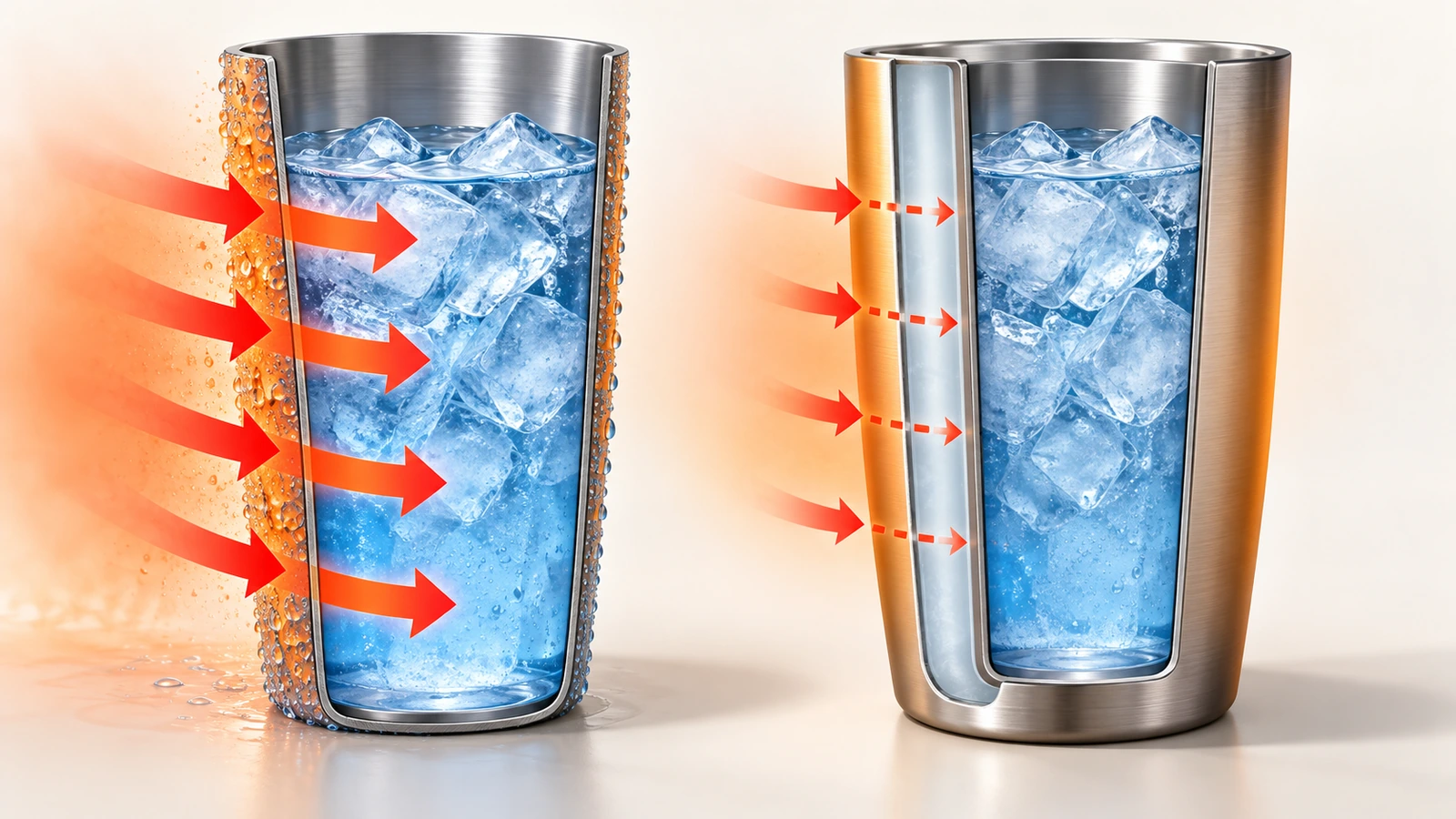
Do double wall plastic tumblers sweat? Event planners, café managers and caterers usually ask this after they have already lived through the alternative: a table of single-wall cups leaving rings on linen, guests wiping wet hands on their clothes, and a branded cup that ends up wrapped in a napkin so nobody can see the logo. For an iced-drink promotion, that puddle is the thing people remember.
The stakes go beyond one afternoon. In the 2026 drinkware edition of its Ad Impressions Study[1], ASI reports that 87% of end users would keep branded drinkware because it is useful, and estimates about 1,300 lifetime brand impressions per item. A cup that drips, or one that fogs up inside its wall after a few washes, does not get kept. Drinkware was also the second-largest promotional category in the U.S. in 2024, at 10.2% of distributor sales, according to PPAI's sales volume estimate[2]. Plenty of buyers face this choice, and the wrong one is costly.
This guide explains what the air gap actually does, when a double-wall cup can still show condensation, why water sometimes gets trapped between the walls, and how to test samples before you commit to an event order.
How the Air Gap Works: A Plain Definition
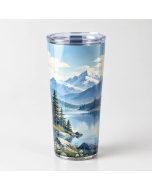
An air-gap double-wall plastic tumbler is two molded cups, one nested inside the other and joined at the rim, with a thin layer of sealed air between them. The drink touches only the inner wall. Your hand and the table touch only the outer shell. The air layer is not a vacuum. It is ordinary air at roughly atmospheric pressure, trapped when the two walls were welded together.
That distinction drives everything below. Heat moves through a tumbler wall in three ways: conduction through solid material, convection through moving air or liquid, and radiation. Still air is a poor conductor. Textbook values put it at roughly 0.026 W/m·K, against roughly 0.1–0.2 W/m·K for polypropylene, so a few millimeters of still air resist heat flow far better than the same thickness of plastic. A vacuum flask goes further and removes the air altogether, which nearly eliminates conduction and convection in the gap. An air-gap plastic cup slows heat transfer. It does not stop it.
If you are sourcing branded cups rather than studying the physics, the product construction, materials and decoration options are covered on our custom plastic tumblers page. This article stays on thermal and moisture behavior.
Why Do Double Wall Plastic Tumblers Sweat Less Than Single-Wall Cups?
"Sweat" is condensation. Water vapor in the air turns to liquid on any surface colder than the air's dew point, the temperature at which that air becomes saturated. Whether a cup sweats depends on one comparison: is the outer surface colder than the dew point of the surrounding air?
Here are two typical situations. The dew points are approximate, calculated from standard psychrometric relationships:
- Indoor reception, 72°F (22°C) at 50% relative humidity: dew point about 52°F (11°C).
- Summer outdoor event, 90°F (32°C) at 60% relative humidity: dew point about 74°F (23°C).
A single-wall cup of ice water has an outer surface only a few degrees above the drink, so it sits far below either dew point and beads almost immediately. In a double-wall cup, the air gap holds most of the temperature drop. The outer shell settles much closer to room temperature, comfortably above 52°F in the indoor case. That is why double wall tumbler condensation is usually absent indoors, and why buyers who switch from single-wall stadium cups notice the difference on day one.
The outdoor case is less forgiving. At a 74°F dew point, the outer shell only has to fall about 16°F below a 90°F ambient temperature before droplets form. A thin air gap holding a cup packed with ice can get there, especially in shade where the shell is not warmed by sun. The honest answer, then: indoors, essentially no sweat; outdoors in humid heat, possibly a light film, still far less than a single-wall cup.
When Can a Double-Wall Tumbler Still Show Condensation?
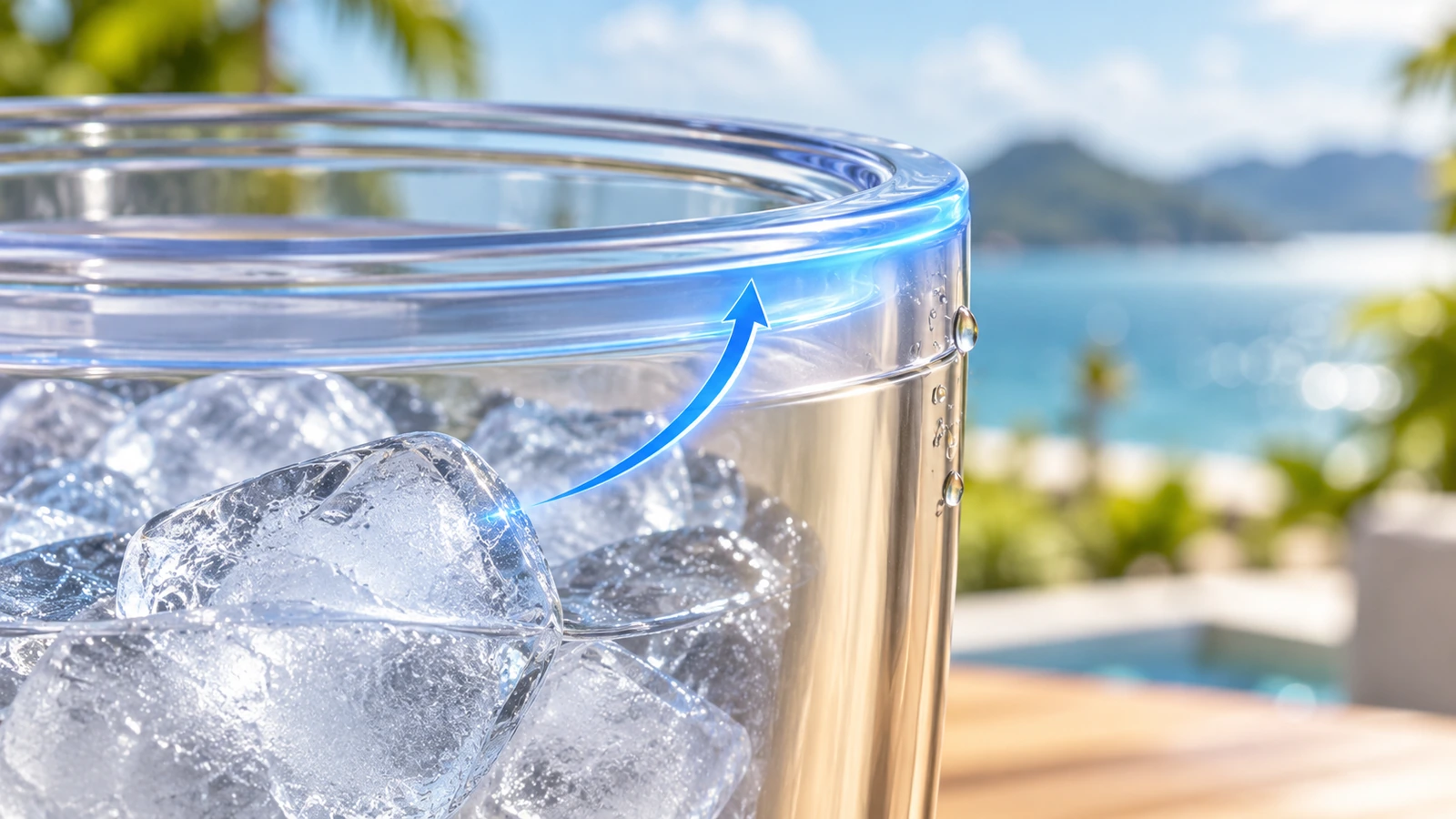
When a double-wall cup gets wet outside, the cause is usually one of five things, and only some of them are sweat:
- The rim joint. Inner and outer walls fuse at the rim into solid plastic with no air layer. That band conducts cold directly to the outside, so the first beads tend to show just below the lip.
- Ice packed to the top. When ice sits right up against the rim, it chills that solid joint hardest. Leaving a little headspace helps.
- Lid drip. Cold air under a lid condenses on the lid's underside, and sipping or tilting moves that water to the outside. It looks like sweat but comes from inside the cup.
- Overfill and spill. At busy bars and catering stations, a wet outer shell often means the cup was topped up to the brim and splashed during service.
- Extreme humidity. As shown above, a high dew point narrows the margin enough that even a well-made air gap can show a faint film.
Moisture on the outside matters for branding too. Water and handling wear on surface-printed artwork, so a cup that stays dry protects the logo as well as the guest's hand. How each decoration method holds up is a product-page topic; the short version is that a dry shell helps any print last.
Why Does Water Get Trapped Inside a Double-Wall Tumbler?
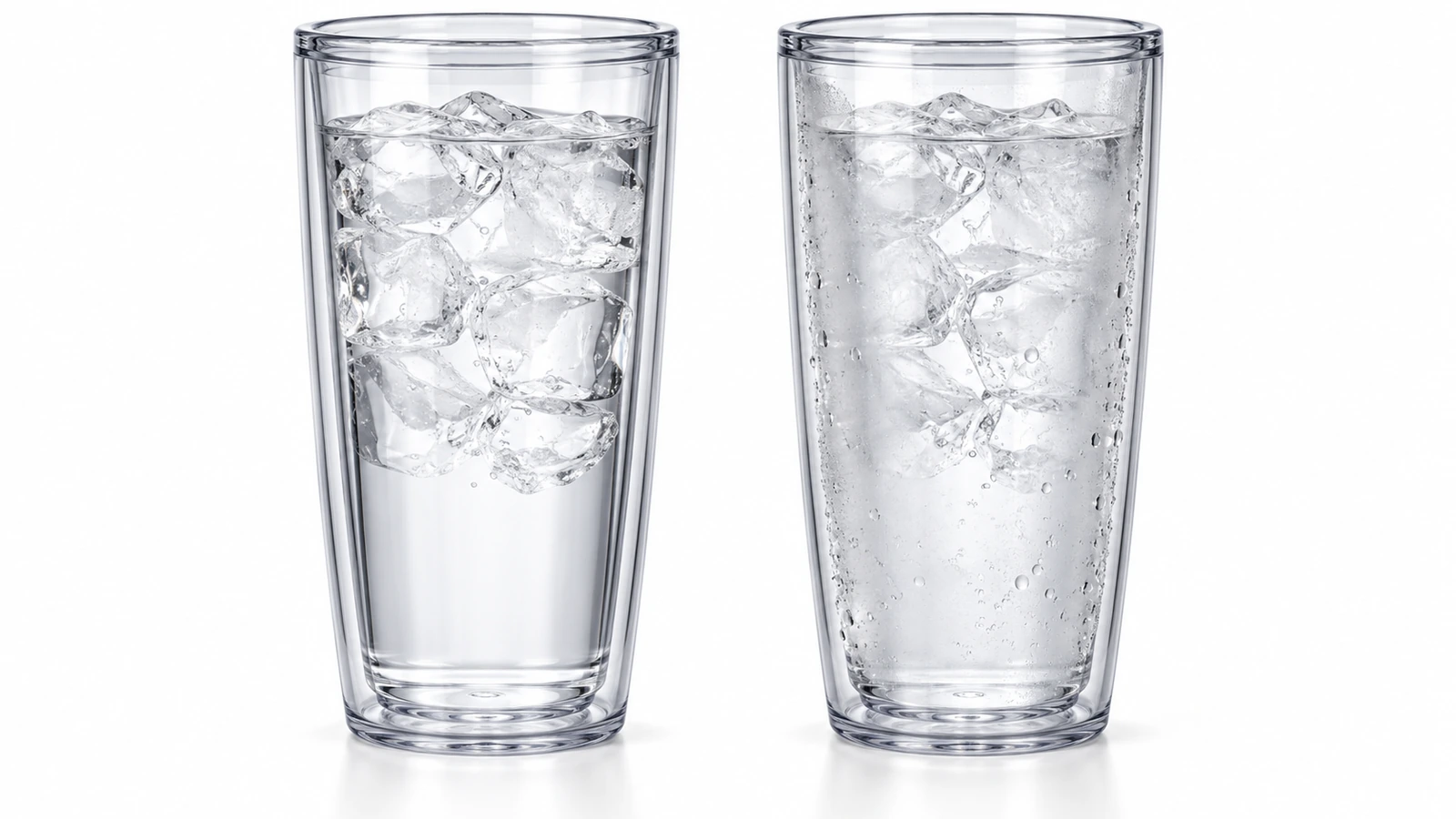
Water trapped inside a double wall tumbler is a different problem from sweat, and it is the one users complain about most. Owner reviews of branded double-wall plastic cups describe "condensation between the inside and the outer layer" and water that "gets in between the 2 layers, ruining the cup." Once it is in there, you cannot wipe it off.
The usual mechanism is a seal defect. If the weld at the rim or base has a pinhole or a hairline crack, the sealed air is no longer sealed. Temperature cycling then works like a slow pump. A hot dishwasher cycle expands the air in the gap and pushes some of it out through the flaw. When the cup cools, or is filled with ice, the remaining air contracts and draws in moist air, or wash water if the cup is still submerged. The opening is too small for that water to dry back out, so it fogs every time the cup is chilled.
The practical points that follow:
- Heat is the main stressor. Many decorated plastic tumblers are labeled hand wash only for this reason, along with print durability. Treat dishwasher safety as a claim about a specific SKU, not a property of the material.
- Soaking makes small flaws worse. Leaving cups submerged in a sink gives a leaky seal time to take in liquid.
- Fogging is a workmanship defect, not a cosmetic quirk. Branded double-wall warranties generally list seal failure as a covered defect. For an event order, put it in your acceptance terms; the product page covers what to verify in care and warranty terms.
How Long Do Plastic Tumblers Keep Drinks Cold?
We are not going to quote a single "hours of ice" figure. Results depend on starting ice volume, fill size, ambient heat, sun exposure, whether there is a lid, and how often the drink is topped up. Any number without those conditions attached is marketing. What the physics supports is this ranking:
- Single-wall plastic: shortest ice life, and the cup sweats from the start. Owner reviews of single-wall cups describe ice melting "within a couple hours" alongside an outer wall that sweats.
- Air-gap double-wall plastic: noticeably slower melt than single-wall, with a dry shell indoors. Plastic tumbler insulation performance is suited to a session: a reception, a match, a lunch service.
- Vacuum-insulated steel: the only option on this list that is built for all-day ice. It is heavier, costs more and uses a different supply chain.
To get more out of an air-gap cup: chill the drink before it goes in, fill with more ice than liquid, use a lid to cut convection at the opening, and keep cups out of direct sun. Each of these slows heat gain without changing the cup.
How to Test Sweat and Seal Performance Before an Event
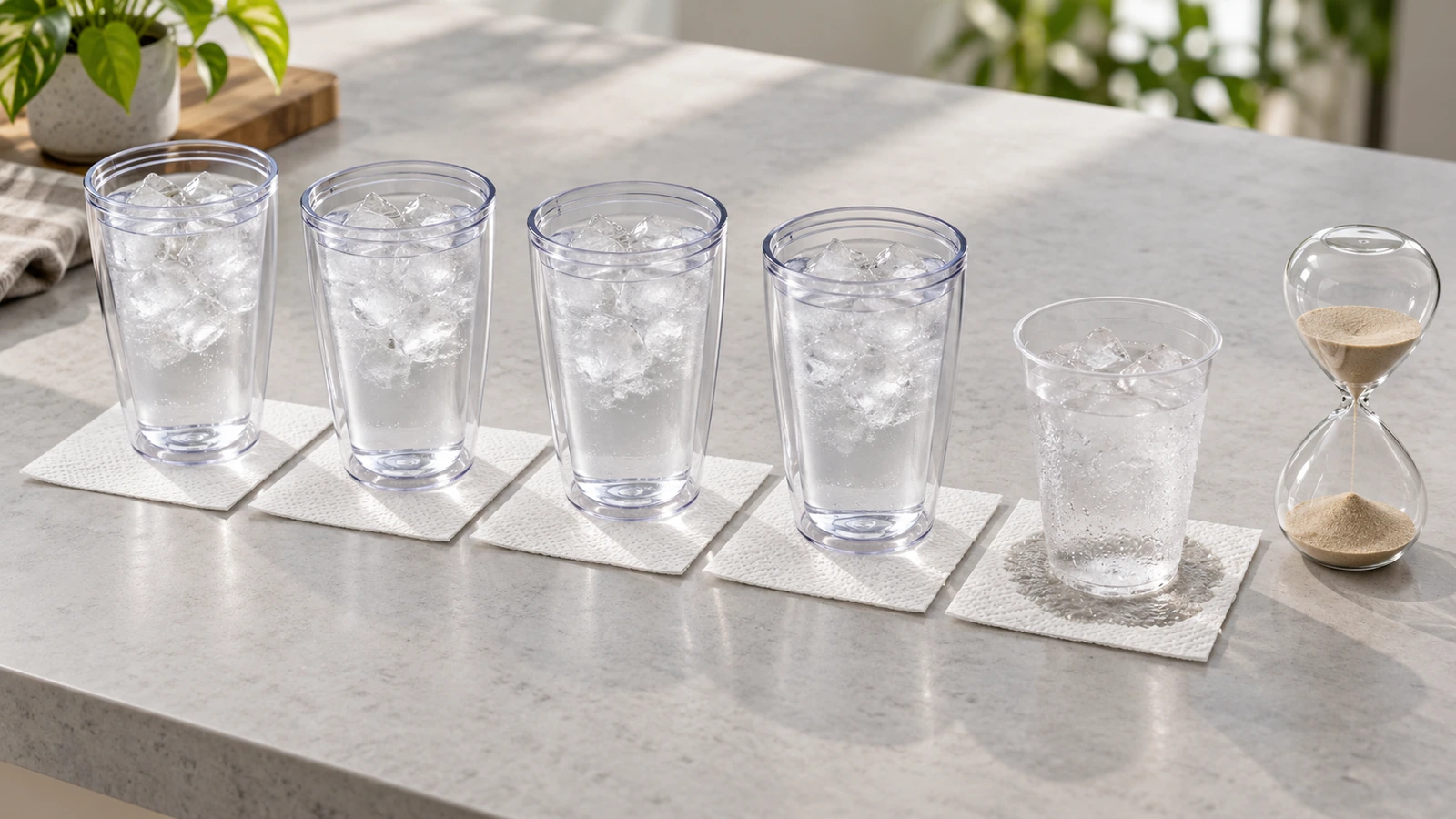
Spec sheets rarely list condensation or seal performance, so test a few samples yourself. It takes an afternoon and costs nothing beyond the sample cups.
- Record the conditions. Write down air temperature and relative humidity. If your event is outdoors in summer, test outdoors or in the most humid room you have, because the indoor result will be too optimistic.
- Use identical fills. Fill each cup to the same level with the same ratio of ice to cold water, leaving a little headspace below the rim.
- Use the paper towel check. Stand each cup on a dry white paper towel. At 15, 30, 60 and 120 minutes, look for a wet ring and run a dry fingertip around the rim band and the base.
- Run a control. Put a single-wall cup in the same test. It shows you what "sweating" looks like in your conditions, so you can judge the double-wall result against it.
- Check for melt. At the end, note how much ice is left in each cup. Compare cups against each other; do not compare your result to a number from a different test.
- Test the seal. Empty and dry the cups, then let them sit in a sink of warm (not boiling) water for several minutes. Dry the outside, refill with ice water and inspect the gap against a bright background. Any fog, droplets or sloshing sound means the seal is compromised.
- Repeat once. A second warm-then-cold cycle catches marginal welds that survive the first. If a sample fails, ask for more samples before you approve the order.
Comparison: Single-Wall, Air-Gap Double-Wall and Vacuum Tumblers
| Factor | Single-wall plastic | Air-gap double-wall plastic | Vacuum-insulated steel |
|---|---|---|---|
| Outside sweat with iced drinks | Yes, almost immediately | None indoors; possible light film near the rim in humid heat | Essentially none |
| Ice retention | Shortest | Moderate, suited to one session | Longest, all-day |
| Trapped-moisture risk | None (no gap) | Yes, if the weld fails; avoid heat cycling | Vacuum loss shows as warm or sweating walls, not fog |
| Weight and breakage | Lightest, shatter-resistant | Light, shatter-resistant | Heaviest, can dent |
| Feel in the hand with ice | Cold and wet | Cool and dry | Room temperature and dry |
| Best fit | One-off, high-volume pours | Events, iced promotions, catering service | Premium gifts, all-day commuting |
What This Means for Outdoor Events, Iced-Drink Promotions and Catering
Outdoor events. Air-gap cups are the practical middle ground: light enough to hand out in bulk, dry enough that guests keep holding them. In humid heat, expect a small amount of beading at the rim, and keep stock out of the sun before service. If the event runs from morning to night and the cup has to hold ice the whole time, that is a vacuum-steel job.
Iced-drink promotions. A dry shell keeps the logo visible in photos and on the counter. Before you add metal straws as a premium extra, note that a 24 oz plastic tumbler sold with a metal straw was the subject of a CPSC recall[3] covering about 60,000 units after four laceration reports. Accessories carry their own risk.
Catering. Dry cups protect linens and keep service trays from slipping. The bigger risk is the commercial dishwasher, because repeated high-heat cycles stress the welds. Plan a hand-wash or low-heat routine, or treat the cups as guest takeaways rather than rotating stock.
If an air-gap cup fits your event and you need it decorated and delivered by a set date, brief us through the custom plastic tumblers page. Quantities, pricing and lead times are quoted per project.
FAQ
FAQ: Is a little moisture on the rim a sign the cup is defective?
No. The rim is a solid joint with no air gap, so it is the coldest part of the outer surface and the first place sweat forms in humid air. Fog or droplets inside the wall are the warning sign.
FAQ: Can I dry out water trapped between the walls?
Usually not. The flaw that let it in is too small to let it evaporate in any reasonable time, and warming the cup to drive it out stresses the weld further. Treat fogging as a seal defect and handle it under your warranty or acceptance terms.
FAQ: Is moisture trapped in the wall a hygiene problem?
The gap is not a food-contact surface, because the drink only touches the inner wall. But trapped water can grow visible spots over time, and guests will judge the cup by how it looks. FDA regulates the materials that touch food based on their intended conditions of use[4], so a fogged cup should be replaced, not explained away.
FAQ: Does adding an air gap change food-safety requirements?
No. The inner wall, lid and straw still need to meet the rules for their resin. For polypropylene, the federal reference is 21 CFR 177.1520[5]. FDA's BPA Q&A[6] explains its current position, while California lists BPA under Proposition 65[7]. Ask your supplier for the documents; our product page lists what to check.
FAQ: Do recycled-content plastic tumblers insulate differently?
The thermal behavior comes from the air gap, not from whether the resin is virgin or recycled, so sweat performance should be similar. Food-contact use of recycled plastic is a separate question, and FDA's recycled plastics guidance[8] expects the recycling process itself to be evaluated.
FAQ: Do double-wall plastic tumblers work for hot drinks?
The air gap keeps the outside cooler to the touch with a hot drink as well, but plastic heat limits vary by resin and lid. Use them for hot drinks only when the specific SKU says so.
FAQ: Are earlier impression figures for drinkware still valid?
Use the most recent figures. ASI's 2023 study[9] reported 3,162 lifetime impressions for drinkware, and the 2026 edition reports about 1,300. Methods differ, so cite the edition and do not average the two.
Key Takeaways
- Cups that stay pleasant to hold get kept, so dryness protects your brand exposure — 87% of end users keep branded drinkware for its usefulness (Source)
- Drinkware is a mainstream promotional choice, so the sweat-versus-dry decision comes up for many buyers — 10.2% of U.S. promotional distributor sales in 2024 (Source)
- Accessories added to iced-drink cups carry their own safety risk — about 60,000 plastic tumblers with metal straws were recalled after 4 laceration reports (Source)
- An air gap does not change food-contact rules for the inner wall — polypropylene is covered under 21 CFR 177.1520 (Source)
- Impression figures depend on the study edition, so always cite the year — 3,162 impressions (2023) versus about 1,300 (2026) (Source)
Conclusion
A sealed air gap does one job well: it keeps the outer shell warm enough to stay above the dew point in normal conditions. That makes double-wall plastic tumblers dry to hold indoors and much drier than single-wall cups outdoors, though not completely sweat-proof in humid summer heat. The failure that ruins them is moisture getting into the wall through a bad seal, usually after heat cycling. Test a few samples under your real event conditions, run the warm-then-cold seal check, and keep the cups away from high-heat washing. If an air-gap cup suits your event, brief us on your date, quantity and artwork through the branded double-wall cup page and we will quote the project.
References
- ASI, "ASI's 2026 Ad Impressions Study: Drinkware," June 9, 2026. https://members.asicentral.com/news/strategy/june-2026/asi-s-2026-ad-impressions-study-drinkware/ ↩
- PPAI, "Sales Volume Estimate: Modest Growth in 2024," published February 2025. https://www.ppai.org/media-hub/ppai-sales-volume-estimate-modest-growth-in-2024-but-reasons-for-optimism-remain/ ↩
- U.S. Consumer Product Safety Commission, "HALO Recalls Tumblers with Metal Straws Due to Laceration Hazard," October 31, 2024. https://www.cpsc.gov/Recalls/2025/HALO-Recalls-Tumblers-with-Metal-Straws-Due-to-Laceration-Hazard-Sold-Exclusively-at-Wawa-Stores ↩
- U.S. FDA, "Understanding How the FDA Regulates Food Additives and Food Contact Substances." https://www.fda.gov/food/food-packaging-other-substances-come-contact-food-information-consumers/understanding-how-fda-regulates-substances-come-contact-food ↩
- eCFR, 21 CFR § 177.1520 Olefin polymers. https://www.ecfr.gov/current/title-21/section-177.1520 ↩
- U.S. FDA, "Questions & Answers on Bisphenol A (BPA) Use in Food Contact Applications." https://www.fda.gov/food/food-packaging-other-substances-come-contact-food-information-consumers/questions-answers-bisphenol-bpa-use-food-contact-applications ↩
- California OEHHA, Proposition 65 BPA chemical-specific fact sheet, updated April 2026. https://www.p65warnings.ca.gov/sites/default/files/downloads/factsheets/bpa_chemical_specific_fact_sheet.pdf ↩
- U.S. FDA, "Guidance for Industry: Use of Recycled Plastics in Food Packaging (Chemistry Considerations)," 2022. https://www.fda.gov/regulatory-information/search-fda-guidance-documents/guidance-industry-use-recycled-plastics-food-packaging-chemistry-considerations ↩
- ASI, "2023 ASI Ad Impressions Study: Powerful Stats on Promo's Top Products," April 27, 2023. https://www.asicentral.com/news/web-exclusive/april-2023/2023-asi-ad-impressions-study-powerful-stats-on-promo-s-top-products ↩






The information below is required for social login
Sign In
Create New Account