


 Blog PDF for offline reading
Quick answer: The most common poker chip denomination colors are white for $1, red for $5, blue for $10, green for $25, black for $100, purple for $500 and yellow or orange for $1,000. These are industry conventions, not a single legal standard. For a custom set, choose four or five denominations, split quantities from your buy-in and player count, and make each value readable at a glance with contrasting edge spots and large printed numerals.
Most problems with poker chip denomination colors start before anyone touches the artwork. A charity casino night runs out of small chips by the second hour. A card room's $500 purple disappears into its $100 black under dim table lighting. A corporate event ships a beautiful logo set where nobody can tell the $5 from the $25 without picking a chip up. Each of these comes from treating color as decoration instead of a reading system. This guide covers the conventions players expect, how many chips each denomination needs for real game formats, and how to keep values distinguishable from across the table.
The cost of getting this wrong goes beyond looks. Every misread chip slows a hand, causes a dispute at a cash game, or forces a dealer to stop and count. Once a full set is printed, the color map is fixed. The planning below is meant to be done once, on paper, before any design work.
What Are Standard Poker Chip Denomination Colors?
A denomination color is the base color assigned to one chip value so players can identify it without reading the print. The convention developed in casinos and carried over into home games. Players arriving at your table will assume it unless you tell them otherwise.
The colors are not set by one national rule. The state rules quoted in this guide deal with size, approval and counterfeiting rather than a fixed palette. Nevada's Regulation 12[1] requires licensed chips to be disk-shaped, 0.130 inch thick and 1.55 inches in diameter for games other than baccarat, and designed to prevent counterfeiting "to the extent reasonably possible." New Jersey adds a physical cue tied to value. Its value chip rules[2] fix a uniform diameter of 1 9/16 inches for $0.25 through $100 chips and 1 11/16 inches for $1,000 through $25,000 chips. A regulator treating size as a denomination signal is a useful lesson for private sets: color alone carries a lot of weight, and a second cue helps.
| Value | Most common color | Frequent alternatives | Where you will see it |
|---|---|---|---|
| $0.25 / $0.50 | No fixed convention | Light blue, yellow, grey | Low-stakes home cash games |
| $1 | White | Blue, grey | Cash games everywhere |
| $2.50 | Pink | None common | Blackjack tables (paying 3:2) |
| $5 | Red | None common | Cash games, table games |
| $10 | Blue | Brown, orange | Mostly home sets; many casinos skip it |
| $25 | Green | None common | Cash games, table games |
| $100 | Black | None common | Cash and tournament play |
| $500 | Purple | Violet, plum | Higher-stakes cash, tournaments |
| $1,000 | Yellow or orange | Fuchsia, burgundy | Tournaments, high-limit tables |
| $5,000 | Grey or brown | Orange, red | Tournament color-ups |
Two rows cause most of the confusion. Blue moves between $1, $10 and sometimes $0.50 depending on the room. Yellow and orange both claim $1,000. If your players come from different backgrounds, print the value on the chip and post a one-line color key at the table. Do not assume everyone shares the same mental chart.

How Many Denominations Does Your Set Need?
Fewer than you think. Each extra denomination adds a color that has to stay distinct from all the others, a stack in every player's area, and more counting at cash-out. One player planning a custom order on r/poker proposed values from $0.25 to $5,000. The top reply in the r/poker thread[3] called the range unnecessary and suggested capping it at $25 or $100 unless the host actually planned to spread games as big as $25/$50. One verified retail reviewer made the same point after buying a pre-valued set: "Who needs a set with both $1 and $1000 denominations?"
Use these working limits:
- Cash games: 3–4 denominations. The smallest equals the small blind, and the largest is about 25–50 times the big blind.
- Tournaments: 4–5 denominations, including one high value reserved for coloring up small chips as blinds rise.
- Charity casino nights: 3 value denominations, plus separate non-value roulette colors if you run a wheel.
- Corporate or promotional sets: 1–3. Often a single "point" or "drink" value is all the event needs.
If you are planning cash and tournament play from one set, choose values that work in both. A $1/$5/$25/$100 set reads as T25/T100/T500/T1000 in tournaments only if you print the values so players know which game they are in. Otherwise, a dual-purpose set needs a separate printed tournament face or a distinct edge treatment.
How Many Chips per Denomination: Three Worked Breakdowns
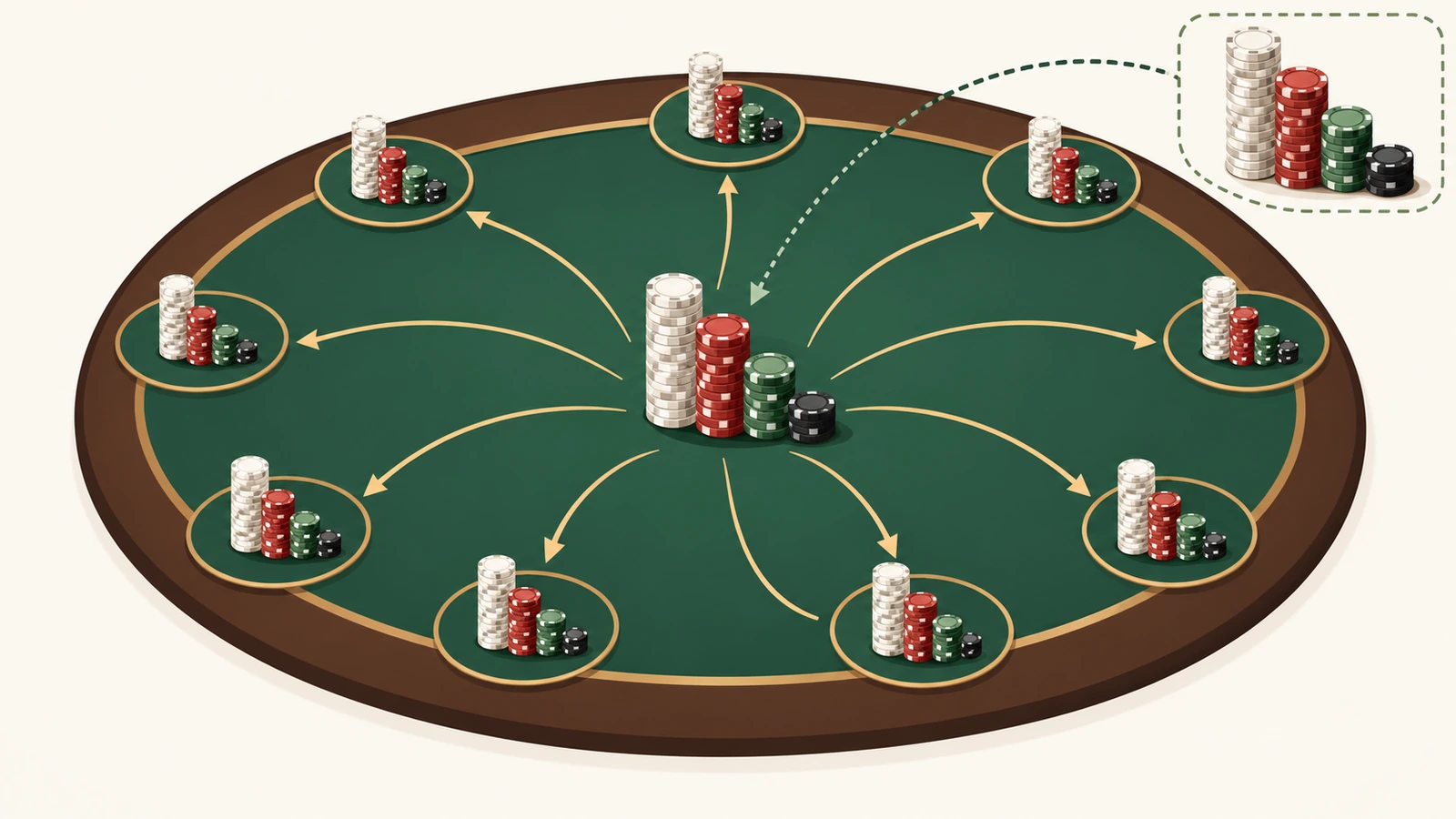
The quantity split follows from three inputs: player count, buy-in and the smallest bet. The method is the same for each format. Build one starting stack, multiply it by the number of seats, then add a bank for rebuys, change-making and color-ups. The figures below are planning examples for your own spec sheet, not a quote.
A. Home cash game: 9 players, $1/$2 blinds, $100 buy-in
Each player starts with 25 × $1 + 10 × $5 + 1 × $25 = $100, which is 36 chips. Twenty-five white chips cover blinds and small bets for many orbits without anyone running out of change. Nine seats put 324 chips in play. The bank then has to cover rebuys, usually paid in reds and greens, and pots that grow large enough to need black.
| Denomination | Color | Per starting stack | In play (9 seats) | Suggested set total |
|---|---|---|---|---|
| $1 | White | 25 | 225 | 300 |
| $5 | Red | 10 | 90 | 200 |
| $25 | Green | 1 | 9 | 125 |
| $100 | Black | 0 | 0 | 25 |
| Total | 650 | |||
B. Home tournament: 10 players, 10,000 starting stack, 25/50 opening blinds
Each player gets 8 × T25 + 18 × T100 + 8 × T500 + 4 × T1000 = 10,000, which is 38 chips. Ten players need 380 chips. Allowing for two re-entries adds 76, and 20 × T5000 chips let the director color up the T25s once the small blind reaches 100.
| Denomination | Common color | Per stack | In play (10 players) | Suggested set total |
|---|---|---|---|---|
| T25 | Green or white | 8 | 80 | 100 |
| T100 | Black | 18 | 180 | 215 |
| T500 | Purple | 8 | 80 | 95 |
| T1000 | Yellow | 4 | 40 | 50 |
| T5000 | Orange or grey | 0 | 0 | 20 |
| Total | 480 | |||
Most tournament sets need fewer chips than cash sets of a similar player count. The structure retires the smallest chip partway through, so you do not need a deep reserve of it.
C. Charity casino night: 60 guests, 1,000 in play money each
A donation ticket buys a starter pack of 10 × $5 + 10 × $25 + 7 × $100 = 1,000, which is 27 chips. Sixty guests take 1,620 chips. Blackjack and craps dealers also need a float to pay winners and make change, so add roughly a third on top.
| Denomination | Color | Per guest pack | Packs (60 guests) | Suggested total with table floats |
|---|---|---|---|---|
| $5 | Red | 10 | 600 | 800 |
| $25 | Green | 10 | 600 | 800 |
| $100 | Black | 7 | 420 | 550 |
| Total | 2,150 | |||
Roulette works differently. Each player at the wheel receives chips in their own color with no printed value, and the value is set at buy-in. A wheel therefore needs several non-value colors, one per seat, that are visibly different from your red, green and black value chips. Charity events should also make it obvious that the chips have no cash value. New Jersey keeps a separate category of promotional gaming chips[4] with a 48 mm diameter and no cash value, which shows how regulators separate play chips from money. Charitable gaming rules are set state by state, so check with your state's charitable gaming office before the event.
How to Keep Denominations Distinguishable at a Glance
At a live table, players read chips in three ways. They see stack sides from across the felt, chip faces in the pot, and single chips in a dealer's hand. A good design gives every denomination at least two independent cues so that one failing, such as low light, a color-blind player or a worn print, does not cause a misread.
1. Separate base colors by lightness, not just hue
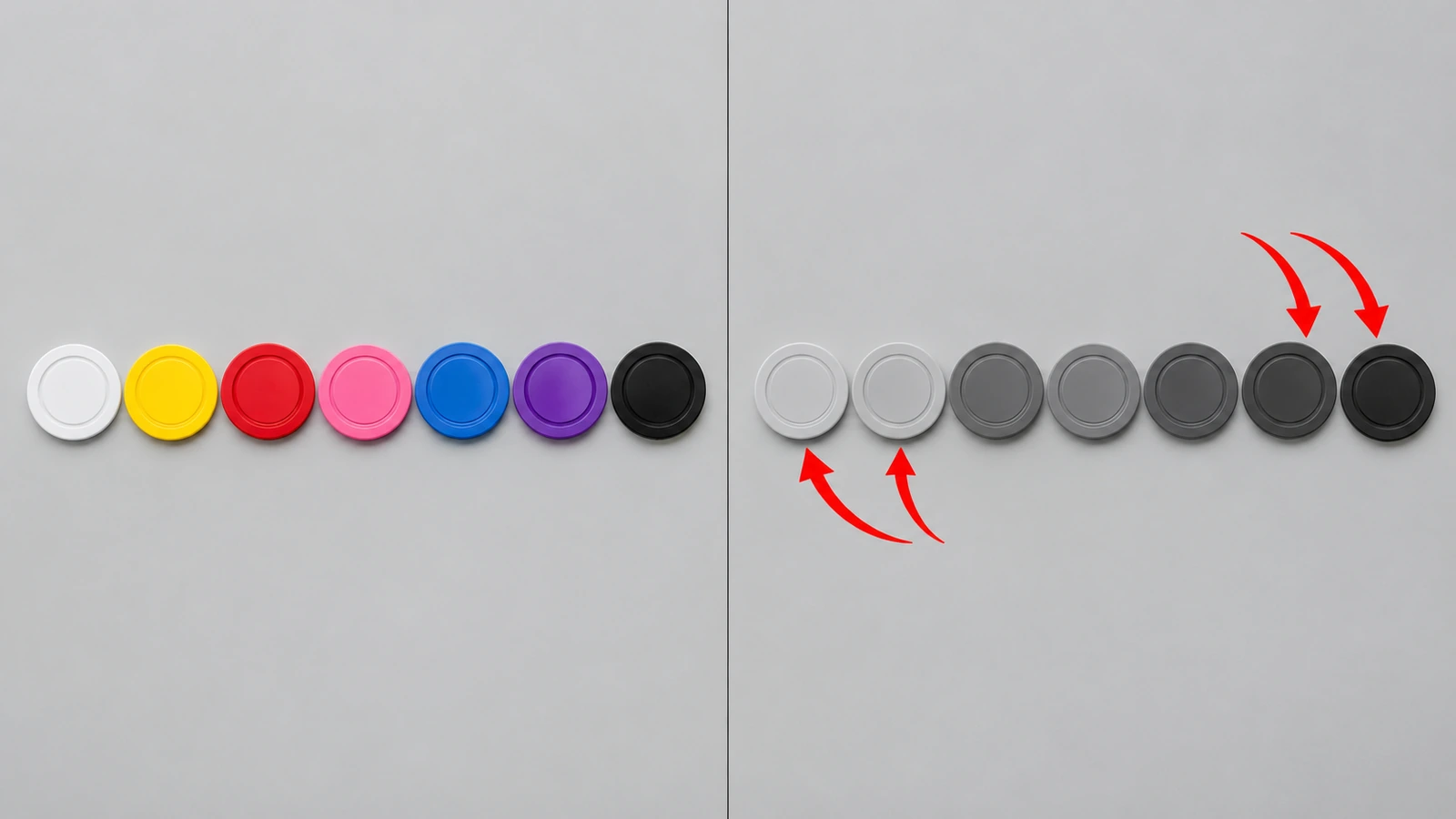
Convert your proof to grayscale before approving it. If two denominations turn into the same grey, they will blur together under dim or warm room lighting. The classic risks are white next to yellow, red next to pink and orange, and blue next to purple next to black. Red and green, the conventional $5 and $25, are also the pair most often confused by people with red-green color vision deficiency. That is one more reason not to rely on hue alone.
Dark colors need extra attention on printed chips. In a Poker Chip Forum comparison[5], one owner summed up a printed set: "Black is not black, it's dark grey." If your $100 black prints as charcoal and your $500 is a deep purple, the two can merge. Lighten the purple or add a bright edge pattern to the black.
2. Give each denomination its own edge-spot geometry
From across a table you mostly see stack sides, not faces. Assign each value a different edge pattern: count, width or arrangement of spots and stripes. Then use light spots on dark chips and dark spots on light chips. A purple and a black stack are easy to tell apart side-on if one carries thin paired stripes and the other wide single blocks, even when the base colors are close.
Alignment matters to experienced players. On the Poker Chip Forum, one buyer wrote that unaligned edge spots[6] were "a complete nonstarter." Edge patterns that line up front to back keep a stack reading as one clean column. Patterns that wander make neighboring denominations harder to separate.
3. Print the value big, simple and on the edge too
Printed numerals are the cue that survives color blindness and bad lighting. Use a plain, heavy typeface. Avoid script fonts where 1 and 7 look alike. Let the numeral fill a large share of the face. Short forms such as "5K" read faster than "5000." Players care about print area: in a 2026 forum poll on a chip mold redesign, 55% of 60 voters[7] wanted the printed label enlarged from 23.8 mm to 25 mm or more. Where the chip allows edge printing, repeat the value on the rolled edge so a stack can be read without turning a chip over.
Full-face and edge printing make all three cues possible on a single chip. The base color, spot geometry and numerals are part of the same artwork rather than a sticker. If you want to see how a planned color map turns into a printed set, our page on edge-to-edge printed ceramic chip sets planned from a spec sheet covers the material and ordering side, which this guide intentionally leaves out.

4. Plan around dye behavior and retail color drift
Saturated reds deserve care in storage. A long-running forum thread on color transfer[8] describes red chips that, after a couple of years, transferred color onto neighboring chips, felt and hands. The explanation offered was that sublimated dye can move again if chips get hot. Keep the case out of hot cars and attics, and do not store reds pressed against whites.
If you plan to fill gaps later with off-the-shelf chips, expect variation. Verified reviews of one popular retail add-on line report orange arriving as "peach" or "pale coral," grey arriving as "charcoal," and two shades of yellow in a single pack of 50. Order your full color range at once rather than matching later.
5. Treat a unique design as a security feature
Standard colors with generic art are easy to copy. In 2015 the New Jersey Attorney General[9] announced charges in a case where chips bought from an online vendor were fitted with fake logo stickers, and about $3.6 million in face value was recovered. A home game is not a casino, but the logic scales down. As one r/pokerchips buying guide[10] put it, chips "cost more to cheat if they have to place a custom order." Custom edge geometry plus your own artwork makes slipped-in lookalikes obvious.
Comparing Color Schemes and Identification Cues
The right color map depends on who is at the table and how values change hands. This comparison sums up the four buyer types this guide is written for.
| Use case | Typical denominations | Color priority | Biggest risk | Planning fix |
|---|---|---|---|---|
| Home cash game | $1 / $5 / $25 / $100 | Follow casino convention | Running out of the smallest value | 25+ small chips per seat |
| Home tournament | T25 / T100 / T500 / T1000 / T5000 | Dark-to-light contrast between neighbors | Purple and black merging | Lighter purple, bright black edge pattern |
| Card room / league | 4–5 values, both formats | Same map across all tables | Players from different rooms reading blue differently | Printed values plus a posted color key |
| Charity casino night | $5 / $25 / $100 plus roulette colors | Value chips must not resemble roulette colors | Guests confusing play chips with money | "No cash value" marking, separate wheel colors |
| Corporate event | 1–3 values or points | Brand colors, but distinct per value | Logo dominates, value unreadable | Numeral larger than logo; value on edge |
Each identification cue works at a different distance and fails in a different way:
| Cue | Readable from | Fails when | Best paired with |
|---|---|---|---|
| Base color | Across the table | Dim or warm light, color-blind players, dark prints | Edge-spot geometry |
| Edge-spot pattern | Across the table, stack side-on | Spots misaligned or too similar between values | Base color |
| Rolled-edge value text | Arm's length, stack side-on | Text too small or low contrast | Face numeral |
| Face numeral | In hand or in the pot | Decorative fonts, logo crowding | Base color |
| Chip size (regulated casinos) | Touch and sight | Mixed sizes do not stack together | Reserved for very high values only |
FAQ
FAQ: What color is a $1 poker chip?
White is the most common $1 color in U.S. cash games. Some rooms use blue or grey instead, so print the value on the face. In tournaments, the smallest chip is often green or white at T25.
FAQ: Is there a law that sets poker chip colors?
The Nevada and New Jersey rules cited here govern size, approval and anti-counterfeiting for licensed casino chips, not a mandatory palette for private sets. New Jersey does tie diameter to value, using a larger chip for $1,000 and above. Colors in home games are convention.
FAQ: How many chips per denomination do I need for 8–10 players?
For a $1/$2 cash game with a $100 buy-in, plan on about 300 $1, 200 $5, 125 $25 and 25 $100 chips (650 total). For a 10-player tournament with a 10,000 stack, about 480 chips across five values is enough, including re-entries and color-up chips.
FAQ: Which colors should never sit next to each other in a set?
Avoid putting white next to yellow, red next to pink or orange, and blue next to purple next to black as consecutive denominations unless edge patterns and numerals clearly separate them. A grayscale check of the proof will show which pairs merge.
FAQ: Can I use the same chips for cash games and tournaments?
Yes, if the printed values make sense in both formats or the chips carry no printed value. A set marked $1/$5/$25/$100 used as T25/T100/T500/T1000 confuses new players, so explain the conversion before the first hand or keep a separate tournament set.
FAQ: Can custom home chips be used in a casino?
No. Licensed casinos accept only chips approved by their regulator, and Nevada law (NRS 465.080[11]) makes it unlawful to use counterfeit chips in a gambling game. Custom sets are for private games, leagues, fundraisers and events, and their artwork should never imitate a real casino's chips.
FAQ: How many denominations does a charity casino night need?
Three value chips, such as $5 red, $25 green and $100 black, cover blackjack, craps and poker tables. Add separate non-value colors only if you run a roulette wheel, where each seated player is assigned their own color.
Key Takeaways
- Colors are convention; regulators fix the physical chip. — Nevada sets 1.55 in diameter and 0.130 in thickness for non-baccarat chips (Source)
- A second cue beyond color is good practice. — New Jersey uses 1 9/16 in for $0.25–$100 chips and 1 11/16 in for $1,000+ (Source)
- Cap the denomination range to the stakes you actually play. — Experienced players advise topping out at $25 or $100 unless running $25/$50 games (Source)
- Dark denominations need lighter neighbors or bright edge patterns. — Printed black can read as dark grey, close to deep purple (Source)
- Players want larger printed values. — 55% of 60 forum voters backed enlarging the label area beyond 23.8 mm (Source)
- Charity play chips should look nothing like money. — New Jersey defines 48 mm promotional chips with no cash value (Source)
- Generic chips with stickers are easy to fake. — About $3.6 million in counterfeit face value was recovered in the Borgata case (Source)
Conclusion: Lock the Color Map Before the Artwork
A chip set that plays well starts with a spreadsheet, not a logo. Decide your formats, cap the denominations, calculate one starting stack and multiply it out with a realistic bank. Then give every value at least two cues that hold up in bad light: a base color that separates in grayscale, an edge pattern that reads side-on, and a numeral large enough to read in the pot. Once that map is fixed, the design work becomes straightforward.
When your denomination plan and quantity split are ready, take them to our custom chip set planning and quote page. Send the color map, the per-denomination counts and your event date, and we will confirm what can be printed and quote it from your spec.
Sources
- Nevada Gaming Commission, Regulation 12 (Chips and Tokens), §12.030 and §12.040, text as of January 2026. gaming.nv.gov ↩
- N.J. Admin. Code §13:69E-1.1 and §13:69E-1.3, value chip diameters and sample/anti-counterfeiting requirements, Cornell Legal Information Institute, retrieved text updated 2025-08-04. law.cornell.edu ↩
- r/poker, "Thinking about ordering these custom poker chips," reply by u/Objective-History402, 2025-11-21. reddit.com ↩
- N.J. Admin. Code §13:69E-1.5A, promotional gaming chips, Cornell Legal Information Institute. law.cornell.edu ↩
- Poker Chip Forum, "Pro and cons for clay and ceramic chips," 2023-05-07. pokerchipforum.com ↩
- Poker Chip Forum, "Ceramic poker chips pros & cons," 2023-10-12. pokerchipforum.com ↩
- Poker Chip Forum, "New Tina public mold for 2026: should the label be bigger? A poll," 2025-11-02 (60 votes). pokerchipforum.com ↩
- Poker Chip Forum, "Chipco/ceramic color transfer/bleeding," 2015-06. pokerchipforum.com ↩
- New Jersey Office of the Attorney General, press release on counterfeit chips used at a Borgata poker tournament, 2015-07-08. njoag.gov ↩
- r/pokerchips, "2023 poker chip buying guide," 2023-06-21. reddit.com ↩
- Nevada Legislature, Nevada Revised Statutes Chapter 465, including NRS 465.080 on counterfeit chips. leg.state.nv.us ↩












The information below is required for social login
Sign In
Create New Account