


 Blog PDF for offline reading
Quick answer: To run personalized stainless steel tumblers at scale, lock one engraving template, build a single data file with one row per tumbler, choose a decoration method that can read variable data (laser engraving or digital UV printing, not screen printing), approve a rendered proof of every row plus a physical first article, reconcile unit counts at engraving and at packing, and pack each tumbler against a recipient ID. Compared with one shared logo, expect more proofing, handling and sorting, and start collecting names early because clean data usually takes longer to gather than the engraving takes to run.
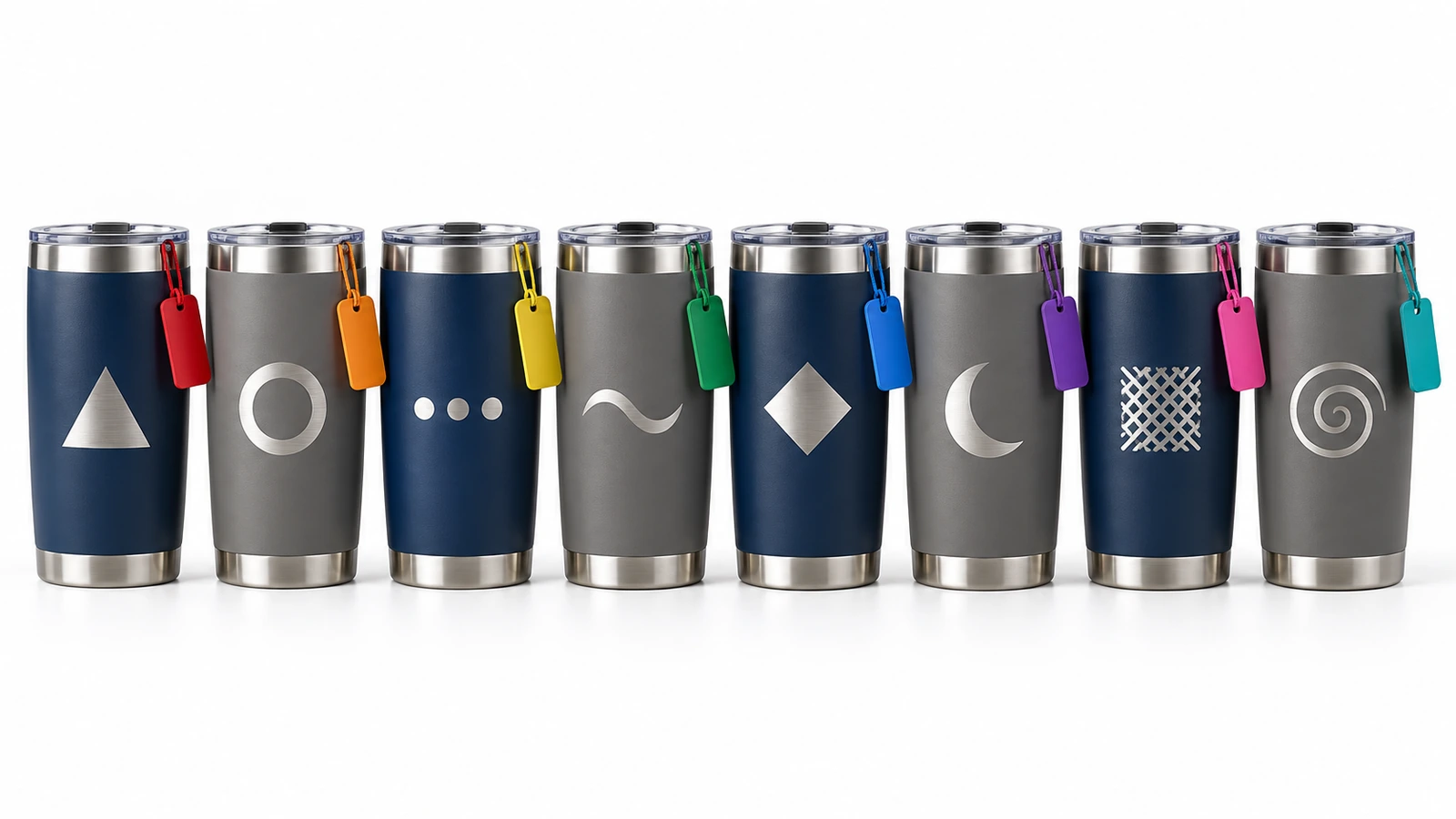
Why Do Per-Name Tumbler Orders Go Wrong?
A shared logo order has one approval moment: the logo is right or it is wrong. A per-recipient order has as many approval moments as there are names. Three hundred employees means three hundred separate chances to misspell a surname, drop an accent, swap two people with the same first name, or put the right tumbler in the wrong box. Most corporate gifting failures we see are not decoration failures. They are data failures that get permanently engraved into steel.
The stakes are higher than with a giveaway pen because people keep drinkware. In the ASI 2026 Ad Impressions Study[1], more than 87% of respondents said they would keep a branded drinkware item because it is useful, more than three-quarters use it at least weekly and keep it for at least a year, and ASI estimates roughly 1,300 lifetime brand impressions per item. A misspelled name on a tumbler that someone carries to every meeting is not a small error; it is a daily reminder that HR did not check.
Timing makes it worse. One event organizer publicly described ordering 80 custom tumblers more than two months before an event, hearing repeatedly that production was nearly done, and receiving the first sample video about three weeks before the date, with the customization wrong. With personalized orders, a late discovery cannot be fixed by reprinting one plate; every affected unit has to be re-engraved or replaced. The fix is a workflow that catches errors in the spreadsheet, not on the shipping dock.
What Are Personalized Stainless Steel Tumblers, and How Do They Differ From Logo Tumblers?
In corporate gifting, "personalized" means each unit carries information specific to one recipient: a full name, initials, a job title, a team, a start date or a milestone. Technically this is variable-data decoration. The design is a fixed template (logo position, font, layout) with one or more merge fields that the decoration software fills from a data file, one row at a time. A logo tumbler, by contrast, is identical across the batch, so every unit can be decorated from the same file without checking which unit is which.
That single difference changes the whole job. Each tumbler now has an identity that must survive engraving, inspection, packing and delivery. The base cup itself, its steel grade, lid, vacuum performance and inspection, is the same whether you add names or not; that part is covered in our guide to specifying custom stainless steel tumblers. This article focuses only on what personalization adds on top.
Demand is moving in this direction. Exhibitors at ASI Show Chicago 2026[2] reported that customization and function now matter more than sheer size, and ASI's research found 41% of end-users name drinkware as the promotional item they would be most excited to receive. The same personalization workflow applies to other customized drinkware travel mugs and bottles, so the data process you build once can be reused across product lines.
How Do You Run Per-Recipient Personalization Step by Step?
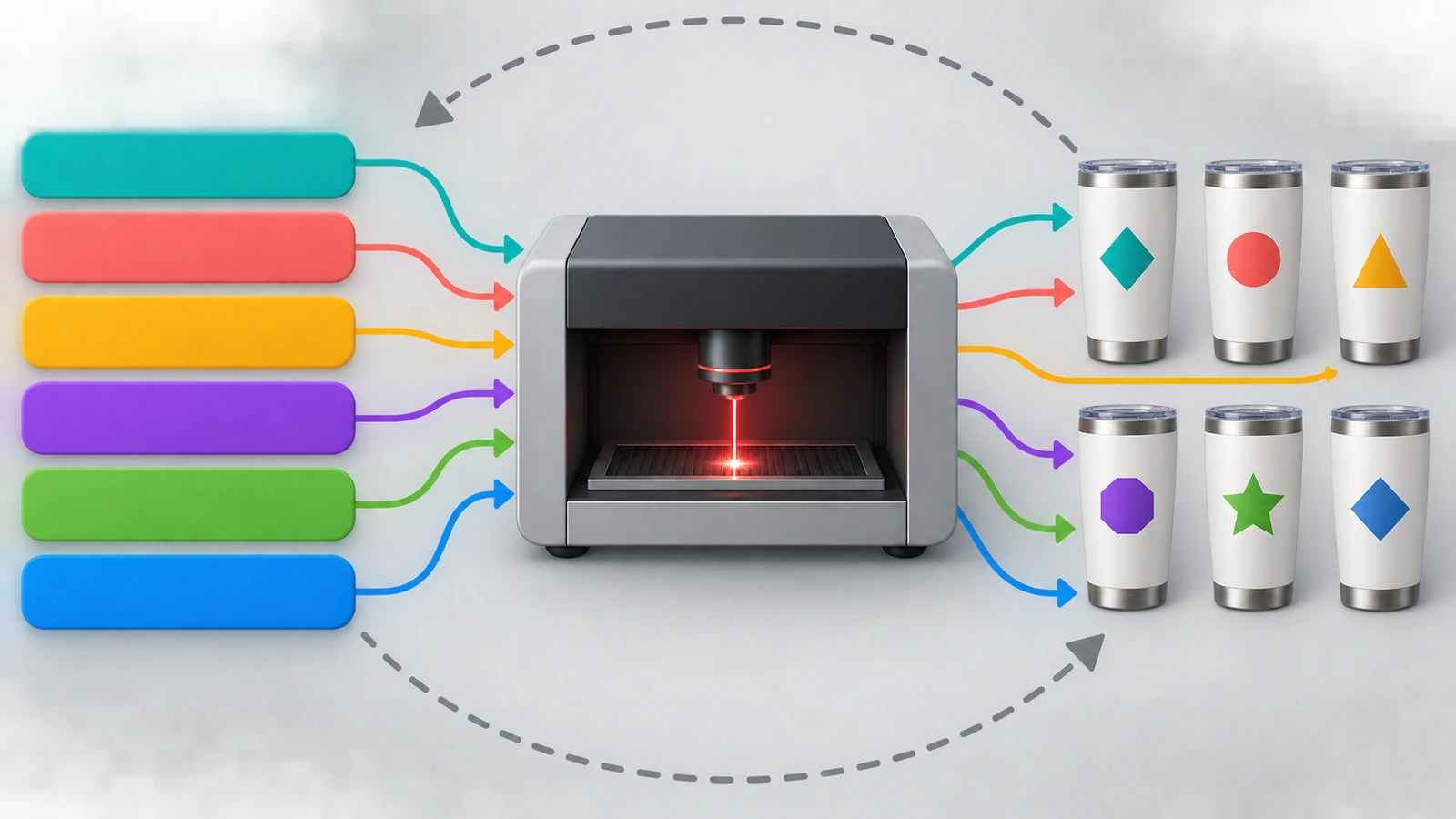
Step 1: Lock the template before you collect a single name
Decide the layout first: which side carries the logo, which side carries the name, how many text lines are allowed, the font, and the case rule (as typed, all caps, or title case). Then have the supplier render the template with the longest real name you can find in your HR system, ideally one with a hyphenated surname or an accented character. That test sets your maximum character count per line. Publishing the limit before collection prevents the most common late problem: a name that only fits if the font shrinks, which then looks inconsistent next to everyone else's.
Step 2: Build one name-list data file, one row per tumbler
Use one row per physical tumbler, not per person. If a manager receives two tumblers, that is two rows with two IDs. Keep the file to the fields the decorator actually needs, and hold home addresses in a separate fulfillment file shared only with whoever ships.
| Column | Purpose | Common error it prevents |
|---|---|---|
| Unit ID | Unique key printed on the inner box label and used at every checkpoint | Two people with the same name getting each other's tumbler |
| Line 1 (exactly as engraved) | Name in final spelling, spacing and case | Legal name engraved when the person uses a preferred name |
| Line 2 (optional) | Role, team, initials or milestone | Outdated titles after a reorganization |
| Template / finish code | Which color tumbler and which layout | Name engraved on the wrong color or wrong side |
| Ship-to group | Office, department kit or drop-ship batch | Correct tumbler sent to the wrong location |
| Delivery wave | Main batch vs. top-up batch for late additions | New hires silently missing from the order |
Save the file as UTF-8 CSV or XLSX. Spreadsheet software causes quiet damage: it strips leading zeros from employee IDs, converts entries that look like dates, turns straight apostrophes into curly ones (O'Brien becomes a different glyph), and leaves trailing or non-breaking spaces that shift centered text. Format ID and name columns as text before pasting anything in.
Step 3: Validate the data before it reaches the decorator
Collect names from the people who know them. A short form where each recipient confirms their preferred name is more reliable than exporting the HR system, which often holds legal names and outdated titles. Then run these checks:
- Row count equals the number of tumblers ordered, per color and per template.
- No duplicate unit IDs; duplicate names are flagged and confirmed as genuinely different people.
- No empty required fields and no line exceeding the character limit set in Step 1.
- Special characters (é, ñ, ø, ß, non-Latin scripts) are confirmed as supported by the chosen font.
- A second person, ideally a team lead who knows the recipients, signs off on the final list.
After sign-off, set a data freeze. Changes after the freeze go into a top-up wave rather than the main run. This one rule protects the schedule more than any rush fee.
Step 4: Approve a proof of every row, then a physical first article
A layout proof shows one example name. A data proof shows every name rendered in the actual template, laid out as a contact sheet with unit IDs. Ask for both, and review the data proof against the source list rather than against memory. Then approve a small physical first article: the longest name, the shortest name, one with special characters, on each tumbler color in the order. Laser contrast varies by coating color, so a name that reads clearly on a dark tumbler can look faint on a light one. Approving these on steel, not on screen, closes the gap between preview and product that drives many personalization complaints.
Step 5: Produce with scan-and-verify, and reconcile counts
On the production side, the reliable pattern is to label each blank with its unit ID before decoration, have the operator scan or select that ID so the software pulls the matching row, and inspect each finished unit against its row. Ask your supplier to report three counts that must match: units decorated, units passed inspection, and units packed. Any rejected unit is logged by ID and re-run individually, which is why holding a small buffer of spare blanks in each color matters more for personalized orders than for logo orders.
Step 6: Pack and distribute by recipient
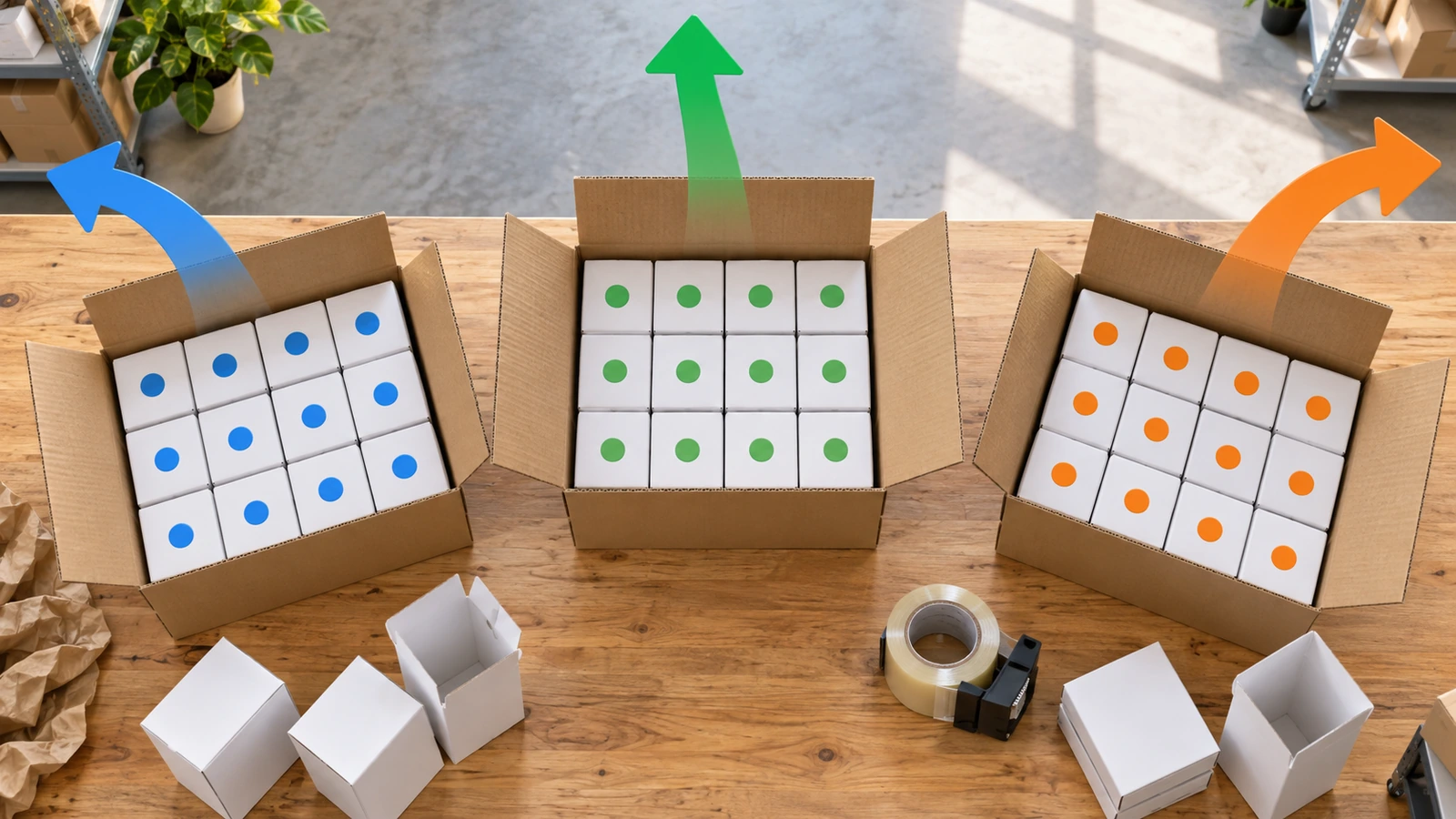
Pack each tumbler in its own box with the unit ID and recipient name on the outside, so nobody has to open a box to find the right gift. Group boxes by ship-to group and include a packing list per carton generated from the same data file. For distributed teams, drop-shipping directly to recipients avoids a second handling step in the office but requires sharing addresses; keep that file separate, limited to fulfillment, and deleted after delivery. For onboarding programs, a standing top-up process (new names collected monthly, engraved in small waves) keeps late hires from receiving a generic cup next to colleagues who got personalized ones.
Which Decoration Methods Handle Variable Data?
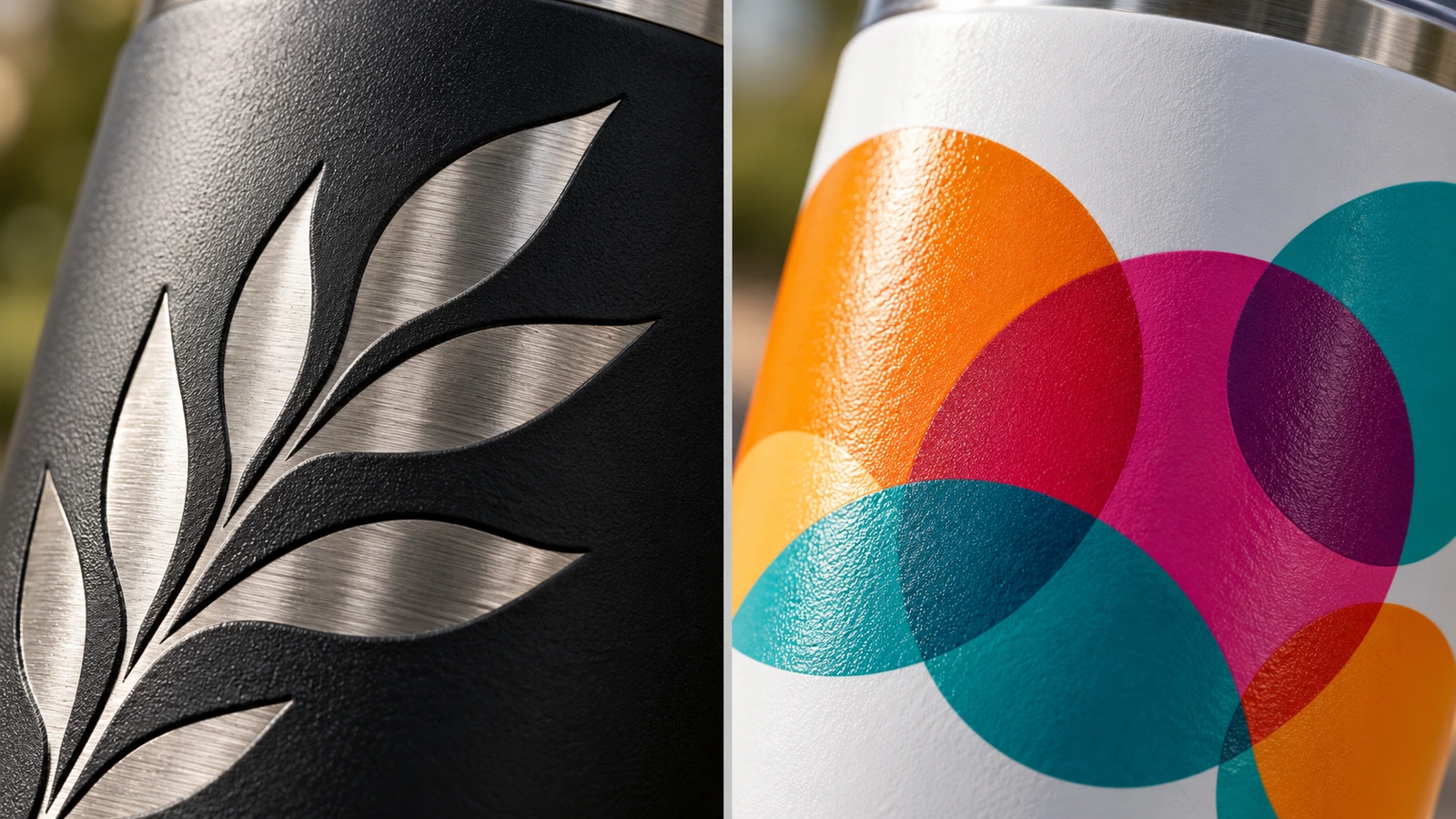
Not every method can change content from one unit to the next. The deciding question is whether the process needs a physical tool per design (a screen or a plate) or reads a digital file per unit.
| Method | Variable names per unit? | What it looks like | Watch-outs |
|---|---|---|---|
| Laser engraving | Yes, reads the data file directly | Removes the coating to reveal bare steel; permanent, single tone | Cannot reproduce brand colors; contrast is weakest on white and light coatings |
| Digital UV printing | Yes | Full color, can include colored names | Ink sits on the surface; confirm adhesion and dishwasher guidance |
| Sublimation | Yes, with per-unit transfers | Full-color wraps | Requires a sublimation-ready coating; adds a print-and-match step |
| Screen printing | Not practical | Solid spot colors | Needs a screen per design; suited to the shared logo, not names |
| Pad printing | Not practical | Small spot-color marks | Needs a plate per design |
A widely used combination is a hybrid: the shared logo goes on one side using whichever batch method suits your brand color, and the name goes on the other side by laser. The logo stays consistent across the batch while only one side carries variable data, which keeps proofing focused on names. If coating adhesion is a concern for printed designs, ask the supplier which adhesion test they run (cross-hatch tape testing under ASTM D3359 is a common reference) and what result they accept.
Does Personalization Change Food-Contact and Safety Obligations?
Engraving and printing happen on the exterior, away from the drinking surface, so personalization does not change what the interior must meet. It does add materials, inks and coatings, and it gives you a tool that logo orders lack: recipient-level traceability.
In the United States, materials that contact food must be of a purity suitable for their intended use under 21 CFR 174.5[3], and plastic lids, gaskets and straws fall under the polymer provisions of 21 CFR Part 177[4]. There is no single "FDA certificate" for a finished tumbler, and the FDA states on its lead in foodwares page[5] that no regulation authorizes lead as a component of food contact surfaces.
If tumblers ship to California employees, coatings and inks matter under Proposition 65. OEHHA lists lead[6] with a reproductive-toxicity safe harbor (MADL) of 0.5 µg per day and an oral cancer NSRL of 15 µg per day, codified in 27 CCR §25805[7]. Ask for test reports covering the decoration materials, not just the steel.
Vacuum-seal materials have drawn public attention too. In April 2026 a federal judge dismissed consumer claims over a lead pellet sealed beneath a well-known brand's vacuum layer, finding plaintiffs had not shown a "specific and plausible risk of harm," as Reuters reported[8]. Employees still ask, so get the sealing method in writing before gifting.
Traceability is where your data file earns its keep. In 2024, ASI reported[9] that 43 people fell ill after a promotional tumbler giveaway of an estimated 33,000 units with suspected chemical residue in the insulation cavity. Anonymous giveaways are hard to trace. If your file links each unit ID to a production batch and a recipient, you can notify exactly the people affected by any problem batch instead of recalling everything.
Per-Name vs. Shared Logo: What Changes in Cost and Lead Time?
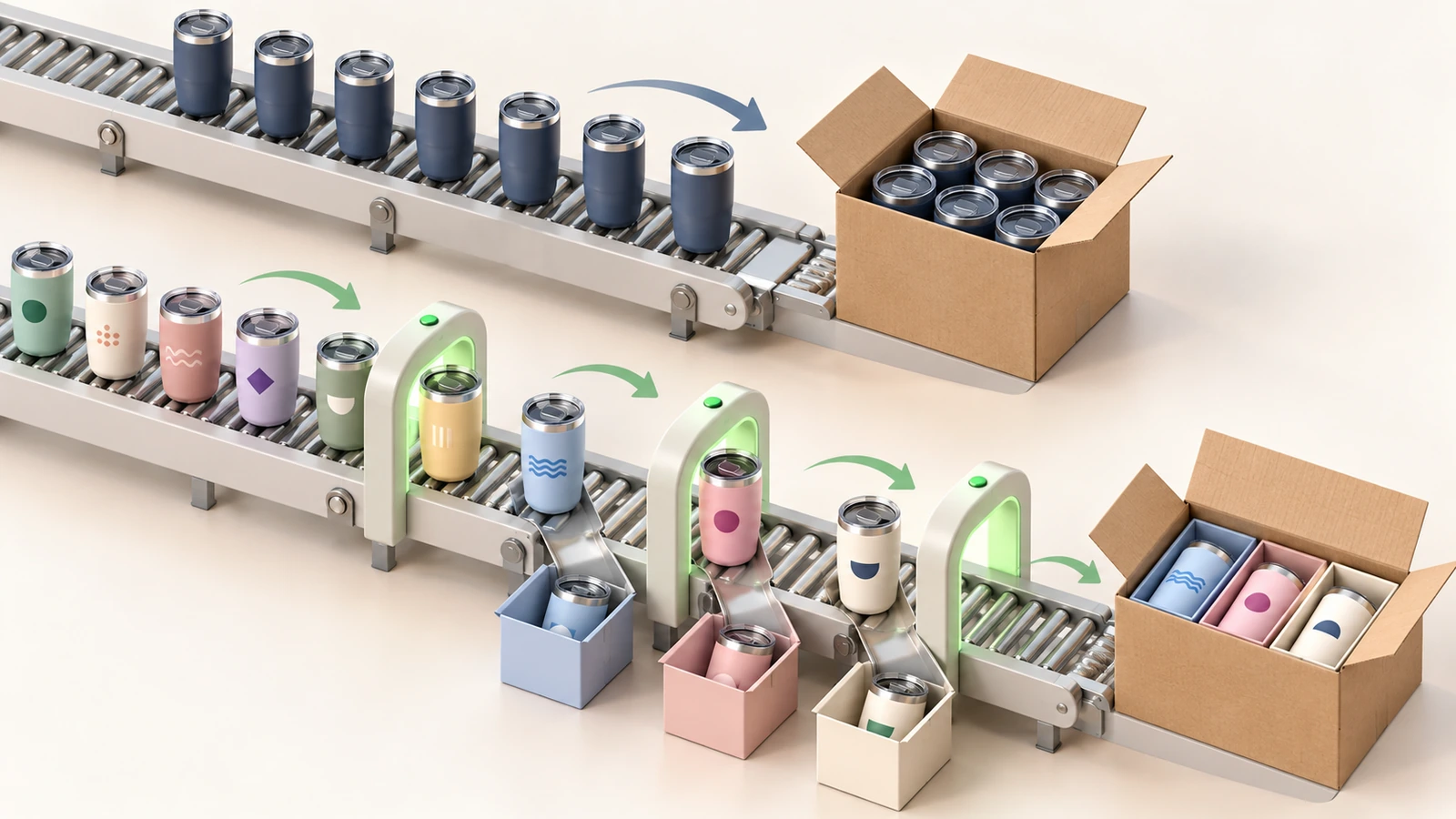
Personalization rarely changes the price of the cup itself. It changes the work around each cup. The table shows where the extra effort lands so you can plan for it.
| Factor | Shared logo | Per-recipient names | Hybrid (logo + name) |
|---|---|---|---|
| Artwork input | One vector file | Template plus data file | Logo file plus template plus data file |
| Proofing | One proof | Layout proof, data proof of every row, physical first article | Logo proof once; name proofs per row |
| Decoration methods | Any, including screen print | Laser, digital UV, sublimation | Batch method for logo; laser or UV for names |
| Production handling | Continuous batch | Unit-by-unit verification against data | Batch side plus unit-by-unit side |
| Packing | Bulk cartons | Individual boxes, sorted by recipient and location | Individual boxes, sorted |
| Error cost | Reprint whole batch if logo is wrong | Re-run individual units; spare blanks needed | Mostly individual re-runs |
| Main schedule risk | Artwork approval | Name collection and data cleanup | Name collection |
Two practical conclusions follow. First, the largest schedule risk usually sits inside your organization: chasing preferred names and confirming titles across departments. Start collection the day the budget is approved, not after the supplier is chosen. Second, cost drivers are handling, proofing labor, individual packaging and the spare-blank buffer, so the gap versus a shared logo depends on order size, number of colors and how many ship-to locations you have. Send your supplier the planned row count, color split and number of destinations to get a quote that reflects your real workflow rather than a per-unit list price.
Budget holders tend to support this effort. ASI's end-buyer research[10] found that buyers aged 25 to 34, a large share of the workforce, mostly plan to increase promotional spending, and personalized items are an easy case to make when the goal is retention and recognition rather than reach.
Frequently Asked Questions
FAQ: Can individual names be screen printed on tumblers?
Not practically. Screen printing needs a separate screen for each design, so a different name on every unit would mean a different screen for every unit. Use laser engraving or digital UV printing for names, and keep screen printing for the shared logo if you want a specific brand color.
FAQ: What file format should our name list be in?
A UTF-8 CSV or XLSX with one row per tumbler, a unique unit ID, the exact text to engrave, and template and ship-to codes. Format ID and name columns as text so the spreadsheet does not strip leading zeros, convert values into dates, or change apostrophes.
FAQ: How do we handle new hires and name changes after approval?
Set a data freeze date. Anything after it goes into a top-up wave produced from the same template, so the main batch is not delayed. For onboarding programs, schedule recurring small top-up runs.
FAQ: Will laser-engraved names match our brand color?
No. Laser engraving removes the coating and reveals the steel underneath, so names appear as bare metal. If colored names are essential, use digital UV printing and confirm adhesion and care instructions with the supplier.
FAQ: Do we have to share employee home addresses with the supplier?
Only if you choose drop-shipping. Otherwise ship to office locations and distribute internally. If you drop-ship, keep addresses in a separate file limited to fulfillment and ask for deletion after delivery.
FAQ: How much more does personalization cost than a single logo?
It depends on row count, number of colors, proofing rounds and number of destinations, because the added cost comes from handling, verification and packing rather than the cup. Share those figures when you request a quote to get an accurate comparison.
Key Takeaways
- A misspelled name gets kept and seen, not thrown away. — more than 87% of recipients keep branded drinkware, with about 1,300 lifetime impressions (Source)
- Personalized drinkware is the gift recipients want most. — 41% of end-users name drinkware as the promo item they would be most excited to receive (Source)
- Decoration materials need their own test reports for California shipments. — lead's Prop 65 reproductive safe harbor is 0.5 µg per day (Source)
- Food-contact compliance covers the cup and lid, not a single certificate. — materials must meet the purity rule in 21 CFR 174.5 (Source)
- Unit-level IDs turn a blanket recall into a targeted notice. — one untraceable giveaway affected an estimated 33,000 units and sickened 43 people (Source)
Getting Every Name Right the First Time
Personalized tumblers succeed or fail in the spreadsheet. Lock the template, collect preferred names early, validate and freeze the file, proof every row, verify each unit against its ID, and pack by recipient. The decoration itself is the most predictable part of the job once the data is clean. When you are ready to choose the base tumbler and decoration, review how to specify custom stainless steel tumblers with the right steel, proofs and inspection, then send us your planned row count, color split and delivery locations for a quote built around your recipient list.
Sources
- ASI Central, "ASI's 2026 Ad Impressions Study: Drinkware," June 2026. https://members.asicentral.com/news/strategy/june-2026/asi-s-2026-ad-impressions-study-drinkware/ ↩
- ASI Central, "ASI Show Chicago 2026: Drinkware Trends From the Show Floor," July 23, 2026. https://members.asicentral.com/news/strategy/july-2026/asi-show-chicago-2026-drinkware-trends-from-the-show-floor/ ↩
- Electronic Code of Federal Regulations, 21 CFR §174.5, General provisions applicable to indirect food additives. https://www.ecfr.gov/current/title-21/chapter-I/subchapter-B/part-174/section-174.5 ↩
- Electronic Code of Federal Regulations, 21 CFR Part 177, Indirect food additives: polymers (accessed version dated 2025-10-27). https://www.ecfr.gov/on/2025-10-27/title-21/part-177 ↩
- U.S. Food and Drug Administration, "Lead in Food and Foodwares." https://www.fda.gov/food/environmental-contaminants-food/lead-food-and-foodwares ↩
- California OEHHA, Proposition 65: Lead and Lead Compounds. https://oehha.ca.gov/proposition-65/chemicals/lead-and-lead-compounds ↩
- Cal. Code Regs. tit. 27, §25805, Specific Regulatory Levels: Chemicals Causing Reproductive Toxicity (Cornell LII). https://www.law.cornell.edu/regulations/california/27-CCR-25805 ↩
- Reuters, "Maker of Stanley tumblers prevails in lawsuit over lead scare," April 6, 2026. https://www.reuters.com/sustainability/boards-policy-regulation/maker-stanley-tumblers-prevails-lawsuit-over-lead-scare-2026-04-06/ ↩
- ASI Central, "More Than 40 People Sickened by Contaminated Tumblers," May 29, 2024. https://members.asicentral.com/news/industry-news/may-2024/more-than-40-people-sickened-by-contaminated-tumblers/ ↩
- ASI Central, "End-Buyer Research: Ages 25-34," September 12, 2024. https://members.asicentral.com/news/strategy/september-2024/end-buyer-research-ages-25-34/ ↩












The information below is required for social login
Sign In
Create New Account