We use cookies to enable our websites to remember information, to help some website functionalities to work properly, to understand how you interact with and use our websites and to display you content and ads that are relevant and engaging for you.
By clicking Accept All you consent to the use of these cookie.
The store will not work correctly when cookies are disabled.
Quick answer: The five common journal fabrics differ most in surface and decoration. Linen and cotton canvas give the strongest texture but stain and fray most easily. Coated bookcloth wipes clean and holds crisp foil. Faux suede reads as soft luxury and suits debossing. Recycled PET carries a sustainability story you can measure. Choose by how the journal will be carried, how the logo will be applied, and which material claims you can document.
Corporate gift buyers usually choose journal fabrics from a swatch card or a photo. Recipients judge them months later, after the journal has been in a laptop bag, on a café table and under a coffee cup. That gap is where most disappointments start. A branded notebook is not a short-lived giveaway. In the 2026 Ad Impressions research from the Advertising Specialty Institute, 61% of consumers said they would keep a promotional notebook for at least a year[1], 75% would use one at least weekly, and the category generates about 500 lifetime impressions per piece. Whatever is wrong with the cover gets seen hundreds of times.
The problems that come up most in buyer reviews and stationery forums follow the fabric. Light linen picks up ink and coffee that a damp cloth will not remove. Coarse weaves blur fine logo lines. Untreated edges fray at the corners within weeks. Fabric labelled "eco" sometimes has no paperwork behind it. This guide compares the five fabrics gift programs most often consider and links each one to a decoration method, a level of wear and a brand position. You can then shortlist with evidence rather than relying on how the swatch feels.
What journal fabrics are, and why the backing matters
A journal fabric is the textile wrapped around the cover boards of a hardcover journal, or used as the full cover of a flexible one. On a hardcover, the fabric is glued over greyboard, which supplies the stiffness, and folded around the board edges and corners. Fabric sold specifically for binding is usually backed with paper or treated with a coating. Without that backing, glue soaks through the weave and the cloth stretches while it is being wrapped. That is why an ordinary dress-weight textile turned into notebook fabric tends to feel limp and bubble at the edges.
Formal product standards treat fabric covers as a separate quality category. China's 2026 group standard for notebooks, T/NBWJ 04—2026[2], sets four requirements for them. The cover must be clean with no stains or broken yarns. Stitching must be even with no skipped or loose stitches. Free formaldehyde must not exceed 300 mg/kg. The 2021 edition it replaced also required colour fastness of at least grade 3. Buyers can copy that wording directly into an acceptance checklist, whatever the fabric.
Fabric covers also sit in a premium tier of the market. Mordor Intelligence's paper notebook analysis values the market at USD 76.28 billion in 2025. It reports that hardcovers wrapped in fabric, cork or vegan leather carry 20–40% higher unit prices[3]. It also names printed fabric covers and recycled PET felt as growth drivers. Because you are paying that premium, the fabric needs to justify it in daily use and not only on the day the box is opened.
How to choose journal fabrics in five checks
These checks narrow the fabric choice before you request samples. Writing the full specification, reviewing artwork and approving samples are covered step by step on our linen-wrapped hardcover notebook page. This section deals only with the material decision.
Map the journal's real life. A journal kept on an executive's desk wears differently from one carried to trade shows in a tote. Bag friction attacks corners and the spine head first, so heavily carried journals need a coated or tightly woven fabric. Desk journals can use open, textured weaves.
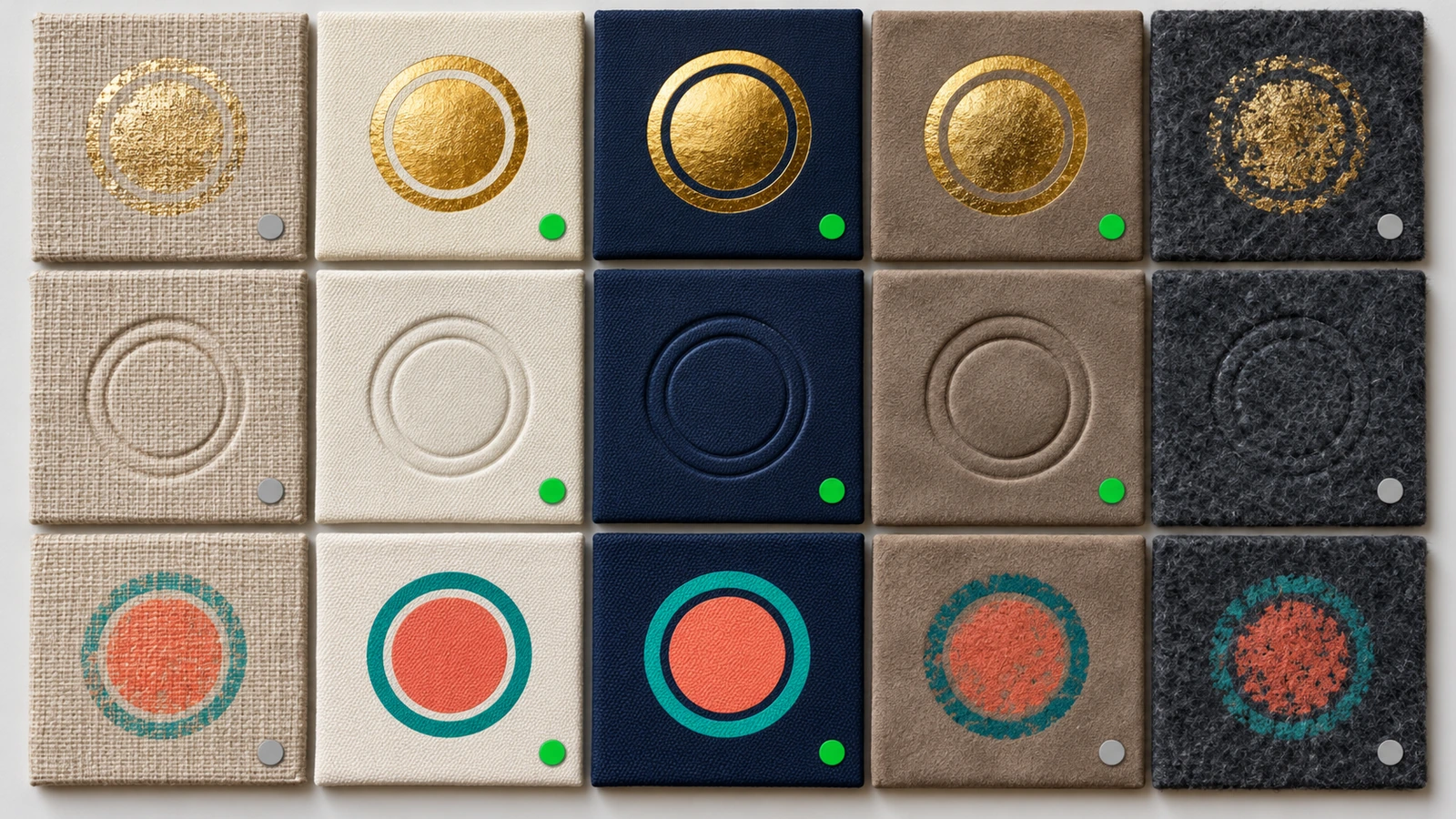
Match the logo method to the weave. Cloth and coated cloth take a die, which means foil stamping and debossing. They do not accept four-colour process ink. If the artwork depends on a photograph or gradient, consider screen print on a smooth canvas, or move that artwork to a printed band or insert. Common prepress practice for foil on cloth is to keep lines no thinner than about 0.3 mm and to avoid foiled text below roughly 8 pt. Blind deboss reads clearly only on bolder type.
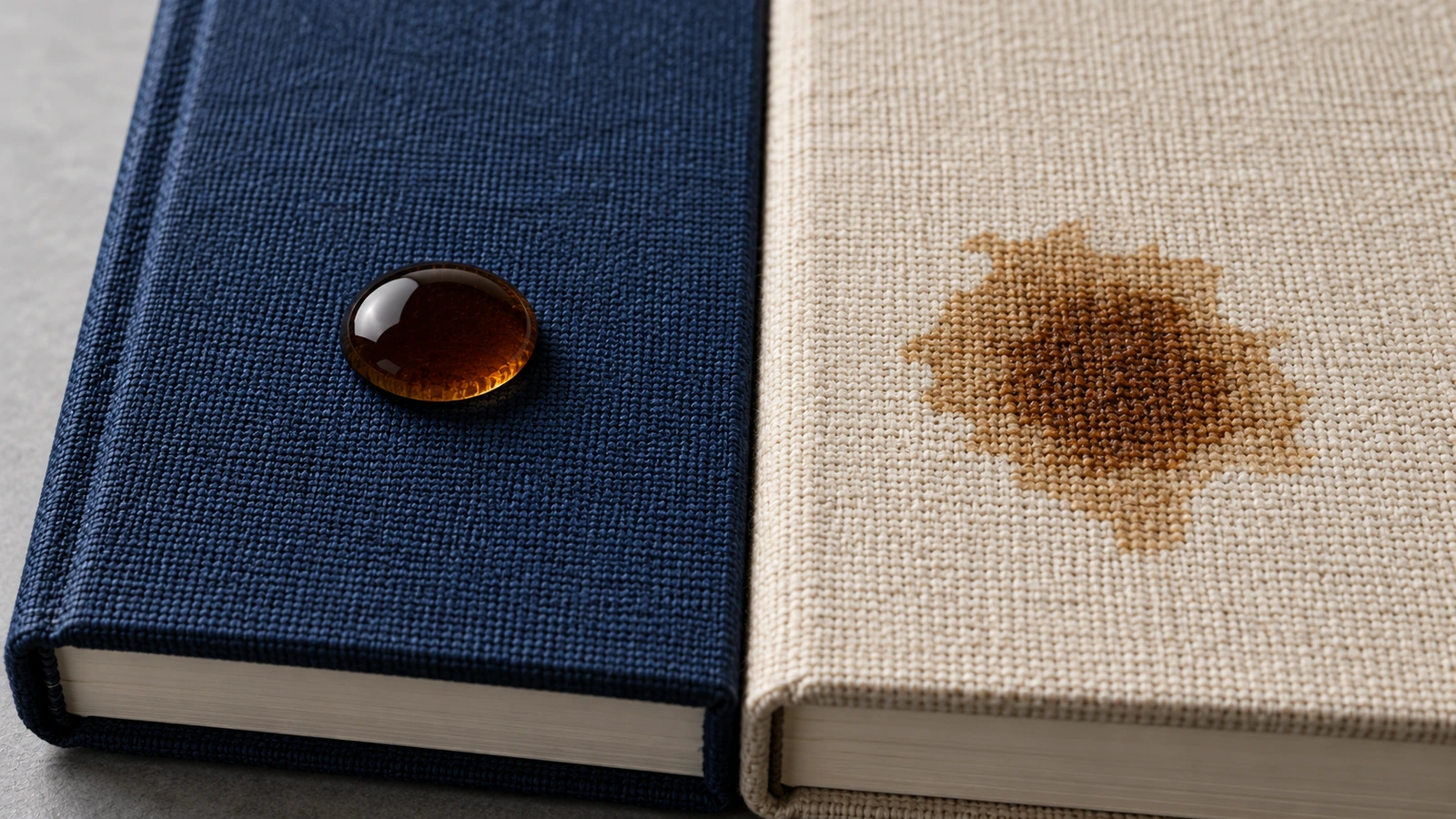
Decide your stain tolerance before you choose a colour. On an uncoated natural fibre, a pale shade will show ink, coffee and hand oil within a few weeks. If a light colour is non-negotiable, use a coated cloth. If the texture of an open weave matters more, choose a mid-to-dark shade.
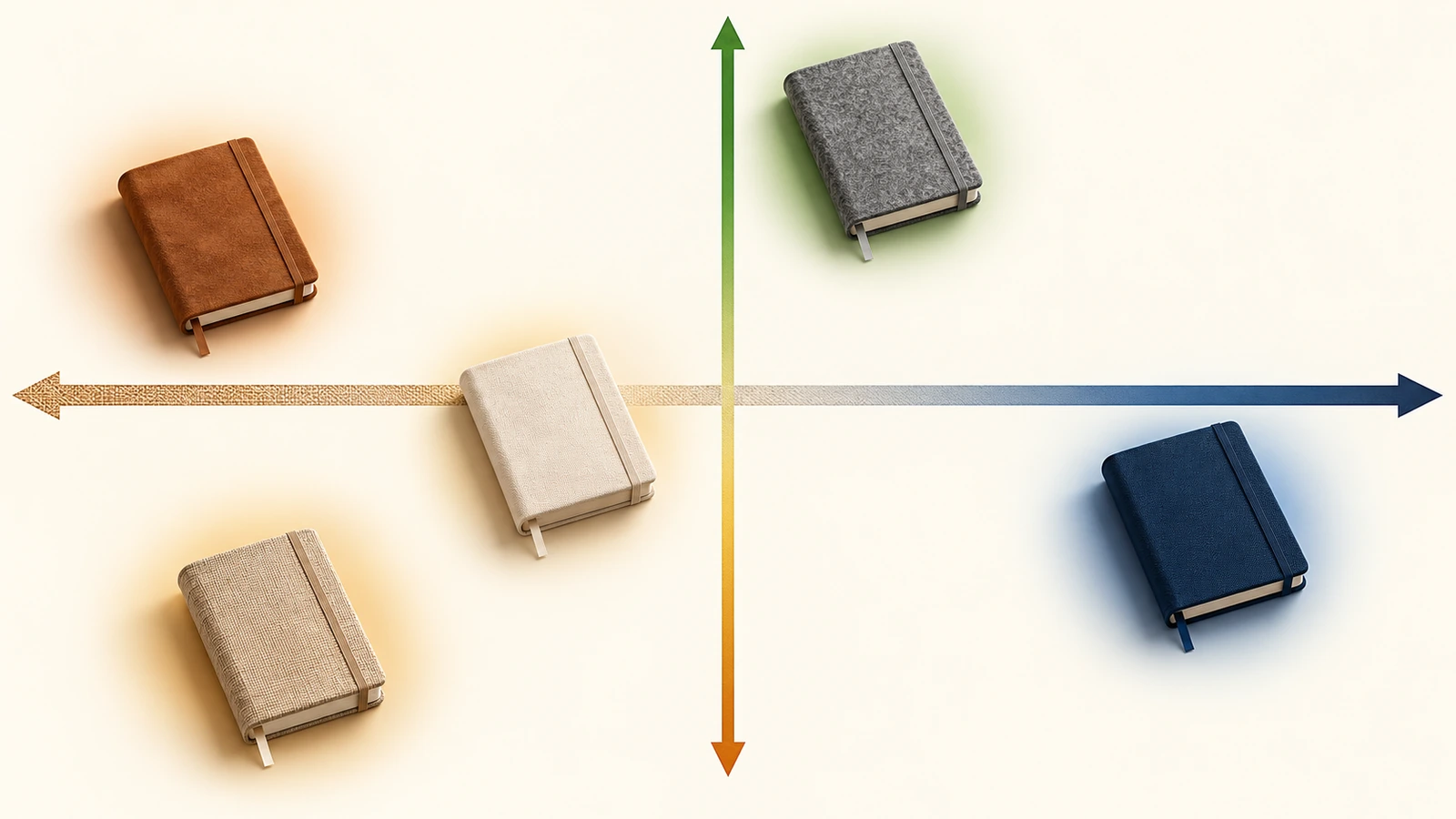
Pick the story the recipient should tell. Linen suggests craft and heritage. Canvas suggests utility and the outdoors. Coated bookcloth suggests permanence. Faux suede suggests softness and fashion. Recycled PET suggests measurable impact. The fabric communicates before the logo is even noticed.
Confirm you can prove every claim. A fibre percentage, a recycled-content figure or an "eco" message each creates a documentation duty, and the fabric and the paper each need their own proof. A short summary follows, and the full documentation checklist is on the product page.
Proof points that apply to the fabric, not the paper
Buyers often assume one certificate covers the whole journal. It does not. FSC 100%, FSC Mix and FSC Recycled labels[4] describe the forest fibre in the paper and board, and say nothing about the cover textile. For the fabric, buyers commonly ask for OEKO-TEX STANDARD 100[5] certification for harmful substances. That certificate is usually valid for one year and should name the specific article. Recycled-content claims need a separate composition document from the mill.
Fibre claims also have legal consequences in the United States. The FTC's textile labelling guidance[6] lists notebook covers and book cloth among items that normally do not need a fibre label. Once you advertise fibre content, such as "100% linen", the fibre disclosure rules apply. Without a composition sheet, describe the look ("linen-texture cloth") rather than the fibre.
The five fabrics, one by one
1. Linen: the heritage choice that needs care
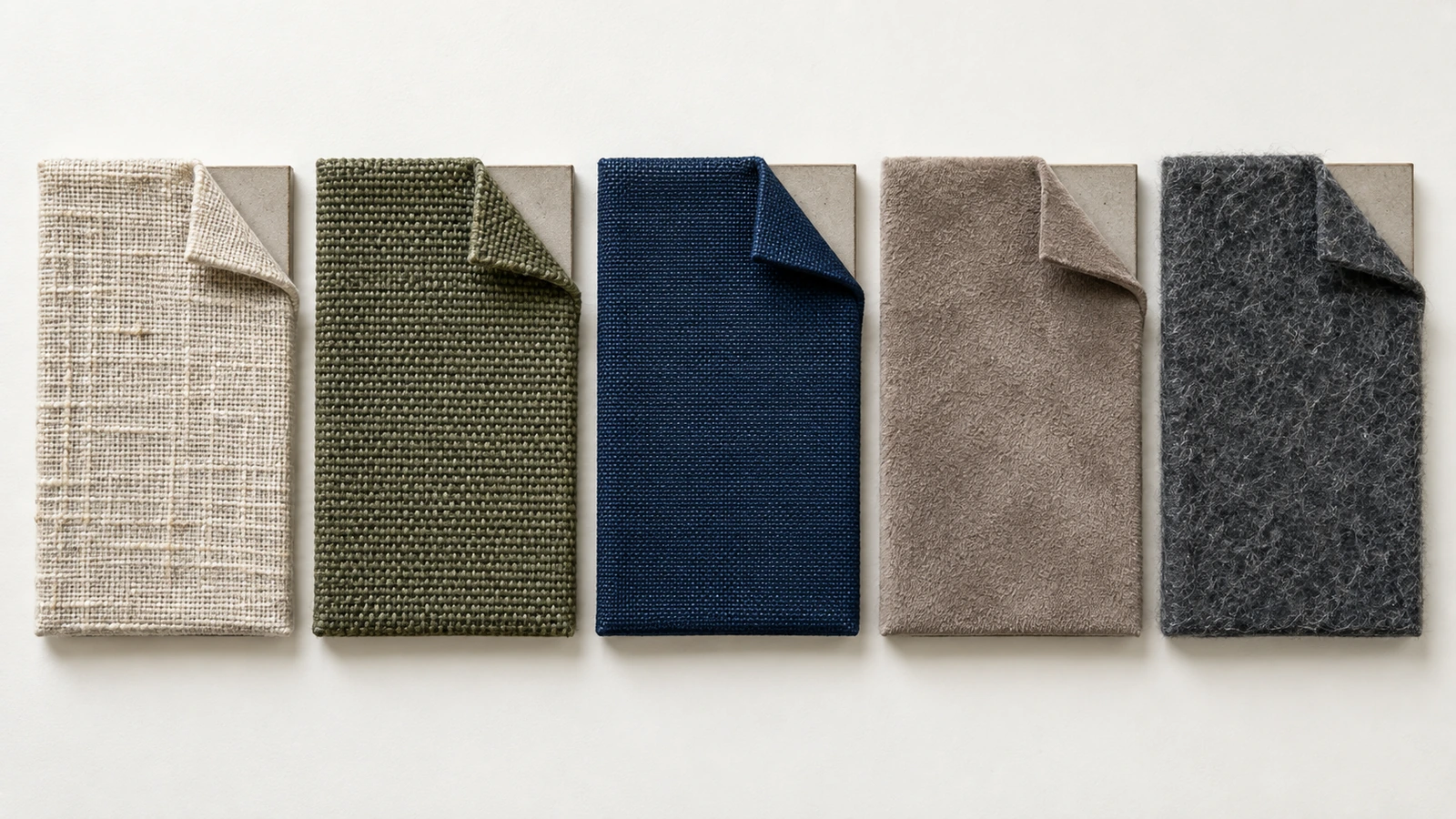
Linen has a crisp, slightly irregular slub and a matte surface. That is why it suits editorial, architecture, hospitality and luxury brands that want to look established. Its weaknesses are well documented. The Well-Appointed Desk, reviewing a fabric-covered pocket notebook, noted that "the edges are already fraying a bit"[7] after a short period of use. Notebook Stories examined a batch of premium linen journals and found uneven spines and cover overhang that was larger on one side[8]. Natural linen moves more than coated cloth during wrapping, so tolerances tend to vary more from one journal to the next.
For decoration, linen suits bold foil and deep deboss. A coarse weave breaks up thin serifs, so heavy weights of a logo work better than outline versions. Choose a tightly woven, paper-backed linen for gifts, and use darker or heathered shades if the journal will travel. For the specific trade-offs of a linen-wrapped hardcover, see our custom linen notebook options.
2. Cotton canvas: casual, sturdy and print-friendly
Canvas has a heavier, more regular weave than linen. It feels practical rather than precious, and it fits outdoor, education, tech start-up and employee onboarding programs. A smooth, tight canvas is the best of the natural fabrics for screen print, because the ink sits evenly on the flatter surface. That allows multi-colour flat artwork that a die cannot reproduce. Foil works when the weave is fine. Debossing gives softer edges than on coated cloth.
The weaknesses resemble linen's. Uncoated cotton absorbs spills, and stationery forum users describe coffee stains that a damp cloth only lightens. Recycled cotton canvas makes a good sustainability story, but the recycled share must be documented by the supplier. It is not shown by an FSC paper label.
3. Coated bookcloth: the workhorse for long-term desks
Coated bookcloth is a woven base, often a poly-cotton blend, finished with a water-based acrylic layer. The coating seals the weave. Liquids bead on the surface instead of soaking in, corners resist abrasion, and foil lands on an even surface, so it gives the cleanest metallic edges of the five. Deboss is crisp too. This makes it the safest choice for executive gifts, law and finance firms, and any program where the journal must look the same after a year on a desk.
The trade-off is tactile. A heavy coating can make cloth look slightly synthetic, so choose a finish that keeps the visible weave. Coating also changes the regulatory picture in two ways. Under FTC rules, a coated fabric whose coating adds at least 35% of the base fabric's weight falls into a category where no fibre label is needed unless you make a fibre claim. Under the U.S. lead rules for children's products, coating removes the fabric from the natural-fibre exemption. More on that in the FAQ.
4. Faux suede: soft luxury for beauty and fashion
Faux suede is usually a polyester microfibre with a brushed nap. Its main appeal is touch, which is what gift recipients notice first. Reviews of soft fabric journals often focus on how the cover feels in the hand. That makes it a strong fit for beauty, fashion, wellness and influencer gifting.
Decoration is narrower. Debossing usually works well, because pressing the nap flat creates a tonal mark that reads as subtle luxury. Foil on a pile surface can look patchy, and fine detail gets lost. Screen print sits on the tips of the fibres and can look uneven. The nap also shows directional brushing and holds oily marks, although polyester resists water-based spills better than cotton or linen. Use it for brands that want a quiet, tonal logo, not a bright multi-colour one.
5. Recycled PET: the measurable sustainability story
Recycled PET appears on journals in two forms: as a pressed felt and as a woven bookcloth. The woven versions are the more mature option for gifts. Material ConneXion profiled one ocean-bound bookcloth that is 74% recycled polyester, with 55% sourced from ocean-bound PET[9]. It is finished with a water-based coating and takes hot foil, blind deboss, screen and offset print. Its producer equates 1,000 square metres with diverting about 5,200 PET bottles. Figures like these let a sustainability team report impact rather than just claim it.
Felt has more texture and colour depth. However, compressed fibres take foil poorly, and the cut edges show the material's structure. Whatever the form, ask for the mill's composition sheet and recycled-content documentation. An rPET cover is still a polyester product, so describe recyclability accurately for a multi-material journal with board, glue and paper.
Journal fabrics side by side
The ratings below are relative, comparing typical gift-grade versions of each notebook fabric. Actual performance depends on weave density, backing and coating, so confirm it with the supplier's test data. For woven cloth, buyers can request tensile (ISO 13934-1), tear (ISO 13937-2) and folding endurance (ISO 5626) results.
Fabric
Hand feel
Edge and corner wear
Stain behaviour
Best decoration
Weakest decoration
Brand fit
Relative budget
Linen
Crisp, slubbed, matte
Moderate; frays if edges untreated
Absorbs ink and coffee; pale shades show marks quickly
Bold foil, deep deboss
Fine-line foil, full colour
Heritage, editorial, luxury hospitality
Mid to high
Cotton canvas
Sturdy, regular weave
Good on heavy weights
Absorbent; mid and dark shades recommended
Screen print, foil on fine weaves
Photo artwork
Casual, outdoor, onboarding, ESG
Mid
Coated bookcloth
Smooth, visible weave
Strongest of the five
Wipeable; liquids bead
Crisp foil, sharp deboss
Raised emboss
Corporate, legal, finance, executive
Mid
Faux suede
Soft, brushed nap
Good; nap may flatten
Resists water spills; holds oily marks
Tonal deboss
Foil detail, screen print
Beauty, fashion, wellness
Mid to high
Recycled PET (woven or felt)
Woven: smooth; felt: dense, soft
Woven good; felt shows cut edges
Woven coated grades wipe clean
Woven: foil, screen, deboss
Foil on felt
Sustainability-led brands
Mid to high
Budget tiers vary with cover size, board, page count and decoration as much as with the fabric. For a quote on a specific fabric and quantity, send your brief through the custom fabric notebook page rather than relying on a general price table.
FAQ
FAQ: Can a full-colour logo be printed directly onto a cloth journal cover?
Not with four-colour process printing on standard bookcloth. Cloth and coated cloth take dies, which means foil stamping and debossing. Smooth canvas and woven rPET can take screen print in a limited number of flat colours. Photographic or gradient artwork normally moves to a printed paper wrap, a band or an inside page.
FAQ: Which journal fabric hides stains best for a journal that travels?
Coated bookcloth, followed by coated woven rPET. The coating stops liquids soaking into the fibres. Of the uncoated fabrics, a dark or heathered canvas hides marks better than pale linen. Faux suede resists water but can hold hand oil in the nap.
FAQ: Is fraying on a fabric journal a defect?
Opinions differ. Some independent makers leave raw edges on purpose as a mark of use. For corporate gifts, most buyers treat visible threads at delivery as a defect. Edges should be folded around the board, and the cover should arrive with no broken yarns, which is the same wording T/NBWJ 04—2026 uses.
FAQ: Does an FSC label cover the fabric too?
No. FSC labels describe the forest fibre in the paper and board. A recycled cotton or recycled PET cover needs its own composition and recycled-content documents, and OEKO-TEX STANDARD 100 is the usual reference for harmful substances in the textile.
FAQ: Do journals for children need a different fabric decision?
Yes, if they are designed mainly for children aged 12 and under. U.S. lead limits apply, and 16 CFR 1500.91[10] exempts dyed natural fibres such as cotton and linen, as well as polyester, from testing for lead content. That exemption does not apply once the fabric is coated or screen printed. Children's programs also come under the CPSC toy and children's product framework[11] where it applies.
FAQ: Are coated fabrics a Proposition 65 concern for California recipients?
They can be. Vinyl-type coatings and some inks may contain listed chemicals such as lead or phthalates. California requires a clear and reasonable warning when exposure is significant, and businesses with fewer than 10 employees are exempt, according to the official Proposition 65 FAQ[12]. Water-based acrylic coatings are generally lower-risk, but ask for test data rather than assuming.
Key takeaways
A gift journal's cover is seen for a long time, so wear matters as much as first impressions. — 61% keep a promotional notebook at least a year; about 500 lifetime impressions (Source)
Fabric-wrapped hardcovers sit in a premium tier that the material has to justify. — 20–40% higher unit prices than standard covers (Source)
Use a fabric-cover standard's wording as your acceptance checklist. — no stains, no broken yarns, free formaldehyde ≤300 mg/kg (Source)
Recycled PET bookcloth lets sustainability teams report specific figures. — 74% recycled polyester, 55% ocean-bound PET in one profiled cloth (Source)
Coating or screen printing changes the U.S. lead-testing position for children's journals. — the natural-fibre exemption is lost once fabric is coated or printed (Source)
A fibre claim on the cover triggers labelling rules. — the FTC exemption for notebook covers ends when fibre content is advertised (Source)
Conclusion
No single journal fabric is best for every program. Each is best for one combination of carry pattern, logo method and brand message. Linen and canvas win on texture but need darker shades and well-finished edges. Coated bookcloth is the dependable choice for crisp foil and journals that live on a desk for years. Faux suede suits tonal, tactile luxury. Recycled PET gives sustainability-led brands figures they can report, provided the paperwork exists. Shortlist two fabrics using the table above. Then, when you are ready to turn a choice into a sampled journal, share your brief on our linen-wrapped custom notebook page and ask for a quote based on your quantity and decoration.
Sources
Advertising Specialty Institute, Ad Impressions Study 2026, notebooks category. media.asicentral.com↩
Ningbo Stationery Industry Association, T/NBWJ 04—2026 Notebooks, published 2026-03-28, effective 2026-04-28; record at the National Digital Library of Standards. ndls.org.cn↩
Mordor Intelligence, Paper Notebook Market Size & Share Analysis, 2025–2030, insights updated January 2026. mordorintelligence.com↩
Forest Stewardship Council US, What do the FSC labels mean. us.fsc.org↩
Hi there! I'm Bruce, proud dad to my amazing son. I'm the founder of Zigpac, a printing and packaging company empowering small and medium-sized businesses with custom solutions. Let's create something great together!



 Blog PDF for offline reading












The information below is required for social login
Sign In
Create New Account