We use cookies to enable our websites to remember information, to help some website functionalities to work properly, to understand how you interact with and use our websites and to display you content and ads that are relevant and engaging for you.
By clicking Accept All you consent to the use of these cookie.
The store will not work correctly when cookies are disabled.
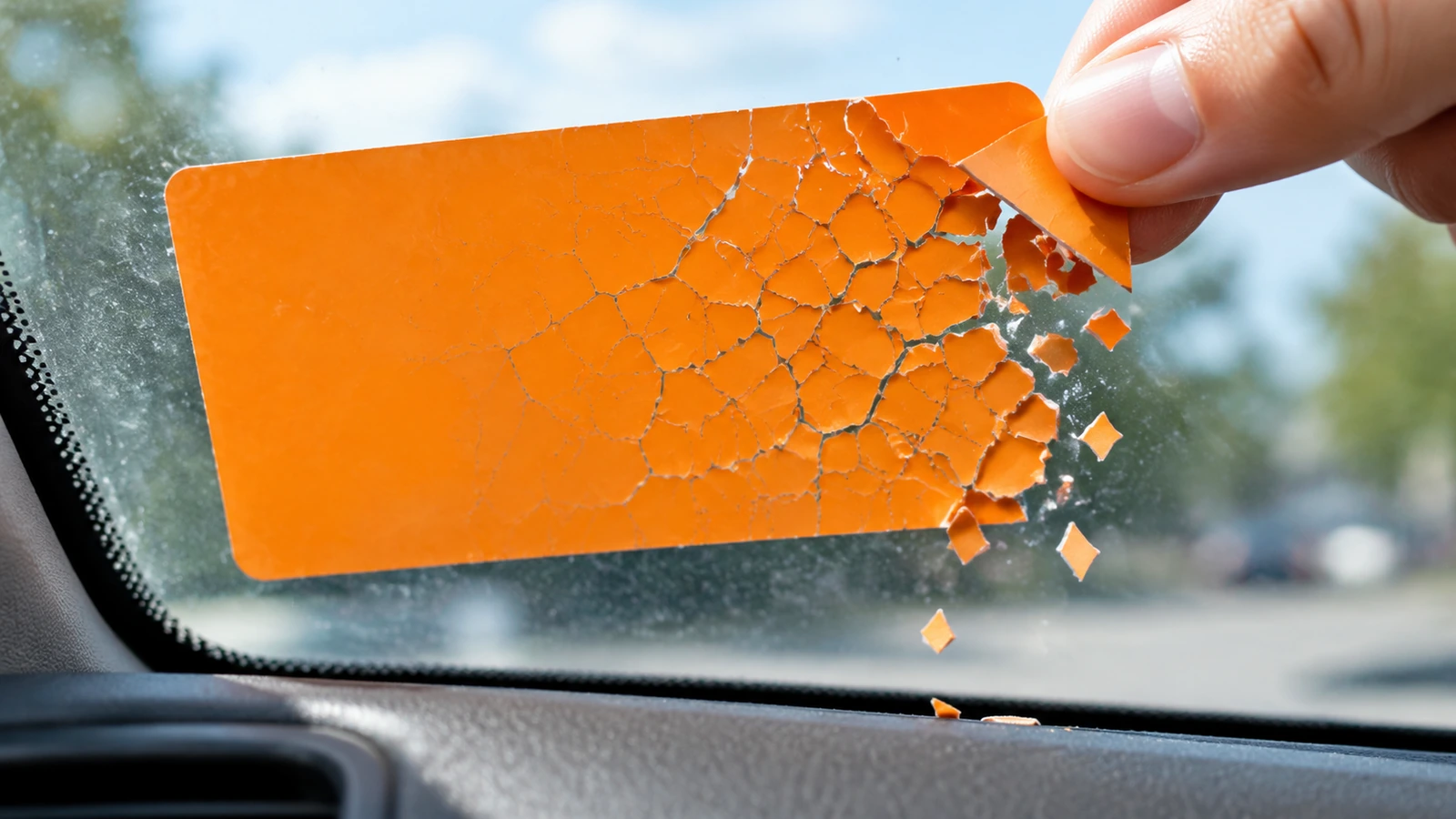
Quick answer: An eggshell parking sticker is a windshield permit printed on a brittle, destructible face stock over a permanent adhesive. Anyone who tries to peel it off breaks it into small flakes, so it cannot be moved to a second car or resold. To make it work, give every permit a unique serial, color-code by term or zone, fix one windshield position, plan renewal and vehicle-change rules, and train patrol staff on a short inspection routine.
Most permit leakage is not counterfeiting. It is ordinary sharing. A resident lends a hangtag to a visitor. A student sells a semester decal to a classmate. A tenant moves out and the permit leaves with the new owner of the car. An eggshell parking sticker removes the easiest route, because the permit no longer survives being moved. The sticker alone does not close every gap, though. Serialization, color logic, placement, renewal policy and enforcement routine decide whether the material's one-way behavior turns into fewer unauthorized cars in your lot.
This guide is written for property managers, parking operators and campus facilities teams who are replacing hangtags or peelable decals. It covers how to plan the system around a destructible permit. Material and ordering details are on the custom eggshell stickers product page.
What Is an Eggshell Parking Sticker, and Why Does It Stop Permit Resale?
The name refers to how the sticker fails, not to what it is made of. The face film or paper is deliberately weaker than the adhesive bond underneath. When someone lifts an edge, the face cracks into small pieces before the adhesive lets go, much like a shell coming off a boiled egg. The permit stays readable while it is left in place. Once someone attempts removal, it is gone.
That failure mode changes how a parking program works. A permit that can be peeled and re-stuck is effectively a bearer token: whoever holds it gets in. A destructible permit is bound to one piece of glass, so it is bound to one vehicle. Selling it means handing over the windshield.
Describe it accurately in your policies. The correct term is tamper-evident, not tamper-proof. A determined person can still scrape the permit off. What they cannot do is move it intact or hide the attempt. If you need the background on why the material breaks on purpose, the destructible eggshell label overview explains the construction.
Why Hangtags and Peelable Decals Leak
Before you change formats, work out which leak you are trying to close. Each permit format has its own weak point:
Hangtags are designed to move. Households with two cars share one tag. Residents lend tags to guests. Tags reported as "lost" sometimes keep circulating.
Standard vinyl decals can be peeled off whole, especially from glass. A decal applied in September can be lifted with a fingernail in January and sold.
Paper permits on the dashboard are easy to photocopy and impossible to bind to one vehicle.
Virtual permits tied to a plate do not transfer, but they only work if every patrol has a working license-plate reader or handheld lookup. Visual enforcement is not possible.
An eggshell permit addresses the first three directly. It also works alongside the fourth: a printed serial gives patrol staff a visual check that still works when the reader is down.
How to Plan an Eggshell Permit System, Step by Step
Step 1: Design a serial format that carries meaning
Every permit needs a unique serial, and the serial should tell staff something before they look it up. A practical structure is facility code + term code + zone code + sequence + check digit. For example, "B-26F-Z3-004812-7" could stand for Building B, fall 2026 term, Zone 3, sequence 4,812, and check digit 7. Six sequence digits allow one million permits per term and zone, which is far more than any single lot needs. Leading zeros keep every serial the same length, so a typed-in serial that is too short gets flagged.
Add the check digit. A mod-10 (Luhn-style) check digit catches every single-digit typo and most swapped neighboring digits. Those are the two most common mistakes when an officer reads a serial through a dusty windshield and types it into a handheld.
Keep the license plate in your database, not printed on the permit. The plate changes when a car is re-registered, and printing it makes every misprint a reissue. Some programs have staff write the plate on the permit at issuance with a paint marker. Brittle face stocks usually accept paint markers well, but test your marker on a sample first.
If you plan to add a barcode or QR code for handheld scanning, test it on the actual material behind real windshield glass. Tint, glare and the brittle edge zone all affect readability. Layout rules for keeping serials and codes legible are covered on the product page and are not repeated here.
Step 2: Color-code by term and use shape for zone
Color is the fastest check your patrol has. It works from across a row of cars, at walking pace. Use it for the question that changes most often: is this permit current?
Variable
Encode with
Why
Term (year, semester, quarter)
Background color, rotated every term
A last-term permit looks wrong from a distance, with no lookup needed
Zone or lot
A large, simple shape (circle, triangle, square, diamond)
Shape stays readable for staff with color-vision deficiency and does not clash with the term color
Permit class (resident, staff, contractor, ADA-linked)
Border style or a band position
A third visual channel that does not dilute the other two
Identity
Serial plus optional code
The only element that needs close inspection
Rotate through at least three well-separated term colors so that no two consecutive terms look alike. Avoid using red and green together as the only difference between two terms. Hold back one small design element each term, such as a pattern change, and do not announce it in advance. A color copy made from last term's permit will then fail the close check even if the color is right.
Step 3: Fix one windshield position and apply on bare glass
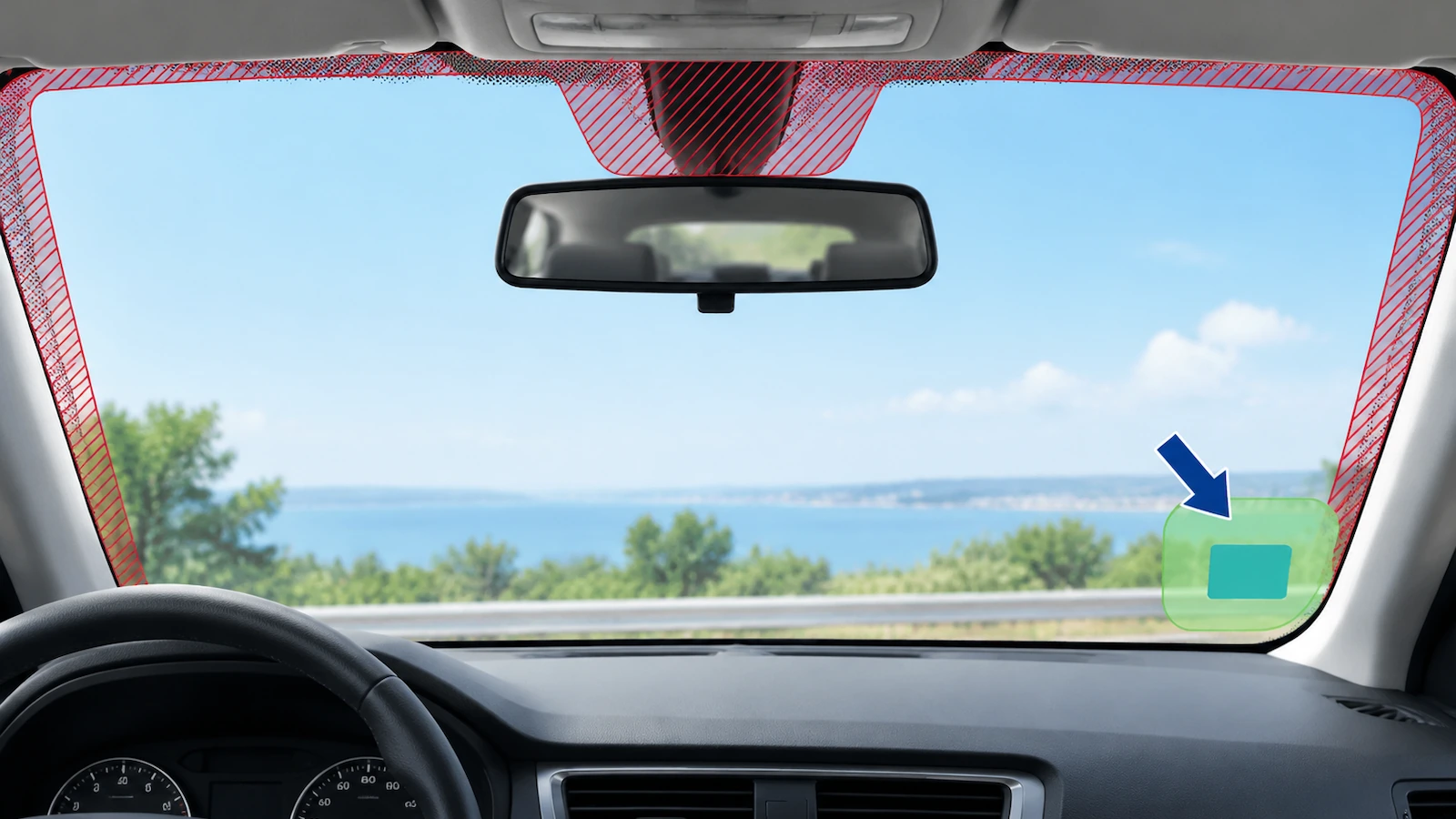
One standard position, used on every vehicle, cuts patrol time more than any other single decision. Officers learn where to look, and a missing permit stands out at a glance. When choosing the position:
Apply on the inside of the glass. This keeps the permit away from ice scrapers, wipers, car washes and people walking past who try to pick at it.
Check your local vehicle code for where windshield stickers are allowed. Lower corners and the area next to the mirror are commonly permitted, but rules vary by jurisdiction.
Stay clear of the camera and sensor zone behind the rear-view mirror on cars with driver-assistance systems.
Avoid the dotted ceramic band around the edge of the glass. Its texture weakens adhesion and gives someone an edge to lift.
Avoid aftermarket tint film and rear-window defroster lines. On tinted glass, the permit bonds to the film, not the glass, so removing it can damage the tint. Removing a permit from a defroster grid can break the heating lines.
Adhesive performance always depends on the surface and conditions. UL makes this point about labels, surfaces and conditions[1]. For permits, this means cleaning the glass with isopropyl alcohol, applying firm pressure, and not applying onto frost or condensation. Ask your supplier for the minimum application temperature. Winter pickup lines are where cold-glass failures happen.
Step 4: Have staff apply the permit at issuance
The most common workaround is not peeling. It is putting the permit on a carrier before it ever touches glass: clear packing tape, a static-cling sheet or a piece of window film. The permit then bonds to the carrier, and the carrier moves between cars. Mailing permits out invites this.
Staff application removes the problem. Hand out permits at a pickup point, have staff apply them directly to clean bare glass, and record the serial against the plate on the spot. If you must ship permits, require a photo of the installed permit and tell patrol to look for signs of a carrier: a visible film edge, a halo around the permit, trapped bubbles in a regular pattern, or a permit that moves slightly when pressed.
Step 5: Write renewal and vehicle-change rules before launch
Because the permit cannot move, events like selling or replacing a car need a written procedure. Decide these points before the first permit is issued:
Fixed or rolling expiry. A single cutover date for everyone gives patrol one clear "color switch" day. Rolling expiry spreads out workload at the counter but makes color checks less reliable. Most campuses use a fixed term date. Many residential properties use lease-aligned dates with a short grace window.
Vehicle change. Deactivate the old serial in your system, then issue a new permit for the new plate. Decide what proof you will accept that the old car is gone: a registration document, a photo of the scraped glass, or an in-person check.
Windshield replacement. Glass replacement destroys the permit. Accept a repair invoice as proof and reissue.
Lost or stolen car. Put the serial on a hot list immediately so patrol flags it wherever it appears.
Removal at term end. Tell holders how to remove expired permits. On untinted glass, a razor scraper and adhesive remover work. Expect flakes and some residue. FINAT notes that permanent adhesives are not designed to release cleanly[2]. Offering a staffed removal station at renewal improves goodwill.
Step 6: Give patrol a three-layer inspection routine
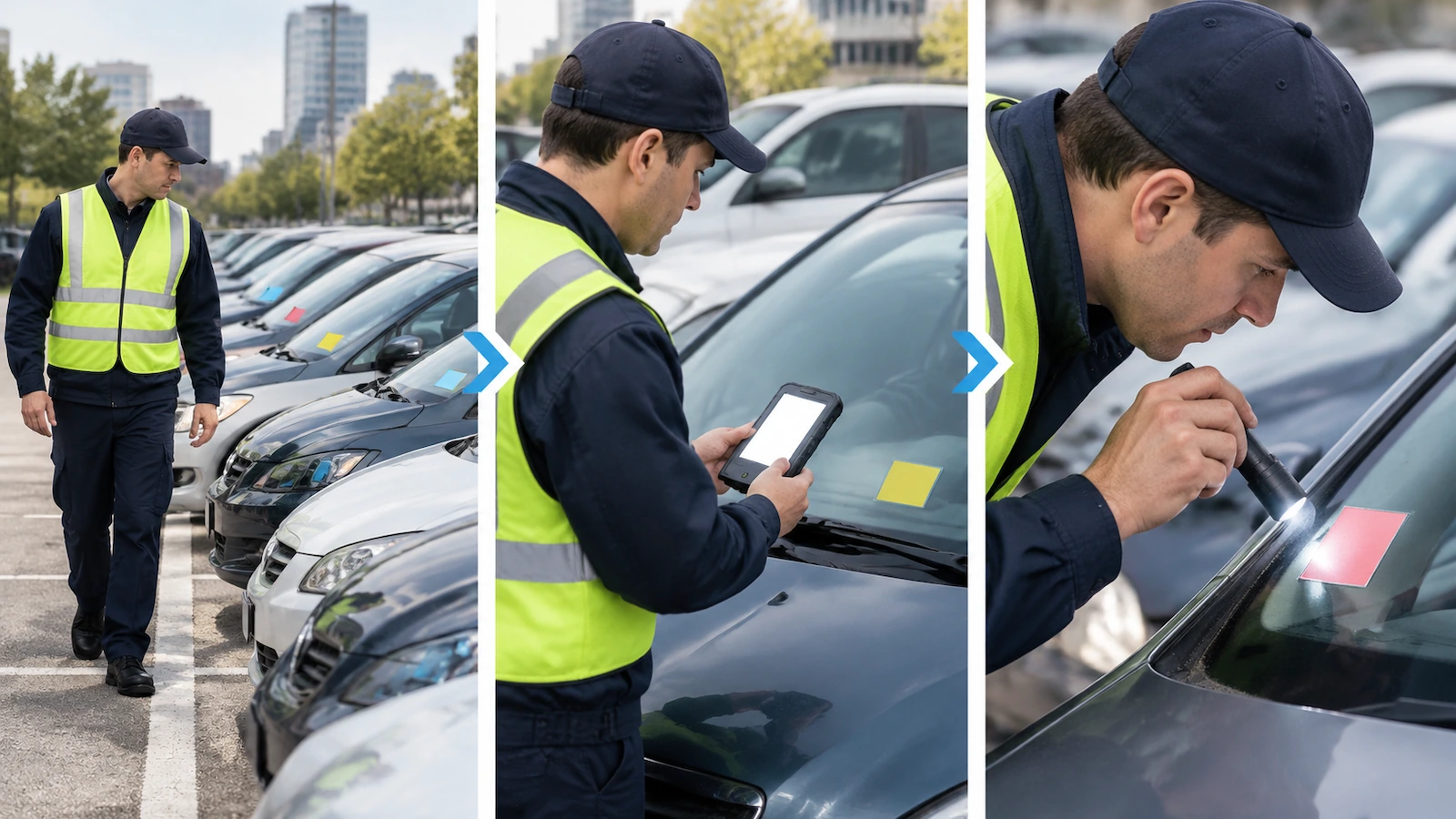
A permit only deters if someone checks it. Train staff on three layers, in order:
Glance (walking pace): Is the permit in the standard position? Is the term color current? Does the shape match the zone? Anything that fails moves to layer two.
Lookup: Read or scan the serial and validate the check digit. Check it against the active list and the hot list (deactivated, lost, stolen, or linked to another plate).
Close look: Check for lifted or cracked edges, signs of a carrier film, an unexpected surface finish that suggests a photocopy, and whether this term's hidden design element is present.
Log every exception with the serial and a photo. After a few weeks, the log shows where leakage is happening, for example one building or one permit class. That evidence is more useful than any material specification.
Eggshell Permits vs. Other Permit Formats
Format
Transfer resistance
Evidence of tampering
Vehicle change
Patrol speed
Best fit
Eggshell windshield permit
High: breaks when removed
Visible fragments, lifted or cracked edges
Reissue required; plan a procedure
Fast visual check plus serial lookup
Residential lots, campuses, staff parking with resale problems
Hangtag
Low: designed to move
None
Easy, which is also the problem
Fast, but proves little
Visitors, short-term or shared-vehicle programs
Standard vinyl decal
Low to moderate: often peels off whole
Little
The holder may move it themselves
Fast
Low-risk lots where convenience matters more
VOID-pattern label
Moderate: the film stays whole
Leaves a visible message on the surface
Reissue required
Fast
Sealing boxes and equipment more than windshields
Virtual plate-based permit
High
Not applicable
Update a database record
Depends on reader coverage
Operators with full plate-reader patrols; pairs well with a printed backup
Many operators now run a hybrid: a plate-based record for primary enforcement and an eggshell permit as the visual layer. The material comparison between eggshell, VOID and fragile paper is covered on the product page.
Run a Field Pilot Before Full Rollout
Run a pilot in your own lot, on the kinds of vehicles your holders actually drive, before you order for the whole program. A useful pilot covers:
A mix of glass: clear, factory-tinted, aftermarket-tinted, and a steeply raked windshield.
At least one cold-morning application, if your renewal falls in winter.
A full day of curing before any removal test. Permanent acrylic adhesives build strength over time, and testing too early makes a good permit look weak.
A removal attempt with a fingernail, then with a razor blade. Record whether the permit came off in one piece (a failure) or in fragments (a pass).
A serial-reading test through the glass in daylight and under lot lighting, with the handhelds you actually use.
If you want numbers in a purchase specification, use the industry's standard vocabulary. The FINAT test methods[3] are the common reference for self-adhesive materials. The FINAT Technical Handbook[4] lists FTM 1 (180° peel adhesion at 300 mm per minute), FTM 2 (90° peel) and FTM 8 (resistance to shear). These describe the adhesive. They do not measure how the face breaks apart, so your field pilot is still the real acceptance test. Delivery inspection procedures are covered on the product page.
Which Standards Apply to an Eggshell Parking Sticker?
No standard is written specifically for parking permits, so be careful what you claim in tenant handbooks and enforcement notices. Here is how the nearest standards relate:
UL 969 covers permanent marking and labeling systems that carry safety-related information. UL's marking and labeling systems program[5] evaluates printed labels (category PGDQ2) and label materials (PGGU2) under it. The current UL 969 sixth edition[6] was published in July 2025. An Intertek update notice[7] sets the compliance date at 28 July 2027 and quotes the core requirement that a system be "permanent and legible" for its intended use. A parking permit is not a safety marking, so UL 969 does not apply. Do not call a permit "UL 969 compliant" unless a specific listed construction exists.
Performance and validation testing by an independent lab, such as label performance and validation testing[8], is an option for large programs that want third-party data on their exact construction and glass type.
EN 16679:2014 addresses tamper-verification features for medicinal product packaging. Security labels for that sector have been reported as meeting it[9]. It is a packaging standard. Do not borrow it for a parking program.
For policies and signage, "tamper-evident, non-transferable permit" is accurate and defensible.
Frequently Asked Questions
FAQ: Can a permit holder move an eggshell permit to a second car?
Not intact. Peeling breaks the face into fragments. The realistic workaround is applying the permit to a removable carrier film before installation. Staff application on bare glass and a patrol check for film edges close that gap.
FAQ: What happens when someone sells or replaces their car?
They need a new permit. Deactivate the old serial, record the new plate, and require whatever proof your policy specifies, such as registration, a photo of the cleared glass, or an in-person check. Publish this rule at issuance so it does not feel like a penalty later.
FAQ: Does it work on tinted windows?
Factory tint is inside the glass, so it is generally fine. Aftermarket tint is a film on the inner surface, so the permit bonds to the film, and removal can damage it. Choose a position outside the tinted area, or tell holders before you apply.
FAQ: Should the permit go inside or outside the glass?
Inside. It is protected from scrapers, wipers, car washes and people trying to pick it off, and the windshield's outer surface stays clear. Check the local vehicle code for which positions are allowed.
FAQ: Are egg shell stickers the same as VOID labels?
No. Eggshell face stock breaks apart when removed. A VOID label stays whole and leaves a visible message on the surface. For windshields, the breaking behavior is what prevents resale. The full material comparison is on the product page.
FAQ: How do we clear expired permits at renewal?
On untinted glass, use a razor scraper with adhesive remover. Expect small flakes and some residue. Keep blades away from tint film and defroster lines. A staffed removal table on renewal day speeds things up and cuts complaints.
Key Takeaways
Peel adhesion has a standard test method you can put in a purchase specification. — FTM 1 is a 180° peel at 300 mm per minute (Source)
Adhesive data does not measure how the face breaks apart, so a field pilot on your own glass is the real acceptance test. — FINAT methods cover peel (FTM 1, FTM 2) and shear (FTM 8), not fragmentation (Source)
UL 969 applies to permanent safety markings, not parking permits, so avoid claiming it. — Sixth edition, with a compliance date of 28 July 2027 (Source)
UL recognition attaches to a specific label construction, not to the word "eggshell". — Categories PGDQ2 (printed labels) and PGGU2 (label materials) (Source)
Tamper-evident packaging standards exist but do not apply to windshields. — EN 16679:2014 covers medicinal packaging (Source)
Conclusion: The Material Stops Transfer, the System Stops Leakage
An eggshell parking sticker takes away the cheapest way to share or resell a permit: peeling it off and moving it. The results depend on the system around it. That means serials with a check digit, term colors that make an expired permit obvious from a distance, one fixed windshield position, staff application on bare glass, written vehicle-change rules, and a patrol routine that logs every exception. Plan those six pieces first, run a pilot on your own vehicles, and then order.
When you are ready to test a destructible permit on your own windshields, see the custom eggshell stickers page and request samples and a quote for your program.
Hi there! I'm Bruce, proud dad to my amazing son. I'm the founder of Zigpac, a printing and packaging company empowering small and medium-sized businesses with custom solutions. Let's create something great together!



 Blog PDF for offline reading













The information below is required for social login
Sign In
Create New Account