


 Blog PDF for offline reading
Quick answer: A sack made of jute, also called a gunny or burlap sack, is a woven bag of coarse bast fiber used to ship bulk commodities such as green coffee, cocoa beans, grain, sugar and potatoes. It breathes, stacks and grips well on pallets, and it biodegrades when uncoated. Food buyers now specify vegetable batching oils and mineral-oil limits rather than accepting any industrial sacking.
If you buy packaging for a commodity supply chain, a roastery, a food brand or a promotional campaign, the phrase "sack made of jute" can describe two very different products. One is industrial sacking built to carry a full commodity load from origin to warehouse. The other is a lighter decorative bag that only looks like a sack. Ordering one when you need the other is the most common and most expensive mistake in this category.
The gap matters most where jute touches food. Conventional jute spinning uses a batching oil to soften the fiber, and a mineral-oil version leaves a diesel-like smell plus hydrocarbon residues that can migrate into coffee or cocoa beans. European coffee and cocoa associations tightened their jute specification in 2026 for exactly this reason. Retail buyers report the same problem in a milder form: odor complaints dominate negative reviews of cheap burlap bags, and loose weaves shed fiber onto clothes and products.
This guide explains how jute sacks are woven and graded, which supply chains still depend on them, what fill weights are conventional, how to write a specification that avoids the failure points, and when a branded jute sack makes more sense than a tote bag.
What Is a Sack Made of Jute, Exactly?
Jute is a long, soft bast fiber stripped from the stalks of two Corchorus species: white jute (Corchorus capsularis) and tossa jute (Corchorus olitorius). The plant is an annual crop grown mainly in the Ganges delta. Raw fiber is retted in water, stripped, dried, baled and sent to mills, where it is softened, carded, spun into yarn and woven on wide looms. International trade still counts raw jute in bales of 180 kg, the unit used in the FAO jute statistical bulletin[1], which compiles government data on world jute supply and trade. India's mill association publishes the Indian crop area and output figures behind much of that supply on its crop production page[2].
The names overlap, so it helps to separate them:
- Jute is the fiber itself.
- Hessian (the British trade term) or burlap (the North American term) is a plain-woven jute fabric, usually lighter and more open than sacking.
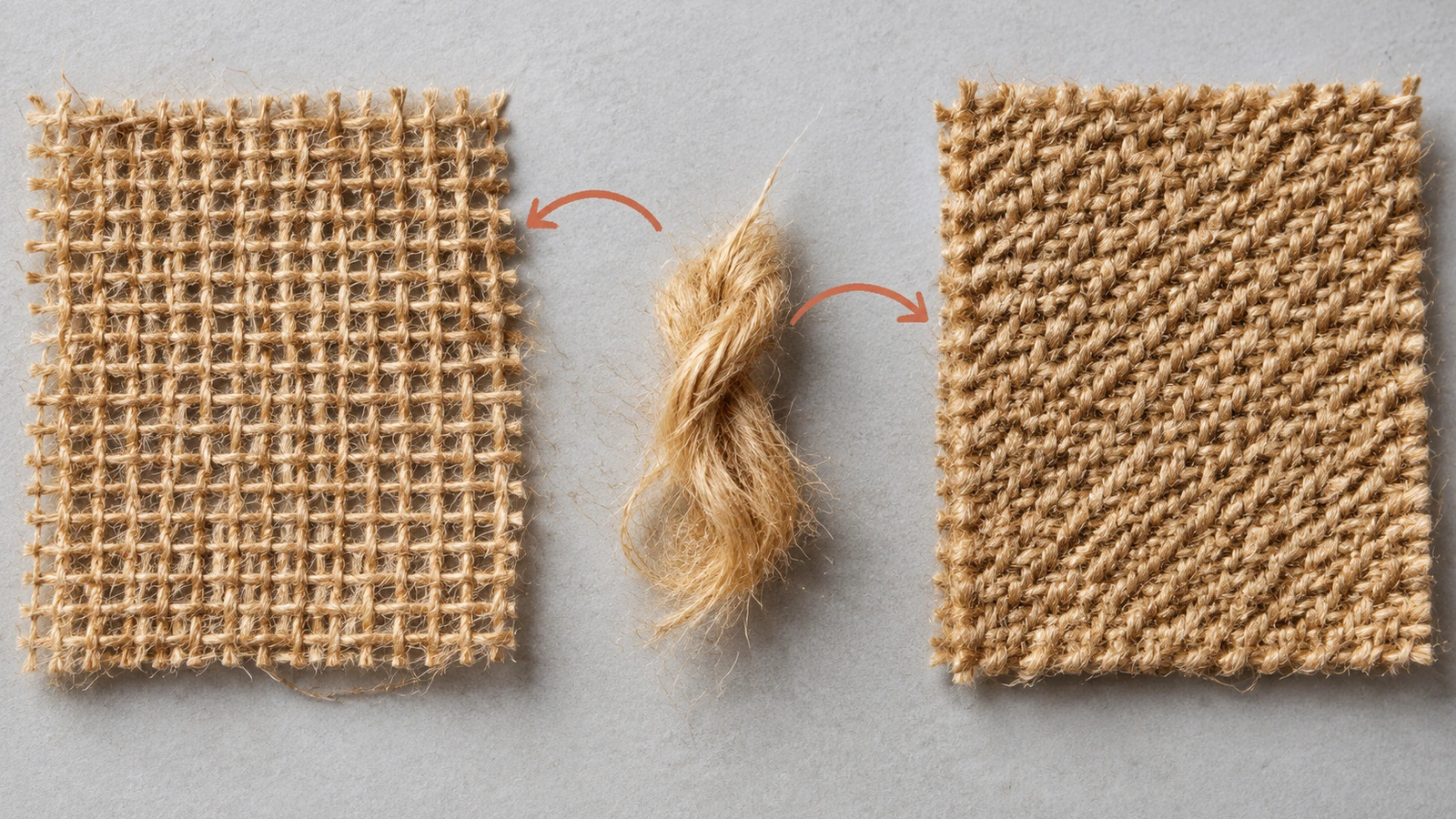
- Sacking is heavier jute cloth, often twill-woven or double-warp, made specifically for load-bearing bags.
- Gunny sack is the everyday name for the finished bag, derived from the Sanskrit word for a sack.
A true commodity sack is a rectangle of sacking folded and sewn on two sides, with an open mouth that is stitched shut with twine after filling. It has no handles, no lining and no print area beyond stenciled shipping marks. Everything decorative that buyers now call "jute packaging bags" grew out of this simple container.
How Jute Sacks Are Woven and Graded
Two separate grades decide how a sack performs: the grade of the raw fiber and the construction of the cloth.
Fiber grade. Indian standards grade raw jute separately for tossa (TD grades) and white jute (W grades) on a numbered scale, judged on strength, color, defects and root content. Higher grades spin into finer, more even yarn for hessian and decorative fabric. Lower grades and cuttings go into heavy sacking, where bulk matters more than appearance. This is why two bags described as "100% jute" can look and smell completely different.
Cloth construction. Mills describe jute fabric by "porter" (warp density) and "shots" (weft threads per inch), plus the fabric weight. The major families are:
- Hessian or burlap cloth, a plain weave that is lighter and more open, used for coffee-style sacks, wrapping and decorative bags.
- B-Twill sacking, a twill weave that resists seam slippage under load, the traditional choice for grain, sugar and similar heavy fills.
- Double-warp (DW) and heavy sacking, a dense construction used where fine powders must not sift through, such as flour.
Batching oil. Before spinning, jute is lubricated with an oil emulsion so the brittle fiber can be carded. Industry sources put the dose at roughly 5 to 8 percent of fiber weight. A petroleum-derived oil leaves the diesel-like odor buyers complain about. Food-grade sacks use vegetable oils instead, which is the point of the hydrocarbon-free specifications discussed below.
Moisture behavior. Jute absorbs water readily. Supplier data puts its moisture regain at about 13 to 15 percent, and one bag maker's in-house tensile test recorded a 57 percent loss in warp strength when samples were wet. This is a benefit and a risk at the same time: the fiber buffers humidity around beans and grain, but a sack left in a damp container or warehouse loses strength and can mildew.
Which Commodities Still Ship in Jute Sacks
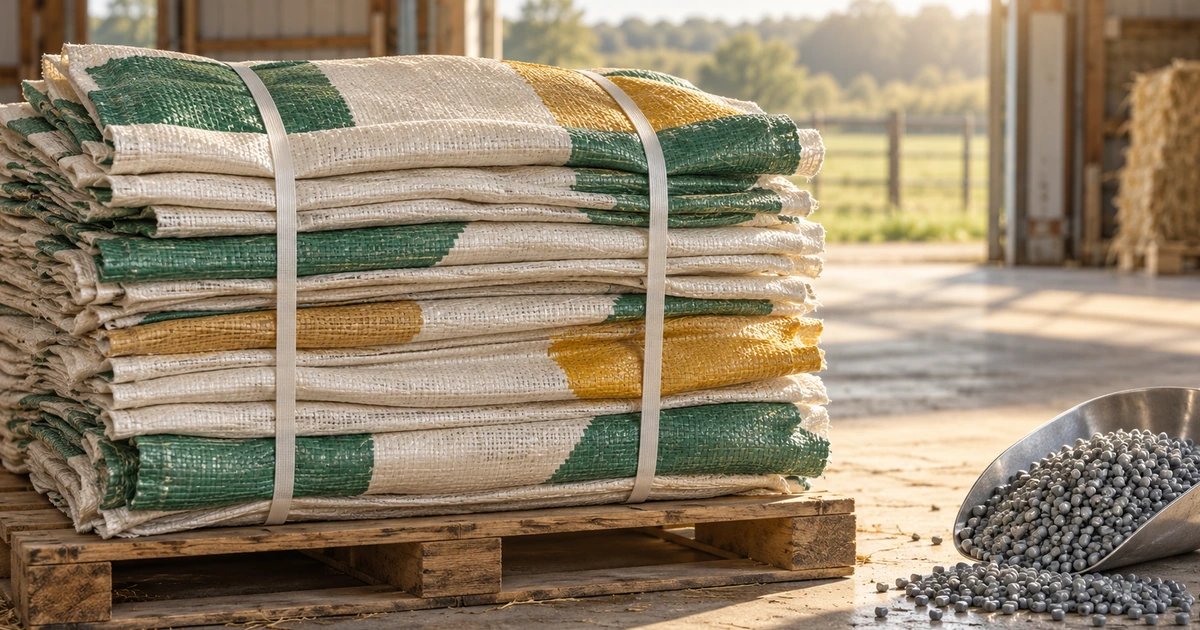
Woven polypropylene took over much of the cheap bulk-bag market decades ago, but jute holds on wherever breathability, grip and a natural material matter more than the lowest unit cost.
| Commodity | Conventional fill | Why jute is used | What buyers check |
|---|---|---|---|
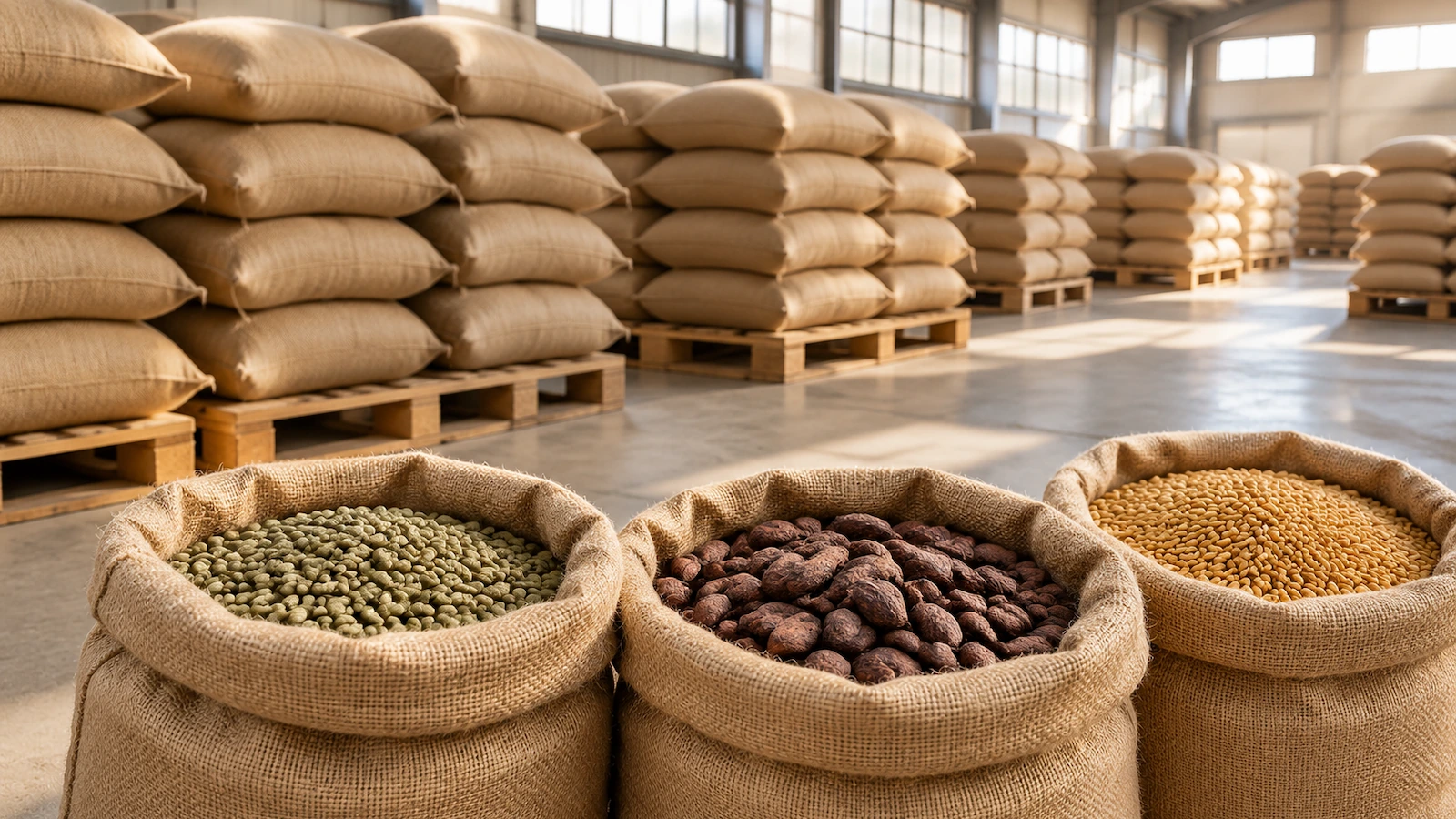
| Green coffee | 60 kg is the statistical unit; some origins ship 69–70 kg bags | Lets beans breathe in transit and storage; the stenciled sack identifies origin | Hydrocarbon-free oil, clean odor, origin marks |
| Cocoa beans | Roughly 60–65 kg | Breathability limits condensation during sea freight | MOSH and MOAH limits under the ECF/ECA specification |
| Shelled nuts | Varies by trade contract | Covered by the same food-contact jute rules as coffee and cocoa | Food-grade inks and oils |
| Grain, rice, sugar | Commonly 50 kg; heavier sacks also used in some markets | Twill sacking stacks stably and resists slipping on pallets | Sift-proof weave, seam strength |
| Potatoes, onions, root crops | Commonly 25–50 kg | Airflow reduces sweating and rot | Open weave, dry storage |
Fill weights are trade conventions, not guarantees. Always confirm the exact capacity and cloth construction with the buyer's contract or the exchange rules that apply to your lot.
The 2026 food-contact reset. For almost three decades, jute bags for cocoa, coffee and shelled nuts were governed by the IJO 98/01 standard. In 2026 the European Coffee Federation and the European Cocoa Association published a joint industry specification for jute bags and yarns[3] as its modern replacement. The specification requires every substance used in production to be food-grade and safe for food contact, including batching oils, emulsifiers, lubricants and printing inks. The cocoa version of the specification document[4], dated 9 February 2026, sets direct limits of 250 mg/kg for mineral oil saturated hydrocarbons (MOSH) and 25 mg/kg for mineral oil aromatic hydrocarbons (MOAH). The concern behind those limits is migration of oil residues into food, a risk the European Food Safety Authority reviews under its mineral oil hydrocarbons[5] work.
Demand is moving, not shrinking. Reuters reported in September 2026[6] that Bangladesh's jute and jute goods showed 22.26 percent cumulative growth between July and August 2026, as single-use plastic bans in markets such as the United Arab Emirates pushed buyers toward natural-fiber alternatives. The same report notes that EU rules now require EN 13432 certification before a product can be sold as biodegradable or compostable, so the fiber alone does not support those claims.
How to Specify a Jute Sack in Six Steps
A sack is cheap, but the contents usually are not. Writing these points into the purchase specification prevents most of the failures buyers report.
- Define the contents and fill weight first. A 60 kg coffee lot, a 25 kg potato pack and a 2 kg gift of roasted beans need different cloth. State the product, the fill weight, the bulk density and whether the contents are powder, granule or whole produce. Everything else follows from this.
- Choose the cloth family. Hessian for breathable, lighter loads and decorative use; twill sacking for heavy, stacked loads; double-warp where fine particles must stay inside. Ask the mill to quote porter, shots and fabric weight, not just "heavy jute."
- Specify the batching oil and food-contact status. For any food use, require vegetable batching oil and a laboratory report against the ECF/ECA limits or your buyer's own limits. A verbal "food grade" is not evidence. For non-food promotional sacks, a sealed-bag odor check on samples is still worth doing: close a sample in a bag for 24 hours, then open it and smell it.
- Specify seams, hems and closure. Field failures start at seams and corners, not in the middle of the cloth. Define the seam type, stitch density, hem at the mouth and the closing method (hand-sewn twine, machine-sewn, or drawstring for retail sacks).
- Fix the marking method. Commodity sacks carry stenciled or printed origin and lot marks. For food sacks, inks fall under the same food-grade requirement as the oil. For branded retail sacks, keep artwork bold: fine lines, small reversed text and gradients break up on coarse weave.
- Plan storage and transit. Ship and store dry, off the floor, away from strong odors. Jute absorbs smells from damp cartons and neighboring cargo. Write wet cartons, mildew spots and foreign odor into your inspection criteria as rejectable defects.
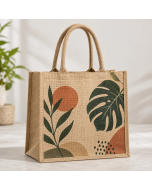
If your project is actually a carry bag for shoppers or event guests rather than a container for goods, the ordering process is different. That process is covered in detail on our logo-printed jute tote bag page.
Jute Sack vs. Polypropylene Sack vs. Jute Tote
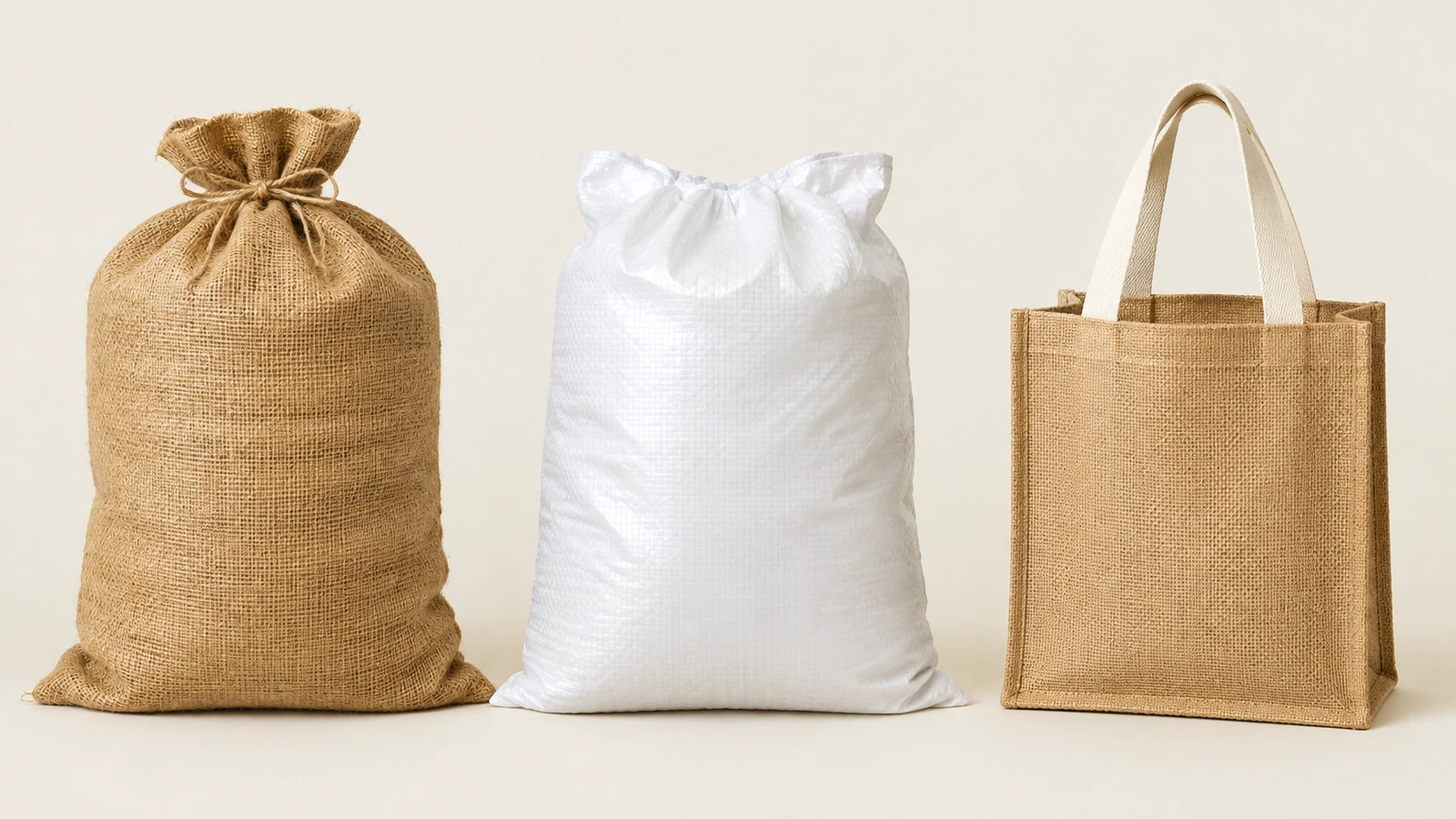
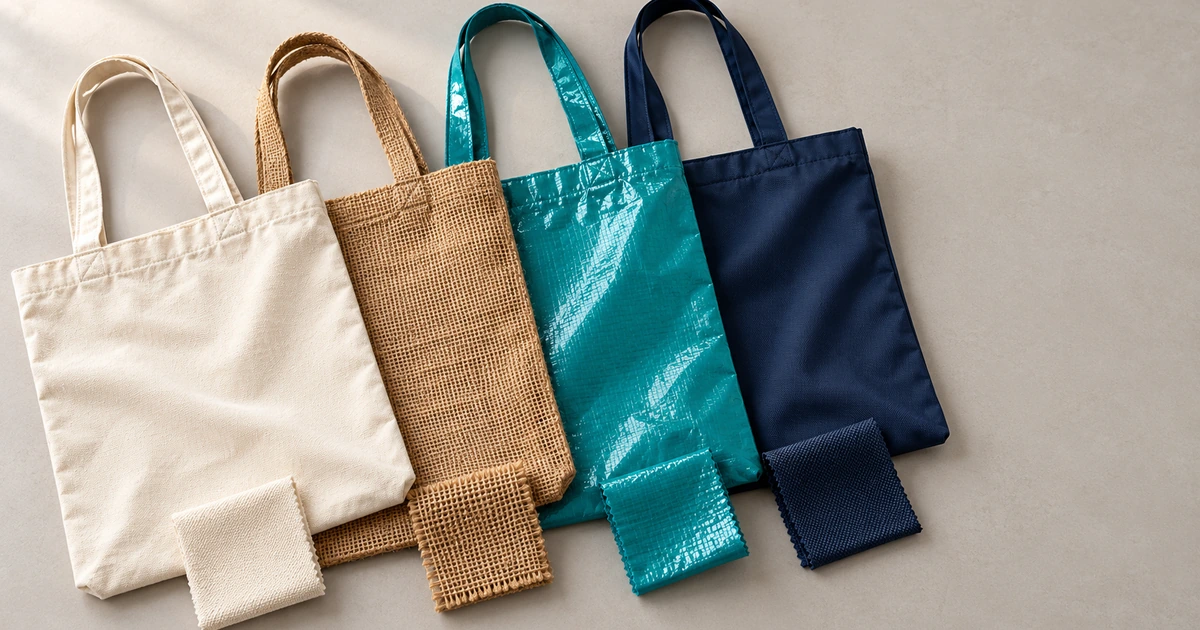
Buyers rarely choose jute in a vacuum. The realistic alternatives are woven polypropylene (PP) bulk sacks and, for branded uses, a jute tote.
| Factor | Jute sack | Woven PP sack | Jute tote |
|---|---|---|---|
| Primary job | Contain and ship goods | Contain and ship goods at the lowest cost | Be carried and reused by a person |
| Breathability | High; buffers humidity | Low unless perforated or mesh | Moderate; often laminated inside |
| Grip when stacked | Good; rough surface resists sliding | Slippery unless treated | Not designed for stacking |
| Moisture risk | Mildew and strength loss if left wet | Water-resistant | Depends on lining |
| End of life | Biodegradable when uncoated | Persistent plastic | Biodegradable fabric, but laminated linings are not |
| Branding surface | Stencils and bold one- to two-color marks | Printed film or flexo print | Screen print, transfers, patches |
| Food-contact risk | Batching oil residues unless specified hydrocarbon-free | Additive migration depends on resin grade | Usually not a food-contact item |
The carbon question depends on reuse. A 2025 life-cycle assessment from Bangladesh in Sustainable Production and Consumption[7] found that a single-use jute bag carries 313.41 g CO₂-eq against 56.7 g for a single-use LDPE bag, because the jute bag is much heavier. After ten uses, however, the jute bag performed better in most impact categories, and its littering-risk indicator was far lower. The practical conclusion for packaging buyers is that jute earns its environmental case through reuse, return loops and safe disposal, not through a one-trip shipment.
When a Branded Jute Sack Beats a Tote
A sack and a tote look related, but they answer different briefs. A sack holds a product. A tote is the product the recipient keeps carrying. Choose a branded jute sack when:
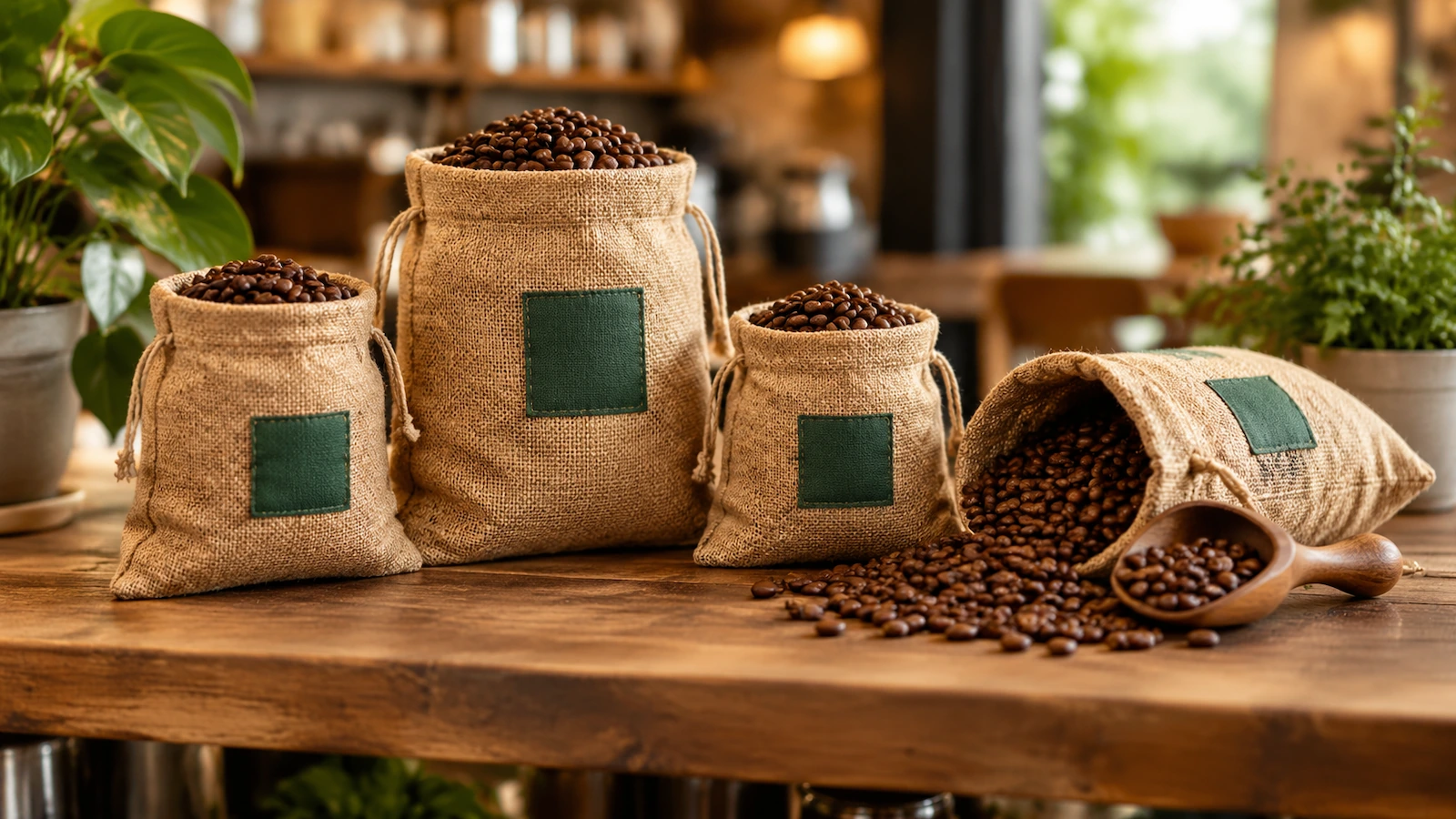
- The sack is the package. Roasters selling green or roasted beans, farm shops selling potatoes or rice, and gift-hamper makers use small drawstring or sewn sacks as primary packaging. The sack tells the origin story before the customer opens it.
- The display matters more than the carry. Open jute sacks filled with beans, grains or produce are a common retail and trade-show display, because the rough texture signals "straight from origin."
- The recipient will refill or repurpose it. A sturdy sack becomes storage for firewood, toys or garden bulbs, which supports the reuse case from the LCA above.
- Handles would be wasted. If the item is boxed, shelved or shipped rather than carried, handles add cost and stitching points without adding value.
Choose a tote instead when the recipient needs to carry things repeatedly, such as at a conference, in a store or at a farmers market. If a tote fits your brief, you can compare options on our custom jute tote page rather than adapting a sack.
Two cautions apply to both formats. First, if a branded sack will be sold or given away as a textile product in the US, claims such as "eco-friendly" need specific, provable support under the FTC's Green Guides[8]; our product page covers the labeling side for totes. Second, if the sack will hold food or be used by children, ask for test evidence. Certification such as OEKO-TEX STANDARD 100[9] screens textiles against a list of more than 1,000 harmful substances and must be renewed annually, but it is not a food-contact or biodegradability certificate.
FAQ
FAQ: Is a gunny sack the same as a burlap sack?
In everyday use, yes. "Gunny sack" is the common name for the finished bag, and "burlap" is the North American name for the woven jute fabric (called hessian in the UK). In trade, buyers distinguish lighter hessian from heavier twill or double-warp sacking, which matters for load and sifting.
FAQ: How much does a standard coffee sack hold?
Coffee statistics use a 60 kg bag as the standard unit, and many origins ship in 60 kg jute sacks. Some producing countries use 69 or 70 kg bags. Always confirm the capacity in the sales contract rather than assuming a size.
FAQ: Are jute sacks safe for food?
Only when they are made for it. Conventional jute may be processed with mineral batching oil, whose residues can migrate into food. For coffee, cocoa and nuts, the 2026 ECF/ECA specification requires food-grade oils, lubricants and inks, with cocoa limits of 250 mg/kg MOSH and 25 mg/kg MOAH. Ask for a lab report for each lot.
FAQ: Why does a new jute sack smell like diesel or earth?
A diesel-like smell usually comes from petroleum-based batching oil. An earthy or musty smell comes from the fiber itself or from damp storage. Airing the bags out reduces both, but a strong hydrocarbon smell is a sign the sack should not be used with food.
FAQ: Are jute sacks waterproof?
No. Uncoated jute absorbs moisture, loses strength when wet and can mildew in humid storage. Laminated linings add water resistance but also add plastic, which changes what you can truthfully claim about biodegradability.
FAQ: Can a jute sack be printed with a logo?
Yes, with limits. Bold one- or two-color marks, similar to traditional origin stencils, read well on coarse weave. Fine lines, small reversed text and photographic artwork break up. For detailed artwork, a smoother jute-cotton blend or a sewn-on cotton patch is the usual workaround.
Key Takeaways
- Raw jute is still traded and counted in bales. — 1 bale = 180 kg (Source)
- Food-contact jute now has hard mineral-oil limits for cocoa. — MOSH max 250 mg/kg, MOAH max 25 mg/kg (Source)
- The ECF/ECA specification replaces a standard in place since 1998. — IJO 98/01 governed coffee and cocoa sacks for nearly 30 years (Source)
- Jute's carbon case depends on reuse. — 313.41 g vs. 56.7 g CO₂-eq for single use; jute leads in most categories after 10 uses (Source)
- Demand for jute goods is rising as plastic bans spread. — 22.26% cumulative growth in Bangladesh, July–August 2026 (Source)
- Textile safety certificates do not cover food contact. — OEKO-TEX STANDARD 100 screens for 1,000+ substances, renewed yearly (Source)
Conclusion
A jute sack is a simple object with a demanding specification. Fiber grade, cloth construction and batching oil determine whether it carries a 60 kg coffee lot safely or tints the beans with a diesel note. Commodity buyers should write cloth type, seam construction, oil type and lab limits into every order. Brands borrowing the sack format for packaging or display should keep artwork bold, store the bags dry and back any environmental claim with evidence.
When your brief is a bag people will carry rather than a container for goods, a tote is usually the better tool. Tell us your use, artwork and target date, and we will help you choose the right format and send a quote based on your specification. You can start from our custom jute tote bags page.
Sources
- FAO. Jute, Kenaf, Sisal, Abaca, Coir and Allied Fibres Statistical Bulletin 2024. Rome, 2025. https://www.fao.org/3/cd5395en/cd5395en.pdf ↩
- Indian Jute Mills Association. Crop Production and Area. https://www.ijma.org/crop-production-area.html ↩
- European Coffee Federation. "ECF and ECA Publish Joint Industry Specification for Jute Bags and Jute Yarns in Cocoa and Coffee Supply Chains." 2026. https://www.ecf-coffee.org/ecf-and-eca-publish-joint-industry-specification-for-jute-bags-and-jute-yarns-in-cocoa-and-coffee-supply-chains/ ↩
- European Cocoa Association. MOH Specification for Jute Bags (Cocoa), 9 February 2026. https://www.eurococoa.com/wp-content/uploads/MOH-specification-jute-bags-cocoa_9-Feb-2026_FINAL.pdf ↩
- European Food Safety Authority. Mineral Oil Hydrocarbons. https://www.efsa.europa.eu/en/topics/topic/mineral-oil-hydrocarbons ↩
- Reuters. "How Jute, Bangladesh's 'Golden Thread', Could Replace Plastic." 22 September 2026. https://www.reuters.com/default/how-jute-bangladeshs-golden-thread-could-replace-plastic--ecmii-2026-09-22/ ↩
- Islam et al. Life-cycle assessment of jute and LDPE bags. Sustainable Production and Consumption, 2025. https://www.sciencedirect.com/science/article/pii/S2352550925000600 ↩
- U.S. Federal Trade Commission. Environmental Claims: Summary of the Green Guides. https://www.ftc.gov/business-guidance/resources/environmental-claims-summary-green-guides ↩
- OEKO-TEX. OEKO-TEX STANDARD 100. https://www.oeko-tex.com/en/our-standards/oeko-tex-standard-100 ↩






The information below is required for social login
Sign In
Create New Account