We use cookies to enable our websites to remember information, to help some website functionalities to work properly, to understand how you interact with and use our websites and to display you content and ads that are relevant and engaging for you.
By clicking Accept All you consent to the use of these cookie.
The store will not work correctly when cookies are disabled.
Quick answer: Choose a die-cut heart shaped pillow when the silhouette itself has to carry the message, as with a Valentine's hero product, a wedding keepsake or a get-well campaign. Choose a standard square throw with a heart motif when you need year-round flexibility, easy insert swaps and forgiving artwork. A die-cut heart prints on only about two-thirds of its bounding rectangle, so faces, logos and text need a dieline with seam and safe lines before any art is approved.
A heart shaped pillow looks like the easiest seasonal SKU a brand team can add. It needs no explanation, it photographs well, and it works for Valentine's Day, weddings, Mother's Day and memorial gifting. It is also one of the hardest shapes in soft goods to get right. The curves, the cleft between the lobes and the narrow point each behave differently once fabric is sewn and fiberfill goes in.
The failure patterns in public buyer reviews repeat. Hearts that "looked like a circle," names swallowed by the cleft, faces clipped at the lobes, text landing in a seam crease, and pillows that look flatter and smaller than the listing photo. One marketplace analysis of couple-themed heart pillows attributed roughly 69% of negative feedback to size not matching expectations. Few of these failures come from the print method. Most come from planning decisions made before the artwork was ever placed.
This guide covers those planning decisions: when to use a die-cut heart and when to use a heart motif on a standard throw, how to set silhouette proportions and size tiers, where the artwork safe zones sit around curves and seams, and how each format performs in retail displays, hospitality decor and year-round promotional lines. If you are ready to plan a personalized gifting run, our custom heart pillows for Valentine's Day and keepsake gifts page covers ordering, print methods and fabric options.
What Is a Heart Shaped Pillow, and How Is It Different From a Pillow With a Heart?
The category name hides two different products, and merchandise plans go wrong when teams treat them as one.
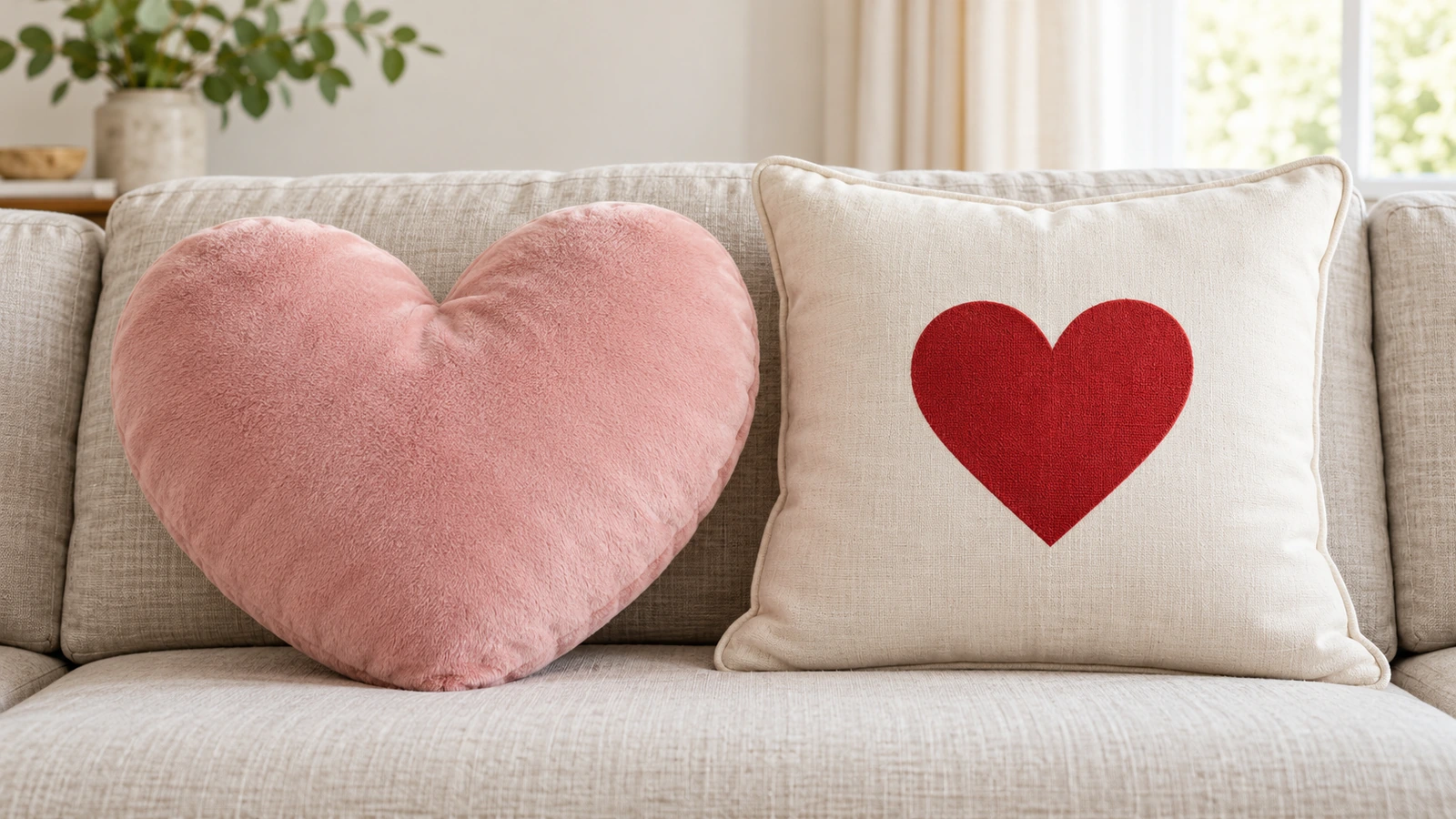
A die-cut heart shaped pillow is cut and sewn along a heart outline, so the heart is the object. It comes in two constructions. A knife-edge heart has two heart panels sewn directly together. It puffs into a soft dome, and its visible flat face shrinks as it fills. A boxed or gusseted heart adds a side band between the panels. That keeps the front face flatter and gives the pillow a defined profile that stands upright on a shelf.
A heart motif throw pillow is a standard square or rectangular pillow that carries a heart as a printed graphic, an all-over heart pattern, embroidery or an appliqué. The heart is the message, but the object is a normal throw. In practice, a heart pattern pillow fits into existing cushion assortments, uses standard inserts and reads as decor first and gift second.
The distinction matters because each format moves risk to a different stage. With a die-cut heart, the risk sits in pattern making, filling and artwork placement. With a heart motif throw, the shape is solved, so the risk shifts to art direction and to whether the design still feels right outside February.
How to Plan a Heart Shaped Pillow Program in Eight Steps
Step 1: Name the job the pillow has to do
Write one sentence before choosing a format. "Seasonal traffic driver on a February endcap" leads to different decisions than "keepsake that carries a family photo for years" or "suite accent that housekeeping launders weekly." The first rewards a bold silhouette. The second rewards print area and durability. The third rewards removable covers and standard inserts. If one SKU is expected to do all three jobs, it usually does none of them well.
Step 2: Choose the format against that job
Use a die-cut heart when the outline has to be recognized from across a room or in a thumbnail. Use a heart motif throw when the pillow has to sit in a coordinated set, needs frequent laundering, or has to stay on display beyond one holiday. Many brands run both: a die-cut hero for the peak season and a heart motif cover that rotates into everyday decor.
Step 3: Set silhouette proportions
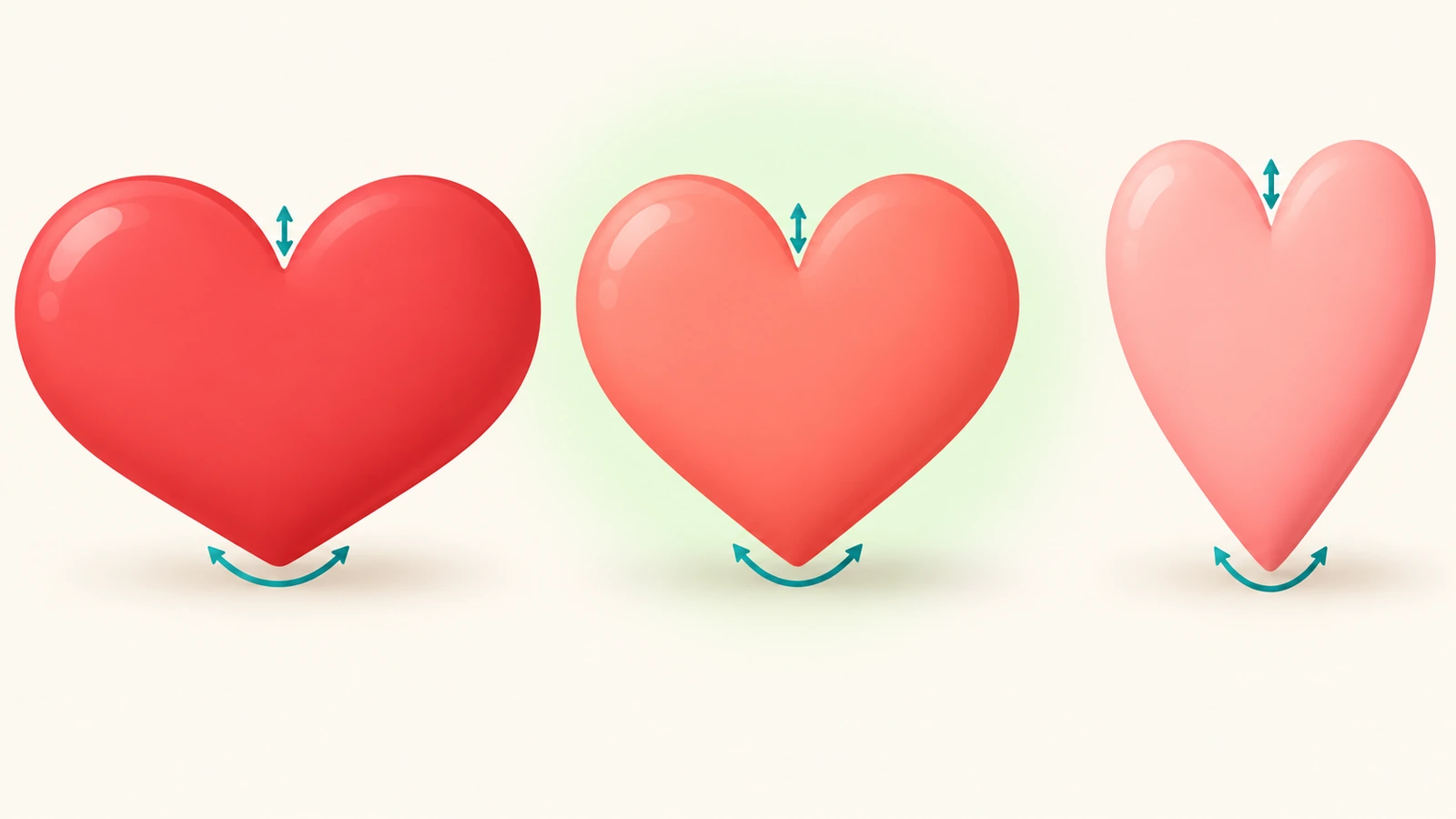
Heart proportions drive both shelf appeal and print yield. Public listings for die-cut hearts that we reviewed cluster between about 1.1:1 and 1.35:1 width to height. A wider heart reads as plush and huggable and gives more horizontal room for two faces or a couple's names. A taller heart reads more elegant but narrows the usable zone across the middle.
Three geometry choices decide whether the finished pillow still looks like a heart:
Cleft depth. A deep, narrow cleft looks crisp on paper but puckers when sewn and leaves a fiber gap where the lobes meet. As a rule of thumb, keep the cleft shallow to moderate, around a tenth to a sixth of the total height, with a rounded inner curve rather than a sharp V.
Lobe roundness. Full, round lobes keep their shape after filling. Flat-topped lobes slump, and the heart drifts toward the circle shape reviewers complain about.
Point radius. A needle-sharp point can't be filled and collapses into an empty flap. Give the point a small radius so fiberfill can reach it, and specify that the corner is turned fully before stuffing.
Step 4: Plan size tiers by role, not by number
Size complaints rarely mean the measurement was wrong. They usually mean the buyer pictured something different. A heart is measured across its widest and tallest points, but its visible mass is far smaller than a square of the same nominal size, because the area outside the curves is empty. A heart fills roughly two-thirds of its bounding rectangle, and filling then rounds off the face further. A heart and a square with the same listed dimensions will therefore never look the same size side by side.
Plan tiers by role:
Accent tier: a palm-to-lap heart for gift bags, shelf styling, dorm rooms and add-on purchases. Keep artwork simple, with a name, a single icon or a pattern, because there is little room inside the safe zone.
Companion tier: a heart sized to sit in front of standard sofa or bed throws. This is the workhorse for photo and name personalization.
Always show each tier beside a familiar reference object in product photography, such as a standard throw, a hand or a book. Don't rely on a dimension line alone. For exact tier dimensions on a specific run, request a quote and a dieline from your supplier instead of copying sizes from marketplace listings.
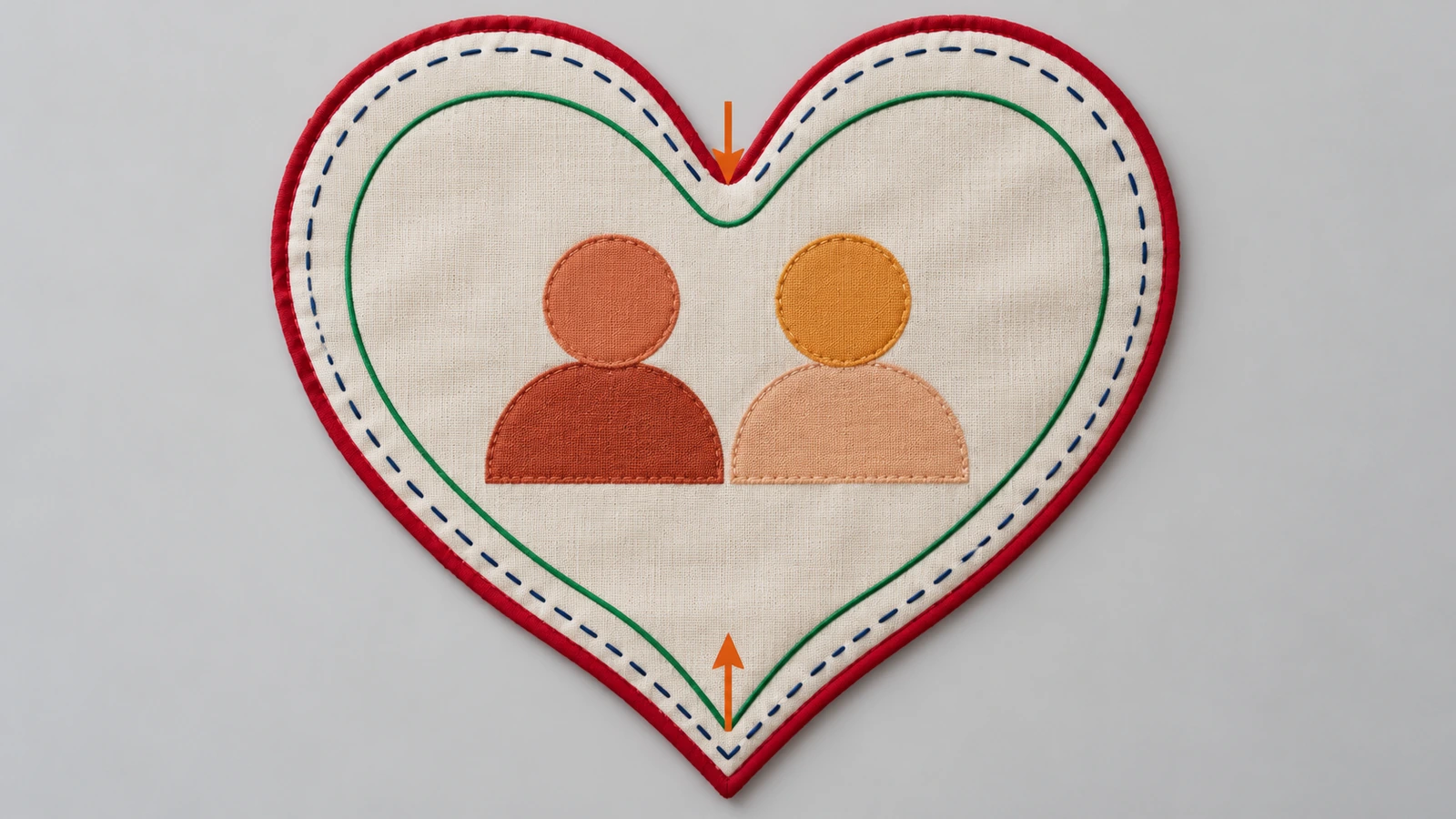
Step 5: Build the dieline with three nested lines
Every heart artwork file should start from a dieline with three outlines, not a square canvas with a heart drawn on top.
Cut line: where the fabric panel is cut. Artwork should bleed past it so no white edge shows if the cut drifts.
Seam line: where the stitch runs, typically about 0.4–0.6 in (1–1.5 cm) inside the cut. Anything between the cut and the seam disappears into the seam allowance.
Safe line: a further 0.5–0.75 in inside the seam. Beyond this line, curvature, fill and the roll of the edge distort or hide detail.
On a heart, the safe line should not follow the outline evenly. Pull it further inward at the cleft, where the fabric folds into the dip, and at the point, where the panel narrows and rolls under. A uniform offset is the most common reason names and chins get clipped even when the proof looked fine.
Step 6: Place artwork for curves, not corners
Faces and focal points. The visual center of a heart sits above its geometric center, because the lobes carry most of the mass. Place faces in the upper-middle band, between the lobes and below the cleft, and never inside either lobe edge. Two-person photos work best when the subjects are close together and centered. Wide group shots lose people at both sides.
Resolution. Fabric softens detail, so budget 150 pixels per printed inch as a floor and 300 pixels per inch for anything viewed up close, such as faces and small type. Screenshots and chat-app forwards are usually compressed far below that.
Text. Straight horizontal lines of text fight the shape. Set short names across the widest band, or arc longer messages along the lobe curves inside the safe line. Keep text out of the cleft and away from any gusset fold, because type that lands in a crease is unreadable once the pillow is filled.
Logos. For branded or promotional hearts, put the logo low and centered on the reverse panel, or small in the lower-middle of the front. A large logo across the front turns a gift into an ad and lowers the chance the pillow stays out on display.
Patterns. All-over heart patterns are the most forgiving artwork on a die-cut heart, because nothing is lost when an edge shifts. On a square heart motif throw, a centered heart graphic needs only a standard square safe zone, which is why this format tolerates looser art direction.
Double-sided art. Register front and back on the cut panels before sewing, so the two hearts line up at the seam instead of meeting with a visible offset.
Step 7: Decide closure, insert and label position early
Hearts have almost no straight edge, so zipper openings on a die-cut heart tend to be short. Short openings make it hard to remove and refit the insert. For removable covers, put the zipper along the flattest stretch of the lower curve, or use a boxed construction with the zipper in the gusset. For sewn-shut keepsakes, make sure the care claim on the label matches what the finished pillow can actually survive.
Step 8: Approve a physical sample against a shape checklist
A screen mockup cannot show how a heart behaves once it is filled. On the sample, check that the two lobes are symmetrical, the point is fully filled, the cleft has no fiber gap or pucker, front and back art are registered, no text sits in a seam or crease, and color matches the approved proof under daylight-balanced light rather than warm room light. Photograph the approved sample from the front and in profile. That image, not the digital render, becomes the production standard.
Die-Cut Heart Shaped Pillow vs. Heart Motif Throw: Side-by-Side Comparison
Factor
Die-cut heart shaped pillow
Square throw with heart motif
Message carried by
The silhouette itself, recognizable at a glance
The graphic, pattern or embroidery
Usable print area
About two-thirds of the bounding rectangle, minus seam and safe margins
Nearly the full face, minus a standard margin
Artwork risk
High: cleft, lobes and point clip faces and text
Low: edges are straight and predictable
Insert
Shape-specific insert or sewn-in fill
Standard square insert, easy to source and swap
Laundering
Harder: short zipper openings or sewn-shut construction
Easier: removable covers are the norm
Shelf behavior
Leans and stacks poorly; strong as a face-out hero
Stacks in cubes and pairs with existing throws
Seasonal flexibility
Strongest around Valentine's Day, weddings and keepsakes
Works year-round when the palette rotates
Best for
Hero SKUs, photo keepsakes, get-well and charity campaigns
How Each Format Performs in Retail, Hospitality and Promotional Lines
Retail displays
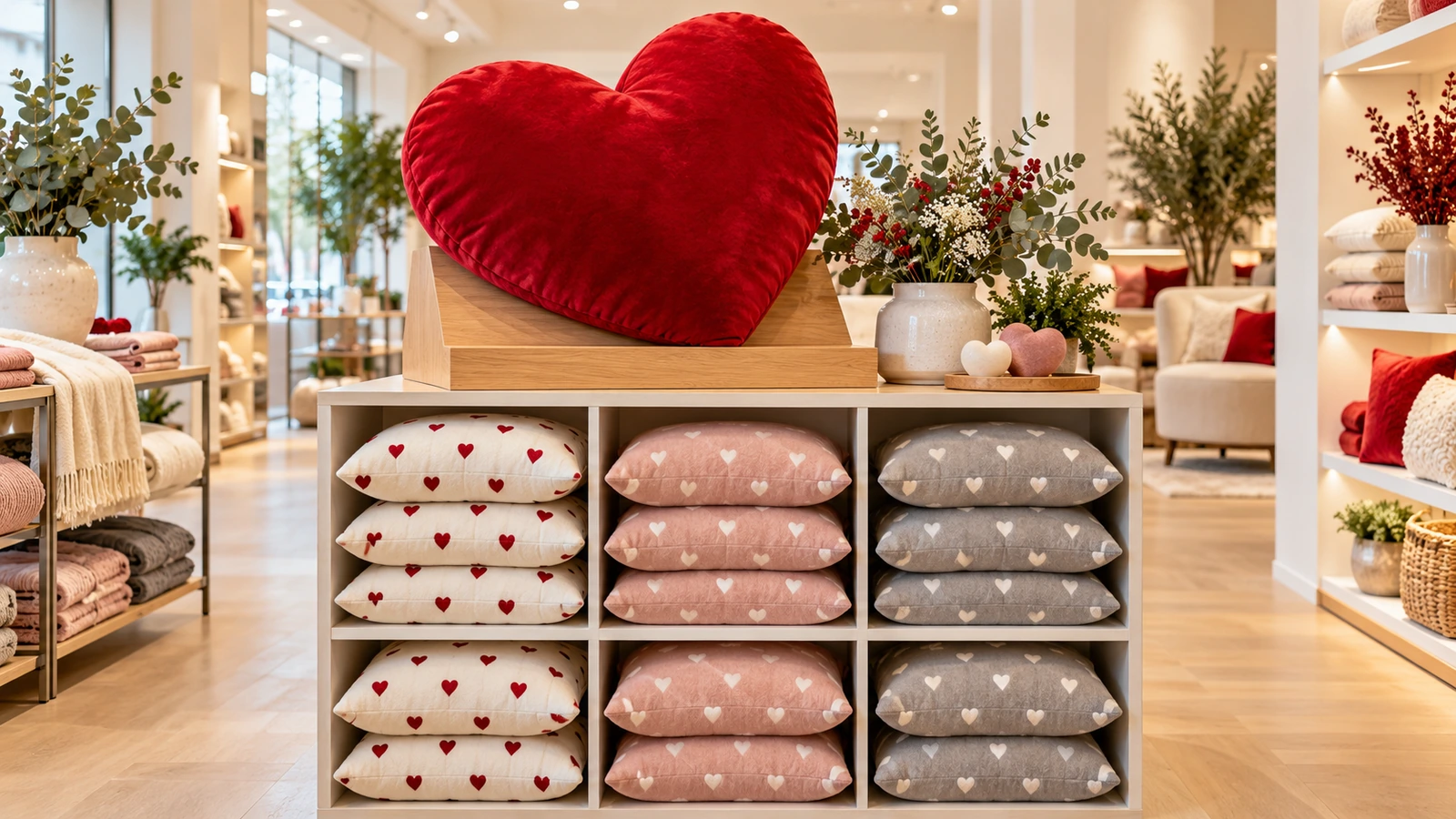
In-store, a die-cut heart works as a signal. One oversized heart on an endcap tells shoppers the seasonal set has arrived before they read any signage. The trade-off is space. Hearts lean when stood upright, waste the corners of cube shelving, and nest poorly when stacked. Plan easels, a tilted riser or a lying-down pyramid stack instead of the vertical rows used for squares.
Heart motif throws merchandise like any cushion. They stack, fill a bay neatly, and can be sold as a pair with a plain coordinating square. They are the safer choice when one fixture has to stay in place from late January through Mother's Day.
For either format, allow recovery time after unboxing. Vacuum-packed polyester-fill pillows arrive flat and need fluffing before they look like the photo. Buyers have mistaken a flat package for a cover with no insert, and gift reviewers mention having to reshape the pillow before presenting it. Build that step into store setup instructions.
Hospitality decor
Hotels, rentals and event venues judge pillows by laundering cycles and replacement logistics as much as by looks. A square heart pattern pillow with a removable cover and a standard insert slots straight into existing housekeeping routines. Covers go to the laundry, and inserts are swapped from common stock. For the inserts themselves, consumer care guidance for polyester-filled pillows suggests washing once or twice a year and drying completely on low to medium heat[5], so plan cover-only laundering between those washes.
The heart silhouette reaches well beyond February, and that is what makes a year-round line possible. Demand still has clear peaks. One marketplace keyword tracker recorded photo pillow searches peaking at about 18,100 a month in December 2025 and sliding to about 5,400 a month from May to July 2026. Plan production and artwork releases around winter gifting, Valentine's Day and Mother's Day, and keep the summer slot for weddings.
Between peaks, the heart carries other meanings that brands can design for:
Weddings and anniversaries: names and established dates, in palettes matched to wedding colors rather than Valentine's red.
Memorial and pet-loss keepsakes: soft neutrals, a single photo and generous safe margins, because these orders are the least forgiving of a clipped face.
The efficient structure is one approved dieline per size tier with rotating artwork. You validate the shape once, then refresh the art each season. On the square side, a single insert stock can serve several seasonal cover designs.
FAQ: Is a heart shaped pillow or a heart motif throw better for a year-round product line?
A heart motif throw is usually better for a year-round line. It uses standard inserts, fits existing cushion assortments and changes seasons with a palette swap. Add a die-cut heart as the hero piece for peak periods, and reuse one approved dieline so each season only needs new artwork.
FAQ: How much of my artwork will actually show on a die-cut heart?
A heart fills roughly two-thirds of its bounding rectangle. Seam allowance of about 0.4–0.6 in and a safe margin of 0.5–0.75 in then reduce the usable area further, and the margin should be deeper at the cleft and the point. Design inside the safe line, and let background color or pattern bleed past the cut line.
FAQ: Where should faces and logos go on a heart pillow?
Put faces in the upper-middle band, below the cleft and between the lobes, because that is the visual center of the shape. Put logos low and centered on the back panel, or small in the lower-middle of the front. Never place faces, names or logos inside the lobe edges or the point.
FAQ: Can hotels and venues launder heart pillows easily?
Square heart pattern pillows with removable covers are the easiest option, because covers go to the laundry and standard inserts are swapped from stock. Die-cut hearts often have short zipper openings or sewn-shut construction, so keep them as occasion pieces for honeymoon or Valentine's packages, or specify a boxed heart with the zipper in the gusset.
FAQ: Why does a heart pillow look flat or small when it arrives?
Polyester-fill pillows are often vacuum-packed and need fluffing before they reach full shape. A heart also looks smaller than a square with the same listed dimensions, because the space outside its curves is empty. Show size tiers next to a familiar object in photos, and include fluffing in display setup instructions.
FAQ: Can a personalized heart pillow be sold for a nursery?
Only as decor. Federal rules treat decorative nursery pillows personalized with a baby's name as outside the infant support cushion rule only while they are not marketed, designed or intended for infant use. Keep sleep, support and nursing language out of listings. Our product page covers the applicable US labeling and safety rules in detail.
Key Takeaways
US fiber labels must list every fiber at or above a weight threshold, so plan label space in the seam. — 5% by weight (Source)
Decorative pillows sold in California carry a specific law label format. — Type No. 1 label (Source)
Decorator pillows may omit size on the California law label, but not the filling information. — 4 CCR § 1126(c)(9) (Source)
Decorative pillows sold separately are outside the federal upholstered furniture flammability standard. — 16 CFR 1640 (Source)
Name-personalized nursery heart pillows stay outside the infant support cushion rule only while not marketed for infant use. — 16 CFR Part 1243, final rule published 2024-11-04 (Source)
Hospitality teams should launder covers often and wash polyester inserts sparingly. — 1–2 insert washes per year (Source)
Conclusion
The heart shape forgives nothing at the planning stage. Pick the format for the job: a die-cut heart when the silhouette is the message, and a heart motif throw when the pillow has to live in a set, survive housekeeping or stay out all year. Then fix proportions, size tiers and a three-line dieline before anyone opens a photo. Most "it doesn't look like the preview" complaints are decided in those steps, long before printing starts.
If you are planning a Valentine's, wedding or keepsake run and want a dieline, safe-zone template and sample review for your artwork, see our custom heart pillows and request a quote with your target quantities, sizes and in-hand date.
Hi there! I'm Bruce, proud dad to my amazing son. I'm the founder of Zigpac, a printing and packaging company empowering small and medium-sized businesses with custom solutions. Let's create something great together!



 Blog PDF for offline reading












The information below is required for social login
Sign In
Create New Account