We use cookies to enable our websites to remember information, to help some website functionalities to work properly, to understand how you interact with and use our websites and to display you content and ads that are relevant and engaging for you.
By clicking Accept All you consent to the use of these cookie.
The store will not work correctly when cookies are disabled.
Quick answer: A trustworthy poker chips website shows you how it works before it takes your money. Look for five things: a written proof-and-approval workflow, published artwork upload specs, a clear sample policy, minimum order rules stated per design, and a production description that names the molding method instead of just saying "clay." If any of these are hidden behind a checkout button, request them in writing. If the supplier won't put them in writing, move on.
If you buy chips for a club series, a charity casino night or a corporate gift run, your first contact with a supplier is almost always its poker chips website. That makes the website your first piece of evidence. Most buyers, though, judge it on mockups and star ratings, and those are the two things that predict production quality least.
The cost of getting this wrong is specific and well documented. Hobbyist forums and review platforms keep recording the same failures. Designs get printed visibly off-center and the end client rejects the whole order. Chips sold as "clay" turn out to be injection-molded plastic with a metal slug and a sticker. Event orders arrive the evening after the tournament starts. And custom orders are almost always non-returnable, so once you approve a proof, every one of these problems becomes yours.
The good news is that most of these failures can be predicted from the website itself. Real manufacturers, contract printers and resellers leave different traces in their copy, their upload rules and their policies. This guide gives you a seven-check audit you can run in about 30 minutes, a comparison table for telling supplier types apart, and a list of red flags that justify closing the tab.
What Counts as a Trustworthy Poker Chips Website?
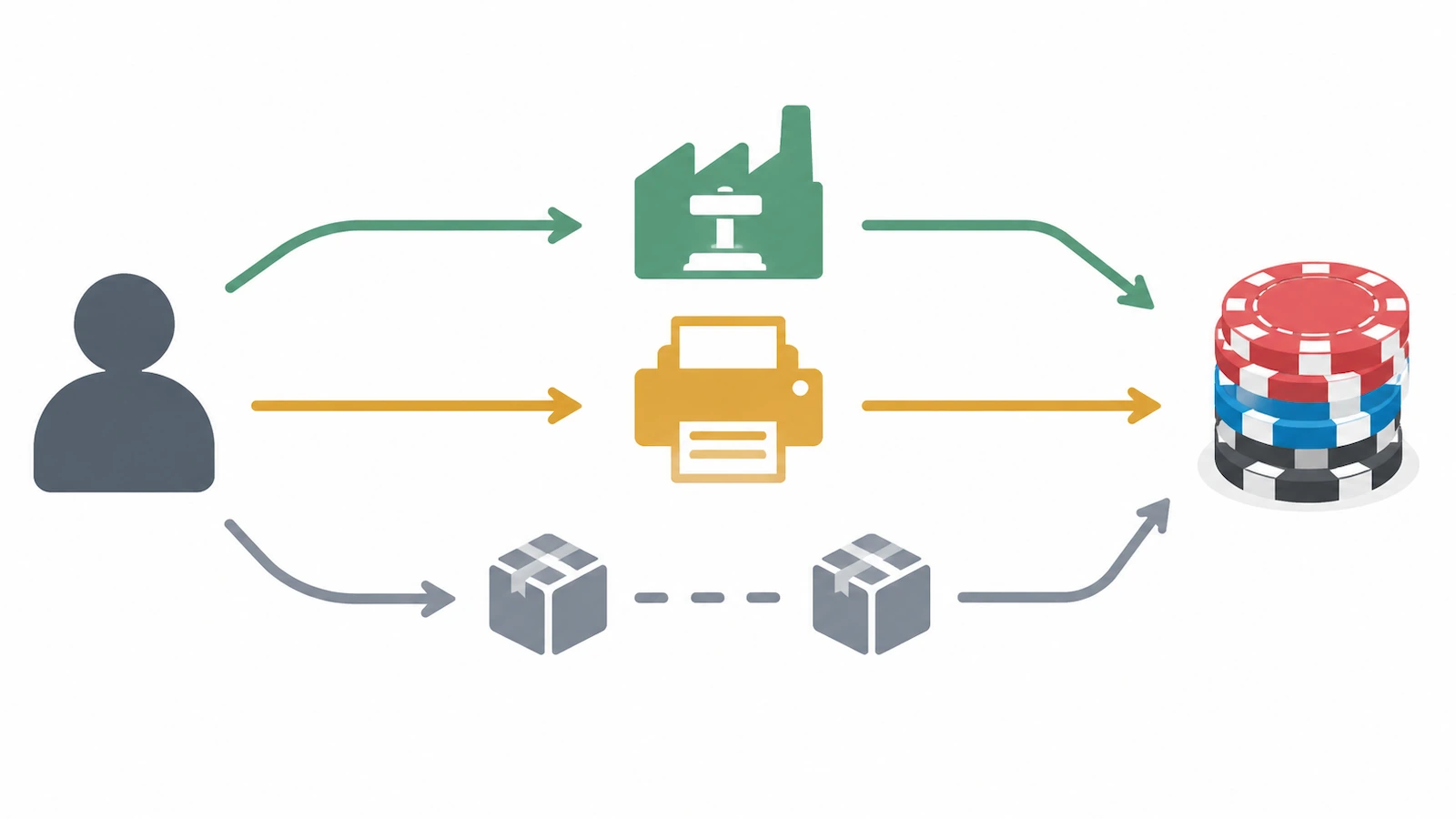
For a business buyer, a trustworthy site is one where every promise can be traced back to a process. It does not need to be the best-designed site in search results. Behind most custom chip storefronts sits one of three business models, and each one carries a different level of risk.
Manufacturer: owns the molds, presses or printing line. It can tell you which mold produced your edge pattern and who on staff signs off the proof.
Contract printer or converter: buys blank chips and decorates them with stickers, hot stamps, UV direct print or dye-sublimation. It controls the artwork but not the chip body.
Reseller or dropshipper: passes your file to someone else. It controls neither the body nor the print, and it often cannot answer process questions without forwarding them.
None of these models is automatically bad. A reseller can be the right choice for a 100-piece promo run. The problem starts when a reseller writes copy as if it were a factory. Then you price, schedule and accept the order on assumptions that nobody in the chain is actually responsible for.
How to Audit a Poker Chips Website in Seven Checks
Run these checks in order. The first three can be done from the public pages alone. The last four usually need one email, and how the supplier answers that email is itself evidence.
If you want the full breakdown of what "clay" means on a quote, the custom clay-composite poker chip spec guide covers it. For this audit you only need a yes or no answer: does the site state the method in writing, or only describe the feel?
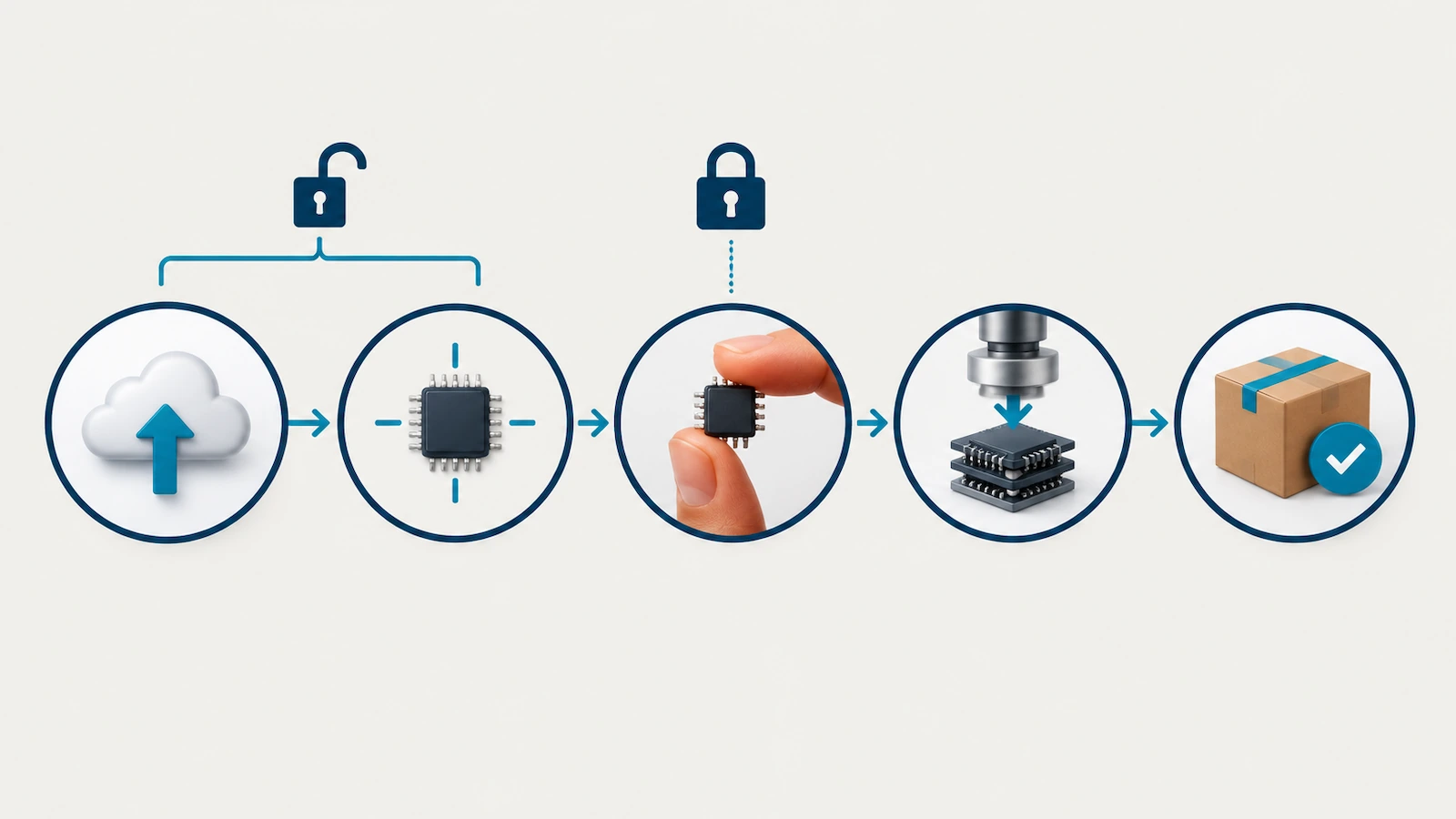
2. Trace the proof workflow from upload to sign-off
A serious supplier explains what happens between your upload and the press. That means who prepares the proof, what file format it arrives in, how many revision rounds are included, and the exact moment the spec is locked. The most useful sentence you can find on any site is a version of "nothing is locked until you approve the final proof," followed by a description of what approval covers: colors, centering, denomination text and edge pattern.
Check whether the proof shows the chip at actual size next to the edge pattern, or only as a flat logo on a colored circle. A flat logo proof cannot reveal the most common complaint, which is artwork that drifts off-center relative to the mold. Ask whether the proof includes a centering tolerance. If the answer is "we'll do our best," write your own tolerance into the order.
3. Test the artwork upload specs
Upload rules show what the production line can actually reproduce. Useful specs give you all of the following:
accepted file types (vector or high-resolution raster)
printable area as a diameter, kept separate from overall chip diameter
a safe zone near the edge
minimum line weight and text height
how spot colors are matched to the chip body
A site that only says "upload your logo" either reworks every file manually (slow) or prints whatever it receives (risky).
Pay particular attention to color. Screen colors rarely match a pigmented chip body. Better suppliers say this outright and point you to a physical color reference instead of promising a match to your brand hex code. If the site promises that, treat it as marketing copy, not a production commitment.
4. Read the sample policy before you read the reviews
A widely shared 2023 community buying guide[3] puts it as a hard rule: buy samples before a whole set, because chips look and feel different in hand than online. A supplier's sample policy tells you how confident it is in its own product.
Find out which sample types are available. Stock-mold color samples show body color and edge pattern. Printed samples show decoration quality. A pre-production sample from your actual order shows whether the line can hit your spec. Then ask whether the cost of a paid sample is credited against the bulk order.
Once samples arrive, measure them instead of admiring them. Weigh 10 chips on a kitchen scale and note the spread. Stack 20 chips and check whether the column leans. Look at the inlay or print edge under a desk lamp to see whether it sits flush. Compare two candidates under the same light, on the same felt, in the same session. Do not pay a production deposit until a sample has passed these checks.
5. Make MOQ and design-count rules explicit
Minimum order quantity on its own is not enough information. What matters is how many distinct designs, denominations or colorways that minimum covers, and what happens when one denomination falls below a threshold. Some production methods charge per unique chip because every new color or edge pattern means a mold or tooling changeover. A clear site states the rule, for example "X unique designs per Y chips." A vague site states a single number and leaves the surcharge for the invoice.
Check for consistency as well. Researchers comparing supplier pages found sites whose FAQ and pricing table listed different minimums for the same product. If one site gives two minimums, the checkout cart is the only number that counts. Get that number confirmed by email before you design around it. For a quote on our own clay-composite line, send your denomination breakdown through the custom clay poker chips page rather than relying on a generic figure.
6. Verify factory credentials and any "casino" claims
Start with the basics. Is there a physical address you can find on a map? Are there photos or video of the actual process, such as presses, molds, print heads or inspection tables, rather than stock casino imagery? Is a named person responsible for quality?
Then check the specific claims against primary sources:
"Casino size": Nevada's Regulation 12, §12.040[4] requires licensed casino chips to be disk-shaped, 0.130 inch (3.30 mm) thick and 1.55 inches (39.37 mm) in diameter for most games. New Jersey's value-chip rule[5] specifies 1-9/16 inches. Neither rule sets a weight or a material formula, so a site claiming "regulation 11.5 g casino weight" is citing a standard that does not exist.
"Certified" or "lab-tested durability": ask for the standard number and the test report. Our research found no published ASTM or ISO product standard for poker chip durability, so impact-cycle figures on sales pages are the supplier's own ratings.
RFID or "security" chips: ask which air-interface standard the tag uses. Casino RFID chip patents such as US20250117614A1[6] reference ISO/IEC 18000-3 Mode 2 at 13.56 MHz. A supplier that cannot name a standard is selling a decorative feature, not a security one.
Kids' sets: if chips will be marketed to children 12 and under, the CPSC total lead limit of 100 ppm[7] for accessible substrate applies, along with a separate 90 ppm limit for paint and surface coatings. Ask for a Children's Product Certificate. Adult game-night chips usually fall outside this rule, so a supplier that waves a CPSIA badge on an adult product is padding its credentials.
One more thing to keep in mind: custom home chips are not casino gaming instruments. In October 2026, BJ21 reported[8] that Las Vegas poker rooms were tightening cross-property chip redemption on anti-money-laundering grounds. A supplier offering to "replicate" a working casino's chips is a legal risk, not a selling point.
7. Stress-test after-sales, shipping and capacity
"Custom orders are non-returnable" is standard and fair. What you need is the exceptions written down: misprints outside an agreed centering tolerance, wrong color codes, short counts, transit damage and missed written ship dates. A supplier that won't list any exceptions is asking you to carry all of its production risk.
Ask about capacity in plain terms: how many orders are in the queue right now, and what happens to your slot if the factory is disrupted? This is a real risk, not a theoretical one. In June 2025, the Portland Press Herald reported[9] that a US chip plant relocating across the country expected "three to five more months" just to clear its existing orders. Websites rarely update lead-time banners when something like this happens, so get the current queue in an email, dated.
Finally, ask how the chips will be packed. Brittle, low-grade "clay" chips have arrived cracked when cushioning was placed on only one side of the carton, and community members have documented budget clay chips that shattered on their first drop onto soft flooring after long storage[10]. Request double-sided suspension packing, and agree on a 48-hour window for reporting transit damage with photos.
Manufacturer, Printer or Reseller: Side-by-Side Signals
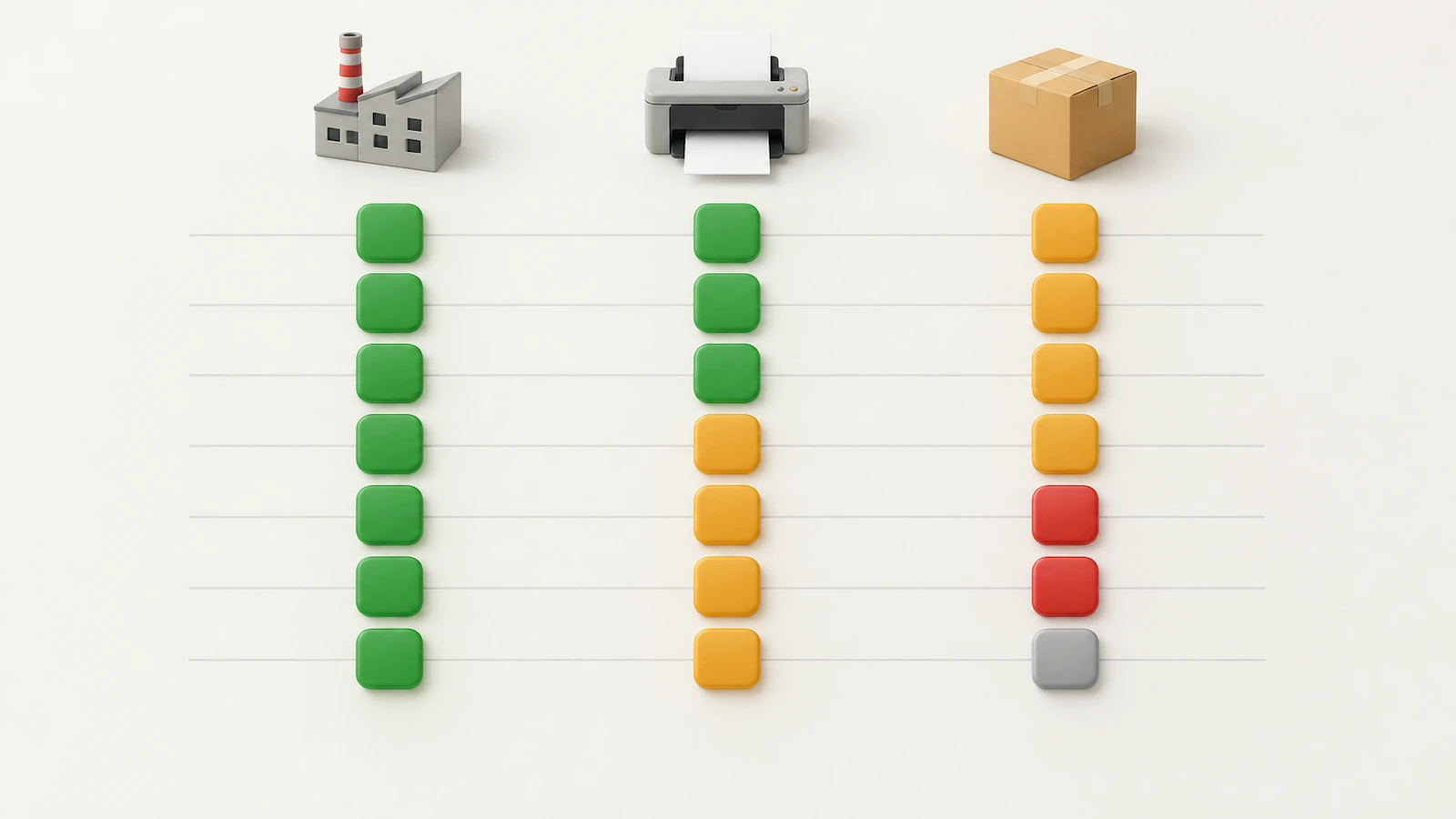
Use this table to classify a supplier before you compare prices. A price comparison only means something when both quotes come from the same row.
Signal on the website
Likely manufacturer
Likely printer/converter
Likely reseller
Molding method stated
Names compression or injection, insert or none
Names the print method, vague on the body
Uses "clay," "casino weight," "premium"
Proof workflow
Proof at actual size with mold edge, named approver
Flat artwork proof, fast turnaround
"Design tool" preview only
Upload specs
Printable diameter, safe zone, minimum text height
File type and resolution
"Upload your logo"
Sample policy
Color/mold samples plus pre-production sample
Printed stock samples
None, or "photos available"
MOQ rule
Per unique design, with a surcharge rule
Single number, sometimes per side
Inconsistent across pages
Process evidence
Press, mold or inspection footage
Print-room photos
Stock casino imagery
Answer to "who makes the chip body?"
"We do"
"We source blanks from…"
Delayed or forwarded reply
A printer row is often perfectly fine for event giveaways. It is the wrong row for a club that needs reorders to match chips it bought two years ago, because the printer may not control which blank batch it receives next time.
Weight presented as quality. Extra grams in heavy home chips usually come from a metal insert, not a better body material.
Payment before any proof. Full prepayment can be normal for slow, queue-based production. Prepayment before you have seen a proof or sample is not.
A guaranteed screen-to-chip color match. Pigmented bodies and print inks do not reproduce RGB values exactly.
A fixed ship date with no reference to proof approval. Every credible lead time starts counting from sign-off, not from payment.
A review profile that only covers promo tokens. High star ratings from one-time giveaways tell you little about chips meant for weekly play.
The Pre-Order Email to Send Every Shortlisted Supplier
Send the same message to every supplier on your shortlist, so you can compare the answers line by line:
How is the chip body formed, does it have a metal insert, and how is the artwork applied?
Will the proof show the artwork on the actual mold at true size, and what centering tolerance do you accept?
What is the printable diameter, the safe zone and the minimum text height?
Which samples can I order, and is the sample cost credited against the bulk order?
How many unique designs does your minimum cover, and what is the surcharge below it?
What is your current queue from proof approval to shipment, as of today's date?
Which defects qualify for a remake or refund, and what is the reporting window?
Pay attention to how long the reply takes and how specific it is. A manufacturer usually answers questions 1 and 3 from memory. A reseller usually needs a few days and a forwarded email.
FAQ
FAQ: How can I tell if a poker chips website is a real manufacturer?
Ask who forms the chip body and request footage or photos of the press, molds or inspection step. Manufacturers state the molding method and the per-design MOQ rule without hesitation. Resellers tend to describe feel and weight instead of process, and process questions get forwarded.
FAQ: Is a design-tool preview the same as a proof?
No. A preview shows your artwork on a generic circle. A production proof should show the artwork on the specific mold and edge pattern at true size, list color references, and state what your approval locks in.
FAQ: Should I pay for samples?
Paid samples are normal and usually worth the money. Ask whether the cost is credited against the bulk order, and check samples against measurable criteria: weight spread across 10 chips, lean in a 20-chip stack, and how flush the inlay or print sits.
FAQ: Do casino regulations apply to my custom home chips?
Generally no. Rules such as Nevada Regulation 12 govern chips issued by licensed casinos. They are useful as a size reference, not as a certification your home or event chips need. Avoid any supplier offering to copy a working casino's chips.
FAQ: What if the website lists two different minimum order quantities?
Treat the conflict itself as a warning sign. Get the minimum, and the number of unique designs it covers, confirmed by email before you build your denomination plan around it.
FAQ: Are lead times on the website reliable?
Treat them as best-case figures. Factory moves, queue backlogs and peak season all stretch timelines without the website banner changing. Ask for the current queue in writing, counted from proof approval, and build in time for at least one remake before your event date.
Key Takeaways
"Clay" on a website is a label, not a specification. Demand the molding method in writing. — 0 official standards define clay chips (Source)
"Casino size" claims can be checked against regulation, and "casino weight" claims cannot. — 1.55 in (39.37 mm) × 0.130 in (3.30 mm), no weight specified (Source)
Lead-time banners lag behind real factory disruptions. — 3 to 5 extra months reported to clear a backlog after a plant move (Source)
Lead-safety certificates only matter for children's products. — 100 ppm substrate and 90 ppm paint limits for ages 12 and under (Source)
"Security" or RFID claims should name a radio standard. — ISO/IEC 18000-3 Mode 2 at 13.56 MHz cited in casino RFID chip filings (Source)
Conclusion: Let the Website Earn the Order
Mockups and star ratings are the easiest parts of a website to polish, and they tell you the least about production. Policies, upload specs and process evidence are harder to fake, and those are what protect a club, an event planner or a corporate buyer from a set that arrives wrong and can't be returned. Run the seven checks, send the same seven questions to every shortlisted supplier, and compare their answers before you compare their prices.
When you're ready to put a real supplier through that audit, start with our custom clay-composite poker chips. Send your denomination plan and artwork, ask the seven questions above, and request a sample before you approve anything.
Hi there! I'm Bruce, proud dad to my amazing son. I'm the founder of Zigpac, a printing and packaging company empowering small and medium-sized businesses with custom solutions. Let's create something great together!



 Blog PDF for offline reading














The information below is required for social login
Sign In
Create New Account