We use cookies to enable our websites to remember information, to help some website functionalities to work properly, to understand how you interact with and use our websites and to display you content and ads that are relevant and engaging for you.
By clicking Accept All you consent to the use of these cookie.
The store will not work correctly when cookies are disabled.
Quick answer: To choose a rigid box packaging supplier, confirm who actually makes the boxes, normalize every quote to the same scope, get MOQ and lead-time terms in writing, test how the team communicates, request verifiable test and certification documents, and tie payments to approved milestones before you sign.
Choosing a rigid box packaging supplier is a different job from choosing a box. The box is a specification. The supplier is a production system, a communication channel and a contract. This checklist covers the supplier side: how to compare a rigid box manufacturer in the US with an overseas factory, how to audit capability claims, which MOQ and lead-time terms to lock down, and which red flags should end a conversation before a deposit leaves your account.
Why does supplier choice decide whether a rigid box program succeeds?
The problem: rigid boxes (also called set-up boxes) are built from thick board that is wrapped, formed and glued, often with a good deal of hand assembly. Unlike folding cartons, they ship assembled, so every mistake travels as full-volume freight. Demand keeps growing. Global Market Insights[1] valued the global rigid boxes market at USD 31.2 billion in 2025 and the US market at about USD 7.8 billion. That growth draws in many new sellers, and not all of them run their own factories.
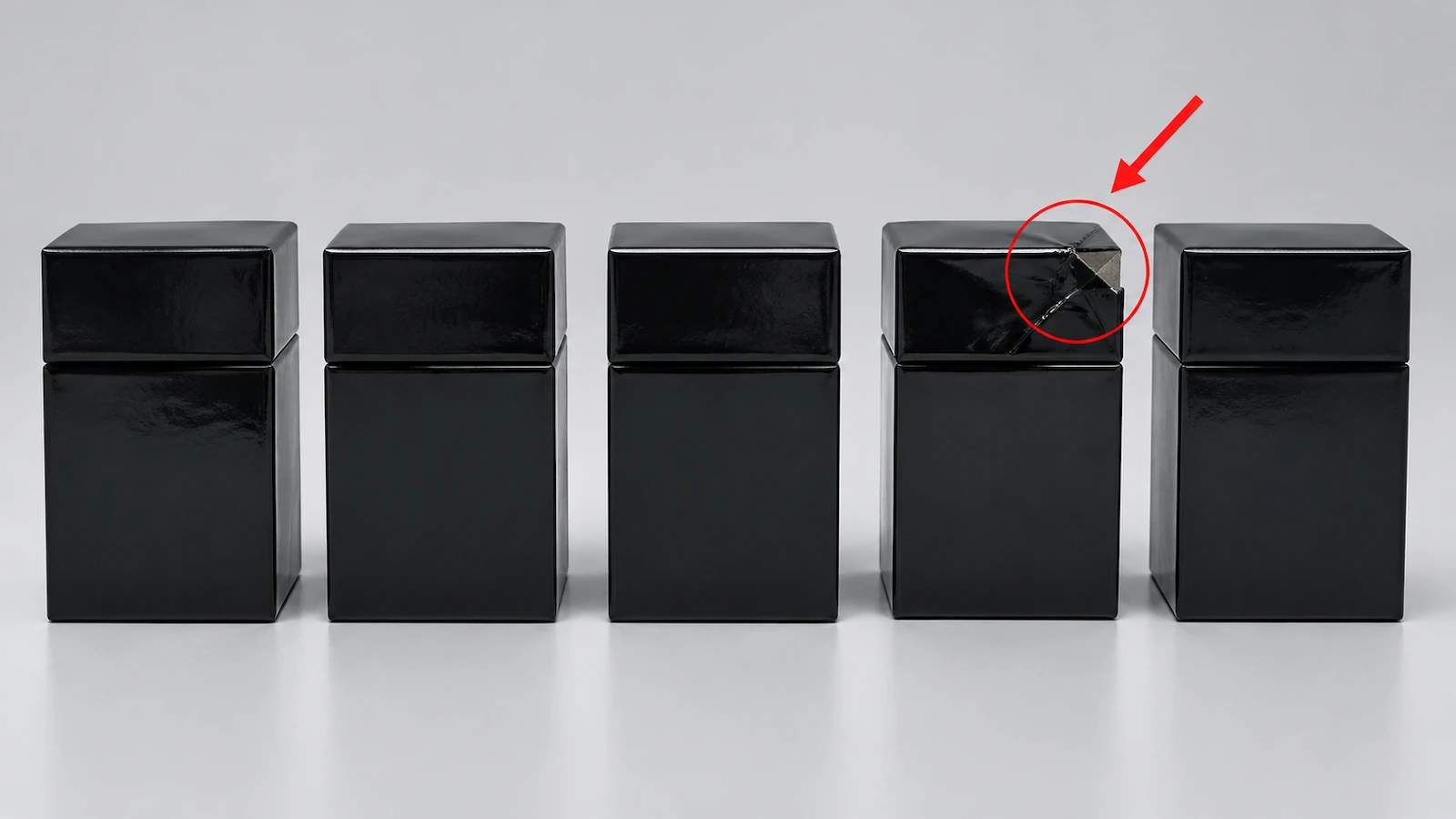
The pain: buyer complaints in this category follow a predictable pattern. Proofs come back wrong. Second orders arrive with ink marks or handprints that the first order did not have. Boxes are crushed in transit. Updates promised as "our team is working on it" never arrive. Some sellers describe a domestic factory when production actually happens on another continent. The worst cases involve materials. In 2016 the U.S. Consumer Product Safety Commission[2] announced a recall of about 8,400 imported gift boxes because of mold, after nine reports of respiratory irritation. Each of these failures traces back to how a supplier was selected and contracted, not to the box style.
The solution: treat supplier selection as a structured audit with evidence at every step. The sections below give you the order of operations, a comparison of sourcing models, the warning signs to watch for, and the documents to request.
What does a rigid box packaging supplier actually do?
"Supplier" covers at least three business models. Ask which one you are talking to in the first call, because each carries a different level of risk.
Manufacturer: owns the board cutting, grooving, wrapping and assembly lines, and usually printing as well. You can audit the process directly.
Converter or partial manufacturer: assembles in-house but buys printed wraps, foil work or inserts from partners. Quality depends on partners you never see.
Broker or online platform: takes the order, handles design files and customer service, then places production with one or more factories. Brokers can be efficient, but they must be transparent about where and by whom the work is done.
None of these models is wrong. What causes trouble is not knowing which one you are dealing with. Two practical consequences follow from rigid construction. First, finished boxes are bulky, so the supplier's outer carton and palletizing plan affects your landed cost as much as the unit price. Packing to modular footprints such as the 600 × 400 mm base described in ISO 3394[3] helps shipper cartons fill pallets efficiently. Second, much of the quality comes from hand work, so consistency from run to run depends on the supplier's process discipline more than on its machines.
If you still need to settle the box itself (structure, dimensions, artwork and finishes), the custom rigid gift boxes guide on our product page covers those decisions. This article assumes your specification is roughly settled and focuses on who should build it.
How do you vet a rigid box packaging supplier step by step?
Work through these steps in order. Each one is designed to eliminate weak candidates cheaply before you spend money on samples.
Step 1: Write a one-page sourcing brief before contacting anyone
Your brief should state the ship-to locations, the realistic volume band for the first order and for repeat orders, the in-hands date, the product category (food, cosmetics, electronics, apparel), and any claims you plan to print, such as recyclable or responsibly sourced. Send the identical brief to every candidate. If suppliers quote against different assumptions, you cannot compare their answers.
Step 2: Decide your sourcing model, then build a shortlist of three to five
Use the comparison table in the next section to decide between domestic, overseas and hybrid sourcing. Then shortlist within that model. A mixed shortlist that compares a domestic short-run shop with an overseas volume factory on unit price alone will push you toward the wrong decision.
Step 3: Audit capability, not the catalog
A catalog proves only that someone can photograph boxes. Ask each candidate to state in writing which processes are done in-house and which are subcontracted: greyboard cutting, V-grooving, printing, lamination, foil stamping, embossing, wrapping, insert making and final assembly. Then verify the answers.
Request a live or recent video walkthrough that shows the wrapping and assembly lines running, not a promotional reel.
Check that the factory address on the quotation matches business registration records and any certificate scope.
Ask for photos of work in progress on a box similar to yours, including the back of the wrap and the inside corners, where poor gluing and exposed board show up first.
For overseas production, consider an independent third-party factory audit before the first order. The cost is small compared with a failed run.
Step 4: Normalize every quote to the same scope
"Low price" claims in this category often leave items out. Build a quote comparison sheet and require every supplier to state whether each of these is included: structural engineering and dieline, sample rounds and revisions, inserts, assembly, outer shipping cartons, palletizing, freight to your door, duties and customs brokerage for imports, and the cost of a reprint if the run fails the agreed standard. A line left blank counts as excluded until the supplier confirms otherwise. Only landed, like-for-like totals are comparable.
Step 5: Get MOQ and lead-time terms in writing, with definitions
An MOQ is only meaningful once it is defined. Ask whether it applies per size, per artwork version or per order, and how much over- or under-delivery is acceptable. Lead time needs the same precision. Ask when the clock starts (deposit received, proof approved or sample approved), how many sample rounds are included, whether the quoted time covers production only or delivery to your dock, and what happens if a date slips. Add a buffer ahead of seasonal peaks, when every factory's capacity tightens at the same time. Because MOQ and lead times vary with structure and finishes, we do not publish fixed figures for our own boxes. Send your brief and we will put both in your written quotation.
Step 6: Test communication before you test production
Your RFQ is a free trial of the supplier's service. Track how long replies take, whether questions are answered specifically or with templates, and whether one named person owns your project. Ask the supplier how it logs artwork and specification changes. A supplier that cannot show you a version history during quoting will not have one during production. Agree on a response-time commitment and an escalation contact, and write both into the contract.
Step 7: Request evidence that can be checked independently
Ask for documents you can verify yourself, rather than adjectives:
Transit performance: test reports referencing ASTM D4169 distribution-cycle testing for the packed shipper, one of the packaging standards maintained by ASTM International[4], and ASTM D642[5] compression results if your cartons will be stacked in storage.
Fiber sourcing: if you plan to print a responsible-sourcing claim, ask for the supplier's chain-of-custody certificate code and check that it is valid and covers paper packaging through the Forest Stewardship Council[6]. A logo on a sample is not proof.
Food contact: for candy, tea or baked goods that touch the board or wrap, ask for written confirmation that materials meet 21 CFR Part 176[7] (§176.170 for aqueous and fatty foods, §176.180 for dry foods), or plan for a compliant inner liner.
Retail labeling: if the box is the retail package, your label content must meet the federal packaging and labeling rules summarized by NIST[8]. The supplier prints the label, but you remain responsible for its compliance.
Moisture and storage: ask how board and finished goods are stored, and whether shipments to humid regions are packed with moisture protection. The mold recall cited above is a reminder that storage conditions matter.
Product-level material and labeling evidence for a specific box is covered on our custom rigid gift boxes page. Here the goal is to confirm that the supplier can produce such evidence at all.
Step 8: Structure the contract and payments around milestones
Tie payments to events you can verify: a deposit to start, a further payment after you approve the pre-production sample, and the balance after you accept the shipment or receive inspection results. Name the approved golden sample as the quality reference. Define in writing what counts as a defect and what the remedy is (credit, reprint or refund) and set a deadline for each. Pay by a method that allows a dispute. The sampling and inspection sequence itself is outlined on the product page. Your contract should state that the supplier must follow it.
Domestic, overseas or hybrid: which sourcing model fits?
The domestic-versus-overseas choice is less about patriotism or price and more about which risks your program can absorb. A rigid box manufacturer in the US cuts transit distance and makes site visits easy. An overseas factory may offer a wider range of finishes and better economics at scale, but you take on longer transit and import paperwork. Many brands use a hybrid approach: domestic for launches and urgent reorders, overseas for planned volume.
Factor
Domestic manufacturer (US)
Overseas manufacturer
Broker / online platform
Hybrid program
Transit risk
Short domestic freight; fewer handoffs
Ocean or air freight plus customs; more handoffs and humidity exposure
Depends on the hidden factory; ask where it is
Urgent volume stays domestic
Auditability
Site visits are practical
Video walkthroughs or third-party audits
Low unless the factory is disclosed
Audit both legs
Landed-cost drivers
Labor and materials
Freight volume, duties, brokerage, inspection
Platform margin plus the factory's own costs
Blended; requires two quote sheets
Finish and structure range
Varies by shop
Often broad
Limited to the platform's menu
Broadest overall
Communication
Same time zones
Time-zone lag; needs a named contact
Front-end friendly; escalation can be slow
Two relationships to manage
Compliance exposure
Simpler origin documentation
Origin, import and material declarations
Must pass factory documents through to you
Keep separate document files
Best fit
Launches, short runs, tight deadlines
Planned seasonal or repeat volume
Simple specs and quick tests
Brands with both launches and steady volume
Compliance pressure applies to every model. According to EY[9], seven US states have enacted extended producer responsibility (EPR) laws for packaging, and fees are adjusted for recyclability. Policy trackers such as the Sustainable Packaging Coalition[10] follow new rules as they appear. Choose a supplier that can provide a material breakdown for each component (board, wrap, adhesive, magnets, insert) so you can report accurately. If any boxes go to Europe, the EU Packaging and Packaging Waste Regulation[11] began applying on 12 August 2026. As Packaging Gateway[12] notes, premium packaging will increasingly have to justify its materials, volume and complexity. A supplier that offers separable components is easier to keep compliant.
Which red flags should stop a deal?
Any one of these warning signs justifies pausing. Two or more usually justify walking away.
The supplier will not say where boxes are made. Vague answers such as "our production partners" combined with a domestic-looking website match the pattern behind many misrepresented-origin complaints.
Prices or lead times far better than every other quote, with no breakdown. The missing cost usually reappears as freight, duties or reprints.
"No minimum" with no definition attached. Ask what the price is at your actual quantity. The answer often shows the real minimum.
Payment demanded in full before a sample is approved, or only through methods that cannot be disputed.
Certificates that cannot be checked: no certificate code, a scope covering a different company, or a logo used without a license.
Proofs that skip structural detail and show only flat artwork, which suggests nobody has engineered the fit.
Replies slowing down once the quote is accepted. Service during quoting is the best this supplier will offer.
Review patterns where first orders are praised and repeat orders draw complaints. This points to weak process control. Check recent reviews and complaint records, not only star averages.
FAQ
FAQ: Is a rigid box manufacturer in the US always the safer choice?
Not automatically. Domestic production shortens transit and makes audits easier, but a domestic broker that subcontracts overseas brings back the same risks you were trying to avoid. Judge suppliers by verified process ownership and written terms, not by the location on their website.
FAQ: How many suppliers should be on a shortlist?
Three to five within one sourcing model is enough to compare normalized quotes without wearing out your team. Fewer than three gives you no benchmark. More than five usually means the brief was not specific enough to filter candidates.
FAQ: How can I verify a factory's claims without traveling?
Combine a live video walkthrough of the wrapping and assembly lines, business registration records matched against the quotation address, certificate codes checked against the issuer's database, and photos of work in progress on a similar box. For larger overseas programs, add an independent third-party audit.
FAQ: What should a quotation include for custom rigid boxes in the USA?
At minimum: structure and material description, included sample rounds, inserts, assembly, outer cartons, palletizing, freight to your address, and, for imports, duties and brokerage. Also ask for a definition of MOQ, a lead-time start point, and the remedy for a failed run. Anything left unlisted should be treated as an extra cost.
FAQ: Can I move repeat orders to a different supplier?
Yes, if you own your dielines, artwork files and the approved golden sample. State in the contract that tooling files and dielines become yours once paid, and keep a reference sample from each approved run so a new supplier has an exact target to match.
FAQ: Which documents matter most for sustainability claims?
A valid chain-of-custody certificate covering the supplier's paper packaging, a material breakdown for each component to support EPR reporting, and evidence for any recyclability claim you print. Claims without documentation create regulatory exposure, especially as state EPR programs expand.
Key takeaways
The category is large enough to attract intermediaries, so confirm who actually manufactures. — USD 7.8 billion US rigid box market in 2025 (Source)
Material and storage control are safety issues, not just quality issues. — about 8,400 gift boxes recalled over mold, with 9 reports of irritation (Source)
Assembled rigid boxes ship by volume, so ask for a palletizing plan built on modular cartons. — 600 × 400 mm base module (Source)
Request standardized transit and compression evidence instead of "durable" claims. — ASTM D4169 distribution testing and ASTM D642 compression (Source)
Suppliers must provide component-level material data for compliance reporting. — 7 US states with packaging EPR laws (Source)
Export programs need separable, justifiable designs. — EU PPWR applying from 12 August 2026 (Source)
Conclusion
The best rigid box packaging supplier for your brand is the one whose claims hold up under verification: disclosed production, like-for-like landed quotes, defined MOQ and lead-time terms, responsive and named contacts, checkable documents, and payments tied to approved milestones. Run every candidate through the same eight steps and the shortlist usually narrows quickly.
When you are ready to compare a real quote against this checklist, send us your product, quantity band, ship-to location and target date. We will reply with a written quotation for custom rigid gift boxes with a two-piece lid and base that states MOQ, lead time and included scope for your project.
U.S. Consumer Product Safety Commission, "Schurman Retail Group Recalls Gift Boxes," Recall 17-046, December 2016. cpsc.gov↩
International Organization for Standardization, "ISO 3394:2012 Packaging — Complete, filled transport packages and unit loads — Dimensions of rigid rectangular packages," Online Browsing Platform, 2012. iso.org↩
ASTM International, "Packaging" industry standards overview (Committee D10, including ASTM D4169 Standard Practice for Performance Testing of Shipping Containers and Systems). astm.org↩
ASTM International, "ASTM D642-25 Standard Test Method for Determining Compressive Resistance of Shipping Containers, Components, and Unit Loads," 2025. astm.org↩
Forest Stewardship Council, "Paper and Packaging." fsc.org↩
U.S. eCFR, "21 CFR Part 176 — Indirect Food Additives: Paper and Paperboard Components." ecfr.gov↩
National Institute of Standards and Technology, "Packaging and Labeling Requirements FAQs." nist.gov↩
EY, "US packaging EPR in 2026: costs and compliance," June 2026. ey.com↩
Hi there! I'm Bruce, proud dad to my amazing son. I'm the founder of Zigpac, a printing and packaging company empowering small and medium-sized businesses with custom solutions. Let's create something great together!



 Blog PDF for offline reading
















The information below is required for social login
Sign In
Create New Account