


 Blog PDF for offline reading
Quick answer: An orange enamel mug is a steel mug coated with fired orange glass enamel. For a branded run, approve a fired color chip instead of a Pantone swatch. Pair orange with a black, navy or stainless rim, print the logo in opaque white or black, and agree in writing how much shade drift between batches you will accept.
If you are planning an orange enamel mug for a brand, a festival or an outdoor merch drop, the hardest part is usually the color, not the logo. Orange is one of the most requested retro shades and one of the hardest to reproduce consistently in kiln-fired glass. This guide is for promo and merch buyers. It covers how to brief an orange body color, which rim colors make it read as vintage enamelware, how logo inks behave on a colored base, and why two production runs of the "same" orange can come out of the kiln looking slightly different.
Why Does Your Brand Orange Rarely Survive the Kiln Unchanged?
The usual sequence goes like this. The brand team sends a Pantone code, approves a digital mockup, and then the first fired sample arrives looking more rust or more tomato than the screen showed. A logo that looked crisp on a white mockup turns muddy on the orange body. The reorder six months later sits next to the first batch on a store shelf and is visibly a shade darker.
Buyers notice these gaps because they are judging the mug as a retail-style object. In PPAI's 2026 distributor research, 78.7% of distributors reported rising demand for better-designed retail-style products[1], and 70.4% called durability the strongest signal of product value. A colored enamel mug that shifts shade or loses its logo contrast fails both tests at once.
The fix is not a better mockup. You need a specification written for fired glass, which behaves differently from ink on paper. The sections below show how to write one.
What Is an Orange Enamel Mug, and Why Is Orange So Hard to Fire?
A true enamel mug is a formed steel body coated with powdered glass (frit) that is fused onto the metal in a kiln, typically somewhere between 750 and 850 °C. The color comes from inorganic pigments mixed into that glass. A dark ground coat goes on first to bond with the steel, and the colored cover coat is applied on top. In other words, the orange you see is a layer of colored glass sitting over a darker layer, not a paint. For the basics of what the mug is, see our guide to custom enamel camping mugs. This article stays focused on color.
Three things make orange harder than white, black or navy.
The pigment chemistry is narrow. Bright, heat-stable reds, oranges and yellows in glazes and enamels have historically relied on cadmium-based pigments. That is why regulators look at warm colors closely. The FDA's cadmium compliance policy for ceramic foodware[2] states that the metal is extractable by acid foods. Modern lead- and cadmium-free orange systems exist, but they often fire slightly less saturated, or drift toward brown when the kiln runs hot.
Orange sits between two failure directions. A little extra heat or a thinner cover coat pushes it toward rust, because the dark ground coat starts to show through. A heavier pigment load pushes it toward red. White or black can only get lighter or darker, but orange can also change hue.
Safety testing is color-specific. Europe's industry guideline for enamel, EEA Guideline 1001[3], sets migration limits of 10 µg/L for lead and 5 µg/L for cadmium. The newer ISO 4531:2022[4] defines how metal-ion release from food-contact enamel is tested. A report on a white mug does not cover your orange one. If the color changes, ask for a test on the new color.

How to Specify an Orange Enamel Mug Color Step by Step
The steps below turn "make it our orange" into a brief that a kiln operator can actually hit. The general ordering workflow (artwork files, sampling, payment) is covered on our custom enamel mugs page. Here we only cover the color-specific decisions.
- Send a physical reference, not just a code. Pantone Solid Coated chips are ink on coated paper. Enamel is glossy fused glass with depth. Mail a Pantone chip, a painted sample or an existing product in the target shade, and say which matters more: hue (how orange it is), lightness, or saturation. Something usually has to give.
- Ask for fired color plaques in a small spread. A useful request is three to five fired steel chips: one on target, plus lighter, darker, redder and yellower variants. Choosing between real fired options is faster than going back and forth over a single sample.
- Judge under controlled light. Orange shifts strongly between warm indoor bulbs and daylight. Compare chips under daylight-balanced light (a D65 viewing booth if the supplier has one) and photograph them next to your reference with a gray card in frame.
- Turn the approved plaque into the master. Sign and date the chosen plaque. The supplier keeps one and you keep one. Every later production run is compared against this physical master, not against your file.
- Approve light and dark limit samples. Ask for two extra fired pieces that mark the lightest and darkest shade you will accept. These "limit samples" turn color acceptance into a side-by-side check instead of an argument.
- Request a lead and cadmium report for this exact color and decoration. Under FDA's lead policy for ceramic foodware[5], cups and mugs have a lead action level of 0.5 µg/mL in a 4% acetic acid leach test. For the full paperwork list, see the compliance section on our enamel camping mug sourcing guide.
- Record the frit and pigment lot. Ask the supplier to note which glaze lot was used. For reorders, request the same lot, or a new fired plaque checked against your master before production starts.
Which Rim, Interior and Handle Colors Pair Best with an Orange Enamel Mug?
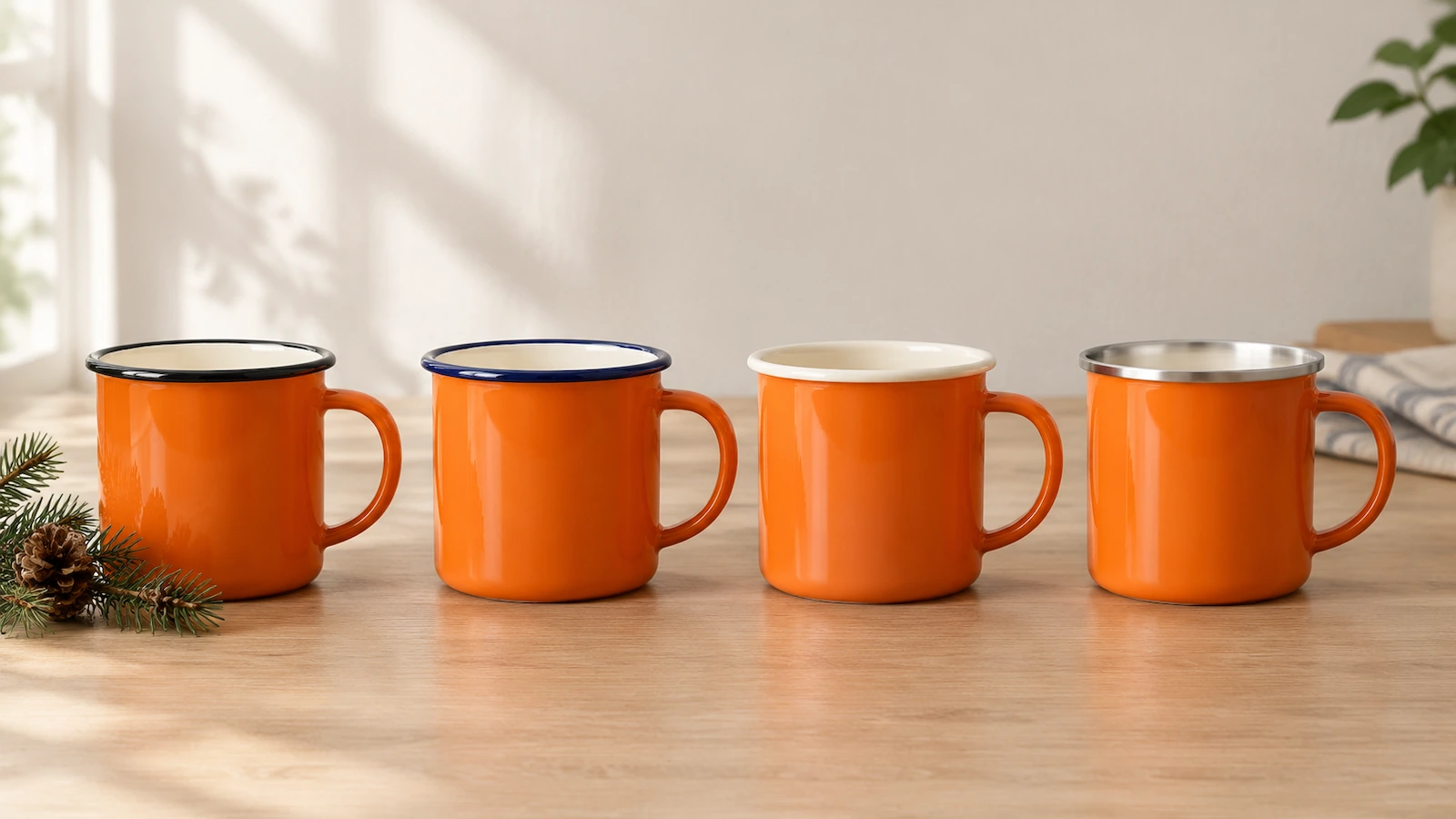
Most enamel camp mugs have four color zones: body, rolled rim, interior and handle. The rim does the most to decide whether the mug reads as vintage, sporty or modern.
Black rim. This is the classic mid-century camp look, and the closest to the enamelware people picture from old cabins and diners. A black rim also hides wear well. When enamel chips at the rim, the dark ground coat or steel underneath shows, and on a black rim that damage is barely visible. Independent reviewers such as Advnture[6] note that enamel is somewhat prone to chipping when it hits a hard surface at the wrong angle.
Navy rim. Blue is orange's complement on the color wheel, so a navy rim makes the body look brighter and more saturated. It reads as outdoor or nautical rather than kitchen. It is a good choice when your fired orange came out slightly duller than hoped.
White or cream rim. This gives a softer, 1960s kitchen-canister look. The downside is wear: any chip shows as a dark spot, so it suits gift and display mugs better than mugs headed for a campfire.
Stainless steel rolled rim. Many camp mugs use a stainless rim instead of an enameled one. It reads more modern and technical, it cannot chip the way glass does, and it stays neutral next to any orange. It is the safest option when the body color tolerance is tight, because it adds no second enamel color that also has to match.
Interior. A white or cream interior keeps the drink's color honest and contrasts nicely with an orange exterior when the mug is viewed from above, which is the angle most social media photos use. Light interiors show tea and coffee residue more readily, so a care card that recommends prompt rinsing is worth including.
Handle. Matching the handle to the body gives a solid, object-like silhouette. Matching it to the rim gives a two-tone "trimmed" look. Both work. Just avoid introducing a third accent color on the handle unless your brand palette demands it.
For a broader vintage enamelware mug palette, orange sits naturally with cream, mustard, teal, forest green and black. These are the colors that dominated mid-century enamel and appliance design. If you are producing a set, keep one shared rim color across all bodies so the collection reads as a family.
How Do Logo Colors Read on Orange Enamel?
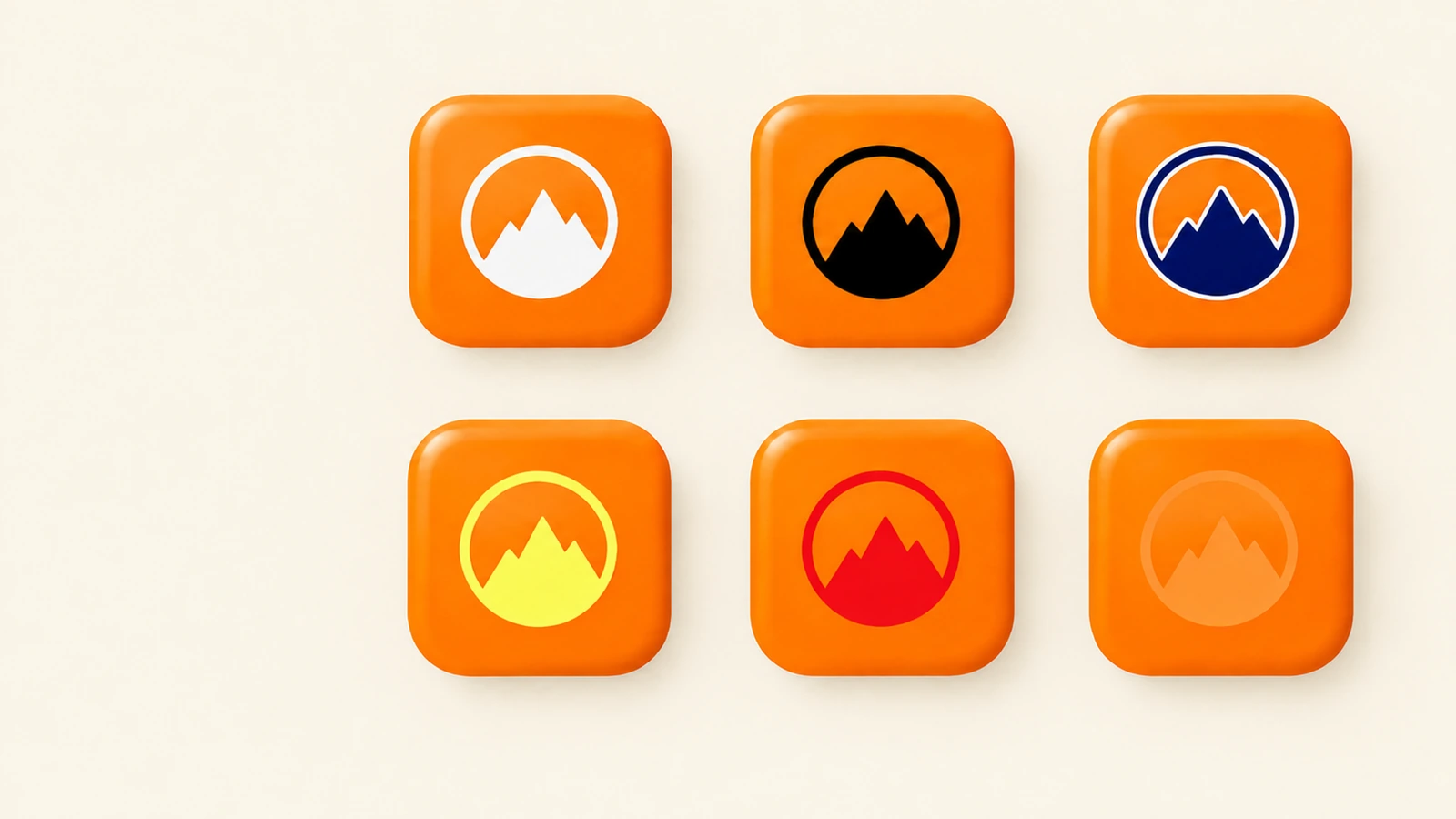
Logo colors behave differently on orange than on white. Fired ceramic decals and many enamel inks are partly translucent, so the orange body tints whatever sits on top. A blue that looked vivid on a white mockup can fire into a brownish navy on orange, and yellow can nearly disappear. Use the table below as a starting point, then confirm it on a fired sample.
| Logo color | How it reads on glossy orange | Main risk | What to specify |
|---|---|---|---|
| Opaque white | Highest contrast; clean and retro | Thin strokes lose opacity and turn peach | Heavier white deposit; minimum stroke weight agreed on the proof |
| Black | Strong and classic; best for small text | Very low; can look heavy on small mugs | Use where fine detail or small type is needed |
| Navy / deep blue | Vivid at a distance (complementary contrast) | Translucent ink darkens toward brown-black | White underlay beneath the blue in the decal |
| Yellow, cream, light tan | Weak; blends into the body | Logo vanishes beyond arm's length | Add a black or white outline, or avoid |
| Red | Low contrast; edges appear to vibrate | Illegible small type | Outline it, or reverse the logo out of a white panel |
| Brand orange on orange body | Disappears | No visible branding | Reverse to white, or put the logo on a white interior or panel |
| Metallic gold | Warm and premium, but low contrast | Precious-metal decals often need gentler care | Confirm care limits in writing before approving |
Print method matters even more on a colored body. Dye sublimation needs a white polymer coating to work, so it is not a real option on fired orange glass. On colored coated mugs, the base color tints every color in the image. Polymer coatings fall under the FDA's rules for resinous and polymeric coatings[7], which are a separate regime from fired enamel. Which decoration methods last longest is compared on our custom enamel mugs page. On orange, the practical choice is usually a fired decal or fired screen print with a white underlay.
Exterior decoration also carries its own compliance exposure. In February 2026, a California Proposition 65 notice[8] targeted "mugs with exterior designs" for lead, listing both ingestion and skin contact as exposure routes. Prop 65 is a warning law administered by California's OEHHA[9], not a certification. In practice, test the decal colors as well as the body, especially warm decal colors laid over a warm body.
Why Do Colored Enamel Batches Vary, and What Is Normal?
Every fired orange is the result of several variables that never line up exactly the same way twice. Knowing what they are helps you separate normal variation from a real defect.
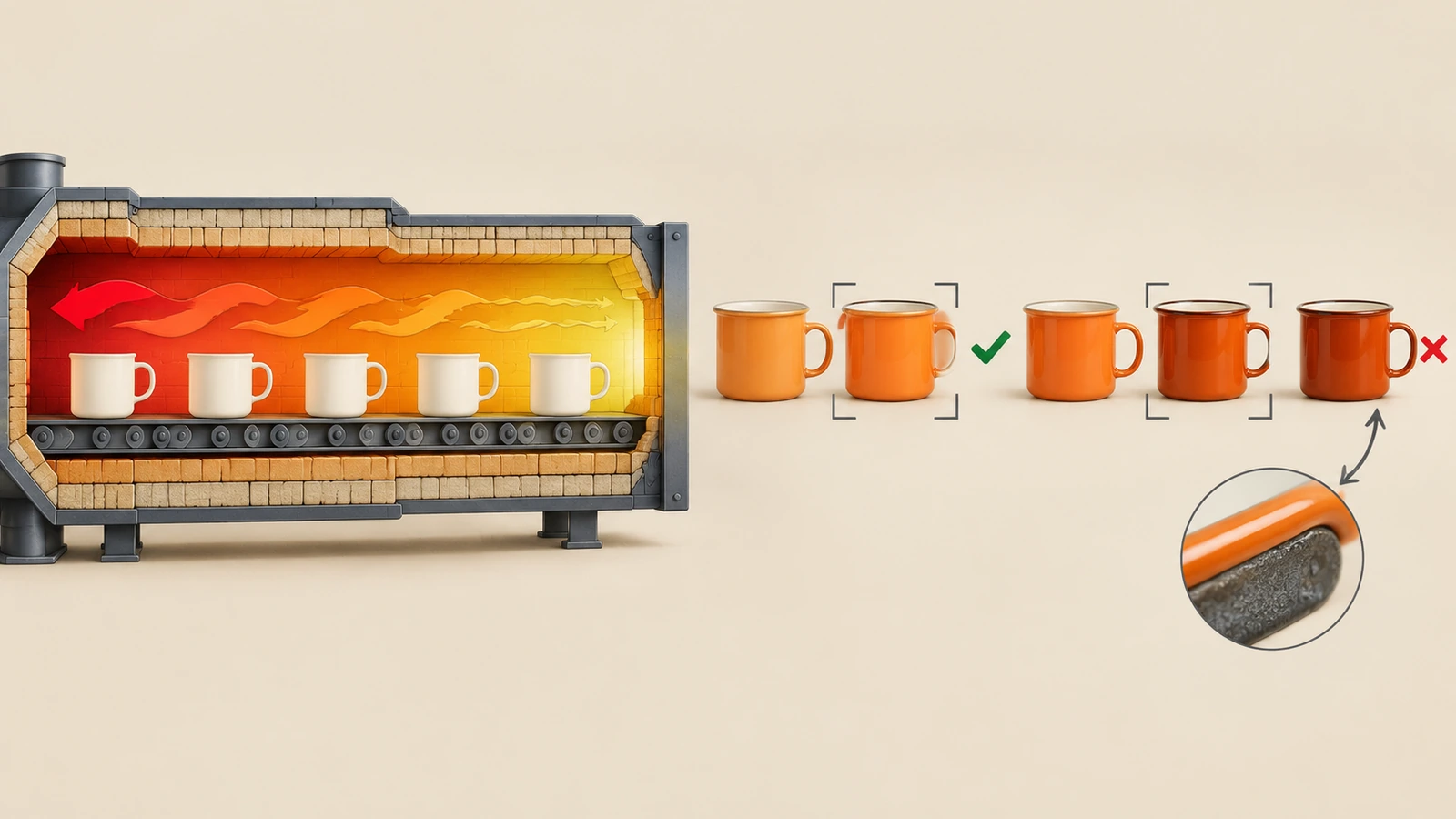
Coat thickness. Enamel is dipped or sprayed, often by hand. A thinner cover coat lets the dark ground coat show through, which makes the orange darker and redder. This is also why the shade often looks deeper at the rim and the handle joint, where the coating naturally thins.
Kiln temperature and position. Mugs at the edges of a kiln load or belt can run hotter or cooler than those in the middle. Small temperature differences change how the pigment develops in the glass, and orange is more sensitive to this than neutral colors.
Frit and pigment lots. A new batch of glaze or pigment can shift the color even when the recipe is unchanged. This is the most common reason a reorder looks different from the first run.
Decoration refiring. Fired decals require a second, lower-temperature firing, which can slightly change the body color. Approve your color on a mug that has gone through every firing step, not on a plain body.
Speckle randomness. Speckled finishes are scattered by hand or spray, so the density and placement of flecks vary from mug to mug. Many makers describe this as handmade character rather than a flaw. If you need a uniform look, choose a solid body.
What is "normal" should be decided by your contract, not by either side's opinion after delivery. The limit samples from the step-by-step section define it. Anything between the light and dark limits passes, and anything outside them fails. Bare steel spots or pinholes are a separate issue: they are coating defects, not color variation, and Europe's food-contact framework[10] expects materials not to transfer substances or alter food in unacceptable ways. Full inspection and acceptance steps are covered in our custom enamel camping mug guide.
The simplest way to avoid visible mismatch is to produce everything that will be displayed together in one run, using one glaze lot. If you know you will reorder, order a few extra mugs from the first run as retained reference samples and keep them sealed and out of sunlight.
Five Ways to Get a Vintage Enamelware Mug Look
Not every retro orange mug needs a solid orange body. If color consistency is critical, an orange decal on a white body is far easier to control. The table compares the main options.
| Approach | Retro feel | Color consistency risk | Logo legibility | Best for |
|---|---|---|---|---|
| Solid glossy orange body, black rim | Strongest classic camp look | Medium to high | Excellent in white or black | Hero merch, outdoor brands |
| Speckled orange body | Rustic, cabin-style | High (speckle varies per mug) | Good in white; fine detail gets lost in flecks | Lifestyle and gift sets |
| Two-tone (orange body, cream interior and rim) | Mid-century kitchen | High (two colors must match) | Good | Cafés, retail collections |
| Orange body, stainless rolled rim | Modern-retro | Medium (only one enamel color) | Excellent | Heavy-use camp and event mugs |
| White body with orange fired decal | Retro graphic, poster-style | Low (decal color is easier to control) | Excellent; multicolor possible | Tight brand-color requirements |
FAQ
FAQ: Can an orange enamel mug exactly match my Pantone color?
Usually close, but rarely exact. Pantone chips are ink on coated paper, while enamel is fused glass over a dark ground coat. Treat the Pantone code as a target, approve a fired plaque as the real standard, and set light and dark limit samples for acceptance.
FAQ: Is orange enamel safe to drink from?
It can be, but don't assume it. Warm colors have historically used cadmium pigments, so ask for a lead and cadmium extraction report that covers the exact orange glaze and any decal colors. The FDA lead action level for cups and mugs is 0.5 µg/mL. If the glaze lot, color or decoration changes, retest.
FAQ: What logo color works best on an orange enamel camp mug?
Opaque white and black are the most reliable. Navy works well if the decal includes a white underlay. Avoid yellow, red or your brand orange unless they are outlined or placed on a white panel.
FAQ: Why does my reorder look darker than the first batch?
The most common causes are a new glaze or pigment lot, a thinner cover coat, or a hotter kiln profile. Keep sealed retained samples from the first run, and ask for a fired plaque from the new lot to be compared against your master before production.
FAQ: Does a darker rim really hide chips?
Visually, yes. A chip exposes the dark ground coat or steel underneath, which stands out on cream or white rims and blends into black or navy ones. A stainless rolled rim avoids rim chipping entirely.
FAQ: Can I sublimate a photo onto an orange enamel mug?
Not onto true fired enamel. Sublimation needs a white polymer coating, and a colored base tints every color in the image. For full-color artwork on an orange mug, use a fired decal with a white backing, or put the image on a white body.
Key Takeaways
- Buyers judge colored merch mugs as retail products, so shade and logo contrast matter. — 78.7% of distributors report rising demand for retail-style design, and 70.4% call durability the strongest value signal (Source)
- Every orange glaze and decal color needs its own lead test. — FDA lead action level for cups and mugs: 0.5 µg/mL (Source)
- Warm colors deserve a specific cadmium check. — FDA states cadmium is extractable by acid foods from ceramic foodware (Source)
- EU-bound orders should be measured against enamel migration limits. — 10 µg/L lead and 5 µg/L cadmium under EEA Guideline 1001 (Source)
- Exterior designs are an active enforcement target, not just interiors. — Prop 65 notice 2026-00767 covers "mugs with exterior designs" for lead (Source)
Conclusion: Brief the Glass, Not the Screen
A successful orange enamel mug comes from accepting that the color is made in a kiln, not on a monitor. Approve a fired plaque, set light and dark limits, pick a rim that flatters the shade you actually got, design the logo for an orange background, and test the exact colors you are shipping. Those five decisions prevent most of the surprises that turn a retro merch idea into a returned shipment.
When the color brief is settled, the rest of the project (decoration method, sourcing route, paperwork and inspection) is laid out in our guide to custom enamel camping mugs. Send us your reference color and rim preference to request fired color options and a quote.
Footnotes
- PPAI Research: New Year, New-ish Trends — Promotional Products Association International, 2026-01-07. ↩
- CPG Sec. 545.400 Pottery (Ceramics); Import and Domestic — Cadmium Contamination — U.S. Food and Drug Administration. ↩
- EEA Guideline 1001: Porcelain enamels in contact with food — European Enamel Association, March 2016. ↩
- ISO 4531:2022 Vitreous and porcelain enamels — Release of metal ions from enamelled articles in contact with food — International Organization for Standardization, April 2022. ↩
- CPG Sec. 545.450 Pottery (Ceramics); Import and Domestic — Lead Contamination — U.S. Food and Drug Administration. ↩
- Are enamel mugs good for camping? — Advnture, 2023-06-14. ↩
- 21 CFR 175.300 Resinous and polymeric coatings — Electronic Code of Federal Regulations, accessed October 2026. ↩
- Proposition 65 60-Day Notice 2026-00767: Mugs With Exterior Designs (Lead) — California Department of Justice, Office of the Attorney General, 2026-02-17. ↩
- Proposition 65 Law and Regulations — California Office of Environmental Health Hazard Assessment. ↩
- Food contact materials — European Food Safety Authority. ↩












The information below is required for social login
Sign In
Create New Account