


 Blog PDF for offline reading
Quick answer: The nail design stickers that sell most reliably fall into six families: evergreen classics, trend effects, seasonal and holiday motifs, occasion sets, fandom or licensed art, and brand-signature designs. Build a lineup with a small evergreen core, two or three seasonal capsules timed to the retail calendar, and limited drops. Then lock artwork, motif sizes, and packaging claims before you commission a single custom sheet.
Updated October 2026. Written for beauty brands, salon owners, and retail buyers planning a private-label sticker range.
Why Most Sticker Lineups Stall After the First Order
Most first sticker ranges start the same way. A brand picks designs the team likes, commissions sheets, and launches everything at once. Two months later, the floral sheets are gone, the Halloween sheets arrived in November, and a stack of oversized full-nail motifs sits unsold because they only fit long nails. The artwork was fine. The lineup had no structure.
The cost is real. A mistimed seasonal sheet usually cannot be discounted into profit after its holiday passes. Oversized or one-size motifs trigger "didn't fit" reviews. Designs copied from social media can bring takedown requests instead of sales. Demand also swings: third-party tracking of the top 50 Amazon US listings for "nail stickers for nail art" (Asinsight, 2026) recorded roughly 94,400 units in December 2025 and only about 47,900 in May 2026. That is nearly a 2:1 swing between the peak and the trough.
The fix is to plan the collection before you plan the print run. That means choosing design families with proven demand, mapping each to a selling window, setting sheet layouts that fit real nails, and clearing artwork rights and packaging copy early. The rest of this guide walks through that process. Material, format, and production questions are covered separately on our page about custom nail art sticker sheets printed from your own artwork.
What Counts as a Nail Design Sticker Collection?
A nail design sticker is a printed, self-adhesive motif applied over dry polish or gel and usually sealed with top coat. A collection is the set of sheet designs you sell together under one brand, organized by purpose, season, and buyer. The sheet is the product unit, so collection planning decides three things: which artwork appears, how motifs are sized and grouped on each sheet, and when each sheet reaches shelves.
The buyer you are designing for is mostly an at-home user. In The Benchmarking Company's 2025 survey of more than 4,000 US beauty-buying women, only 10% got their nails done exclusively at salons, 43% did them only at home, and 47% combined both (Benchmarking Company survey[1]). That hybrid 47% matters most to salons. A sticker sheet can be a retail add-on for clients who maintain their look between appointments, not only a tool used at the station.
The category has also picked up collecting behavior. In September 2025, The New York Times reported[2] that some shoppers now collect gel nail strips by the hundreds, the way they once collected blind-box toys. For sticker brands, this is a merchandising signal. Numbered drops, themed series, and limited seasonal releases give repeat buyers a reason to come back before their last sheet runs out.
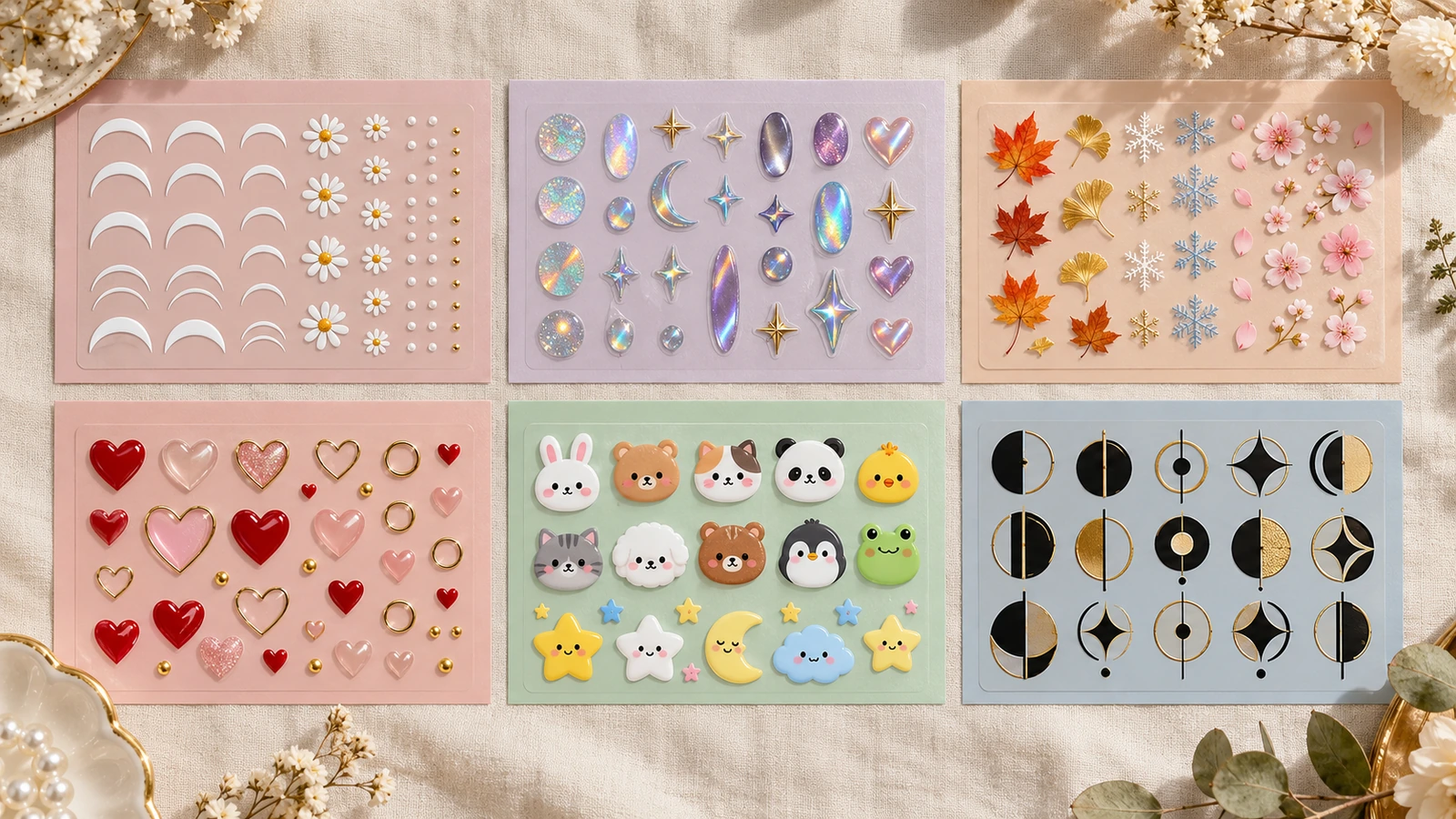
Which Nail Design Stickers Sell Best? Six Design Families
Bestseller lists tend to repeat the same patterns. The highest-volume listings are inexpensive multi-sheet packs built around familiar motifs. On Amazon US, average selling prices for tracked nail sticker listings sat near $6.81 in July 2026 (Asinsight). Shoppers searched "nail stickers" about 10.5 million times in a year (Flapen estimate). Use the six families below as your planning categories.
1. Evergreen classics
French-tip outlines, daisies, small hearts, stars, fine line art, and dots sell in every month. They are your volume base and reorder safety net. Classics also work with almost any polish color, which reduces returns from shoppers who find a design clashes with their base shade.
2. Trend effects
Prints that imitate cat-eye shimmer, holographic flares, chrome swirls, and aura gradients follow social media. They spike fast and fade fast. Release them in small runs and refresh them often. Metallic and holographic looks carry a known risk: shoppers often report foil prints fading or clouding under solvent-based quick-dry top coats. If a trend sheet leans on metallic effects, put top-coat guidance on the packaging.
3. Seasonal and holiday motifs
Valentine's hearts, spring florals, summer fruit and waves, autumn leaves, Halloween icons, and winter holiday sets drive the December peak described above. They also carry the highest timing risk, because each one has a hard sell-by date.
4. Occasion sets
Bridal, graduation, anniversary, birthday, and team-color designs are bought for a specific day. They do not depend on the season, which makes them useful for filling the late-spring dip. Graduation and wedding season land in May and June, when general sticker volume is lowest. The main pain point in this segment is delivery: a sheet that arrives after the event is worth nothing to the buyer.
5. Fandom and character-style art
Tiny character-style motifs, gaming icons, and pop-culture themes travel well on social media. Fans regularly post handmade mini stickers made for conventions. This family requires either original artwork or a written license, as covered in the compliance section.
6. Brand-signature designs
Salon monograms, brand pattern motifs, and collaboration art turn a sticker sheet into marketing that customers wear. These sheets rarely top sales charts. Their value is in retention, gifting, and event giveaways.
How to Plan a Seasonal Lineup Before You Commission Sheets
The sequence below assumes you are building a 12-month range. It works the same way for a single capsule.
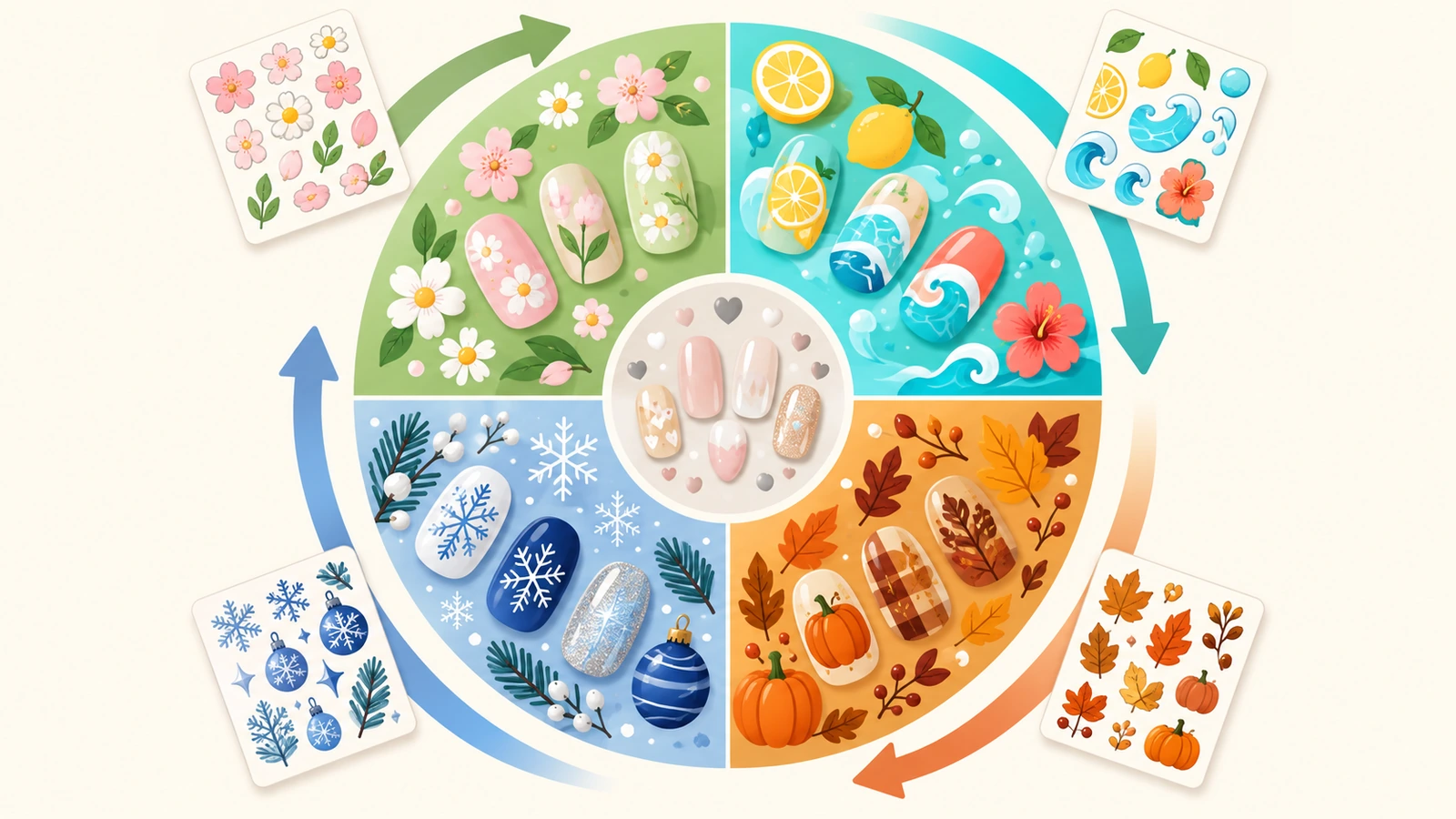
- Fix your evergreen core first. Choose a small set of classic sheets you will keep in stock all year. These carry your reorders and help you judge how quickly each seasonal sheet sells compared with your baseline.
- Map selling windows, not holidays. For each seasonal capsule, write down the date shoppers start buying, not the holiday itself. Holiday gift sets need to be on shelves before the late-November rush, and Valentine's sets in January. Spring florals should land before the spring search lift, which category trackers saw begin in April 2025.
- Work backward from each window. Ask your supplier for current proofing, production, and freight times, then add a buffer for proof revisions. The result is your artwork lock date. Missing it is the most common reason seasonal sheets arrive late.
- Assign one job to each capsule. A Halloween capsule might bring in new shoppers, while a bridal capsule protects margin. Capsules without a defined job tend to grow bloated and sell unevenly.
- Cap trend effects. Keep trend sheets to a small share of each order so a fading trend does not leave dead stock. Reorder winners instead of guessing big up front.
- Clear artwork rights and packaging claims. Confirm that every motif is original, commissioned, or licensed. Have your packaging copy reviewed before proofing, not after the print run.
- Proof the collection side by side. Review all sheets in a capsule together on real polish colors. Gaps and duplicates are easier to spot as a group than one file at a time. Format and pre-production checks are covered on the custom sticker sheet product page.
Design Families Compared
| Design family | Demand window | Primary buyer | Sheet layout tip | Main risk |
|---|---|---|---|---|
| Evergreen classics | Year-round | At-home DIY, salon retail | Many small repeats per sheet | Commoditized pricing |
| Trend effects | Weeks to a few months | Social-media-driven shoppers | Accent motifs, not full-nail coverage | Fast fade; metallic prints clouding under top coat |
| Seasonal / holiday | 4–8 weeks before each holiday | Gift buyers, retailers | Mix one hero motif with fillers | Hard sell-by date |
| Occasion sets | Event-driven; strong in May–June | Brides, graduates, event guests | Symmetrical sets for both hands | Late delivery |
| Fandom / character-style | Tied to releases and conventions | Collectors, fans | Very small motifs, several per nail | IP infringement |
| Brand-signature | Campaigns, events, gifting | Salon clients, brand loyalists | One logo motif plus neutral accents | Low standalone sell-through |
The demand windows above are planning guidance drawn from the seasonal tracking data cited in this article. They are not guarantees. Use your own sell-through history once you have a season of data.
Sheet Layout Rules That Protect Sell-Through
Layout decides whether a good design gets good reviews. Even top-rated products lose points on sizing: Good Housekeeping's nail sticker roundup[3] listed "only eight nail sizes" as the main drawback of its best-overall pick. A Beauty Lab chemist quoted there puts typical wear at one to two weeks before nail growth makes a look appear dated. That wear window matters for planning: a buyer who loves a design returns for a new sheet roughly every two weeks.
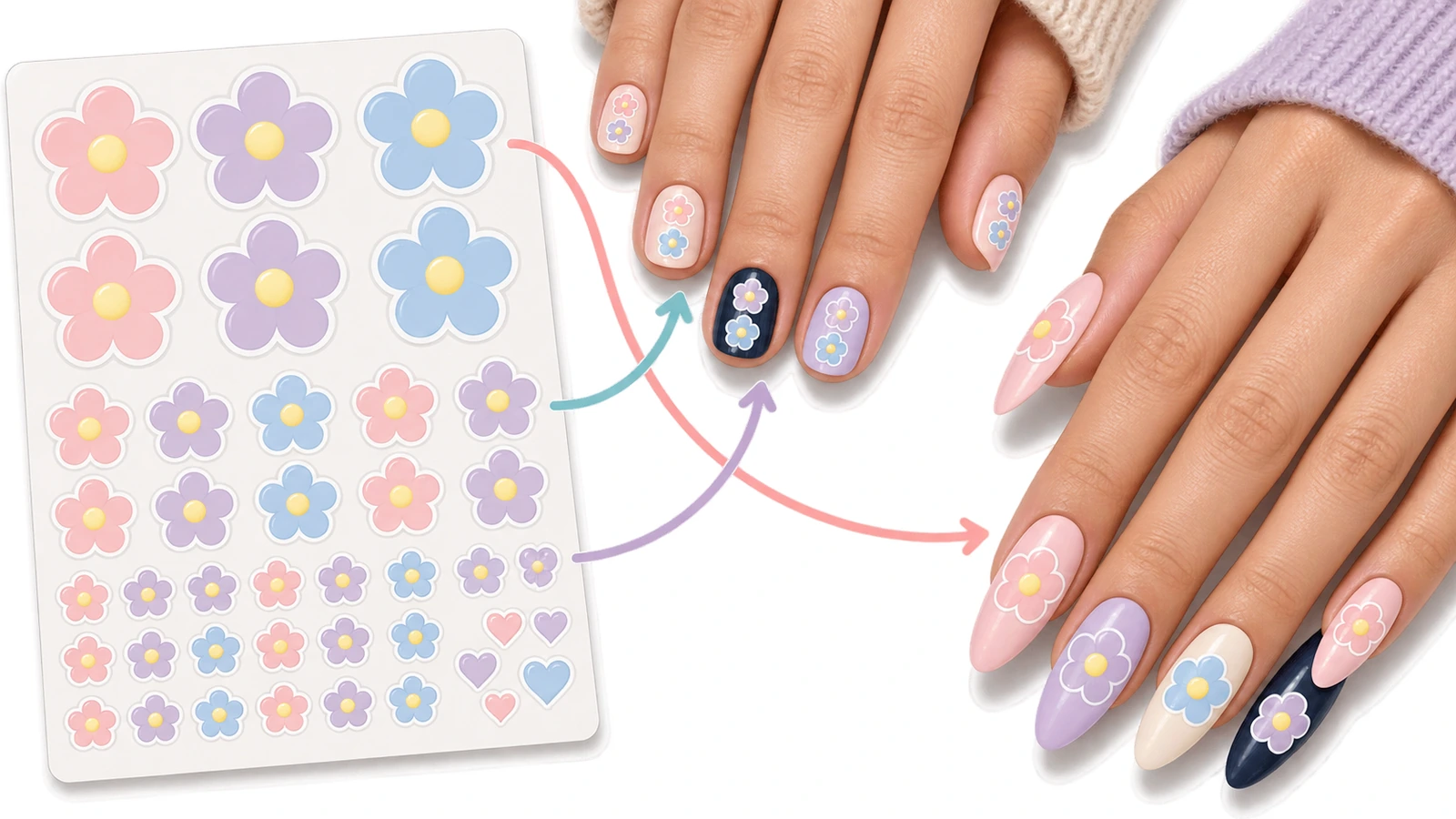
- Grade motif sizes. Put large, medium, and small versions of the same element on one sheet. Reviewers repeatedly praise motifs small enough to stack two or three per nail, and criticize designs "too big for two, too small for one."
- Design for short nails too. Full-coverage artwork gets cropped badly on short nails. Accent placements such as tip, corner, and cuticle-line motifs work across nail lengths and keep sticker edges less visible, which is one of the most common aesthetic complaints.
- Plan for light and dark bases. On clear film, white and pale inks can turn see-through unless the print includes a white underlayer. Mark which sheets are meant for light polish and which can sit on dark polish.
- Include extras of popular pieces. Accent-nail motifs such as ring-finger hearts run out first. Printing duplicates of the most-used elements stretches each sheet across more manicures.
- Use foil sparingly. Metallic elements look great in photos but draw the most fading complaints. Use them as highlights within a design rather than the whole design.
Artwork Rights and Packaging Copy
Copying is a known problem in this category. Modern Salon has reported[4] on nail artists who found their original work reproduced as decals and sold for about $2 a package. When you commission sheets, the brand placing the order is responsible for the artwork. Keep a written record of where each design came from: in-house art, a paid illustrator with a rights transfer, or a license for characters, team logos, or school marks. Never use reference images pulled from social media.
Packaging copy deserves the same care. Under the FD&C Act, nail products are generally regulated as cosmetics, and most do not need FDA approval before sale, except for most color additives (FDA nail care products guidance[5]). Labeling must be truthful and not misleading (FDA cosmetics labeling rules[6]). That rules out "FDA approved" badges and blanket claims such as "safe for everyone, including children and pregnant women" unless you can back them up. Since the Modernization of Cosmetics Regulation Act (MoCRA)[7], the responsible person must report serious adverse events to the FDA within 15 business days. Make sure your contact details on the pack are real and monitored.
Be especially careful with bundles. Adding nail glue or gel products to a sticker set brings in acrylate chemistry. A 2024 JAAD review of online at-home nail kits[8] found ethyl cyanoacrylate in about 44% of products and 2-HEMA in about 16%. None carried a sensitization warning. The EU has restricted HEMA to professional use since 2021, yet the Dutch RIVM concluded in 2026[9] that current restrictions and warnings do not seem sufficient to reduce allergy risk. A European dermatology audit of 26,297 patients[10] found nail-related contact allergy rising from about 0.91% in 2016 to 1.98% in 2023. If a bundle contains adhesive, list full ingredients and recommend a patch test.
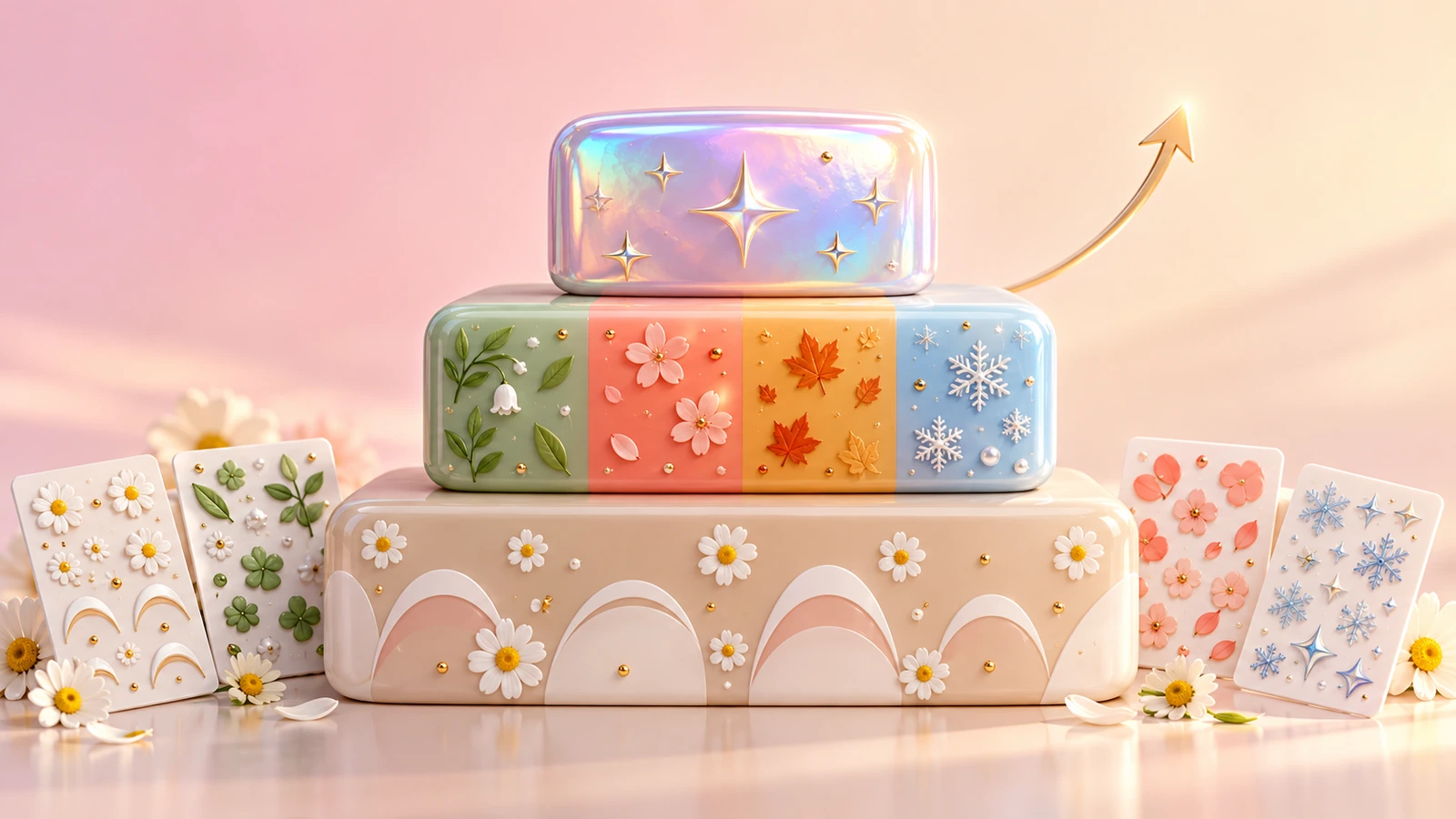
FAQ: Planning a Nail Sticker Collection
FAQ: How many designs should a first collection include?
Fewer than most brands expect. Start with a compact evergreen core and one seasonal capsule. Add new sheets once you see which ones sell through. A tight first range makes the sales data easier to read and keeps you from tying up cash in designs that have not been tested. Ask your supplier how minimums apply per design versus per order before you set the number.
FAQ: When should seasonal artwork be finalized?
Before the work-back date you get by subtracting proofing, production, freight, and a revision buffer from the day shoppers start buying. That buying day comes earlier than the holiday itself. Gift-driven winter sets in particular need to be in stock before the November rush. Request current timelines when you plan each capsule rather than reusing last year's.
FAQ: Can we print characters, team logos, or school crests?
Only with written permission from the rights holder. Character, sports, and school marks are trademarked and often copyrighted. Original character-style art, meaning your own cute animals or gaming-inspired icons, captures much of the same demand without the licensing exposure.
FAQ: Do metallic and holographic designs sell better?
They photograph well and attract clicks, but they also draw the most complaints about fading or clouding under solvent-based top coats. Use metallics as accents, include top-coat guidance on the pack, and see the product page for how print format affects durability.
FAQ: Do nail sticker sheets need FDA approval before we sell them?
Generally no. The FDA does not pre-approve cosmetics, except for most color additives. Your labeling still has to be truthful and not misleading, and MoCRA adds obligations for adverse event reporting and, for many businesses, facility registration and product listing. Confirm how your specific products are classified with a regulatory adviser.
FAQ: Should salons retail stickers or use them during services?
Both work, and they serve different clients. With 47% of US beauty buyers combining salon visits and at-home manicures, a retail sheet that matches the salon's signature look keeps clients engaged between appointments. Quick sticker accents can also be offered as a low-time upsell at the station.
Key Takeaways
- Most buyers do their nails at home, so retail sheets need clear placement cues — 43% home-only and 47% hybrid (Source)
- Plan restock and drop rhythm around the wear cycle — one to two weeks typical wear (Source)
- Collectible drops fit current shopper behavior — strips lasting up to two weeks are now collected by the hundreds (Source)
- Original or licensed artwork only — copied designs have been resold as decals for about $2 a pack (Source)
- Keep the pack's adverse-event contact real and monitored — 15 business days to report serious events under MoCRA (Source)
- Treat glue or gel bundles as an allergy-labeling issue — 44% of online kits contained ethyl cyanoacrylate, none with sensitization warnings (Source)
- Restrictions alone have not curbed acrylate allergy — nail-related allergy rose from 0.91% to 1.98% between 2016 and 2023 (Source)
Conclusion: Plan the Collection, Then Print
Sticker lines that keep selling share a structure: an evergreen base that funds reorders, seasonal capsules timed to buying windows rather than holiday dates, small trend runs, and occasion sets that fill the spring dip. Add graded motif sizes, a written record of artwork rights, and packaging claims you can defend. With those in place, each design you commission has a clear job and a clear selling window.
Once your lineup and artwork are ready, share the files and target launch dates with us. We will confirm current minimums, proofing steps, and timelines for your custom printed nail sticker sheets and send a quote.
Sources
- The Benchmarking Company / GCI, "Obsessed with Nail Care: A Timeless Consumer Beauty Favorite," 2025-06-12. https://benchmarkingcompany.com/news/gci-obsessed-with-nail-care-a-timeless-consumer-beauty-favorite/ ↩
- Aimee Ortiz, "Forget Labubus: We're Collecting Semi-Cured Gel Nail Strips," The New York Times, 2025-09-28. https://www.nytimes.com/2025/09/28/business/semi-cured-gel-nails-manicures.html ↩
- Good Housekeeping Institute Beauty Lab, "Best Nail Stickers and Wraps." https://www.goodhousekeeping.com/beauty/nails/g37662892/best-nail-stickers/ ↩
- Modern Salon, "Protecting Your Work Online." https://www.modernsalon.com/articles/protecting-your-work-online ↩
- U.S. Food and Drug Administration, "Nail Care Products," accessed October 2026. https://www.fda.gov/cosmetics/cosmetic-products/nail-care-products ↩
- U.S. Food and Drug Administration, "Cosmetics Labeling," accessed October 2026. https://www.fda.gov/cosmetics/cosmetics-labeling ↩
- U.S. Food and Drug Administration, "Modernization of Cosmetics Regulation Act of 2022 (MoCRA)," accessed October 2026. https://www.fda.gov/cosmetics/cosmetics-laws-regulations/modernization-cosmetics-regulation-act-2022-mocra ↩
- Journal of the American Academy of Dermatology, review of allergens in e-commerce at-home nail kits, 2024. https://www.jaad.org/article/S0190-9622%2824%2902655-0/fulltext ↩
- RIVM (Dutch National Institute for Public Health and the Environment), "Methacrylates in Nail Products: Presence, Health Effects and Potential Follow-up," 2026-05-08. https://www.rivm.nl/publicaties/methacrylates-in-nail-products-presence-health-effects-and-potential-follow-up ↩
- European Environmental Contact Dermatitis Research Group, "Contact Allergy to Methacrylate Containing Nail Products," audit 2016–2023. https://hdl.handle.net/11391/1595074 ↩












The information below is required for social login
Sign In
Create New Account