


 Blog PDF for offline reading
Quick answer: Stainless steel nameplate scribing drags a diamond or carbide stylus across the plate to plow a continuous, burnished groove. It uses no heat, ink or chemicals, which makes it a low-cost way to add serial numbers and dates in-house to pre-etched blanks. Its marks are shallower and lower in contrast than deep etching or dot peen, so it suits variable data rather than fixed safety text.
If you build equipment in batches, your rating plate is mostly fixed. Logo, model, voltage fields and warnings are the same on every unit. The serial number, build date and sometimes an option code change on every unit. Stainless steel nameplate scribing fills that gap. This article explains how scribe marking physically forms a mark on 304 and 316 plates. It also shows how to set up an in-house workflow and where scribing loses to chemical etching, fiber laser or dot peen on legibility, corrosion behavior and throughput.
The Problem: Variable Data Is Where Nameplate Programs Break
Problem. OEM plants typically handle per-unit data in one of four ways, and each has a cost. The first is to order fully custom etched plates for every serial. That ties final assembly to a supplier's artwork queue, and any data error scraps a permanent part. The second is hand stamping with punches, which works but leaves uneven baselines, and on thin stock the impact can bow the plate around the mounting holes. The third is surface ink or a printed overlay. Industry failure analyses repeatedly describe printed marks that fade until "the metal might still be there, but the text is gone." The fourth is buying a fiber laser, which means capital cost, an enclosure, fume extraction and a safety program for a job that may only be a few dozen plates a week.
Agitation. The volume is real but small. In one practitioner discussion, an equipment maker described sending about 50 serialized stainless tags a month on roughly 0.5 mm stock to a local trophy shop it called "very unreliable."practitioner discussion[1] That volume is too low to justify a dedicated marking cell. It is also too important to depend on an outside vendor: an unreadable or missing serial plate breaks traceability, warranty records and, on electrical equipment, inspection sign-off.
Solution. Split the plate into fixed and variable content. Buy deep-etched, color-filled blanks for everything that never changes, and scribe the per-unit fields on the line. The rest of this guide covers how to do that well and where it is the wrong tool.
What Is Stainless Steel Nameplate Scribing?
Scribe marking, also called drag marking or diamond drag engraving, is a cold mechanical process. A stylus with a hard tip, usually a diamond or tungsten carbide point, is held against the plate under spring or pneumatic force. The machine then moves it along the strokes of each character. The tip does not spin and does not hammer. It plows a continuous V-shaped groove, pushing material sideways and down instead of cutting it away as chips.
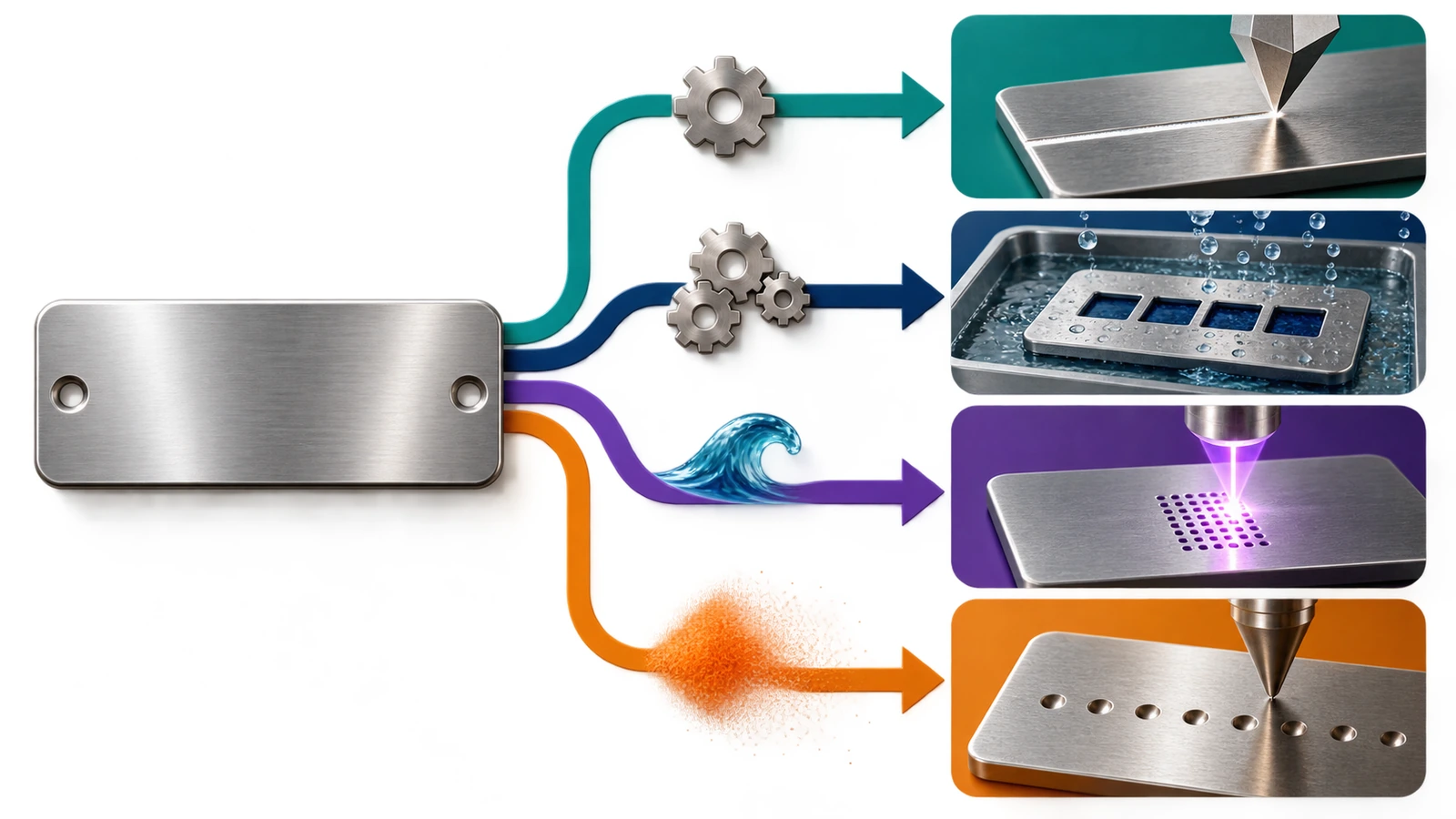
That puts it between three neighboring processes that are often confused with it:
- Rotary engraving uses a spinning cutter that removes chips and can go deeper. It also produces burrs and tool wear.
- Dot peen hammers a pin to form a row of craters. It marks deeper and copes well with rough or curved surfaces, but it is louder and the characters look dotted.
- Chemical etching dissolves metal through a photoresist mask. It creates a recess that can hold color fill, but it needs a mask for every artwork change.
Because the scribed line is continuous and its walls are burnished smooth, scribed text reads as clean single-stroke lettering. CNC scribers and diamond-drag tools run single-line ("stick") fonts, not outline fonts. When you lay out the variable field, you choose stroke paths, not filled shapes.
Engraved stainless is an established marking category in its own right. ASTM's specification for shipboard valve label plates lists "type III - stainless steel, engraved" as a defined plate type.ASTM F992[2] If your customer's drawing references that standard, check whether a drag-scribed mark satisfies its inscription method before you substitute scribing for rotary engraving.
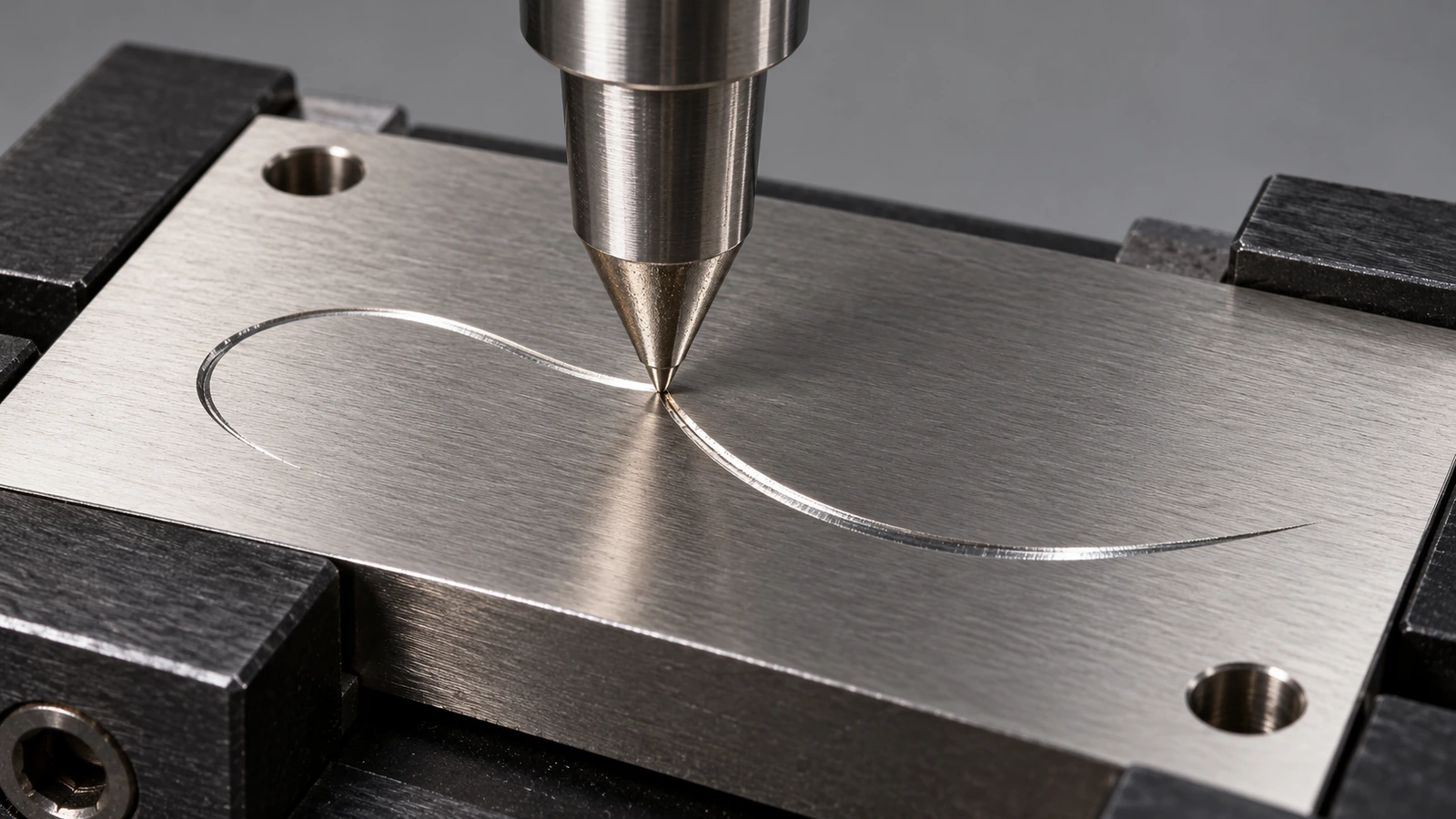
What Happens to 304 and 316 Under the Stylus
No heat input. A fiber laser changes the oxide layer or melts the surface. That is how laser-annealed black marks form, and it is why some users mistake laser discoloration for corrosion. In one metal-finishing forum thread, a user suspected that the "dark discoloration that was left after the laser process is rust/corrosion."Finishing.com discussion[3] Scribing creates no heat tint, so this ambiguity does not come up during incoming or field inspection.
Work hardening and the passive film. Austenitic grades such as 304 and 316 work-harden quickly. The groove wall is cold-worked and burnished, and the chromium-rich passive film is broken along the line and then re-forms in air. Clean scribing therefore does not, by itself, create a corrosion weak point. The real risk is contamination. A U.S. Navy laboratory evaluation of label plate materials (report CARDIVNSWC-TR-62-00-05, 2005) observed rust staining on 304 and 316 plates "especially in the areas where engraving of the label plates was conducted." It attributed the staining to iron particles left by tooling. Two habits follow from that finding. First, keep the stylus tip and fixture free of carbon-steel debris. Second, never clean scribed plates with steel wire brushes or shared grinding wheels.
Grade matters most at the groove. Any chloride attack starts where crevices and cold-worked surfaces exist. ASTM A240/A240M specifies 2.00–3.00% molybdenum for Type 316 and 316L, and 304 has no molybdenum requirement.ASTM A240/A240M[4] For salt spray, de-icing salt or chlorinated washdown, scribe onto 316. Grade selection in detail is covered on our custom etched stainless steel nameplates page, so it is not repeated here.
Plate stiffness. The stylus applies a steady downward load. Thin, unsupported plates flex, and the groove depth then varies across the field. Industrial stainless nameplate stock commonly runs from about 0.018 to 0.125 in. Military construction specifications set floors for some plate types. MIL-DTL-15024 calls for etched or engraved Type A plates of not less than 0.03 in.MIL-DTL-15024[5] Below roughly 0.5 mm, a flat, fully supported fixture is not optional.
How to Set Up In-House Scribing for Serials and Dates
The workflow below assumes a bench-top or line-side scribe marker and pre-etched blanks from a nameplate supplier.
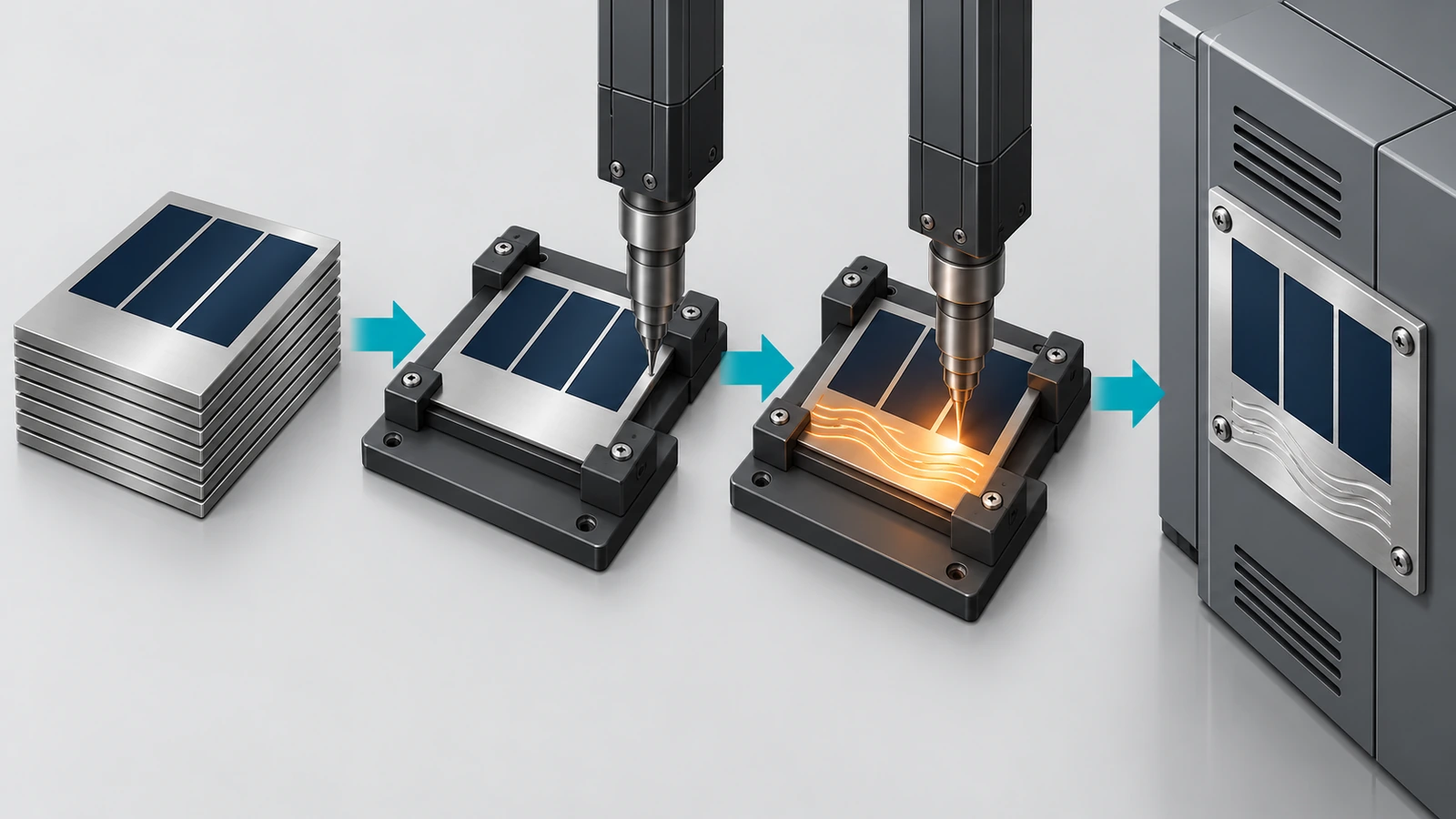
- Design the blank around the scribe zone. Ask your supplier to etch and fill all fixed content and to leave the variable fields as plain, unfilled metal. Etched field labels such as "SERIAL" or "DATE" go next to the zone, not inside it. Leave clear margins from holes and edges, because the stylus needs a flat, unperforated path.
- Pick the surface finish for contrast. A scribed line is a bright, burnished groove. It shows best against a duller surface. A matte #2B or bead-blasted field usually gives better contrast than a highly reflective #4 brush, where the grain can compete with the strokes. Specify the finish of the scribe zone on the blank drawing.
- Build a locating fixture. Hold the plate by its mounting holes or edges on a flat, rigid nest so it cannot shift or flex. Most of the repeatability of a scribing program comes from the fixture: position errors put serials on top of etched text, and flex produces shallow, uneven strokes.
- Choose the tip and set force and speed. Diamond tips hold their point on hardened 300-series stainless and carry no iron to the plate. Carbide tips are cheaper but wear faster on stainless. Start at the marker maker's recommended force for stainless, then adjust force and travel speed together. More force deepens the groove but raises the edge more. Lower speed improves stroke consistency on small characters. Record the final settings as a controlled recipe for each grade and thickness.
- Set character height from the reading distance. Decide where the technician will stand when reading the plate, then size the single-stroke characters for that distance under realistic lighting. Electrical rating data falls under NFPA 79 and NEC 670.3(A) field requirements. Confirm that your scribed fields match what the certifying body expects to see and can read.
- Feed data from a system, not a keyboard. Pull serial and date strings from your MES or ERP and lock the format (for example ISO 8601 dates). Block duplicate serials in software. A permanent mark cannot be corrected. A wrong digit means scrapping the plate, and on etched blanks that is the most expensive part of the assembly.
- Run a first-article check per recipe. Check legibility at the specified distance and under oblique light. Measure groove depth with a depth gauge or a profilometer and keep the trace with the recipe. Then rub-test with your plant's actual cleaning agents and gloves. Repeat after any change of tip, fixture or plate lot.
- Keep the plate clean after marking. Wipe with a non-chlorinated cleaner. If steel contamination is suspected, have the plates passivated (ASTM A967-type treatments are commonly specified) before they go into chloride service.
What about 2D codes and UID marks?
Some scribe markers can draw Data Matrix symbols, but drawing square cells with continuous strokes is slow, and the resulting contrast is low. If the contract invokes MIL-STD-130 unique item identification, the mark must be machine-readable and verifiable.MIL-STD-130N[6] In that case the contract requirements, not supplier preference, decide what the mark must achieve. Where a drawing calls for code-quality grading to ISO/IEC 15415, dot peen or laser is the more practical choice for the code. Scribing remains useful for the human-readable line beside it. Always check the current revision of any military specification in the DLA ASSIST database before quoting.ASSIST QuickSearch[7]
Stainless Steel Nameplate Scribing vs. Chemical Etching, Laser and Dot Peen
Depth figures below come from published supplier and equipment-maker guides and illustrate typical ranges, not guaranteed values. Scribe depth depends heavily on force, tip geometry and plate support, so measure your own process rather than relying on a catalog number.
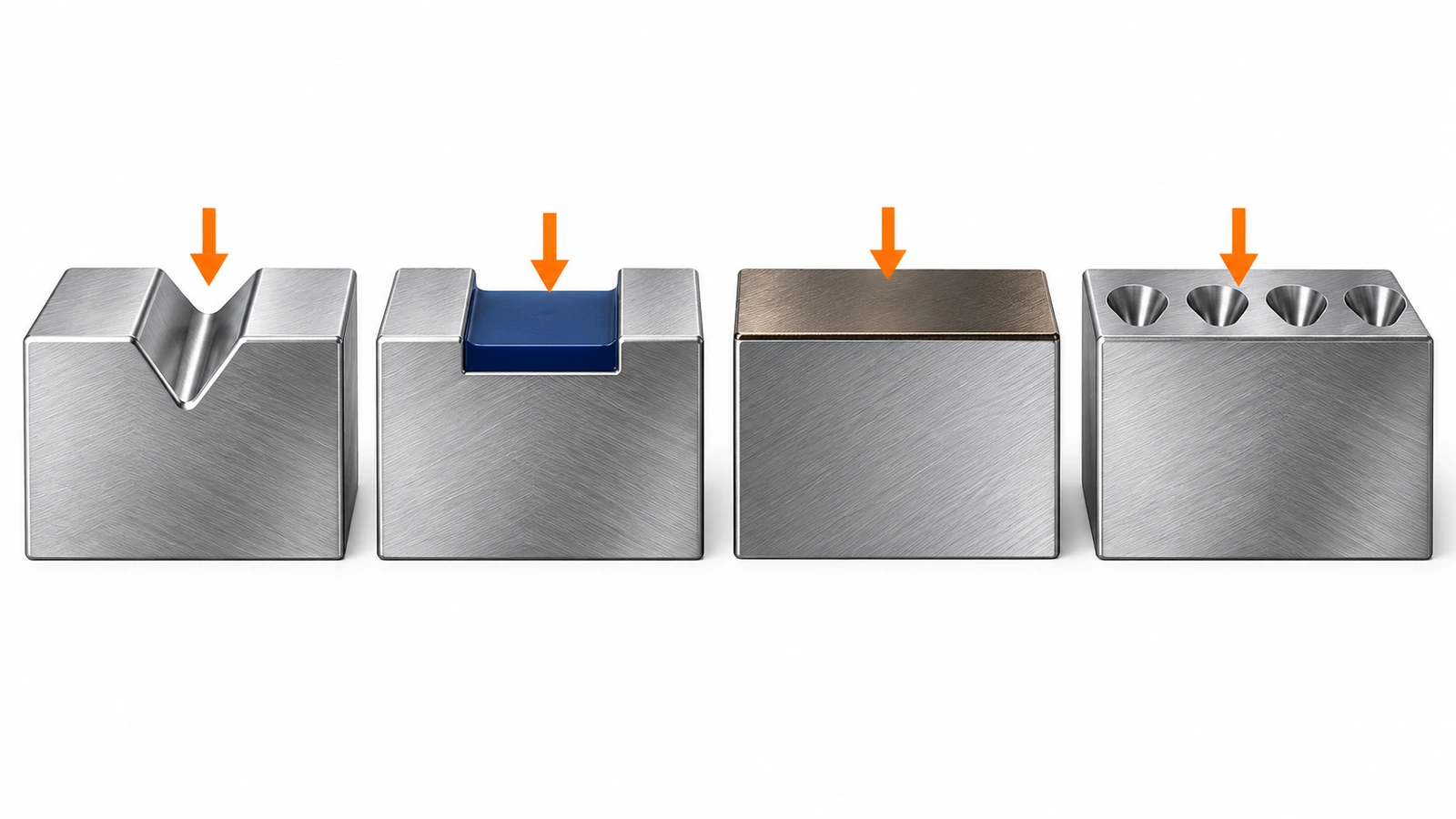
| Factor | Scribe / diamond drag | Chemical etch + fill | Fiber laser (anneal or ablate) | Dot peen | Rotary engraving |
|---|---|---|---|---|---|
| How the mark forms | Stylus plows a continuous burnished groove | Acid dissolves metal through a photoresist mask; recess filled with paint | Heat changes the oxide color or removes surface metal | Pin impacts form crater rows | Spinning cutter removes chips |
| Typical published depth | Shallow; verify per recipe | ~0.0015–0.004 in common; deeper on request | Near zero (anneal) to shallow (ablate) | ~0.2–0.4 mm in equipment-maker examples on 304/316 | ~0.003–0.007 in average cut |
| Per-unit variable data | Yes, from a data feed | No; new mask per artwork | Yes, excellent | Yes | Yes, but slow |
| Contrast source | Light reflection from the groove; no color | Color fill, high contrast | Dark oxide or textured surface | Shadow in craters | Groove; can be filled |
| Heat input | None | None | Yes (heat tint, HAZ) | None | None |
| Consumables and plant needs | Stylus tip; quiet; no fumes | Done at supplier; chemistry and wastewater | Enclosure, fume extraction, laser safety | Pins; noisy | Cutters; chips and burrs |
| Best fit | Serials and dates on pre-made blanks, low to mid volume | Fixed text, logos, safety info at batch volume | Codes, fine graphics, high variable volume | Deep, rugged IDs and DPM codes | Deep text on thicker plates |
One difference does not show up in a depth column: what fails first. Published supplier comparisons note that with etched plates, color fill is the weak point, because the epoxy wears faster than the metal around it. A scribed mark has no fill to lose. Its contrast is purely geometric, so it degrades only when the groove itself is worn, flattened or packed with dirt and paint. That makes scribing more tolerant of solvents and washdown chemistry than a shallow painted mark. It also makes scribing more vulnerable to abrasion and overspray than a deep etch, dot peen or embossed character.
When Scribing Wins and When It Falls Short
Scribing is the better choice when:
- Only a few fields change per unit and the rest of the plate can be etched once at batch volume.
- You need marking at the assembly line without laser enclosures, fume extraction or chemical handling.
- Heat tint is unacceptable, for example on sanitary equipment where inspectors may question any discoloration.
- Noise matters, since scribing is far quieter than dot peen in an assembly area.
- Cleaning chemicals would attack paint fill but abrasion is mild.
Choose something else when:
- The text is safety-critical and permanent, such as hazard warnings, signal words or arc-flash data. Keep these deep-etched and filled at the supplier, never scribed on the line.
- The plate will be painted over, sandblasted or heavily abraded. A shallow groove disappears. Dot peen, deep engraving or embossing survive better.
- You need machine-readable codes graded to a standard. Laser or dot peen gives more reliable cell contrast.
- Volume is high and every plate is unique. A fiber laser's speed and graphics flexibility will eventually beat stroke-by-stroke scribing.
- The surface is curved, textured or rough. A drag stylus needs a flat, smooth path. Dot peen tolerates far more variation.
Frequently Asked Questions
FAQ: Is scribing the same as engraving?
No. Both form a groove, but rotary engraving cuts metal away with a spinning tool, while scribing displaces and burnishes metal with a non-rotating stylus. Scribing leaves no chips, and its lines are usually shallower. Where a specification names "engraved" plates, confirm that a drag-scribed mark qualifies before you substitute it.
FAQ: Will scribing make a 304 or 316 nameplate rust?
A clean scribed groove re-passivates in air. Rust staining on marked stainless is usually caused by iron particles from steel tooling, brushes or nearby grinding, as noted in a Navy laboratory evaluation of engraved label plates. Use diamond tips, keep fixtures clean, avoid steel wire brushes, and specify 316 for chloride exposure.
FAQ: Can I scribe on top of a color-filled etched plate?
Scribe into bare metal fields only. Scribing through paint fill or clear coat chips the coating and leaves ragged edges. Ask your supplier to keep the variable zones unfilled and uncoated.
FAQ: How thin can the plate be?
Thin plates flex under stylus load, which makes groove depth uneven. With full support from a flat fixture, thin stock can be scribed. Without support, expect inconsistency below about 0.5 mm. Military Type A etched or engraved plates under MIL-DTL-15024 call for at least 0.03 in.
FAQ: Is a scribed serial number enough for UL, CE or NEC plates?
The marking method matters less than legibility, durability and complete fields. NEC 670.3(A) and NFPA 79 define what electrical data must appear, and CE machinery plates require items such as the serial number and year of construction. Validate your scribed fields with the certifying body during the first inspection rather than assuming acceptance.
FAQ: Should I buy blanks or fully marked plates?
If more than a few fields change per unit, or if serials must match a build record at final assembly, pre-etched blanks plus in-house scribing usually give better control. If every unit is identical, or you have no line-side marking capacity, fully marked plates are simpler. For blank design, quantities and timing, request a quote on custom stainless steel nameplates.
Key Takeaways
- Scribing is a cold process, so it leaves no heat tint for inspectors to mistake for corrosion. — 1 forum case where laser discoloration was suspected as rust (Source)
- Scribe variable fields on 316 whenever chlorides are present. — Type 316 specifies 2.00–3.00% Mo (Source)
- Engraved stainless is a recognized plate category, but check the inscription method the drawing calls for. — ASTM F992-17 (reapproved 2022), Type III (Source)
- Plate rigidity governs scribe consistency, so fixture thin stock fully. — 0.03 in minimum for MIL-DTL-15024 Type A (Source)
- Contract UID marks need machine-readable codes, which usually means laser or dot peen next to the scribed text. — MIL-STD-130N, 2007, Change 1 in 2012 (Source)
- Low-volume serialization is exactly where outside vendors become a bottleneck. — ~50 serialized tags per month in one practitioner case (Source)
Conclusion
Scribing does not replace etching or laser marking. It works best alongside them. The pattern most OEMs settle on is to etch and fill everything permanent and safety-related at the supplier, then scribe only the fields that change per unit, on a fixtured, recipe-controlled marker at the line. That keeps serials matched to build records, avoids heat tint and paint-fill wear on those fields, and removes the plate supplier from the critical path of final assembly. Where codes, abrasion, overspray or high variable volume are involved, move those fields to laser or dot peen.
If you are planning a hybrid program, start with the blank: reserved scribe zones, a matte field finish and the right grade. Our etched 304 and 316 equipment nameplates can be built with unfilled variable-data fields. Send your drawing and environment details for a quote.
References
- Reddit r/lasercutting, "Cutting / etching stainless steel nameplates," practitioner discussion of in-house serialized tag marking, 2025-04-29. https://www.reddit.com/r/lasercutting/comments/1kayy4b/cutting_etching_stainless_steel_nameplates_and/ ↩
- ASTM International, ASTM F992-17(2022), Standard Specification for Valve Label Plates. https://doi.org/10.1520/F0992 ↩
- Finishing.com, discussion thread on discoloration after laser marking stainless steel. https://www.finishing.com/151/41.shtml ↩
- ASTM International, ASTM A240/A240M-25a, Chromium and Chromium-Nickel Stainless Steel Plate, Sheet, and Strip. https://www.astm.org/a0240_a0240m-25a.html ↩
- Defense Logistics Agency, QuickSearch document image, MIL-DTL-15024 Plates, Tags and Bands for Identification of Equipment. https://quicksearch.dla.mil/ImageRedirector.aspx?token=107391.11007 ↩
- U.S. Department of Defense, MIL-STD-130N w/Change 1, Identification Marking of U.S. Military Property (2007; Change 1, 2012). https://pieetraining.eb.mil/cms/docs/Supporting/mil-std130N_ch1.pdf ↩
- Defense Logistics Agency, ASSIST QuickSearch, official database for current military specifications and standards. https://quicksearch.dla.mil/ ↩












The information below is required for social login
Sign In
Create New Account