


 Blog PDF for offline reading
Quick answer: To produce rhinestone letter stickers for a team, uniform program or event, start by cleaning the roster data. Choose a typeface with strokes at least two stones wide, and match stone size to letter height and viewing distance. Use pre-built name or number sheets when every name is different, then kit and label each order by name or number before it ships.
Ordering one sparkly monogram is easy. Ordering 30 cheer names, a full set of jersey numbers or 400 personalized event badges is a data job that happens to involve crystals. Most rhinestone letter stickers on the retail market come as alphabet packs designed for one-off crafts. Their weaknesses only show when you scale them. A pack runs out of E's halfway through the roster. A thin script name turns into scattered dots when seen from the bleachers. A 6 gets applied upside down as a 9. A late roster change forces someone to re-sort every bag.
Each mistake costs more than the stickers themselves, because it lands on a coach, a volunteer or a customer-service desk the week of the event. Public buyer reviews of stock alphabet and gem sheets repeat the same complaints: stones joined in strips that have to be cut apart, backing adhesive that stays on the liner, and a strong chemical smell when the pack is opened. Every one of those problems multiplies by the number of kits. Praise in the custom segment is just as consistent. Buyers rate sellers highly when they see a mockup of their design before it ships, and one reviewer noted that a 30-member cheer squad order arrived with previews approved in advance.
The fix is to plan letters and numbers the way a uniform supplier plans sizes. Treat each character as a line item, each name as a SKU and each recipient as a kit. This guide covers that process in order: the roster file, the typeface, stone sizing, name and number layout, format choice, kitting, proofing, and the compliance checks that apply when the wearers are children.
What Are Rhinestone Letter Stickers and Rhinestone Numbers?
Rhinestone letter stickers are characters (letters, digits, punctuation) built from flat-backed crystals or acrylic stones and held on a backing so they can be transferred to a surface as a unit. For roster work they come in three practical formats:
- Stock alphabet sheets. Rhinestone sticker sheets carrying a fixed set of individual letters or digits. You assemble names by hand.
- Individual custom characters. Single letters or rhinestone numbers made in your chosen typeface, stone size and color, then supplied in the quantities your roster needs.
- Name or number motifs. Each complete name, number or name-and-number lockup is built as one piece on one carrier, so spacing and alignment are fixed before it reaches the user.
The adhesive (peel-and-stick or heat-applied) depends on the surface, whether that is a polyester jersey, a stainless tumbler or a lanyard card. Our page on custom rhinestone stickers specified for your surface covers that choice. This guide stays with what changes when you multiply letters and numbers across dozens or hundreds of people.
How to Plan Rhinestone Letter Stickers for a Full Roster
Step 1: Build the roster file before the artwork
The roster spreadsheet is the real production document, and the artwork is generated from it. Give every row a unique ID and columns for display name, number, garment or item size, placement (back, sleeve, tumbler, badge), quantity and delivery group. Before any design work, normalize the data:
- Case and spelling. Choose all caps or mixed case and apply it to everyone. Confirm the spelling with the person, not the registration form.
- Special characters. Flag apostrophes (O'NEIL), hyphens (SMITH-LEE), spaces, and accented letters such as Ñ, É or Ü. A stock alphabet sheet rarely includes them, and a custom typeface has to be drawn with them.
- Length. Sort by character count. The longest name sets your name-bar width (see Step 4).
- Number conflicts. Check for duplicate jersey numbers and for numbers that read ambiguously when rotated (6, 9, 66, 99, 69).
If you are kitting from stock sheets, count character demand directly in the spreadsheet. In Excel or Google Sheets, =LEN(B2)-LEN(SUBSTITUTE(UPPER(B2),"A","")) returns how many A's appear in the name in cell B2. Copy the formula across a column for each letter and sum the columns. Names are not evenly distributed across the alphabet. A sheet with one of each letter will run out of A, E, N and R long before it runs out of Q or Z, which is the most common reason alphabet-pack projects stall halfway.
Step 2: Choose a stone-friendly typeface
A rhinestone character is a path of dots, so typefaces that look elegant on screen often fall apart in stones. Use these rules when you choose or approve a font:
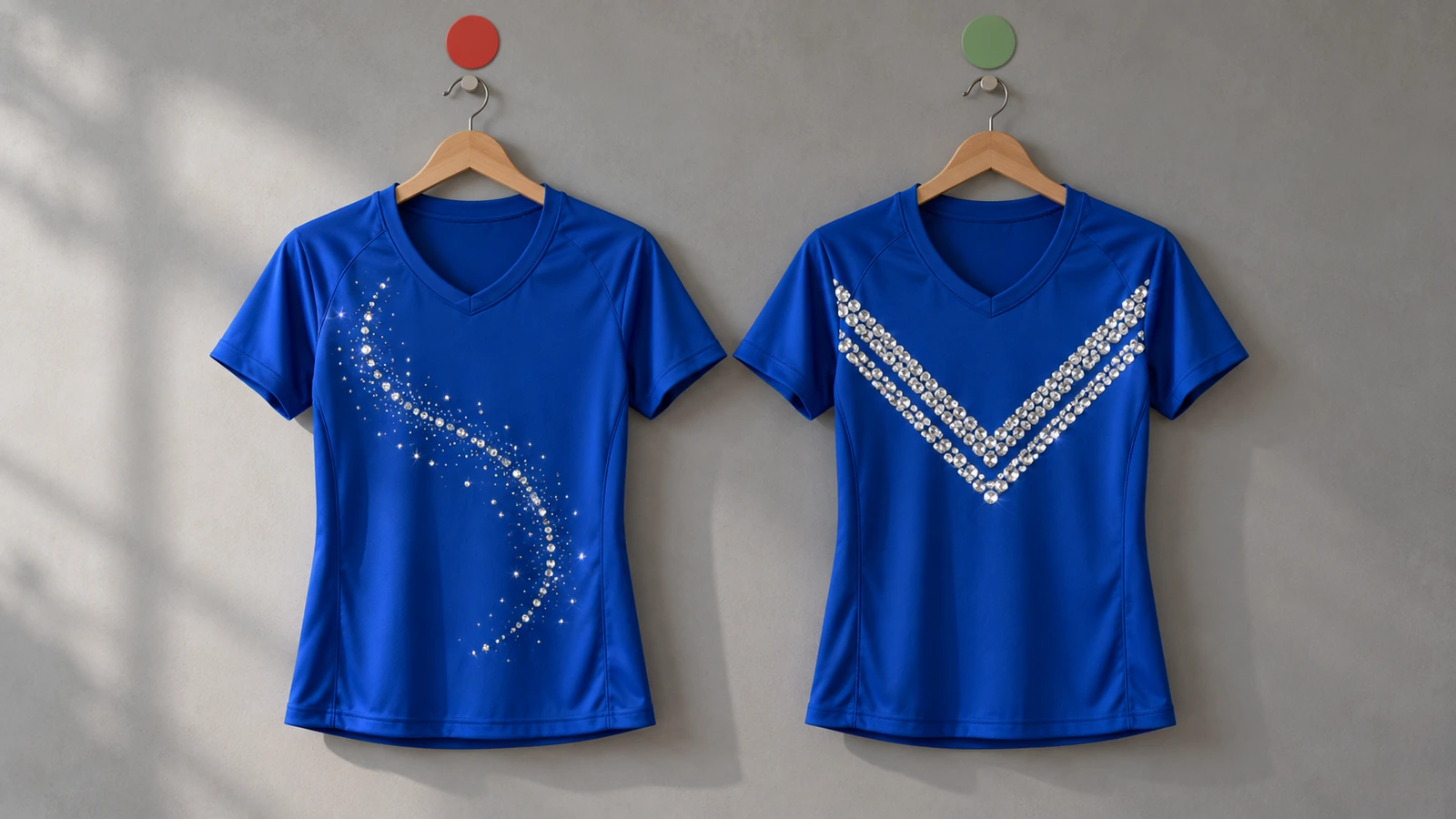
- Strokes at least two stones wide for filled characters. Alternatively, use a clean single-row outline at a large size. Hairline serifs and thin crossbars become isolated stones that read as noise.
- Open counters. The enclosed spaces in A, B, O, R, 0 and 8 should stay at least one stone-width open, or the character fills in and loses its shape.
- Script only at large sizes, with connected strokes, because joined lettering needs enough stones on each curve to look continuous.
- Disambiguate lookalikes. Give the 1 a flag or base so it differs from I and l. Make 0 narrower than O. Add a clear tail or curve so 6 and 9 cannot be swapped by rotation.
Color counts as much as shape. Clear crystals on a white jersey lose contrast, and dark stones on navy disappear from a distance. Pick stone colors against the actual garment or surface color, not a white mockup background. Some crystal component makers now promote cadmium-free red shades as a materials trend[1]. For youth programs, still ask for test documentation rather than trusting a color name (see Step 8).
Step 3: Match stone size to letter height
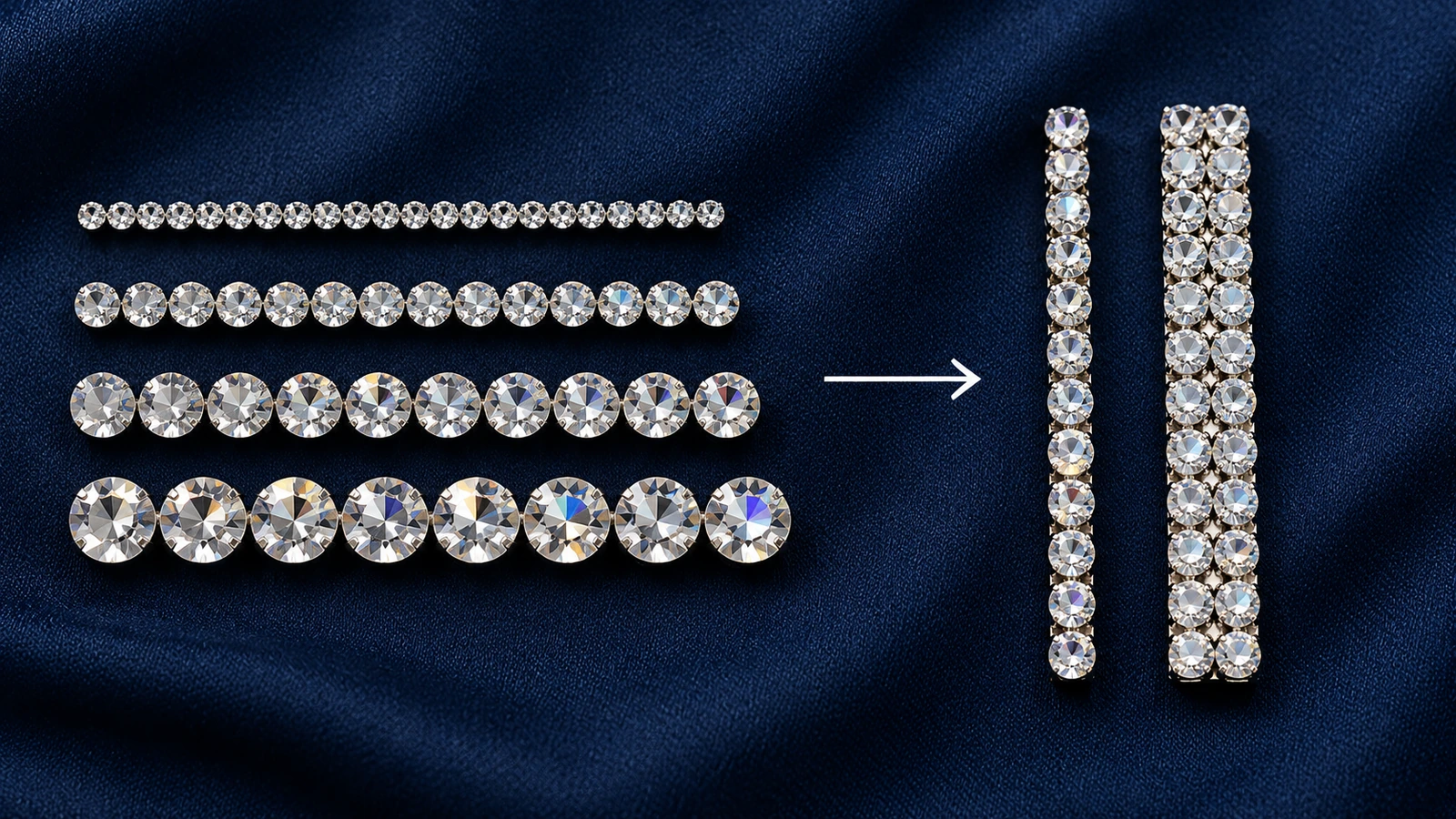
Rhinestones are sized in "SS" (stone size) grades. Suppliers' conversion charts give each grade as a diameter range rather than a single value, and the ranges vary slightly between makers. Treat the figures below as planning references and confirm the exact stone with your supplier.
| Stone grade | Typical diameter range | Approx. single-row stroke | Approx. double-row stroke | Typical roster use |
|---|---|---|---|---|
| SS6 | 1.9–2.1 mm | ~2 mm | ~4 mm | Small detail, accents, close-viewed badges |
| SS10 | 2.7–2.9 mm | ~3 mm | ~6 mm | Name runs, sleeve text, general letter fill |
| SS16 | 3.8–4.0 mm | ~4 mm | ~8 mm | Team names, medium numbers, outlines |
| SS20 | 4.6–4.8 mm | ~5 mm | ~10 mm | Large numbers and borders viewed from a distance |
A quick check: divide the planned cap height by the stone diameter plus spacing to see how many stones fit on a vertical stroke. When that count gets low, curved characters such as S, G, 3 and 8 start to look stepped. Fix this by moving to a smaller stone or increasing the letter height rather than accepting a blocky curve. Mixing two stone sizes inside one character, with larger stones on the straights and smaller ones on tight curves, smooths the shape. However, it adds a second stone to track in production and kitting.
Tolerances matter more at volume than on a single piece. One hobbyist in a public rhinestoning forum reported SS12 stones constantly shifting in a template cut with 3.4 mm holes, and other users noted stones of mixed sizes within a single bag. If your supplier builds characters from templates, ask which stone grade each template is cut for. Inconsistent stones also show up first on the long, straight strokes of numbers, where any irregularity is easy to see.
Step 4: Size jersey numbers and name runs as a system
Name runs and numbers fail when each one is sized individually. Set the rules once and apply them to the whole roster:
- Fixed height, maximum width. Keep cap height identical for every name and define a maximum width for the name bar. Names that exceed it, which you identified in Step 1, get a condensed version of the same typeface or tighter tracking. Never use a smaller height, because one shrunken name on a line of players is the first thing spectators notice.
- Center to the zone, not the first letter. A three-letter name and a twelve-letter name should share a center line. Mark that center line on the garment or on a placement guide, not on each sticker.
- Single and double digits. Keep digit height constant. Center single-digit numbers optically, then confirm that the outer edges of double-digit numbers still sit within the placement zone.
- League and venue rules. If the garment is a competition uniform, check your governing body's rulebook for number height, placement, contrast and whether decorative embellishment is allowed before you finalize sizes.
- Curved surfaces. On tumblers, caps and arm sleeves, long name runs wrap around the curve, and the end letters face away from the viewer. Shorter runs or slightly larger letter spacing near the ends help them stay readable.
Step 5: Decide between sheets and individual characters
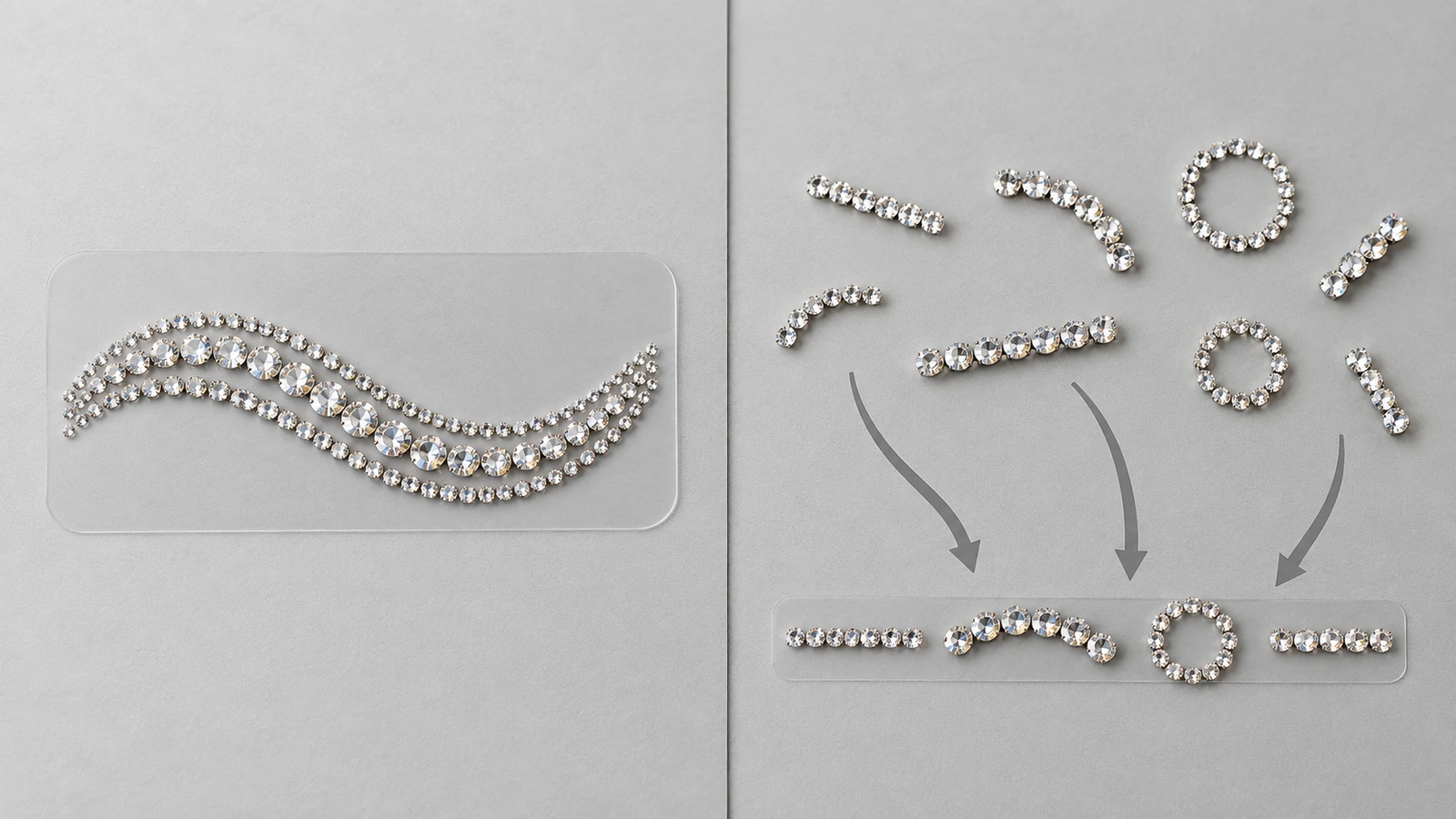
Your format choice determines who does the alignment work and where errors can happen. Stock rhinestone sticker sheets put all assembly on the end user. Individual custom characters cut stock waste but still require hand alignment. Pre-built name or number motifs move spacing and spelling control to the production stage. The comparison table below sets the trade-offs side by side. A common hybrid for teams is a shared logo or team-name motif made as one design, combined with a separate pre-built name strip and number for each person.
Step 6: Kit by name or number
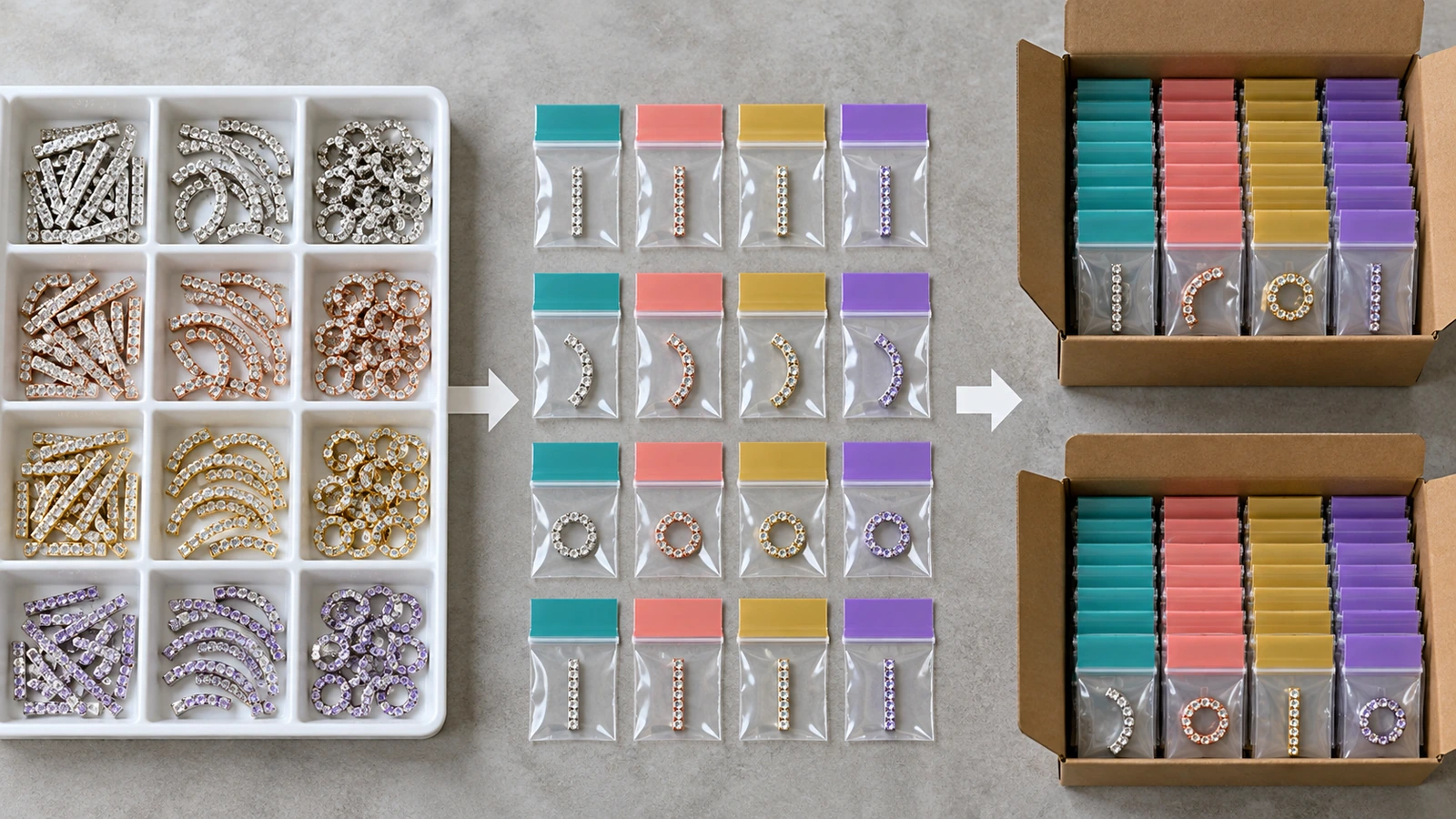
Kitting is where a well-planned roster either holds together or falls apart. Build each kit around one roster ID, not around a character type:
- One kit per person or per item, labeled outside with roster ID, name, number and garment size, so the distributor never has to open it to check.
- Pack in distribution order. That might be squad, then position, then alphabetical by last name, or check-in table order for events. A box packed in the same sequence as the hand-out list can be handed out in minutes.
- Include spare characters only where they are needed. The letters most at risk are the ones that appear twice in a name (two N's in ANNA, two 1's in 11).
- Mark orientation on 6, 9, M and W when characters are supplied individually, with a small arrow or baseline mark on the carrier. A rotated 6 is a correctly spelled 9.
- Hold blank or overflow kits for late additions, and keep a versioned roster file so everyone knows which list a kit was built from.
- Air out sealed kits if reviews or samples of a material mention a strong odor, especially when kits go home with children.
Step 7: Proof the roster, not just the design
Approving one sample name does not prove the other 29. Ask for a mockup of every unique name and number, or at least of the longest name, the shortest name, every name with special characters and every number with a rotation risk. Have the team contact sign off on a specific file version. Remember that heat-applied transfers are carried face-down, so the template artwork for text is mirrored even though the finished piece reads correctly. Check the final orientation on the mockup, not on the template file. General sampling and approval steps for custom pieces are covered on our custom rhinestone sticker page. The roster-specific step is checking every name, not a representative one.
Step 8: Check who will wear or handle the stickers
Adult spirit wear and corporate merchandise sit in a different regulatory category from items made for children. Once a product is designed or marketed mainly for children 12 and under, US rules for children's products apply. The CPSC total lead content guidance[2] sets a 100 ppm limit for lead in accessible substrate materials. Paint and surface coatings are held to a separate 90 ppm limit[3]. The materials that can skip third-party lead testing are listed in 16 CFR 1500.91[4]. Glass or acrylic stones, coatings and adhesives are not on that list, so a youth roster needs real test reports.
Choking risk depends on the format. The CPSC small-parts rules[5] cover items intended for children under 3. Children's clothing is exempt, but loose sticker sheets handed out as event giveaways are not clothing. Enforcement against decorated youth items is ongoing. The CPSC recalled about 12,440 children's rhinestone tiaras[6] in January 2024 because of lead in the stones. Washington State's 2025 retail sampling[7] found 6 of 60 component samples above its levels of concern, which are 90 ppm for lead and 40 ppm for cadmium. In Canada, Health Canada tested 38 imported children's jewellery products[8] in 2024–2025, which led to 3 recalls and 2 alerts. A US lead report alone does not cover a cross-border youth order.
Import paperwork has also changed. Since July 8, 2026, certificate data for regulated imported products must be eFiled[9] before entry. The CPSC states this creates no new testing obligation. It does mean a youth order needs a Children's Product Certificate[10] ready at import, not after a buyer asks for it. Stickers sold as toys in the EU will eventually fall under Regulation (EU) 2025/2509[11], which fully applies from August 1, 2030.
Rhinestone Sticker Sheets vs Individual Characters vs Name Motifs
| Factor | Stock alphabet sheets | Individual custom characters | Pre-built name / number motifs |
|---|---|---|---|
| Best fit | Small groups, craft sessions, last-minute single names | Uniform programs with a house font and recurring rosters | Teams, events and merchandise runs where every name differs |
| Variable data handling | User assembles each name, and letter supply is fixed by the sheet | Supplied in counted quantities per character | Each name or number is built as one finished piece |
| Character shortages | High risk on common letters (A, E, N, R) and repeat digits | Low if quantities come from a roster count | None. Characters come with the name |
| Spacing and alignment | Done by hand on every item | Done by hand with a placement guide | Fixed at production |
| Special characters | Usually missing (accents, apostrophes) | Must be drawn into the font | Built per name |
| Rotation errors (6/9, M/W) | Common | Possible unless orientation is marked | Eliminated |
| Proofing effort | None upfront, so errors surface at application | Proof the font once, then count quantities | Proof every unique name |
| Leftover waste | High (unused letters) | Low | Minimal beyond spares |
| Kitting | Sheets shared across a group | Characters picked per kit | One motif per kit, labeled by roster ID |
FAQ
FAQ: What stone size works best for rhinestone numbers on a jersey?
It depends on number height and viewing distance. Many decorators use SS16 to SS20 for large back numbers and outlines meant to be read from the stands, and SS10 for name runs and sleeve text. Choose the size so that each stroke is at least two stones wide, or a clean outline, at your planned height. Then confirm with a full-size mockup held at real viewing distance.
FAQ: Can I build team names from stock alphabet rhinestone sticker sheets?
For a handful of names, yes. For a full roster, count letter demand from the spreadsheet first, because one-of-each sheets run out of common letters quickly and rarely include accents or apostrophes. Budget time for hand alignment on every item, and use a straight-edge guide so baselines match across the team.
FAQ: How should we handle roster changes after the order is placed?
Set a roster lock date. Version the file (v1, v2, final) and keep a few blank or overflow kits for late additions. Ask your supplier how changes after proof approval are handled before you submit, rather than finding out when a name changes.
FAQ: Why does the transfer artwork for our names look backwards?
Heat-applied rhinestone transfers sit face-down on the carrier, so text is mirrored on the template and reads correctly once applied. Peel-and-stick formats are usually not mirrored. Always judge spelling and orientation on the finished-view mockup, not on the production template.
FAQ: Are rhinestone letter stickers safe for youth cheer or dance teams?
They can be, but youth products need documentation. In the US, children's products must meet the 100 ppm substrate lead limit and the 90 ppm coating limit, backed by testing and a Children's Product Certificate. Loose stickers handed to children under 3 also raise small-parts concerns. Ask for test reports that cover the stones, coatings and adhesive actually used.
FAQ: Can branded rhinestone stickers go on a car steering wheel?
Do not market or kit them for steering wheels. NHTSA has warned that decorative emblems on steering wheels[12] can become projectiles when an airbag deploys. Merchandise buyers should state a "not for steering wheels or airbag covers" limitation on vehicle-themed items.
Key Takeaways
- Youth rosters need lead testing for stones, coatings and adhesive, not just a color or material claim. — 100 ppm substrate limit for children's products (Source)
- Coated or painted stones and carriers are held to a stricter limit than the base material. — 90 ppm for paint and surface coatings (Source)
- Imported youth orders need certificate data ready at the border. — eFiling mandatory since July 8, 2026 (Source)
- Cheap decorated children's items still fail independent sampling. — 6 of 60 components (10%) above Washington's levels of concern (Source)
- Cross-border youth orders need each market's rules, not one report. — 38 imported products tested in Canada, 3 recalls (Source)
- Rhinestones themselves have triggered children's product recalls. — about 12,440 rhinestone tiaras recalled for lead (Source)
Bottom Line for Roster Buyers
At scale, letters and numbers are a logistics problem first and a sparkle problem second. Clean the roster before the artwork. Choose a typeface the stones can actually draw. Size every name and number from one shared rule set, choose the format that puts alignment where it is least likely to go wrong, and kit by roster ID in hand-out order. For youth teams, add the compliance paperwork to the plan from the start.
When your roster file is ready, send it with the placement, surface and audience details through our custom rhinestone sticker motifs page and request a quote. We will review the longest names, special characters and number set with you before production.
Sources
- WWD, "Swarovski Components Fall 2027: Persian Red," October 1, 2026. wwd.com ↩
- U.S. Consumer Product Safety Commission, "Total Lead Content," business guidance. Accessed October 2026. cpsc.gov ↩
- LegalClarity, "CPSIA Lead Limits: 100 ppm and 90 ppm for Children's Products," May 19, 2026. legalclarity.org ↩
- Electronic Code of Federal Regulations, 16 CFR § 1500.91, determinations regarding lead content for certain materials. Accessed October 2026. ecfr.gov ↩
- U.S. CPSC, "Small Parts for Toys and Children's Products," business guidance. Accessed October 2026. cpsc.gov ↩
- U.S. CPSC, Recall 24-093, children's rhinestone silver tiaras, January 25, 2024. cpsc.gov ↩
- Washington State Department of Ecology, Publication 26-03-006, August 2026. ecology.wa.gov ↩
- Health Canada, "Compliance Verification Project 2024–2025: Children's Jewellery Regulations." Accessed October 2026. canada.ca ↩
- U.S. CPSC, "CPSC Implements Mandatory eFiling for Certificates of Compliance," July 8, 2026. cpsc.gov ↩
- U.S. CPSC, "Certificates," business guidance (16 CFR part 1110). Accessed October 2026. cpsc.gov ↩
- Regulation (EU) 2025/2509 on the safety of toys, Official Journal of the European Union, December 12, 2025. europa.eu ↩
- National Highway Traffic Safety Administration, "Consumer Alert: Steering Wheel Decorative Emblem Decals." Accessed October 2026. nhtsa.gov ↩












The information below is required for social login
Sign In
Create New Account