We use cookies to enable our websites to remember information, to help some website functionalities to work properly, to understand how you interact with and use our websites and to display you content and ads that are relevant and engaging for you.
By clicking Accept All you consent to the use of these cookie.
The store will not work correctly when cookies are disabled.
Quick answer: In the PVC vs TPU vs EVA clear pouches comparison, PVC gives the sharpest clarity, easiest RF welding and lowest unit cost, but it carries the most odor, cold-crack and phthalate scrutiny. TPU stays clear and flexible in the cold and needs no plasticizer, at a higher price. EVA is soft and plasticizer-free, but it is usually frosted rather than glass-clear and is normally heat-sealed instead of RF-welded.
Buyers comparing PVC vs TPU vs EVA clear pouches usually start from one question: which film keeps the kit visible, the logo crisp and the compliance file clean? The three films look similar on a supplier's sample board. They behave very differently once a pouch is filled, shipped through a winter warehouse, opened on a store shelf or sent to a lab for testing. This guide compares them on seven criteria (clarity, cold-crack resistance, odor, print adhesion, weld strength, regulatory acceptance and cost) so you can pick a film before you request samples.
Why the film decision goes wrong so often
Most complaints about clear zipper pouches are not about the design. Public buyer reviews of budget clear pouches return to the same four failures: the zipper separates from the film, the bag smells of chemicals on arrival, the film is thinner than promised and cracks at a corner, and the clear panel clouds or yellows after a few months. Three of those four start with the film, not the zipper.
The cost of a wrong choice grows quickly. A pouch that smells when a customer opens a beauty gift reflects on the brand inside it. A PVC pouch shipped into California without a phthalate test can draw a Proposition 65 notice. A frosted EVA pouch chosen to "avoid PVC" can disappoint a retail team that expected crystal-clear shelf visibility. Each of these is a material mismatch that a side-by-side comparison would have flagged before sampling.
The fix is to decide on the film using use-case evidence, then confirm it with targeted sample tests. The sections below give you that evidence and the tests.
What PVC, TPU and EVA actually are
Flexible PVC (polyvinyl chloride) is a rigid polymer that becomes soft only when plasticizers are added. Chlorine is part of the polymer itself, so it cannot be formulated out. Plasticizers can be legacy phthalates such as DEHP or non-phthalate alternatives. That one formulation choice drives most of PVC's odor, cold-performance and compliance outcomes. The US reference specification for this material, ASTM D1593[1], covers nonrigid vinyl chloride film and sheeting in which the resin contains at least 90% vinyl chloride. Material up to 0.25 mm is classified as film and thicker material as sheeting. Pouch suppliers often quote "PVC" without saying which side of that line they mean.
TPU (thermoplastic polyurethane) is an elastomer that is flexible on its own, with no plasticizer added. It comes in two main families. Aromatic TPU is cheaper and can yellow under UV light. Aliphatic TPU resists yellowing and costs more. "TPU" on a quote is therefore not a single specification.
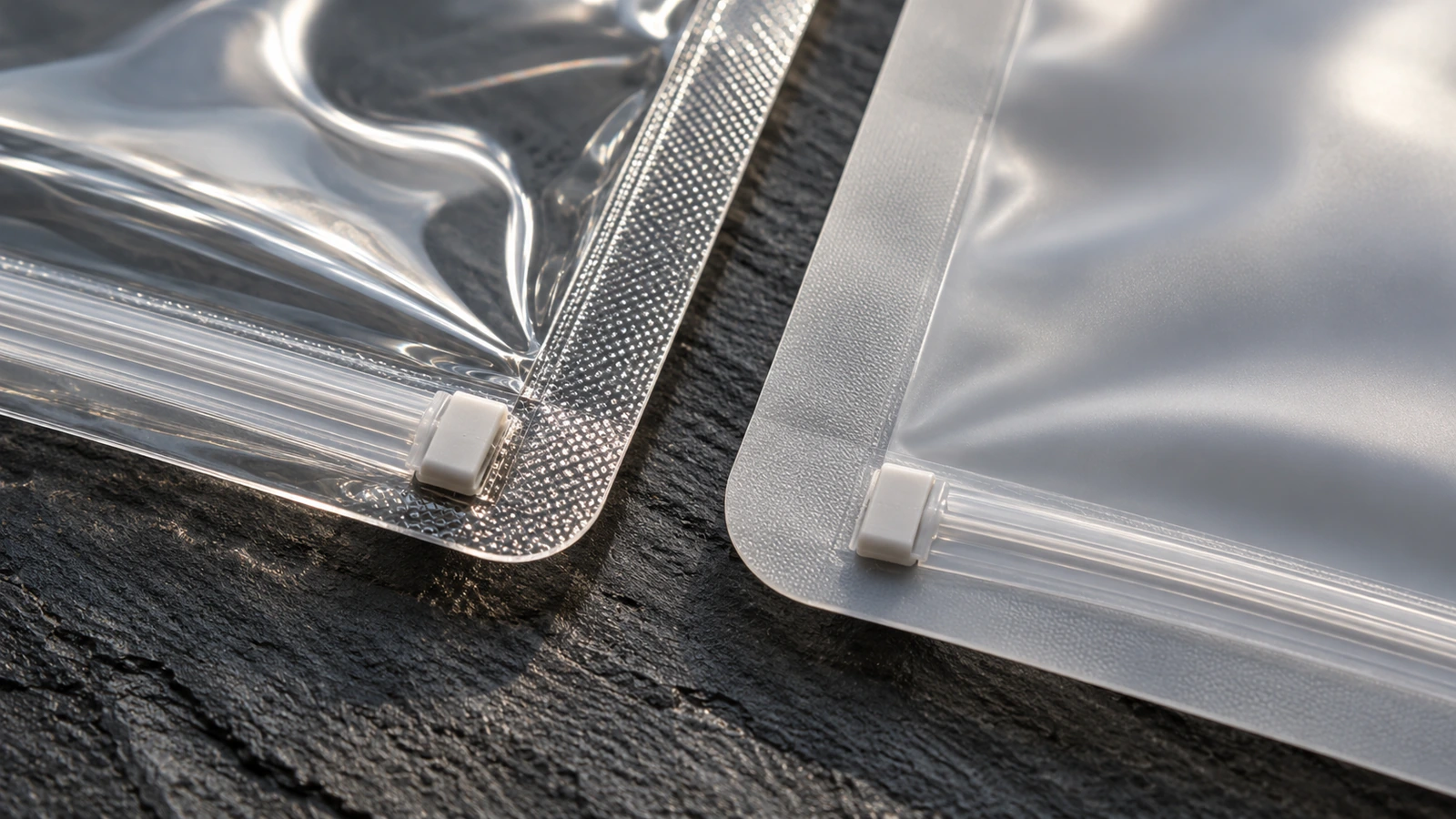
EVA (ethylene vinyl acetate) is a copolymer of ethylene and vinyl acetate. A higher vinyl acetate content makes the film softer and clearer. EVA also needs no plasticizer. In pouch work it is usually supplied as a matte or frosted film, and because it is a low-polarity polymer it responds poorly to radio-frequency welding. That point affects seam construction, which is covered below.
PVC vs TPU vs EVA clear pouches: side-by-side comparison
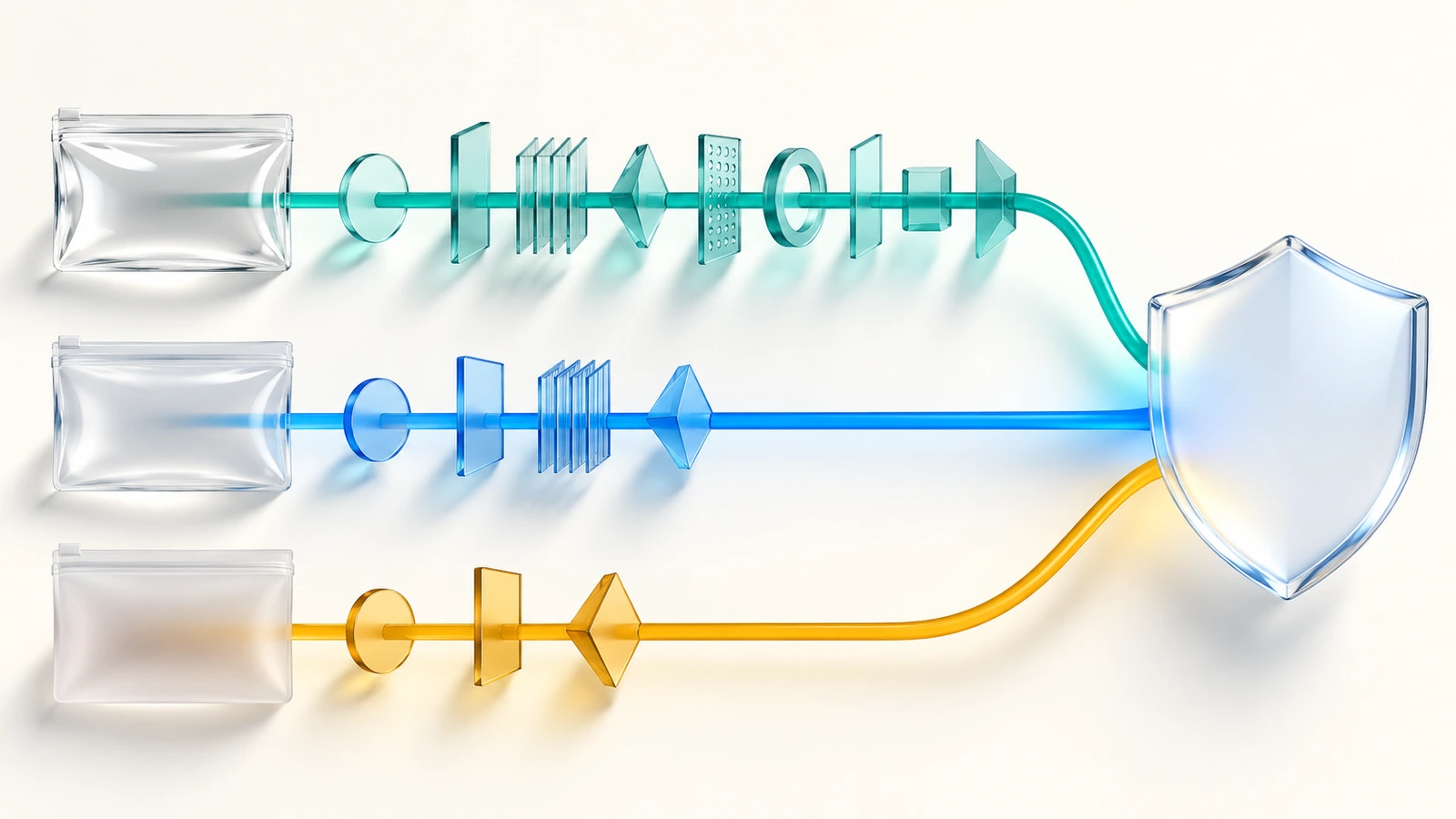
The ratings below are relative. They compare typical commercial grades of each film for branded zipper pouches; they are not laboratory scores. Any one supplier's formulation can move a rating up or down, which is why the how-to section ends with sample tests.
Criterion
Flexible PVC
TPU
EVA
Clarity
Highest, glass-like; can cloud or yellow with heat and UV
High; aliphatic grades hold clarity, aromatic grades can yellow
Usually frosted or translucent; rarely glass-clear
Cold-crack resistance
Weakest; stiffens near freezing, and corners and folds can crack
Strong; stays flexible at low temperatures
Good; remains soft in the cold
Odor risk
Highest; plasticizer and stabilizer package dependent
Low
Low; occasionally a faint vinegar note
Print adhesion
Easiest; standard vinyl screen inks bond well
Good with TPU-matched inks; validate adhesion
Hardest; low surface energy needs treatment or matched inks
Short-cycle promo kits and gift-with-purchase pouches where clarity and price lead
Reusable travel and beauty pouches and cold-chain shipments
Soft-touch toiletry and spa kits where a frosted look is acceptable
How each film behaves, criterion by criterion
Clarity: day one versus month six
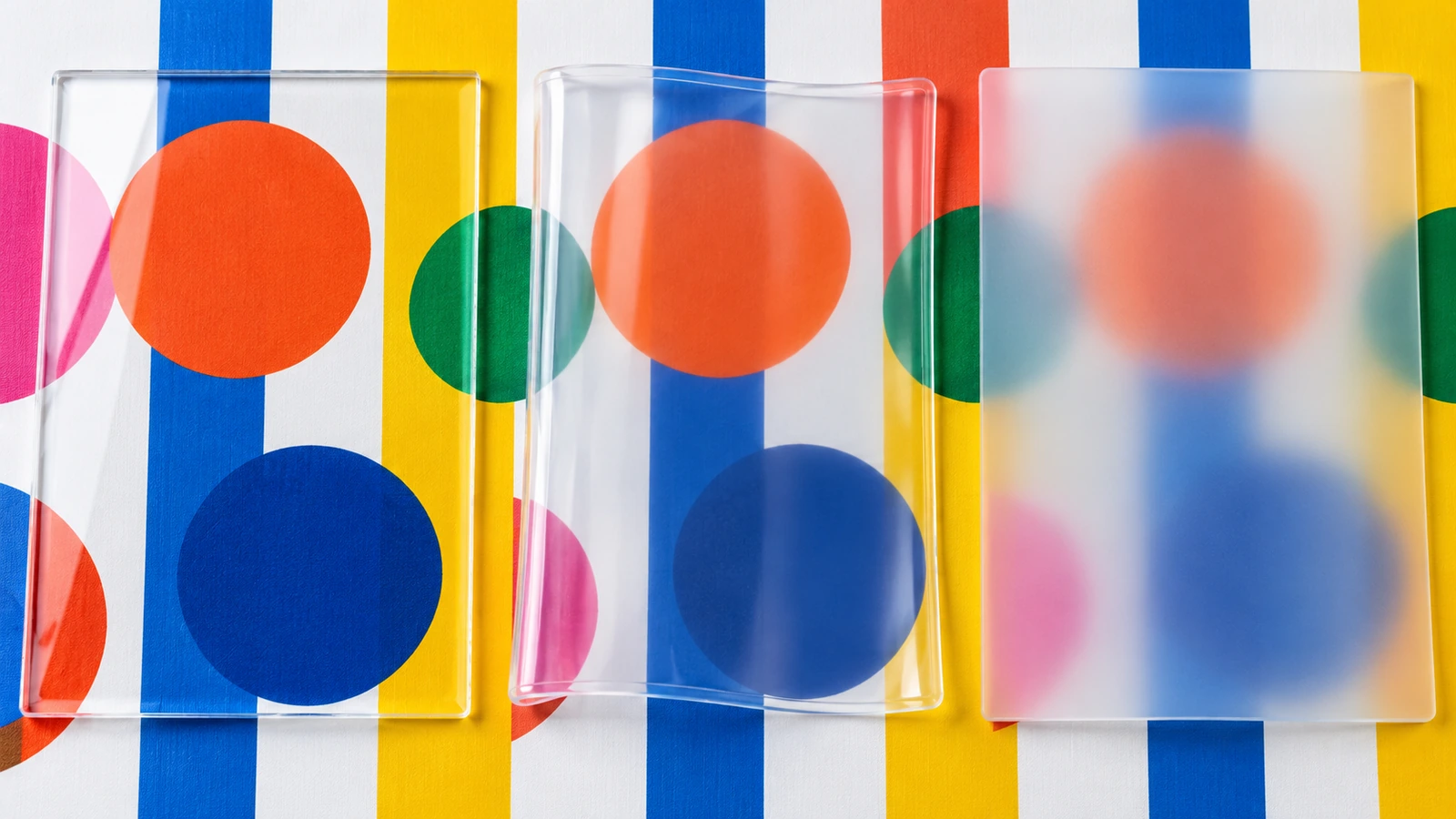
PVC usually wins the unboxing photo. Its weakness is over time: heat, sunlight and plasticizer migration can cloud the surface or turn it yellow, and the visibility that justified the purchase fades. TPU starts almost as clear. Over months the main variable is the TPU family, because aliphatic grades resist yellowing and aromatic grades may not. EVA has the opposite profile. It is rarely glass-clear on day one, but a frosted surface also hides the fine scratches that clear PVC shows. If the brief says "contents visible at a glance," EVA can work. If it says "crystal clear," EVA is the wrong film.
Cold-crack resistance
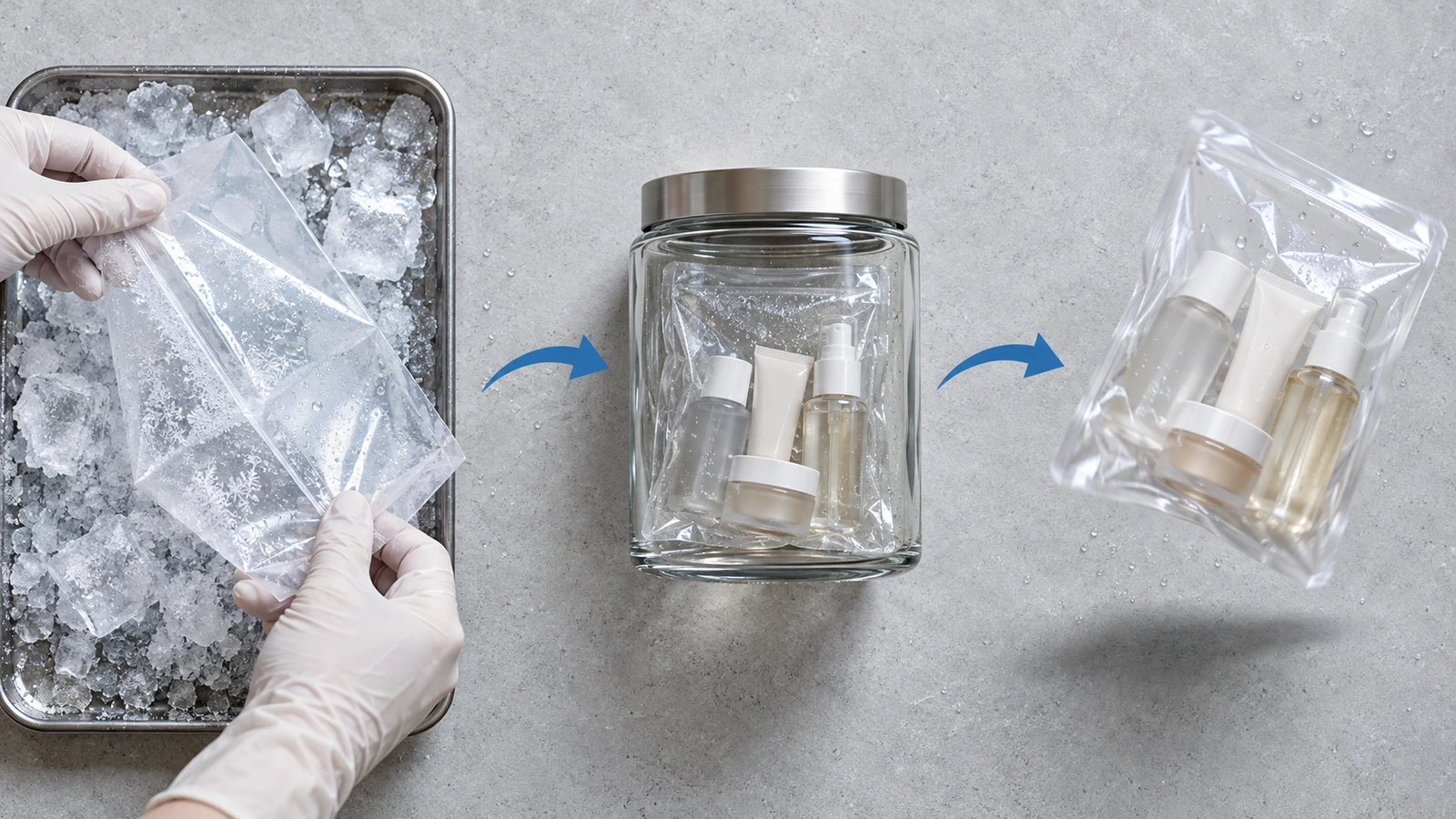
Plasticized PVC stiffens as temperatures fall. A pouch flexed in a cold truck or an unheated warehouse can crack along folds and at welded corners. Buyer reviews describing corners that "cracked when dropped" are often cold-stiffness failures. TPU and EVA both stay flexible at low temperatures. For winter shipping or outdoor-event kits, ask suppliers for brittleness-temperature data (ASTM D1790 is the usual impact method for plastic sheeting), or run a simple fold test on samples that have been chilled overnight.
Odor
Odor is the fastest way a clear pouch fails a buyer review. Public reviews of low-cost PVC jewelry pouches show odor mentions that are almost entirely negative, with buyers airing bags out for days or weeks before use. The source is the formulation: plasticizers, stabilizers and processing residues. Low-odor PVC exists, but you have to request it and verify it. TPU and EVA carry a much lower baseline risk because neither film contains a plasticizer that can off-gas.
Print adhesion
PVC is the most forgiving film to print on. Vinyl screen inks bond well and give crisp logos on a clear background. TPU prints well with inks formulated for polyurethane, but a mismatched ink can pass a visual check and then flake once the pouch flexes. EVA has low surface energy and usually needs corona treatment or a dedicated ink system. Its frosted surface also lowers contrast for pale ink colors. For any of the three, ask for a cross-hatch tape adhesion check (the ASTM D3359 method) on the printed sample, not only a visual approval.
Weld strength and seam construction
PVC's polar structure heats efficiently in a radio-frequency field, so RF-welded PVC seams are strong, uniform and leak-resistant. That is a key reason PVC dominates welded clear pouches. TPU also RF-welds well, although it needs tuned settings and can run slower than PVC. EVA responds poorly to RF energy, so EVA pouches are normally heat-sealed or stitched. Heat sealing works, but seam width and temperature control matter more, and stitched seams leave needle holes that liquids can pass through. For pouches that will hold liquids, ask how the seam is formed before you ask what the film costs.
Regulatory acceptance by material
No film is compliant by name. Each regulation tests specific substances in the finished article, and that includes the zipper tape, the slider, the inks and any trim. What differs between the three films is how much scrutiny each one attracts.
Children's products (US). If a pouch is designed or marketed for children aged 12 and under, the CPSC phthalate rule[2] limits each of eight phthalates to 0.1% (1,000 ppm) in accessible plasticized components. Flexible PVC falls squarely in scope. PVC also does not appear on the CPSC list of plastics that are exempt from phthalate testing under 16 CFR Part 1308[3], so third-party testing is the default. An adult cosmetic or travel pouch is not automatically a children's product, but licensed characters or school marketing can change that.
California.Proposition 65[4] does not ban PVC. It requires a clear and reasonable warning before exposure to listed chemicals, and DEHP is on the list. Enforcement already reaches this category. A 2023 60-day notice[5] named "Zippered Pouches With PVC Components" for DEHP exposure. TPU and EVA avoid the plasticizer issue, but lead in zippers or inks can still trigger a warning.
European Union. REACH Annex XVII restricts DEHP, DBP and BBP above 0.1% by weight in plasticized articles. In September 2025, Sweden reported clear and blue PVC zip pouches sold for jewelry that contained DEHP up to 16%, short-chain chlorinated paraffins up to 2.3% and cadmium up to 0.027% by weight, and the product was withdrawn from the market (consumer safety alert[6]). That case shows that a "phthalate-free" claim is only one item to check: cheap PVC can also hide chlorinated additives and heavy-metal stabilizers.
Packaging heavy metals. State laws based on the Toxics in Packaging Clearinghouse[7] model cap lead, cadmium, mercury and hexavalent chromium at 100 ppm combined in packaging. This applies to all three films. It matters most for PVC because of its stabilizer history and for colored zipper pullers on any film.
Food contact. FDA does not "approve" pouches. It allows specific substances under specific conditions. For vinyl chloride copolymers, 21 CFR 177.1980[8] sets extraction limits such as no more than 0.10 weight-percent in n-heptane at 150°F for 2 hours. A cosmetic-grade clear pouch in any of the three films should not be marketed as food-safe without a substance-level declaration.
Sustainability claims. The EU Packaging and Packaging Waste Regulation has applied since August 12, 2026, and buyers are now writing recyclability and substance requirements into supplier contracts (PPWR coverage[9]). In California, SB 343 labeling restrictions[10] apply to packaging manufactured after October 4, 2026. A recycling symbol on a PVC, TPU or EVA pouch now needs evidence that the material is actually collected and sorted, and a material's theoretical recyclability does not meet that test.
Once you have chosen a film, the paperwork you need still depends on where and how the pouch will be sold. That is covered in the documentation section of our custom clear PVC zipper pouch specification guide.
How to choose a film in five steps
Name the use cycle. A one-trip event giveaway and a pouch reused daily for a year are different products. Short cycles favor PVC on cost. Repeated flexing, especially in the cold, favors TPU.
Decide how clear "clear" must be. If shelf visibility or a glass-like look is the selling point, shortlist PVC and TPU. If seeing the contents at a glance is enough and a soft touch matters more, add EVA.
Map the destination and the audience. Children's marketing, California retail or EU distribution all raise the bar for PVC. If any of the three applies, either specify a documented non-phthalate PVC formulation or move to TPU or EVA.
Match the seam to the contents. Liquids and toiletries call for welded seams. That points to RF-welded PVC or TPU, or to carefully validated heat-sealed EVA, and away from stitched construction.
Write film-specific sample tests into the request. Run an overnight-chill fold test for PVC, a sealed-bag odor check after 24 hours for all three, cross-hatch ink adhesion on the printed panel, and a filled-bag drop test on the seams. For PVC, also request a test report that covers the finished pouch, not just the raw sheet.
FAQ
FAQ: Is TPU always better than PVC for clear zipper pouches?
No. TPU outperforms PVC on cold flexibility, odor and plasticizer risk. PVC still delivers top clarity, the easiest printing and the lowest cost. For a short-cycle promotional kit that ships to a market without children's or California exposure, a documented low-odor PVC is often the rational choice.
FAQ: What is the best phthalate-free clear pouch material?
TPU and EVA need no plasticizer, so phthalates are not part of the film itself. Phthalate-free PVC also exists, using non-phthalate plasticizers. For any of the three, only a test report on the finished pouch, including zipper tape, slider and inks, proves the claim. The material name alone does not.
FAQ: Can EVA pouches be as clear as PVC?
Rarely. Higher vinyl acetate grades improve clarity, but EVA pouches are typically frosted or translucent. If the brief calls for a crystal-clear panel, compare PVC and TPU instead.
FAQ: Which film holds up best against cracking?
TPU has the strongest combination of cold flexibility and abrasion resistance. EVA stays soft in the cold but scratches and creases more easily. Plasticized PVC is the most likely to stiffen and crack at folds and welded corners at low temperatures.
FAQ: Does any of these materials make a pouch "TSA approved"?
No. TSA does not certify bags. Under the TSA liquids rule[11], each passenger may carry one quart-size bag of containers of 3.4 oz (100 mL) or less. Pouch size and flexibility matter for that rule; the film type does not.
FAQ: Can I print "recyclable" on a TPU or EVA pouch?
Only with evidence that the format is actually collected and sorted where it is sold. Under California's SB 343 and the EU PPWR, a material's theoretical recyclability is not enough, and multi-material pouches with zippers and inks are harder to substantiate.
Key takeaways
PVC is defined by its resin, and its risks come from additives. — at least 90% vinyl chloride in the resin, and 0.25 mm marks the line between film and sheeting (Source)
Children's pouches need tested phthalate levels, whatever the film. — 0.1% (1,000 ppm) limit for each of 8 phthalates (Source)
Cheap clear PVC can fail on more than phthalates. — DEHP up to 16% and SCCPs up to 2.3% by weight in an EU-withdrawn pouch (Source)
Heavy-metal limits apply to all three films and their trims. — 100 ppm combined lead, cadmium, mercury and hexavalent chromium (Source)
Recycling symbols now need proof. — California restrictions apply to packaging made after October 4, 2026 (Source)
Travel suitability depends on size, not film. — one quart-size bag per passenger, with containers of 3.4 oz (100 mL) or less (Source)
Conclusion
Each film has a clear role. PVC suits branded pouches where glass-like clarity, crisp printing and price lead, provided the formulation is documented. TPU suits pouches that will be reused, flexed and shipped cold, and it removes the plasticizer question. EVA suits soft, frosted kits where a PVC-free brief matters more than shelf sparkle. Choose the film against your use cycle, destination market and seam requirements, then confirm the choice with the five sample tests above. When PVC is the right fit and you are ready to turn that decision into a brief, start with our branded clear PVC zipper pouches, and ask us for a quote and samples for your quantity and market.
Hi there! I'm Bruce, proud dad to my amazing son. I'm the founder of Zigpac, a printing and packaging company empowering small and medium-sized businesses with custom solutions. Let's create something great together!



 Blog PDF for offline reading












The information below is required for social login
Sign In
Create New Account