


 Blog PDF for offline reading
Quick answer: The child resistant reclosable edible bag market is estimated at about US$2.77 billion in 2025 and is forecast to reach US$5.63 billion by 2035, a 7.35% CAGR. The main drivers are state cannabis edible rules, federal 16 CFR §1700.15/§1700.20 effectiveness thresholds, and the shift from rigid containers to reclosable flexible pouches. Buyers should budget around tested bag-and-closure configurations, not around film names or "certified" labels.
Updated October 2026 · Market overview for packaging buyers, brand owners and compliance leads
If you are planning a packaging budget for edibles, gummies, nutraceuticals or other regulated products, the child resistant reclosable edible bag market is hard to read. Forecasts conflict. Supplier pages describe test thresholds in different ways. Rules change from state to state. Most buyers face the same problem: they need a defensible number for next year's packaging line, but the public information mixes regulation, marketing and market research.
The cost of getting this wrong is high. A pouch that was tested in one size can lose its compliance basis when the artwork, film or zipper changes. Packaging claims that regulators consider misleading have already forced product pulls in Washington and Colorado. Adults who cannot open a bag often switch to scissors, which removes the protection the bag was meant to provide.
This overview separates verifiable regulation from vendor shorthand. It sets out what is actually driving demand and shows how to turn those signals into a sourcing and budgeting plan. Every regulatory figure below links to the primary text.
What counts as a child-resistant reclosable edible bag?
A child-resistant reclosable edible bag is a flexible pouch that holds a consumable product and closes with a mechanism that young children find significantly difficult to open. Adults must still be able to open it and close it again. In the U.S. the performance definition comes from the Poison Prevention Packaging Act and its rules. Under 16 CFR §1700.15[1], special packaging must reach at least 85% child-resistant effectiveness without a demonstration and 80% after one. It must also reach at least 90% senior-adult use effectiveness.
Two points matter for anyone reading market data. First, the barrier film and the child resistance are separate functions. Foil or metallized layers control oxygen, moisture, light and odor. The double-action closure, such as pinch-and-slide or press-and-pull, delivers the child resistance. Second, "reclosable" is a regulatory property as well as a convenience. Some state rules require edible packaging to stay child-resistant for the whole life of the product, not only until it is first opened. For how a flat zipper pouch achieves this mechanically, see our page on custom child resistant Mylar bags in a flat zipper format.

How big is the child resistant reclosable edible bag market, and what drives it?
The narrowest published estimate for this segment comes from Spherical Insights[2]. It values child-resistant re-closable edible bags at US$2.77 billion in 2025 and forecasts US$5.63 billion by 2035, a 7.35% CAGR for 2026–2035. The applications it lists span cannabis edibles, nutritional supplements and pharmaceuticals.
The wider cannabis packaging data shows where flexible formats are gaining. Mordor Intelligence[3] sizes cannabis packaging at US$1.99 billion in 2025, US$2.29 billion in 2026 and US$4.65 billion by 2031, a 15.22% CAGR. Rigid packaging held 67.15% of 2025 share. Flexible packaging, however, has the fastest projected growth at a 17.05% CAGR through 2031. The same report estimates that child-resistant and tamper-evident requirements add about 2.9 percentage points to market CAGR.
Treat any single forecast with caution. At least one other published cannabis packaging forecast projects a CAGR several times steeper than Mordor's, so the estimates do not agree to within an order of magnitude. For budgeting, use the direction of change rather than the absolute dollar figures. All of these forecasts show flexible child-resistant formats growing faster than rigid ones, and regulation acting as a structural demand driver rather than a temporary one.
Four demand drivers are visible in the source material:
- Edible-specific state rules. These rules require child resistance for the life of the product, which directly favors reclosable formats over single-use heat-sealed packs.
- Pre-packaging mandates. These move bag demand upstream from dispensary counters to producers. Oklahoma is the clearest recent example (see below).
- Federal attention to candy-like flexible packaging. In a September 2025 FDA statement[4], the agency reported that about 72% of nicotine pouch exposure cases reported to U.S. poison centers (April 2022–March 2025) involved children under 5, and urged manufacturers to adopt child-resistant packaging.
- Non-cannabis categories. Supplements, household chemicals and nicotine products fall under PPPA or EPA rules, which widens the buyer base beyond licensed cannabis operators.

Regulatory pressure: what federal and state rules actually require
Federal baseline: effectiveness thresholds, not product approvals
The test method is 16 CFR §1700.20[5]. It uses a sequential child panel that starts at 50 children aged 42–51 months and can extend to 200. The panel runs 5 minutes without a demonstration and then 5 more minutes after one. Any child who opens the package or gains access to its contents counts as a failure. A separate senior-adult panel checks that adults can open the package and close it again.
No federal agency approves individual bags. The CPSC Guide to Special Packaging[6] states that CPSC "does not approve, certify, or endorse any specific special packaging, package manufacturer, testing firm, package consultant, or any of their services." The guide also places the requirement on the primary packaging in direct contact with the regulated substance. An outer carton or exit bag does not replace a compliant inner pouch. Responsibility for compliance rests with the company that fills the package.
ASTM D3475: classification, not certification
Buyers who search for "child proof ASTM bags" usually want proof that a bag passed a test. ASTM D3475-20, approved in May 2020, does not provide that. As the CPSC Special Packaging Index[7] explains, the voluntary standard classifies child-resistant packages by the type of closure and the opening action they require. Being listed in a class does not show that a package passed testing. Claims of a new "ASTM D3475-2024 certification" that became mandatory in 2026 do not match the current ASTM listing. Base procurement documents on the §1700.20 report for the exact configuration you are buying. For export programs, the international equivalents are ISO 8317:2015 for reclosable packs and ISO 28862:2018 for non-reclosable non-pharmaceutical packs. Both are intended for type approval only.
State rules: where edible packaging diverges
California shows why edibles drive demand for reclosable packaging. Under 4 CCR §17412[8], packaging for edibles, orally consumed concentrates and suppositories must be "child-resistant for the life of the product." Inhaled and topical products may be child-resistant only until first opening, provided the package carries the statement "This package is not child-resistant after opening." A companion rule also requires opaque edible packaging.
Oklahoma moved demand upstream. Since June 1, 2025, the Oklahoma Medical Marijuana Authority[9] has required non-concentrate medical marijuana and flower-based products to be sold in pre-packaged quantities between 0.5 grams and 3 ounces. As a result, sealed, labeled, retail-ready pouches are ordered by producers in short runs instead of being filled at the counter.
New York links sustainability to child resistance. 9 NYCRR §128.4[10] encourages strategies such as more than 25% post-consumer recycled content. Any reused package must be inspected for chips, cracks or other defects "that could compromise the child-resistant properties." Recycled content is welcome, but not at the expense of closure performance.

Material and format trends
Flexible pouches are replacing rigid containers for value and mid-tier SKUs. Mordor's 17.05% flexible CAGR compares with a still-dominant 67.15% rigid share. The shift is happening, but rigid formats keep the premium tier. Child resistant flexible pouches win on freight weight, printable area and unit economics. They lose on crush protection.
Recycled and reduced-plastic structures are entering specifications. New York's PCR guidance and wider plastic-reduction plans are pushing brands to trial PCR and mono-material films. The practical issue is that a new film structure is a new configuration, and it needs fresh evaluation under §1700.20.
Accessibility is becoming a design requirement. A systematic review in Age and Ageing[11] found that between about 2% and 80% of older participants across studies could not open child-resistant containers. Some transferred the contents into unprotected containers as a result. Consumer forums show the same pattern for pouches, with frequent reports of scissors and decanting. Closures that pass the 90% senior-adult threshold comfortably, and clear on-pack opening cues, are moving from a nice-to-have to a retention factor.
Visual restraint is replacing candy-like graphics. Federal attention to candy-like flexible packaging, state bans on cartoon imagery, and an EPA rule that applies child-resistant measures to pesticide pouches that resemble children's food all push in one direction. Edible bag artwork is moving toward graphics that look adult and pharmaceutical.
How the supplier landscape is shifting
Short-run digital printing has opened the market to small brands. Analysts report that digital presses have made compliant child-resistant pouches viable at much lower volumes than gravure. This suits micro-brands and producers affected by pre-packaging mandates. The trade-off is that unit costs at low volume rise, while gravure stays cheaper at scale.
Claims enforcement is catching up with packaging marketing. MJBizDaily reported in November 2025[12] that regulators in Washington and Colorado treated a packaging maker's functional claims, such as mold prevention, as mislabeling, which led to product pulls and reprints. The same risk applies to "CPSC-approved" or "ASTM certified" claims printed on bags. Suppliers that can produce a configuration-specific §1700.20 report are gaining ground over those that only offer a marketing certificate.
Documentation is becoming a point of competition. Supplier pages still state thresholds inconsistently. Examples include "90% of adults open within 1 minute" and "85% within 10 minutes," and neither matches the regulation. Buyers increasingly ask for the report number, lab name, test date and tested structure up front. Suppliers who answer cleanly shorten the sales cycle.
How to turn market signals into a sourcing and budget plan
- Map every jurisdiction before choosing a format. List each state or country you sell into. Note whether the product is an edible, whether child resistance must last for the life of the product, and whether opacity or specific labeling applies. California edibles and Oklahoma pre-packs lead to different SKU plans.
- Count configurations, not SKUs. A §1700.20 result covers one bag-and-closure combination. Group your planned sizes, films and zippers into the fewest distinct configurations. Each additional configuration means a separate testing line item and lead-time buffer.
- Budget testing and change control separately from unit price. Third-party child and senior panels are not included in the per-bag price. Add a contingency for re-evaluation whenever you switch to PCR film, resize a pouch or change zipper suppliers.
- Match the print method to your volume curve. Use digital runs for launches and pre-pack SKUs whose demand is not yet proven. Move stable sellers to gravure once volumes justify plate costs.
- Screen suppliers on evidence, not adjectives. Ask for the configuration-specific report and remove any "CPSC-approved" or "child-proof" wording from supplier claims and your own artwork.
- Plan for accessibility and complaints. Ask for senior-panel results, not only pass/fail, and budget artwork space for opening instructions. This lowers scissor workarounds and negative reviews.
Once a configuration is chosen, the detailed work of sizing, artwork readability, sampling and acceptance checks is covered on the flat child-resistant zipper pouch product page.
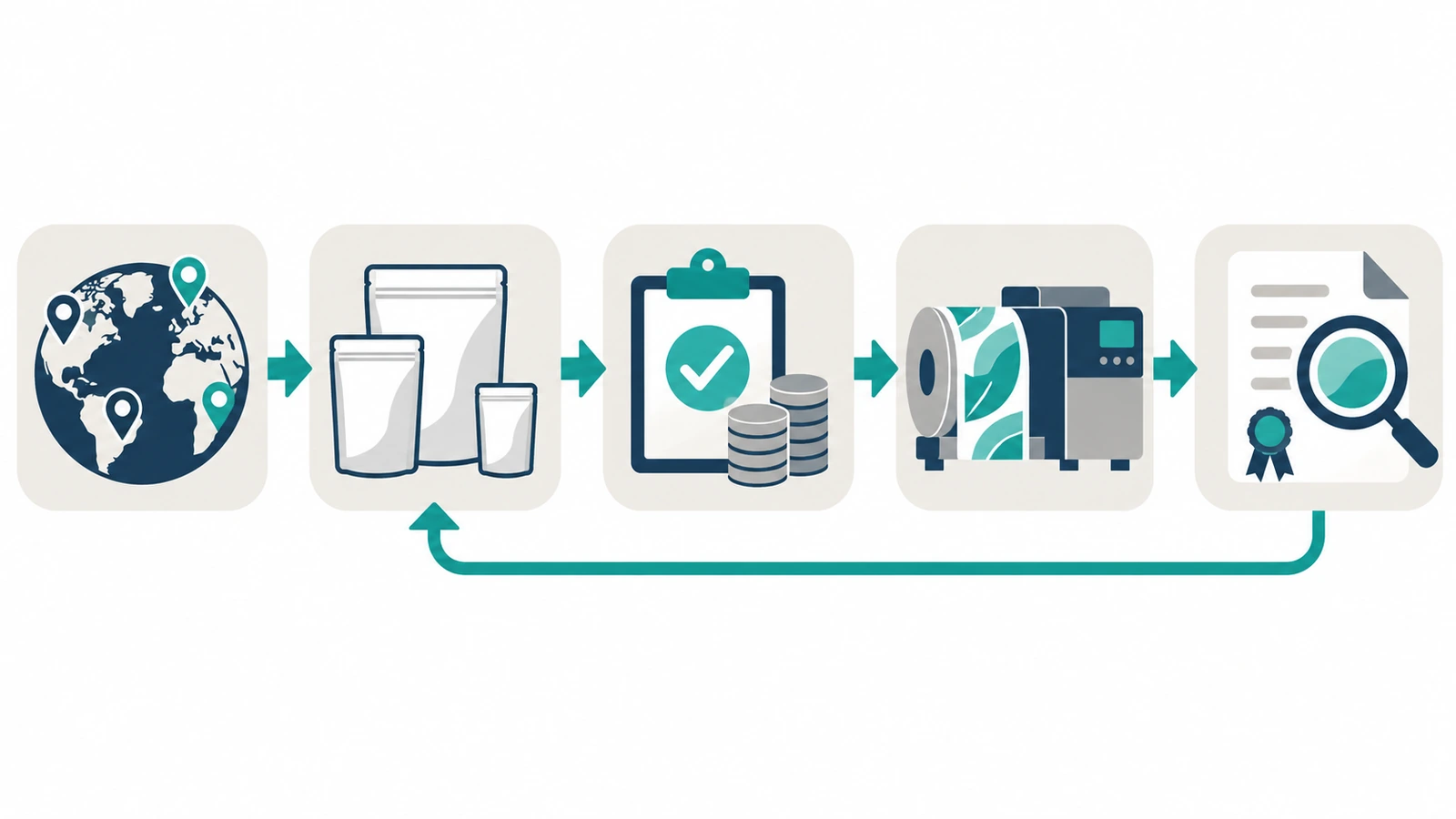
Flexible pouches vs. other child-resistant formats
The table compares formats on the factors that matter for budgeting. Ratings are qualitative and summarize public industry guidance. Request quotes for actual costs.
| Format | Relative unit cost | Barrier | Crush protection | Freight weight | Typical regulated use | Market direction |
|---|---|---|---|---|---|---|
| Reclosable CR flexible pouch | Lowest | High (foil/metallized laminate) | Low | Lightest | Gummies, value-tier flower, supplements | Fastest growth |
| Glass jar with CR cap | High | Very high, inert | High, but breakable | Heaviest | Premium flower, concentrates | Stable premium niche |
| CR plastic bottle / pop-top | Medium | Medium | Medium | Light | Capsules, tinctures | Stable |
| CR metal tin | Medium–high | Full light block | High | Medium | Mints, small edibles | Niche |
| CR carton or blister | Highest | Low without inner liner | Medium | Bulky | Gift sets, unit-dose edibles | Premium / unit-dose |
Buyers often confuse the standards themselves. This is how they divide responsibility:
| Reference | What it is | Does it prove a specific bag passed? | Where it applies |
|---|---|---|---|
| 16 CFR §1700.15 | Effectiveness thresholds (85% / 80% / 90%) | Defines the pass line | U.S. federal; cited by many state cannabis rules |
| 16 CFR §1700.20 | Child and senior-adult panel test method | Yes, for the tested configuration only | U.S. federal |
| ASTM D3475-20 | Classification by opening action | No | Voluntary U.S. classification |
| ISO 8317:2015 | Reclosable CR test method | Type approval only | International / EU buyers |
| ISO 28862:2018 | Non-reclosable, non-pharma CR test method | Type approval only | International single-use packs |

FAQ
FAQ: How reliable are child resistant reclosable edible bag market forecasts?
Use them for direction, not precise budgets. The segment-level estimate (US$2.77B in 2025 to US$5.63B in 2035) and Mordor's cannabis packaging figures agree that flexible formats are outgrowing rigid ones. Other published forecasts, however, differ by several times on growth rate. When you cite a market size internally, list at least two sources and their methods.
FAQ: Is an "ASTM D3475 certified" bag compliant?
Not on that basis alone. ASTM D3475-20 classifies packages by opening action and does not issue certifications. Compliance evidence is a 16 CFR §1700.20 test report that matches the exact bag size, film structure and closure you are buying.
FAQ: Why are edibles stricter than flower in many states?
Edibles look like ordinary food and are often multi-serving. California, for example, requires edible packaging to stay child-resistant for the life of the product, while inhaled products may be child-resistant only until first opening with a printed warning. That difference is why reclosable formats dominate edible demand.
FAQ: Does a passed test carry over when we switch to recycled film or a new size?
Assume it does not. A §1700.20 result applies to the tested configuration. Changing film structure (including adding PCR), pouch dimensions, zipper type or seal position calls for re-evaluation. New York's reuse rule makes the same point: sustainability changes must not weaken child-resistant properties.
FAQ: Can an exit bag or outer carton replace a child-resistant inner pouch?
Not for products regulated under the PPPA. CPSC applies the requirement to the primary packaging in direct contact with the substance. State cannabis rules on exit bags vary, so confirm the current text in each target state.
FAQ: Are federal test thresholds expected to change?
As of October 2026, 16 CFR §1700.15 still sets 85% child effectiveness before demonstration, 80% after, and 90% senior-adult use effectiveness. Recent changes have come from states and from agency guidance, such as the FDA's 2025 statement on nicotine pouches, not from new federal pass rates.
Key Takeaways
- The segment is growing steadily but not explosively. — US$2.77B (2025) to US$5.63B (2035), 7.35% CAGR (Source)
- Flexible formats are outgrowing rigid ones within cannabis packaging. — 17.05% flexible CAGR vs. 67.15% rigid share in 2025 (Source)
- The federal pass line is fixed and specific. — 85% / 80% child effectiveness, 90% senior-adult use effectiveness (Source)
- Testing is configuration-specific and panel-based. — 50 to 200 children aged 42–51 months per sequential test (Source)
- Pre-packaging mandates move bag demand to producers. — Oklahoma: 0.5 g to 3 oz pre-packs since June 1, 2025 (Source)
- Accessibility failures undermine protection. — 2% to about 80% of older adults unable to open CR containers across studies (Source)
Conclusion
The child resistant reclosable edible bag market is expanding because edible rules require child resistance for the life of the product, pre-packaging mandates multiply SKUs, and regulators are scrutinizing candy-like flexible packaging. None of these drivers depends on the film name on a quote. Each depends on whether a specific bag-and-closure configuration passed a §1700.20 panel and still performs after every change you make. Buyers who budget by configuration, set aside money for re-testing, and require documented evidence rather than "certified" wording will avoid the reprints and product pulls that have hit less careful brands. When you are ready to price a tested configuration, start with our custom child resistant Mylar bags and request a quotation based on your jurisdictions and volumes.
Footnotes
- U.S. eCFR, 16 CFR §1700.15 Poison prevention packaging standards (current text, accessed October 2026). ecfr.gov ↩
- Spherical Insights, Child-Resistant Re-Closable Edible Bags Market overview (published August 28, 2026). sphericalinsights.com ↩
- Mordor Intelligence, Cannabis Packaging Market: Size, Share and Forecast 2026–2031. mordorintelligence.com ↩
- U.S. Food and Drug Administration bulletin, FDA calls on nicotine pouch manufacturers to use child-resistant packaging (September 2, 2025). FDA via GovDelivery ↩
- U.S. eCFR, 16 CFR §1700.20 Testing procedure for special packaging (current text). ecfr.gov ↩
- U.S. Consumer Product Safety Commission, Guide to Special Packaging (page updated October 6, 2026). cpsc.gov ↩
- U.S. Consumer Product Safety Commission, Special Packaging Index, describing the ASTM D3475 voluntary classification of special packaging by closure type and opening action (page updated September 28, 2026). cpsc.gov ↩
- California Code of Regulations, Title 4, §17412 Child-Resistant Packaging, via Cornell Legal Information Institute. law.cornell.edu ↩
- Oklahoma Medical Marijuana Authority, Pre-Packaging Requirements (effective June 1, 2025). oklahoma.gov ↩
- New York Codes, Rules and Regulations, 9 NYCRR §128.4, via Cornell Legal Information Institute. law.cornell.edu ↩
- Age and Ageing (Oxford Academic), systematic review on accessibility of medication packaging for older adults (October 23, 2022). academic.oup.com ↩
- MJBizDaily, report on cannabis packaging firms and labeling enforcement (November 12, 2025). mjbizdaily.com ↩








The information below is required for social login
Sign In
Create New Account