We use cookies to enable our websites to remember information, to help some website functionalities to work properly, to understand how you interact with and use our websites and to display you content and ads that are relevant and engaging for you.
By clicking Accept All you consent to the use of these cookie.
The store will not work correctly when cookies are disabled.
Quick answer: The five main shaker sticker filler options are glitter, sequins, custom-cut confetti, beads and liquid or oil fills. Dry fills (sequins, confetti, beads) tumble freely, cannot leak and suit most brand promotions. Glitter adds sparkle but can bury fine artwork. Liquid fills give the slow, floating motion people love, but they add a seal that has to pass leak and material-compatibility testing before you order in volume.
You have the artwork approved and the sticker shape locked. Then the supplier asks, "What goes inside?" Most buyers treat the fill as a finishing touch. It is actually the part that decides how the sticker moves, how long it survives, and whether your logo stays readable. This guide compares the shaker sticker filler options buyers actually choose between, using published standards, regulator data and documented buyer complaints rather than adjectives.
The wrong fill causes real problems. One widely shared review of low-cost water-filled shaker stickers reported that most units leaked within 48 hours and others faded in sunlight. A social media user warned that water fills can dry out, leave stains and leak once the dome is punctured. Buyers of flat glitter stickers report that glitter "washes out" a design unless the artwork is very bold. Each of those failures traces back to a fill decision made before sampling. Below you will find what each fill does well, where it fails, and how to specify it so your samples tell you something useful.
What Counts as a Shaker Sticker Fill?
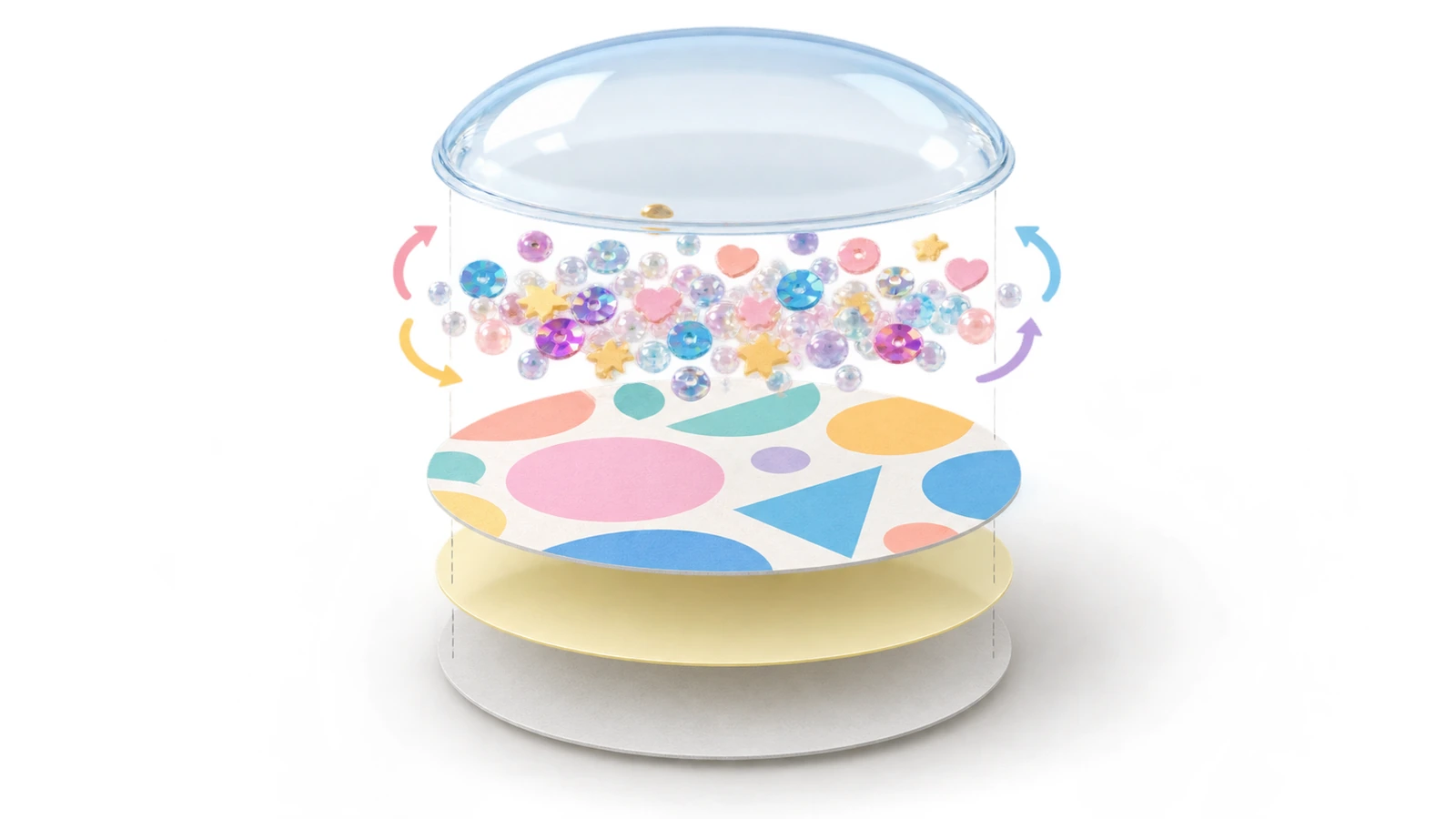
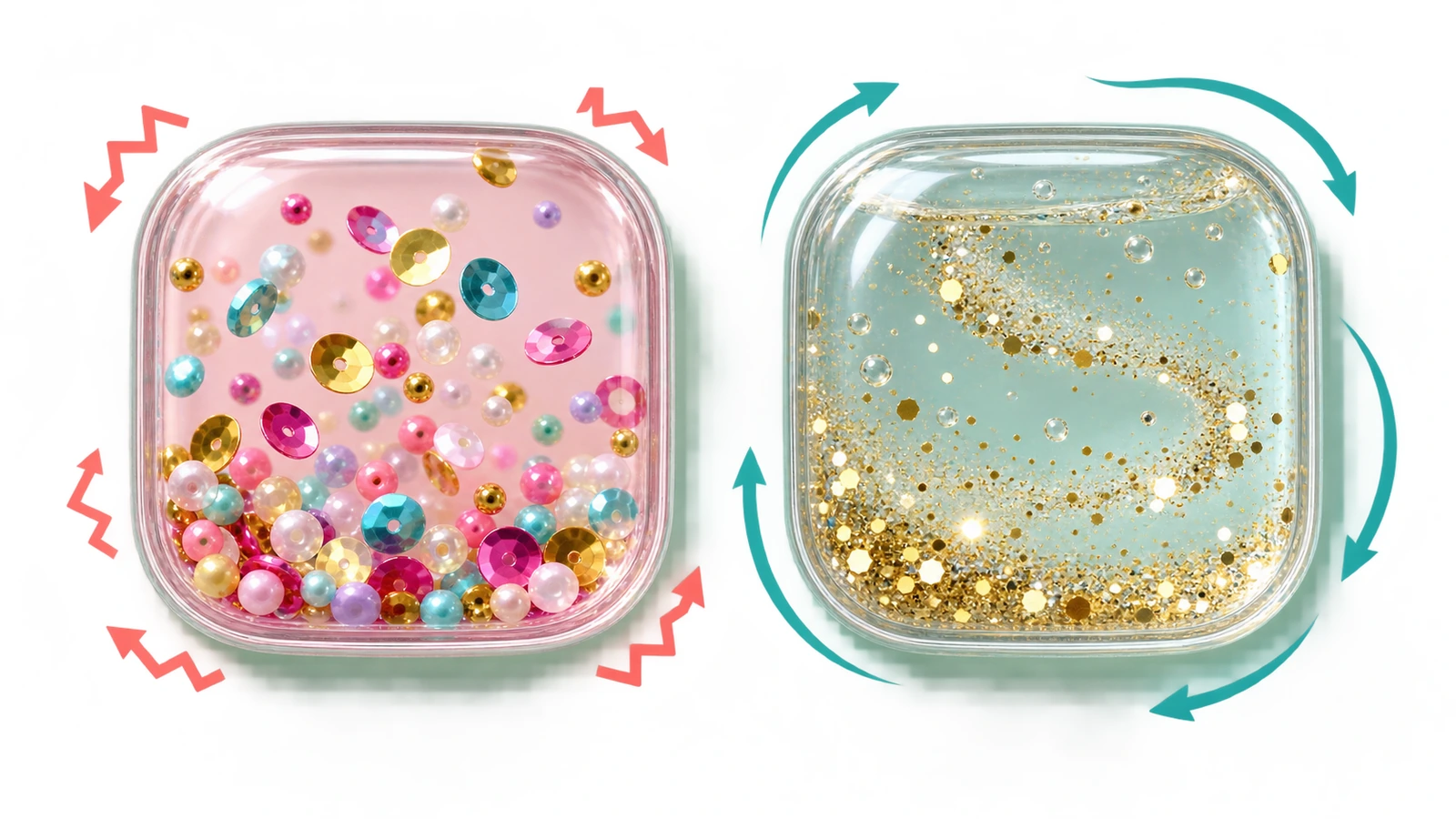
A shaker sticker is a printed base sealed under a clear, raised cavity. The fill is whatever moves inside that cavity. In the trade, fills are also called inserts or shaker sticker insert materials. They fall into two families. Dry fills are loose solids such as glitter, sequins, confetti and beads. Wet fills are a liquid (usually water-based or oil-based) that carries glitter or small pieces in suspension.
The fill interacts with the other layers. It sits on top of your artwork, so it can hide or frame the design. It presses against the inner walls of the dome, so static, condensation or oil can fog the view. With wet fills, it also tests the seal every time someone shakes the sticker. If you need the full picture of how the dome, seal and backing are built and ordered, the custom PVC blister shaker stickers page covers that. This article focuses only on what goes inside.
The Five Shaker Sticker Filler Options, Explained
1. Glitter
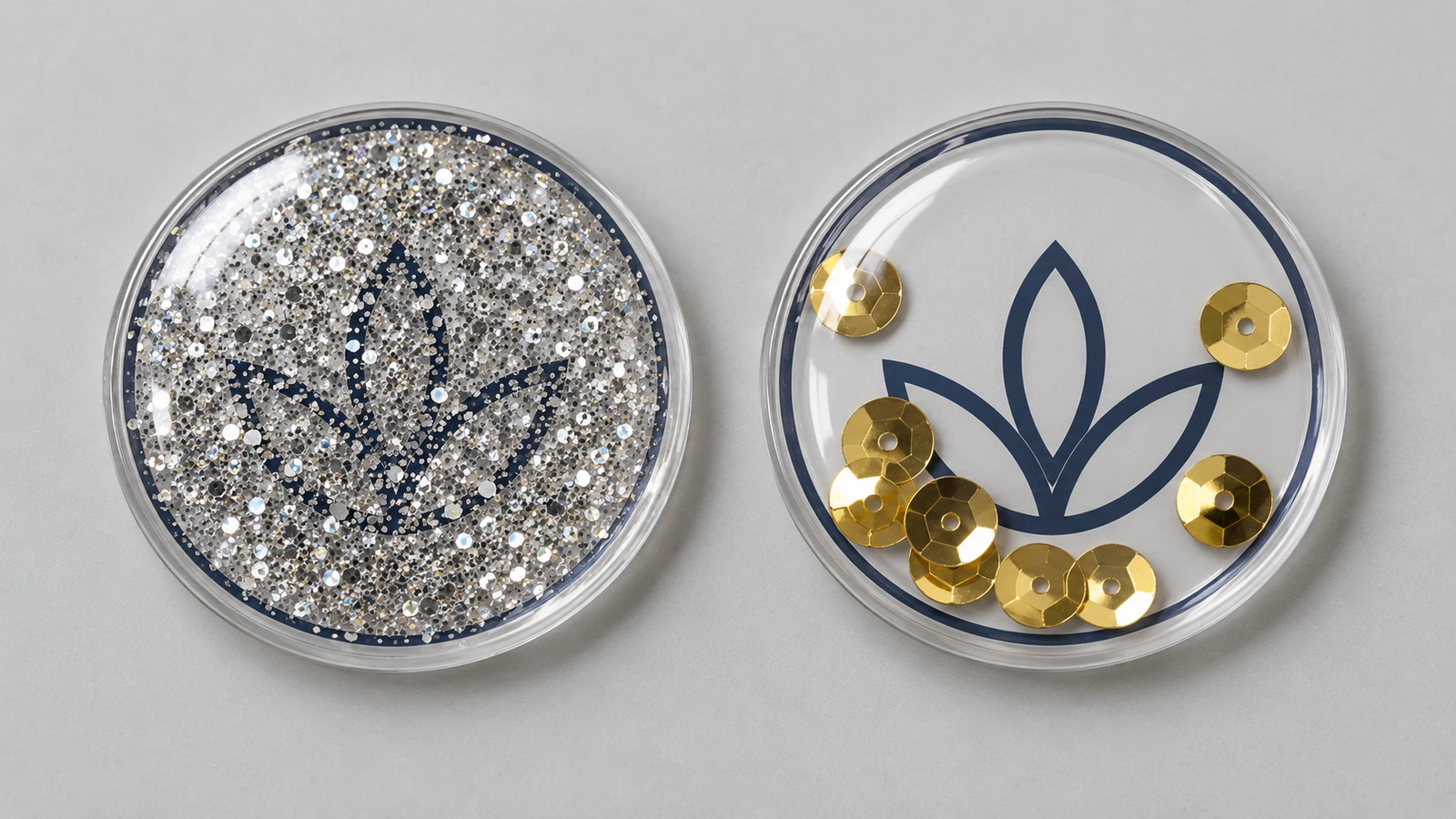
Glitter gives the most sparkle per unit of fill and costs the least, because it is a stock material that needs no cutting or printing. The trade-off is coverage. Fine glitter spreads across the whole cavity and settles over the printed base, so thin lines, small text and low-contrast logos disappear under it. Buyers of flat glitter stickers report the same effect and advise either a "super bold" design or no glitter at all. Inside a dry cavity, fine glitter can also cling to the dome walls through static, which leaves a cloudy patch after shaking. Chunky or hexagonal glitter clings less and moves more visibly.
Glitter also carries an environmental question. Researchers have studied glitter as a microplastic[1] that can transport metallic elements in aquatic environments. A sealed sticker keeps glitter contained while it stays intact. However, if your brand makes sustainability claims, ask whether a plant-based glitter alternative is available, and check it on a sample before committing.
2. Sequins
Sequins are larger, flat pieces such as discs, stars or hearts. They flip and catch light as they move, so motion reads clearly even from arm's length. Because each piece is large, sequins cover less artwork than glitter and leave gaps where the printed base shows through. That makes them the safer choice when a logo must stay legible. The main design constraint is clearance: pieces must be small enough relative to the cavity to tumble rather than jam flat against the dome. Sequins are dry, so there is no leak path.
3. Custom-Cut Confetti
Custom-cut confetti consists of small shapes cut from printed film or paper. You can use your logo mark, a product silhouette or a mascot. It is the strongest option for brand storytelling, because the moving pieces carry the message instead of covering it. Cost per unit rises because the confetti needs its own artwork, color matching and a cutting step. Material matters if you combine confetti with liquid. Paper confetti softens and bleeds in water, so wet fills need film-based confetti with inks that have been tested in that liquid.
4. Beads
Beads include microbeads, pearls and faceted rhinestone-style pieces. They are heavier than glitter or sequins, so they drop quickly and produce a soft rattle. For many people that sound is part of the appeal. Beads rarely cling to the dome and never cloud the view, which keeps artwork crisp. The risk is what happens if the dome is punctured. Loose beads are small parts, and products for young children typically carry small-parts warnings for exactly this reason. If the sticker might reach children under three, discuss bead size and dome toughness with your supplier during sampling.
5. Liquid and Oil Fills
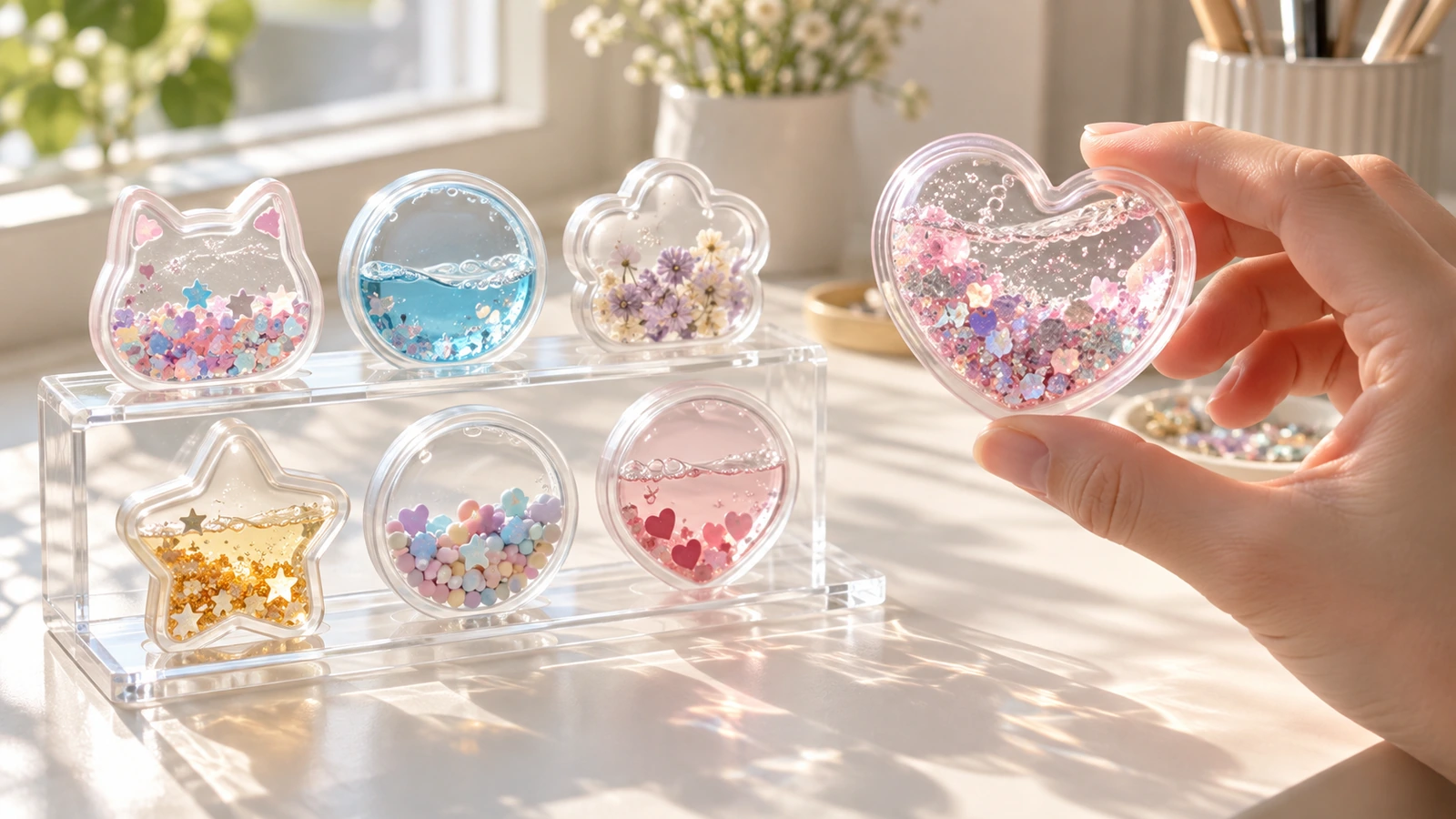
Liquid fills produce the signature effect: glitter or confetti drifting slowly after a shake. Oil-based fills drift more slowly than water-based ones. This is the most eye-catching option, and also the most demanding one. A liquid adds four failure modes that dry fills do not have: leaks at the seal, evaporation that leaves an air gap or stains, condensation fogging the dome, and chemical interaction between the liquid and the plastic.
That last point gets overlooked. Flexible PVC gets its softness from plasticizers, and engineers in public discussions point out that oil and soft vinyl are often incompatible. Oil can draw plasticizer to the surface and leave the shell hazy or sticky. Oil fills also bring safety baggage. Baby oil and similar low-viscosity hydrocarbons can cause chemical pneumonia if swallowed and aspirated. The U.S. Consumer Product Safety Commission recently recalled about 8,420 baby oil bottles[2] on 2026-06-25 for failing child-resistant packaging rules. It took similar action earlier on lamp oil products[3]. A sealed sticker is not a bottle. Even so, if an oil-filled product can leak near children, the risk profile is the same.
Regulators also watch leaking novelty items. Citing the CPSC, Consumer Reports[4] reported that 355,683 hazardous squishy toys were stopped at U.S. ports. It advised parents to discard toys that leak, feel oily or unusually sticky, or smell strongly of chemicals. Treat those same signs as rejection criteria for liquid-filled shaker samples, and prefer a water-based fill for anything child-facing.
How to Choose and Specify a Fill in Six Steps
Step 1: Start From the End Use
Brand promotions, retail merchandise and kids' events each need something different from the fill. Promotional giveaways are handed out, dropped into bags and mailed, so durability and a low cost per unit matter most. Dry fills usually win here. Retail merchandise sits on shelves and gets handled by shoppers, so visual impact and long-term appearance matter. A liquid fill can justify its extra testing in this setting. Anything aimed at children shifts priorities toward containment and compliance (see Step 6).
Step 2: Decide Dry vs Liquid Before Anything Else
This single choice determines your testing plan. A dry fill only needs to move well and look right. A liquid fill needs a seal that holds, a liquid that does not react with the shell, and inks and confetti that survive immersion. If your timeline or budget cannot absorb an extra sampling round, choose dry.
Step 3: Match the Fill to the Artwork
Put your artwork next to the fill and ask what must stay readable. Fine-line logos pair best with sequins, beads or sparse confetti. Bold, simple shapes can handle dense glitter. Confetti in your brand shapes lets the fill carry the message. Plan a clear zone in the printed base where the fill will settle least, and keep critical elements away from the edges, where loose pieces tend to collect.
Step 4: Write the Fill Recipe, Including Quantity
"Glitter, pink" is not a specification. For each design, write down five things:
The material, such as polyester glitter, film confetti or glass beads.
The piece size range relative to the cavity.
Color references.
Whether the fill contains water, oil or metallic particles.
The amount per unit.
Express custom shaker sticker fill quantity in the unit that fits the material: piece count for sequins and confetti, weight or volume for glitter and beads, and fill level for liquids. Overfilled cavities look full but barely move. Underfilled ones look cheap. Ask for two or three fill levels on the same sample run so you can choose by eye instead of guessing.
Step 5: Test Samples on the Fill's Weak Points
For dry fills, shake each sample repeatedly. Check for static cling, pieces jamming flat, and artwork coverage at rest. For liquid fills, stand samples upright and inverted for 48 hours. Note that this checkpoint comes from buyer practice, not from a standard. Then press the dome, leave samples in a sunny window, and look for leaks, air gaps, haze or stickiness. Because the fill adds weight and bulk, check the backing adhesive at the same time. Ask the supplier which peel method they use. ASTM D3330/D3330M-04(2025)[5] defines four relevant methods: Method A (180° peel), Method C (double-coated tape), Method D (liner release) and Method F (90° peel). The standard was reaffirmed on 2025-08-01. BSI's listing[6] describes its purpose as assessing the uniformity of adhesion. The standard's own scope notes, recorded by China's National Digital Library of Standards[7], say there is "usually no direct relationship between peel adhesion and any functional requirement". Use peel data for batch consistency, and test on your real target surface as well.
Step 6: Check Which Compliance Rules Your Fill Triggers
If you market the sticker as a children's product in the U.S., CPSIA requires third-party testing by a CPSC-accepted lab and a Children's Product Certificate, usually alongside the ASTM F963 toy standard. Request reports for your exact SKU and fill. A report for a different fill does not transfer. Never accept a claim of compliance with ISO 11607-2:2019[8] as proof of leak resistance. That standard covers sealing processes for terminally sterilized medical device packaging, not decorative stickers. Before launch, it is also worth scanning CPSC recall listings[9] for related product categories.
Liquid vs Dry Shaker Sticker Fill: Side-by-Side Comparison
The table ranks each fill on the five factors buyers weigh most. Cost per unit is relative, because real pricing depends on size, quantity and fill recipe. Request a quote for actual figures.
None, but beads are small parts if the dome is punctured
Low to medium
Adult merchandise, tactile novelty items
Liquid or oil
Slow floating drift; the strongest "wow"
Slowest, longest-lasting motion
Highest: seal, evaporation, plastic compatibility
Highest (filling, sealing, extra inspection)
Premium retail items, collectibles
Glitter vs Sequin Shaker Stickers
Choose glitter when sparkle is the point and the artwork is a bold silhouette. Choose sequins when a logo or face must stay readable through the fill, or when you want motion that shows up in photos and video. Sequins are larger and lighter per piece, so they cling less and need a slightly roomier cavity.
Mixing Fills
Blends often perform best. A few sequins with a pinch of chunky glitter combine flash with sparkle. Adding beads to confetti brings a rattle and weight. Keep blends dry unless every component has been tested in the liquid. List each component and its quantity separately in the fill recipe so reorders match the approved sample.
FAQ
FAQ: Which shaker sticker fill keeps a logo most visible?
Sequins, beads or sparse custom-cut confetti. They cover less of the printed base than glitter, which tends to settle as a layer over fine lines and small marks.
FAQ: How much fill should go into each shaker sticker?
There is no universal number. Specify quantity per unit in the right measure for each material (piece count, weight or fill level). Then ask for two or three fill levels on one sample run and pick the one that moves freely while still looking full.
FAQ: Do liquid-filled shaker stickers leak?
They can. Publicly shared reviews of low-cost water fills describe leaks within 48 hours. No international standard defines a leak test for decorative shaker stickers, so build your own: 48 hours upright and inverted, finger pressure, and sun exposure on every sample.
FAQ: Is baby oil a good filler for shaker stickers?
Use it with caution. Mineral oil can react with plasticized soft PVC and leave surfaces sticky or hazy. Low-viscosity hydrocarbons are also an aspiration hazard for children, which is why the CPSC enforces child-resistant packaging for baby oil and lamp oil. For child-facing products, a tested water-based fill is the safer choice.
FAQ: Can confetti be cut in my brand's logo shape?
Yes. That is the main appeal of custom-cut confetti. Expect a separate artwork proof and a higher cost per unit than stock glitter. If the sticker will also contain liquid, ask for film-based confetti.
FAQ: Do kids' shaker stickers need special testing?
If you sell them in the U.S. as children's products, yes. CPSIA requires third-party testing by a CPSC-accepted lab and a Children's Product Certificate for that specific product. Reports for a different fill or SKU do not transfer.
Key Takeaways
No shaker-specific leak standard exists, so liquid fills need your own test plan. — ISO 11607-2:2019 covers only terminally sterilized medical device packaging (Source)
Oil fills carry child-safety baggage that dry fills avoid. — The CPSC recalled about 8,420 baby oil bottles on 2026-06-25 over child-resistant packaging (Source)
Leaking, oily or sticky samples are a recognized red flag. — 355,683 hazardous squishy toys were stopped at U.S. ports (Source)
Specify the adhesive test method, not just "strong adhesive". — ASTM D3330 defines 4 methods (A, C, D, F) and was reaffirmed on 2025-08-01 (Source)
Peel data checks consistency, not real-world hold. — The standard notes there is usually no direct relationship between peel adhesion and functional requirements (Source)
Conclusion
The best shaker sticker fill is the one that fits your end use, your artwork and your risk tolerance. Sequins and custom-cut confetti keep logos readable and never leak, which makes them the default for brand promotions. Glitter is the cheapest sparkle but needs bold artwork. Beads add sound and weight. Liquid fills give the most memorable motion, provided you test the seal, the plastic compatibility and the compliance obligations before you scale up. Write a precise fill recipe, sample two or three fill levels, and judge the samples on their weak points rather than on first impressions. When you are ready to turn a fill choice into a sealed, testable product, start with custom blister shaker stickers built to a defined spec and request a quote with your fill recipe attached.
Hi there! I'm Bruce, proud dad to my amazing son. I'm the founder of Zigpac, a printing and packaging company empowering small and medium-sized businesses with custom solutions. Let's create something great together!



 Blog PDF for offline reading













The information below is required for social login
Sign In
Create New Account