We use cookies to enable our websites to remember information, to help some website functionalities to work properly, to understand how you interact with and use our websites and to display you content and ads that are relevant and engaging for you.
By clicking Accept All you consent to the use of these cookie.
The store will not work correctly when cookies are disabled.
Quick answer: Choose die cut sticker sheets when one person peels several designs from a shared liner, as in promo kits and retail packs. Choose individual die-cut singles when each sticker is handed out or mailed on its own. Choose rolls whenever a dispenser or labeling machine does the application.
Most sticker RFQs describe the artwork, the material and the quantity in detail, then leave the format as an afterthought. Format is the decision that settles who handles the sticker, how it is packed, what each unit really costs once labor is counted, and how inventory behaves when one design sells faster than another. This guide compares die cut sticker sheets, individual singles, and custom rolls across those five factors so you can specify the right one before the first proof.
Why does the wrong sticker format cost more than the wrong color?
A color problem is visible at proof stage. A format problem usually shows up later, on the packing table or the production line, after the order has already been printed and paid for.
The failure patterns are predictable. Loose singles dropped into a promo kit slide out of position, so packers start counting by hand and the kit build slows down. Sheets sent to a contract packer who expected rolls cannot be loaded into a labeling head, so a machine job becomes a manual one. Rolls ordered for a retail pack force the retailer to peel and re-bag each label. In public buyer reviews, one recurring complaint is a kiss-cut that never reached the liner: one buyer reported that not a single sticker in a 500-piece promotional order would separate from its backing. The art was fine. The cut and format were wrong for the job.
The fix is to choose the format before quoting. Start from three questions: who applies the sticker, how many designs travel together, and how the product reaches its end user. The sections below turn those questions into a specification.
What are die cut sticker sheets, singles, and rolls?
All three formats can carry the same printed vinyl. What differs is how deep the blade cuts and how the liner is shared, and those two things decide how the sticker leaves the factory.
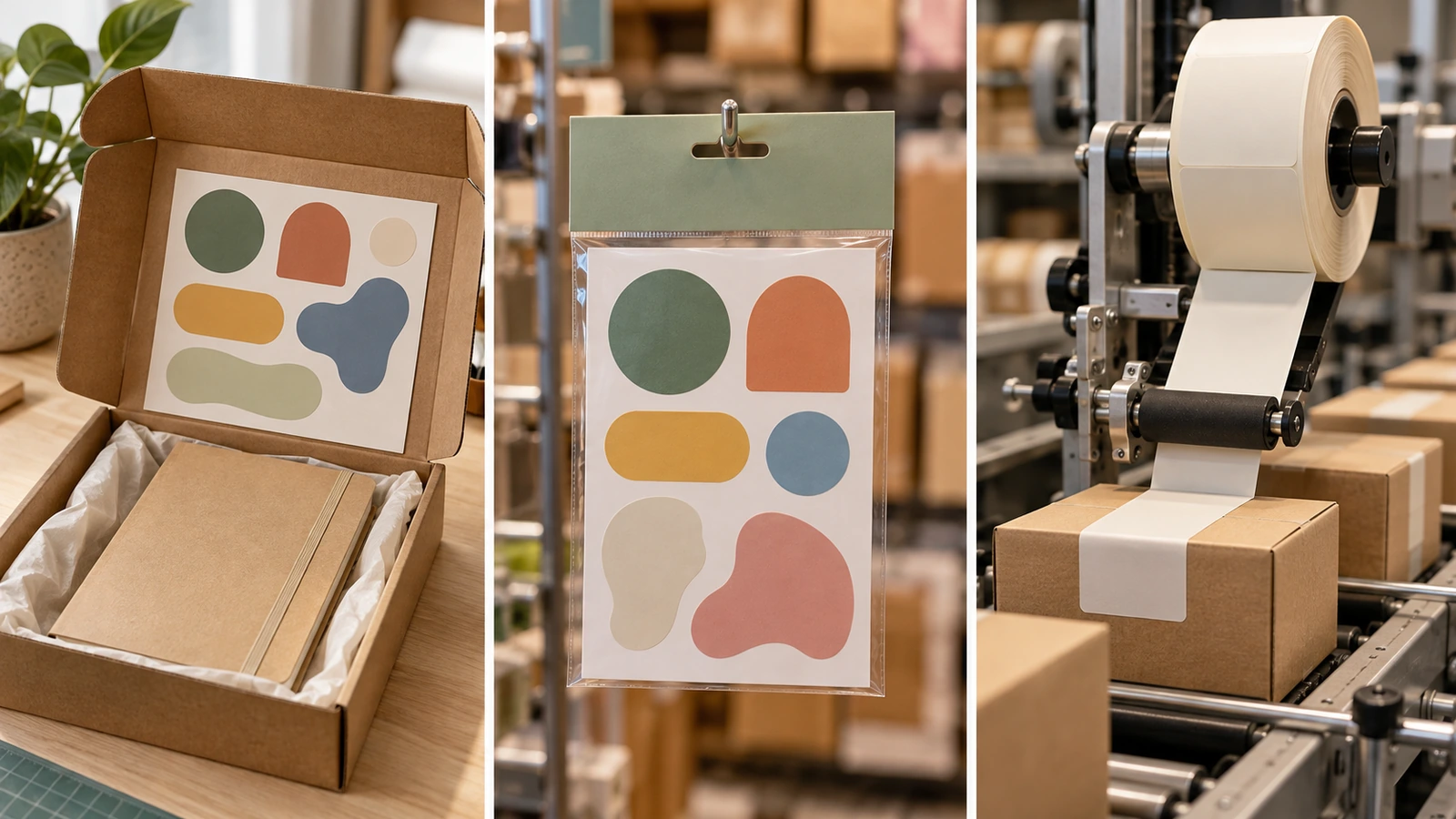
Die cut sticker sheets hold several stickers on one shared liner. Each shape is kiss-cut, meaning the blade cuts through the face film and adhesive but stops at the liner, and the outer edge of the sheet is then through-cut to a rectangle or a branded outline. The sheet is the unit that gets shipped, packed and sold, and the user peels stickers off one at a time.
Individual die-cut singles, often sold as custom cut out stickers, are through-cut: face film and liner are cut together along the artwork outline, so every sticker is its own object with its own backing. Each one can be handed out, dropped in a mailer, or placed on a counter on its own.
Custom rolls carry kiss-cut labels on a continuous liner. The waste film between labels, called the matrix, is stripped away, and the liner is wound onto a core. A roll is built for a dispenser or an automatic applicator, so it needs specifications that sheets and singles never require: core diameter, maximum outside diameter, gap between labels, label orientation, and unwind direction.
How do the three formats compare side by side?
The table compares formats, not materials. The same face film and adhesive can run in any of the three; the differences come from cutting, handling and packing.
Factor
Die cut sticker sheets
Individual die-cut singles
Custom rolls
Cut type
Kiss-cut shapes, through-cut sheet edge
Through-cut on every piece
Kiss-cut on a continuous liner, matrix stripped
Unit that travels
One sheet carrying a set of designs
One sticker
One roll carrying hundreds or thousands of labels
Application
By hand, peeled one at a time by the end user
By hand, by the end user or staff
Dispenser, semi-automatic, or inline applicator
Packaging
Flat: sleeve, header card, kit insert
Bagged in counts, inserted loose, or carded
Boxed by roll count, sometimes shrink-wrapped
Main unit-cost drivers
Number of shapes per sheet, nesting efficiency, sheet trim
Cut path per piece, counting and bagging labor
Label pitch, matrix waste, rewinding and roll setup
Inventory behavior
Design ratio is fixed per sheet; one SKU holds the full set
Each design restocks on its own
Few SKUs, high counts; needs roll and lot tracking
Packaging lines, mailer seals at volume, product labeling
Failure to check
Kiss-cut too shallow to peel, or deep enough to cut the liner
Rough edges that lift, liner hard to start
Cut-line drift along the roll, wrong unwind direction
A common assumption is that sheets are always cheaper because several stickers share one liner. That only holds when the shapes nest tightly. A sheet with one large logo and three small icons can waste more film than four singles cut on a digital cutter. Rolls lower the per-label cost at volume but add setup for core, winding and roll labels, which matters less on long runs than on short ones.
How do you choose a format in six steps?
Step 1: Decide who applies the sticker
If a machine applies it, the answer is a roll, and every other choice follows from the applicator. Ask your line engineer or co-packer for the applicator model, the core diameter it accepts, the largest roll it can hold, and the unwind position, which is the label orientation as it comes off the roll. A sticker roll custom-wound to the wrong unwind position will feed upside down or sideways, and rewinding it afterward is extra labor. If people apply it by hand, move on to Step 2.
Step 2: Count the designs that travel together
When one recipient should receive three to eight designs at once, such as a brand set, a product's safety icons, or a collectible pack, a sheet keeps the set together and turns packing into one pick instead of several. When each recipient gets a single design, singles avoid printing stickers nobody asked for.
Step 3: Match the format to the packaging
Sheets lie flat, which suits polybags, kit boxes and retail sleeves, and a printed sheet can work as the pack's own presentation card. Singles are counted into bags or dropped loose into mailers, so specify whether you want them pre-counted and in what bundle size. Rolls arrive boxed; tell the supplier how many labels go on each roll so the count matches your production batch and the operator doesn't have to splice mid-shift.
Step 4: Price the handling, not just the print
The quote covers printing and cutting. Your real unit cost also covers what happens after delivery: counting, bagging, peeling and applying. A slightly higher-priced roll can be the cheapest option if it removes hand application, and sheets can beat singles by turning eight picks into one. Ask suppliers to quote the same artwork in two formats so you can compare like for like, and add your own labor estimate per unit.
Step 5: Model how inventory will move
A sheet fixes the ratio between designs. If one design on a six-up sheet is used twice as fast as the others, you will run out of it while still holding the other five. Singles restock design by design but multiply SKUs and storage bins. Rolls hold large counts in few SKUs but need lot tracking, because a quality issue tends to affect an entire roll or lot rather than a scattering of pieces.
Step 6: Write the cut into the purchase order
State "kiss-cut on sheet," "through-cut singles," or "kiss-cut roll, matrix removed" in plain words, and attach a vector cut line separate from the print file. Ambiguous wording is the root cause of most format complaints, because "die cut" can mean a through-cut single to one supplier and a kiss-cut shape to another. For custom die cut vinyl stickers with tight inside corners or thin connecting bridges, ask for a physical cut sample in the chosen format before approving the full run.
Which format fits promo kits, retail packs, and production lines?
Use case
Recommended format
Why
Specify on the RFQ
Onboarding or promo kits
Sheet
One pick per kit, and the full set always arrives together
Sheet outline, designs per sheet, sheet fits the kit insert
Retail sticker packs
Sheet, or singles in a sleeve
A sheet doubles as the display card; singles suit blind-bag or mix-and-match packs
Hang-hole or header area, flat packing, count per pack
Event and trade-show giveaways
Singles
Staff hand out one at a time; nothing is wasted on unwanted designs
Bundle count, design split across the quantity
E-commerce mailer inserts
Singles or small sheets
Fits a flat mailer without bending; a small sheet can carry a care or reorder graphic
Maximum insert size, bag or loose
Production-line product labeling
Roll
Applicators need continuous liner, consistent pitch and a known unwind
Core, max outside diameter, gap, unwind position, labels per roll
Box or mailer seals at volume
Roll on a hand dispenser
Faster than peeling sheets and keeps fingers off the adhesive
Dispenser compatibility, labels per roll
Asset or serial tagging
Sheet or roll with sequential data
Keeps number sequences in order, which loose singles do not
Number range, sequence direction, one number per position
Mixed programs are common. A brand might ship rolls to the packaging line for the product label and send die cut sticker sheets of the same artwork to its retail partners. If you plan both, ask for one print run and two finishing routes, so color stays matched across formats.
What should you inspect for each format?
Each format fails in its own way, so the incoming inspection should differ by format too. The checks below can be done with a ruler, a timer and a test surface; none requires a lab.
Format
Check
How to measure
Reject or escalate when
Sheets
Kiss-cut depth
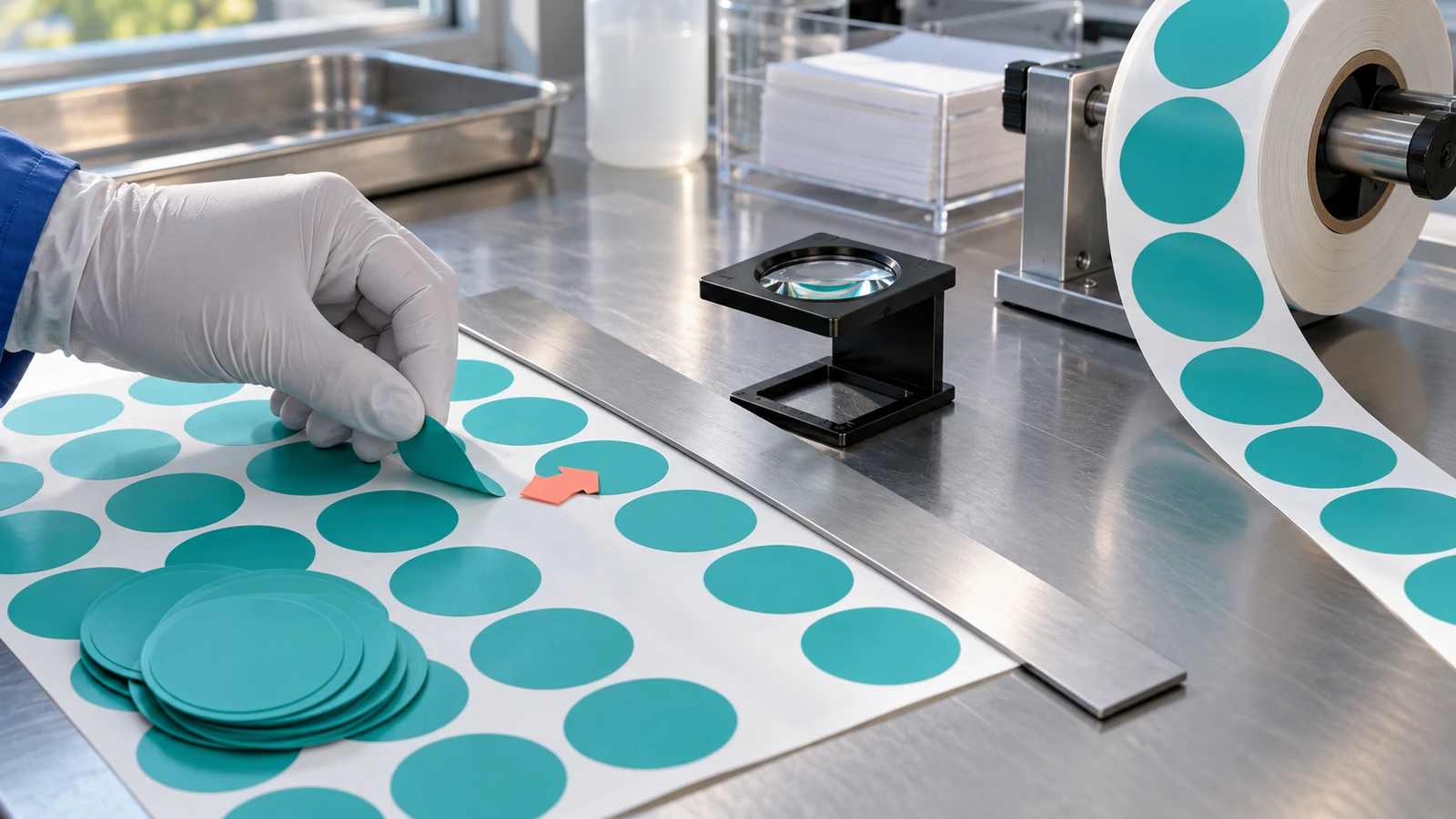
Peel 20 consecutive stickers from random sheets
Any sticker tears, stays on the liner, or the liner is cut through
Sheets
Print-to-cut registration
Measure the largest offset between print edge and cut line
Offset exceeds the tolerance agreed at proof
Singles
Edge quality
Inspect cut edges under raking light
Fibrous or ragged edges, which trap moisture and lift
Singles
Liner start
Time how long it takes to start the peel by hand
Staff need tools or bend the sticker to start it
Rolls
Cut drift along the roll
Measure registration at the head, middle and tail of the roll
Drift grows along the roll, which buyers report on long runs
Rolls
Unwind and splices
Mount one roll on the actual applicator
Wrong orientation, splices without markers, or matrix left on the liner
All
Adhesion on the target surface
Apply samples, check edges at 7 and 14 days, including a wet cycle
Corners or narrow parts lift before 14 days
All
Traceability
Record the material lot and roll or batch number
No lot number on the carton or roll label
Traceability matters most for rolls, because a defect affects a whole lot. Public safety-recall records show how narrowly a lot-level defect can be defined: one federal recall report covered 244 rolls of a single lot of conspicuity tape that fell below the required value at just one measurement angle while passing at the others (NHTSA recall report 23E-033[1]). A die-cut sticker is not a regulated tape, but the lesson carries over: if every roll label shows a lot number, a problem can be contained to one lot instead of the whole order. Buyers can look up recall history for regulated vehicle equipment in the NHTSA safety issues database[2].
Converting heat is a second check that is often skipped. When stickers go through drying or curing before final cutting, the face film and liner must still cut cleanly afterward. The Texas Department of Transportation's specification for validation stickers requires the sheeting-and-liner combination to stay die-cuttable without adhesive bleed or cracking after drying at up to 360°F (182°C) (TxDOT DMS-8391[3]). That requirement is a useful model for any sheet or roll program that includes a heat step.
What changes when the format carries reflective film?
Reflective vinyl puts more strain on every format choice. It is thicker and stiffer than standard glossy PVC (printable reflective face films are commonly reported at roughly 130–160 μm versus about 70–100 μm for glossy PVC), it has no air-release channels, and its adhesive grabs hard. In practice that means three format-specific adjustments.
Sheets: The usable kiss-cut depth window is narrower, so the 20-pull peel test above matters more. Print professionals report that glass-bead reflective film can be kiss-cut on standard plotters, while prismatic film usually needs a flatbed or laser cutter.
Singles: Rounded corners outlast sharp ones, because stiff film lifts first at points and tight inside corners.
Rolls: Confirm the applicator can handle the thicker build without curling labels at the peel plate. Request a trial roll before committing to a full production order.
Brightness claims should also come with a measurement method. Retroreflection is measured under defined geometry; the U.S. sign manual states its minimum maintained levels at a 0.2° observation angle and a −4.0° entrance angle (FHWA MUTCD, Chapter 2A[4]), and the instrument test is defined in ASTM E810[5]. Type names are easy to confuse: the United States uses two national sheeting classifications, and their type numbers do not necessarily indicate relative performance (Manual of Traffic Signs[6]). State agencies even publish visual identification guides for telling sheeting types apart (MnDOT sheeting ID guide[7]).
Finally, format does not change what a decorative reflective sticker legally is. On commercial vehicles, additional retroreflective surfaces may be used together with the required reflectors but not in place of them (49 CFR § 393.26[8]), and a sticker on a hard hat does not turn the wearer's outfit into high-visibility apparel under ANSI/ISEA 107-2020[9]. Material grades, artwork rules and the line between decoration and regulated conspicuity are covered on our reflective die-cut stickers page.
FAQ
FAQ: Are die cut sticker sheets cheaper than individual singles?
Not automatically. Sheets save money when shapes nest tightly and when one pick replaces several during packing. They cost more when large and small designs share a sheet and leave unused film, or when one design on the sheet is used much faster than the rest. Ask for both formats to be quoted on the same artwork and add your own handling labor before comparing.
FAQ: Can different designs share one sheet?
Yes, and that is the main reason to choose a sheet. The trade-off is that the ratio is fixed: every sheet carries the same mix, so you reorder the whole set even when only one design runs low. If usage is uneven, split heavy-use designs onto their own sheet or switch them to singles.
FAQ: Can rolls be applied by hand?
Yes. A hand dispenser makes rolls fast for box seals and batch labeling, and the user never touches the adhesive. The reverse does not work: sheets and singles cannot be fed into an automatic applicator, so any program with a machine step should be quoted as rolls from the start.
FAQ: What is the difference between kiss-cut and die-cut on a sticker sheet?
On a sheet, each sticker is kiss-cut through the vinyl and adhesive only, so it peels away from a liner that stays intact. The sheet's outer edge is through-cut, slicing vinyl and liner together. A die-cut single is through-cut along the artwork outline, so the backing follows the sticker's shape.
FAQ: What does a supplier need from me to quote rolls?
The applicator or dispenser model, core inside diameter, maximum roll outside diameter, labels per roll, gap between labels, label orientation and unwind position, and whether the matrix should be removed. If you don't know these, a photo of the applicator's spindle and the current roll is usually enough for a supplier to confirm them.
FAQ: Do reflective stickers work in sheet and roll formats?
Yes, with tighter cut control. Reflective film is thicker and stiffer, so kiss-cut depth on sheets and label curl on rolls both need a physical sample check. Prismatic film is generally harder to kiss-cut than glass-bead film and often needs flatbed or laser cutting.
Key Takeaways
Put lot numbers on every roll so a defect can be contained. — one federal recall covered 244 rolls of a single lot that failed at one measurement angle (Source)
Confirm heat steps won't spoil the cut on sheets and rolls. — a state DOT spec requires sheeting and liner to stay die-cuttable after drying at up to 360°F / 182°C (Source)
Ask for reflective brightness claims with their measurement geometry. — 0.2° observation and −4.0° entrance angle in the U.S. sign manual (Source)
Instrument tests cover a defined angular range, not "visible from far away." — ASTM E810 applies at observation angles of 0.1°–2.0° and entrance angles up to 60° (Source)
Reflective stickers on vehicles add to required reflectors; they never replace them. — at least 3 inches from required lamps or reflectors unless the same color (Source)
Choose the format first, then quote
The most reliable way to pick a format is to work backward from the last pair of hands, or the last machine, that touches the sticker. Machine application points to rolls. Several designs per recipient points to die cut sticker sheets. One design per recipient points to singles. Once the format is set, write the cut type plainly on the order, run the format-specific checks on a sample, and track lots from the first delivery.
If your program involves reflective film, whether as kit sheets, event singles, or rolls for a labeling line, send us the artwork, the intended surface, how it will be applied, and the format you have in mind. We will confirm what the material and cut can support and return a quote. Start from the reflective die-cut sticker product page to share your RFQ details.
ASTM International, E810-20(2025), Standard Test Method for Coefficient of Retroreflection of Retroreflective Sheeting Utilizing the Coplanar Geometry. https://store.astm.org/e0810-20r25.html↩
Hi there! I'm Bruce, proud dad to my amazing son. I'm the founder of Zigpac, a printing and packaging company empowering small and medium-sized businesses with custom solutions. Let's create something great together!



 Blog PDF for offline reading















The information below is required for social login
Sign In
Create New Account