


 Blog PDF for offline reading
Quick answer: Choose custom cinch backpacks in polyester or nylon when recipients will wear the bag and reuse it for weeks, because every reuse adds impressions at no extra cost. Choose flat PE film drawstring bags for one-day handouts, clear or moisture-proof containers, and long runs where unit cost matters more than reuse. Decide on four factors: how the bag is carried, how long it must last, which print method your artwork needs, and when the production clock starts.
Search for custom cinch backpacks and you will get two different products under one phrase. The first is a wearable fabric pack with shoulder cords. The second is a flat polyethylene (PE) film bag that closes with a draw tape or cotton cord. Supplier catalogs, marketplaces, and even some quote requests treat them as the same item. They are not. They differ in material, print process, how they fail, and how long they keep your logo in front of people.
That confusion is expensive. A team that orders film bags as "backpacks" ends up with bags nobody can carry on their shoulders. A hotel or clinic that orders fabric packs for wet laundry or patient belongings gets bags that soak through and hide the contents. Buyers who expected photo-quality artwork on a one-color screen-printed pack end up with hundreds of bags that look nothing like the proof. This guide sorts the formats by use case, so you can choose by program rather than by keyword.
What Are Custom Cinch Backpacks, and How Are PE Drawstring Bags Different?
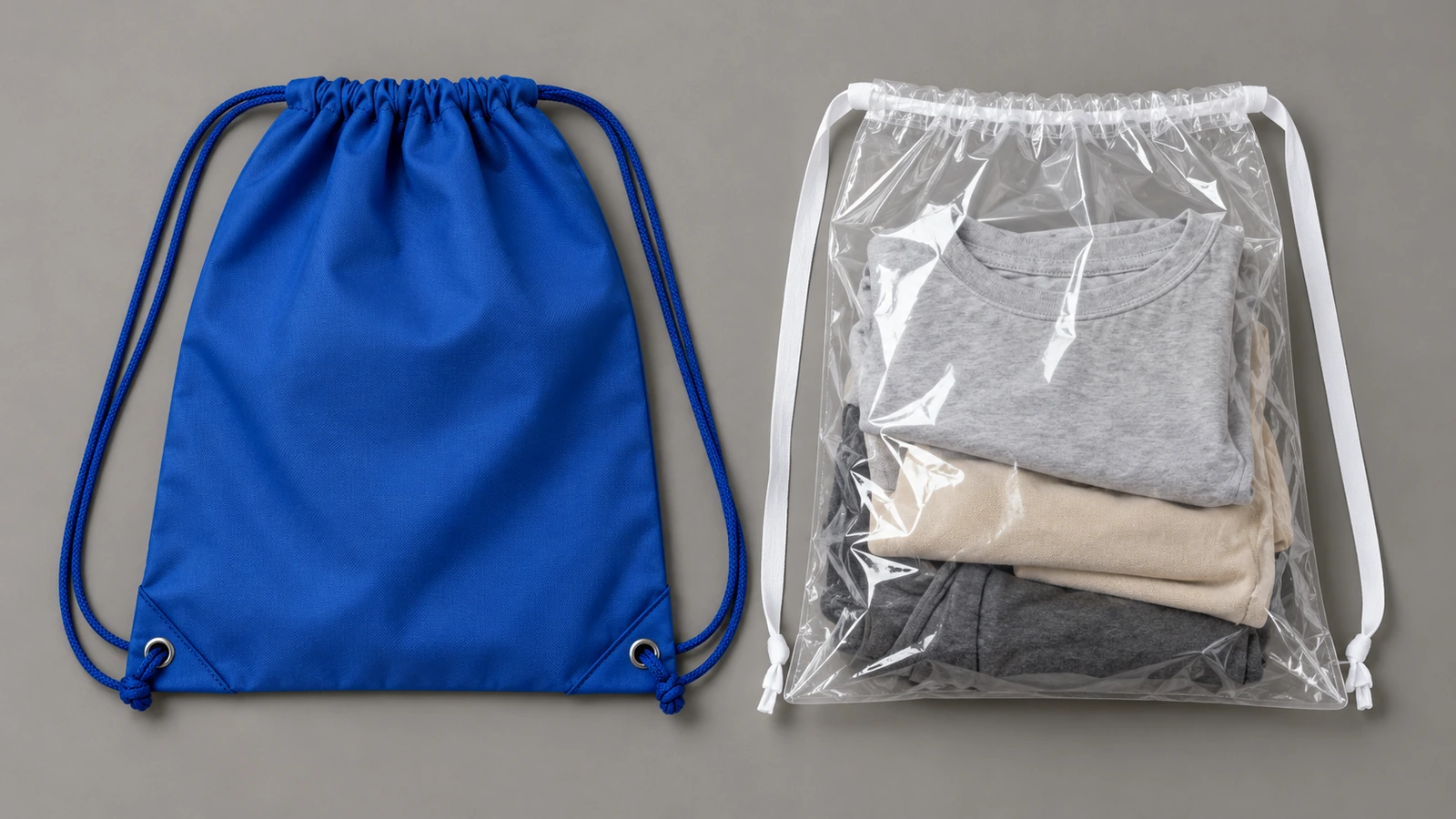
A cinch backpack is a sewn fabric sack, usually polyester or nylon. Two cords run through a top channel and anchor at the bottom corners, often through grommets or reinforced patches. Pulling the cords closes the bag and turns them into shoulder straps. Customized drawstring backpacks add a logo, team name, or event mark by screen printing, heat transfer, or sublimation. Because the cords are also straps, the bag is built to be worn.
A PE drawstring bag is made from polyethylene film, the same family of resin as poly mailers and garment bags. A draw tape or cord runs through a heat-sealed hem at the mouth. It closes the bag and serves as a carry loop, but it is not a pair of shoulder straps. The film is printed on the roll before conversion, usually by flexography. The roll then goes into a bag machine that folds the hem, inserts the closure, seals, and cuts each bag. The result is lightweight, water-resistant, and can be made transparent, so security staff, nurses, or housekeepers can see the contents without opening the bag.
Thickness is described differently for each material, and buyers often mix the units up. Fabric is specified by yarn weight (denier). Film is specified in mil, where 1 mil equals 0.001 inch, about 25.4 microns. A "2 mil" film bag is roughly 0.05 mm thick, not 2 mm. Public reviews of blank film bags show buyers misreading this unit both ways: some call the same gauge too thin, others too heavy. Confirm the unit on every quote.
How to Choose Between Custom Cinch Backpacks and PE Drawstring Bags in Five Steps
Step 1: Decide how the bag will be carried
Start with the carry, because it rules out one format right away. If recipients will walk a campus, a race expo, or a three-day tournament with the bag on their backs, you need shoulder cords anchored at the base. Only the fabric pack has that structure. Search for "custom drawstring bag sports" and you will find mostly team buyers who need exactly this. Snacks, water bottles, and a jersey put the load on the bottom corners, and that is where a sewn, reinforced pack is strongest.
If the bag is carried by hand for a short time, film is the better fit. Examples include a trade-show literature kit, a patient-belongings bag, a hotel laundry pickup, or a sample pack handed over a counter. Film keeps out moisture, can be clear, and adds very little weight to a shipment of kits. Do not market it as a backpack. Recipients who try to sling a film bag over a shoulder will strain the hem channel, which is the bag's weakest point.
Step 2: Estimate the bag's useful life and convert it to cost per impression
Unit price is a misleading metric here. Cost per impression is better, and it is simple to calculate:
Cost per impression = (unit price + setup cost ÷ quantity + freight per unit) ÷ (expected uses × people who see the bag per use)
The reuse term usually decides the result. Suppose a fabric pack costs three times as much as a film bag but is carried ten times, while the film bag is used once at the event and then thrown away. The fabric pack then delivers its impressions at well under half the cost. The reverse also holds. When the bag only has to survive a single afternoon, such as a giveaway at a festival gate or a conference badge pickup, the extra durability of fabric is wasted, and the cheaper format reaches more hands per dollar.
Be honest about the reuse estimate. Thin, see-through polyester packs bought for one event often get a lukewarm reception: recipients say they "hold everything, but we'll see for how long." If your pack would be reused only once or twice, model it that way. Ask suppliers for unit price, setup charges, and freight as separate lines so the formula uses real figures from your quotes.

Step 3: Match the decoration method to your artwork
Each format is printed differently, and the print process limits what your artwork can look like.
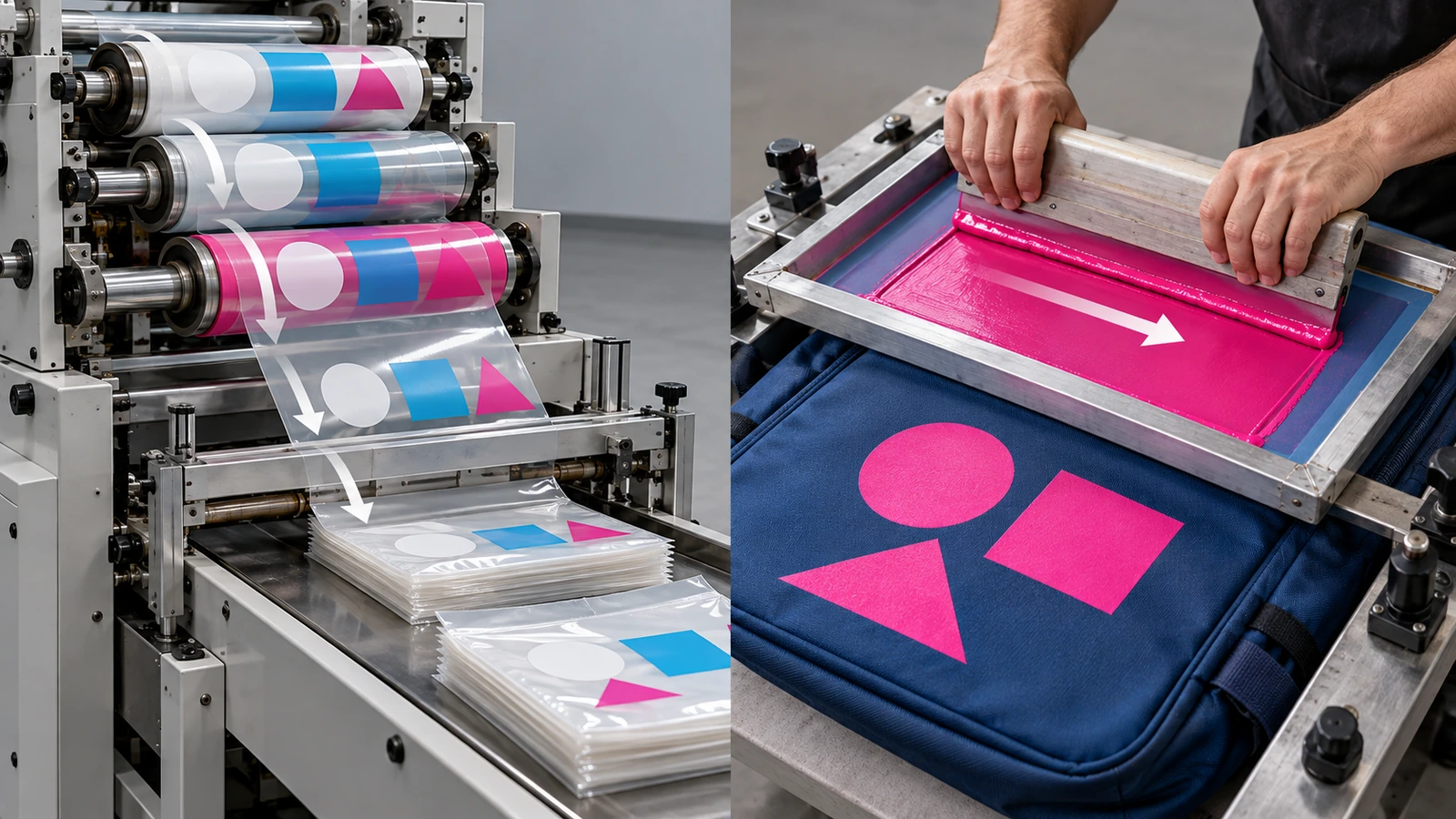
- Fabric cinch packs: Screen printing is the default for bulk runs. Each ink color needs its own screen, so many low-cost offers are one color only. Buyers who missed that detail have ended up with photo artwork reduced to a flat single-color mark. Heat transfer and sublimation can reproduce full color. Sublimation needs light-colored polyester. If you are pressing bags yourself, protect the cords, because buyers report the drawstrings are what melts first under the press.
- PE film bags: Flexographic printing uses one photopolymer plate per spot color. The film is corona-treated first so the ink bonds to the surface. On clear film, colors need a white underlay, and that white takes up a print station. Plate costs are charged per color and are spread across the run, so multicolor film printing pays off at volume, while a one- or two-color mark works at smaller quantities.
Either way, approve a physical or digital proof before production. Keep artwork clear of the seams, the hem channel, and the cord exits. Artwork preparation for film bags is covered on the product page; this guide does not repeat it.
Step 4: Work backward from the event date, not the quote date
For both formats, the production clock starts at proof approval. It does not start when you request a quote or place the order. Count backward from the event date, and allow time for artwork revisions, proof sign-off, payment of the deposit or setup charges, production, and freight. For overseas production, add ocean or air transit, which is separate from the factory's production time.
The two formats slip for different reasons. Fabric packs are delayed by thread and fabric color matching, and by screens that have to be remade when the artwork changes. Film bags are delayed by plate making, and by any change to gauge, size, or closure after plates are cut, because each of those changes usually means a new sample. Freeze the specification first, then request the timeline. For the film route, the steps between proof approval and shipment are covered on the custom PE drawstring bags page.
Step 5: Check the rules that can override your preference
Three outside factors can decide the format for you.
Venue policies. Many stadiums and arenas set a maximum bag size, require clear bags, or limit how large a logo can be. Clear film may be required at a venue where an opaque fabric pack would be turned away at the gate. Get the venue's written policy before you choose a size.
State bag laws. Checkout-bag laws target carryout bags, not garment, parts, or promotional drawstring bags. They do affect retail handouts. California's SB 1053 ended plastic checkout bags at grocery stores from January 1, 2026. Washington kept a 2.25 mil minimum for reusable plastic bags[1] and pushed the 4 mil requirement to 2028. If your "event bag" is actually handed out at a store checkout, have the bag type reviewed first.
Packaging responsibility rules. California's SB 54 packaging EPR program[2] aims for 65% recycling of covered single-use plastic packaging by 2032. Starting in 2027, producers that have not joined an approved program cannot sell covered material in the state. A film bag used as packaging may fall under this law; a reusable fabric backpack sold as merchandise usually will not. Ask whoever handles compliance which category your program falls into.
Sustainability messaging also differs between the two formats. A film bag is easier to recycle when it is a single material. Industry press reports that switching to a PE draw tape keeps bags above 95% PE by weight[3]. European design guidance such as RecyClass's natural PE film guidelines[4] grades designs below 70% as not recyclable. The #4 resin identification code[5] identifies the resin only; it does not mean the bag is recyclable. The Grade A clear PE film specification[6] caps total contamination at 5% by weight, so heavily printed or tinted bags may not qualify. End markets for recycled film are also narrow. A recent analysis found that the most viable outlets could absorb about 800,000 tons of household PE film per year[7], and none of those outlets involve food contact.
If the bags will hold food, the rules are stricter. The PE resin must comply with 21 CFR 177.1520[8]. Any coating on the food-contact surface falls under 21 CFR 175.320[9], which limits chloroform-soluble extractives to 0.5 mg/in². Recycled content needs separate review under FDA's recycled-plastics guidance[10]. New Jersey has delayed some food-contact PCR mandates to the end of 2029[11]. Which claims you can put on the bag is covered on the product page; do not print any claim until it has been checked.
Custom Cinch Backpacks vs. PE Drawstring Bags: Side-by-Side Comparison
| Decision factor | Polyester / nylon cinch backpack | Flat PE film drawstring bag |
|---|---|---|
| Carry style | Worn on both shoulders; cords anchored at the base corners | Carried by hand from the draw tape or cord loop; not built to be worn |
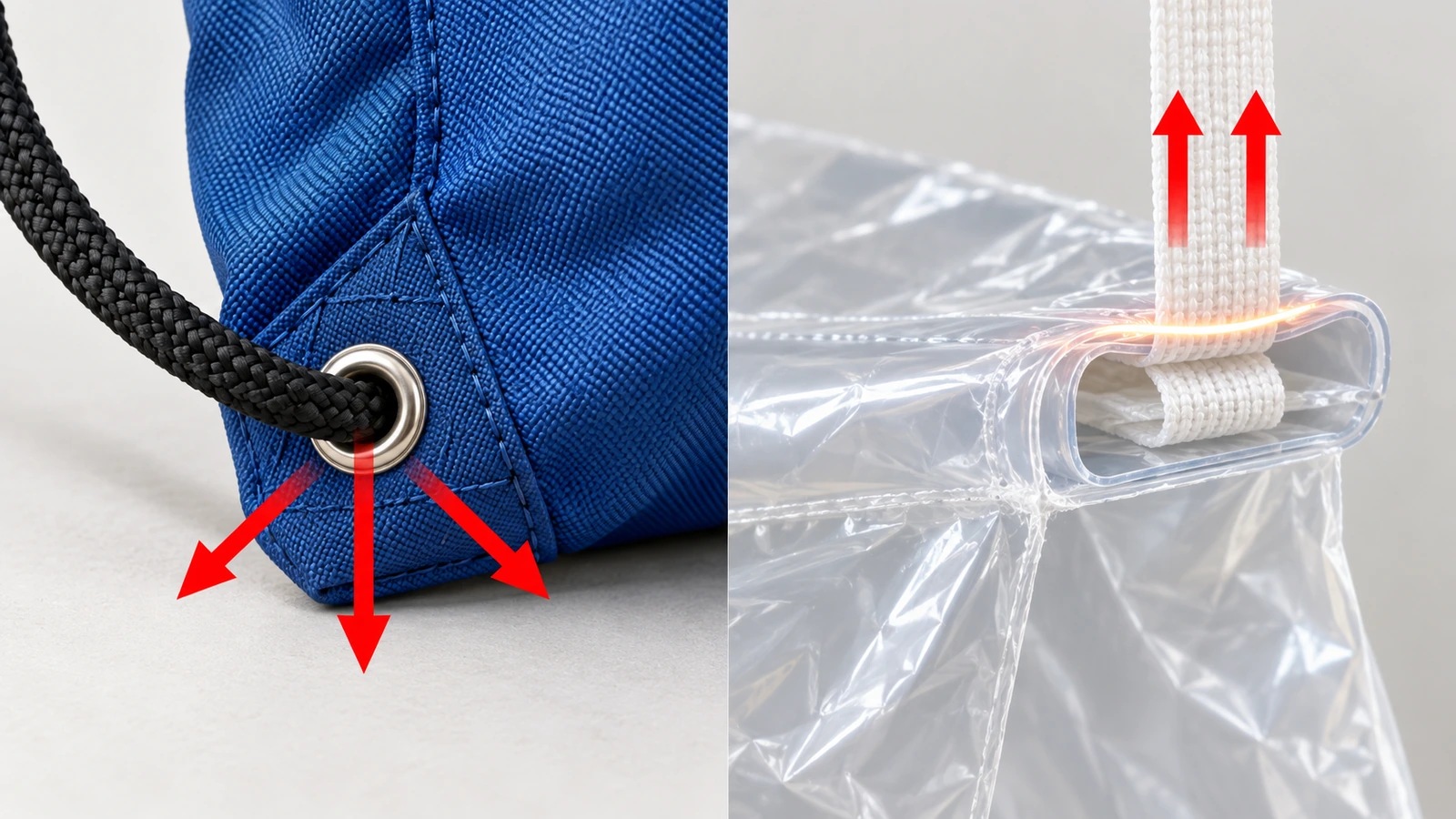
| Typical failure point | Corner stitching or grommets under heavy loads; thin fabric wears out | Hem channel tearing, draw tape pulling out, closure not threaded through the channel |
| Thickness unit | Denier (yarn weight) | Mil (1 mil = 0.001 in ≈ 25.4 µm) |
| Moisture and visibility | Usually opaque; fabric lets water through | Water-resistant; can be fully transparent |
| Decoration | Screen print (per color), heat transfer, sublimation | Flexography, one plate per spot color, white underlay on clear film |
| Where cost per impression is earned | Repeated reuse over weeks or months | Low unit cost spread across very large handouts |
| What slips the schedule | Screen remakes, fabric and cord color matching | Plate making, spec changes after plates are cut |
| Best-fit programs | Sports teams, school programs, race kits, gym and travel merchandise | Trade-show kits, patient belongings, hotel laundry, sample and parts packs, clear-bag venues |
Mixed programs are common. A tournament might give players customizable drawstring backpacks and use clear film bags for the welcome kits handed out at registration. Order each format from a specification written for that format, not from one shared "drawstring bag" spec.
Frequently Asked Questions
FAQ: Can a PE drawstring bag be used as a cinch backpack?
No. Film bags have a single closure loop at the hem rather than two cords anchored at the base, so wearing one on the back puts all the load on the heat-sealed channel. If people will wear the bag, specify a sewn polyester or nylon pack.
FAQ: Which format is better for a sports team?
For players, a fabric cinch pack is almost always better: it carries bottles and gear on the shoulders and gets reused all season, which lowers cost per impression. Film bags work well for team-run events, such as sorting donated items or bagging wet uniforms after a game.
FAQ: Can I get full-color photo artwork on a cinch backpack?
Yes, but not by one-color screen printing. Ask for heat transfer, or sublimation on light polyester, and confirm the print method in writing before approving the proof. Many low-cost listings are limited to one color, and buyers often miss that line.
FAQ: Does "2 mil" mean the film is 2 millimeters thick?
No. A mil is a thousandth of an inch, so 2 mil is about 0.05 mm. Write both units on the purchase order to avoid buying the wrong gauge.
FAQ: Which format is faster to produce?
Neither is always faster. For both, the timeline starts at proof approval, and changing the specification after plates or screens are made resets the schedule. Get a dated timeline from each supplier, measured from proof approval, and add freight time.
FAQ: Where can I specify printed PE film bags in detail?
Gauge, closure choice, artwork preparation, batch inspection, and permitted claims are covered on our printed PE film drawstring bag page. Send your quantity and event date for a quote.
Key Takeaways
- Choose the format by how the bag is carried before comparing prices. — Film thickness is measured in mil, and Washington's legal minimum for reusable plastic bags is only 2.25 mil, which shows how thin these films are (Source)
- Single-material PE design makes recyclability claims easier to support. — A PE draw tape keeps bags above 95% PE by weight (Source)
- A resin code is not a recycling claim. — The #4 code identifies LDPE only; it does not mean the bag will be recycled (Source)
- Heavy printing can push film out of the clean recycling grade. — Grade A clear PE film allows at most 5% total contamination by weight (Source)
- California's EPR rules apply to film used as packaging. — SB 54 targets 65% recycling of covered plastic packaging by 2032 (Source)
- Food-contact use needs documentation beyond the resin. — Coatings on polyolefin film are limited to 0.5 mg/in² of chloroform-soluble extractives (Source)
Conclusion: Choose the Format for the Program, Not the Search Term
Custom cinch backpacks pay off when people wear them and keep using them, so their cost is spread over many impressions. PE film drawstring bags pay off when the bag needs to be clear, moisture-resistant, light, or cheap enough to hand out by the thousands. Before requesting quotes, answer four questions: how will the bag be carried, how many times will it be used, which print method does the artwork need, and what is the proof-approval deadline that still meets the event date. Then check the venue policy and the state rules. If film is the right choice, review the custom printed PE drawstring bag specifications and send your quantity, artwork, and event date for a tailored quote.
References
- Packaging Dive, "Packaging laws taking effect in 2026," January 5, 2026. https://www.packagingdive.com/news/state-packaging-laws-2026-bags-foam-pfas-hotels/808682/ ↩
- CalRecycle, "Plastic Pollution Prevention and Packaging Producer Responsibility Act (SB 54)," accessed October 2026. https://calrecycle.ca.gov/packaging/packaging-epr/ ↩
- Packaging Europe, "Adapa targets PPWR recyclability requirements with PE bag drawstrings," February 6, 2025. https://packagingeurope.com/news/adapa-targets-ppwr-recyclability-requirements-with-pe-bag-drawstrings/12458.article ↩
- RecyClass, "Design for Recycling Guidelines: Natural PE Flexible Films," March 2026 update. https://recyclass.eu/wp-content/uploads/2026/04/RecyClass-DfR-Guidelines-Natural-PE-Films.pdf ↩
- ANSI Blog, "Resin Identification Codes (RICs) – ASTM D7611." https://blog.ansi.org/ansi/resin-identification-codes-rics-astm-d7611/ ↩
- Recycled Materials Association (formerly ISRI), "PE Clear Film (Grade A)" specification, 2025. https://www.recycledmaterials.org/wp-content/uploads/PE-Clear-Film-Grade-A.pdf ↩
- Waste Dive, report on end markets for recycled flexible PE film (Eunomia and Delterra), October 8, 2026. https://www.wastedive.com/news/flexible-plastic-film-recycling-eunomia-delterra-amcor-kraft-heinz/830294/ ↩
- Electronic Code of Federal Regulations, 21 CFR § 177.1520 "Olefin polymers." https://www.ecfr.gov/current/title-21/section-177.1520 ↩
- Electronic Code of Federal Regulations, 21 CFR § 175.320 "Resinous and polymeric coatings for polyolefin films." https://www.ecfr.gov/current/title-21/chapter-I/subchapter-B/part-175/subpart-C/section-175.320 ↩
- U.S. Food and Drug Administration, "Use of Recycled Plastics in Food Packaging (Chemistry Considerations): Guidance for Industry," July 2021. https://www.fda.gov/regulatory-information/search-fda-guidance-documents/guidance-industry-use-recycled-plastics-food-packaging-chemistry-considerations ↩
- Waste Dive, "New Jersey delays PCR requirements for food-contact packaging to 2030," September 11, 2026. https://www.wastedive.com/news/new-jersey-delays-pcr-requirements-food-contact-packaging/830139/ ↩












The information below is required for social login
Sign In
Create New Account