We use cookies to enable our websites to remember information, to help some website functionalities to work properly, to understand how you interact with and use our websites and to display you content and ads that are relevant and engaging for you.
By clicking Accept All you consent to the use of these cookie.
The store will not work correctly when cookies are disabled.
Quick answer: Who made scratch and sniff stickers? The technology comes from Gale W. Matson, a 3M chemist. His patent for microcapsule-coated paper was filed on November 18, 1969 and granted on June 23, 1970. Educational publishers such as Creative Teaching Press, starting in 1977, and later Trend Enterprises turned that fragrance coating into the classroom stickers many people remember.
Most people who ask who made scratch and sniff stickers are curious about a childhood memory. B2B buyers have a more practical reason to care about the answer. Matson's invention was not a scented ink. It was a way to trap fragrance oil inside microscopic shells that break only when scratched. Almost every complaint about modern scented stickers comes back to that mechanism: the smell is faint, it fades quickly, it doesn't match the picture, or it can be smelled before anyone scratches it. Once you understand how the original worked, you can write a specification that prevents those failures. Without that understanding, you end up approving a sample on looks alone.
The cost of getting this wrong goes beyond a disappointing giveaway. In 1987, a utility mailed scent patches strong enough to set off gas-leak panics across Baltimore. Today, schools with fragrance-free policies may refuse a reward sticker outright. This article traces the path from a 3M laboratory to the classroom to modern brand campaigns, and turns each stage into a decision you will face when you order.
Who Made Scratch and Sniff Stickers, and What Did Matson Actually Invent?
The inventor credited with scratch-and-sniff is Gale W. Matson, a chemist at 3M. The scratch-and-sniff encyclopedia entry[1] defines the technology as a fragrant coating applied to items such as stickers or paperboard that releases an odor when scratched. Microencapsulation itself was older. It had already been used for carbonless copy paper in the 1950s, where tiny ink capsules burst under pen pressure. Matson's contribution was putting fragrance oil into those capsules and bonding them to paper.
The legal record is specific. Patent US3516846A, "Microcapsule-containing paper"[2] was filed on November 18, 1969 and granted on June 23, 1970. 3M kept developing the idea. A later 3M patent, US4493869A[3], granted on January 15, 1985, covers fragrance-releasing microcapsules on a see-through substrate. That patent matters to buyers because it shows substrate choice was an engineering problem from the start. You cannot assume paper and film behave the same way.
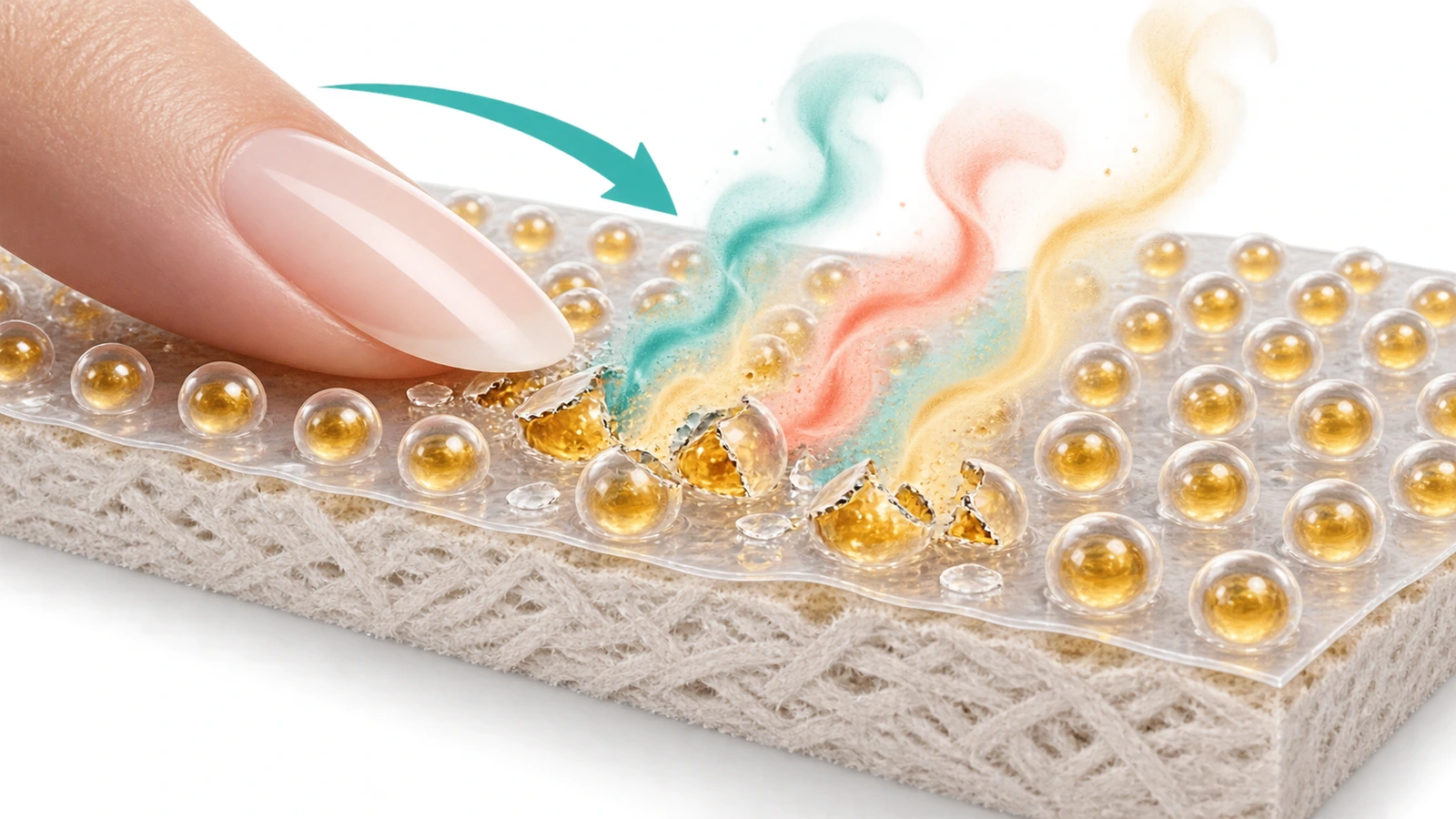
The industrial process has barely changed in concept. According to the How Products Are Made reference on scratch and sniff[4], fragrance oil is added to a water-soluble polymer solution and agitated. After about 12 hours the oil beads reach 20 to 30 microns, which is smaller than the eye can see. A catalyst then forms a polymer shell around each bead. The same reference notes that stickers are usually produced by flexographic printing. The key fact for buyers: each capsule can release its scent only once. A scratch spends some capsules and leaves others for later. How long a scent area keeps working depends on how many intact capsules are deposited there, not on how strong the fragrance smells on day one.
From Patent to Classroom to Brand Campaign
The patent did not create the sticker craze by itself. Educational publishers did. The encyclopedia entry cited above records that Creative Teaching Press produced some of the earliest scratch-and-sniff stickers in 1977 and marketed them mainly to teachers as student rewards. Trend Enterprises followed with its Stinky Stickers line. A 2026 Moss & Fog retrospective[5] reports that Trend said it had sold more than one billion Stinky Stickers by 1983. That volume is why one smell, like grape or popcorn, can bring back a childhood memory for so many adults. It is also why buyers today get compared against a memory, not just a competitor's product.
The classroom chapter is now closing. On July 10, 2025, Trend Enterprises announced it would close by the end of 2025 after more than 55 years in business. People's report on the closure[6] quotes the company citing higher material, manufacturing and shipping costs, lasting effects of the pandemic, and falling demand for traditional classroom décor. With the best-known stock line gone, the demand that remains is shifting toward custom work: brand artwork, specific fragrances, and limited runs.
The 1980s also produced the cautionary tale every buyer should know. In 1987, Baltimore Gas & Electric mailed safety booklets to roughly 300,000 households with a scratch patch that smelled like natural gas. According to Hackaday's account of the gas panic[7], the scent escaped before envelopes were even opened. Residents reported leaks, and one false alarm drew 27 firefighters and 8 pieces of equipment. The capsules were not the problem. The fragrance load and the packaging were. This failure is still worth studying because it happened at full mailing scale.
The current chapter is about experience-driven brand marketing. Chemical & Engineering News reported in January 2026[8] on France's La Poste issuing a baguette-scented stamp in 2024, with a print run of about 594,000, followed by pastry-scented issues. A printer quoted in that article said nearly any scent blend can be encapsulated and made into printable ink. She also mentioned a Christmas card that still smelled of pine 15 years later. That is one printer's anecdote, not a guarantee. Still, it shows what well-made capsules can do when they are stored without being scratched.
How to Turn the Origin Story Into a Better Specification
Each part of Matson's design suggests a question to ask before you approve a run. The steps below cover only what the history explains. For the order workflow and print options, see our custom scratch and sniff stickers page, which covers the brief-to-delivery process and why scented stickers disappoint in detail.
Step 1: Define durability in terms of capsules, not adjectives
Because each capsule releases once, "long-lasting" means nothing on a quote. Ask how the supplier tests scent life before scratching, how many scratches a given scent area survives in their own testing, and what storage conditions those results assume. Ask for the test results, not marketing copy. Confirm that the product uses true microencapsulation. Fragrance oil sprayed or wiped onto a sticker without capsules evaporates within days. This is the shortcut the 1970 patent was invented to replace.
Step 2: Choose fragrance with the classroom-era lessons in mind
Forty years of reviews show a consistent pattern. Simple notes such as mint, honey and many fruits are usually judged accurate. Complex savory scents like pizza, popcorn and chocolate split opinion sharply, and citrus is known to be difficult to stabilize. Reviewers of mass-market packs also frequently notice an extra sweet base note layered over the intended smell. Judge the physical sample blind, against the real object or your product's own scent, not against a scent name on a list. If you plan to supply your own fragrance, ask early whether it can be encapsulated, because highly volatile materials may not hold up.
Step 3: Protect print quality by keeping the scent zone separate from the artwork
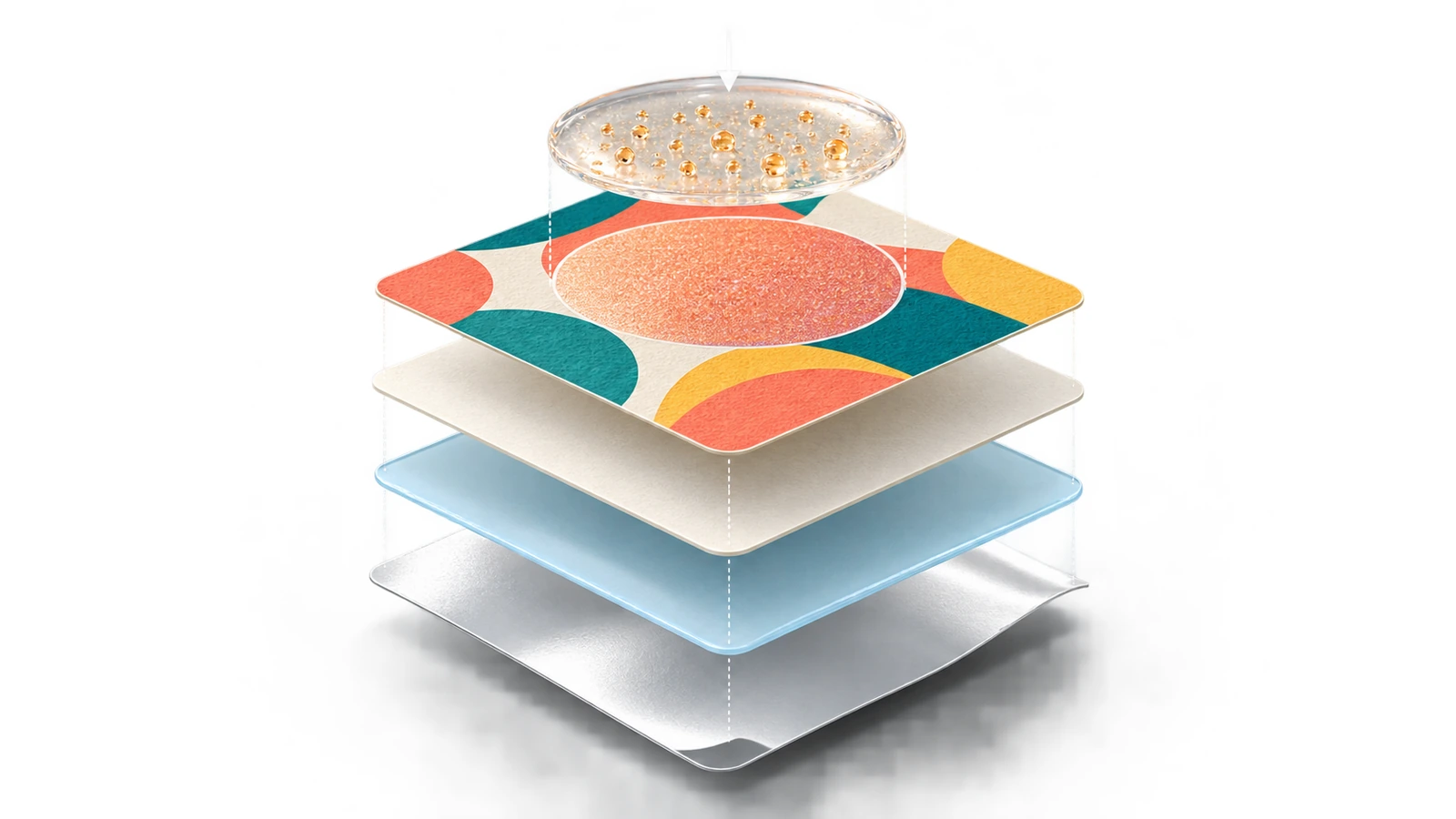
Modern production follows the same principle as Matson's paper: the capsules sit in their own coating, applied after the artwork is printed. In practice, the scent is usually a clear coat over a designated "scratch here" zone. Laminate over that zone blocks the scent, and printers commonly say the zone needs solid coverage rather than a halftone screen. Metallic inks and heavy UV varnishes should be tested for adhesion and scratch release before you sign off. Get approval on artwork color and scent zone position as two separate checks.
Step 4: Plan storage and shipping around early capsule breakage
The Baltimore mailer is the extreme case of a common problem. Friction during transit breaks some capsules, and heat and pressure weaken capsule shells. Specify sealed packing, scent zones that do not rub against each other, and separate packing for each scent so they don't cross-contaminate. Avoid hazard-like odors such as gas, smoke or fuel in any mass mailing. A faint smell before scratching is normal. A strong smell from a closed package means the coating or storage needs to be checked.
Step 5: Check who will smell it and where it will be sold
Scratch-and-sniff began as a children's reward, so safety rules apply. The CPSC's toy safety guidance[9] explains that Section 106 of the CPSIA made ASTM F963 mandatory for toys intended for children under 14. The current version, ASTM F963-23, applies to toys manufactured after April 20, 2024, along with Children's Product Certificates and tracking labels. Whether a promotional sticker counts as a toy depends on its design, marketing and intended age group, so make that call for each SKU. Indoor settings matter too. The American Lung Association's sample fragrance-free policy[10] notes that strong scents can reduce indoor air quality and trigger reactions in sensitive people, so check the venue policy before handing out stickers.
On the fragrance itself, the IFRA Standards (51st Amendment, 2022)[11] are the voluntary international industry benchmark. They support supply-chain trust but do not replace national law. For European distribution, the capsule shell is now regulated too. The EU microplastics restriction, Regulation (EU) 2023/2055[12], took effect on October 17, 2023. It gives synthetic polymer microparticles used to encapsulate fragrances a transition period until October 17, 2029. This is why suppliers are developing bio-based and mineral shells to replace the synthetic polymer walls used in earlier generations.
Three Eras of Scratch-and-Sniff, Compared
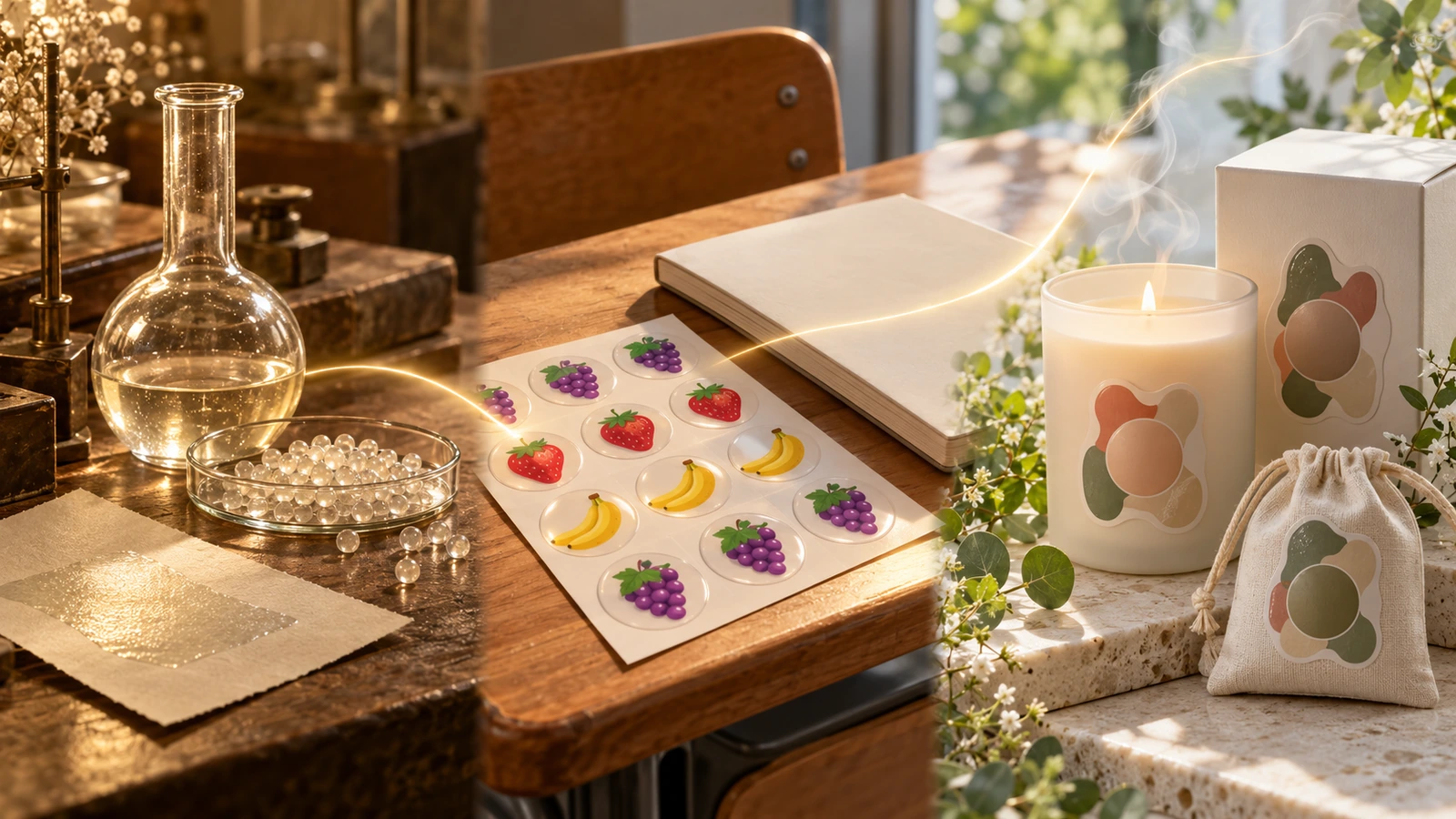
The table below compares how the same core mechanism has been used over time and what each era teaches today's buyer. It is a historical comparison, not a comparison of print options.
Dimension
Invention era (1969–1970s)
Classroom era (1977–2025)
Brand and experience era (2020s)
Key players
3M chemist Gale W. Matson; carbonless-paper microencapsulation
Educational publishers, including Creative Teaching Press and Trend Enterprises
Postal services, publishers, advertisers and custom brands
Milestone figure
Patent granted June 23, 1970
More than 1 billion Stinky Stickers sold by 1983 (reported)
About 594,000 baguette-scented stamps (2024)
Fragrance source
Encapsulated fragrance oil in polymer shells
Stock library of fruits, foods and novelty smells
Stock libraries plus brand-specific blends
Typical failure mode
Capsules breaking during coating or curing
Off-notes on savory scents; fading in cheaper imitations
Laminate over the scent zone; early leaking; scent not matching the product
Regulatory frame
Patent law
Children's product safety (CPSIA from 2008)
ASTM F963-23, IFRA standards, EU 2023/2055 shell rules
Lesson for buyers
Scent life depends on intact capsules
Judge scent accuracy by blind testing, not by name
Specify the scent zone, packaging and compliance from day one
FAQ
FAQ: Who made scratch and sniff stickers first?
The underlying technology is credited to Gale W. Matson of 3M, whose microcapsule-containing paper patent (US3516846A) was granted in 1970. The first widely marketed stickers came from educational publishers. Creative Teaching Press sold early scratch-and-sniff stickers to teachers in 1977, and Trend Enterprises' Stinky Stickers became the best-known line.
FAQ: Is Trend Enterprises still making Stinky Stickers?
No. Trend announced on July 10, 2025 that it would close by the end of 2025, citing rising costs and declining demand for traditional classroom décor. It also said it would sell its intellectual property, so the brand's future depends on who buys it.
FAQ: Why do some 1980s stickers still smell decades later?
Capsules that are never scratched stay sealed, so an unscratched sticker stored somewhere cool and dark can keep releasing fragrance years later. Collectors also report that heavily scratched or poorly stored stickers have faded. Old stock shows what the technology can do. It is not a warranty for a new custom run.
FAQ: Can my brand's own fragrance be encapsulated?
Often, yes, but it depends on the fragrance. Highly volatile or unstable materials may encapsulate poorly or fade faster, so compatibility is checked before production and confirmed with a physical sample. Share your fragrance supplier's details when you request a quote on our custom scratch and sniff stickers page.
FAQ: Do scratch and sniff stickers have to meet ASTM F963?
Only if they are toys intended for children under 14 in the U.S. market. In that case, ASTM F963-23 applies to products manufactured after April 20, 2024, along with a Children's Product Certificate. Stickers designed and marketed as adult promotional or packaging items may fall outside that definition, but you need to assess each SKU.
FAQ: Why does the sticker have to be scratched at all?
Scratching is what makes the scent last. The fragrance is sealed inside shells about 20 to 30 microns across. Without the shells, the oil would evaporate within days. Scratching breaks a small portion of the shells each time, so the scent can be released repeatedly over a long period.
Key Takeaways
Scratch-and-sniff began with a 3M patent, not a sticker brand. — filed November 18, 1969, granted June 23, 1970 (Source)
Durability depends on intact microcapsules, and each one releases only once. — beads of 20–30 microns after about 12 hours of agitation (Source)
The classroom era set buyers' expectations for how these stickers should smell. — more than 1 billion Stinky Stickers reported sold by 1983 (Source)
Too much fragrance in poor packaging can cause real public alarms. — about 300,000 mailers; one call drew 27 firefighters (Source)
Children's toy versions must meet U.S. mandatory toy safety rules. — ASTM F963-23 for toys intended for under-14s (Source)
Capsule shell materials have a deadline in the EU. — fragrance-encapsulation transition period ends October 17, 2029 (Source)
Conclusion: What the Answer to "Who Made Scratch and Sniff Stickers" Means for Buyers
The answer to who made scratch and sniff stickers is more than a trivia fact. Matson's 1970 patent defined the rules that still decide whether a sticker works. The scent must be sealed in capsules, the capsules must survive printing, and each scratch spends part of a limited supply. Trend's billion stickers explain why customers judge your scent against a memory. The Baltimore mailer shows what happens when fragrance load and packaging are ignored. Today's rules on child safety, fragrance standards and capsule shells add the compliance checks that a modern brief has to include.
If you are planning a run with your own artwork and a specific scent, start with these three questions: how durability is tested, which fragrance has been blind-tested and approved, and where the scent zone sits relative to the design. Then bring that brief to our custom scented sticker program and request a quote for your quantity, fragrance and use case.
Hi there! I'm Bruce, proud dad to my amazing son. I'm the founder of Zigpac, a printing and packaging company empowering small and medium-sized businesses with custom solutions. Let's create something great together!



 Blog PDF for offline reading












The information below is required for social login
Sign In
Create New Account