


 Blog PDF for offline reading
Quick answer: A 3D lenticular card is a rigid plastic card. A ridged lens on its face shows layered depth or an image change as the card tilts, and it needs no adhesive or host surface. Choose a card over a sticker when the piece has to stand on its own, such as a direct-mail insert, launch-kit card, event invitation or collectible promo card. For hand-held viewing, specify a fine lens in the 75–100 LPI range, move small text to a printed flat back, and budget for envelope mailing, because rigid lens stock rarely behaves like a standard machinable postcard.
Most teams that search for a 3D lenticular card already know the effect. What they need to know is whether it will survive their campaign. The usual brief is a launch kit, a VIP invitation or a mailer that has to be noticed in a stack of flat paper, and an optical card looks like the obvious upgrade.
Problems tend to show up late. The depth looked rich on screen and reads as mush at arm's length. The RSVP line on the front breaks into stripes. The mail house flags the rigid insert as nonmachinable, which adds postage and days nobody planned for. Each of these sends the job back for re-proofing, usually when the event date can no longer move.
This guide works through those decisions in production order: what the card is, how depth reads in the hand, when a rigid card beats a sticker, how stock, size and mailing interact, and which factors drive budget and schedule.
What Is a 3D Lenticular Card?
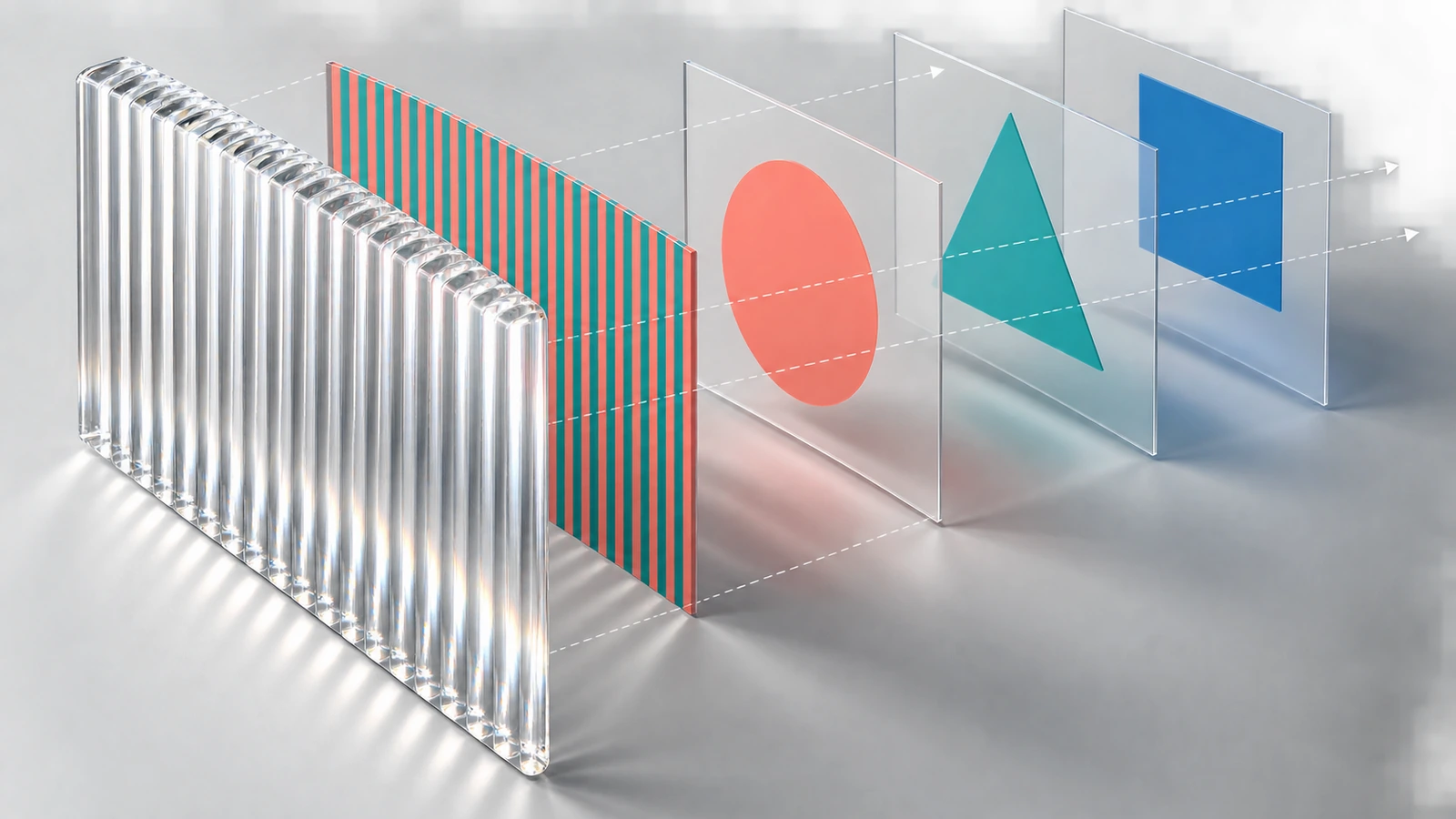
A lenticular card is built from two or more images. They are sliced into thin strips, interlaced, and printed behind a sheet of tiny parallel cylindrical lenses called lenticules. Each lenticule sends a different strip to your eye depending on the viewing angle. A plain-language explainer of the optics is available from Explain that Stuff[1]. The same lens can be used in two quite different ways, and the difference matters for cards:
- Flip and motion cards change from one picture to another as the card tilts. Clean results come from 2–3 frames for a flip and roughly 4–8 frames for short motion.
- 3D depth cards show one scene that appears to recede behind or float in front of the card surface. They are typically built from about 10–16 rendered views of the same scene.
In a rigid card the lens sheet usually is the card. The plastic (commonly PET, APET or PETG) carries the print on its back face, so there is no separate paper board underneath unless one is laminated on. That is why a lenticular card feels denser and stiffer than a paper card of the same size. It is also why a flat, printed back is the natural place for anything you need people to read.
Change-image prints have an international quality reference. ISO 20793:2024[2] specifies how to measure crosstalk, viewing-angle range, angular misalignment and image uniformity for lenticular prints used for changing images. Its scope explicitly excludes prints used for 3D images, so for depth cards an approved physical proof is the acceptance reference.
How Does Depth Read on a 3D Lenticular Card at Hand-Held Distance?
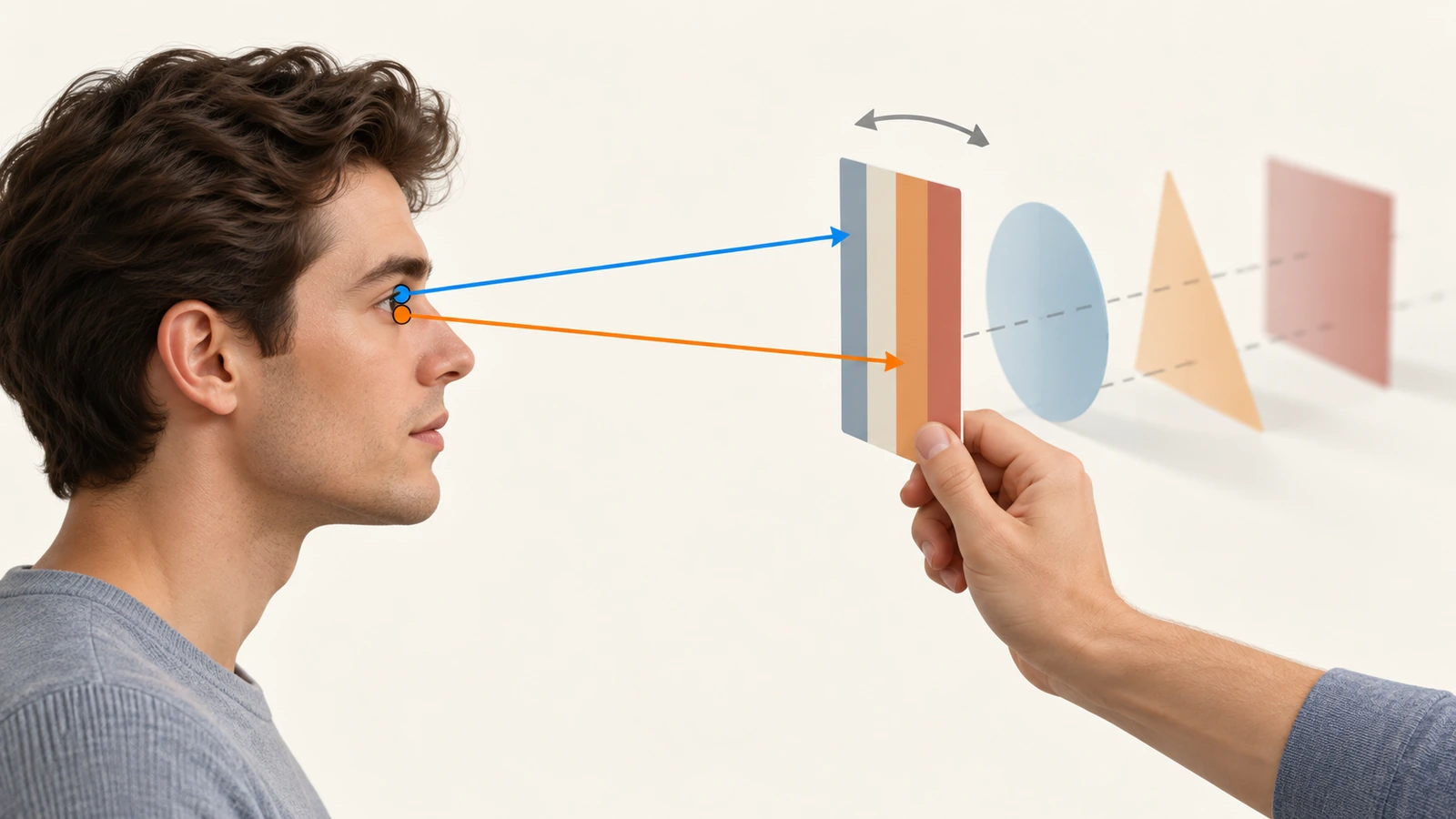
Depth depends on binocular parallax. Your left and right eyes sit a few centimetres apart, so the lenticules deliver a slightly different view to each eye, and the brain fuses the two into depth. Two practical consequences follow for cards held about 30–50 cm (12–20 in) from the face.
Lens orientation is fixed by the effect. A depth effect needs the lenticules to run vertically, so that each eye sits behind a different strip. A flip effect on a hand-held card generally works better with horizontal lenticules: both eyes see the same frame, and the viewer triggers the change with a natural top-to-bottom tilt. Left-right animations also ghost more than up-down ones. Because orientation follows the effect, you cannot have deep 3D and a crisp flip on the same lens at full strength. Pick one primary effect.
Finer lenses trade depth for clarity. Industry design guides put hand-held pieces such as cards, postcards and stickers in the 75–100 LPI (lenticules per inch) range, and reserve 20–40 LPI for posters viewed from several feet. A coarser lens gives stronger depth but more visible ridges. A finer lens gives a sharper image within a narrower depth budget. For a card held at reading distance, the most convincing depth usually comes from modest separation between three to five clearly staged layers, not one dramatic extreme.
Staging rules that keep depth readable:
- Place the logo and any front-side text on the focal plane, the zero-depth layer that looks like it sits on the card surface. Text placed behind or in front of that plane softens first.
- Fill every layer completely in the source file. A gap behind a foreground object shows up as a smear when the card tilts.
- Avoid hard black-to-white contrast between adjacent elements. High contrast is the most common cause of ghosting, where one image "burns" into another. Collectors are unforgiving about it, and published complaints about lenticular covers describe seeing "a blend of both covers at the same time"[3].
- Respect minimum type sizes by lens: about 18 pt at 40 LPI, 12 pt at 75 LPI and 8 pt at 100 LPI. Thin serif type and hairlines break up first.
When Does a Rigid Card Work Better Than a Sticker?
The lens optics are identical. The job differs. A sticker borrows its stiffness and its context from whatever it is applied to. A card has to supply both itself. Choose the card when:
- There is no flat host surface. Envelopes, tissue-wrapped kits and event lanyards give a sticker nothing rigid to sit on. A bent lens loses its optics, so the card's own rigidity becomes the feature.
- The object is the keepsake. Invitations, collectible promo cards and loyalty cards are held, passed around and stored. People keep a card. A sticker gets applied or forgotten.
- You need a second, flat information surface. A card back can carry the agenda, QR-free URLs, legal copy or a serial number at normal type sizes. A sticker's back is release liner.
- You want to avoid adhesive decisions. Cards remove questions about surface energy, application temperature and residue on premium packaging.
The sticker is the better tool when the effect has to live on the pack itself: a lid panel, a flat box face, a laptop-style merch item or a limited-edition seal. Lenticular labels have a long industrial history of being laminated in continuous webs with the lenticules set across the web direction; a 2006 US patent on lenticular label manufacture[4] describes the approach. If your effect belongs on the box rather than in it, see our custom lenticular stickers for flat packaging and launch kits, which covers sticker formats, artwork approval and supply routes in detail.
Many launch kits use both. A sticker seals the outer box, and a matching card inside carries the depth scene and the message on its back.
Which B2B Jobs Suit a Lenticular Card?
Direct-mail inserts. A lens card inside an envelope gives the recipient a tactile reason to open it and keep it. Use a flip if the mailer has one before/after message, such as a product reveal or an offer unlocking. Use depth if the point is to show off a product or space. Keep the call to action on the printed back.
Launch-kit cards. Inside a press or influencer kit, the card is often the item photographed for social posts. Depth tends to photograph poorly because a camera has one eye. A flip films well because the change survives a single lens. If social capture is the goal, that argues for flip over 3D.
Event invitations. Rigid invitations feel premium and survive a desk drawer until the event. The usual front-and-back split is the event visual or brand mark on the lens face, and date, venue and RSVP details on the flat back.
Collectible promo cards. Numbered series, game tie-ins and limited drops depend on perceived quality. Collectors notice crosstalk and banding, so this is where ISO 20793-style acceptance language (crosstalk, angle range, uniformity) is worth writing into the brief for flip cards.
How to Plan a Lenticular Card Project Step by Step
- Write a one-line effect brief. Choose "Flip from A to B," "short motion" or "3D depth of one scene," and only one. Record how the card will be held and seen (in hand, on a desk, on camera).
- Choose the lens for the viewing distance. For hand-held cards, ask for a lens in the 75–100 LPI range and confirm orientation: vertical lenticules for depth, typically horizontal for a hand-held flip.
- Decide what lives on each side. Put the visual on the lens face and the information on the printed back. Anything below the minimum type size for your lens moves to the back.
- Prepare files the way the press needs them. Supply each flip frame as a separate CMYK file at 300 dpi at final size, or a layered PSD for depth with every layer filled. Add 1/8 in (3 mm) bleed and a 1/4 in (6 mm) safety zone. Depth files usually need wider left/right bleed, often 3/4–1 in, so the edges still hold when the card tilts. Do not interlace files yourself unless the printer asks you to, because interlacing must match the measured pitch of that specific lens batch.
- Approve a physical proof, not a PDF. Check it at the real hand-held distance, under the lighting where it will be used, at left, centre and right tilt. Look for ghosting, readable text and depth that holds.
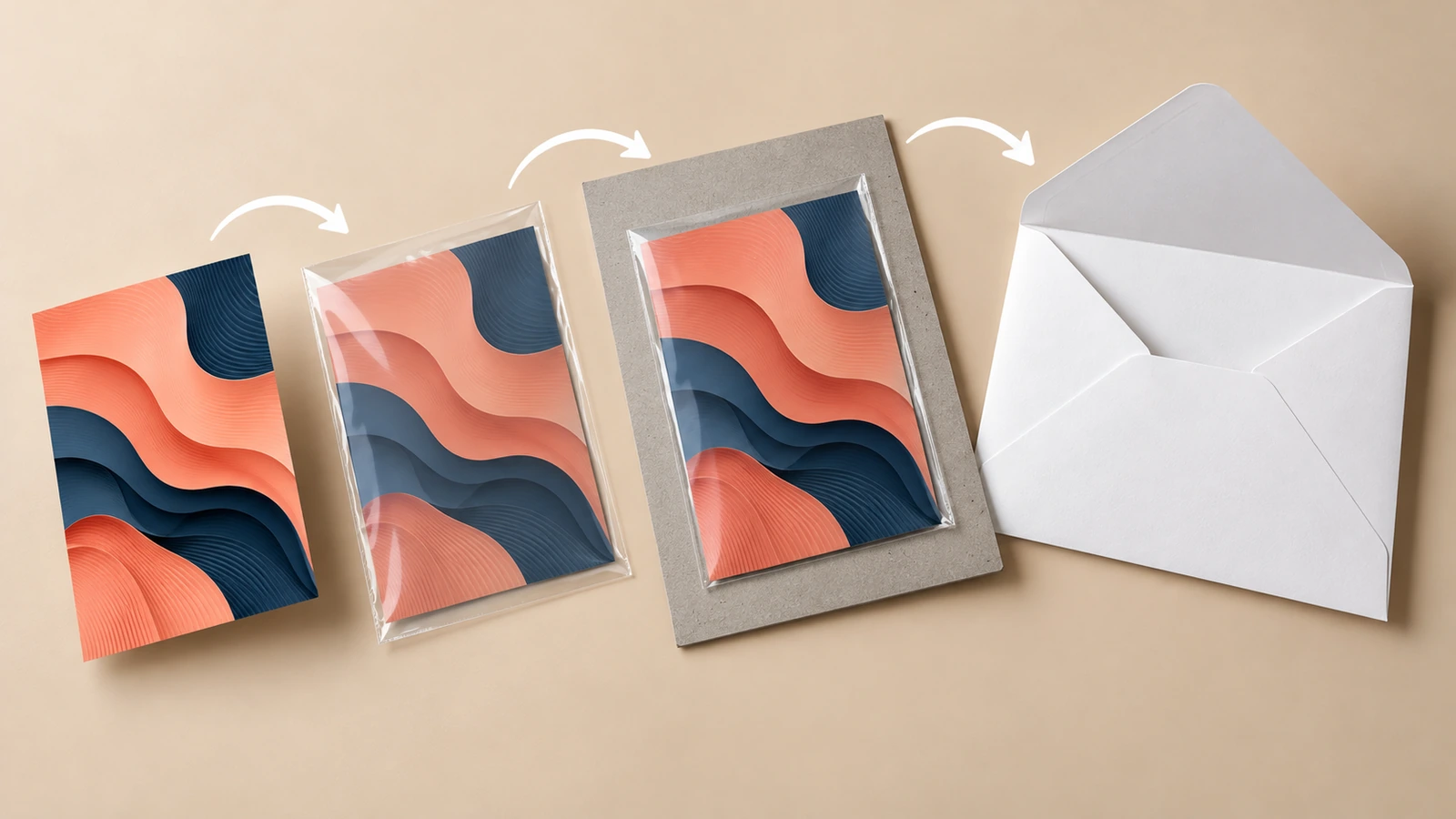
- Lock packing and mailing before production. Settle the envelope, sleeve or backing board and the mail class now, because they can change the card's size and finish. The next section covers why.
What Do Card Stock, Size and Mailing Limits Mean for Budget?
Stock is lens thickness. Lens sheets for hand-held work are thin compared with poster lenses. Published 100 LPI and 75 LPI specifications sit around 14 mil and 18 mil (roughly 0.36–0.46 mm). Coarser lenses get thicker. Thicker lenses feel more substantial and give more depth, but they cost more per sheet and add weight to every mailed piece. If you want a heavier, board-like feel, the card can also be laminated to a printed backer, which adds a process step and some lead time.
Size is a sheet-yield question. Lens sheets are printed in fixed press formats and then die-cut. A card that nests efficiently on the sheet costs less per piece than an odd size that wastes lens material. Custom shapes add a cutting die. Before locking a size, ask for the yield at your preferred dimensions and at one slightly smaller alternative. We'll quote both so you can compare.
Mailing is where rigid cards surprise people. In US mail, postcard-rate pieces have a maximum thickness of 0.016 in, and a lens card near or over that limit, especially one with a laminated backer, is treated as a letter or flat. Postal rules also class letters that are "too rigid" to bend as nonmachinable, which carries a surcharge. A rigid plastic insert can tip an otherwise standard envelope into that category. Lens surfaces also scuff in automated sorting, so mailing a card bare is rarely a good idea. Confirm the classification with your mail service provider or postal account representative using a physical sample, and include sleeves or backing boards in the budget from the start.
What drives lead time. Lenticular schedules are measured in weeks, not days, and the clock normally starts when the proof is approved, not when the order is placed. The main things that stretch it:
- 3D depth work, which requires converting a flat image into layered views
- Extra proof rounds caused by high-contrast frames or undersized text
- Custom die shapes and lamination to a backer
- Kitting, inserting and mail-house time after the cards are produced
- Freight transit to the fulfilment site
Working backward from the in-home or event date with every one of these steps included is the most reliable way to protect the schedule. For quantities, pricing and production time on a specific card, ask us for a quote and proof, because those figures depend on lens, size, effect and finishing.
Card vs Sticker vs Flat Print: Comparison Table
| Factor | 3D / flip lenticular card | Lenticular sticker | Flat printed card (incl. foil or holographic finish) |
|---|---|---|---|
| What the viewer sees | Real depth or a true image change on tilt | Same optics, on a host surface | Static image; foil or holo shine moves, art does not |
| Needs a host surface | No, self-supporting | Yes, flat and rigid only | No |
| Space for readable small text | Printed back at normal sizes | Front only, limited by lens | Both sides |
| Curved surfaces | Not applicable | Not suitable; lens loses optics when bent | Holographic film can follow curves |
| Mailing behaviour | Rigid; often letter/flat class, sleeve advised | Usually applied to a pack, not mailed alone | Can qualify as a standard postcard if within limits |
| Camera / social capture | Flip films well; depth needs two eyes | Same as card | Films well |
| Typical keep rate | High: collectible or invitation object | Applied once or stored | Lower; often discarded |
| Schedule | Weeks; proof-dependent | Weeks; proof-dependent | Fastest |
Which Compliance Questions Apply?
A promotional card is not regulated as a lenticular product. The regulations attach to where the card goes and who it is aimed at.
- Children's collectibles. If a promo card series is designed primarily for children aged 12 and under, or sold as a toy, US rules under CPSIA, including the ASTM F963 toy standard, can apply, with third-party testing and a Children's Product Certificate. See the CPSC toy safety guidance[5].
- Food and pharma inserts. Placing a card loose inside food packaging raises indirect food-contact questions under 21 CFR[6]. Pharmaceutical kits fall under labeling and packaging controls. Assess these with your regulatory team before an insert goes near the product.
- EU shipments. Regulation (EU) 2025/40, the Packaging and Packaging Waste Regulation[7], has applied directly across the EU since 12 August 2026, as the European Sealing Association[8] notes. A card shipped as part of the packaging should be assessed as a packaging component.
- Recyclability claims. Lens cards are plastic and are sometimes laminated to board. Trade analysis warns that incompatible multi-material components[9] can compromise recycling streams. Do not print "recyclable" on a laminated card without verification.
Looking further out, researchers are already producing lenticular-style effects without a conventional lens. A Northeastern University team demonstrated a single metasurface device that shows 25 independent images[10], and MIT's ShiftLens[11] changes appearance by shifting printed micro-lenses. Both are lab work. For 2026 campaigns, PET lens cards are still the practical route.
FAQ
FAQ: Can one 3D lenticular card show both depth and a flip?
Only in a limited way. Depth needs vertical lenticules so each eye sees a different view, while a clean hand-held flip usually uses horizontal lenticules. Combined effects exist, but each part is weaker than a single dedicated effect. For campaign pieces, choose the one that carries the message.
FAQ: Why does my depth look flat in photos and videos?
A camera has one lens, so it cannot reproduce binocular parallax. Depth cards read strongly in the hand and weakly on screen. If social capture matters, a flip or short motion effect usually performs better.
FAQ: Where should the event date and RSVP details go on an invitation?
On the printed back. Lens ridges break up small type: about 12 pt is the floor at 75 LPI and 8 pt at 100 LPI. A flat back has no such limit and keeps the details legible.
FAQ: Can I mail a lenticular card as a postcard?
Rarely as-is. US postcard rates cap thickness at 0.016 in, and rigidity can make letter mail nonmachinable, which adds a surcharge. Most campaigns mail lens cards inside an envelope with a sleeve or backing board. Confirm the class with a physical sample before printing the envelopes.
FAQ: What file format should my designer prepare?
For flips and motion, separate CMYK frames at 300 dpi at final size. For depth, a layered PSD with every layer filled and text on the focal plane. Add 1/8 in bleed, a 1/4 in safety zone, and wider side bleed for depth. Leave interlacing to the printer.
FAQ: How do I judge proof quality objectively?
For flip cards, borrow the metrics in ISO 20793:2024: crosstalk (ghosting), viewing-angle range, angular misalignment and uniformity. Check at hand-held distance under the final lighting. For depth cards, the standard does not apply, so the signed physical proof is the reference.
Key Takeaways
- Flip cards can be accepted against an international measurement standard — 4 metrics: crosstalk, viewing-angle range, angular misalignment and uniformity, ISO 20793:2024 (Source)
- Depth cards fall outside that standard, so the signed proof is the reference — scope of the 2024 edition excludes 3D images (Source)
- Children-targeted collectible series may trigger toy-safety testing — CPSIA 2008 §106 makes ASTM F963 mandatory for children's toys (Source)
- EU-bound kits must treat cards as packaging components — PPWR applies directly from 12 August 2026 (Source)
- Laminated plastic cards should not carry unverified recyclability claims — 2025 trade analysis on multi-material labels and recycling streams (Source)
- Lens-free multi-image optics exist but are not production-ready — 25 independent images from one metasurface in lab tests (Source)
Conclusion: Plan the Card Around the Hand, the Envelope and the Date
A 3D lenticular card works when three things are decided early: one effect matched to how the card will be held, a split between the lens face for the visual and the flat back for the words, and a packing and mailing plan sized to a rigid object. If those are settled before artwork starts, proofing goes faster and the in-home or event date holds.
If your effect belongs on the package rather than in it, see our custom lenticular stickers. For a card project, send us the use case, target size, effect and delivery date. We'll come back with lens and stock options, quantities, a quote and a physical proof.
References
- Explain that Stuff, "How does lenticular printing work?" ↩
- ISO 20793:2024, Image quality of lenticular prints for changing images, ISO/TC 42, May 2024 ↩
- Reader discussion of ghosting on lenticular covers, r/comicbooks, October 2017 ↩
- US 7,001,654 B2, Lenticular label manufacture, granted 21 February 2006 ↩
- U.S. Consumer Product Safety Commission, Toy Safety business guidance ↩
- Electronic Code of Federal Regulations, Title 21: Food and Drugs ↩
- Publications Office of the EU, Regulation (EU) 2025/40 on packaging and packaging waste ↩
- European Sealing Association, EU PPWR overview, 1 October 2026 ↩
- Plastics Decorating, "Recyclability Beyond the Numbers: The Impact of Labels on Plastic Packaging," 2025 ↩
- Northeastern University College of Engineering, single nanodevice displaying 25 independent images, 31 October 2025 ↩
- 3D Printing Industry, MIT ShiftLens report, 5 August 2026 ↩












The information below is required for social login
Sign In
Create New Account