


 Blog PDF for offline reading
Quick answer: Glow in the dark Halloween stickers work best as battery-free trick-or-treat treats, storefront window clings and October gift-with-purchase pieces. They succeed when the artwork leaves the glow layer unprinted, when they are charged with light just before dark, and when artwork is locked about eight weeks before October 31.
Every October, the same promotional mix goes out the door. Candy disappears in a day, flyers end up in the recycling bin, and the storefront looks like every other storefront on the block. Brands, retailers and event organizers need something that people keep, show their friends, and associate with the business after Halloween is over. Glow in the dark Halloween stickers can do that, because the reveal happens in the dark, at home and at night, which is when the memorable part of Halloween takes place.
The format is also easy to get wrong. A skeleton printed in solid black ink over the glow film will not glow. A bowl of stickers left on an unlit porch has no stored light to release. Window clings placed in front of bright display lights look like dark silhouettes from the street. And a shipment that arrives on November 2 is wasted budget. Some substitutes carry their own problems: battery-powered glow toys were the subject of a federal safety warning this year.
This playbook covers what you need to run a glow campaign that works: design themes that glow, three ready-to-run October campaigns, a backward order timeline, and the safety checks that matter when your audience is a crowd of eight-year-olds in costumes.
What Makes Glow in the Dark Halloween Stickers Different From Other Spooky Swag?
A glow sticker is printed on photoluminescent film. The film contains pigment, typically strontium aluminate or the older zinc sulfide, that absorbs light and then releases it slowly as visible glow after the lights go out. It does not need a battery, a chemical liquid or a switch. Modern strontium aluminate pigment is also not radioactive, according to the Photoluminescent Safety Products Association[1]. That point is useful when a parent asks what the "glowy stuff" is.
For a campaign, three properties matter most:
- Two looks in one piece. In daylight, the sticker shows your full-color art and branding. In the dark, only the glow areas appear. You design for both states.
- It must be charged first. The glow is brightest right after the lights go out and fades from there. Plan when and where each piece will receive light.
- The glow comes from the film, not the ink. Unprinted and light areas glow, while dark ink blocks the glow. The artwork rules and material options are covered on our custom glow in the dark stickers page, so this guide focuses on how to use them in a Halloween campaign.
Glow in the dark window clings use the same photoluminescent principle in a format built for glass. If storefront glass is part of your plan, ask in your quote request whether a cling construction or a removable adhesive is available. Glass must come clean on November 1, and the removal method affects how quickly staff can reset the window.
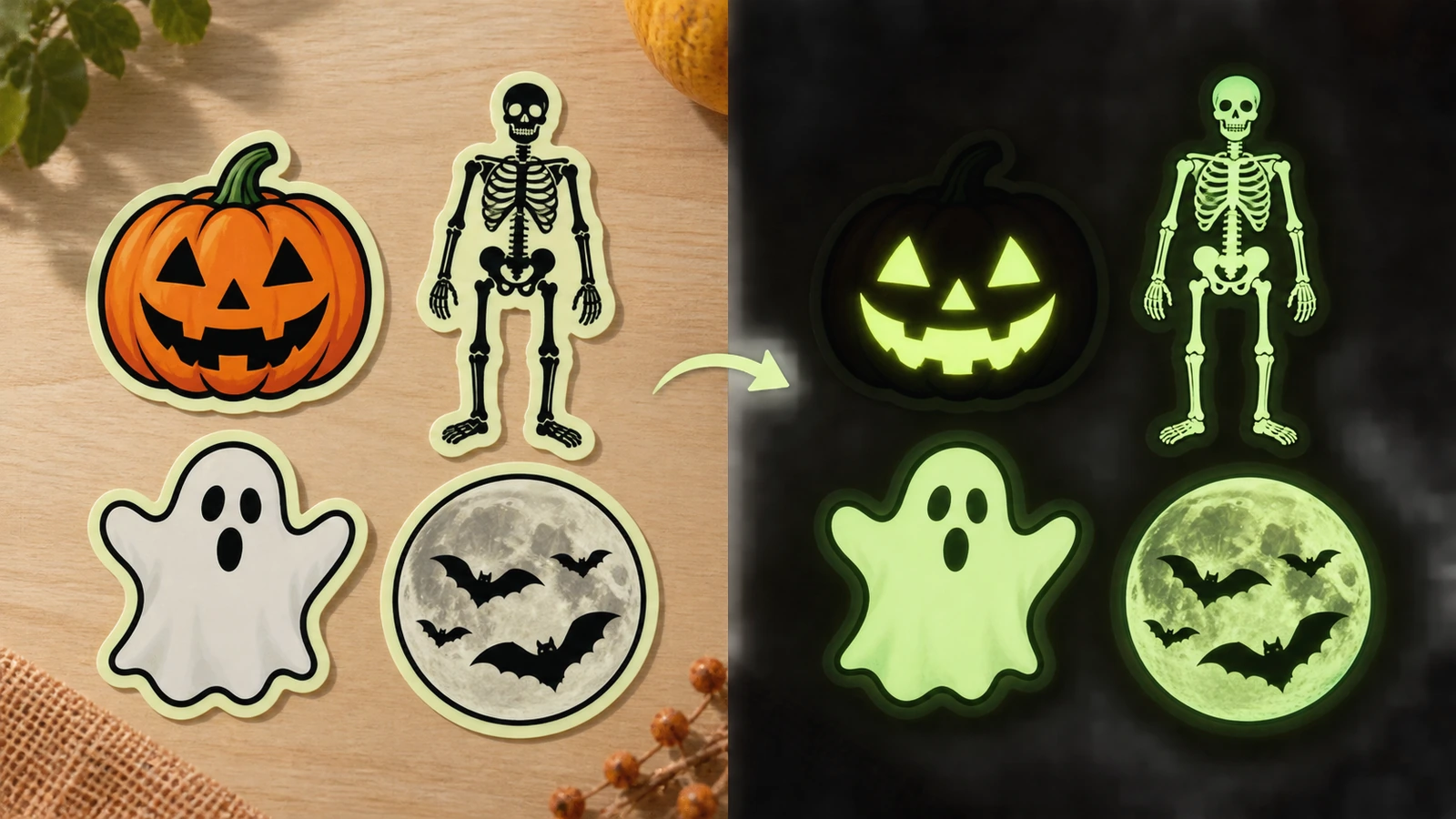
Which Halloween Design Themes Glow Best?
Halloween artwork is dark by nature, which works against glow film. The solution is to reverse the usual approach: treat black ink as the night and leave the highlights unprinted so they can glow. Classic Halloween imagery already follows this pattern, because so much of it consists of pale shapes against a dark background.
| Theme | What prints (daylight) | What glows (dark) | Best campaign fit |
|---|---|---|---|
| Skeleton | Black body silhouette | Bones left unprinted | Trick-or-treat giveaways, collectible series |
| Jack-o'-lantern | Orange pumpkin, green stem | Carved eyes and grin | Window clings, gift-with-purchase |
| Ghost | Thin dark outline only | Almost the entire body | Kids' giveaways where maximum glow matters |
| Bats over a full moon | Black bats, dark sky | The moon disc | Storefront centerpiece clings |
| Eyes in the dark | Solid black field | Pairs of eyes | Lower window panes, scavenger hunts |
| Haunted house | Dark house shape | Windows and door | Event and venue branding |
Some practical rules for Halloween artwork:
- Do not promise orange glow. An orange pumpkin is orange in daylight, but in the dark the glow takes the pigment's color, most often yellow-green. Mention this in your product copy so customers know what to expect.
- Thicken spider webs and thin details. Fine lines blur together in the dark. If a web matters to the design, make it the glow element with heavy strands, or put it in daylight ink and let a different element glow.
- Make the brand visible in daylight and the glow memorable at night. Put your logo in the printed artwork. Give the night view one strong glow feature, such as the grin, the moon or the eyes, rather than a faint glowing wordmark.
- Expect a tinted base. Most printable glow films look pale yellow-green in daylight. White-on-white details disappear, so give light elements a dark outline.
How to Run Three October Campaigns With Glow Stickers
Campaign 1: Trick-or-treat giveaways that outlast the candy
This works for neighborhood businesses handing out treats, school and HOA Halloween nights, trunk-or-treat events, and brands sponsoring community festivals. A sticker is a non-food treat, so families managing food allergies can accept it, and it keeps your name in a child's bedroom long after the candy is gone.
- Estimate your volume from last year. Count the bags of candy you went through and multiply by the pieces per bag. That is your visitor count. Add a buffer for siblings and second laps.
- Choose a format that fits a treat bag. A single die-cut sticker or a small sheet is better than loose tiny pieces. The pigment chemistry is less of a concern than choking: Biology Insights notes[2] that small pieces present a much greater risk than the pigment itself. Avoid formats young children could swallow.
- Charge at the hand-off point. Keep the bowl under the porch light or a desk lamp so each sticker leaves already glowing. Kids react immediately when the sticker glows in their hand.
- Brief whoever hands them out. One sentence is enough: "Hold it under a light, then turn the lights off." Kids repeat the trick at home, which extends the impression.
Safety checks before you order. Stickers have a clear advantage over light-up toys because they contain no battery. On 2026-01-29, the CPSC warned consumers about glow party toy sets[3] because children could reach the button batteries inside. Liquid-filled children's products are covered separately under federal rules such as 16 CFR 1500.231[4]. A solid sticker avoids both issues. It does not avoid children's product rules. If a giveaway is designed primarily for children 12 and under, CPSC toy guidance[5] calls for third-party testing and a Children's Product Certificate, and toys manufactured after 2024-04-20 must meet ASTM F963-23. The CPSIA lead limits[6] are 100 ppm for accessible substrate and 90 ppm for surface coatings, and the phthalate rule in 16 CFR 1307[7] sets a limit of 0.1% for listed phthalates in toys. Decide early whether your giveaway counts as a children's product, and ask for the relevant documentation in your quote. For a fuller kid-safety checklist, see the buyer notes on our photoluminescent vinyl sticker page.
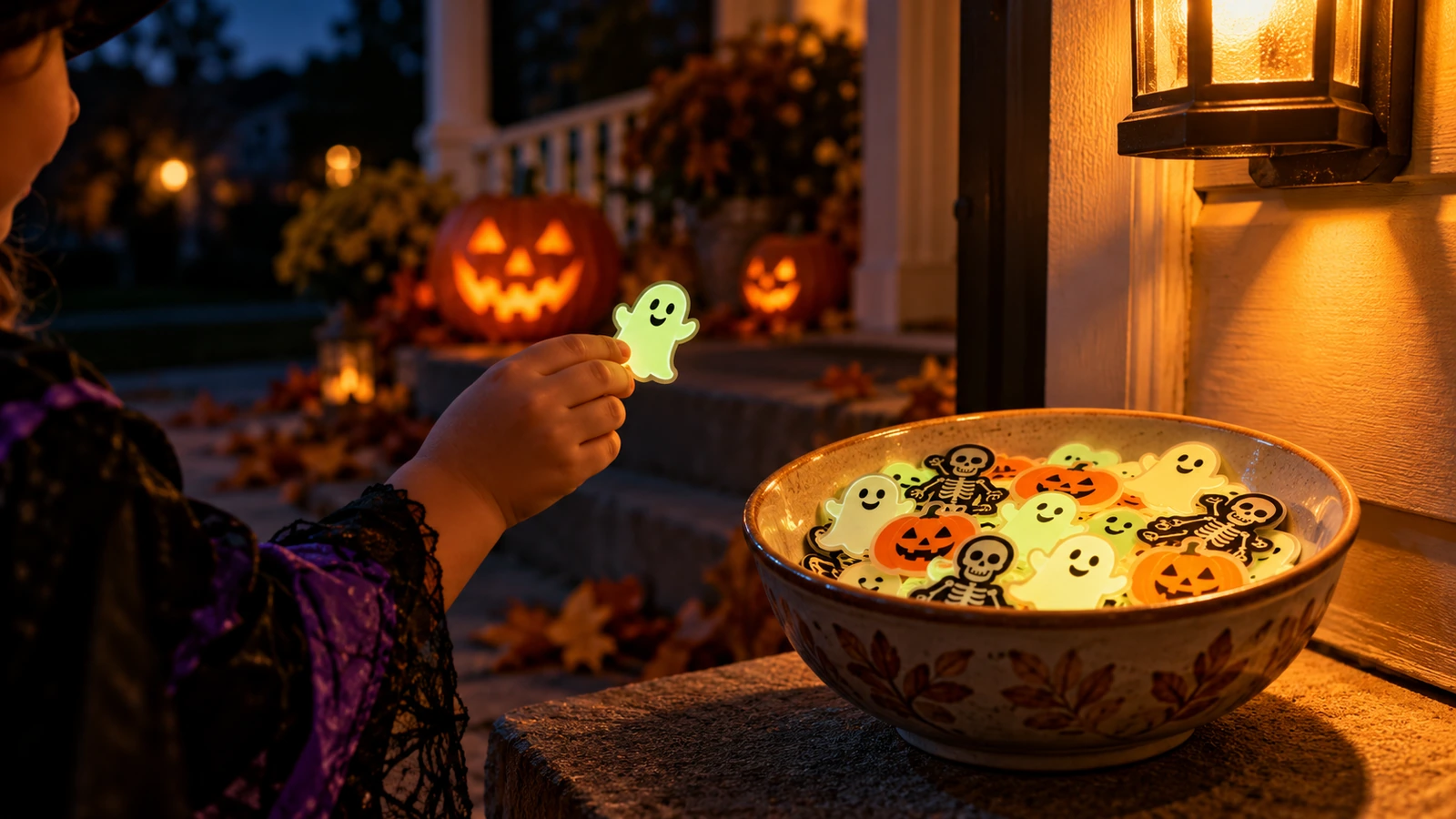
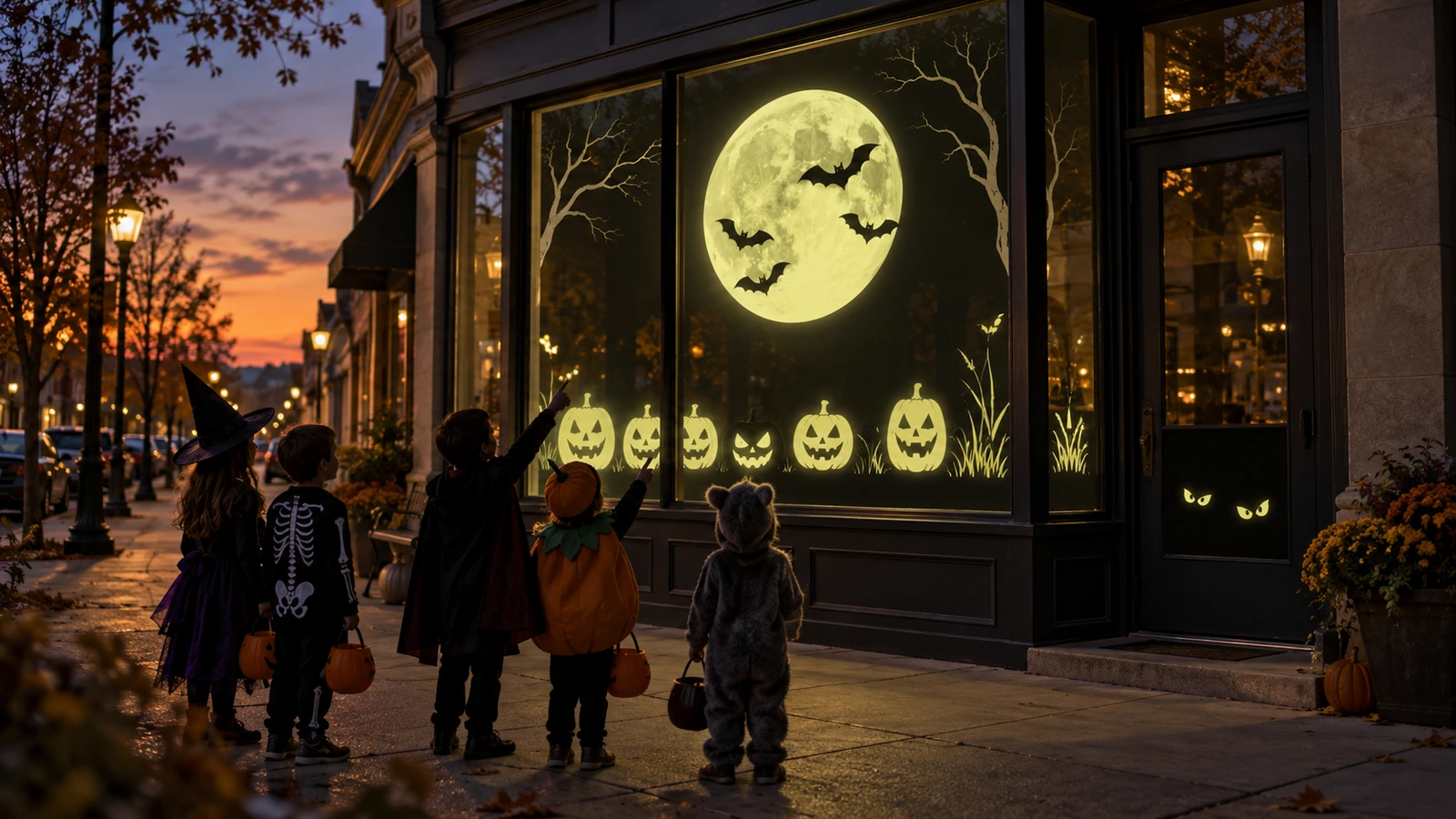
Campaign 2: Storefront displays with glow in the dark window clings
A storefront is on view for the whole month, but the glow only matters during a few hours on a few evenings. Plan the daylight artwork for the full month and the glow for the evenings when foot traffic is highest.
- Check where the light comes from. Glow is visible only when the surroundings are darker than the cling. If bright display lights shine through the window behind it, people on the sidewalk see a dark silhouette. Place glow pieces against an opaque backing such as a display board or a painted panel, or plan to dim the display.
- Plan the charge. Daylight or display lighting charges the clings during business hours. The brightest glow follows right after the lights go down, so a scheduled lights-out moment, such as the start of trick-or-treat hours on October 31, gives the strongest effect.
- Confirm print orientation for inside-glass mounting. If clings go on the inside of the glass but are viewed from the street, the artwork must read correctly through the glass. Mention the viewing direction in your quote request.
- Place glow pieces at kid height. The lower panes are where trick-or-treaters look. Eyes-in-the-dark clings work well near the bottom of the door.
- Schedule the removal. Put November 1 on the staff calendar and use the time to photograph the display for next year's planning.
Campaign 3: October promotions and event branding
- Gift-with-purchase. Set a spend threshold and give one glow sticker per qualifying order. It encourages a slightly larger basket without discounting.
- Weekly collectible drops. October has four to five weeks. Release one design each week (skeleton, ghost, pumpkin, bats) to bring customers back to complete the set.
- E-commerce packaging inserts. Add a glow sticker to every October shipment along with an insert card that invites customers to turn off the lights. The reveal is easy to film, which makes it suitable for user-generated content.
- In-store scavenger hunts. Hide eyes-in-the-dark stickers around the shop for an after-hours family event, and reward children who find them all.
- Event accents. Haunted walks and Halloween festivals can use glow pieces on decorations, wristband stations and photo walls. Glow pieces are decorative and do not replace required exit or path marking. Code-grade photoluminescent markings are tested to standards such as ASTM E2072[8], which sets minimum luminance of 30 mcd/m² at 10 minutes and 5 mcd/m² at 90 minutes, measured with the ASTM E2073-24 test method[9]. Follow your venue's code requirements for real wayfinding.
The Backward Halloween Order Timeline
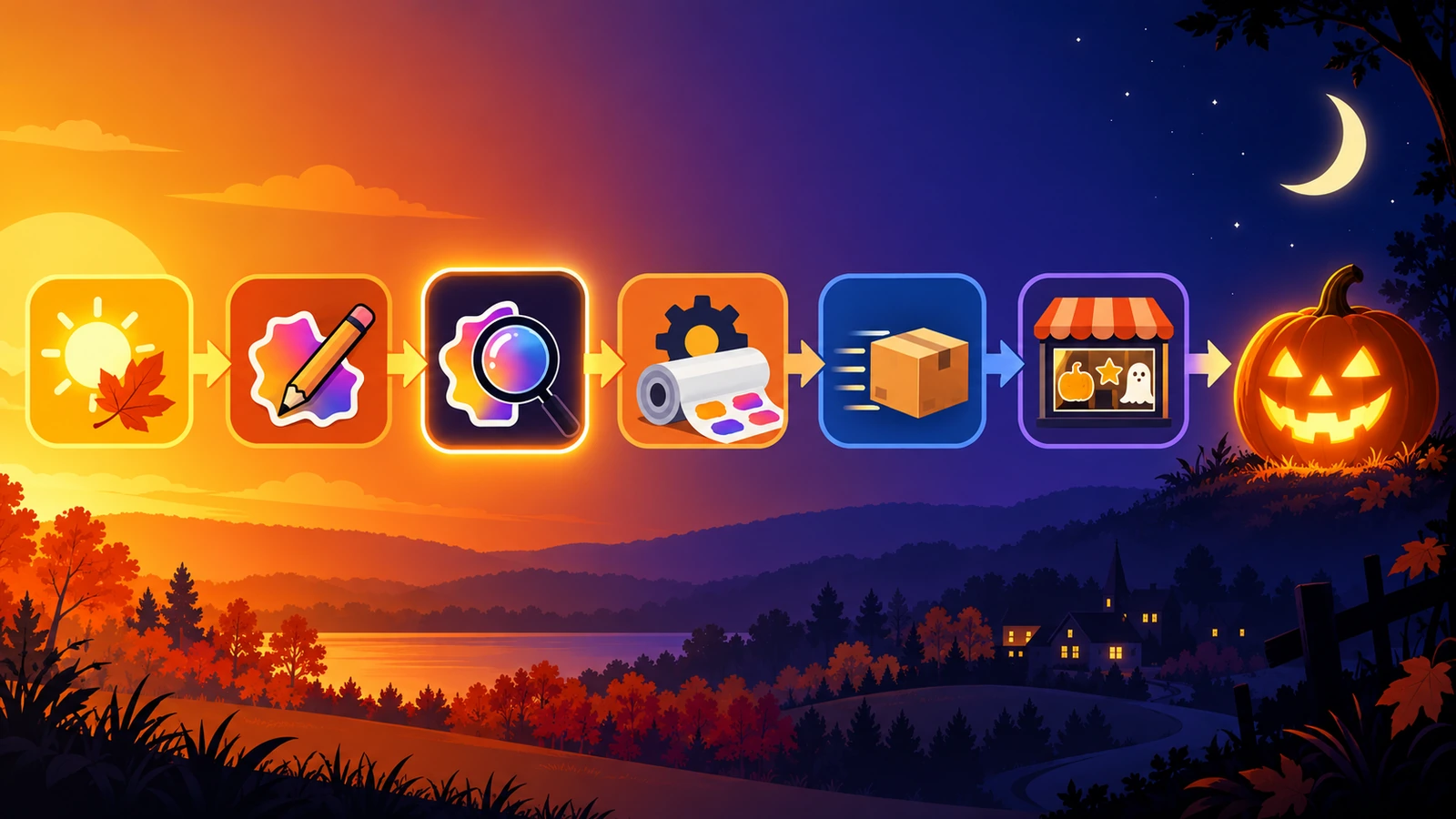
Most failed Halloween campaigns are late rather than badly designed. Work backward from October 31 and treat the dark-room proof as a fixed milestone. The weeks below are planning buffers, not supplier lead times. Your quote should list production time and transit time separately, and those dates take precedence.
| Weeks before Oct 31 | Milestone | Owner |
|---|---|---|
| 12–10 (mid-to-late August) | Choose campaigns, split quantities by channel (giveaway, window, gift-with-purchase), select themes | Marketing |
| 10–8 (early September) | Finalize artwork with glow areas marked; request a quote with production and transit listed separately | Design, purchasing |
| 8–6 (mid-September) | Test the proof or sample in a dark room after charging it; approve and lock quantities | Marketing |
| 6–4 (late September) | Production and shipping according to your quote; keep a buffer for customs or carrier delays | Supplier, logistics |
| 4 (first days of October) | Window clings installed for the full month; promotion launched; staff briefed on charging | Store team |
| 2 (mid-October) | Giveaway stock in hand and packed for events and porches | Events |
| 0 and after | Lights-out moment on Halloween night; remove clings Nov 1; record what worked | Everyone |
If you are reading this in late October, the safest approach is to use this table for next year. The September dark-room test is the step most often skipped, and it is the step that prevents the most complaints.
Glow, Blacklight, Reflective or LED: Which Effect Fits Your Halloween Plan?
"Glow" can mean several different products. Each one needs different conditions at night, so it helps to decide which effect you need before writing a brief.
| Effect | What it needs at night | Battery or liquid? | Best Halloween use | Watch out for |
|---|---|---|---|---|
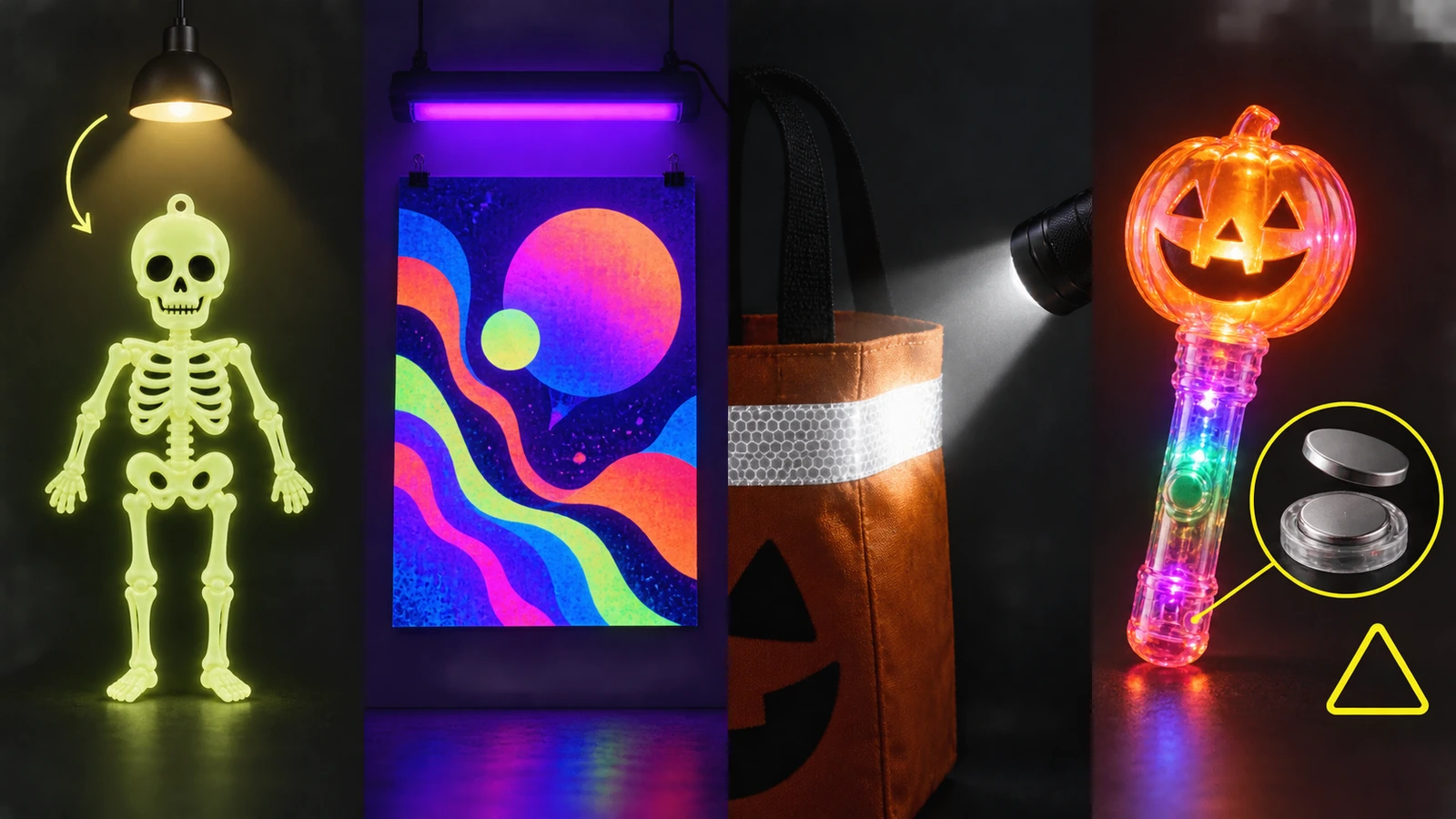
| Photoluminescent glow sticker or cling | Light beforehand, then darkness | Neither | Take-home giveaways, windows, packaging inserts | Glow fades after the lights go out; dark ink blocks it |
| UV-reactive (blacklight) print | A blacklight running continuously | No, but the blacklight needs power | Haunted rooms and booths you control | Goes dark at home without a blacklight |
| Reflective film | A direct light source such as headlights or flashlights | Neither | Costume and bag visibility near traffic | Does not emit light on its own |
| LED toys and liquid glow sticks | Power or a chemical reaction | Yes | One-night novelty | Button-battery and liquid-chemical rules for children's products |
For a branded piece that families take home and use again, photoluminescent stickers are the only option in this table that needs neither power nor a controlled environment.
FAQ
FAQ: Do glow in the dark window clings work on a lit storefront?
Only if the area around the cling is darker than the cling. Bright display lights behind the glass turn glow pieces into silhouettes when viewed from outside. Mount them against an opaque backing or dim the display at a set time. Daylight during business hours charges them for the evening.
FAQ: Why don't the stickers glow when kids take them from the bowl?
They have not been charged. A bowl on a dark porch stores no light. Keep the bowl under a porch light or lamp, and tell kids to hold the sticker under a light at home and then switch it off.
FAQ: Are glow stickers safe to hand out to trick-or-treaters?
They avoid the button-battery and liquid hazards of light-up toys and glow sticks, but they are not exempt from children's product rules. If the giveaway is aimed primarily at children 12 and under, plan for third-party testing, a Children's Product Certificate, lead and phthalate compliance, and a format too large for small children to swallow.
FAQ: Is the glowing material radioactive?
No. The Photoluminescent Safety Products Association states that strontium aluminate-based photoluminescent pigment is not radioactive. It glows by storing and releasing ordinary light.
FAQ: Can we use glow stickers to mark a haunted trail route?
Use them as decoration, not as safety wayfinding. Exit and path markings have to meet code-grade standards such as ASTM E2072, with minimum luminance of 30 mcd/m² at 10 minutes and 5 mcd/m² at 90 minutes. Follow your venue's requirements for any required route marking.
FAQ: How early should we order for Halloween?
Work backward from October 31: final artwork in early September, dark-room proof approved by mid-September, window pieces installed in the first days of October. Production and transit dates come from your quote, so ask for both before committing to a launch date.
Key Takeaways
- Battery-free stickers avoid the hazard behind this year's glow-toy warning. — CPSC warning dated 2026-01-29 on button batteries in glow party sets (Source)
- Kid-targeted giveaways can fall under toy rules. — Products for ages 12 and under; toys made after 2024-04-20 must meet ASTM F963-23 (Source)
- Ask for lead test documentation on children's items. — 100 ppm accessible substrate, 90 ppm surface coatings (Source)
- PVC-based toys also need a phthalate check. — 0.1% limit for listed phthalates (Source)
- Decorative glow is not exit marking. — Code-grade minimum 30 mcd/m² at 10 min and 5 mcd/m² at 90 min (Source)
Plan Next October's Glow Now
Glow in the dark Halloween stickers work when three things are planned together: artwork that leaves the glow areas unprinted, placement and charging that suit the viewing conditions, and a calendar that puts stock in hand by early October. Choose your campaigns, sketch designs using the skeleton, ghost or jack-o'-lantern approach, and send the artwork for a dark-room proof well before September ends. When you are ready, upload your artwork for custom glow in the dark stickers and request a quote that lists production and transit time separately, so your campaign arrives in time for Halloween.
References
- Photoluminescent Safety Products Association, "FAQ," page dated 2019-05-22. https://plsafety.org/faq/ ↩
- Biology Insights, "Is Glow-in-the-Dark Material Toxic?", 2026-09-21. https://biologyinsights.com/is-glow-in-the-dark-material-toxic/ ↩
- U.S. Consumer Product Safety Commission, warning on Maryhonkui Glow Sticks Party Pack Toy Sets (button battery ingestion risk), 2026-01-29. cpsc.gov ↩
- Electronic Code of Federal Regulations, 16 CFR 1500.231, guidance on hazardous liquid chemicals in children's products. ecfr.gov ↩
- U.S. Consumer Product Safety Commission, "Toy Safety" business guidance (ASTM F963-23, 16 CFR Part 1250), accessed 2026-10. cpsc.gov ↩
- LegalClarity, "CPSIA Testing Requirements for Children's Products," 2026-05-28. legalclarity.org ↩
- Cornell Law School Legal Information Institute, 16 CFR Part 1307, Prohibition of Children's Toys and Child Care Articles Containing Specified Phthalates (82 FR 49982, 2017-10-27). law.cornell.edu ↩
- ASTM International, E2072, Standard Specification for Photoluminescent (Phosphorescent) Safety Markings (current edition E2072-24, 2024-06-01). astm.org ↩
- ASTM International, E2073-24, Standard Test Method for Photopic Luminance of Photoluminescent (Phosphorescent) Markings, 2024. astm.org ↩












The information below is required for social login
Sign In
Create New Account