


 Blog PDF for offline reading
Quick answer: Choose CBD Mylar bags one product line at a time, not one brand at a time. For each SKU, confirm four things: the fill (a 1 g sample, a 3.5 g eighth, a single pre-roll or dosed edibles), whether the pack is single-use or reclosable, how much mandatory label copy has to fit, and whether the exact pouch-and-zipper build has a child-resistance test report under 16 CFR 1700.20. Settle all four before you write the packaging brief.
Most cannabis and hemp brands do not start with one product. They start with a strain in eighths, add pre-rolls, then gummies, and soon a single "house pouch" is carrying three regulatory problems at once. This guide covers how to split CBD Mylar bags and THC Mylar bags by product line, which pouch format each fill actually suits, and which rules decide the closure and label layout. Every regulatory figure below was checked against the live government or standards-body text in October 2026.
Why one pouch for every SKU breaks down
The problem. A brand orders one printed pouch size and one zipper and uses it for flower, pre-rolls and gummies. Each product puts different demands on the pouch. Flower needs headspace so the buds are not crushed. A pre-roll needs length and protection from bending. A multi-serve edible needs a closure that stays child-resistant after the tenth opening, not only the first.
The pain. The failures show up after launch, not at the proof stage. Consumers post photos of top-shelf flower "smashed into a pancake" in flat pouches. A zip-only closure without a heat seal above it leaks odor within hours. Some packaging gets pulled from retail because the warning panel, the universal symbol and the potency statement did not fit at a legible size. The most expensive failure is the child-resistance claim. Federal rules measure child resistance as the performance of a specific package design on test panels, and the result does not carry over automatically to a pouch that has a different film or zipper.16 CFR 1700.15[1]
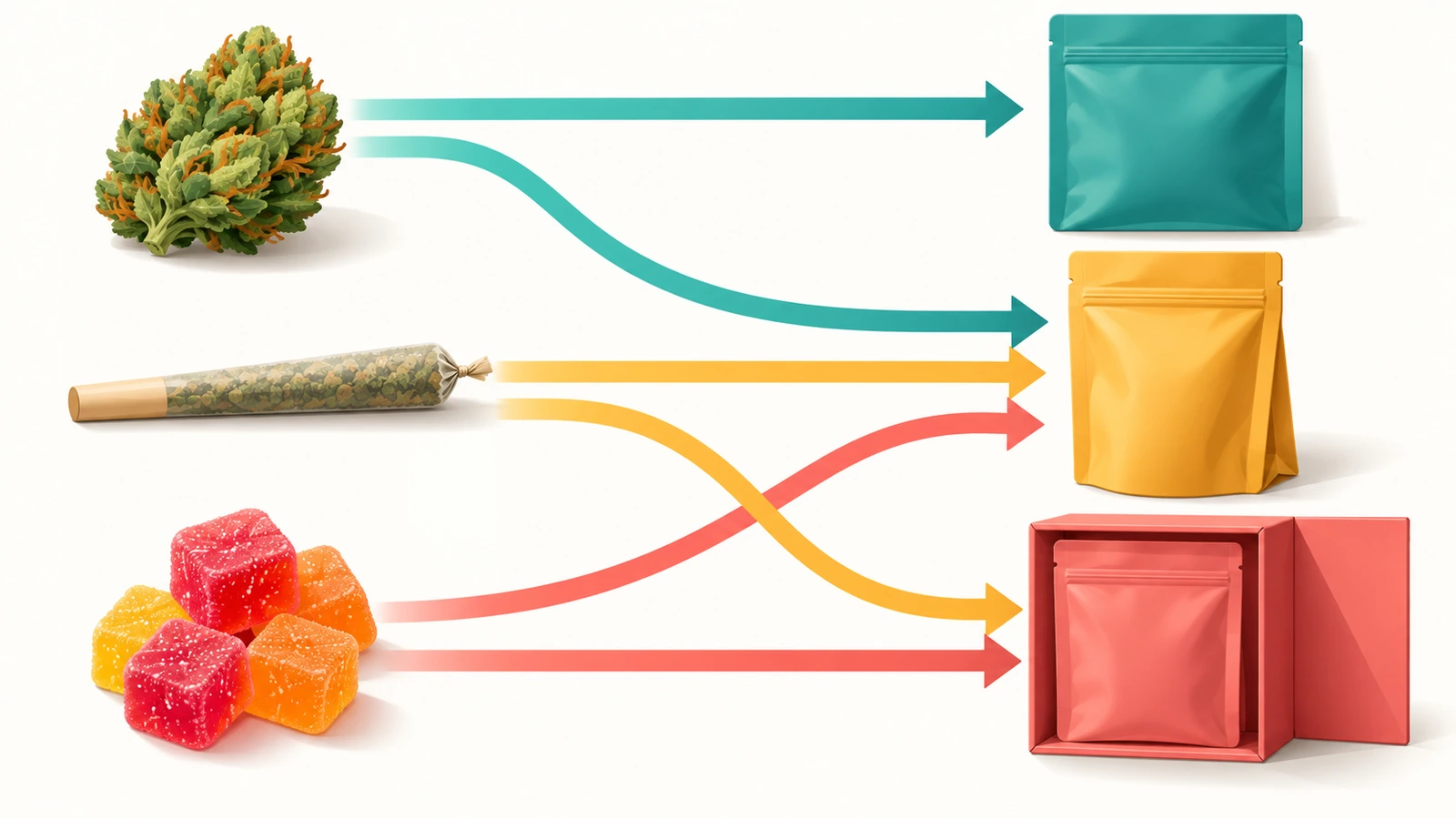
The solution. Build a packaging matrix with one row per product line. Each row records the fill, format, closure type, label load, and the test evidence the supplier must provide. The sections below walk through how to fill in each column.
What "CBD Mylar bags" means in a packaging brief
In the trade, "Mylar bag" is shorthand for a multilayer flexible pouch. It usually has a printable polyester (BoPET) outer layer, a metallized or aluminum-foil barrier layer, and a polyethylene sealant layer inside. "Mylar" is a film trademark. It is not a barrier specification and not a compliance status. For a brief, the label "CBD Mylar bag" tells a supplier almost nothing. What matters is the format, the structure, the closure and the documents that prove each one.
The polyester outer layer falls under FDA's food-contact rule for polyethylene phthalate polymers. That rule sets limits such as no more than 0.5 mg/in² of chloroform-soluble extractives after a 2-hour distilled-water exposure at 250°F.21 CFR 177.1630[2] This matters mostly for edibles, because the pouch touches food. For edibles, FDA ties compliance to the food type and the conditions of use, such as dry versus fatty food and room temperature versus hot fill. A declaration has to name those conditions to be useful.FDA food types and conditions of use[3]
One distinction affects every row of the matrix: hemp-derived CBD and state-licensed THC sit under different regulators. Licensed cannabis packaging answers to the state cannabis program. Hemp-derived CBD answers to federal hemp law plus a patchwork of state hemp rules, and some of those states copy their cannabis packaging requirements. Federal legislation enacted in November 2025 narrows the definition of hemp and is scheduled to take effect in November 2026. That change may move some intoxicating hemp products out of the hemp channel. Have counsel confirm which regime each SKU falls under before artwork is finalized.
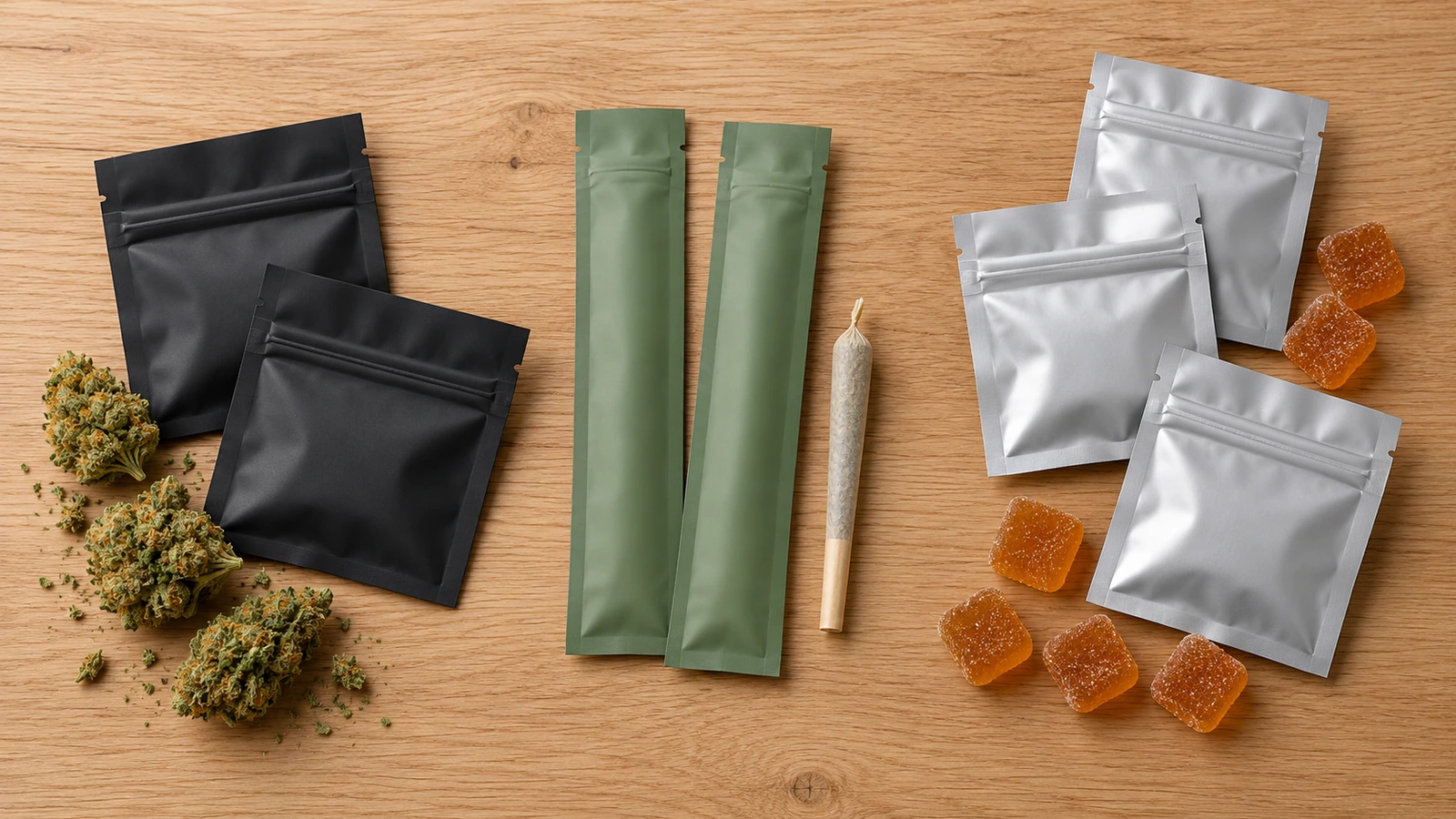
How to match CBD Mylar bags to each product line
Work through these steps in order for each SKU. Most of the steps can be done before you contact a supplier.
Step 1: Fix the fill by weight, count and physical form
Record the net quantity as it will appear on the label, for example 1 g, 3.5 g (an eighth), 7 g, 14 g or 28 g of flower. For pre-rolls, record the count and individual weight. For edibles, record pieces times milligrams. Then note the physical form. Flower is bulky and fragile. Pre-rolls are rigid and crush along their length. Gummies can stick together in heat. Topical samples are oily. Two SKUs with the same weight can need different pouches. A 3.5 g bag of dense indoor flower takes up much less volume than 3.5 g of airy outdoor flower.
Step 2: Decide single-use or reclosable
This one decision determines the closure. A single pre-roll or a single 10 mg gummy is usually consumed in one session, so a heat seal plus a tear notch can be enough. Whether that pack must be child-resistant depends on your state. An eighth, a pre-roll multipack or a 10-piece gummy pack gets opened repeatedly. Under the federal standard, a reclosable special package has to keep its child-resistant effectiveness for the number of openings typical of its use. That is the case where a CR zipper earns its cost.
Step 3: Choose the format the product can survive in
Flat three-side-seal pouches suit products that lie flat and do not mind being compressed: samples, single-serve edibles, sachets, and pouches that ship inside a carton. They do not stand on a shelf, and they offer no protection from crushing. That is why eighth Mylar bags for premium flower often move to a stand-up format or a flat pouch inside a rigid outer box. Pre roll Mylar bags work best for single units that fit the pouch length with seal margin to spare. Multipacks usually go in tubes, tins or cartons. If the flat format fits a product line, see the custom flat Mylar pouches for samples and single-serve packs page. It covers sizing, structure and closure specification, and this guide does not repeat that material.
Step 4: Map mandatory label copy to the two panels
A flat pouch has a front and a back. It has no gusset or base panel to hold overflow copy. Before choosing a size, list everything your state requires. Typical items include the universal symbol, government warnings, potency per serving and per package, net weight, batch or lot number, the license or manufacturer identity, and a test-results reference such as a QR code. Many adult-use states also cap edibles at 100 mg THC per package in 10 mg servings, which is why per-serving statements are mandatory on those labels. Block out the required elements at their minimum legal size first, and give the brand artwork the remaining space. If the copy does not fit, the SKU needs a larger pouch, a format with more panels or an outer carton. Shrinking the warning text is not an option.
Step 5: Confirm the state's opacity, design and CR-level rules
Some states require opaque packaging for edibles. Many restrict imagery that could appeal to children, such as cartoons, candy-like illustrations or bright mimicry of snack brands. States also differ on where child resistance must sit. Some require it on the product package itself. Others have allowed CR at an exit bag or outer container. Record the rule for every state where each SKU will be sold, because these rules change the window option, the color palette and the closure on the same physical pouch.
Step 6: Write a one-page brief per product line
Each page should list the fill, the format, the closure, the label load, the target states and the evidence you need: a CR test report for the exact build, a food-contact declaration for edibles, and barrier data if you plan to make freshness claims. A supplier can quote against that page without guessing.
Child resistance: what the federal protocol actually tests
Most state cannabis programs and many hemp rules point to the federal poison-prevention packaging protocol. That protocol does not certify a material. It tests a package design on people. Under 16 CFR 1700.15, a special package must be at least 85% effective at stopping children before an opening demonstration and at least 80% effective after it, and at least 90% of adults must be able to open and properly close it.[1]
The test procedure is in 16 CFR 1700.20. Children aged 42 to 51 months try to open the package in panels of 50, up to 200 children, with a 5-minute attempt before a demonstration and another 5 minutes after it. A separate panel of adults aged 50 to 70 checks that the package can still be opened and reclosed.16 CFR Part 1700 testing procedure[4] In practice, this has three consequences:
- The report has to match your build. A zipper that passed in one film at one pouch size is not automatically CR in a thicker laminate, a different width, or a pouch that has a hang hole punched near the closure.
- "CR-style" or "designed to be child-resistant" is a description of intent. Ask whether a test report exists, who ran it, and what pouch configuration was tested.
- Reclosable packs carry the heavier burden. If an eighth or a gummy multipack will be opened 10 or 20 times, test the closure after repeated cycles, not only fresh off the line.
Product-line comparison: eighths, pre-rolls, edibles and samples
Use this table as a starting point for your matrix. "Fit" describes how well a flat three-side-seal pouch suits the product. It is not a ranking of quality.
| Product line | Typical fill | Flat-pouch fit | Closure logic | Label pressure | Brief note |
|---|---|---|---|---|---|
| Flower sample / pre-pack | 1 g | Strong | Often single-use; check state CR rule | High relative to panel size | Lay out the warnings first; small panels fill up fast |
| Eighth (flower) | 3.5 g | Conditional | Reclosable CR closure in most adult-use markets | Medium | Crush risk; consider stand-up or flat pouch inside a carton |
| Quarter to ounce (flower) | 7–28 g | Weak | Reclosable CR closure | Low | Bulk volume suits gusseted or stand-up formats |
| Single pre-roll | 1 unit | Conditional | Single-use seal, or CR if required | Medium | Pouch length must include seal margin; protect against bending |
| Pre-roll multipack | Several units | Weak | Reclosable CR closure | Low | Tubes, tins or cartons usually perform better |
| Single-serve edible | 1 dose | Strong | Heat seal + tear notch; CR per state | High | Food-contact declaration plus opacity check |
| Multi-serve edible | Count × mg | Conditional | Reclosable CR zipper, tested after cycling | High (per-serving potency) | Gummies stick in heat; confirm headspace |
| CBD topical or wellness sample | Sachet dose | Strong | Single-use seal | Medium | Ask the supplier to confirm oil and solvent compatibility with the sealant |
Two patterns stand out. Flat pouches are strongest where the product is small, consumed once, or protected by an outer carton. They are weakest where the product is bulky, fragile or opened many times. Within one brand it is normal for some lines to use flat pouches and others to use stand-up formats.
Odor, barrier and sustainability claims to keep off the pouch
The pouch can only support the claims printed on it, and buyers often print claims the build cannot back up. Three areas need attention.
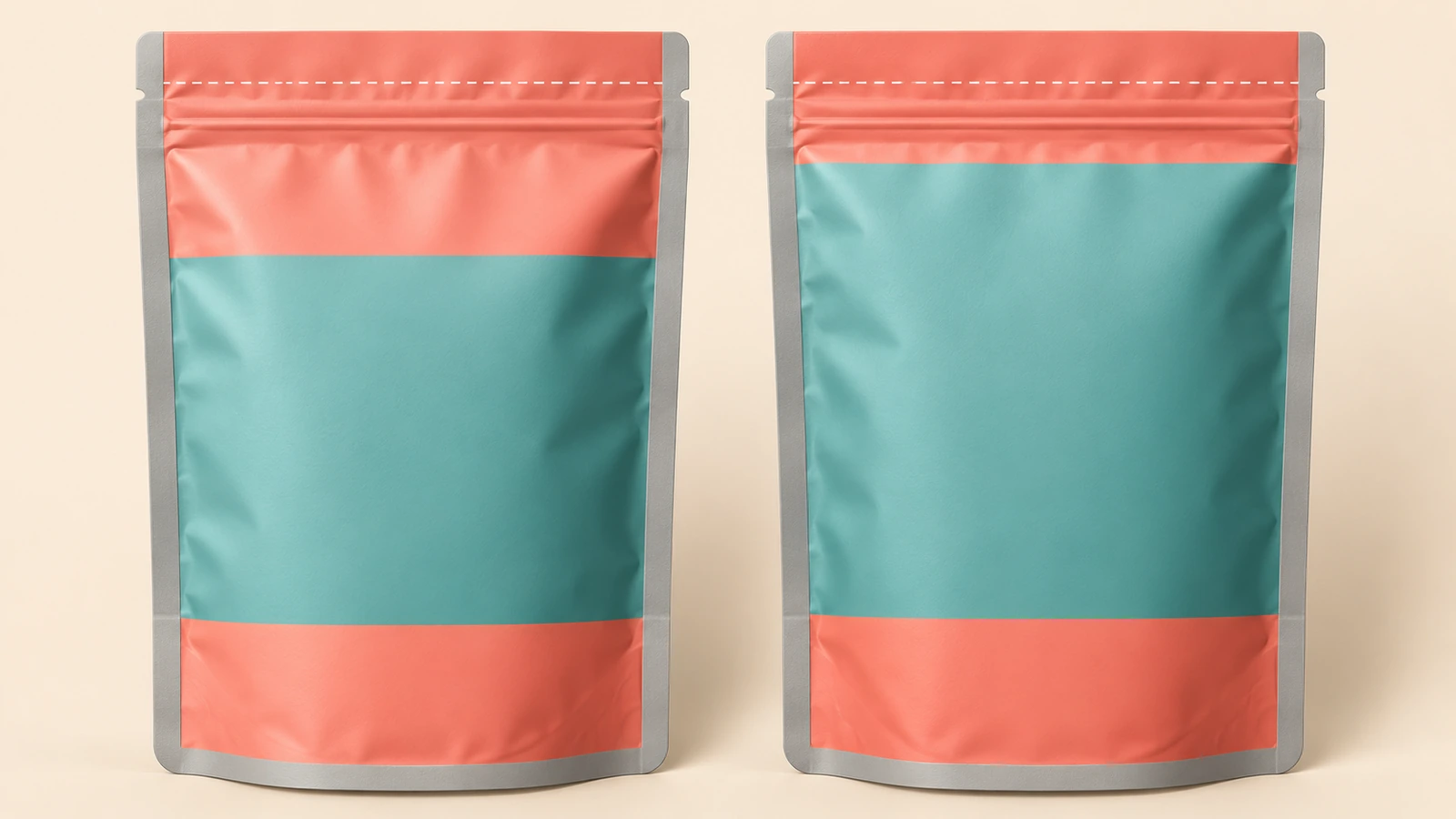
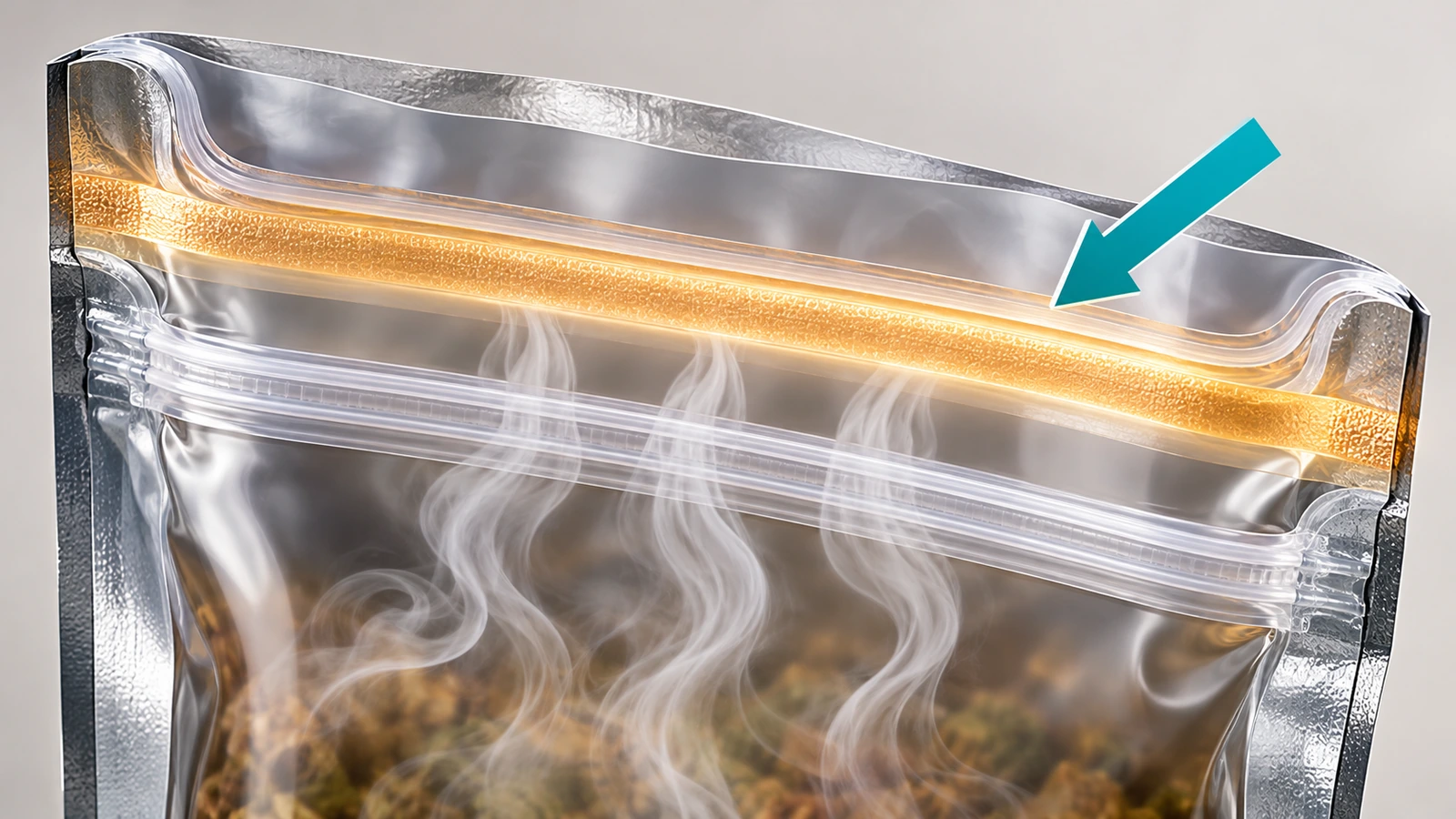
Odor. A press-to-close zipper can leave micro-channels. One published smell-panel test found that zip-only pouches leaked detectable odor within two hours, while pouches heat-sealed above the zipper held odor in. If the SKU is marketed as smell-resistant, specify a heat seal above the zipper for shipping and storage. Present the zipper as a convenience feature for after opening, not as the odor barrier.
Barrier. Metallized film and solid foil look alike on the shelf but perform differently. Industry literature notes that thinner aluminum foil gauges contain pinholes that let oxygen and moisture in.TAPPI on foil pinholes[5] If you make freshness claims, tie them to test data. Water vapor transmission is measured under ASTM F1249, which applies to plastic films, multilayer films and foils up to 3 mm thick.ASTM F1249[6] Oxygen transmission is measured under ASTM D3985, which is currently under revision as D3985-24.ASTM D3985[7] The choice between foil and metallized film is a material-specification decision, and the product page covers it.
Sustainability. Under the FTC Green Guides, an unqualified "recyclable" claim requires that recycling facilities be available to a substantial majority of consumers where the item is sold, which the Guides define as 60%. A single component that significantly limits recyclability makes the claim deceptive.16 CFR 260.12[8] Foil and metallized laminates rarely meet that test. California's SB 54 regulations add another layer. They took effect in May 2026 and required producers to register by June 1, 2026, ahead of a program launch on January 1, 2027.CalRecycle SB 54[9] The statutory targets are 100% recyclable or compostable single-use packaging, a 65% recycling rate and a 25% reduction by 2032.Recycling Today[10] A federal Pack Act introduced in Congress would require third-party certification for recyclable claims, but as of October 2026 it is still a proposal.Packaging Dive[11] If you sell in California, record the material category of each pouch in your matrix now.
FAQ
FAQ: Are CBD Mylar bags different from THC Mylar bags?
The pouch construction can be identical. What differs is the regulator and the label content. THC Mylar bags for licensed cannabis follow the state cannabis program's warnings, symbol and CR rules. Hemp-derived CBD follows hemp rules, which vary by state and may change under the federal hemp redefinition scheduled for November 2026. Build the brief around the regulator, not the cannabinoid.
FAQ: Can eighth Mylar bags be flat pouches?
Yes, but think about crushing. A flat pouch gives a 3.5 g fill no structural headspace, so delicate flower can arrive compressed. Flat works when the pouch ships inside a rigid carton or the flower is dense. For premium flower merchandised directly on a shelf, a stand-up format usually protects bud structure better.
FAQ: Do pre roll Mylar bags need a child-resistant zipper?
That depends on the state and on whether the pack is reclosable. A single pre-roll may be allowed in a non-reclosable CR package, or covered by a CR outer container, depending on the jurisdiction. Multipacks that are opened repeatedly generally need a reclosable CR closure, with a test report covering that exact pouch build under 16 CFR 1700.20.
FAQ: Is "child-resistant" a material certification?
No. The federal protocol tests a finished package design with child and adult panels: at least 85% effectiveness before the demonstration, at least 80% after, and at least 90% adult effectiveness. A change in film, size or zipper can invalidate the result, so ask for the report that matches your configuration.
FAQ: Can I print "recyclable" on a foil Mylar pouch?
Usually not without qualification. The FTC requires recycling access for at least 60% of consumers where the item is sold for an unqualified claim, and multilayer foil or metallized pouches are rarely accepted in curbside programs. Use accurate claims about the pouch's barrier function instead.
FAQ: What should I send a supplier before asking for a quote?
Send one page per product line covering fill, format, closure type, the mandatory label elements and target states, plus the evidence you expect: a CR report, a food-contact declaration for edibles, and barrier data for any freshness claims. Suppliers can then quote MOQ, pricing and timing against a defined build instead of guessing.
Key takeaways
- Child resistance is a pass rate for a specific package, not a material property — ≥85% before demonstration and ≥80% after (Source)
- The CR test uses real child panels, so the report must match your exact build — up to 200 children aged 42–51 months (Source)
- Edible pouches need food-contact evidence for each layer, not a "food grade" label — PET extractives limited to 0.5 mg/in² (Source)
- Freshness claims should rest on standardized transmission tests — ASTM F1249 covers films and foils up to 3 mm (Source)
- Unqualified "recyclable" claims need broad recycling access — a substantial majority defined as 60% of consumers (Source)
- California packaging EPR now applies to pouch material choices — 65% recycling target by 2032 (Source)
Conclusion: brief by product line, not by brand
The brands that avoid reprints and pulled SKUs decide the format, closure and label layout for each product line before talking to a supplier. Flat pouches are a good fit for samples, single doses and anything shipped inside a carton. Eighths, multipacks and multi-serve edibles need closer review of crush risk, reclosable child resistance and label space. Once your matrix shows which lines suit the flat format, use the flat heat-seal pouch specification to define the build and request a quote with pricing and timing for your volumes.
Footnotes
- U.S. eCFR, 16 CFR § 1700.15 — Poison prevention packaging standards (effectiveness thresholds). Checked October 2026. https://www.ecfr.gov/current/title-16/chapter-II/subchapter-E/part-1700/section-1700.15 ↩
- U.S. eCFR, 21 CFR § 177.1630 — Polyethylene phthalate polymers (food-contact conditions and extractive limits). Checked October 2026. https://www.ecfr.gov/current/title-21/chapter-I/subchapter-B/part-177/subpart-B/section-177.1630 ↩
- U.S. Food and Drug Administration — Food Types and Conditions of Use for Food Contact Substances. Checked October 2026. https://www.fda.gov/food/packaging-food-contact-substances-fcs/food-types-conditions-use-food-contact-substances ↩
- U.S. eCFR, 16 CFR Part 1700 — Poison Prevention Packaging, including § 1700.20 testing procedure. Checked October 2026. https://www.ecfr.gov/current/title-16/chapter-II/subchapter-E/part-1700 ↩
- TAPPI — Pinholes in thin-gauge aluminum foil laminates (technical newsletter). https://www.tappi.org/content/enewsletters/eplace/2006/22-2murray.pdf ↩
- ASTM International — ASTM F1249, Water Vapor Transmission Rate Through Plastic Film and Sheeting Using a Modulated Infrared Sensor. https://v1backup.astm.org/Standards/F1249.htm ↩
- ASTM International — Work item WK91974, revision of ASTM D3985 oxygen transmission rate test method. https://www.astm.org/membership-participation/technical-committees/workitems/workitem-wk91974 ↩
- U.S. eCFR, 16 CFR § 260.12 — FTC Green Guides, recyclable claims. Text current as of October 1, 2026. https://www.ecfr.gov/current/title-16/chapter-I/subchapter-B/part-260/section-260.12 ↩
- CalRecycle — Packaging EPR Program (SB 54). Checked October 2026. https://calrecycle.ca.gov/packaging/packaging-epr/ ↩
- Recycling Today — California SB 54 regulations approved and in effect, May 4, 2026. https://www.recyclingtoday.com/news/california-senate-bill-54-regulations-approved-and-in-effect-epr/ ↩
- Packaging Dive — Pack Act introduced in Congress, October 5, 2026. https://www.packagingdive.com/news/pack-act-introduced-congress-labeling-ameripen/808171/ ↩






The information below is required for social login
Sign In
Create New Account