We use cookies to enable our websites to remember information, to help some website functionalities to work properly, to understand how you interact with and use our websites and to display you content and ads that are relevant and engaging for you.
By clicking Accept All you consent to the use of these cookie.
The store will not work correctly when cookies are disabled.
Quick answer: Custom button mirrors are pocket mirrors built like pin-back buttons, with your artwork on one side and a glass or acrylic mirror on the other. Choose acrylic for crowds and kids and glass for the sharpest reflection. Approve a physical sample, then plan MOQ and lead time backward from your event date.
Most marketing teams order custom button mirrors because they work as giveaways. A mirror gets used every day, it fits in a pocket or purse, and your logo is in view every time someone checks their hair or lipstick. That daily use also means a badly specified mirror becomes a daily reminder of a disappointing brand. The common failures are easy to predict. A face that looks cloudy because nobody told recipients to peel the protective film. A logo cut off where the artwork wraps around the edge. A carton of cracked glass faces arriving the week of the show.
These problems are expensive because they surface late. By the time a sample reveals that the QR code on the back will not scan at its printed size, the booth is already booked, the lanyards are already printed, and the freight window has closed. Reviews of reflective consumer products show the same few complaints again and again: distortion, easy scratching, and confusion about protective film. None of these are hard to fix. They just have to be fixed before production rather than after.
This guide walks B2B buyers through the decisions that actually change the outcome: what the product is, how to pick a size and mirror face, how to prepare back-print artwork, what drives minimum order quantities, and how to schedule production so a trade show or retail promotion is not put at risk.
What Are Custom Button Mirrors?
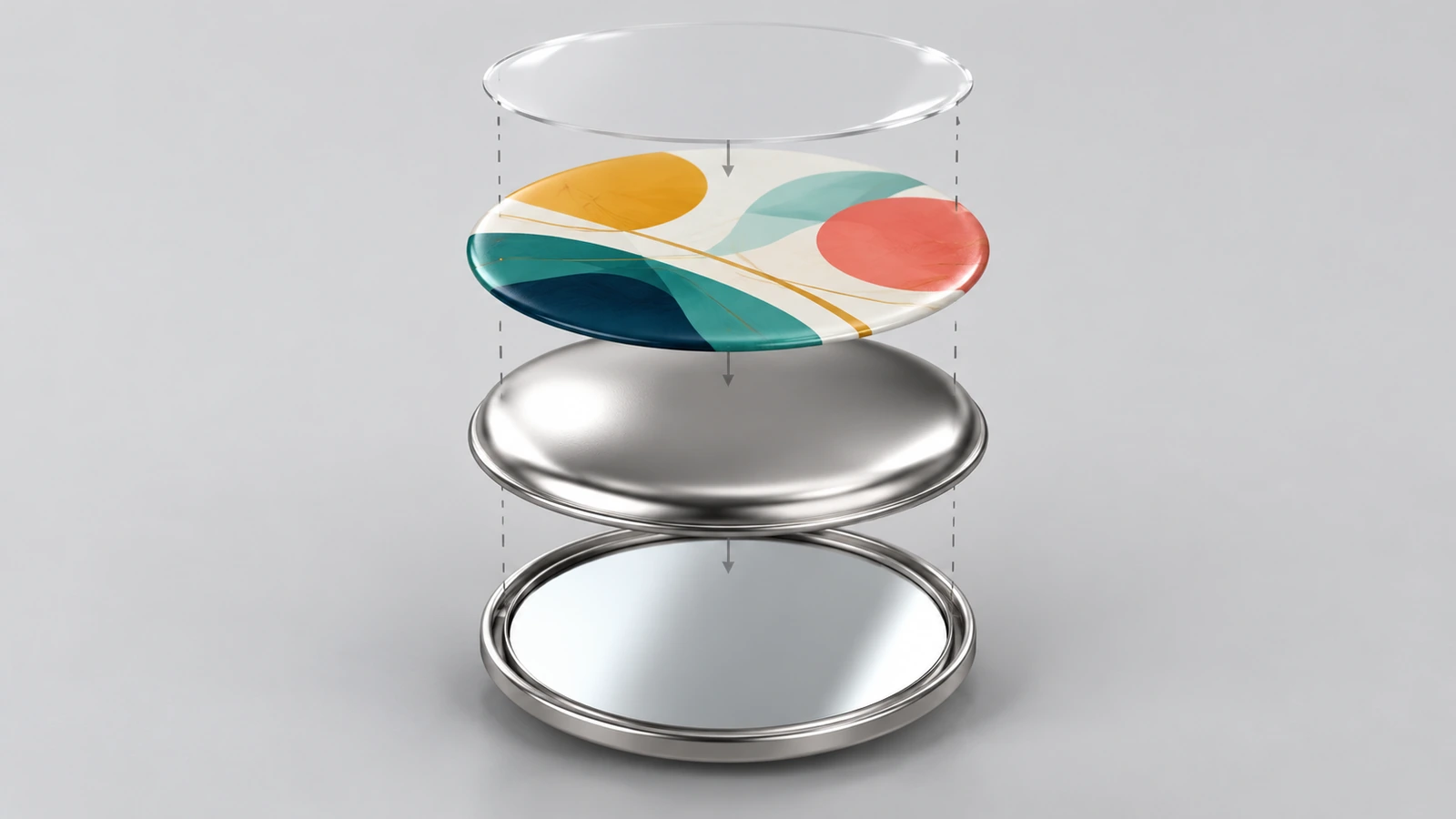
A button mirror uses the same construction as a classic pin-back badge, with one change. Where the pin would normally sit, there is a flat mirror instead. In the typical build, a printed artwork sheet sits on the domed front of a metal shell under a clear protective film. Both are crimped around the edge. The back plate, which is the side the user actually looks into, carries the mirror. Some versions reverse this layout or add a second printed area. When you request quotes, ask suppliers to describe the layer stack in writing, because different factories use the same product name for slightly different constructions.
The mirror itself is usually one of two materials. Glass gives the crispest reflection and resists surface scratches better. Acrylic (PMMA) is lighter and does not shatter into sharp pieces. In general-purpose acrylic sheet, the polymer is defined by ASTM D4802[1] as containing at least 80% methyl methacrylate. Mirrored acrylic gets its reflection from a thin metal coating, usually aluminum, deposited on the back surface and sealed with a protective layer.
Do not confuse a button mirror with a "mirror-effect" printed sticker. Those stickers use metallized film. They give a chrome look, but they are not designed to show a usable reflection. Many buyer complaints in this category come from that mismatch. Write the words "functional mirror face, glass or acrylic" into your purchase order so there is no ambiguity.
Typical buyers include trade show exhibitors, beauty and cosmetics retailers running gift-with-purchase offers, salons, universities stocking orientation bags, nonprofits handing out awareness items, and event organizers putting together attendee kits. All of them want the same thing: an inexpensive item people keep. That makes durability and first impressions more important than with a flyer that gets thrown away.
How to Source Custom Button Mirrors in Eight Steps
Step 1: Define the job before you define the product
Write a short brief that answers three questions. Who receives the mirror: adults, teens, or children? How does it reach them: handed out at a booth, dropped into a retail bag, or mailed in an envelope? What happens next: should it drive a QR scan, carry a promo code, or simply keep the brand visible? Each answer changes the specification. Children shift you toward acrylic and trigger testing obligations, covered in Step 8. Mailers push you toward a flatter build and a protective sleeve. A conversion goal moves the call to action onto the back print and makes scan testing mandatory.
Step 2: Choose size and shape from physical blanks, not drawings
Suppliers quote button mirrors by shell diameter or outer dimensions, and each factory has its own standard tooling range. Ask for the current size chart and request unprinted blanks in the two or three sizes you are considering. Holding them answers questions a drawing cannot. Does it fit a wallet card slot? Is the mirror large enough to check makeup? Does it rattle in a mailer? Round shells use existing tooling. Squares, rectangles, hearts, or brand silhouettes may need custom tooling, which affects both minimum order and schedule. Ask whether the shape you want is in stock or must be tooled.
Pocket mirrors also have a geometric advantage over wall mirrors. People hold them close, and the reflective area is small. Thin acrylic wall tiles often get distortion complaints once viewers step back a few feet. At hand-held distance, minor bowing is much less visible. It still matters, though. An unevenly crimped acrylic disc can bow, so flatness belongs on your sample checklist.
Step 3: Pick the mirror face for the audience and the logistics
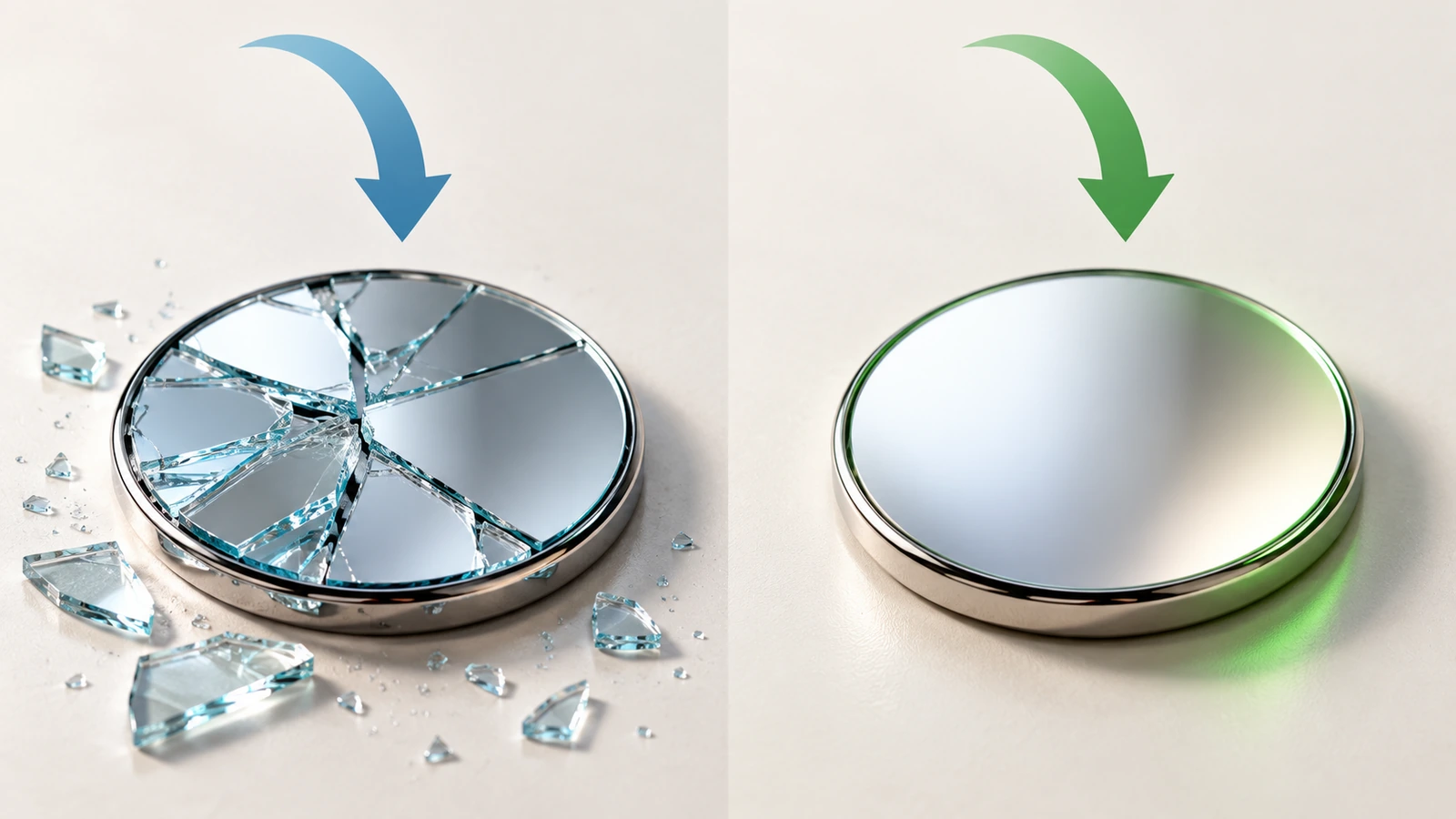
Glass suits premium retail gifts, salon clients, and anyone who will actually use the mirror for grooming. Acrylic suits large crowds, family events, schools, mailers, and any setting where a broken item would be a safety or PR problem. The detailed trade-offs are in the comparison table below. Whichever you choose, confirm whether the mirror ships with a peelable protective film. Film protects the face in transit. In one unboxing video's comment thread, viewers who never removed it believed the mirror was defective. Either have the film removed before packing, or add a simple pictorial instruction to the sleeve.
Step 4: Prepare back-print artwork for wrap, safe zone and scanning
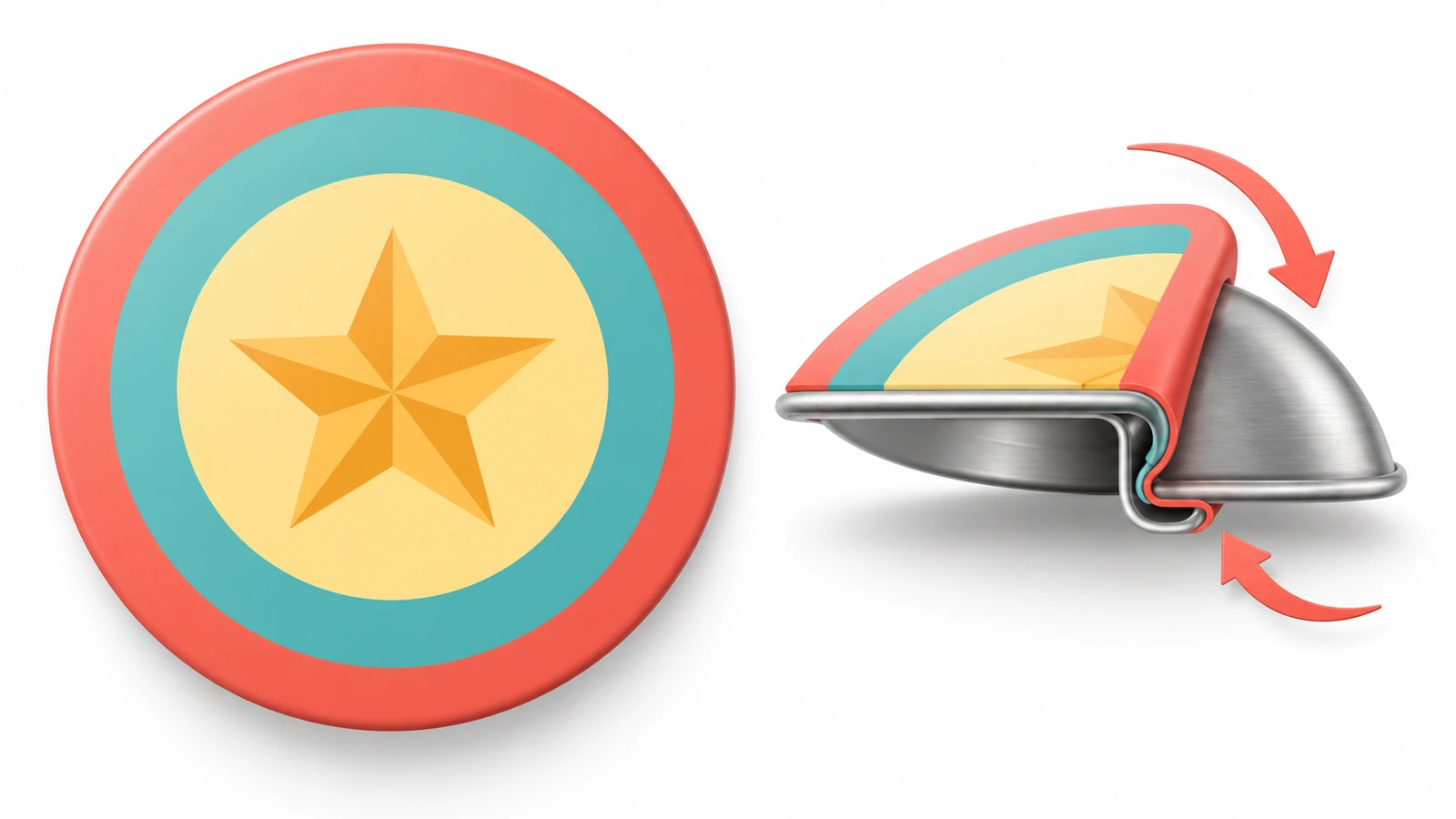
Button artwork does not stop at the visible face. It continues past the front edge and wraps around the side of the shell during crimping. Your file therefore needs three zones: a bleed or wrap area that will fold out of sight, a visible face, and an inner safe zone for logos and text. Ask for the supplier's template for your exact size and shell. Templates differ between manufacturers, and a logo placed by eye is the most common reason for cropped branding.
Supply vector logos and specify spot colors by reference number instead of approving colors from a screen. If the back carries a QR code, keep a clear quiet margin around it. Print the proof at actual size and test it on several phones in dim booth lighting. On a curved front face, the dome adds slight distortion, so keep the code flat on the back plate where possible. Ask for a digital proof showing the cut line, wrap line, and safe zone overlaid on your art, and approve that proof, not just a flat mockup.
Step 5: Approve a pre-production sample against a written checklist
A physical sample is the only reliable way to catch problems in reflection quality and assembly. Check it against a short list. Is the mirror flat, with no visible waviness? Is the crimp even, with no sharp burrs at the edge? Does the print register correctly at the wrap? Are there pinholes or streaks in the mirror coating? Is the protective film intact, and is the surface scratch-free after unpacking? Photograph the approved sample and attach it to the order as the quality reference. Inspection disputes are settled against that sample, not against memory.
Step 6: Understand what drives MOQ and unit price
Minimum order quantities for button mirrors depend on setup work more than on materials. The main drivers are print method and number of colors, whether the shape uses existing tooling, the choice of glass or acrylic, individual packaging such as polybags or backer cards, and any specialty finish. Ask for quotes at three quantity tiers. That shows where the price curve flattens and whether a slightly larger order pays for itself. If you are splitting one order across several designs, for example one per regional office, ask how the supplier counts the minimum: per design or per order.
If the brief is really "a reflective logo on a gift box or a booth wall" rather than something people carry, a button is the wrong tool. A flat, die-cut mirror piece is the better fit. Our self-adhesive acrylic mirror decals cut to your shape cover that use case, and that page explains specification and installation, so we will not repeat it here.
Step 7: Schedule backward from the event date
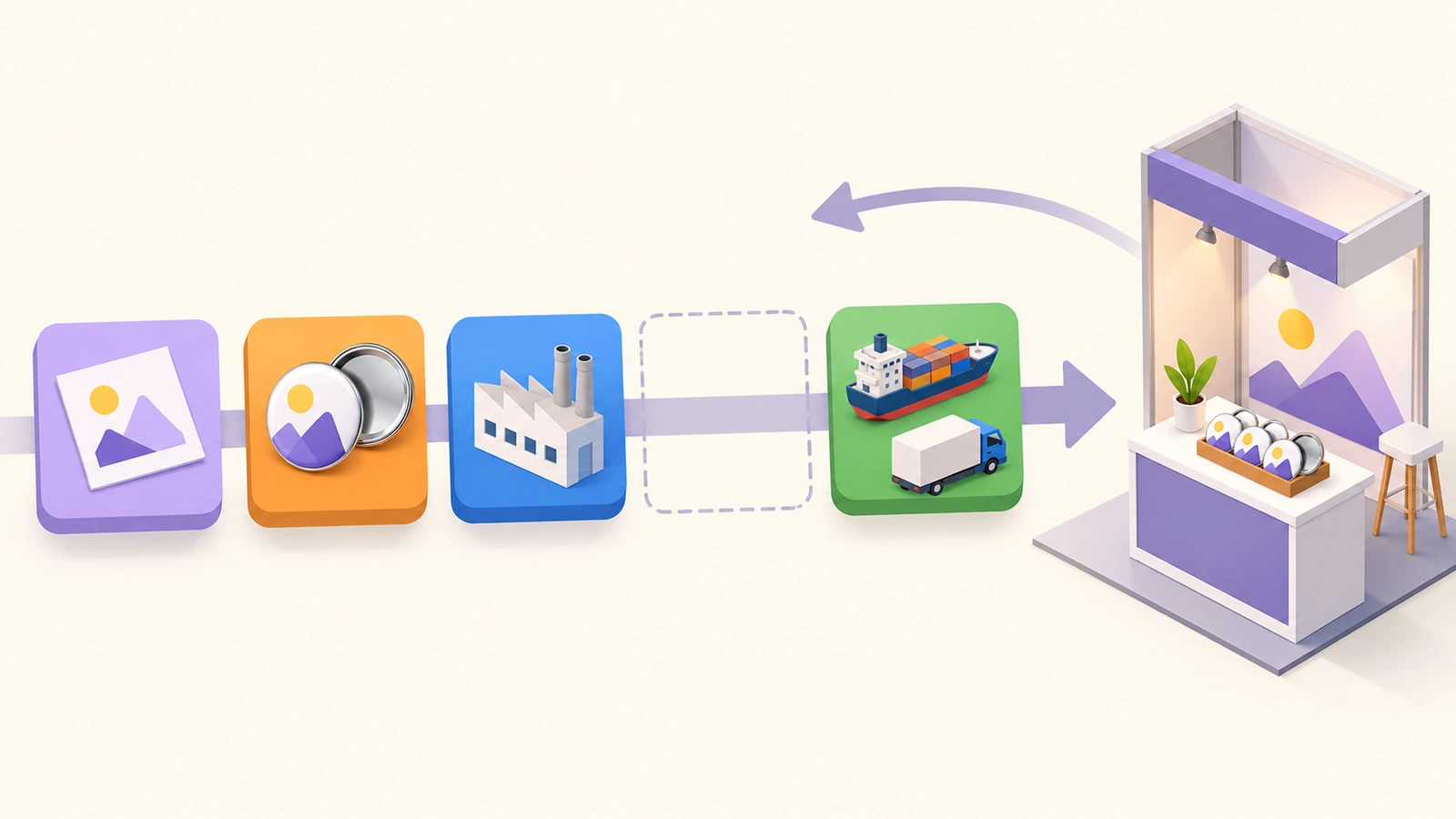
Lead time is not a single number. It is a chain of phases, and any one of them can slip. Work backward from the date the mirrors must be in hand. Start with that date, minus freight and customs time, minus factory production and inspection, minus sample production and your review, minus artwork proofing and revisions. Then add a buffer for one round of sample corrections. Ask the supplier to confirm the duration of each phase in writing at the time of quotation. Peak promotional seasons compress factory capacity, so "standard lead time" quoted in a quiet month may not hold later.
Step 8: Settle packaging, care instructions and compliance before production
Individual sleeves prevent the most common transit damage, which is face-to-face scratching in bulk cartons. Acrylic is softer than glass, and independent home media such as Magicbricks[2] point out that plastic mirrors attract fingerprints and dust, and that cleaning them carelessly can itself cause scratches. A wordless pictorial card showing a soft cloth, with a crossed-out spray bottle, prevents most of these complaints.
Compliance depends on how the product is designed and marketed. If the mirror is designed or intended primarily for children aged 12 or younger, the U.S. requires third-party testing by a CPSC-accepted lab and a Children's Product Certificate[3]. The CPSC's list of rules requiring third-party testing[4] shows which requirements, such as the toy standard incorporated through 16 CFR Part 1250, may apply. A general adult giveaway is not automatically a children's product. Kids-themed artwork and distribution at family events can change that, so decide the target audience on paper.
For orders going to California, check whether Proposition 65 warnings apply. At least one major acrylic resin producer lists its mirrored sheet grades as requiring a Prop 65 warning, so ask your supplier for the material's safety data and warning status. Since January 1, 2025, short-form safe-harbor warnings must name at least one listed chemical, as Food Dive[5] reports. Products manufactured before January 1, 2028 with the old short-form label may still be sold, according to LegalClarity[6]. Adhesives used to bond the mirror can also matter. California's OEHHA[7] notes that warning obligations for vinyl acetate (CAS 108-05-4) took effect on January 3, 2026. It also states that containing a vinyl-acetate-based polymer is not, by itself, proof of exposure. That calls for assessment, not an automatic label.
Glass vs Acrylic Mirror Faces, and Trade Show vs Retail Planning
The first table covers the material decision. The second covers how the distribution channel changes your planning. For a broader look at mirror decals versus printed stickers and glass in flat applications, see the comparison on our acrylic mirror decal page.
Factor
Glass mirror face
Acrylic (PMMA) mirror face
Reflection sharpness
Highest; stays flat and rigid
Good at hand-held distance; can show bowing if crimped unevenly
Surface scratch resistance
Harder surface, more forgiving of everyday contact
Softer; benefits from sleeves and a care card
Breakage behavior
Can crack or break into sharp pieces
Resists shattering; cracks rather than splintering
Weight in mailers
Heavier
Lighter
Best audiences
Premium retail, salons, adult grooming use
Crowds, family events, schools, mail campaigns
What to verify
Edge finish, packing density, breakage allowance in the contract
Flatness on sample, film removal plan, material safety data
Breakage is not a theoretical concern for glass. The CPSC's tempered glass safety alert[8] estimates about 2,300 emergency-room visits linked to shower-door glass breakage over 2012–2016 data. That is a very different product, but it shows why event organizers dealing with children or crowds tend to prefer acrylic. Also avoid borrowing architectural safety-glazing language. 16 CFR Part 1201[9] covers glazing in doors, shower enclosures, and similar installations, not pocket mirrors. A supplier that claims it for a button mirror is overreaching.
Material documentation deserves the same caution. ISO 7823-1[10] covers cast PMMA sheet from 1.5 to 25 mm thick. A thin mirror disc may fall outside that range. Ask for the sheet grade and its data sheet rather than accepting a general "ISO compliant" label.
Planning factor
Trade show giveaway
Retail promotion / gift-with-purchase
Hard deadline
Show date; no flexibility
Campaign launch; sometimes staggered by store
Packaging
Bulk cartons plus sleeves; easy handout
Retail-ready backer cards or polybags, sometimes with barcodes
Back-print priority
Booth number, QR to lead form, social handle
Brand story, promo code, care note
Quantity risk
Leftovers reused at the next show, so avoid dated art
Store allocation; ask about split shipments
Biggest schedule threat
Freight and venue receiving windows
Retailer packaging approval and DC routing
FAQ
FAQ: What sizes do custom button mirrors come in?
Sizes depend on each factory's shell tooling, so there is no universal chart. Ask your supplier for its current size list and order unprinted blanks in your shortlisted sizes. Judge them on three points: pocket fit, usable mirror area, and the space available for your logo and back print. Custom shapes are often possible but may need new tooling, which affects minimums and schedule.
FAQ: Is acrylic or glass better for a promotional pocket mirror?
Choose acrylic when safety, weight, or mailing matter, for example at family events, schools, and large crowds. Choose glass when reflection quality is the selling point, for example in premium retail or salon gifts. Acrylic scratches more easily, so pair it with individual sleeves and a simple care card.
FAQ: Why does a new acrylic mirror look cloudy?
Usually because the transparent protective film is still on the face. Decide in advance whether the film is removed before packing or left on with a pictorial peel instruction. Otherwise recipients may assume the mirror is defective.
FAQ: Can I put a QR code on the back print?
Yes, but test it at final printed size before approving the proof. Keep a clear margin around the code, place it on a flat area rather than the domed edge, and scan it with several phones under dim lighting similar to a convention hall.
FAQ: What is the minimum order and lead time for custom button mirrors?
Both vary with print method, shape tooling, mirror face material, and packaging, so request a written quote with phase-by-phase timing for your specific design. Share your quantity range and event date with us, and we will tell you what is realistic before you commit.
FAQ: Do branded mirrors for kids need special testing in the U.S.?
If the product is designed or intended primarily for children aged 12 or under, the CPSC requires third-party testing and a Children's Product Certificate. Adult-targeted giveaways usually do not fall under this rule. Kids-oriented artwork and distribution can change the classification, so decide the audience in writing.
Key Takeaways
Specify a real mirror face, not a mirror-effect film, and request the acrylic grade's data sheet. — Acrylic sheet is defined as at least 80% methyl methacrylate (Source)
Do not accept a blanket "ISO compliant" claim for a thin mirror disc. — ISO 7823-1 covers cast PMMA sheet from 1.5 to 25 mm (Source)
Kids-targeted mirrors need third-party lab testing and a certificate. — Applies to products primarily for children aged 12 or younger (Source)
Glass breakage is a real injury category, so default to acrylic for crowds and family events. — About 2,300 ER visits tied to shower-door glass in 2012–2016 data (Source)
California short-form warnings must now name a chemical. — Required since January 1, 2025 (Source)
Assess adhesive chemistry, not just the mirror material. — Vinyl acetate warning obligations began January 3, 2026 (Source)
Do not market pocket mirrors with architectural safety-glazing claims. — 16 CFR Part 1201 covers doors and shower enclosures, not giveaways (Source)
Conclusion
A branded pocket mirror succeeds or fails on decisions made before production. Pick the mirror face for your audience. Lay out artwork on the supplier's own template, with the wrap and safe zone respected. Approve a physical sample against a written checklist. Build the schedule backward from the day the mirrors must be in hand. Getting these four right prevents nearly all of the complaints that make giveaways look cheap: cropped logos, cloudy faces, scratches, and late cartons.
Ready to plan your order? Send us your artwork, quantity range, distribution channel, and the date the items must arrive. We will reply with honest feedback on feasibility, materials, and timing. If your project turns out to need a flat, shaped mirror piece instead of a pocket item, take a look at our custom acrylic mirror stickers.
Footnotes
ASTM International, "ASTM D4802 – Standard Specification for Poly(Methyl Methacrylate) Acrylic Plastic Sheet," standard page accessed 2026-10. http://www.astm.org/Standards/D4802.htm↩
Hi there! I'm Bruce, proud dad to my amazing son. I'm the founder of Zigpac, a printing and packaging company empowering small and medium-sized businesses with custom solutions. Let's create something great together!



 Blog PDF for offline reading












The information below is required for social login
Sign In
Create New Account