We use cookies to enable our websites to remember information, to help some website functionalities to work properly, to understand how you interact with and use our websites and to display you content and ads that are relevant and engaging for you.
By clicking Accept All you consent to the use of these cookie.
The store will not work correctly when cookies are disabled.
Quick answer: Promotional sticky notes earn the most brand impressions at trade shows, in direct mailers and in client onboarding kits, because each sheet is written on, passed along and stuck where people look. To estimate cost per impression, divide the landed cost per pad by sheets used × views per sheet. Then size each channel's quantity separately.
Why Giveaway Budgets Leak Before the Booth Even Closes
Most teams judge a giveaway by how fast the booth table empties. That number shows how quickly items left your hands. It says nothing about whether anyone ever saw your brand again. Promotional products are usually bought in small, repeated batches. In PPAI's end-buyer research, about 63% of orders fall between $1,001 and $5,000, and roughly 73% of buyers purchase monthly or quarterly (PPAI 2024 Consumer Study[1]). Because each decision is small and frequent, nobody stops to check which channel actually performed.
The real cost shows up when budgets tighten. PPAI's 2026 follow-up found that about 60% of buyers cut quantities first, while only about 11% cut customization (PPAI Research, January 2026[2]). Teams shrink the print run without knowing whether the trade-show pads or the onboarding-kit pads were doing the work. A pad that sits unopened in a conference tote costs as much as one that lives on a client's desk for a quarter.
The fix is to plan note pads the way you would plan any media buy. Pick the placement, estimate the impressions, calculate cost per impression, then set quantities and timing for each channel. The rest of this guide walks through that process.
What Are Promotional Sticky Notes?
Promotional sticky notes are repositionable adhesive note pads printed with a brand mark, contact details or a campaign message. They are given away free to prospects, clients or employees rather than sold. Most giveaways get displayed or stored. A note pad gets used up. Each sheet leaves the pad and travels to a monitor edge, a file folder or a colleague's desk, and your brand travels with it.
That behavior depends on the adhesive. Spencer Silver's acrylic microsphere adhesive at 3M, protected by U.S. Patent No. 3,691,140, was described by the National Inventors Hall of Fame as "strong enough to hold papers together but weak enough to allow the papers to be pulled apart again without being torn" (National Inventors Hall of Fame[3]). The patent was granted in 1972 and has long since expired, as the German Patent and Trade Mark Office notes in its history of the invention (DPMA milestone review[4]). Repositionable notes are now a generic product category that many printers produce.
The name is a different story. Many buyers search for "promotional post it notes," but Post-it® is a registered 3M trademark, and 3M enforces it. In 2014 the company sued a Kansas printer in Minnesota federal court over the name "Stick-it," seeking more than $75,000 in damages and a permanent injunction (Star Tribune, 2014[5]). In briefs, purchase orders and event signage, use "sticky notes," "adhesive notes" or "logo sticky notes." Use the trademark only when your supplier prints on genuine, licensed stock.
Note pads are also a familiar line item for corporate buyers. ASI's end-buyer research on companies with 101–500 employees lists desk and office accessories among the categories they buy most often, next to T-shirts, caps and bags (ASI Research, 2024[6]). Procurement teams already understand the item. Your job is to prove which placement earns the impressions.
How to Plan a Promotional Sticky Notes Campaign in Five Steps
Step 1: Match each placement to how it creates impressions
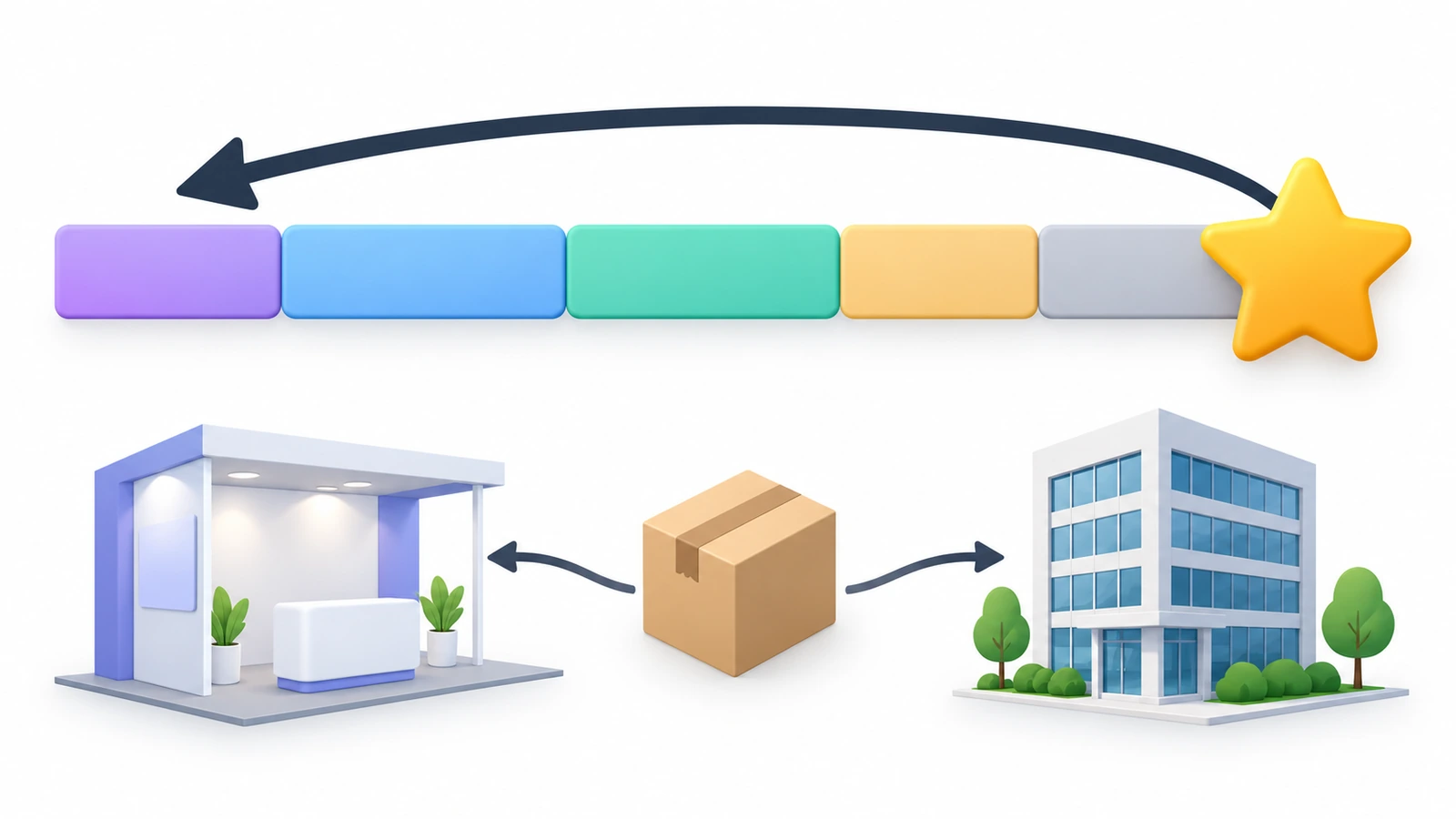
Each channel produces impressions in its own way, so plan them separately.
Trade shows reach the most people per day, but each recipient gives you little attention. Your pad competes with dozens of other items in the same tote bag, and some pads never get unpacked.
Direct mailers go to a known, named contact and land at the desk where the pad will be used. Postage, packaging and list costs come with that precision.
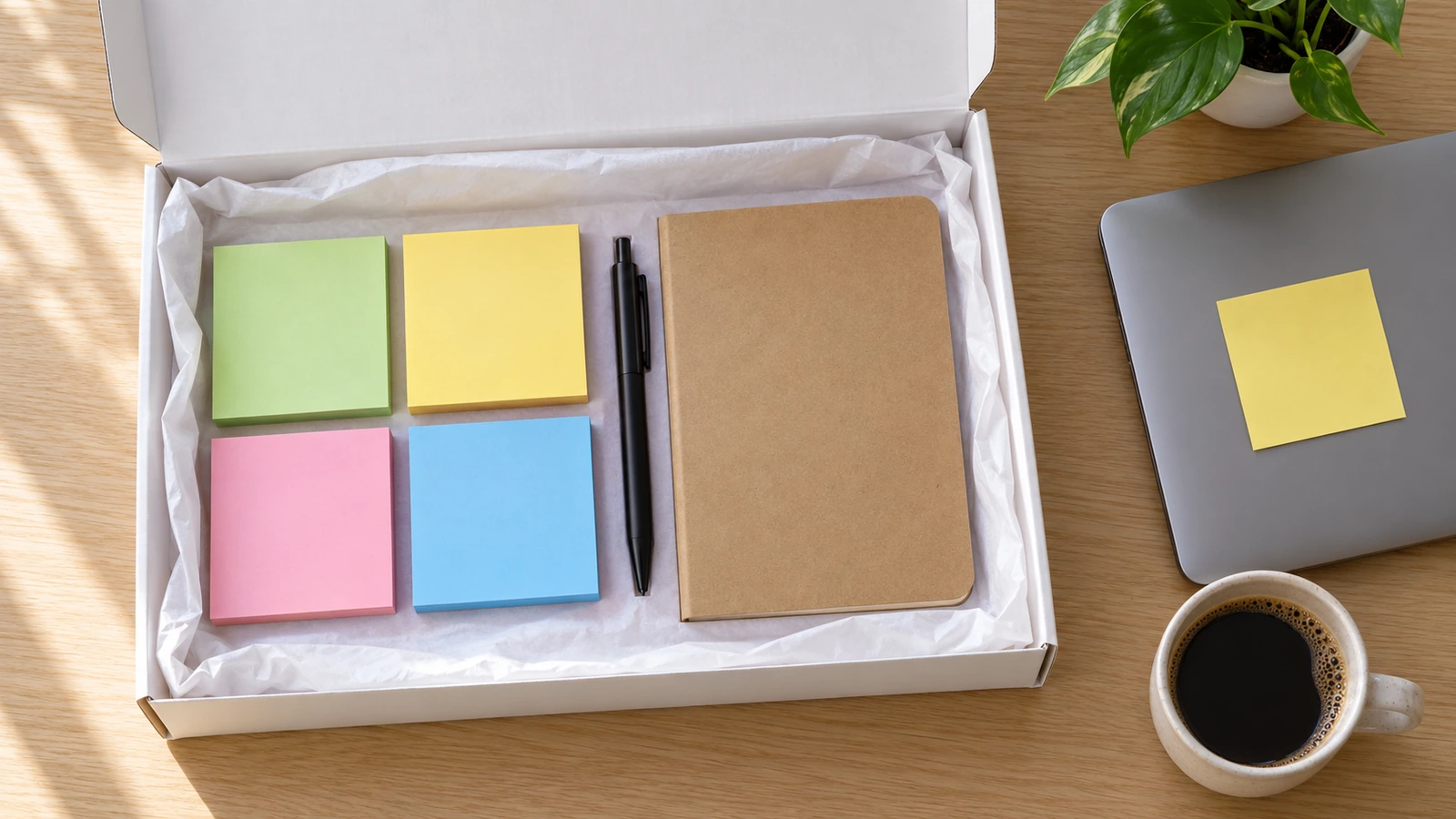
Client and employee onboarding kits reach the fewest people. They are opened deliberately, though, and the recipient is in an active working relationship with you, so the pad tends to get used over weeks rather than days.
Who receives the pad matters as much as where it goes. Designers and agency teams are among the heaviest sticky-note users. Monocle also reported on a Boston architecture firm that used green, yellow, pink and blue notes to help roughly 30 co-housing households agree on a design (Monocle, 2024[7]). For workshop-heavy clients, a set of pads in several colors will see more use than one pad in one color. Generation matters too. ASI's 2025 end-buyer data showed that more than 80% of Baby Boomer buyers consider U.S.-made origin important, compared with under 60% of Gen Z buyers (Print+Promo Marketing, 2025[8]). Weigh that if your mailer list skews toward senior decision-makers.
Step 2: Estimate impressions per pad
An impression is one person seeing your brand once. A note pad produces impressions in two ways. Each used sheet is seen by the writer, the person it is left for and anyone passing the surface it sticks to. The pad itself is also seen every time someone glances at the desk. A workable planning formula is:
Impressions per pad = (sheets used × views per sheet) + (days on desk × glances per day)
Here is a worked example with illustrative assumptions. Replace them with your own observations. Take a 50-sheet pad. Assume the recipient uses 40 sheets, and each sheet is seen 4 times, which gives 160 impressions. Add 20 working days on the desk at 2 glances a day, which gives another 40. The total is about 200 impressions per pad. Every input here is a variable. Reorder data, follow-up conversations and quick polls with onboarding clients will improve your numbers over time.
Step 3: Convert impressions into cost per impression
Divide the landed cost per pad by impressions per pad. Landed cost includes printing plus freight, kitting, booth shipping or postage, and any packaging. With 200 impressions per pad, cost per thousand impressions (CPM) equals landed cost per pad × 5. Each dollar of landed cost becomes five dollars of CPM. This lets you compare pads with paid media without waiting for a price list.
Usage rate drives this math more than anything else. Suppose half of your trade-show pads are never unpacked. Effective impressions fall to 100 per pad distributed, and CPM doubles to landed cost × 10. A mailer with heavy postage can still beat a cheaper booth handout if nearly every pad gets used. The same PPAI 2026 research found that buyers judge promotional products mainly on durability (70.4%), design (65.2%) and material (58%). Those are exactly the factors that decide whether a pad gets used. To see why some branded pads stop being used soon after delivery, see the failure analysis on our printed note pad page. We won't repeat it here.
Step 4: Plan quantities channel by channel
Calculate each channel's quantity on its own. A single campaign total is easy to over-order in one place and under-order in another.
Trade shows: start from your target number of conversations or badge scans, not total attendance. Multiply by the number of pads per contact. Give casual visitors one pad and hold extra for qualified leads. Then add a reserve for the extra show days.
Mailers: multiply list size by pads per piece. Add seed copies for internal checks and spares for reshipments. Check package thickness and weight with your carrier before you finalize pads per piece, because postage can jump to the next tier.
Onboarding kits: multiply your expected new clients or hires per quarter by pads per kit. Set a reorder point so kits never ship without pads. A quarterly reorder schedule suits most companies, since most buyers already purchase on that cycle.
Next, rank the channels by the CPM you calculated in Step 3. If budget is cut mid-year, reduce quantities in the highest-CPM channel first. Buyers already tend to cut quantities when budgets tighten, and this way the cut is based on performance data. If you are comparing custom sticky notes bulk pricing, ask for price breaks at each total you might combine into one run, for example trade-show plus mailer quantities. Shared artwork and a shared size usually make one run cheaper than three separate ones. Pricing depends on your specification, so request a quote with your channel quantities. Do not assume a single number.
Step 5: Schedule production, distribution and measurement
Plan backward from each in-hand date. Allow time for artwork freeze, proof approval, production, transit, kitting, and then a buffer. Get the supplier's production and transit windows in writing. For events, consider splitting the shipment: one batch goes directly to the venue or the show's freight handler, and the rest goes to your office for mailers and kits. If one shipment is late, the other channels still have stock. Artwork rules, such as keeping key details off the adhesive band and leaving open space for writing, are covered on our custom sticky notes page.
Give each channel its own tracking element: a unique short URL, an offer code or a QR code in the pad header. Then you can see in your analytics which placement drove visits. If the campaign highlights sustainability, keep claims tightly worded. FSC's guidance for promotional licence holders warns that "FSC-certified product" as a standalone statement "carries a high level of risk as it lacks specificity." Approved claims require the FSC trademark, a licence code and a supplier with chain-of-custody certification (FSC promotional licence guide[9]). Packaging is part of the story as well. In 2025, UPM moved its notes from 30 µm OPP film to a transparent paper wrap that it says produces about 15–20% fewer emissions (Packaging Strategies, 2025[10]). If your mailer wraps each pad in plastic, that weakens a green message.
Trade Shows vs. Mailers vs. Onboarding Kits: Which Channel Delivers the Most Impressions?
The table below compares the four common placements. Use it to set the usage-rate and views-per-sheet assumptions in your Step 2 formula for each channel.
Channel
Who receives the pad
Main waste risk
What drives impressions
Costs beyond the pad
How to measure
Best fit
Trade-show booth
Broad, partly unqualified visitors
Pads left unopened in totes
Volume handed out
Booth freight, storage, staff time
Booth-specific short URL or code
Awareness among a new audience
Direct mailer
Named contacts on a vetted list
Wrong address, piece ignored
Arrives at the desk where it gets used
Postage, envelope or box, list cost
Mailer code or personalized URL
Account-based outreach, reactivation
Onboarding kit
New clients or employees
Low; kit is opened deliberately
Weeks of daily use during the working relationship
Kit box, other contents, assembly
Reorder rate, follow-up survey
Retention and referral
Reception desk and sales visits
Existing contacts in person
Grabbed but not reused
Pads restocked at frequent touchpoints
Restocking time
Visit-specific code
Local and service businesses
Trade shows usually win on total reach. Onboarding kits often win on cost per impression, because nearly every pad gets used and the recipient has a reason to keep your contact details close. Mailers fall in between, and postage largely decides their result. Industry segment also changes the picture. ASI's 2026 State of the Industry report highlights healthcare as a surging buyer segment (ASI, 2026[11]). In clinical and administrative settings, notes are used all day to flag files, which raises views per sheet for onboarding and sales-visit pads.
FAQ
FAQ: How many promotional sticky notes should I bring to a trade show?
Start from your target number of booth conversations or badge scans, not total attendance. Multiply by pads per contact, with one for casual visitors and more for qualified leads. Add a reserve for extra show days. Keep the rest of your run at the office for follow-up mailers rather than shipping it all to the venue.
FAQ: How do I calculate cost per impression for logo sticky notes?
Divide landed cost per pad (printing, freight, kitting, postage) by estimated impressions per pad. Estimate impressions as sheets used × views per sheet, plus desk glances over the pad's working life. If you assume 200 impressions per pad, CPM equals landed cost per pad × 5. Lower the impression count by the share of pads you expect to go unused.
FAQ: Can I call my giveaway "promotional Post-it notes"?
Only if your supplier prints on genuine, licensed Post-it® stock. Post-it® is a registered 3M trademark, and 3M has gone to court over similar names. Otherwise, use "sticky notes" or "adhesive notes" in briefs, signage and product listings.
FAQ: Which channel usually gives the lowest cost per impression?
Onboarding kits and sales-visit leave-behinds often do, because nearly every pad gets used during an active relationship. Trade shows give the largest reach but lose pads to unopened totes. Mailers depend heavily on postage. Track each channel with its own code and compare the results before your next order.
FAQ: How far ahead should I order for an event?
Plan backward from the in-hand date. Allow for artwork freeze, proof approval, production, transit and kitting, then add a buffer. Production and transit times vary by specification and supplier, so get them in writing when you request a quote. Splitting delivery between the venue and your office reduces the risk of a single late shipment.
FAQ: Can I market my note pads as FSC-certified or eco-friendly?
Only with documentation. FSC requires the trademark, a licence code and chain-of-custody-certified supply, and it warns that a bare "FSC-certified product" statement is high-risk. Avoid vague words like "green" unless you can back them up. Check your packaging as well, since a plastic wrap can undercut a sustainability message.
Key Takeaways
Promotional product buying is small and frequent, so channel performance is rarely reviewed. — 73% of end buyers purchase monthly or quarterly (Source)
When budgets tighten, buyers cut quantity rather than customization, so rank channels by CPM before you cut. — 60% cut quantities vs. 11% who cut customization (Source)
Usage rate dominates cost per impression; if half your pads go unused, CPM doubles. — buyers rate durability as the top value factor at 70.4% (Source)
The repositionable adhesive is long off-patent, but the Post-it® name is a protected trademark. — U.S. Patent No. 3,691,140, granted 1972 (Source)
Audience age shifts what makes a pad valued, especially in mailers to senior buyers. — over 80% of Boomer buyers vs. under 60% of Gen Z value U.S.-made origin (Source)
Sustainability claims on giveaways need specific, licensed wording. — FSC claims require a trademark, a licence code and chain-of-custody supply (Source)
Conclusion
Promotional sticky notes work because they get used. Each sheet carries your brand to a new surface and a new set of eyes. To get the most from them, plan each placement separately. Estimate impressions per pad, convert landed cost into CPM, size quantities by channel and track each one with its own code. Once you have those numbers, quantity decisions follow your results instead of a guess about how fast the booth table emptied.
When your channel quantities are ready, send them with your artwork to get a quote for printed custom sticky notes. Ask for price breaks at each combined run size so you can see which consolidation lowers your cost per impression.
Hi there! I'm Bruce, proud dad to my amazing son. I'm the founder of Zigpac, a printing and packaging company empowering small and medium-sized businesses with custom solutions. Let's create something great together!



 Blog PDF for offline reading














The information below is required for social login
Sign In
Create New Account