We use cookies to enable our websites to remember information, to help some website functionalities to work properly, to understand how you interact with and use our websites and to display you content and ads that are relevant and engaging for you.
By clicking Accept All you consent to the use of these cookie.
The store will not work correctly when cookies are disabled.
Quick answer: Switching from rigid packaging to stand up pouches pays off when a laminate film can meet your product's barrier needs, your line can seal pouches cleanly, and savings on inbound freight, storage and packaging weight outweigh the changeover. Test it first with blank premade pouches and one SKU, then order custom print.
Brands usually start looking at switching from rigid packaging to stand up pouches for one of three reasons. Freight and warehouse bills for jars and tubs keep rising. Glass breakage shows up in parcel claims. Or a retail buyer wants a lighter, bigger-faced pack that tells the brand story from across the aisle. Each reason is valid, but none of them settles the decision on its own.
The problem is that a jar, tub or bottle does several jobs nobody notices: it carries stacking loads, it gives a near-absolute barrier (glass), its liner offers tamper evidence, and its screw thread survives hundreds of openings. A pouch can do most of these jobs, but each one has to be designed in. If you get it wrong, the failures are expensive. A pouch that leaks at the bottom gusset, slumps on the shelf or lets a powder cake in week five costs more than the jar it replaced. And once a printed run exists, it cannot be reworked.
This guide gives brand and operations managers a structured way to decide. It covers the business case, what changes on the filling line, where pouches gain and lose on protection, which commercial pouch formats replace which rigid containers, and how to run a low-risk pilot with premade pouches before you commit to custom artwork.
What Does Switching to Stand-Up Pouches Actually Involve?
A stand-up pouch is a flexible pouch made from a laminated film, with a folded bottom gusset that opens when filled so the pack stands upright. In a premade pouch, the converter forms and seals the pouch before shipping it to you. It arrives flat, usually sealed on three sides with one side left open for filling, and often already carries a zipper, tear notch, hang hole, valve or spout. The alternative is rollstock: printed film on a reel that a form-fill-seal machine turns into packs on your line. Premade pouches suit brands moving off rigid containers because you can fill them by hand, on a tabletop sealer, or on a dedicated premade-pouch machine without rebuilding the plant around film handling.
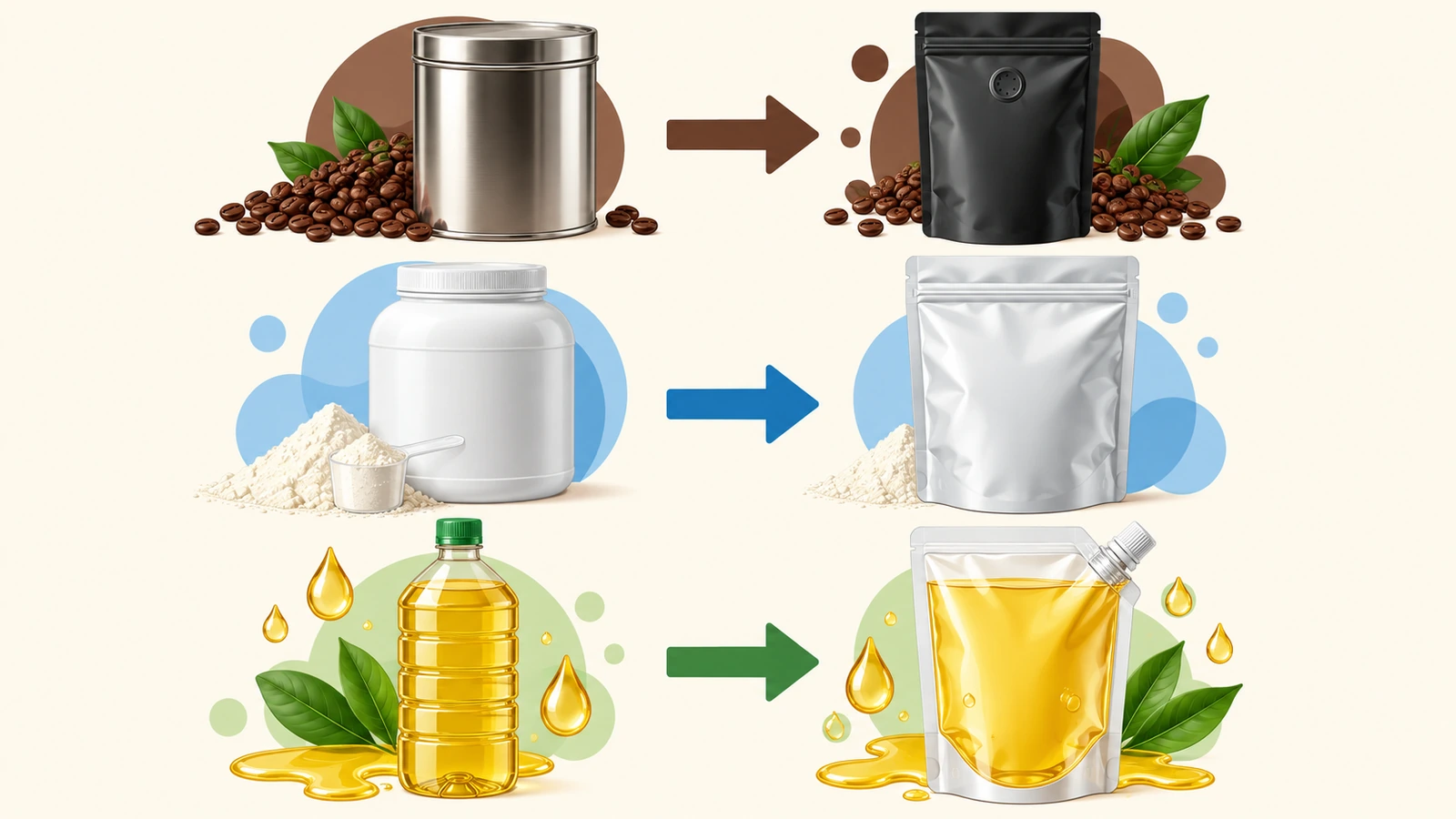
"Rigid" here means glass jars, PET or HDPE tubs and bottles, metal tins and composite canisters. Switching is rarely a one-for-one swap. It also changes your secondary packaging (cases and shelf trays), date coding, labeling, compliance documentation and, in some states, your packaging fees. Plan the project around all of these, not just the primary container.
The Business Case: Freight, Shelf Footprint and Cost per Unit
Inbound freight and storage
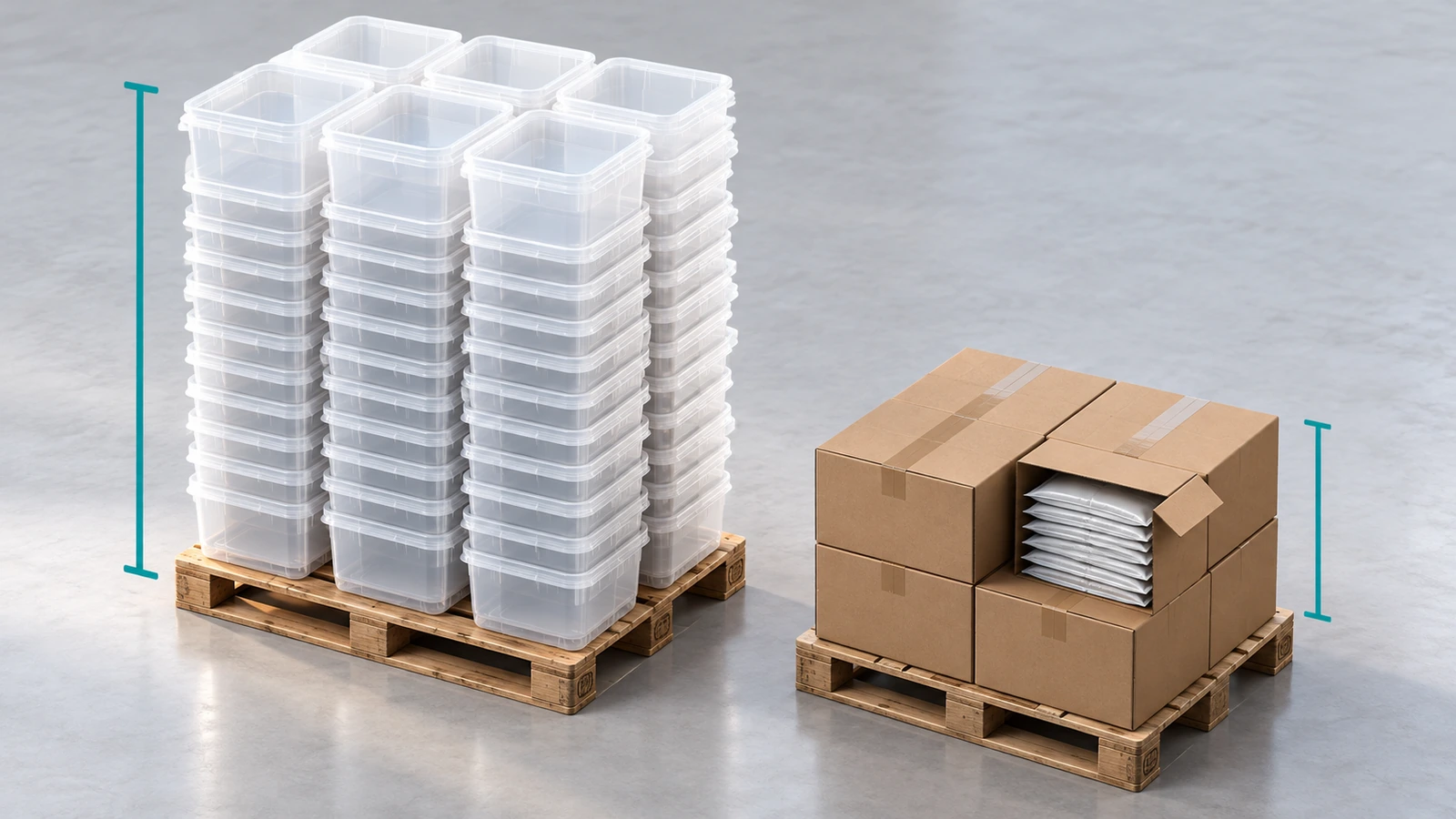
Empty jars and tubs ship and sit in your warehouse at full volume, so you are mostly paying to move and store air. Premade pouches ship flat in cartons. The fastest way to put a number on this is to ask each supplier for units per carton and units per pallet, then compare pallet positions per 10,000 finished units for both formats. Keep that figure. It feeds both your freight model and your warehouse-rent model.
Outbound freight and damage
Filled-product weight barely changes, but packaging weight drops, and glass breakage claims disappear. The trade-off is that a pouch cannot carry a stacking load the way a rigid jar does. Your corrugated case has to do that job, so redesign the case before you calculate any savings. Packing pouches upright with dividers or flat in layers changes case count per pallet, and that changes outbound cost.
Shelf footprint
A pouch gives you a larger printed face and less depth than most jars, which helps on crowded shelves and in e-commerce thumbnails. It also brings new risks. Underfilled pouches slump, overfilled ones bulge at the gusset, and both look poor next to rigid competitors. Retail planograms are often set for rigid dimensions. Ask the buyer early whether you will need a shelf-ready tray or clip strip, and include that cost in the model.
Cost per unit: compare landed packaging cost, not piece price
Comparing a jar price to a pouch price is the most common modeling mistake. Build a landed packaging cost per filled unit for each format instead:
Rigid: container + closure + liner or induction seal + label + shrink band + case share + inbound freight per unit + storage per unit + breakage write-offs.
Pouch: pouch (printed, or blank plus label) + valve or spout if needed + case or tray share + inbound freight per unit + storage per unit + sealing labor or equipment amortization + fill-reject scrap.
Run the model at your current volume and at the volume you expect in 12 months. Printed-pouch economics shift a lot with quantity and print method, so pilot first and request a quote only once the specification is frozen.
Market momentum supports the format. Grand View Research[1] attributes 40.1% of 2023 stand-up pouch revenue to zipper closures and 54.7% to food and beverage, and projects the market to reach USD 48.4 billion by 2030. Speed matters too. Packaging Dive[2] reported Bain & Co. data showing that insurgent CPG brands held under 2% of category share yet generated nearly 39% of category growth in 2024. Those brands are exactly the ones that need packaging they can change quickly.
What Changes on the Filling Line
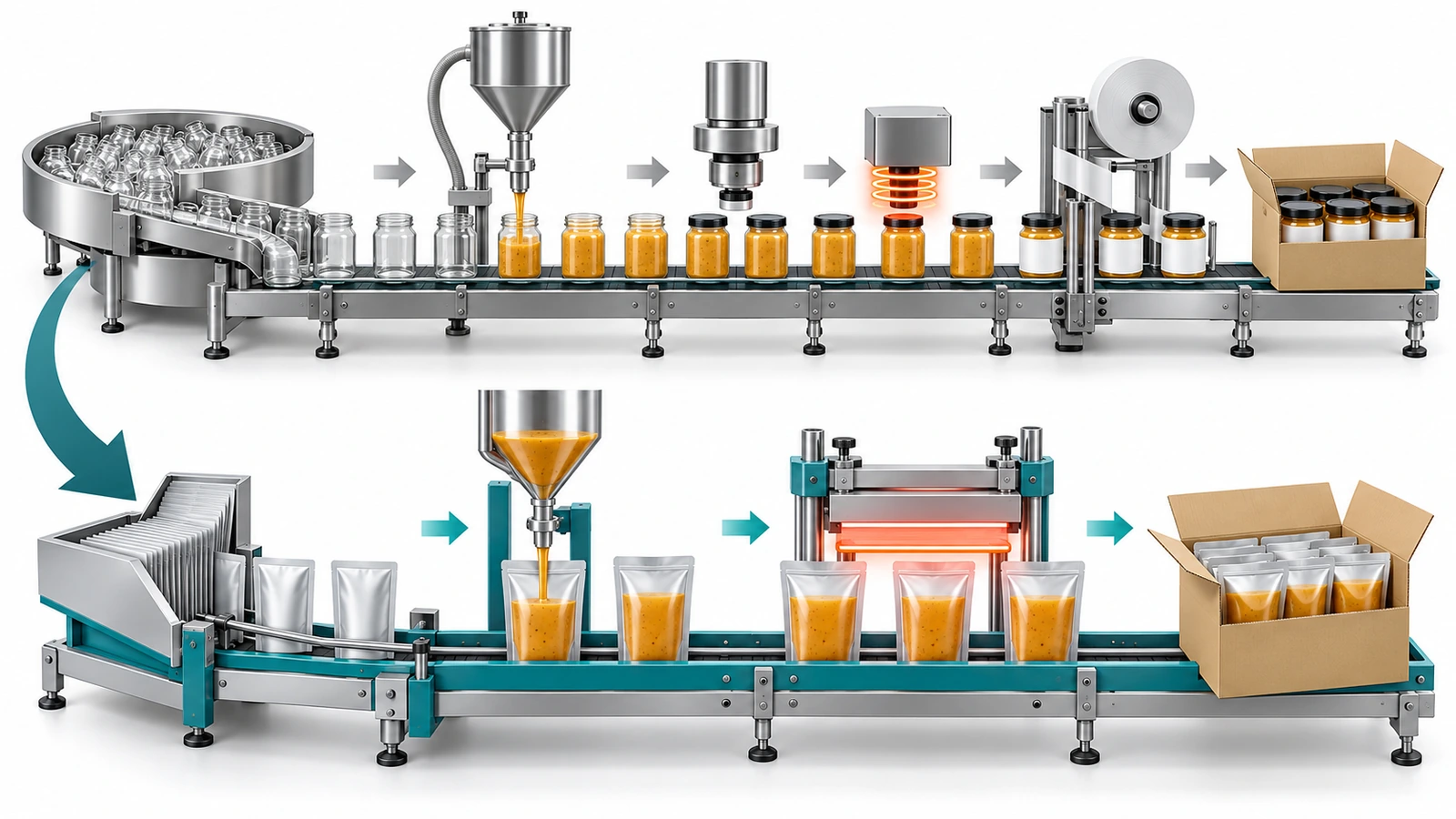
A typical rigid line runs unscrambler → filler → capper → induction sealer → labeler → case packer. A pouch operation follows one of three paths:
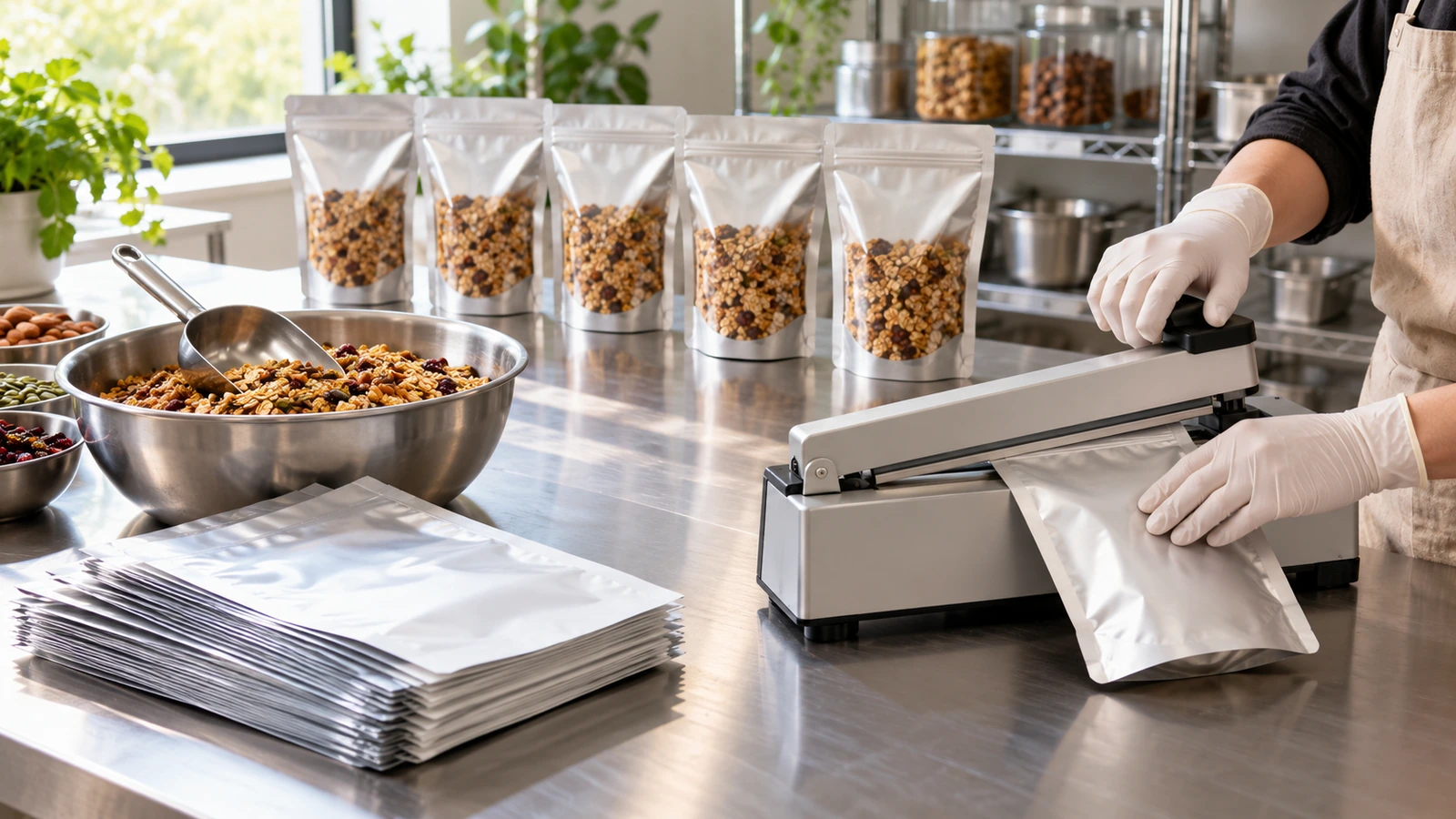
Manual or semi-automatic fill plus a band or impulse sealer. Low capital cost and ideal for pilots and early volumes, but throughput depends on labor.
Premade-pouch fill-seal machine. The machine picks a premade pouch, opens it, fills it and seals it. Your printed graphics stay on the premade pouch, so you keep the same supplier relationship as a hand-fill operation.
Form-fill-seal from rollstock. Built for high volume. It switches your supply chain to film reels and is usually a later-stage move, not a first step.
Whichever path you choose, operators need to change five habits:
Keep the seal area clean. Powder, oil or crumbs in the seal zone are a leading cause of leaks. Fill funnels must clear the top edge, and powders may need a dust shroud or a wipe step.
Seal above the zipper, never across it. A sealing jaw that crushes the zipper gives you a false seal and a broken reclose in a single pass.
Control headspace. Light vibration settles product so the pouch stands and the gusset opens fully.
Move date coding. Codes that used to go on a cap or label now go on film. Reserve a coding window in the artwork and confirm your thermal-transfer or inkjet coder works on that surface.
Lock and record sealing parameters. Temperature, dwell time and pressure define a process window. Verify it by measuring seal strength and failure mode with ASTM F88/F88M-23[3], the current standard test method for seal strength of flexible barrier materials.
Product Protection Trade-Offs
Rigid packaging gives you protection by default. With a pouch, each protective function has to be chosen and specified.
Oxygen and moisture barrier. Glass is close to a perfect barrier. A pouch's barrier depends entirely on its laminate: foil, metallized film or clear barrier layers each perform differently. Ask for oxygen and water-vapor transmission data together with the test conditions, and compare those figures against how long your product lasts in its current rigid pack.
Crush and puncture. Fragile snacks lose the shell a canister gave them. Sharp items such as some pet treats can pierce thin films.
Reclosure. A screw cap survives far more cycles than a press-to-close zipper. For a product opened daily over weeks, test zipper feel at the end of the use period, not on the first day.
Tamper evidence. An induction liner is replaced by a heat seal above the zipper plus a tear notch. Make sure customers can see that the seal is intact.
Seal integrity. This is the risk to engineer out first. An AAPS Open analysis of FDA recalls[4] from 2019 to 2025 found that pouches accounted for 74.8% of seal-integrity recalls and that 54% cited incomplete or defective seals. The data cover medical products, but the failure mechanism is the same one that causes food pouches to leak.
Food contact. U.S. food-contact plastics are regulated under 21 CFR Part 177[5] and related parts. An FDA regulatory overview[6] explains that the safety standard is "reasonable certainty of no harm" and that authorizations depend on the intended use. There is no blanket "FDA approved pouch". Get a compliance statement that covers your food type and use temperature.
Once the pilot has told you which barrier level and features you actually need, the detailed work of choosing film structures, print routes and specifications that survive filling and shipping is covered on our page for custom printed zipper stand-up pouches.
Stand Up Pouch Trends That Shape the Decision
Extended producer responsibility is now live in California.CalRecycle[7] announced that the permanent SB 54 regulations took effect on May 1, 2026, and producers had to register by June 1, 2026. Recycling Today[8] summarizes the targets: by 2032, single-use packaging sold in California must be 100% recyclable or compostable, 65% of it must actually be recycled, and plastic packaging must be reduced by 25%. Multi-material laminates are likely to carry higher fees than mono-material films. Moving from a recyclable HDPE tub to a foil laminate pouch can therefore increase your fee exposure even while it lowers freight. Model both effects.
Claims are under scrutiny. The FTC's Green Guides (16 CFR Part 260)[9] require recyclability claims to reflect collection that consumers can actually use. A "lighter pack, less plastic" message may be true. A "recyclable" message on a multilayer foil pouch usually is not.
Export rules are diverging. The EU Packaging and Packaging Waste Regulation (EU) 2025/40 has applied since August 12, 2026, and its recyclability grading is hard on foil and multi-polymer laminates. EU food-contact plastics must also meet the 10 mg/dm² overall migration limit in Regulation (EU) No 10/2011[10]. If a SKU may go to Europe, raise that before you choose a structure.
Refill models and short runs are growing. Many brands keep the rigid jar as a "hero" pack and sell a pouch refill, which captures freight savings without giving up the premium shelf presence. Digital printing makes short, multi-SKU pouch runs practical, which suits the staged rollout described below.
How to Pilot Switching from Rigid Packaging to Stand Up Pouches with Premade Pouches
The goal of the pilot is to learn everything that would be expensive to discover after a printed run: the right size, the right barrier, how the seal behaves on your line and how customers react. Premade stock pouches with labels let you do that cheaply.
Choose one pilot SKU. Pick a dry, stable, mid-volume product sold mostly direct-to-consumer. Leave liquids, hot-fill products and your largest retail SKU for later waves.
Write a one-page conditions sheet. Record net weight, bulk density, fill volume, oil and moisture content, target shelf life (matching your current rigid pack), sales channel and fill method. A pouch rated by ounces of capacity says nothing about your product's volume.
Fill blank premade pouches with real product. Order two or three sizes and at least two barrier levels. Fill each at your true net weight, then check that the pouch stands, the gusset opens fully and there is clean film above the product for the top seal.
Abuse-test the packs. Measure seal strength at your chosen settings, run a leak check (squeeze or water-immersion is enough at pilot stage), drop-test a fully packed shipping case and stack-test cases for the height your warehouse uses. For coffee, confirm the valve vents without leaking.
Run shelf life against a rigid control. Store pouch and jar samples from the same production lot side by side. Check weight, moisture, texture and aroma at set intervals. Do not print a shelf-life claim you have not measured.
Run a full shift. Whether on a bench or a machine, record throughput, reject rate and how often product contaminates the seal area. That figure decides whether you need a funnel redesign or automation.
Ship to a limited channel. Send labeled pilot pouches to subscribers or a single store. Track damage claims, returns, reviews that mention the zipper or freshness, and reorder rate compared with the rigid pack.
Freeze the specification, then print. Move to custom artwork only when size, fill weight, structure and features are confirmed. Then take your conditions sheet and test results into a request for custom stand up pouches, so the quote reflects a proven specification rather than a guess.
A practical tip from small brands facing order minimums across several flavors: during the transition, use one shared printed design and differentiate variants with labels. Give each variant its own print once its volume justifies it.
Which Pouch Formats Replace Which Rigid Containers?
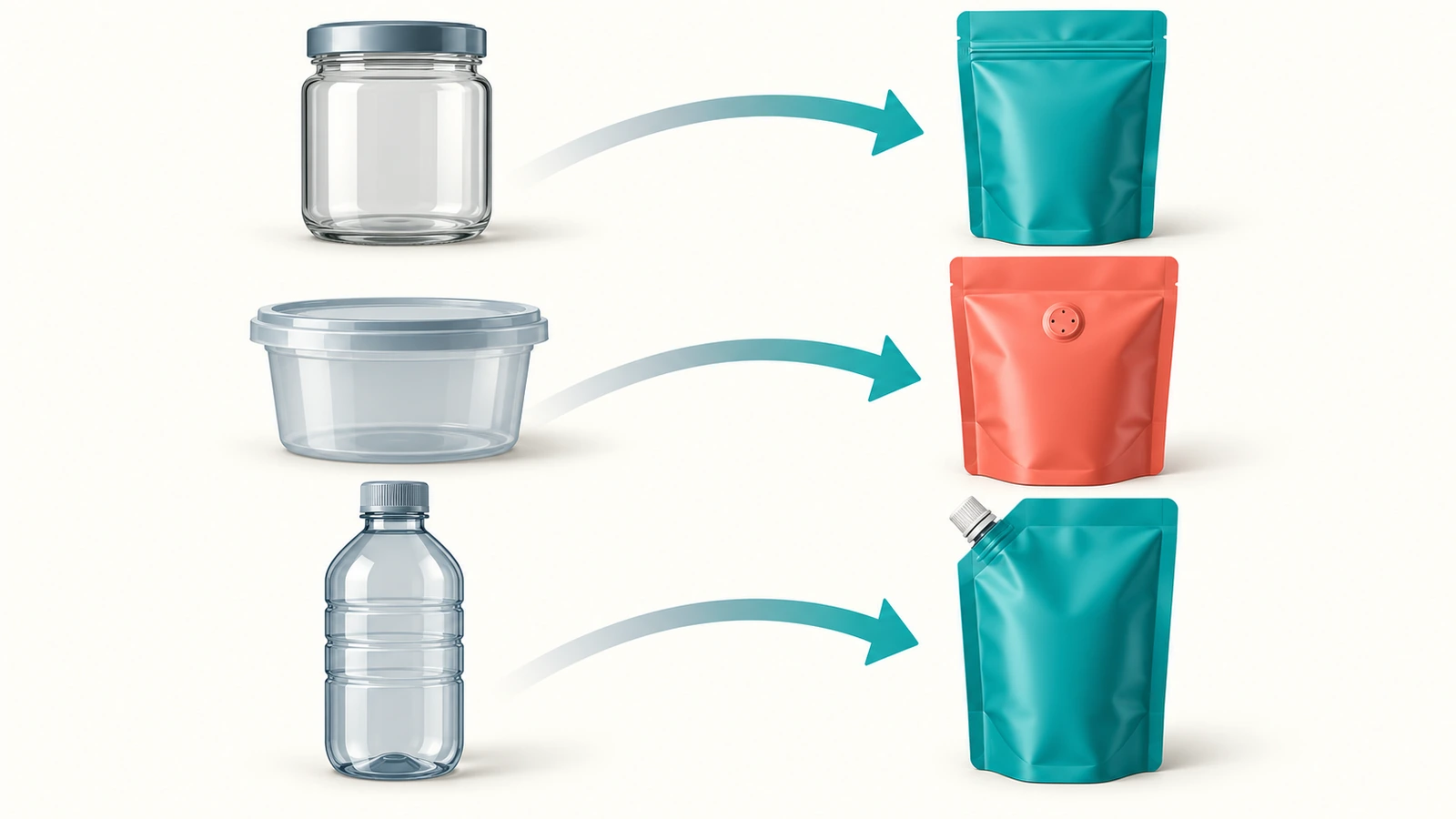
Use the table below to match each rigid container to its closest premade stand up pouch format. Then list the features that format needs and what you give up.
Rigid container today
Typical products
Replacement pouch format
Features to specify
What you give up / watch for
Glass jar or metal tin
Whole-bean and ground coffee
Stand-up pouch with one-way degassing valve
Foil or metallized barrier, zipper, tear notch
Valve must sit clear of the zipper and top seal. The valve bond adds a possible leak path.
PET or HDPE tub
Protein powder, supplements
Large zipper stand-up pouch
Wide opening for scoop access, high moisture barrier
Powder in the seal area is the main leak risk. Scooping is harder than from a tub.
Composite canister or PET jar
Nuts, granola, snack mixes
Zipper stand-up pouch
Metallized barrier for oily products, optional nitrogen flush
Loss of crush protection for fragile snacks.
Glass spice or tea jar
Seasonings, loose-leaf tea
Small stand-up pouch sold as a refill
Aroma barrier, small zipper
Keep the jar as the hero pack. Thin films can let aroma through.
PET or HDPE bottle
Sauces, juices, liquid soap, detergent
Spouted stand-up pouch
Spout fitment, puncture-resistant laminate
Fill temperature limits. Pour control differs from a bottle.
PP jar
Bath salts, scrubs, cosmetic granules
Zipper stand-up pouch, optional clear window
Laminate compatible with essential oils
Oils can attack some sealant layers, so test compatibility.
HDPE tub
Pet treats
Zipper stand-up pouch with hang hole
Odor barrier, puncture resistance
Sharp treats can pierce thin films.
FAQ
FAQ: Will stand-up pouches lower my packaging cost per unit?
Often, but not automatically. Savings usually come from inbound freight, storage and breakage rather than from the pouch's piece price. Build a landed packaging cost per filled unit for both formats, including case redesign, sealing labor and reject scrap, before you decide.
FAQ: Can I run pouches on my existing filling line?
Your filler and checkweigher may carry over, but cappers and induction sealers will not. Most brands start with hand filling plus a band or impulse sealer, then add a premade-pouch fill-seal machine once volumes justify it. Date coding and case packing also need to change.
FAQ: Do pouches protect products as well as glass jars?
A correctly specified foil or high-barrier laminate can protect many dry foods well, but glass remains the stronger barrier. Validate pouch performance in a side-by-side shelf-life test against your current rigid pack instead of relying on generic shelf-life figures.
FAQ: Should I keep the rigid container and add a refill pouch?
For premium or gift-oriented products, often yes. The jar keeps shelf presence and perceived value, while the pouch captures freight savings on repeat purchases and gives you real-world pouch data with lower risk.
FAQ: Can I call the new pouch recyclable?
Only if the structure and the collection systems available to your customers support the claim under the FTC Green Guides. Most multilayer foil or metallized pouches do not qualify for curbside recycling. Compostable claims need certification against a standard such as ASTM D6400. The BPI certification scheme[11] builds on it, and it applies to industrial composting only.
FAQ: How long should the pilot run before I order custom print?
Long enough to pass at least one shelf-life checkpoint and one full replenishment cycle in your pilot channel. If damage claims, seal rejects and customer feedback stay stable over that period, you have the evidence to freeze the specification and request a quote.
Key Takeaways
Zippered stand-up pouches are now mainstream, not experimental. — 40.1% of 2023 stand-up pouch revenue came from zipper closures (Source)
Seal integrity is the first risk to engineer out. — 54% of seal-integrity recalls cited incomplete or defective seals, and pouches made up 74.8% of them (Source)
Agile packaging is a growth lever for challenger brands. — insurgent brands held under 2% share but drove nearly 39% of 2024 category growth (Source)
California EPR changes the material math. — 100% recyclable or compostable and 65% recycled by 2032 (Source)
Measure seals with a recognized method. — ASTM F88/F88M-23 is the current seal-strength standard (Source)
Food-contact compliance depends on intended use, not on a badge. — FDA food additive rules sit in 21 CFR Parts 170–199 (Source)
Conclusion
Moving from jars, tubs or bottles to pouches is an operations project with a packaging decision inside it. The brands that succeed treat it that way. They model landed cost instead of piece price, change line habits around the seal, decide deliberately which protective functions to rebuild, and check fee and claim exposure before they print. A premade-pouch pilot on one SKU answers most of these questions for the cost of some blank pouches and labels. When your pilot data holds steady, send us your conditions sheet and test results and we will quote custom printed stand-up pouches built to the specification you have already proven.
Hi there! I'm Bruce, proud dad to my amazing son. I'm the founder of Zigpac, a printing and packaging company empowering small and medium-sized businesses with custom solutions. Let's create something great together!



 Blog PDF for offline reading












The information below is required for social login
Sign In
Create New Account