


 Blog PDF for offline reading
Quick answer: Choose custom fridge magnets by job, not by look. Flexible printed magnets suit high-volume mailers and handouts. Acrylic and epoxy-domed magnets suit gift bags and retail shelves where perceived value matters. Soft PVC suits playful designs that get handled roughly, and metal suits premium keepsakes. Before you request quotes, confirm magnet safety and that the magnet will hold on your audience's fridges.
A magnet on a kitchen door can stay in view long after a flyer has been recycled. That is why custom fridge magnets remain a staple for real estate agencies, tourism retailers, event organizers and consumer brands. The hard part is not deciding to use magnets. It is choosing between flexible, acrylic, PVC, metal and epoxy formats, each of which behaves differently in an envelope, a gift bag or a souvenir rack. This guide maps each format to a campaign goal, an audience and a distribution channel, so the magnet you order is the one that actually stays on the fridge.
Why do so many promotional magnets miss the mark?
The problem: most magnet orders start from a sample photo and a unit price, not from the campaign. Demand is large enough to attract plenty of suppliers. One estimate puts the global custom segment at about USD 450 million and growing at 6.5% a year (HTF Market Intelligence[1]). The supplier choice is wide, but the format choice is where buyers usually go wrong.
The pain: three failure patterns repeat across buyer reviews and maker forums.
- Format and channel mismatch. A heavy domed magnet mailed loose in envelopes arrives chipped. A thin printed magnet on a museum-shop rack looks like a freebie and will not sell at gift prices.
- Function failure. A thick resin or acrylic face adds weight without adding holding power, so the magnet tilts and slides. Weak adhesive lets the backing peel within weeks. Some stainless-steel doors barely attract a magnet at all.
- Compliance surprises. Small, strong magnets that can come loose are regulated in the US, and regulators have acted against refrigerator magnets that fail the rules.
The solution: treat the magnet as a distribution decision. If you start from the job the magnet must do and the route it takes to the fridge, the right format usually becomes obvious. The rest of this guide works through that sequence.
What counts as a custom fridge magnet?
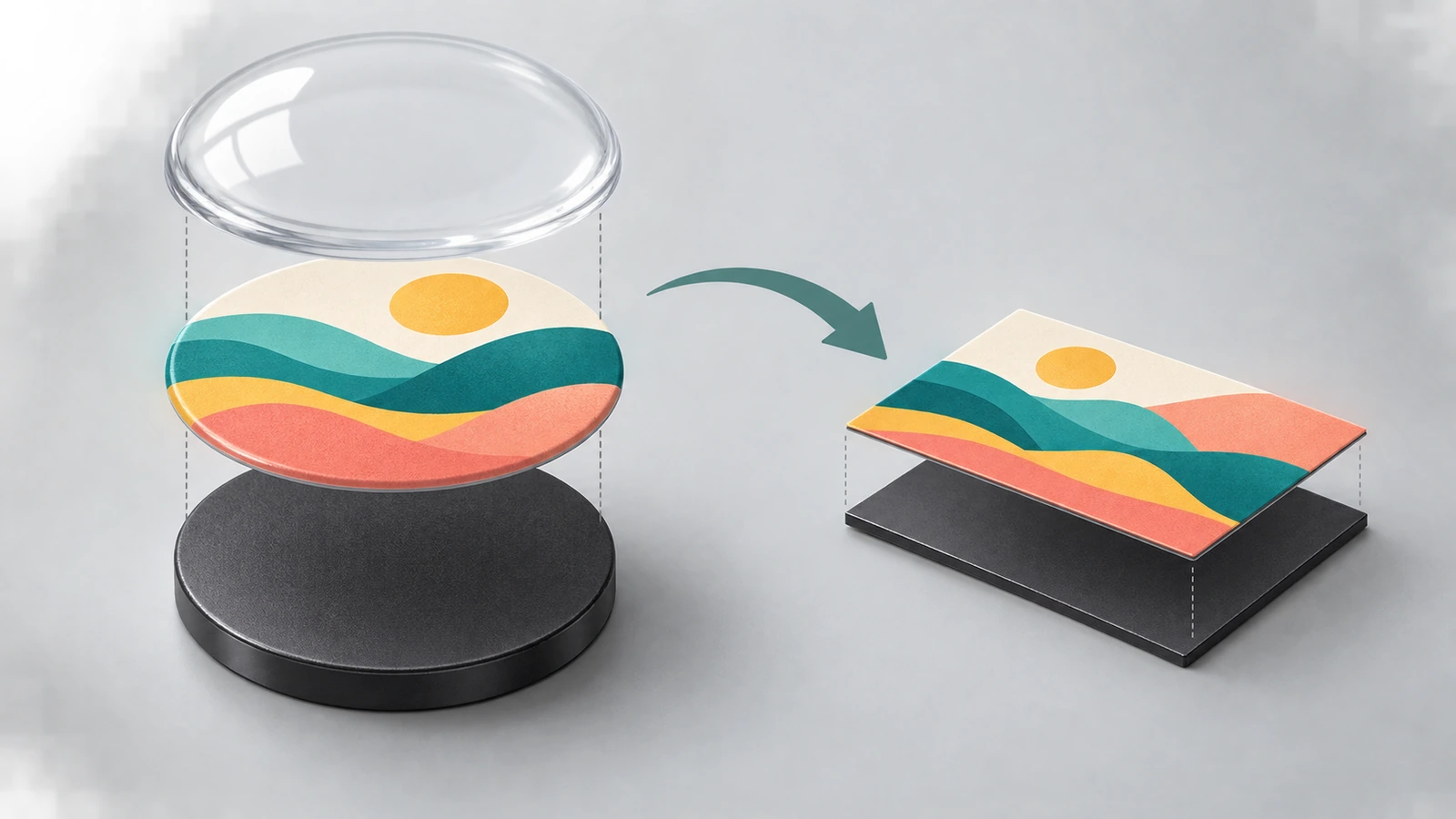
In B2B terms, a custom fridge magnet is a branded or themed object with three layers:
- Face: printed paper or film, acrylic, molded PVC or struck metal.
- Protective layer (optional): a laminate, an acrylic cover or a cured clear resin dome.
- Magnetic backing: what holds the object on the door.
Customizable fridge magnets differ mainly in the first two layers. The third layer is where performance is won or lost.
There are two families of backing.
- Flexible sheet magnet: ferrite powder bound in a rubber-like polymer, covering the whole back. It spreads holding force across the full contact area, which suits light, flat products.
- Discrete magnets: one or more ferrite or neodymium discs glued or embedded in the back. These are used for heavier faces such as acrylic, epoxy domes and metal.
The rule of thumb is simple: the heavier and thicker the face, the more the backing must be engineered rather than assumed.
Your audience also matters. Household use dominates demand, at 61.3% of a market valued at roughly USD 4.8 billion in 2025 by one research firm (DataIntelo[2]). So even a corporate magnet ends up in a family kitchen, among children, sunlight from windows and frequent handling. Estimates differ widely depending on how each report defines the category, so use them as directional context rather than planning figures.
How do you match a magnet type to your campaign?
Work through these six decisions in order. Each one narrows the format choice before price enters the conversation.
- Name the job. Write one sentence:
- Reach means many households cheaply.
- Retention means staying on the fridge for months.
- Revenue means selling at a retail margin.
- Remembrance means commemorating an event.
- Map the channel. Each route to the fridge imposes physical constraints.
- Mail and door drops: the magnet must be flat and light.
- Booth handouts: the magnet must survive pockets and tote bags.
- Gift bags and favor boxes: you can use individual packaging that protects a dome.
- Retail racks: you need hang-tab or display-box packaging and shelf appeal at arm's length.
- Know the audience and the surface. Families with young children need magnets that are fully enclosed and cannot separate. Many fridge doors are painted steel and hold magnets well. Some stainless finishes, especially austenitic grades, attract weakly or not at all. If your audience skews toward newer premium kitchens, include a heavier-hold backing or tell recipients the magnet also works on whiteboards, lockers and filing cabinets.
- Decide what the design must carry.
- Phone number, logo or QR-style call to action: needs flat, legible print, where flexible and epoxy formats excel.
- Photo or illustration: benefits from the depth of acrylic or the lens effect of an epoxy dome.
- Landmark silhouette or mascot: often reads better as PVC relief or embossed metal.
- Plan for durability in the real environment. Souvenir shops near windows expose stock to sunlight, so ask for UV-stabilized resin when you choose a domed format. For adhesion, ask suppliers which test they use. The tape method in ASTM D3359[3] rates coating adhesion from 0B (heavy removal) to 5B (no removal), which gives you a shared vocabulary. Peer-reviewed coatings research also shows that epoxy layers protect neodymium magnets from corrosion only when the coating is continuous and intact (Progress in Organic Coatings[4]). This matters for any design with exposed magnet discs.
- Hand over a decision-ready brief. Once format, channel and audience are fixed, the remaining work is specification: size, artwork, backing, samples and approval. For a domed format, that process is covered on our custom epoxy fridge magnets page, so we won't repeat it here.

Safety and compliance checks for every format
Safety is the one area where a wrong choice creates liability rather than just waste.
The US flux-index rule. The US federal magnet standard, 16 CFR Part 1262[5], applies to loose or separable magnets small enough to fit in the standard's small-parts cylinder. Each such magnet must have a flux index below 50 kG² mm².
Why the rule exists. When the Commission approved the standard, it cited an estimated 26,600 magnet ingestions treated in US emergency departments between 2010 and 2021 (CPSC[6]).
Enforcement on fridge magnets. The rule is not theoretical for this category. A September 2026 CPSC notice covered bear-shaped refrigerator magnets that contained loose magnets and violated the mandatory standard (CPSC notice[7]).
The practical rule for any format with discrete discs is that the magnet must be permanently enclosed or bonded so it cannot separate. Ask the supplier how that is verified.
For European distribution, check two more points:
- REACH: suppliers must communicate any Substance of Very High Concern present above 0.1% by weight in an article, as listed on the ECHA Candidate List[8].
- Resin chemistry: fridge magnets are not food-contact articles. Even so, the EU's restriction of bisphenol A in food-contact materials, tracked by EFSA[9], has made corporate buyers more alert to resin chemistry.
Independent reporting by Environmental Health News[10] on bisphenol-based compounds in epoxy systems mainly concerns uncured resin during production. It is still a good reason to ask whether domes are fully cured before packing. A lingering chemical smell on delivery is a common complaint in buyer reviews.
Which type of custom fridge magnets fits which goal?
The table compares the five main formats on the attributes that drive campaign fit. Cost is shown as relative tiers, because real pricing depends on quantity, shape and finish and should come from a quote.
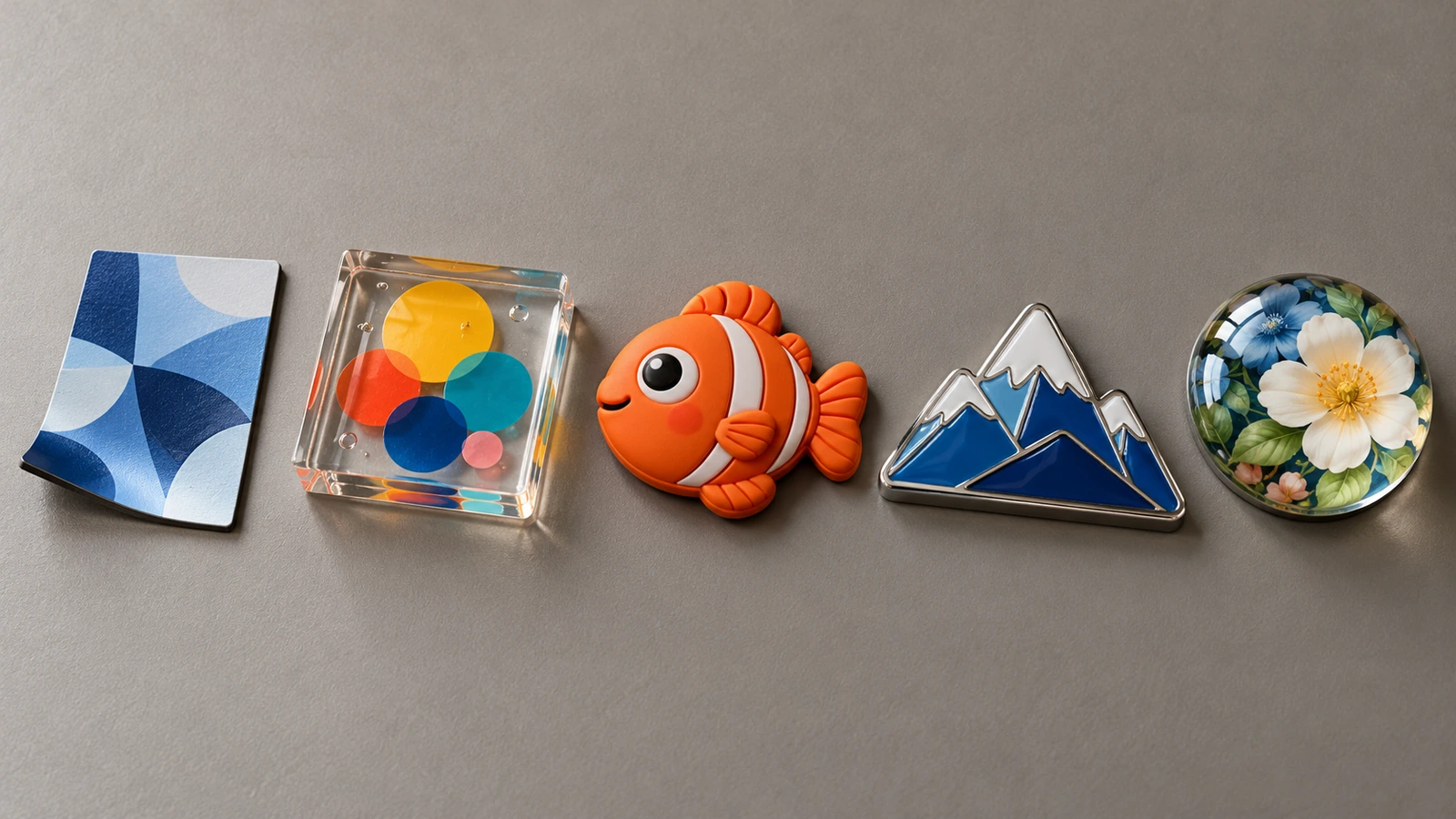
| Format | How it is built | Visual effect | Relative unit cost | Handling durability | Best-fit channel | Main watch-out |
|---|---|---|---|---|---|---|
| Flexible printed | Printed face laminated to a full-back flexible ferrite sheet | Flat, edge-to-edge print | Lowest | Bends without breaking; print can scuff or fade with long sun exposure | Mailers, door drops, calendars, high-volume handouts | No depth; can read as disposable on a retail shelf |
| Acrylic | Print sealed behind or between clear acrylic, cut to shape, magnet on back | Glass-like clarity, layered depth | Moderate | Rigid and moisture-resistant; surface can scratch | Museum and gift shops, fan merchandise, art reproductions | Backing must be sized to the heavier face |
| Soft PVC / rubber | Molded relief with color in the material, magnet attached or embedded | Raised, matte, tactile | Moderate (mold required) | Waterproof and highly impact-resistant | Theme parks, mascots, family attractions | Cannot reproduce photographs; mold adds setup time |
| Metal / enamel | Struck or cast alloy, enamel fill or plating, strong magnet on back | Premium metallic, embossed detail | Highest | Resists cracking and fading | Awards, landmark keepsakes, VIP gifts | Heavier; limited color gradients; tooling needed |
| Epoxy-domed | Printed base topped with a clear, self-leveling resin dome | Glossy dome that slightly magnifies the print | Moderate | Resists moisture and scratches; edges can chip if dropped | Souvenir retail, event favors, brand gifts | Dome weight must be balanced by the backing; resin quality drives bubbles and yellowing |
Two patterns stand out:
- Flexible magnets are reach tools. They win wherever postage, volume or pocket-carry matters.
- Domed and acrylic formats are value tools. They win wherever the magnet is handed over as a gift or priced as a product.
Epoxy sits in a useful middle position. It offers the photographic detail of print with a finish that feels like an object rather than a leaflet. That is why tourism retailers and event planners who want to customize fridge magnets around a photo or emblem often shortlist it. Its known risks are weight-to-hold balance, edge chipping and resin quality, and all three can be managed through specification.
Playbooks for brands, tourism, real estate and events
| Buyer | Primary goal | Typical channel | Usual first choice | Strong alternative |
|---|---|---|---|---|
| Consumer and corporate brands | Retention and brand recall | Product inserts, trade-show booths, employee and client gifts | Epoxy-domed or acrylic | Flexible for inserts at scale |
| Tourism retailers and attractions | Revenue per shelf space | Souvenir racks, museum shops, hotel boutiques | Epoxy-domed, metal for premium tiers | Soft PVC for family attractions |
| Real estate agencies | Reach and repeat contact | Direct mail, door drops, open-house handouts | Flexible printed | Epoxy-domed as a closing gift |
| Event organizers | Remembrance and shareability | Gift bags, favor boxes, registration packs | Epoxy-domed or acrylic | Metal for awards and sponsors |
Brands. The magnet has to earn its place on the door. Utility helps: a recipe card, a care-instructions reminder or a customer-service number. Some brands are adding NFC chips so a tap opens a page or playlist. In 2026, independent tech press covered tap-to-update E-Ink photo magnets (Trusted Reviews[11]). If you add electronics, confirm early that the chip sits behind a sealed layer.
Tourism retailers. Shoppers judge a souvenir in seconds and at arm's length, so depth and gloss help sell it. A practical structure is a range tiered by format: flexible at the entry price, epoxy or acrylic in the middle, metal at the top. Ask for UV-stabilized materials for stock displayed near windows, and for retail-ready packaging that protects domes in transit.
Real estate agencies. The economics favor flat, light magnets that travel in standard envelopes and carry an agent's photo and number legibly. Agencies that hand a domed magnet to buyers at closing get a second, higher-value touchpoint. Because many listings feature newer kitchens, test your chosen backing on stainless and panel-ready doors before a large drop.
Event organizers. Weddings, reunions, conferences and festivals tie quantity to headcount and production to a fixed date. Build production and transit time into the event calendar with your supplier rather than assuming a standard turnaround. Personalized fridge magnets with names, dates or venue silhouettes work well under a dome. Order a small overage so you have replacements for any pieces damaged in transit.

Frequently asked questions
FAQ: Will custom fridge magnets stick to a stainless steel refrigerator?
It depends on the steel. Ferritic stainless grades and painted steel doors attract magnets. Austenitic grades, common in premium appliances, attract weakly or not at all. If your audience is likely to own such fridges, choose a stronger backing, keep the face light, and mention other surfaces the magnet will hold on, such as whiteboards and filing cabinets.
FAQ: Are epoxy-domed magnets safe in homes with young children?
The dome itself is not the hazard. The risk comes from small, strong magnets that can separate. US rules require any such loose or separable magnet to have a flux index below 50 kG² mm². Specify magnets that are permanently bonded or encapsulated, and ask the supplier how that is verified.
FAQ: Do epoxy domes turn yellow over time?
Lower-grade resins can yellow or turn brittle with prolonged sunlight and heat. UV-stabilized resin and indoor placement greatly reduce the risk. For retail displays near windows, raise UV performance explicitly when you brief the supplier.
FAQ: Which magnet format survives mailing best?
Flexible printed magnets. They are flat and light, and they bend rather than crack. Domed, acrylic and metal formats need individual protective packaging and are better suited to hand delivery, gift bags or boxed shipments.
FAQ: Can a fridge magnet link people to a website or listing?
Yes. A printed short web address or scan code works on any flat format. NFC chips sealed behind the face allow tap-to-open links. Keep any electronics fully enclosed and test that the chip still reads through the finished layers.
FAQ: How many pieces should we order, and how long does production take?
Both depend on format, shape, finish and packaging, so treat any generic figure with caution. For epoxy-domed magnets, share your quantity, delivery date and destination through our epoxy magnet quote request, and we will confirm options for your project.
Key takeaways
- The custom segment is growing steadily, so supplier choice is wide; format choice is where buyers go wrong. — 6.5% annual growth toward about USD 700 million by 2033 (Source)
- Even business magnets end up in family kitchens, so design for children, sunlight and handling. — 61.3% household share of demand in 2025 (Source)
- Any small magnet that can separate must meet the US flux-index limit. — below 50 kG² mm² (Source)
- Magnet ingestion is a documented injury pattern, which is why enclosure matters. — about 26,600 emergency-department-treated ingestions, 2010–2021 (Source)
- Use a recognized adhesion scale so "durable" means the same thing to buyer and supplier. — ASTM D3359 ratings from 0B to 5B (Source)
- EU-bound orders need substance disclosure from the supply chain. — 0.1% by weight SVHC threshold (Source)
Conclusion
The right magnet format follows from a simple chain: what the magnet must achieve, how it reaches the fridge, and who lives with it afterward.
- Flexible magnets carry reach campaigns.
- Epoxy and acrylic carry gifts and souvenirs.
- Soft PVC handles rough play.
- Metal signals permanence.
Whatever you choose, enclose the magnets securely, test the hold on the doors your audience owns, and agree on durability terms before production. If an epoxy-domed format fits your campaign, see how we specify and sample custom epoxy fridge magnets and send us your brief for a tailored quote.
Sources
- HTF Market Intelligence, "Global Custom Fridge Magnets Market," 2026 edition. htfmarketintelligence.com ↩
- DataIntelo, "Fridge Magnets Market Research Report 2034," updated 2026. dataintelo.com ↩
- ASTM International, "ASTM D3359-23 Standard Test Methods for Rating Adhesion by Tape Test," 2023 (via ANSI Webstore). webstore.ansi.org ↩
- Progress in Organic Coatings, study on epoxy coatings for corrosion protection of NdFeB magnets, 2022. sciencedirect.com ↩
- U.S. Electronic Code of Federal Regulations, 16 CFR Part 1262, "Safety Standard for Magnets," current as of 2026. ecfr.gov ↩
- U.S. Consumer Product Safety Commission, "CPSC Approves New Federal Safety Standard for Magnets to Prevent Deaths and Serious Injuries from High-Powered Magnet Ingestion," 2022. cpsc.gov ↩
- U.S. Consumer Product Safety Commission, notice on bear-shaped refrigerator magnets violating the mandatory magnet standard, September 2026. cpsc.gov ↩
- European Chemicals Agency, "Candidate List of Substances of Very High Concern for Authorisation," updated 2026. echa.europa.eu ↩
- European Food Safety Authority, "Bisphenol" topic page, updated 2026. efsa.europa.eu ↩
- Environmental Health News, reporting on epoxy resin health risks. ehn.org ↩
- Trusted Reviews, "These NFC E-Ink magnets are the unique way to display your favourite photos," April 2026. trustedreviews.com ↩












The information below is required for social login
Sign In
Create New Account