


 Blog PDF for offline reading
Quick answer: Custom personalized paper bags pay off when the personalization level fits the bag's job. Use a one-color logo on brown kraft for high-volume retail and takeout, and white or colored kraft with richer print for gifting and events. Choose the bag style by load, the kraft color by brand palette, and make environmental claims only when you have documents to back them.
Custom personalized paper bags are often ordered like napkins or receipt rolls: as a cost line, re-quoted once a year, and rarely questioned. That habit misses what the bag actually does. It is the last thing a customer touches in your store, and it is the first piece of your brand that strangers see on the street, in an office lobby or at a conference. This guide treats the bag as a branding touchpoint. It compares personalization levels, bag styles and kraft colors by business type and budget, so you can decide what to print before you ask anyone for a quote.
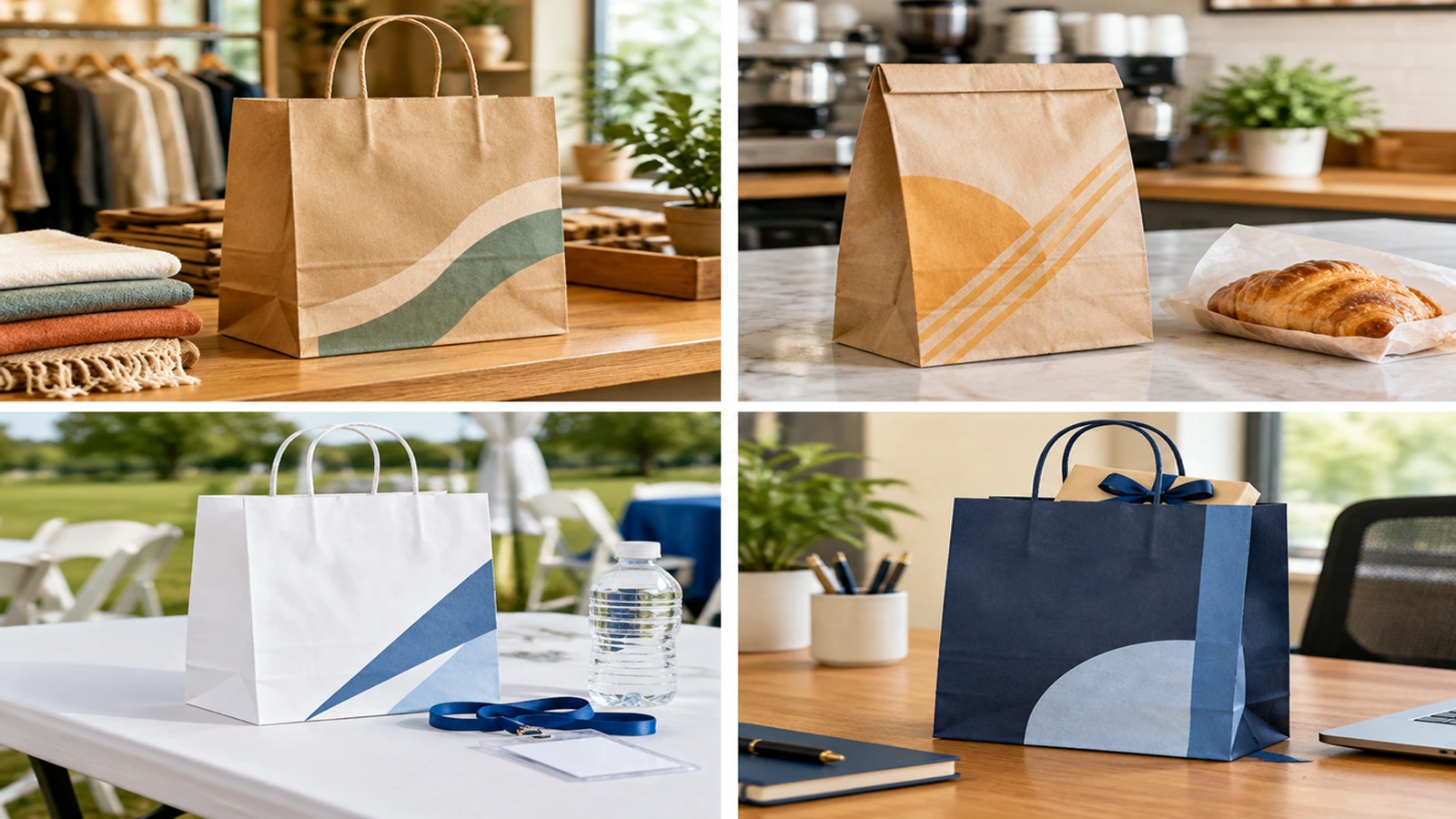
Why a generic bag costs more than it saves
The problem: A plain bag is cheap, but it tells customers nothing about who sold them the product. Demand for kraft bags is growing fast. Grand View Research valued the global kraft paper bag market[1] at USD 4.5 billion in 2024 and projects a 4.6% CAGR through 2030, with the United States holding 72.1% of North American revenue. As more of your competitors switch from plastic to paper, a brown bag no longer sets you apart. A branded paper bag does.
The pain: The wrong bag fails in public. A handle that tears on the sidewalk, a logo that turns muddy on brown paper, or an "eco-friendly" line that your supplier cannot document can damage the brand the bag was supposed to promote. Event teams have a different problem: date-specific bags left over after the event can't be reused. Corporate gifting teams find that a beautiful bag with mixed-material handles undercuts the sustainability message printed on it.
The solution: Decide on strategy before specifications. First define the bag's job, match it to a personalization level, then pick the bag style and kraft color for that job. The rest of this article works through those decisions in order.
What counts as a personalized paper bag?
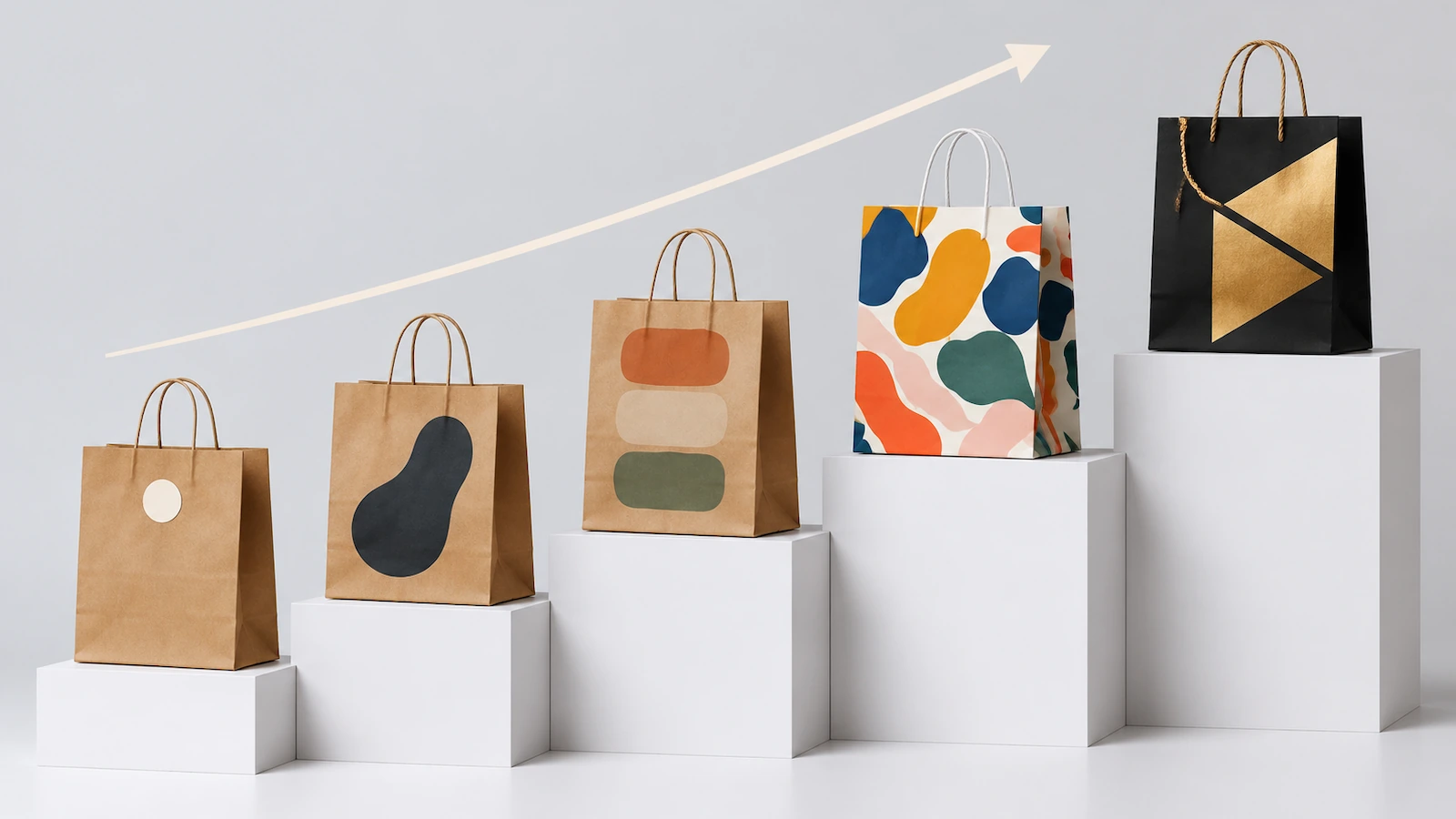
A personalized paper bag is any paper carrier that carries your brand identity beyond the stock bag itself. That covers a range of approaches: a rubber stamp or sticker on a blank bag, a one-color logo printed in production, full-coverage artwork, and premium finishes such as hot foil, embossing or dyed colored kraft. "Custom" usually refers to the bag's construction (size, paper, handle). "Personalized" refers to what the bag communicates. For most businesses, the branding decision drives the budget far more than the construction does.
Kraft is the default base because its long fibers give strength at a modest paper weight, and unbleached brown kraft still dominates. Grand View Research reports that brown kraft held more than 66.4% of revenue in 2024.[1] Choosing white or colored kraft is therefore a deliberate brand signal, not the norm.
How to build a custom personalized paper bags strategy in six steps
Step 1: Define the job of the bag
Write one sentence: "This bag exists to ___." The answers differ by business: carry takeout safely to a car, advertise the store for weeks after a purchase, make a gift feel premium, or give attendees something to carry swag in. The job decides what you are allowed to compromise on. A takeout bag can sacrifice print richness for grease performance. A gift bag cannot.
Step 2: Match personalization to how long the design stays valid
Evergreen artwork (logo, URL, social handle) justifies printed production runs because every bag stays usable until the stock runs out. Short-lived artwork (event dates, seasonal campaigns, limited editions) is safer as a sticker, insert or hang tag on an evergreen printed bag. Many small brands follow a staged path that founders describe in public forums: start with blank kraft bags and custom stickers, then move to fully printed bags once sales are steady.
Step 3: Design for reuse, not just for the walk home
A bag that gets reused delivers more brand impressions, and it also improves the bag's environmental case. The New York Times climate analysis[2] reported that a paper bag needs roughly three uses to match a single-use plastic bag on climate impact. An analysis in Entrepreneur[3] puts the figure at 43 reuses for an unbleached paper bag to match LDPE across all environmental indicators. The practical lesson: sturdy handles and a design people want to carry again do more for both marketing and sustainability than any slogan.
Step 4: Pick the bag style by what goes inside
Food counters need flat-bottom bags that stand open, retail needs comfortable handles, and gifting needs rigidity and finish. The comparison tables below map each style to a use case. Exact dimensions and print-area readability are covered in the specification sections of our product page, so they are not repeated here.
Step 5: Choose kraft color as a brand decision
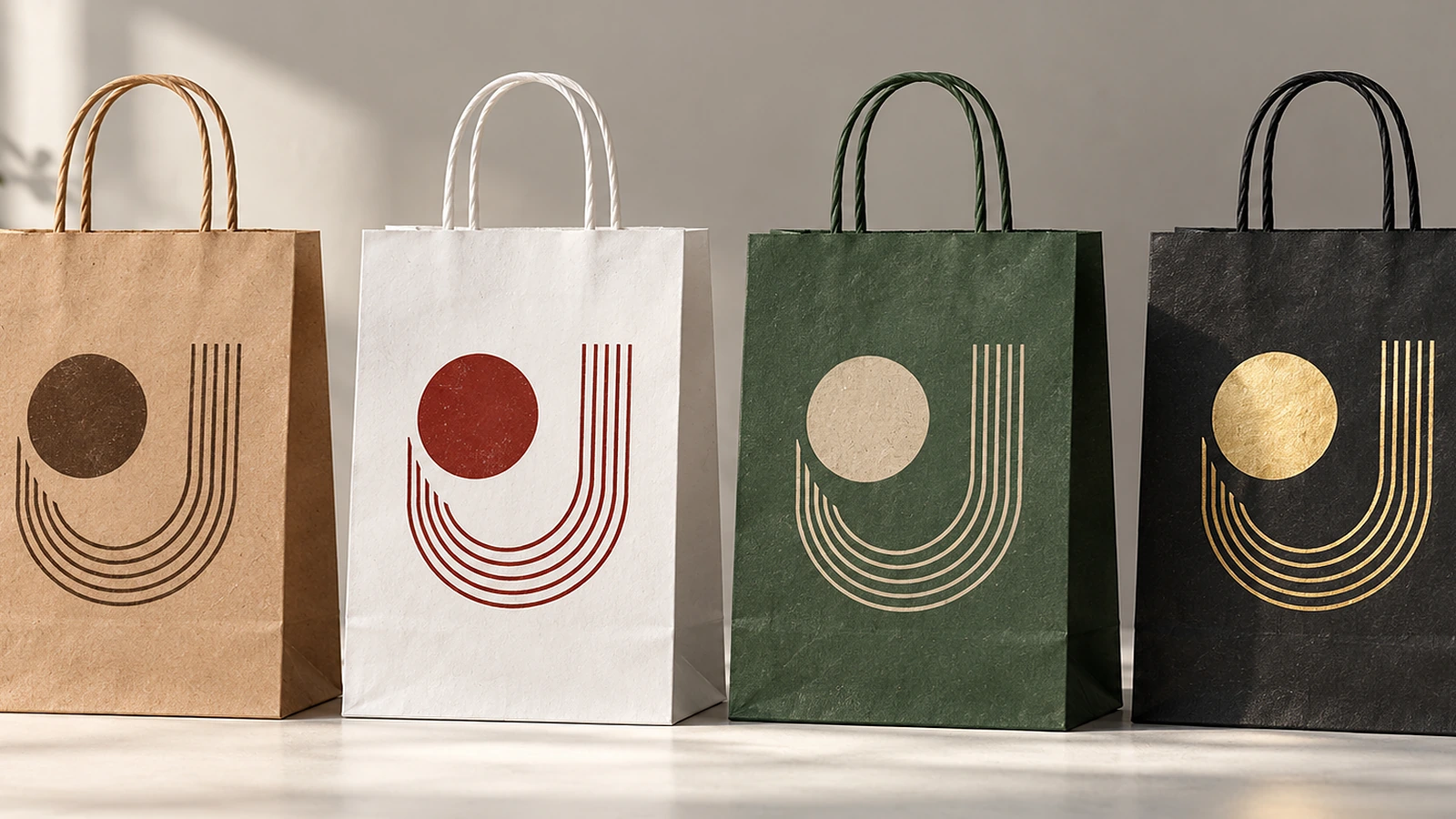
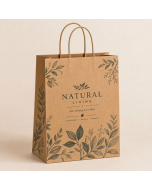
Ink sits on the paper's color, so brown kraft darkens most inks and weakens light tones. Natural brown suits earthy, artisanal and food brands. White kraft brings back color accuracy for brands with strict palettes. Colored or black kraft makes the bag itself the brand color, which works well for gifting and premium retail.
Step 6: Pilot, measure, then scale
Run a small pilot before committing your whole budget. Track simple signals: how often staff double-bag, whether customers ask for extra bags, and whether you see your bags outside the store. Then convert the winning design into a production run. When you are ready to specify materials, artwork and approvals, the custom brown kraft paper bags with twisted handles page walks through each technical step and the quote request.
What each business type should prioritize
Retailers: the walking billboard
For retail, the bag's main value comes after checkout, when it travels through the street, the mall and the customer's home. Put your logo high on both faces so it stays visible when the bag is carried at hip height, and keep the message short: one mark, one URL. If you operate grocery, pharmacy, convenience, food mart or liquor stores in California, the bag also has a legal job. Under SB 1053, CalRecycle rules[4] limit those stores to recycled paper carryout bags from January 1, 2026, sold for at least $0.10 each. The bags must be printed with the manufacturer's name, country of manufacture and postconsumer recycled content, and the minimum recycled content rises to 50% on January 1, 2028. Reserve a small panel for that text in your artwork from the start.
Restaurants and cafés: function first, logo second
Food and beverage is the largest end use for kraft bags, at about 31.6% of demand in 2025 according to Future Market Insights[5]. Restaurants have the least room for a failed bag, because one leak spoils both the meal and the impression. Keep branding on the outside and keep the food-contact question separate. In the US, paper that touches aqueous or fatty food falls under 21 CFR 176.170[6]. Ask for a declaration that covers the finished bag, including paper, inks, adhesives and any coating, not just the base paper roll. Most takeout food is already boxed or wrapped, so the printed carrier bag usually serves as secondary packaging. That gives you more freedom in print choices for the carrier itself.
Event organizers: separate the evergreen from the dated
Event bags have a short active life but a long second life if attendees keep them. Print your organization's identity on the bag and put the event name, date and sponsor marks on an insert, sticker or hang tag. Leftover stock then rolls into the next event instead of the recycling bin. Size the bag around the largest swag item plus printed materials, and choose handles that are comfortable for a full day of carrying.
Corporate gifting teams: perceived value per bag
For gifting, the bag is part of the gift, so material feel matters more than unit cost. White or colored kraft with a tone-on-tone logo looks deliberate. Keep handles consistent with your sustainability policy: paper twisted handles keep the bag all paper, while cotton rope or ribbon adds premium feel but creates a mixed-material bag. Quantities follow headcount and client lists, so order with a buffer for late additions. Plan backwards from the delivery date and confirm production timing when you request a quote.
Comparison: personalization levels, bag styles and kraft colors
The tables below compare options by relative cost and fit. Actual pricing depends on quantity, size, paper, handle type and print coverage, so we don't list price figures. Request a quote for numbers that match your project.
Personalization levels by budget and use case
| Level | What it looks like | Relative cost | Best fit | Watch out for |
|---|---|---|---|---|
| 0 – Blank + add-on | Stock kraft bag with sticker, stamp or tag | Lowest | Pop-ups, pilots, event-specific messages | Labor per bag; uneven placement |
| 1 – One-color logo | Single ink, one or two sides | Low | Takeout, cafés, high-volume retail | Light inks weaken on brown kraft |
| 2 – Multi-spot color | Two to three matched brand colors | Moderate | Boutiques, bakeries, branded retail | Each added color adds setup and approval work |
| 3 – Full coverage | Full-color or flood artwork, often on white kraft | Higher | Fashion, beauty, DTC brand launches | Heavy ink coverage changes the paper look and feel |
| 4 – Premium finish | Foil, embossing, colored kraft, rope or ribbon handles | Highest | Corporate gifting, luxury retail, VIP events | Mixed materials complicate recyclability claims |
Bag styles by business use
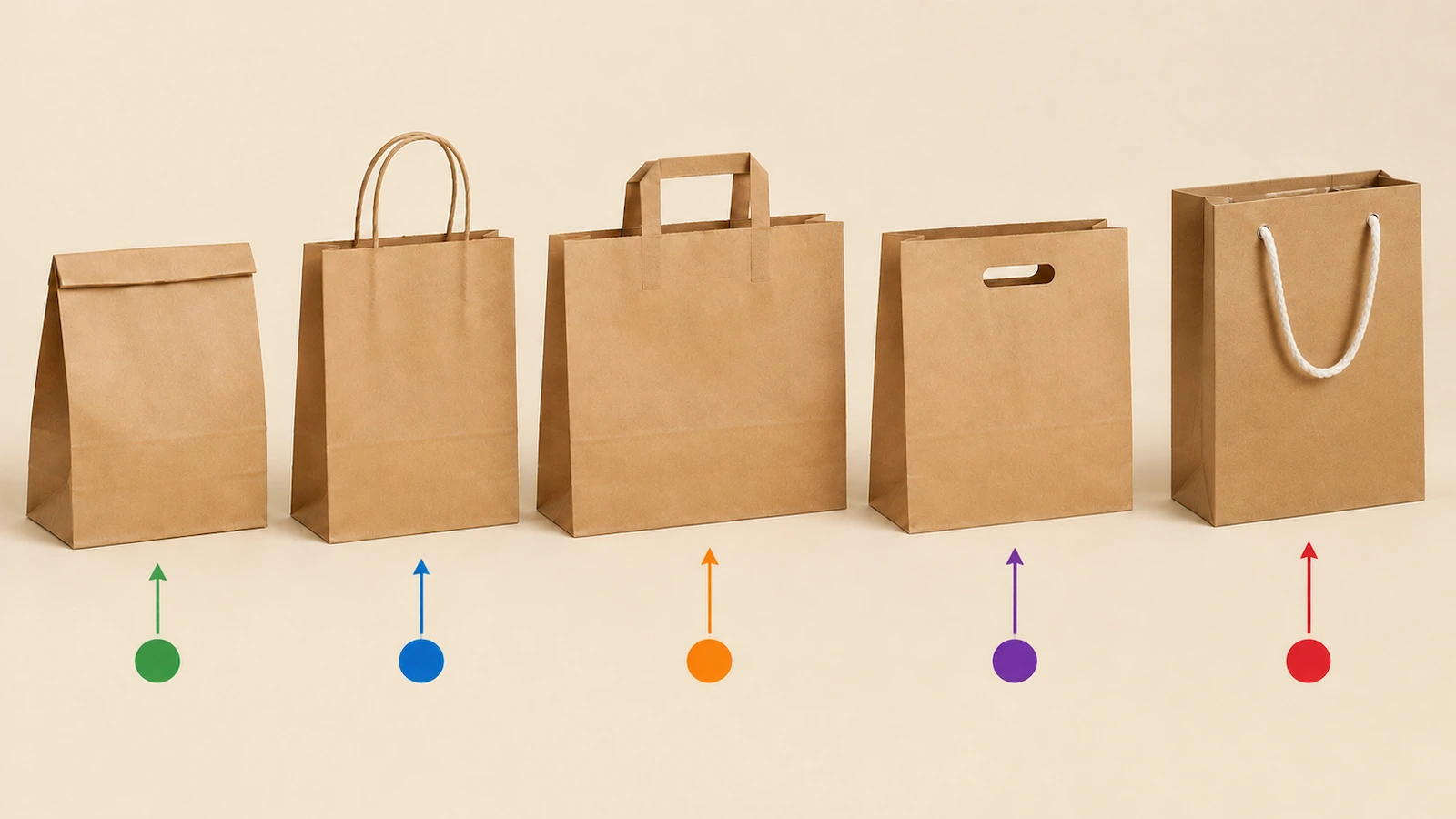
| Style | Strength profile | Branding surface | Typical users |
|---|---|---|---|
| Flat-bottom bag without handles (SOS) | Stands open; carried in arms or inside another bag | Front and back panels | Bakeries, delis, pharmacies |
| Twisted paper handle shopping bag | Comfortable grip, all-paper construction | Large faces, good for logos | Retail, cafés, events, light gifting |
| Flat paper handle bag | Wide handle footprint for bulky loads | Large faces | Takeout, grocery-style service |
| Die-cut handle bag | Clean look; stress concentrates at the hole edge | Full faces, minimalist | Apparel, light retail items |
| Rope or ribbon handle bag | Rigid board body, premium carry | Ideal for foil and embossing | Gifting, luxury, corporate events |
Kraft color options by brand goal
| Kraft color | Brand signal | Print behavior | Best paired with |
|---|---|---|---|
| Natural brown | Honest, artisanal, eco-forward | Dark inks read well; pastels and light tones look muted | Cafés, bakeries, farm and craft brands |
| White kraft | Clean, modern, color-accurate | Closest match to on-screen brand colors | Beauty, fashion, brands with strict palettes |
| Colored kraft | The bag itself becomes the brand color | Best with a single contrasting or tone-on-tone mark | Corporate gifting, seasonal retail |
| Black kraft | Premium, minimal | Needs opaque light ink or foil for contrast | Luxury retail, wine, VIP gifting |
If your printed paper bags with logo must match a corporate color closely, test that color on the actual paper rather than approving from a screen. The artwork preparation and proof steps on the product page explain how to approve color before production.
Claims and regulations that shape your design
Personalization includes what you print about the bag, not just your logo. "Recyclable," "compostable" and "food safe" are claims that need documentation behind them. Grease resistance is a good example. The FDA announced on February 28, 2024[7] that PFAS grease-proofing substances for food packaging paper are no longer being sold in the US market. If your takeout bags need grease resistance, ask what barrier replaces those substances and whether it affects recyclability.
Brands that ship to Europe face a second rulebook. The EU Packaging and Packaging Waste Regulation, (EU) 2025/40, has applied since August 12, 2026, according to the European Sealing Association[8]. Its first obligations restrict PFAS in food-contact packaging, and recyclability and recycled-content requirements follow in later phases. In the US, packaging rules still vary by state, a contrast that Plastics Engineering[9] outlines in its comparison of EU and US state approaches. California's bag law has a clear policy rationale: as Packaging Dive[10] reported, CalRecycle data showed grocery and merchandise bag disposal rose about 47% between 2014 and 2022.
The design rule that follows is simple. An all-paper bag with paper twisted handles and no plastic lamination is the easiest to describe honestly. Every added film, foil or synthetic handle makes the claim harder to support, so keep a short, documented claim rather than a long, vague one.
FAQ
FAQ: What is the difference between custom and personalized paper bags?
"Custom" usually means the bag's construction is made to order: size, paper, handle and color. "Personalized" means the bag carries your identity, through printing or add-ons such as stickers and tags. You can personalize a stock bag without customizing its construction, which is why many businesses start with Level 0 or Level 1 personalization.
FAQ: Are paper bags for businesses worth it if customers throw them away?
They are worth it when the bag gets reused. A paper bag needs roughly three uses to match single-use plastic on climate impact (New York Times, 2025), and reuse also multiplies brand impressions. Sturdy handles and appealing artwork make reuse more likely.
FAQ: Which kraft color makes a logo most readable?
White kraft gives the most accurate color. Natural brown works best with dark, saturated inks. Colored and black kraft need a contrasting ink or foil. For light or pastel brand colors, test on white kraft before committing.
FAQ: Do colored kraft paper bags with handles affect recyclability?
Paper color alone is not usually the issue. Laminations, plastic windows, metallic foils and non-paper handles are what complicate recycling. If recyclability is part of your message, keep the bag all paper and check acceptance with your local recycling program.
FAQ: What must a California checkout paper bag show?
For covered stores (most grocery stores, retail stores with a pharmacy, convenience stores, food marts and liquor stores), CalRecycle requires the bag to show the manufacturer's name, the country of manufacture and the percentage of postconsumer recycled content. The minimum recycled content rises to 50% from January 1, 2028.
FAQ: How do I get pricing and timing for my bags?
Pricing and lead time depend on quantity, size, paper, print and handles. Use the quote request on the product page to get figures for your exact specification.
Key takeaways
- Kraft bags are mainstream, so branding is what sets you apart — 4.6% projected CAGR, 2025–2030 (Source)
- Food brands are the biggest buyers and need documented food-contact compliance — 31.6% of 2025 demand (Source)
- Reuse turns a bag into both marketing and a better environmental result — about 3 uses to match plastic on climate impact (Source)
- Across all environmental indicators, the reuse bar is much higher — 43 reuses versus LDPE (Source)
- California checkout bags need space in the artwork for legal text — 50% recycled content from 2028 (Source)
- Grease-resistant food bags need a non-PFAS barrier story — PFAS grease-proofers off the US market as of 2024 (Source)
- Exporters to Europe must check food-contact bags against PPWR — applicable from 12 August 2026 (Source)
Conclusion
The best branded paper bag isn't the most expensive one. It is the one whose personalization level, style and color match its job. Retailers get the most from evergreen logos that travel. Restaurants should put function and food-contact documentation ahead of print richness. Event organizers save stock by keeping dated messages off the bag. Gifting teams spend where the recipient's hands and eyes notice it. Once your strategy is set, move to specification, artwork approval and pricing on our custom brown kraft paper bags with twisted handles page and request a comparable quote.
Sources
- Kraft Paper Bag Market Size and Share Report, 2025–2030 — Grand View Research, published November 2024. ↩
- Paper, plastic or tote? Shopping bag climate comparison — The New York Times, March 24, 2025. ↩
- No, a Paper Bag Is Not Sustainable — Here Is the Math — Entrepreneur. ↩
- Bag Requirements at Grocery and Retail Stores (SB 1053) — California Department of Resources Recycling and Recovery (CalRecycle). ↩
- Kraft Paper Bags Market — Future Market Insights, updated July 2025. ↩
- 21 CFR 176.170 — Components of paper and paperboard in contact with aqueous and fatty foods — Electronic Code of Federal Regulations. ↩
- FDA Announces PFAS Used in Grease-Proofing Agents for Food Packaging No Longer Being Sold in the U.S. — U.S. Food and Drug Administration, February 28, 2024. ↩
- EU Packaging and Packaging Waste Regulation (PPWR) — European Sealing Association, October 2026. ↩
- EU PPWR vs. US State Laws: Packaging Regulation Trends — Plastics Engineering, February 2026. ↩
- State packaging laws taking effect in 2026: bags, foam, PFAS and hotels — Packaging Dive, 2026. ↩






The information below is required for social login
Sign In
Create New Account