


 Blog PDF for offline reading
Quick answer: Square booklet printing works best when most of your imagery is square or wide, because a square page opens into a 2:1 panoramic spread. The trade-offs are lower sheet yield on common press sheets, tighter saddle-stitch margins, and possible postal surcharges. Check all three before you commit.
Square booklet printing is a format decision first and a printing decision second. A square page changes how photos crop, how many copies fit on a press sheet, how far a saddle-stitched book can grow, and how the finished piece travels through the mail. This guide is written for marketing, merchandising, and brand teams who are choosing between a square trim and a standard portrait size for an image-led catalog, lookbook, or brochure. It gives you the geometry, the limits, and the questions to ask before you request a quote.
Why Portrait Booklets Undersell Image-Led Products
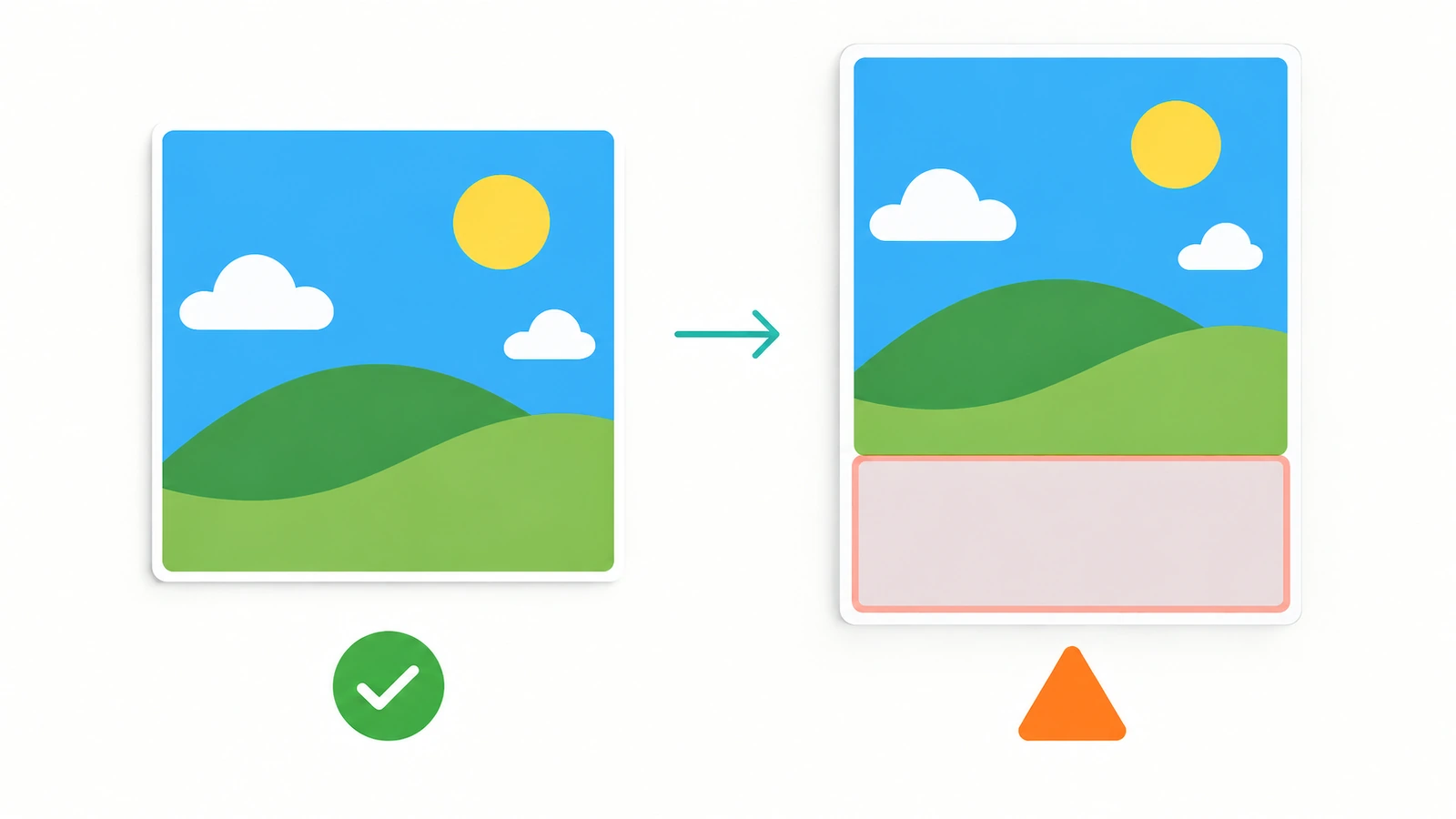
The problem: most product photography is no longer shot for portrait pages. Brand teams shoot square and near-square crops for social feeds and e-commerce grids, and wide crops for hero banners. When that library goes into a Letter or half-letter booklet, a square photo placed at full width on a 5.5 × 8.5 in (140 × 216 mm) page covers only about 65% of the page. The remaining band gets filled with whatever copy is at hand, so the layout looks unplanned.
The pain: the gap is expensive. Print buyers are spending more on custom work, not less. The U.S. custom printing market was valued at USD 6.10 billion in 2023[1], with brochures and booklets listed as a marketing-material segment and a projected 10.5% CAGR through 2030. Over the same period the wider U.S. printing industry contracted at an estimated 2.1% CAGR to USD 81.5 billion in 2026[2]. Budgets are moving toward pieces that earn attention. A catalog that crops your best product shots badly wastes the format premium you paid for.
The solution: choose the format to fit the content. Then confirm the square trim you like also fits the press sheet, the binding, and the mail stream. The sections below cover each check in order.
What Counts as a Square Booklet?
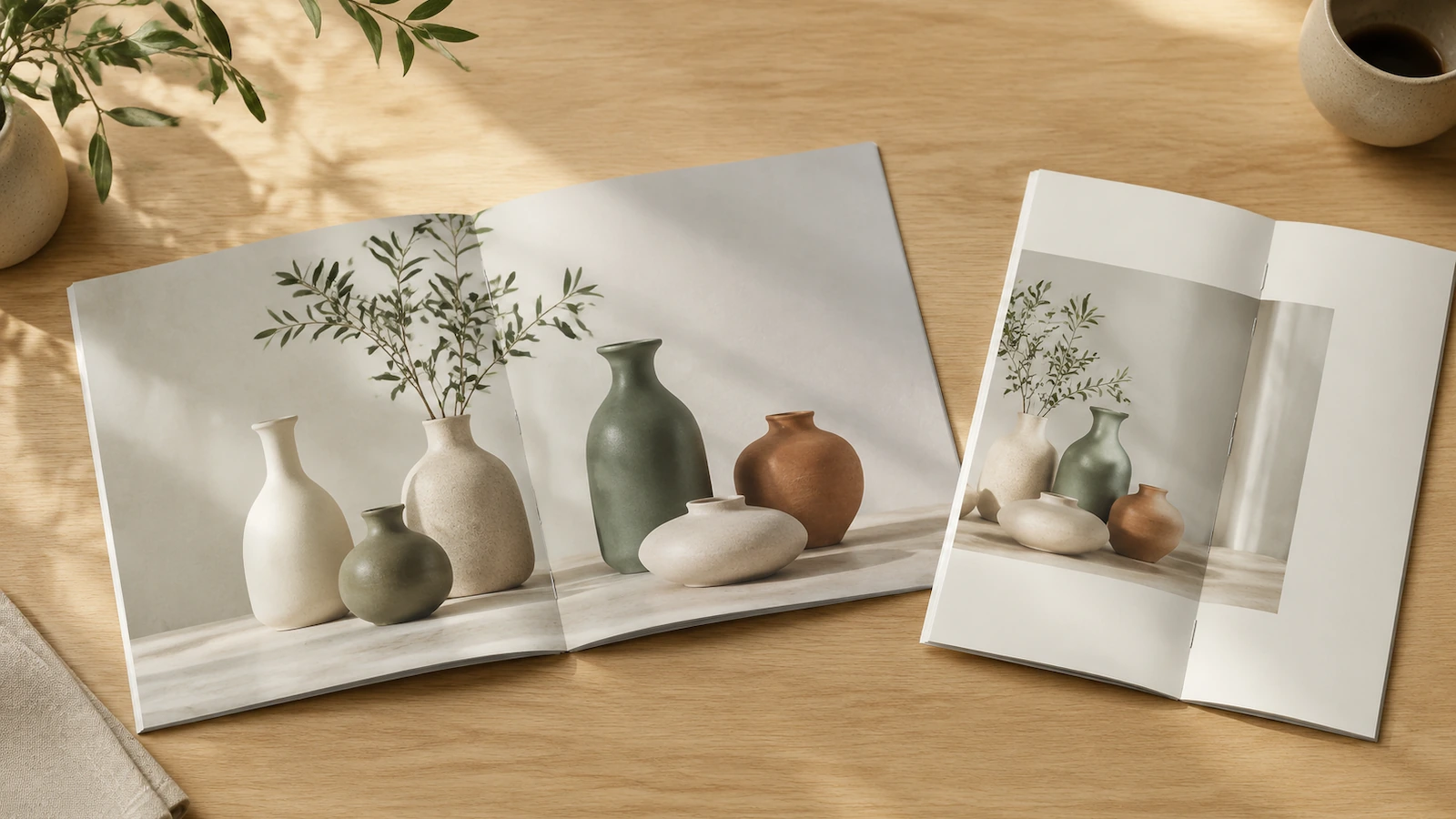
A square booklet is a bound, multi-page piece whose trimmed width equals its trimmed height. When it opens, the reader sees a spread twice as wide as it is tall. That 2:1 proportion is what separates square formats from the alternatives. A Letter booklet (8.5 × 11 in) opens to roughly 1.55:1, and a half-letter booklet (5.5 × 8.5 in) opens to roughly 1.29:1. The square spread is the only common booklet shape that reads as a true panorama.
Online printers in the U.S. commonly list square trims from small formats around 6 × 6 in (152 × 152 mm) and 8 × 8 in (203 × 203 mm) up to 12 × 12 in (305 × 305 mm). Metric markets often use 210 × 210 mm, which matches the width of A4. These are industry reference points, not a menu. Which square trims a given plant runs efficiently depends on its presses and finishing line. Industry analysts also treat "brochures and booklets" as their own application segment within a global custom printing market estimated at USD 37 billion in 2026[3]. Format choices like this one have measurable spend behind them.
Is Your Content Square-Friendly?
Start with the images, not the trim size. Export your shortlist of hero shots and sort them by aspect ratio. If most of them are 1:1, 4:5, or wide landscape crops, a square page uses them almost edge to edge. If most are tall 2:3 portrait shots, such as full-length fashion or standing products, a portrait trim will waste less of each photo.
A quick comparison makes the difference concrete. A square photo placed at full page width uses:
- 100% of a square page, at any square trim size
- about 77% of an 8.5 × 11 in Letter page (8.5 × 8.5 in of image on a 93.5 sq in page)
- about 65% of a 5.5 × 8.5 in half-letter page
Text-heavy content behaves differently. On a square page, lines of body copy get long in the wider formats, so designers usually switch to two columns at 8 in and above. At 6 in and below, captions and specification tables get cramped quickly. Square layouts favor catalogs and lookbooks where the image carries the message. Manuals with long procedural text are usually a poor fit.
Square Booklet Printing and Sheet Yield: The Cost Geometry
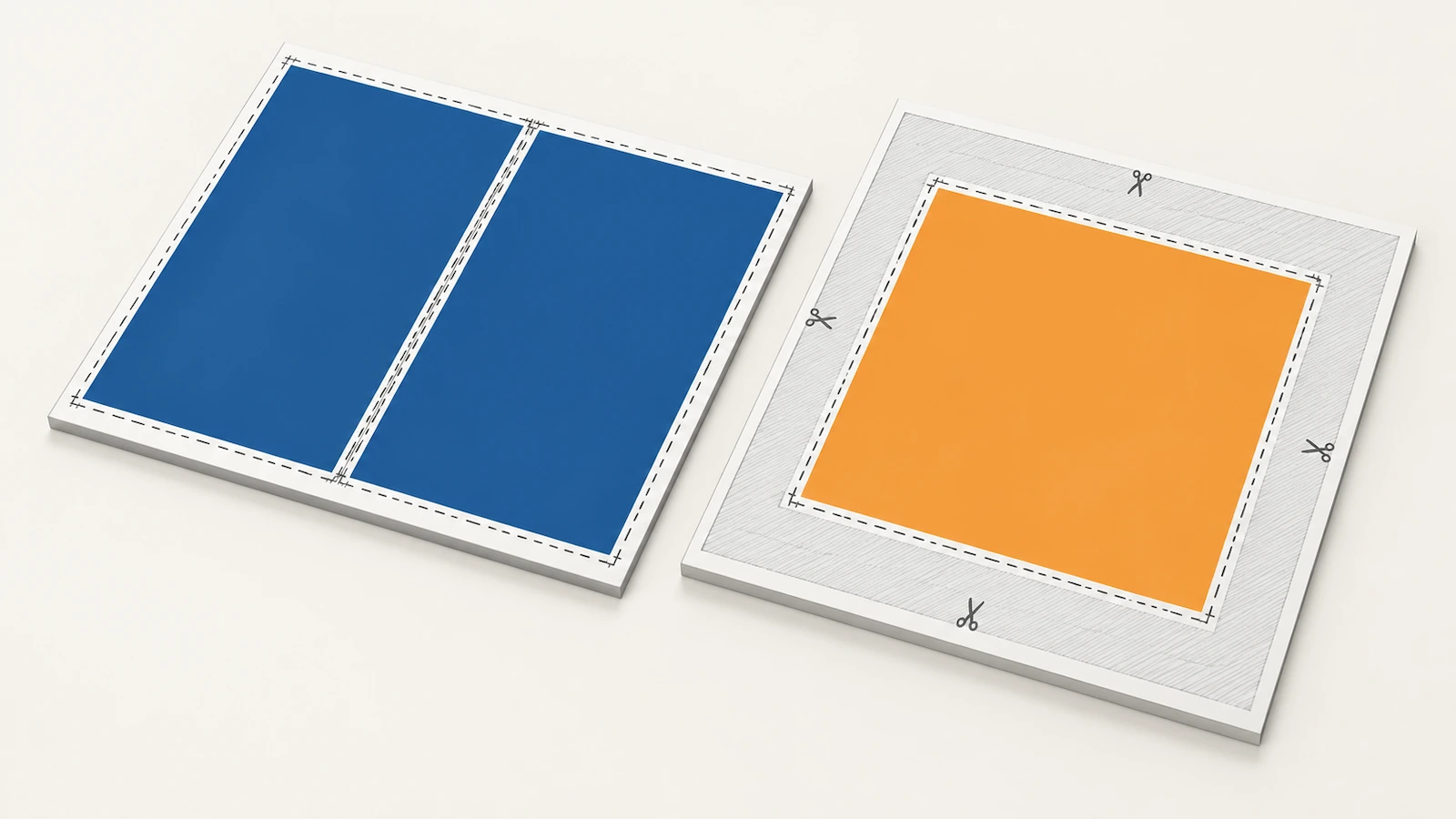
Booklets are printed as flat spreads on larger press sheets, then folded and trimmed. The number of spreads that fit on one sheet ("up") drives paper use and, on many digital presses, the number of impressions you pay for. Square trims tend to fit common sheets less efficiently than portrait trims, and this is where most of their cost premium comes from.
The table below is illustrative layout math. It assumes a 12 × 18 in (305 × 457 mm) digital press sheet, a 0.125 in (3 mm) bleed on every edge, and no allowance for grippers or registration marks. Real impositions will be somewhat less efficient. Use the table to compare formats against each other, not as a quote.
| Trim size (in / mm) | Flat spread with bleed (in) | Spreads per 12 × 18 in sheet | Trimmed area used | Press sheets per 32-page copy |
|---|---|---|---|---|
| 5.5 × 5.5 square / 140 × 140 | 11.25 × 5.75 | 3 | ≈84% | ≈2.7 |
| 6 × 6 square / 152 × 152 | 12.25 × 6.25 | 1 | ≈33% | 8 |
| 8 × 8 square / 203 × 203 | 16.25 × 8.25 | 1 | ≈59% | 8 |
| 8.5 × 8.5 square / 216 × 216 | 17.25 × 8.75 | 1 | ≈67% | 8 |
| 5.5 × 8.5 portrait / 140 × 216 | 11.25 × 8.75 | 2 | ≈87% | 4 |
| 8.5 × 11 portrait / 216 × 279 | 17.25 × 11.25 | 1 | ≈87% | 8 |
Three findings stand out:
- The 6 × 6 in trim is the outlier. Its spread is just 0.25 in too wide to place two across the 12 in sheet edge. It therefore uses as many sheets as a full Letter booklet while delivering about 38% of the page area. On a larger 13 × 19 in sheet, the same spread can fit two or three up, depending on press margins. A small change in trim size or sheet size can change unit cost noticeably.
- 8 × 8 and 8.5 × 8.5 in cost about the same in sheets as Letter. They give you less page area for that cost. Buyers often accept this because the panoramic spread is the point of the format.
- Small squares can be economical. A 5.5 × 5.5 in trim nests three up in this example. That makes it a strong option for event lookbooks, packaging inserts, and leave-behinds.
Offset presses use different sheet sizes, so the winners change on long runs. Ask your printer to show the imposition for your exact trim. Also ask what happens to the price if you move the trim 0.25 in in either direction. It is often the cheapest design change available.
Saddle-Stitch Page-Count Limits in a Square Format
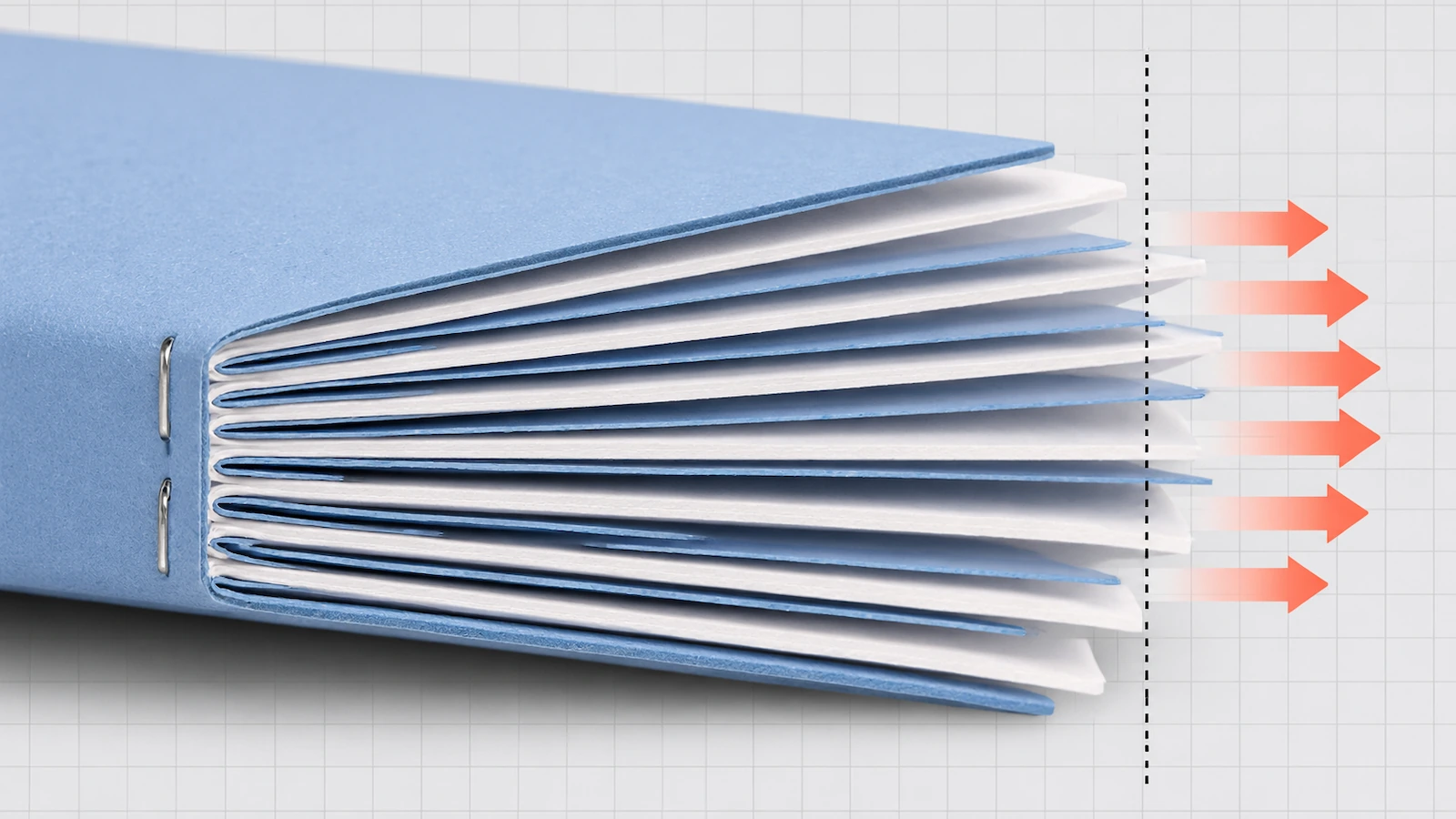
Saddle stitching drives staples through the center fold of nested sheets. Every folded sheet adds four pages, so the page count must be a multiple of four. The binding method and its quality tolerances for brochures and catalogues are covered by ISO 16763:2016, which sets requirements for bound products[4] across cutting, folding, gathering, and binding.
Across the industry, saddle-stitched booklets usually start at 8 pages. Practical ceilings typically fall around 48–64 pages, and some reach about 80–92 on lighter stock. Square formats bring three specific constraints to that range:
- Creep eats a bigger share of a small page. Inner sheets push outward at the fore-edge and are trimmed back. In thicker books this shift can reach roughly 1–2 mm (illustrative, depending on stock). On a 6 in square page, that is a larger share of the outside margin than on an 8.5 in page. Keep live content further from the fore-edge and avoid thin frame borders.
- Gutter-crossing images are the format's main asset and its main risk. A panoramic spread with a product sitting on the fold will lose detail into the spine. Place key products off-center on each page.
- Heavy coated stock adds bulk quickly. Image-led catalogs often use coated text paper for color. Thicker stock lowers the page count at which the spine starts to bulge and the book stops lying closed. If you are near the ceiling, compare a lighter text weight before switching binding methods.
If your plan stays inside saddle-stitch range, our custom saddle-stitched booklets page covers the specification and production side. This guide stays focused on the format decision.
Mailing Square Booklets: Aspect Ratio and Surcharges
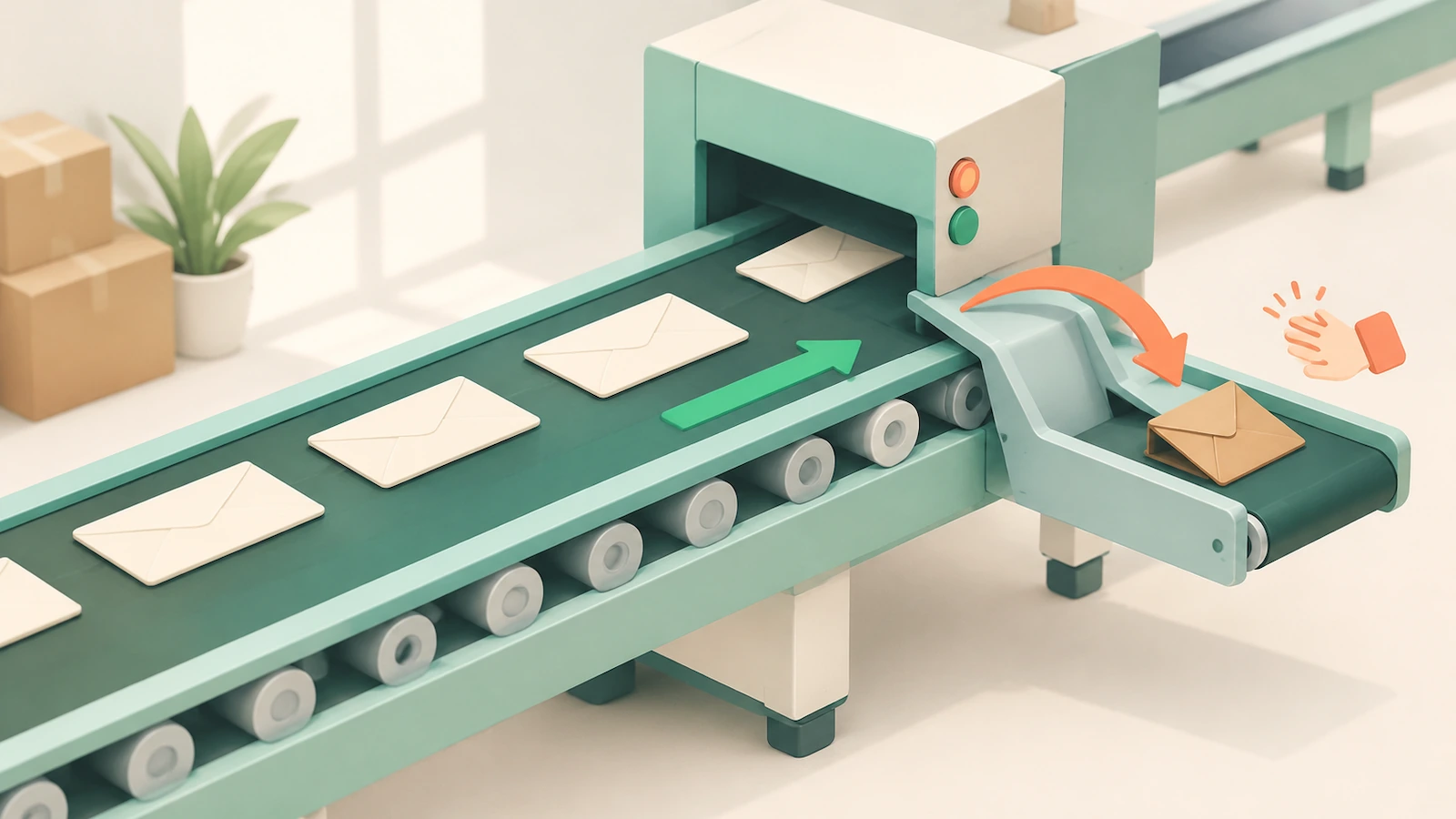
Postal sorting machines in the U.S. are built for rectangles. A letter-size mailpiece must fall within a length-to-height aspect ratio of roughly 1.3 to 2.5 to count as machinable. A square envelope, at 1.0, falls outside that range and is typically charged a nonmachinable surcharge. Small square booklets mailed in square envelopes are the format most exposed to this.
Larger squares above letter-size height usually mail as flats. Flats follow a different set of rules on thickness, flexibility, and uniform thickness. A booklet in a sturdy square envelope can still trip those rules if the stitched spine creates an uneven profile. Because rates and definitions change, confirm your mailpiece against the current USPS Domestic Mail Manual, or check with your mail service provider before the design is locked. Two common workarounds avoid the problem:
- Mail the square booklet inside a standard rectangular envelope.
- Reserve the square format for hand-out and trade-show channels, and mail a portrait companion piece instead.
How to Decide: A Five-Step Check
- Audit the imagery. Count hero images by aspect ratio. If fewer than roughly half are square or wide, a square format will force crops. Default to portrait unless brand differentiation outweighs that.
- Shortlist two square trims and one portrait trim. For example, compare 5.5 × 5.5, 8 × 8, and 8.5 × 11 in, and ask for quotes on all three at the same page count and stock. The portrait quote shows what the square format actually costs you.
- Ask for the imposition, not just the price. Request the "up" count per sheet for each trim. A small trim adjustment, such as moving off 6 × 6 in, can recover a lot of yield.
- Fix the page plan inside saddle-stitch range. Map content to a multiple of four with room to spare. Mark which spreads carry panoramic images and keep products away from the fold.
- Decide distribution before design. If more than a small share of copies will be mailed individually, price the envelope and postage for both formats before choosing.
File setup, proofing, and acceptance checks are the same for square and portrait books, and they are covered on the booklet product page. Treat this five-step check as the stage before that.
Square vs. Portrait vs. Landscape at a Glance
| Criterion | Square (e.g. 8 × 8 in) | Portrait (e.g. 8.5 × 11 in) | Landscape (e.g. 8.5 × 5.5 in) |
|---|---|---|---|
| Open-spread proportion | 2:1, panoramic | ≈1.55:1 | ≈3.1:1, very wide strip |
| Fit for 1:1 and 4:5 product shots | Full page | Leaves a band of about 23% | Heavy cropping |
| Sheet efficiency (12 × 18 in example) | ≈59% at 8 × 8 in | ≈87% | ≈87% (same sheet math as half-letter) |
| Long-form text readability | Fair; needs columns | Strong | Weak |
| Mailing in a fitted envelope | Surcharge risk at letter size | Machinable when within limits | Machinable when within limits |
| Shelf, rack, and folder fit | Non-standard | Standard | Often awkward |
| Best use | Lookbooks, image-led catalogs, brand books | Catalogs with specs, reports, manuals | Calendars, panoramic portfolios |
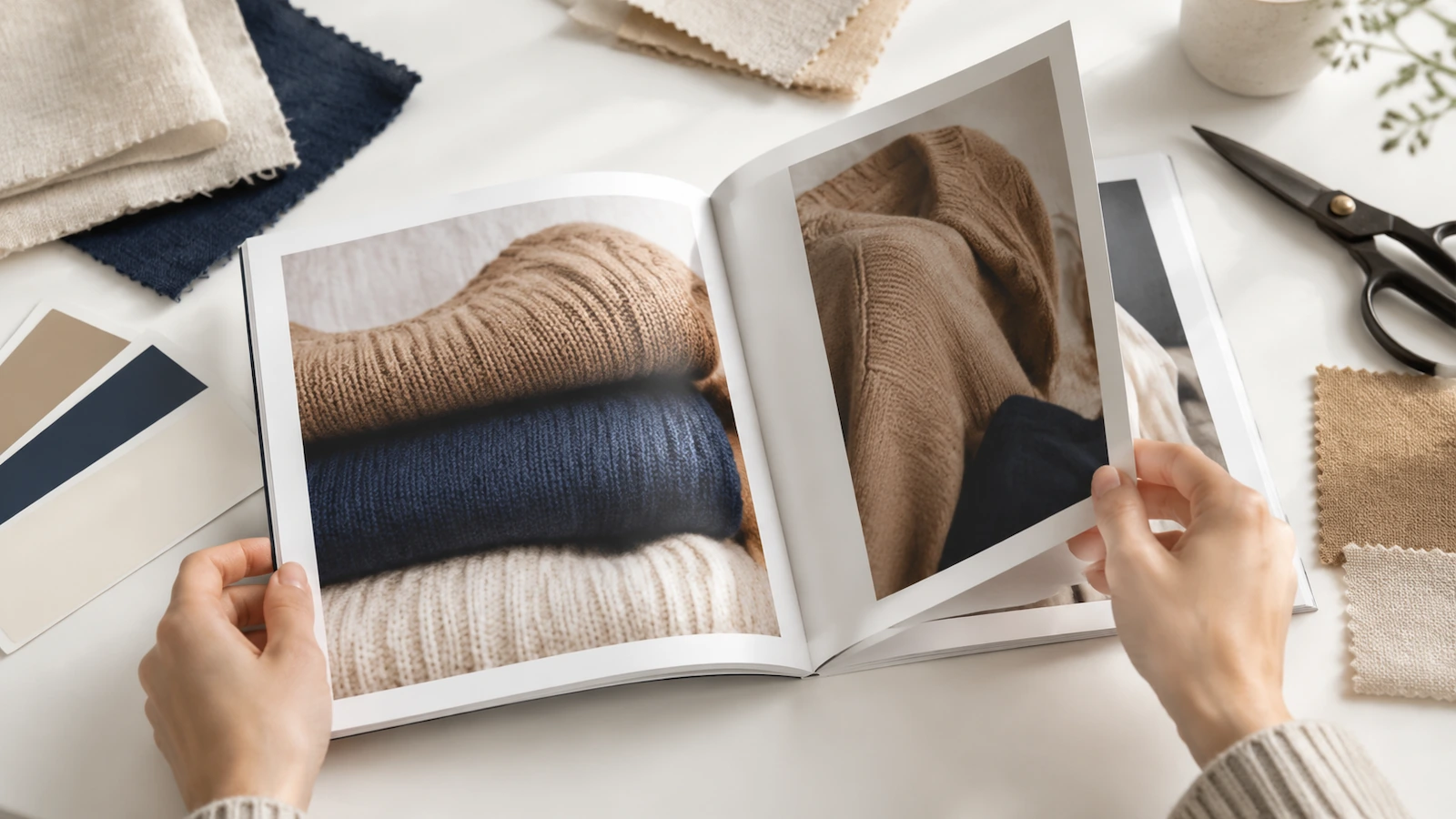
Color consistency matters more in square lookbooks than in most formats, because large flat-color backgrounds and skin tones fill whole spreads. If you plan reprints across seasons, ask whether the printer calibrates to Idealliance G7 gray-balance specifications[5]. G7 is designed to keep color visually similar across print processes and presses, which is what high quality booklet printing depends on when a spring catalog has to match last autumn's.
FAQ
FAQ: Is a square booklet always more expensive than a portrait one?
Not always. The premium comes from sheet yield, not from the shape itself. A square trim that nests well, like the 5.5 × 5.5 in example above, can use fewer press sheets than a half-letter booklet. Large squares and awkward trims such as 6 × 6 in on a 12 × 18 in sheet usually cost more per copy. Request quotes on a square and a portrait option at the same specification to see the real difference for your run.
FAQ: Which square size is the safest choice for a product catalog?
For catalogs with prices, SKUs, and short descriptions, 8 × 8 in or 210 × 210 mm leaves enough room for two text columns beside the imagery. Smaller squares suit lookbooks and inserts where copy is minimal. Choose the trim that fits your printer's sheet best, then fine-tune the layout.
FAQ: Can I use portrait product photos in a square booklet?
Yes, but plan for it. Place tall shots as half-page images in pairs across a spread, or let one portrait image fill a page and set copy on the facing page. Problems start when a team crops tall images into squares and loses product detail at the top or bottom.
FAQ: What if a square booklet grows beyond saddle-stitch range?
First try a lighter text stock, which reduces bulk without changing the design. If the page count still exceeds the stitch limit, perfect binding gives a square spine but no longer lies fully open. That matters for panoramic spreads, so move key images away from the gutter.
FAQ: What paper documentation should brand teams ask for?
If sustainability claims will appear in the booklet, ask the printer for an FSC chain-of-custody certificate[6]. Only certified chain-of-custody holders can apply the FSC label. For distribution in Europe, the EU Ecolabel criteria for printed paper products[7] require an EU Ecolabel-certified paper substrate, limits on hazardous substances, and recyclability. Brochure booklet printing for those markets should be specified with this in mind.
FAQ: Does the EU deforestation regulation apply to printed booklets?
According to the European print federation, co-legislators excluded printed products under HS code 49 from EUDR scope[8]. That covers commercial printing and advertising material. The regulation still applies to paper as a raw material from 30 December 2026 for large and medium operators.
Key Takeaways
- A square page turns every spread into a panorama. — 2:1 spread vs ≈1.55:1 for Letter (Source)
- Sheet yield drives the square premium, and trim choice controls it. — 6 × 6 in used ≈33% of a 12 × 18 in sheet vs ≈84% for 5.5 × 5.5 in (Source)
- Booklet spend is growing even while print overall shrinks. — U.S. custom printing USD 6.10 billion in 2023, 10.5% CAGR to 2030 (Source)
- Binding quality has a published benchmark you can reference. — ISO 16763:2016 sets tolerances for bound brochures and catalogues (Source)
- Reprints of color-critical lookbooks need a calibration standard. — G7 targets visual similarity across all print processes (Source)
Conclusion: Choose Square for Content Reasons, Then Engineer the Cost
Square booklet printing earns its place when your photography is square or wide and the booklet's job is to look like a brand object rather than a manual. It loses that advantage when the trim wastes the press sheet, when a heavy stock pushes a saddle-stitched book past its limit, or when individually mailed copies attract surcharges. All three are predictable, and you can check them before design starts. Industry surveys from the PRINTING United Alliance[9] track print buyers moving toward short, personalized, digitally produced runs. That shift makes testing a square format against a portrait control cheaper than it used to be.
If you are weighing a square catalog or lookbook against a portrait version, send us your trim shortlist, page count, and stock preference through the custom booklet printing page. We will come back with imposition-aware pricing for both options so you can compare the real cost of color booklet printing in each format.
References
- Grand View Research. "U.S. Custom Printing Market Size, Share & Trends Analysis Report, 2024–2030." Accessed October 2026. grandviewresearch.com ↩
- IBISWorld. "Printing in the US — Industry Analysis (NAICS 32311)," 2026 update. ibisworld.com ↩
- The Business Research Company via Research and Markets. "Custom Printing Market Report," January 2026. researchandmarkets.com ↩
- International Organization for Standardization. "ISO 16763:2016 Graphic technology — Post-press — Requirements for bound products," ISO/TC 130, confirmed 2021. iso.org ↩
- Idealliance (PRINTING United Alliance). "G7 Master Facility Qualification." Accessed October 2026. idealliance.org ↩
- Forest Stewardship Council ANZ. "Paper and Print." Accessed October 2026. fsc.org ↩
- Commission Decision (EU) 2020/1803, Annex: EU Ecolabel criteria for printed paper, stationery paper and paper carrier bag products. legislation.gov.uk ↩
- Intergraf. "Statement: Impact of EUDR Deal on Printed Products," December 2025. intergraf.eu ↩
- PRINTING United Alliance. "State of the Industry Update — Fourth Quarter 2024." printing.org ↩












The information below is required for social login
Sign In
Create New Account