


 Blog PDF for offline reading
Quick answer: Choose custom printed paper grocery bags by the load they must carry rather than by how they look. Compare kraft grades on measured burst, tear and water absorption. Match no-handle, flat or twisted handles to basket weight and bagging speed. Print a small spot-colour palette for long wholesale runs, and keep laminated art-paper bags for gift and premium lines.
Most grocers order custom printed paper grocery bags by picking a size, sending a logo and approving a price. Problems usually show up later, at the checkout lane. A bag that looked fine on a sample table splits when a shopper adds two jars and a frozen pack, or a handle peels away halfway to the car park. Each failure costs the retailer a replacement bag, a double-bagging habit that the cashier carries forward, and a branded object sitting broken in a customer's hands. This guide covers kraft grades, handle systems, load testing, compliance wording and wholesale order planning, so the bag specification can hold up under real checkout volume.
The risk is documented. In 2025, the Australian supermarket chain Woolworths acknowledged that paper bag handles sold in New South Wales, Victoria and Queensland stores were faulty. The retailer traced the problem to "a small change in the manufacturing process," even though it had said its bags were tested to carry up to 6 kg, as reported by 7NEWS[1]. The lesson for any grocer is that a passing test result only describes the batch that was tested. The specification, the test method and re-testing after any process change are what keep later batches at the same standard.
What counts as a custom printed grocery bag?
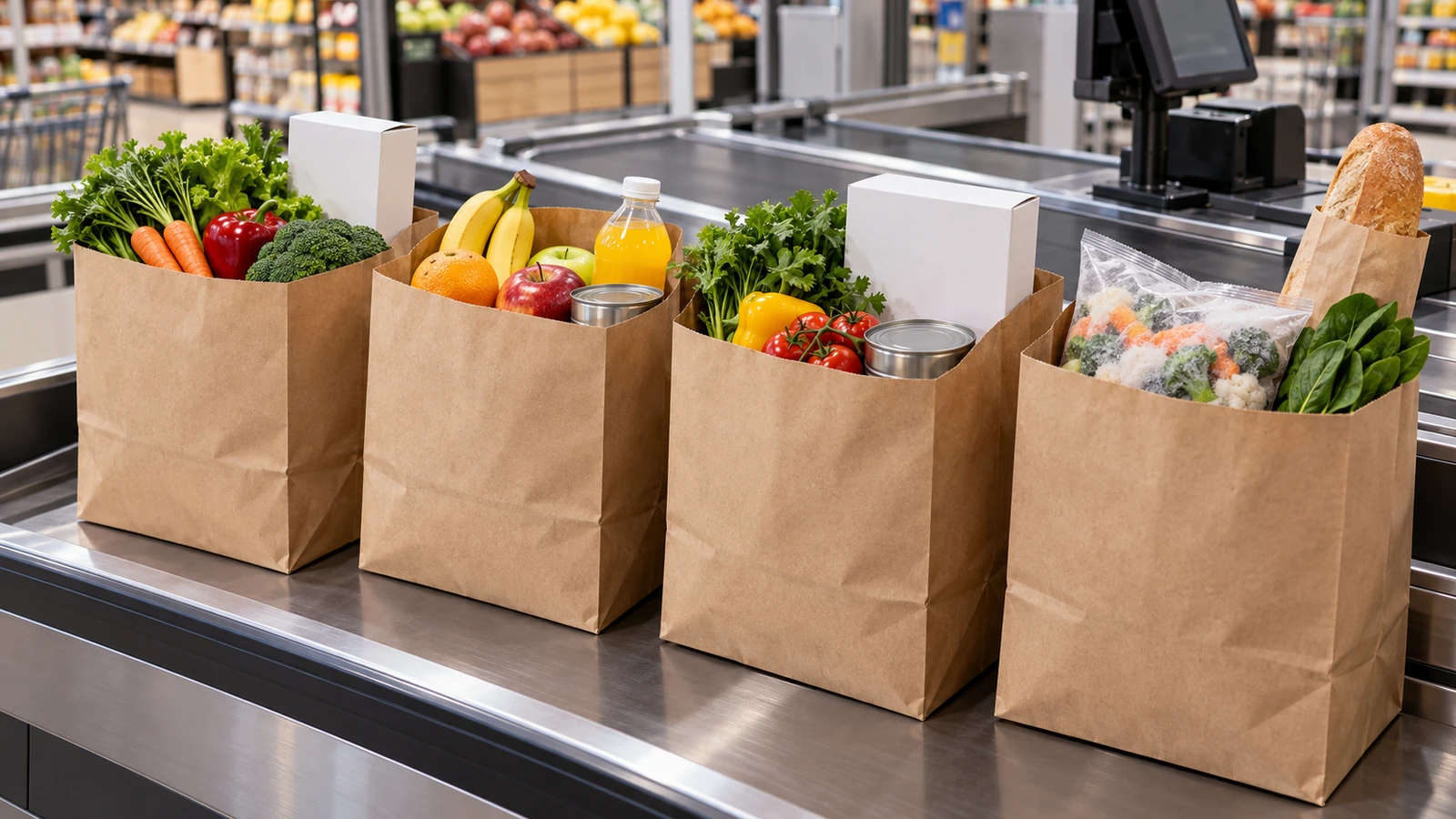
In grocery retail, the term usually means a self-opening square (SOS) or flat-bottom kraft bag. It is made on high-speed tube-forming lines and printed with the store's logo, typically by flexography, a plate-based method that suits long runs with a few solid colours. Bags come in three handle formats. No-handle SOS bags are designed for packing stations and carts. Flat paper handles are glued inside the top fold. Twisted paper cord handles are anchored by a reinforcement patch. The base sheet is brown (unbleached) or white (bleached) kraft made from virgin fibre, recycled fibre or a blend.
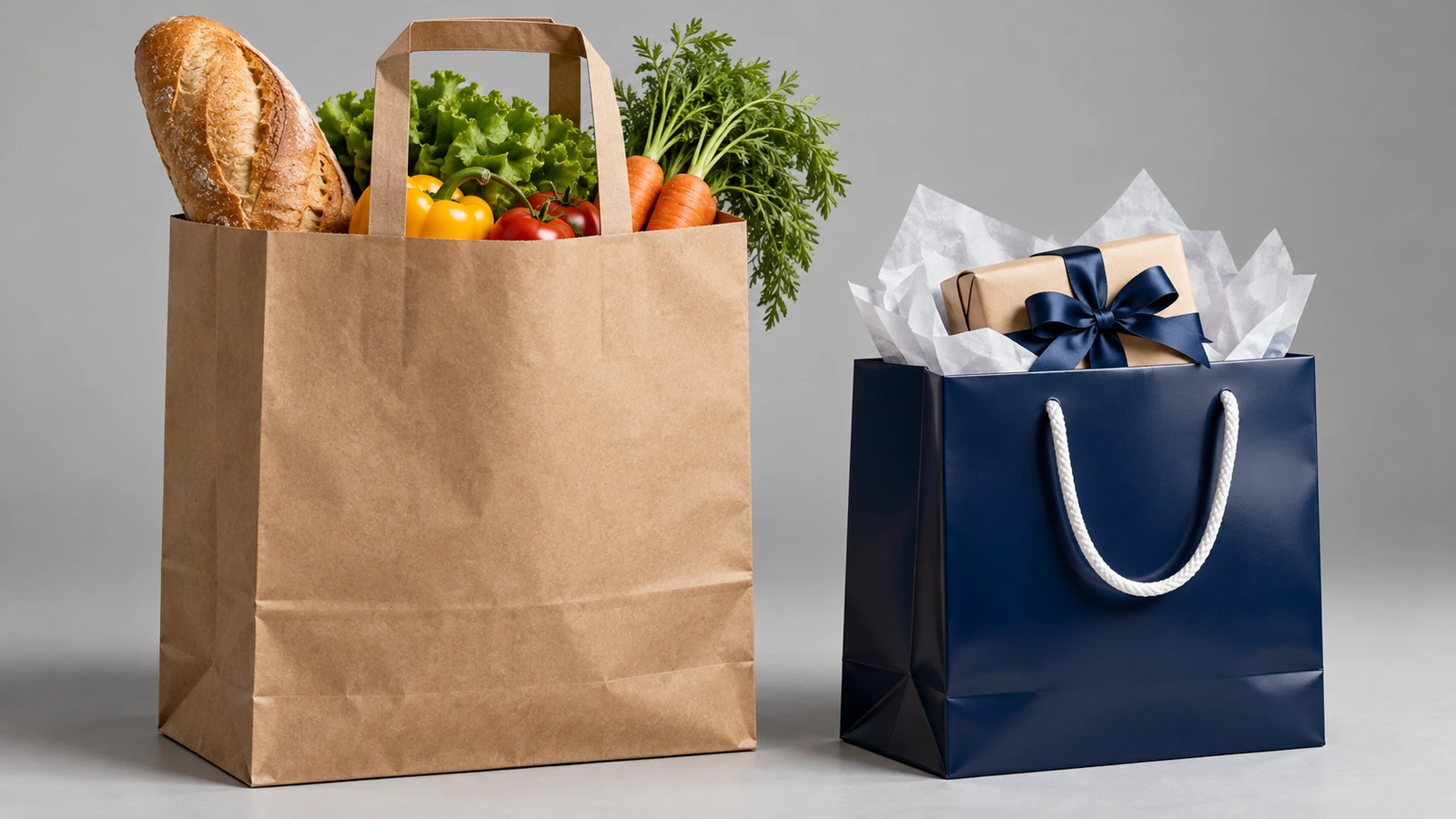
This is a different category from laminated art-paper bags, where a printed coated sheet is bonded to a gloss or matte film and finished by hand or semi-automatically. Both are customized paper bags with logo printing, but they are built for different jobs. The grocery bag is a working tool that is used many times a minute at the till. The laminated bag is a presentation piece. Mixing up the two is the most common reason checkout budgets go wrong, in either direction.
How to specify custom printed paper grocery bags for checkout volume
Write the specification in this order. Each step narrows the options for the next one, so choosing a print design before defining the load is how most mis-specified orders begin.
Step 1: Map the real basket, not the average one
Size the bag for the heaviest basket it will regularly carry, not the typical one. Note the dense items (canned goods, bottled drinks, detergent), items with sharp corners (cereal boxes, multipacks) and items that bring moisture (frozen food, chilled dairy, rotisserie chicken, wet produce). Paper fibres absorb water and the bonds between them weaken. A bag that holds a dry load can fail at the bottom seam when condensation from a cold pack soaks the bottom. If your stores serve humid climates or carry a lot of frozen product, write "wet-bottom performance" into the brief as a separate requirement from dry load.
Step 2: Choose the kraft grade by test values, not grammage alone
Grammage (grams per square metre, measured to ISO 536) tells you how heavy the sheet is, not how strong it is. At the same grammage, virgin long-fibre kraft is generally stronger than recycled kraft. Recycled grades can still work if the bag design compensates, for example with a wider bottom patch or a heavier sheet. Ask every supplier to quote the same four values so that quotes are comparable:
- Burst strength (ISO 2758): resistance to a pointed load pushing through the sheet.
- Tear resistance (ISO 1974): how easily a nick at the top edge or corner spreads.
- Cobb value (ISO 535): how much water the surface absorbs in a set time. Lower is better for wet loads.
- Grammage (ISO 536): needed to compare cost and freight weight.
For a sense of minimum levels, the East African draft standard DEAS 859:2025 for paper bags, notified through the WTO technical barriers to trade system[2], sets these floors: 50 g/m² grammage, 90 kPa burst, 320 mN machine-direction tear and a Cobb value no higher than 35 g/m². These are minimums for general paper bags. A US supermarket bag carrying bottled drinks should sit well above them. Still, the document shows that bag performance can be stated in measurable terms, so a supplier who answers "it's strong" has not answered the question.
Step 3: Match the handle system to the lane
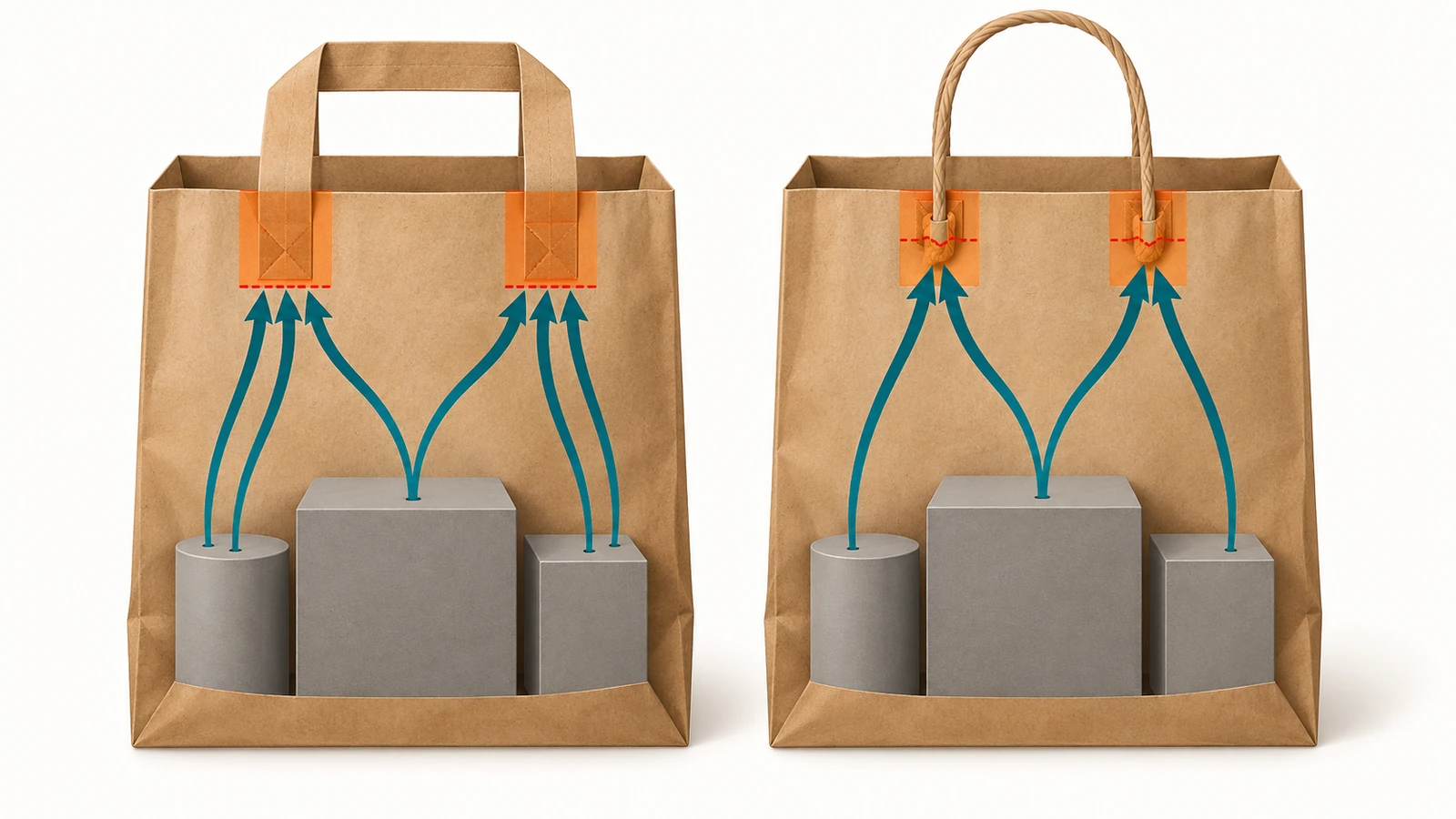
Handles are where grocery bags most often fail, and the weak point is almost always the attachment rather than the handle material. The failure happens where the glue meets the bag wall, or where a patch tears out of a sheet that is too light.
| Handle format | Where it works best | Typical failure point | What to specify |
|---|---|---|---|
| No handle (SOS) | Staffed bagging stations, cart-to-car shopping, curbside pickup totes | Bottom seam under wet or dense loads | Bottom fold glue coverage, Cobb value, stacking height in the cart |
| Flat paper handle | High-speed self-checkout, mid-weight baskets, short carries | Glue line between handle strip and inner wall | Handle strip width, glue type and coverage, pull test on the attachment |
| Twisted paper cord | Specialty grocers, delis, bakeries, longer walking carries | Reinforcement patch tearing out of the bag wall | Patch material and size, cord diameter, pull test after humidity conditioning |
Flat handles usually run faster on the bag-forming line and cost less per unit. They spread the load across a wider grip, which shoppers notice with heavy bags. Twisted handles look more like a retail bag and suit stores where the bag doubles as a carry-home brand piece. They depend on the patch, though, so a light sheet with a twisted handle is a common mismatch.
Step 4: Design the print for brown kraft
Unbleached kraft is a tinted, absorbent base. Light colours and pastels shift noticeably on it, and very fine type spreads. For checkout bags, a bold mark in one to three spot colours usually reads better from across a car park than a full-colour image, and it keeps flexo plate costs manageable. If the brand colour has to be exact, approve it on the production kraft rather than on a white proof. Artwork preparation for premium laminated bags follows a separate workflow, covered on the custom laminated paper bags page.
Step 5: Test the way a checkout lane uses the bag
A useful sample test copies what happens to the bag in a store. Load it to your heaviest realistic basket, lift it by the handles, swing it, set it down on a wet surface, lift it again and carry it a set distance. Repeat with a frozen item sitting against the bottom panel for a set time. Record which part failed first: the seam, the patch, the glue line or the sheet. Then put a clause in the purchase agreement requiring re-testing whenever the supplier changes paper source, glue or line settings. That kind of process change is exactly what caused the Woolworths handle fault.
Step 6: Check food contact and environmental claims before printing them
Anything printed on the bag counts as a marketing claim, so verify the evidence before the plates are made.
- Food contact: In the US, paper and paperboard components that touch aqueous and fatty foods fall under 21 CFR 176.170[3], which includes a net chloroform-soluble extractives limit of 0.5 mg per square inch of food-contact surface. Dry foods fall under 21 CFR 176.180[4]. Ask for a declaration that covers the full construction (paper, ink, adhesive and any coating), not just the base sheet.
- Grease resistance: FDA reported that PFAS-based grease-proofing agents are no longer sold for US paper food packaging and, in January 2025, declared 35 related food contact notifications no longer effective, according to its PFAS phase-out update[5]. If hot-food or deli bags need oil resistance, ask which current barrier is used.
- "Recyclable" wording: The FTC Green Guides[6] warn against broad, unqualified terms like "eco-friendly." Under 16 CFR 260.12[7], an unqualified recyclable claim requires recycling facilities to be available to at least 60% of consumers or communities where the bag is sold. Plain kraft bags with water-based ink are usually on the safer side of this rule. Film-laminated bags usually are not.
- Fibre claims: A chain-of-custody certificate covers where the fibre came from. It does not cover recyclability or compostability, so print only the claim the certificate actually supports.
Step 7: Plan the wholesale order around consumption, not the quote
The unit price on a custom printed paper bags wholesale quote is only part of the cost. In practice, the economics depend on a few planning choices:
- Forecast from transactions: multiply weekly transactions per store by the share of baskets that use paper, then add a buffer for double-bagging. That gives a consumption rate you can schedule releases against.
- Spread setup costs across volume: flexo plates and line setup are fixed costs. Fewer artwork versions and fewer sizes mean each plate set covers more bags. Seasonal artwork adds plate sets, so budget for them separately.
- Agree an over/under tolerance: printed runs rarely land on the exact count ordered. Put the accepted variance and how it is billed into the contract before production, not after delivery.
- Plan for storage: flat-packed kraft bundles take up back-room and distribution-centre space. Scheduled call-offs from a supplier-held stock can beat a single large delivery.
- Check import duties: US antidumping and countervailing duty orders apply to certain paper shopping bags from specific countries, printed or unprinted, as published in the Federal Register[8]. Confirm whether a landed-cost quote includes these duties.
Specific minimum quantities, unit prices and lead times depend on the construction and the print, so request them as a written quotation against your finished specification rather than relying on figures from a catalogue.
Kraft grocery bags vs laminated art-paper bags: where each earns its cost
Some grocers consider moving their checkout bag to a laminated option to make the brand look more premium. The table shows why that rarely pays off at the main till, and where it does make sense.
| Factor | Printed kraft grocery bag | Laminated art-paper bag |
|---|---|---|
| Construction | Single kraft sheet, machine-formed, glued bottom | Printed coated sheet bonded to gloss or matte film, rigid board inserts, cord or ribbon handles |
| Throughput fit | Built for high-speed bagging and self-checkout | Slower to open and pack; suits counter service |
| Print character | Bold spot colours; brown base mutes light tones | Photographic detail, saturated colour, foil and embossing |
| Wet and scuff behaviour | Depends on grade and Cobb value; scuffs in transit | Film resists scuffing and light moisture; bottom glue still decides strength |
| Relative unit cost | Lowest per bag at volume | A multiple of the kraft bag; justified only per gift or premium sale |
| End-of-life wording | Easier to support a qualified recyclable claim | The plastic film has to be separated during repulping; recyclable claims need careful qualification |
| Best grocery use | Main checkout, curbside pickup, delivery | Gift hampers, wine and spirits, holiday assortments, in-store bakery gift boxes |
Regulation affects the comparison too. European paper mills assess recyclability with the Cepi laboratory test method, version 3 (2025)[9], which simulates repulping, screening and sheet formation. Film particles left in the test sheets lower the score. Under the EU Packaging and Packaging Waste Regulation (EU) 2025/40[10], which has applied since 12 August 2026, packaging will need recyclability grades A, B or C from 2030 to stay on the market. In the US, the proposed PACK Act, covered by Packaging Dive[11] in September 2026, would require third-party certification for recyclable claims. It has not become law, but it signals where labelling expectations are heading.
In practice, most grocers end up with two bag specifications. Plain printed kraft handles the main checkout volume. A smaller, separately budgeted line of laminated bags serves gift and premium sales. If you are planning that second line, the laminated paper shopping bag specifications page covers finishes, handles, inspections and repeat-order controls.
FAQ
FAQ: Is a heavier paper always stronger for grocery bags?
No. Grammage measures weight, while burst and tear values measure strength. Fibre type (virgin or recycled), sheet formation and bag construction all matter. A lighter virgin kraft bag with a well-glued bottom can outperform a heavier recycled sheet with weak seams. Compare suppliers on ISO 2758 burst and ISO 1974 tear results tested on the same basis.
FAQ: Should self-checkout lanes use flat or twisted handles?
Flat paper handles suit most self-checkout lanes. They run efficiently on bag-forming lines, open quickly and spread a heavy load across a wide grip. Twisted cord handles suit specialty and deli formats where customers carry bags further and the bag also works as a brand piece. Either way, specify a pull test on the attachment point.
FAQ: Can we print "recyclable" on our custom grocery bags?
Only if you can support it. Under the FTC rule at 16 CFR 260.12, an unqualified recyclable claim requires recycling facilities to be available to at least 60% of consumers or communities where the bag is sold. Otherwise the claim needs qualifying wording. Plain kraft with water-based ink is easier to support than film-laminated paper. Avoid broad terms like "eco-friendly."
FAQ: Do grocery bags need food-contact compliance?
If unwrapped food touches the bag, as with bakery items, produce or hot deli items, the paper, ink, adhesive and any coating should meet 21 CFR 176.170 for aqueous and fatty foods or 21 CFR 176.180 for dry foods. Ask for a declaration that covers the whole construction and the food type, not a generic "food grade" statement.
FAQ: When is a laminated bag worth it for a grocer?
When the bag is part of a higher-margin sale: gift baskets, wine and spirits, holiday assortments or premium bakery boxes. There, the stronger presentation and scuff resistance are worth the higher unit cost. At the main checkout, laminated bags slow packing, cost several times more per transaction and make recyclability claims harder.
FAQ: What should a wholesale quotation for printed grocery bags include?
Paper grade with test values, bag dimensions, handle type, number of print colours, plate or setup charges, the accepted over/under tolerance and how it is billed, packing per bundle and per carton, release schedule, and whether import duties are included. Quotes that leave out any of these cannot be compared fairly.
Key takeaways
- A passing load test only covers the batch tested; require re-testing after any process change. — Woolworths traced a 2025 handle fault to a small manufacturing change despite a stated 6 kg load rating (Source)
- Specify bag strength with measurable values, not adjectives. — the DEAS 859:2025 draft floors are 90 kPa burst, 320 mN tear and a 35 g/m² Cobb maximum (Source)
- Food-contact paper must meet a defined extractives limit. — 0.5 mg per square inch under 21 CFR 176.170 (Source)
- Grease-resistant bags need a current, non-PFAS barrier. — FDA declared 35 PFAS food contact notifications no longer effective in January 2025 (Source)
- Unqualified "recyclable" printing depends on access to recycling facilities. — at least 60% of consumers or communities where the bag is sold (Source)
- Bags sold into the EU will need a recyclability grade. — grades A–C required from 2030 under Regulation (EU) 2025/40, applicable since 12 August 2026 (Source)
Conclusion
A good checkout bag rarely gets noticed, because it simply does its job. That comes from a specification built around the heaviest realistic basket, kraft chosen on burst, tear and Cobb results, a handle system matched to how the lane works, print designed for a brown base, claims backed by regulation, and a wholesale plan built around actual consumption. Keep laminated art-paper bags for the sales where presentation is worth paying for, and budget for them as a separate line.
If you are planning a premium gift or holiday bag alongside your everyday printed grocery bags, see the custom laminated paper bags page. Send your load profile, artwork and expected volumes to receive a quotation based on your exact construction.
References
- 7NEWS — Woolworths admits fault with paper bags sold in NSW, Vic and Qld supermarkets (2025-04-25) ↩
- WTO TBT notification — DEAS 859:2025 Paper bags — Specification (draft, 2025) ↩
- eCFR — 21 CFR 176.170, Components of paper and paperboard in contact with aqueous and fatty foods ↩
- eCFR — 21 CFR 176.180, Components of paper and paperboard in contact with dry food ↩
- U.S. FDA — Market phase-out of grease-proofing substances containing PFAS (updated January 2025) ↩
- U.S. Federal Trade Commission — Environmental Claims: Summary of the Green Guides ↩
- eCFR — 16 CFR 260.12, Recyclable claims ↩
- Federal Register — Certain Paper Shopping Bags: Final Affirmative Countervailing Duty Determination (2024-05-24) ↩
- Cepi — Recyclability Laboratory Test Method, Version 3 (2025) ↩
- EUR-Lex — Summary of Regulation (EU) 2025/40 on packaging and packaging waste ↩
- Packaging Dive — PACK Act introduced in Congress (2026-09-30) ↩












The information below is required for social login
Sign In
Create New Account