


 Blog PDF for offline reading
Quick answer: Choose custom stickers for business by the job each one does. Durable vinyl or polyester with a permanent adhesive suits product branding and asset marking. Paper or film labels suit packaging seals. Die-cut vinyl or soft, raised TPE logo stickers suit promotional giveaways. Test every option on the real surface before you order bulk.
Most businesses start a sticker order with a logo file and a quantity. The order goes better when it starts with a different question: what does this sticker have to survive, and for how long? Custom stickers for business cover very different jobs. One sticker sits on a retail product for years. Another seals a mailer for a week in transit. Another identifies equipment exposed to solvents, and another is handed out at a trade show and ends up on a laptop. Each job calls for a different construction. This guide maps each common commercial use to the sticker type, material and finish that usually fits it, and to the evidence you should ask for before you approve a run.

Why Business Sticker Orders Fail After They Arrive
The problem: stickers rarely fail at the proof stage. They fail weeks later, on a surface or in a condition nobody tested. We reviewed 40 retained buyer reviews of a best-selling 50-piece vinyl sticker pack sold in the US. Seven of the 40 described adhesion failure on a specific surface: luggage, hard plastic, a car roof box, a painted wall, a fabric hat, a pool area and a water bottle. In the same sample, other buyers reported the same stickers holding for months on a curved, painted metal bottle and surviving repeated washing. The sticker was the same. The surfaces were different.
Why it hurts a business more than a consumer: a consumer loses a few dollars. A business loses the reprint cost, the labor to reapply, and the credibility of a brand mark that peels off in a customer's hands. On regulated items the stakes are higher. A wrong number on a label can become a compliance defect, as the asset-marking section below shows.
The solution: define the application first. Then choose the material, adhesive behavior and finish that suit it. Then test on the real surface. The rest of this article works through that sequence use by use.
What Counts as Custom Stickers for Business?
In commercial buying, a custom sticker is a printed or formed graphic built to your artwork and shape. It is made from three layers you can specify separately: a face material, an adhesive, and a liner or backing. "Professional stickers" is less about print quality than about writing down how those three layers should behave on a known surface in known conditions. The face material might be paper, vinyl, polyester or a soft elastomer such as TPE. The adhesive might be permanent, removable or repositionable. The liner affects how easily staff or customers can peel and apply the sticker.
The label industry has no single universal way to designate label materials. For that reason, ISO/TS 18614:2016[1] sets out the information buyers and suppliers should agree when ordering self-adhesive labels. That information includes end use, substrate, face material, adhesive type, environmental conditions and delivery format. Using that structure turns a vague brief ("make it durable") into something two suppliers can quote on the same basis.
Soft logo stickers are one branch of this family. They are made from thermoplastic elastomer and give a raised, slightly cushioned logo. They suit some brand-facing uses well and others poorly, so treat them as one option among several. Specification details for that format, including size, finish, backing and how TPE compares with other materials, are covered on our page for custom TPE stickers with self-adhesive backing. This article stays at the application level.
How to Choose Custom Stickers for Business by Application
Each subsection below takes one commercial use and works through the job, the risks, the fitting construction and the proof to ask for. The aim is to remove the guesswork that causes reprints.
1. Product branding: logos that live on the product
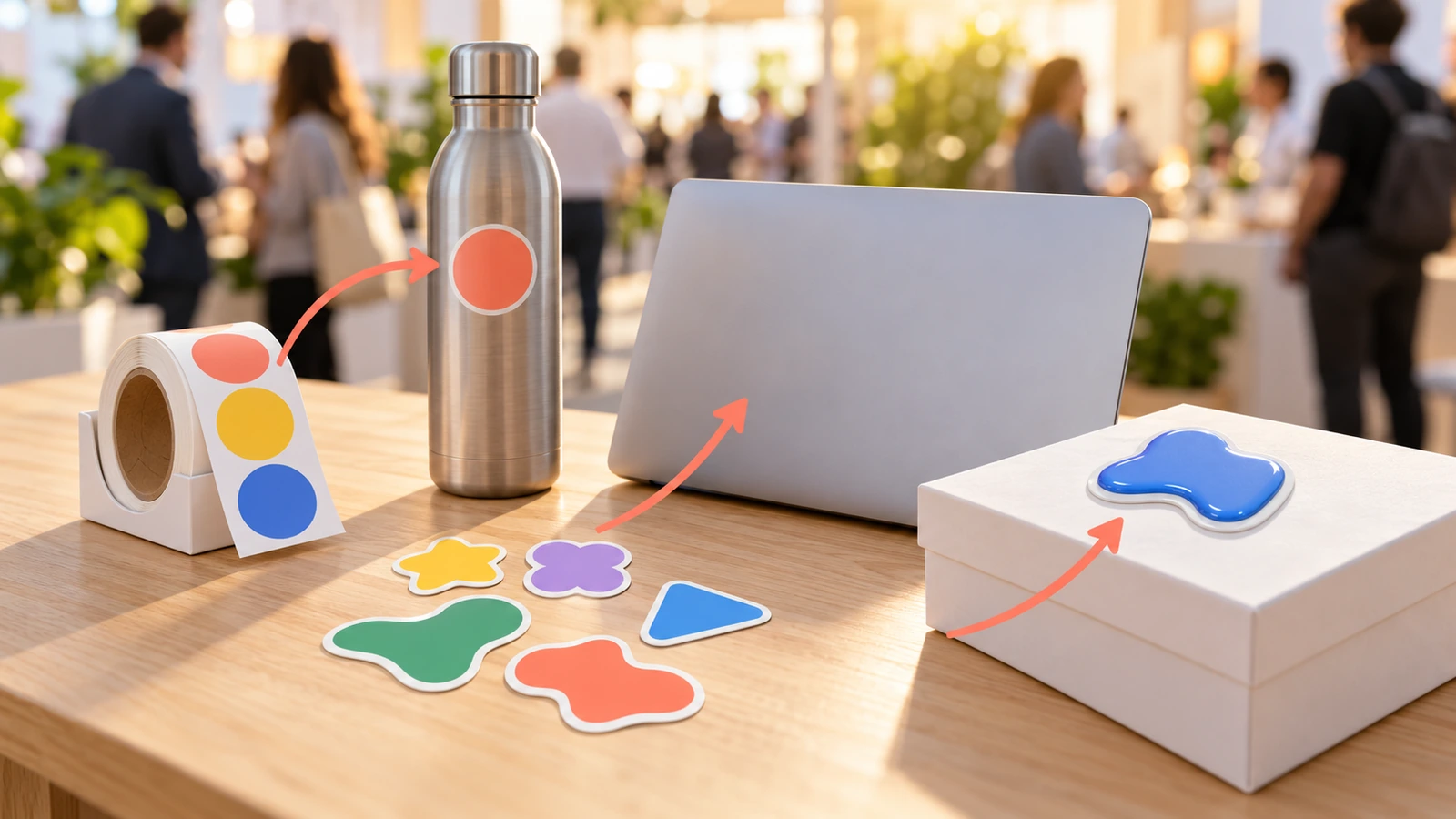
A custom sticker for a business logo placed directly on a product has to last as long as the product looks new. Typical surfaces are injection-molded housings, painted metal, glass, coated board gift boxes and accessory cases. For hard goods with handling and cleaning exposure, buyers usually look at vinyl or polyester faces with a permanent adhesive and an overlaminate or varnish. Where the logo is a tactile brand moment, a soft raised TPE sticker can add perceived value on smooth, clean surfaces. Examples include a premium gift box, a case lid or a counter display.
The surface matters more than the sticker. Polypropylene and polyethylene, which are common in housings, closures and bottles, are low-surface-energy plastics. Standard adhesives can bead up or let go over time on these plastics, so they need an adhesive chosen for low-surface-energy substrates. Soft, oil-extended elastomers bring a similar challenge when they are the substrate rather than the sticker. Materials literature reports untreated TPE surfaces at roughly 28–34 mN/m, below the range many inks and adhesives need to wet reliably.
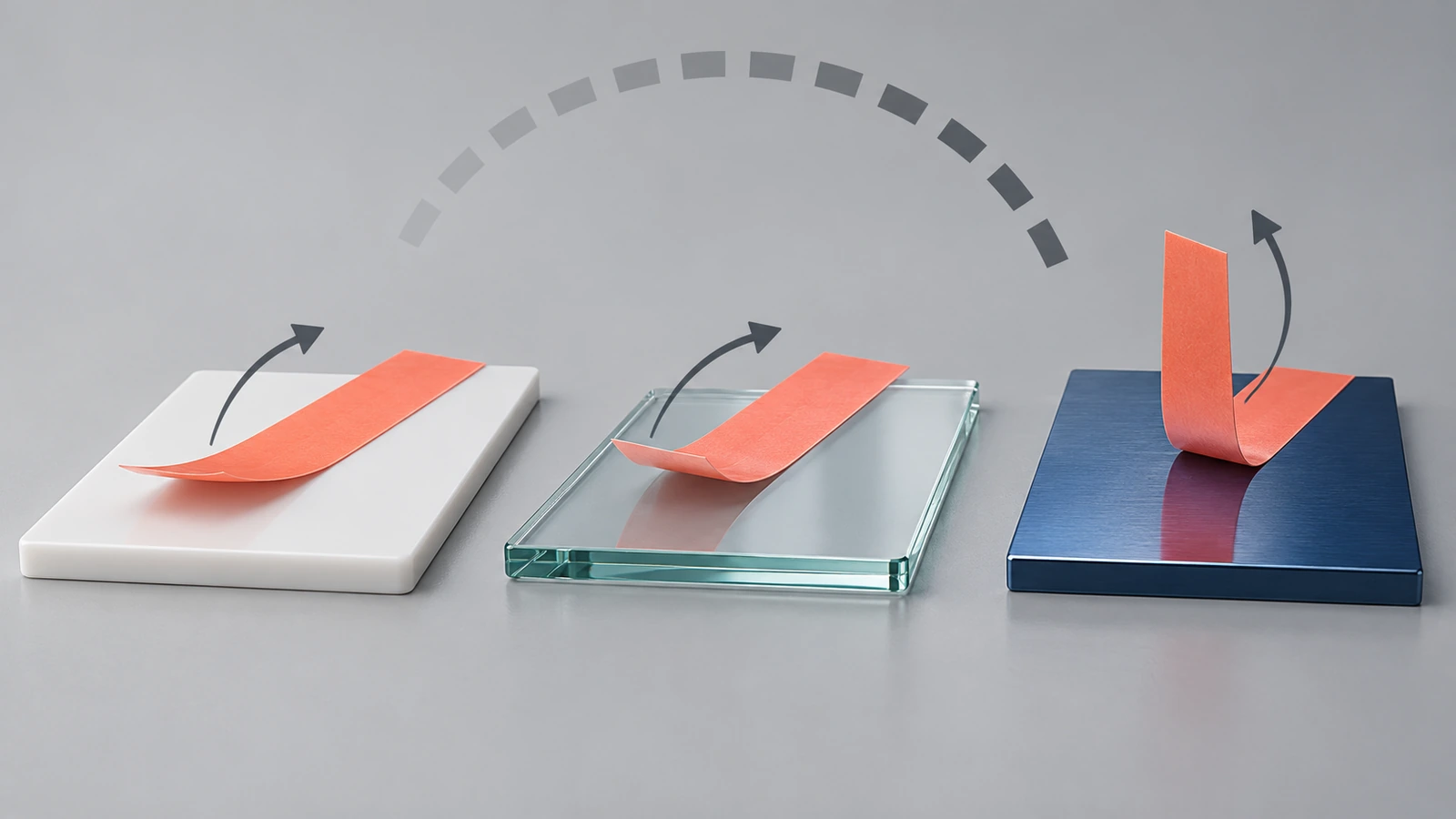
Ask for peel data on your actual part rather than on a steel test panel only. ASTM D3330/D3330M[2] defines peel adhesion at 180° (Method A) and 90° (Method F). Ask for both an early reading and a reading after the part has aged for at least 7 days. Many failures only show once plasticizers or oils migrate to the bond line.
2. Packaging seals: stickers that close boxes, bags and mailers
A packaging seal needs strong initial tack on coated board, kraft paper or poly film. It has to hold through transit temperature swings and, often, show whether the pack has been opened. It does not need to last for years. That usually points to paper or film labels with a permanent adhesive, matched to the pack surface. Matte paper accepts handwriting or a date stamp. Gloss film reproduces brand color more vividly and resists scuffing in transit. Destructible or void-pattern films are used where tamper evidence matters. Confirm that the pattern really triggers on your packaging before relying on it.
Regulation now reaches the words and symbols on seals. Seal stickers on packs sold into the EU are part of the packaging. Under the EU Packaging and Packaging Waste Regulation, Regulation (EU) 2025/40[3], the rules have applied since 12 August 2026. They include a ban on labels, marks and symbols likely to mislead users about packaging sustainability. A leaf icon or an unqualified "eco" line on a seal sticker is a claim, not decoration. Keep sustainability wording on seals limited to what you can document.
3. Equipment and asset marking: identification that has to stay readable
Asset tags, equipment ID stickers, inspection-due markers and service labels have a functional job. Someone must be able to read them after cleaning chemicals, outdoor weather, heat cycles and abrasion. The usual fit is polyester or engineered vinyl with a high-performance permanent adhesive and a protective overlaminate. On textured or slightly oily surfaces, the adhesive should be specified for those conditions. Decorative and reusable sticker formats, including soft jelly-style TPE, are the wrong tool for this job. They are designed to be removable, and that is exactly what an asset tag must not be.
Where durability is critical, use a recognized specification instead of a marketing word like "industrial grade." ASTM D7932-17 (reaffirmed 2023)[4] covers printed pressure-sensitive labels expected to face extended direct exposure to deteriorating chemicals, weather and high or low temperatures. It is a useful benchmark when you brief a supplier on asset labels that leave the office.
Content control matters as much as material. In 2024, Toyota recalled about 33,848 vehicles because a load-capacity label showed inaccurate information, as reported by Car and Driver[5]. The sticker stayed on; the data on it was wrong. For any sticker that carries serial numbers, ratings or warnings, build a separate data-proofing step that is independent of the visual art proof.

4. Promotional merchandise and event giveaways: stickers people choose to keep
Giveaway stickers succeed when recipients actually put them on something: a laptop, water bottle, notebook or phone case. Die-cut vinyl with a laminate is the common default because it prints fine detail and handles water. The review sample above shows its limits, though. Buyers reported failures on textured luggage, rigid hard plastic and fabric. If your audience is likely to stick them on those surfaces, discuss a higher-tack adhesive with your supplier. One reviewer also contrasted thin vinyl that "will not remove easily" with the thicker, easier-to-remove stickers handed out at conferences. If you want recipients to move the sticker without damage, removability is a spec item.
Format affects the event itself. One teacher in the review sample rated a pack one star because sheet-format stickers caused a scramble as recipients picked favorites. A roll would have let each person take the next sticker. For booths and high-traffic handouts, ask about rolls or individually backed singles. For curated kits or packaging inserts, sheets work well.
Soft raised TPE logo stickers fit giveaways where touch and perceived quality matter: VIP packs, retail gift-with-purchase and premium kits. Reusable, glue-free jelly-style stickers appeal to family audiences. An independent review in The Toy Insider[6] highlighted that such stickers peel away without residue and can be reused. Treat "no residue" as a claim to test on your target surfaces, not as a material property.
Child audiences raise the bar. A 2026 regional spot check of children's three-dimensional soft plastic stickers, reported by Hunan Today[7], found 16 of 20 samples exceeding phthalate limits. The worst sample was 44 times over the limit. The report does not confirm the base material of each sample, so it is not evidence against any single material. It does show why soft stickers aimed at children need batch-level testing. Peer-reviewed work in E3S Web of Conferences (2025)[8] notes that substances in stickers can reach children through skin contact or accidental ingestion. California also actively enforces disclosure on soft plastic goods. One Proposition 65 60-day notice[9] concerned DEHP in a gel dashboard mat. If your giveaway targets children, request third-party test reports for the specific batch and color, and avoid "food-grade" or "non-toxic" wording you cannot document.
A note on apparel: when a "sticker" is really a garment label
Brands sometimes brief a "soft logo sticker" when they mean a logo on clothing. Garment branding is usually a heat-transfer or sewn label, not a pressure-sensitive sticker. It is judged on wash durability and textile chemistry. Buyers commonly ask for OEKO-TEX STANDARD 100[10] certification. Its Product Class 1, for articles for babies and children up to 3 years, carries the strictest limits. If the logo has to survive a washing machine, brief a garment label supplier rather than a sticker supplier.
Application Map: Use, Sticker Type and Evidence to Request
The table compresses the sections above into one view. Use it to brief suppliers or to sanity-check a quote that seems too cheap for the job.
| Business use | What the sticker must do | Typical surface and exposure | Sticker type that usually fits | Evidence to request |
|---|---|---|---|---|
| Product branding (hard goods) | Stay put and look new for the product's life | Molded plastic, painted metal, glass; handling and cleaning | Vinyl or polyester, permanent adhesive, laminate or varnish | 180°/90° peel on your actual part, early and after 7 days |
| Premium tactile logo (gift box, case, display) | Add a raised, soft-touch brand moment | Smooth, clean, mostly indoor surfaces | Soft raised TPE logo sticker with self-adhesive backing | Pre-production sample on your surface; aging check for tack and color |
| Packaging seals | Close the pack; optionally show tampering | Coated board, kraft, poly mailers; transit heat and cold | Paper or film label, permanent adhesive; void film if tamper evidence is needed | Seal trial through a real shipment; wording review for EU sustainability claims |
| Equipment and asset marking | Remain readable and attached under harsh conditions | Chemicals, UV, temperature cycling, abrasion | Polyester or engineered vinyl, high-performance adhesive, overlaminate | Test data against a recognized durability specification; separate data proof |
| Adult event giveaways | Be kept and used on laptops and bottles | Laptop shells, bottles, phones, sometimes luggage | Die-cut vinyl with laminate; rolls or singles for fast handouts | Adhesion check on the likely surfaces; removability if it matters |
| Family or child-focused giveaways | Be fun, reusable and safe to handle | Windows, tablets, bottles; children's hands | Reusable soft or jelly-style stickers, or kid-appropriate vinyl | Batch-level third-party chemical test reports; age labeling |
A supplier's ISO 9001:2015[11] certificate tells you the factory runs a documented quality management system. It does not certify that a specific sticker is safe, durable or compliant. Use it to judge process discipline, and still ask for the application-level evidence in the right-hand column.
FAQ
FAQ: Which type of custom sticker is most versatile for a small business?
Laminated die-cut vinyl with a permanent adhesive covers the widest range of everyday uses: product inserts, packaging accents and giveaways. It is not universal. It struggles on textured fabric and some hard plastics, and it is not a substitute for durability-tested asset labels. If you only order one type, test it on the three surfaces your customers are most likely to use.
FAQ: Can soft TPE logo stickers be used on outdoor equipment?
They are a poor fit for long-term outdoor or chemical exposure. UV and heat can yellow light-colored elastomers, and removable-style constructions are not designed to resist deliberate peeling. Use soft TPE logos for brand-facing, mostly indoor surfaces. Use polyester or engineered vinyl labels for equipment that lives outside.
FAQ: Why do my stickers peel off plastic containers?
Many containers are made from polypropylene or polyethylene, which have low surface energy, so general-purpose adhesives cannot wet them well. Ask your supplier for an adhesive rated for low-surface-energy plastics. Clean the surface of oils and mold-release residue before application, and check adhesion again after a few days rather than only at application.
FAQ: Is it safe to hand out stickers to children at events?
It can be, provided the stickers are produced and tested for that audience. Ask for batch-specific third-party reports covering restricted substances such as phthalates and heavy metals for the markets where you will distribute them, and label the recommended age range. Do not rely on a material name or a "non-toxic" label alone.
FAQ: What should I send a supplier to get an accurate quote?
Describe the application, the exact surface, the environment and how long the sticker must last. Add the artwork, the quantity and the delivery format you need, such as rolls, sheets or singles. Framing the brief around the ISO/TS 18614 information categories helps suppliers quote like for like. Quantities, pricing and timelines depend on the construction, so request a written quotation rather than relying on list prices.
Key Takeaways
- Brief stickers by application, using a shared ordering vocabulary. — ISO/TS 18614 has defined the information needed to order self-adhesive labels since 2016 (Source)
- Peel strength is measurable, so ask for numbers on your own surface. — ASTM D3330 specifies peel at 180° and 90° (Source)
- Sustainability wording on EU packaging seals is now regulated. — The ban on misleading labels has applied since 12 August 2026 (Source)
- Asset labels need a durability benchmark, not a marketing adjective. — ASTM D7932-17 was reaffirmed in 2023 for extreme distribution environments (Source)
- Wrong data on a label can trigger a recall even when the label sticks. — About 33,848 vehicles were recalled over an inaccurate label (Source)
- Soft stickers for children need batch-level chemical testing. — 16 of 20 sampled soft children's stickers exceeded phthalate limits (Source)
- Logos on clothing belong to garment-label rules, not sticker rules. — OEKO-TEX Product Class 1 covers items for children up to 3 years (Source)
Conclusion
The best custom stickers for business are not the cheapest per piece or the most impressive on screen. They are the ones built for the surface, environment and lifespan of the job. Use vinyl or polyester for products and assets that must last, and paper or film for seals that must hold through shipping. Use die-cut vinyl for everyday giveaways and soft raised TPE for tactile brand moments on smooth surfaces. Test on the real surface, ask for documents tied to the actual batch, and proof the data as carefully as the design.
If a soft, raised logo fits one of your applications, start with our custom TPE stickers page for specification and sampling details. Then send us your surface, use case and quantity for a tailored quotation.
Footnotes
- ISO, ISO/TS 18614:2016, Packaging — Label material — Required information for ordering and specifying self-adhesive labels. ↩
- ASTM International via ANSI Webstore, ASTM D3330/D3330M-04(2025), Standard Test Method for Peel Adhesion of Pressure-Sensitive Tape. ↩
- EUR-Lex, Summary of Regulation (EU) 2025/40 on packaging and packaging waste; in force 11 February 2025, applicable from 12 August 2026. ↩
- ASTM International via NSAI Standards, ASTM D7932-17 (R2023), Printed, Pressure-Sensitive Adhesive Labels for Use in Extreme Distribution Environments. ↩
- Car and Driver, Toyota recall over inaccurate load-capacity label, 12 August 2024. ↩
- The Toy Insider, Review of reusable jelly sticker books, 18 August 2026. ↩
- Hunan Today (Chinese-language), Spot check of children's three-dimensional soft plastic stickers, September 2026. ↩
- E3S Web of Conferences, Paper on chemical exposure risks in children's stickers (ICUEMS 2025). ↩
- State of California Office of the Attorney General, Proposition 65 60-Day Notice 2020-03283, 3 December 2020. ↩
- OEKO-TEX, OEKO-TEX STANDARD 100 — product classes and testing for harmful substances. ↩
- ISO, ISO 9001:2015, Quality management systems — Requirements; confirmed current at its 2021 review. ↩












The information below is required for social login
Sign In
Create New Account