


 Blog PDF for offline reading
Quick answer: The most common hang tag size in North American apparel retail is 2 × 3.5 in, about the size of a business card, hung vertically from a 1/8 in hole at top center. Mini hang tags of about 1.5–2 in square suit jewelry and accessories. Heavy copy calls for a 2 × 4 in or folded tag. Die-cut tags are quoted by their bounding box.
Ask three printers for a "standard hang tag" and you will likely get three different tags. One arrives 2 × 2 in, one 2 × 3.5 in, and one has the hole on the opposite corner. None of the three quotes can be compared. The trouble starts after you approve one. The punch lands in the price line, or the UPC barcode does not fit the back. Sometimes the tag spins on the rail so shoppers see the blank side. Each of these problems means reprinting the whole run, and that usually happens when the launch date can no longer move.
Those failures come from dimensions, not from design or printing. One large US online printer says in its own sizing guide that the hole is where most reprints come from. The arithmetic is tight. On a 2 × 2 in tag, the bleed, safe margin and hole zone leave only about 1.25 in of usable height. A full-size UPC-A symbol is roughly 1.02 in tall before you add a price or a size line. The hang tag size has to be planned around what the tag must carry.
This guide works through the decisions in order. It maps standard, mini, folded and die-cut formats to product category, retail fixture, copy load and hole placement. By the end you can lock six dimension fields before you request a quote. Paper stock, proofing and full RFQ wording are covered in our custom hang tags specification and buying guide, so this article stays on measurements.
What Does Hang Tag Size Actually Mean?
A hang tag size is more than width × height. A supplier works from at least six related measurements. If you leave any of them unstated, the supplier fills it in with its own default.
- Trim size: the finished dimension after cutting, stated width first. A 2 × 3.5 in vertical tag and a 3.5 × 2 in horizontal tag use the same sheet area, but they hang and read differently.
- Bleed: background colour or images that extend past the trim line so a slight cutting shift does not leave a white edge. Many printers ask for 0.125 in on every side. Confirm the figure in your supplier's template.
- Safe margin: the band inside the trim line where no text or logo should sit. A common working figure is 0.125 in.
- Hole zone: the hole diameter, its center position, and a clear area around it. Keep copy about 0.25 in away from the hole edge.
- Live area: what is left for copy after the other zones are taken out. This is the number that decides whether your content fits.
- Flat vs folded size: folded tags need both values, plus the fold direction.
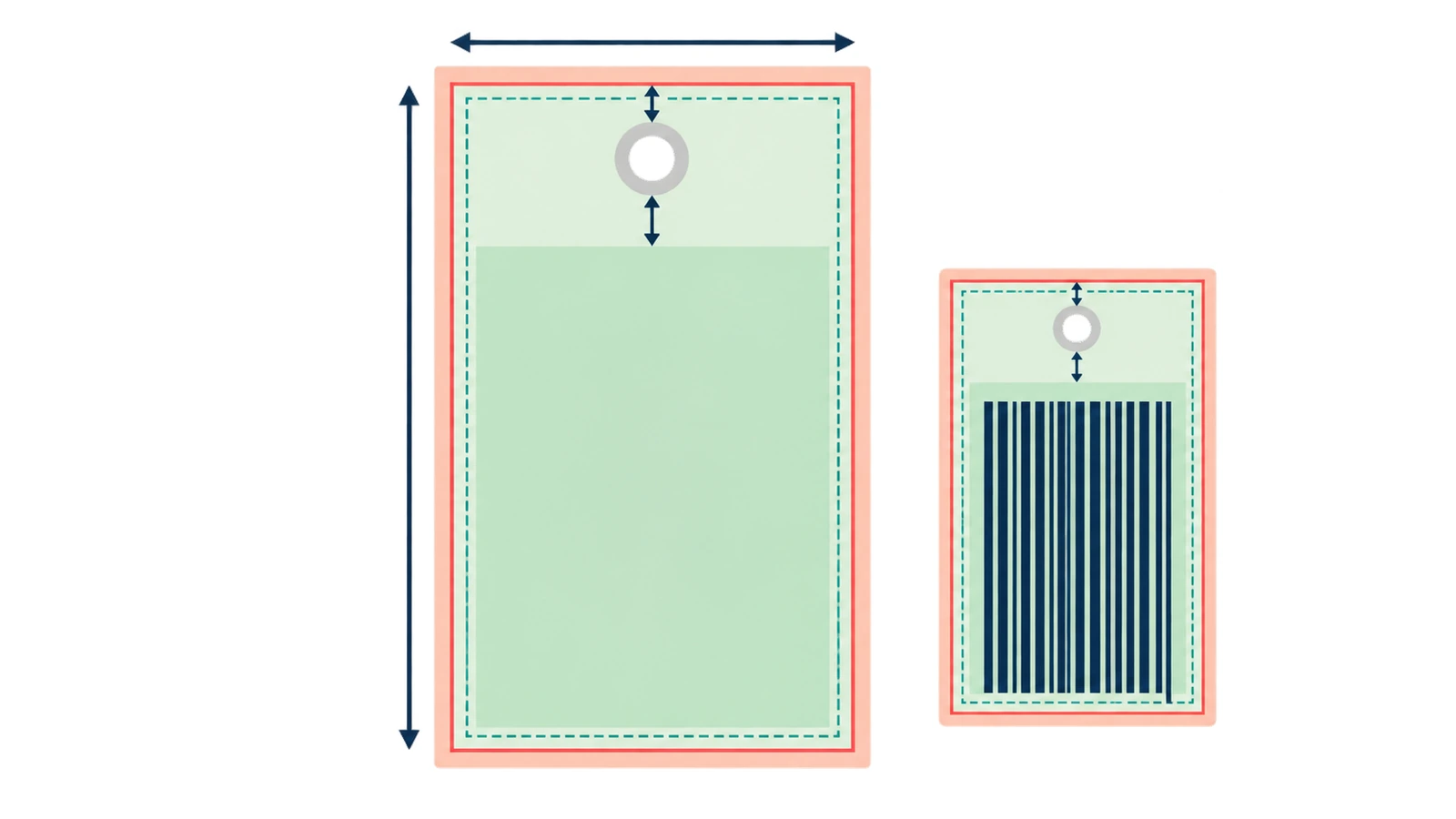
Usable Live Area by Common Trim Size
The table below is a worked estimate, not a supplier specification. It assumes a vertical tag, a 1/8 in hole centered about 0.25 in from the top edge, a 0.125 in safe margin, and copy kept 0.25 in clear of the hole. With those assumptions, copy starts about 0.6 in below the top edge. Use the table to test fit before you send artwork.
| Trim size (W × H, in) | Approx. live area (in) | What realistically fits on one face |
|---|---|---|
| 1.5 × 1.5 | 1.25 × 0.75 | Logo or brand name only. Price on the reverse. |
| 2 × 2 | 1.75 × 1.25 | Logo plus one short line, or a full-size UPC-A with almost no room left over. |
| 2.5 × 2.5 | 2.25 × 1.75 | Logo plus 2–3 lines, or a QR code with a short call to action. |
| 2 × 3.5 | 1.75 × 2.75 | Price, size, SKU and a UPC-A on the back, with room to breathe. |
| 2 × 4 | 1.75 × 3.25 | Everything above plus a short care summary or QR code. |
| 2 × 3.5, folded (4 faces) | 4 × about 1.75 × 2.75 | Brand story, materials note and QR inside. Retail data stays on the back. |
The barcode explains most size upgrades. A UPC-A at 100% magnification is about 1.469 in wide including its quiet zones, which fits inside the 1.75 in live width of a 2 in wide tag. The barcode is also about 1.02 in tall. On a 2 × 2 in tag it uses nearly all of the 1.25 in of usable height. Do not shrink or trim the barcode to fit unless your retailer's vendor guide allows it. Retail chargebacks for barcodes that will not scan cost far more than moving up one tag size.
How to Choose a Hang Tag Size in Six Steps
Step 1: List the copy before you pick a size
Write every line the tag must carry and decide which face it goes on. A typical split puts the logo on the front, and price, size, SKU, barcode and an optional QR code on the back. Then remove anything that legally belongs on the garment's permanent label. Under the US Care Labeling Rule, care instructions go on a permanent label that stays legible for the product's useful life[1]. A hang tag only repeats that information when the label cannot be seen at the point of sale. Fiber content, country of origin and RN numbers follow separate FTC apparel labeling rules[2]. Keeping those lines off the tag usually saves a full size step. The product page covers what a paper tag can and cannot replace.
Every line you do keep is a claim you must keep accurate across every SKU and every reorder. The FTC's labeling history shows how often these claims go wrong. Most textile enforcement has involved fiber names, as Textile World summarized in December 2025[3]. In 2022 the FTC finalized an order requiring an apparel seller to pay $211,335 over false Made in USA labels[4]. An EU-backed test reported by Business of Fashion found that about 37% of tested garments[5] had fiber content that did not match their tags or labels. Fewer lines mean a smaller tag and less to verify.
Environmental claims also take space. The FTC tells marketers not to use broad, unqualified terms like "green" or "eco-friendly"[6]. A claim that holds up, such as a recycled-content statement with its percentage, takes one or two full lines. Regulators abroad apply the same logic. The Netherlands' ACM has acted against "organic cotton" claims that left out the actual share[7]. If you plan a sustainability line, budget the space for it at this step. Our tag claims and RFQ section covers the wording.
Step 2: Match the format to the product and the fixture
Look at where the tag will hang before you look at sizes. A tag on a garment rail is read at eye level from about arm's length, and it competes with the garment's own colour. A tag on a necklace display card has to stay smaller than the piece it describes. A tag looped over a bottle neck should not cover the bottle's front label. On a folded-table stack the tag lies flat, so face orientation matters more than swing. The category table below gives starting points for each case.
Step 3: Check fit against the live area, then test-scan
Place your copy list from Step 1 into the live-area figures above. If the back face holds a barcode plus more than two other lines, a 2 × 3.5 in tag is usually the smallest size that works. A QR code needs a clear quiet zone and a plain background, never metallic foil or a dark image. Print it at final size and scan it with two or three phones before you choose a smaller tag. Anything that still does not fit can move to a QR landing page rather than forcing a bigger tag. Industry interviews such as Hertzman Global Intelligence's October 2026 piece on digital product identity[8] describe QR codes, NFC and RFID as carriers for material, origin and recycling data. They only add value if someone keeps the linked page current.
Step 4: Set hole diameter and position as numbers
Choose the fastener first, then the hole. A 1/8 in hole is the common default for string and plastic fasteners. 3/16, 1/4 and 5/16 in are standard alternatives for thicker cord, ribbon or metal eyelets. A hole that is too large lets a fastener slip through. A hole too close to the trim edge tears when shoppers pull on the tag. Keep the hole center at least about 0.25 in from the nearest edge, and treat your supplier's minimum as final.
Position decides how the tag hangs:
- Top center: a vertical tag hangs upright and front-facing. This is the default for apparel.
- Top corner: the tag hangs at an angle, which suits square and horizontal tags. It can make a vertical tag look crooked.
- Side or near the fold: used on folded tags and wide strips. The hole must pass through every panel at the same point.
State the hole as a diameter plus the coordinates of its center measured from the top-left corner of the trim. Mark it on a non-printing layer in the artwork. Do not assume a "hang tag" order includes drilling. Many online configurators list the hole as a separate option.
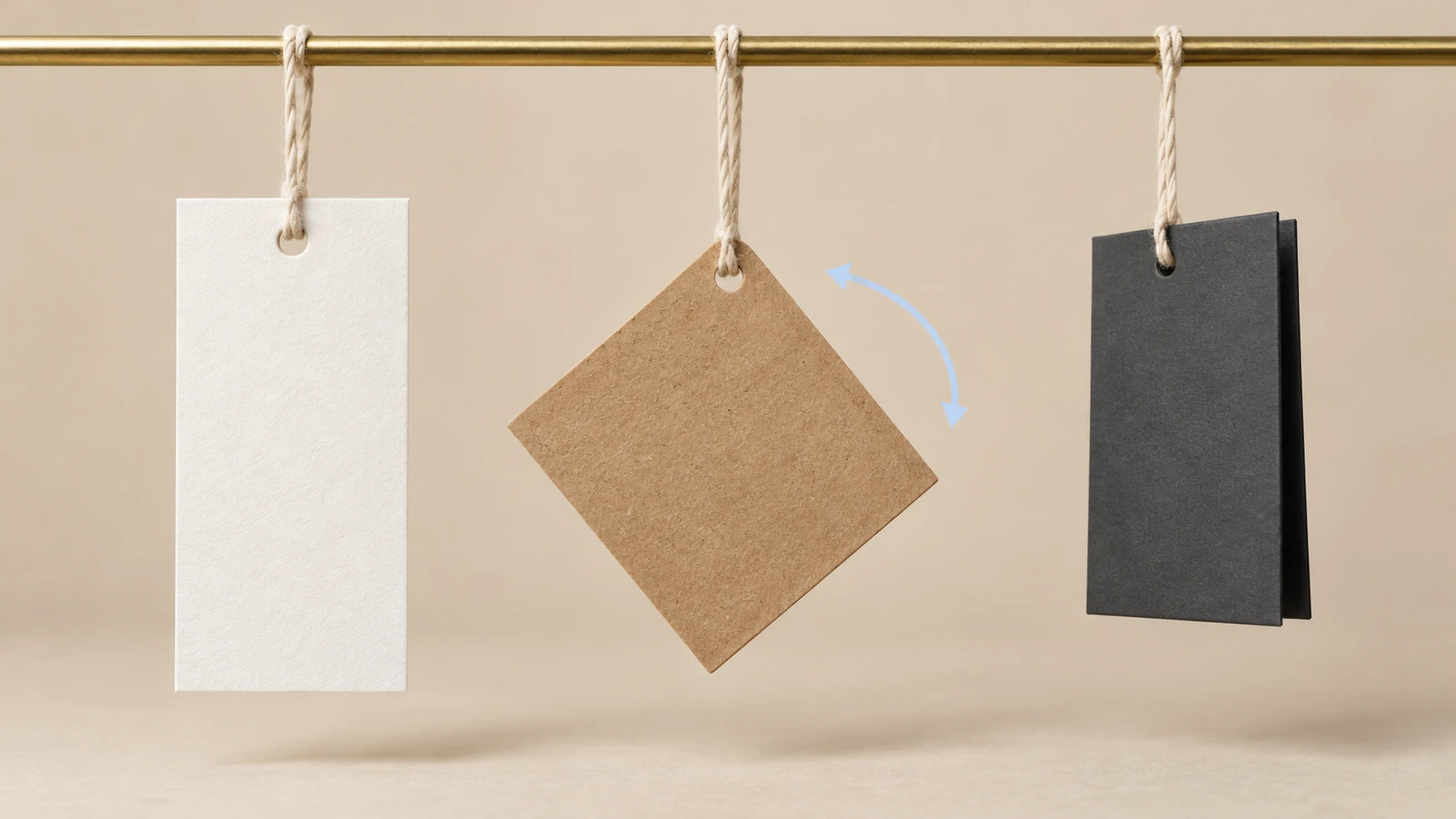
Step 5: Build a 100% scale mock-up and hang it
Print your layout at actual size on ordinary paper or card, cut it to the trim line and punch it. Then hang it on the real product at the real fixture. Check whether the smallest line can be read at arm's length under store lighting and whether the tag flips to its blank side on the hanger. Also check that it does not cover a logo, neckline print or bottle label. If you can, hang 20–50 mock-ups across a full rail to catch tags that rotate. This tests size and position only. Colour is approved separately against a contract proof. ISO's ISO 12647-1:2013 process-control standard[9] treats the contract proof as the reference for production colour. The proofing workflow is on our hang tag product page.

Step 6: Write the dimension block for your RFQ
Send the same dimension block to every supplier you ask, so the quotes can be compared line for line:
- Format: rectangle, square, folded or die-cut
- Trim size W × H and orientation; for folded tags, flat size, folded size and fold edge
- Die line attached as a vector path (die-cut only), with bounding-box dimensions
- Bleed and safe margin you designed to
- Hole diameter and center coordinates, plus the fastener you will use
- Number of versions or SKUs sharing the same die and size
Stock, finish, attachment and quantity fields go in the same RFQ. Our custom hang tags guide lists them, and we confirm by quote which sizes and formats can be produced for your order.
Mini, Standard, Folded and Die-Cut Formats Compared
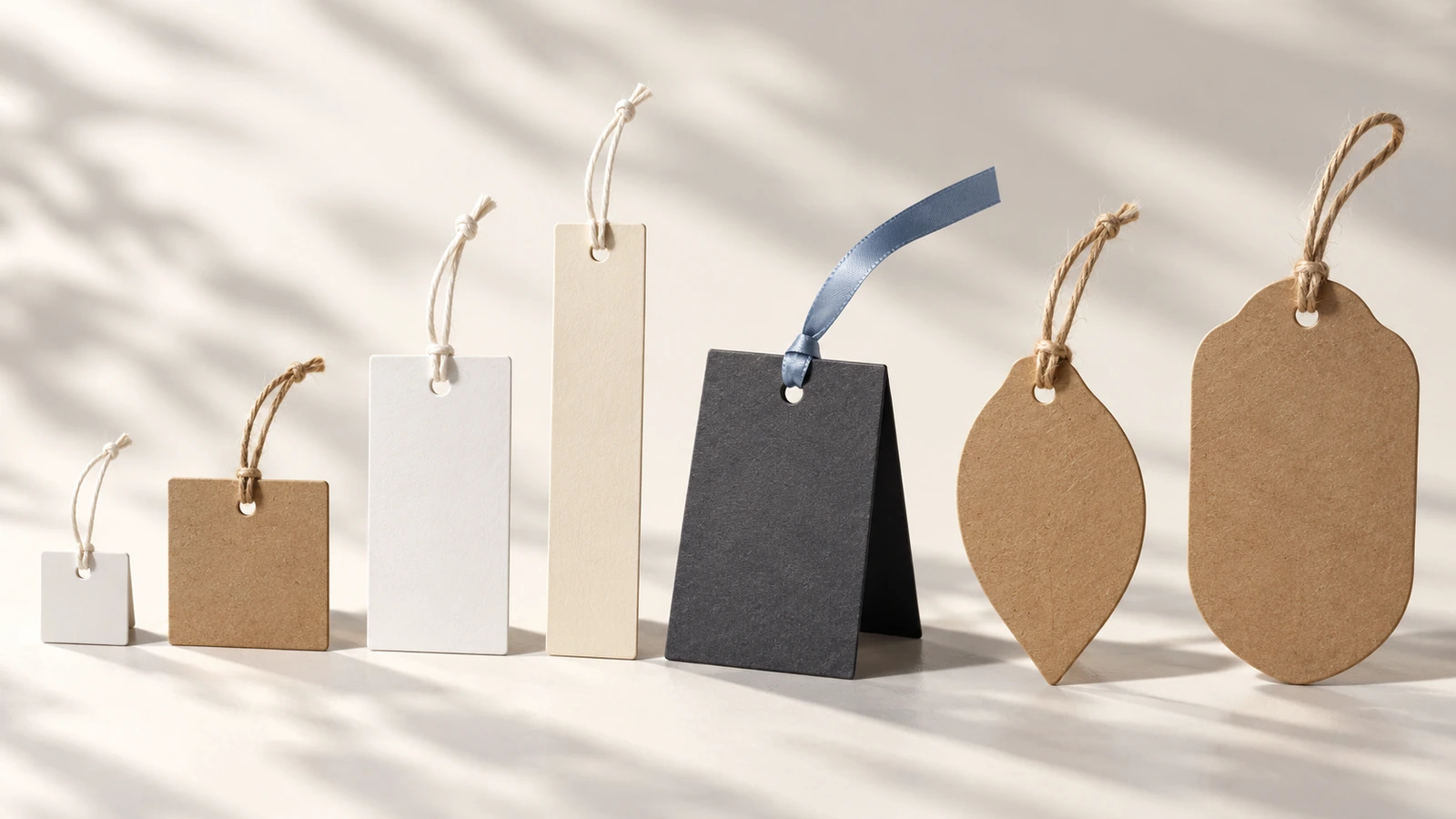
| Format | Typical trim range | Copy capacity | Best for | Watch-outs |
|---|---|---|---|---|
| Mini / small hang tags | About 1.5 × 1.5 to 2 × 2 in | Logo or price only per face | Jewelry, hair accessories, small knitwear, gift items | No room for a full UPC-A plus other copy. A large hole can take half the face. |
| Square | About 2.5 × 2.5 in | Logo plus 2–3 lines, or a QR code | Accessories, candles, gifts with a short message | Hangs better from a corner hole than a top-center hole. |
| Standard rectangle | 2 × 3.5 in (most common), 2 × 4 in | Retail data plus barcode on the back | Tops, dresses, most apparel on rails | Heavy copy on a 2 × 3.5 in tag leads to tiny type. Move up to 2 × 4 in or folded. |
| Long strip | 2 in wide, up to about 8 in tall | Lists, size runs, multilingual lines | Home textiles, bedding, outerwear | Can hang past the hem or wrap around the product. Check on the fixture. |
| Custom folded hang tags | Folded face often 2 × 3.5 in or square; flat size double | Four faces | Brand story, materials note, premium lines | Specify flat size, folded size and fold edge. The hole must align through both panels. |
| Custom die cut hang tags | Quoted by bounding box | Depends on the shape's usable interior | Brand-shaped tags, denim, bags, bottles | Narrow points and tight curves tear or cut unevenly. A die is one-time tooling. |
Sizing custom folded hang tags
A folded tag has three sizes: flat, folded and fold edge. "2 × 3.5 in folded" can mean a 4 × 3.5 in sheet folded at the left side or a 2 × 7 in sheet folded at the top. These two tags open differently and need different hole positions. A top fold hangs closed. A side fold can swing open on the rail unless the hole passes through both panels close to the fold. On heavier card, the fold needs scoring so the print does not crack along the crease. Mention this when you send the dimension block.
Sizing custom die cut hang tags
Suppliers price and impose a die-cut tag by its bounding box, the smallest rectangle that contains the shape. A leaf-shaped tag 2.5 in at its widest and 3.5 in tall is a 2.5 × 3.5 in job, even though it uses less card. The usable live area is the largest clean shape that fits inside the outline with the safe margin applied, and it is usually much smaller than the bounding box. Give the shape gentle radii and keep necks and points wide enough to survive handling. Place the hole where the material is widest. Supply the die line as one closed vector path on its own layer.
Starting Sizes by Product Category and Fixture
These are starting points to test with a Step 5 mock-up, not fixed rules:
| Product category | Typical fixture | Starting format | Hole position |
|---|---|---|---|
| T-shirts, tops, dresses | Garment rail, hanger | 2 × 3.5 in vertical | Top center |
| Denim, workwear | Rail or folded table | 2 × 4 in, folded, or die-cut | Top center or side |
| Knitwear, crochet, handmade | Folded table, basket | 2 × 2 to 2.5 × 2.5 in | Corner |
| Jewelry, hair accessories | Display card, spinner | Mini, about 1.5 × 1.5 in | Top center, small diameter |
| Bags, leather goods | Shelf, hook | Die-cut or 2.5 × 2.5 in | Corner or shape-specific |
| Bottles, candles, gifts | Shelf, neck loop | Square or die-cut, narrower than the front label | Corner |
| Bedding, home textiles | Shelf stack, hook | Long strip or folded | Top center |
FAQ
FAQ: What is the standard hang tag size?
For apparel, 2 × 3.5 in hung vertically is the most commonly ordered size among North American printers. It is close to a business card and leaves about 1.75 × 2.75 in of live area per face. Other common sizes are 2 × 2, 2.5 × 2.5 and 2 × 4 in, and some printers offer tags up to 2 × 8 in. "Standard" still varies from supplier to supplier, so always state the exact trim size.
FAQ: What size are mini hang tags?
Mini or small hang tags are usually about 1.5 × 1.5 in to 2 × 2 in. After margins and the hole, a 1.5 in tag leaves roughly 1.25 × 0.75 in of usable space. That is enough for a logo on the front and a price on the back, but not for a full barcode plus other copy.
FAQ: How big does a hang tag need to be for a UPC barcode?
A UPC-A at 100% magnification is about 1.469 in wide including its quiet zones and roughly 1.02 in tall. A 2 in wide tag fits the width. If the same face also carries a price and a size, plan on at least 2 × 3.5 in. Check your retailer's vendor guide before you reduce or trim the barcode.
FAQ: What hole size should a hang tag have?
1/8 in is the common default for string and plastic fasteners. 3/16, 1/4 and 5/16 in suit thicker cord, ribbon or eyelets. Pick the fastener first and match the hole to it. Keep the hole center at least about 0.25 in from the edge, and keep copy about 0.25 in clear of the hole.
FAQ: Do I quote a folded hang tag by its flat or folded size?
Give both, plus the fold edge (top or side). A 2 × 3.5 in folded tag can come from a 4 × 3.5 in or a 2 × 7 in sheet. These two tags open and hang differently, and their hole positions are different.
FAQ: How is a die-cut hang tag measured?
By the bounding box, the smallest rectangle that contains the shape. Send the die line as a closed vector path with the bounding-box width and height. Then check that your copy fits inside the shape's usable interior, which is smaller than the box.
FAQ: Should care instructions decide my hang tag size?
Usually not. US rules require care information on a permanent label, and fiber and origin information follow separate FTC labeling rules. The tag can repeat a short summary or link to it through a QR code, so you do not need a bigger tag for full care text.
Key Takeaways
- Size the tag around the copy that truly belongs on it; legally required care text lives on the permanent label — 16 CFR Part 423 (Source)
- Every extra line on a tag is a claim to keep true across reorders, and fiber claims fail often — about 37% of garments in an EU-backed test did not match their tags or labels (Source)
- Origin lines printed on tags carry real enforcement risk — a $211,335 FTC order over false Made in USA labels in 2022 (Source)
- Budget one or two lines for any environmental claim, because vague terms are not acceptable shortcuts — FTC Green Guides, 16 CFR Part 260, revised 2012 (Source)
- Approve dimensions with a scale mock-up and colour with a contract proof; they are two separate checks — ISO 12647-1:2013 (Source)
- Move overflow content to a QR page instead of enlarging the tag, if you can keep the page current — 3 carriers named for garment data: QR, NFC and RFID (Source)
Conclusion
Choosing a hang tag size is a fit problem with a short list of inputs: the copy you must carry, the product and fixture, the barcode, and the hole. Start from 2 × 3.5 in for apparel and drop to a mini format only when the copy list is very short. Switch to folded or die-cut when the brand story or the shape justifies the extra specification. Check every candidate against its live area, then hang a full-scale mock-up before anyone prints. Once the six dimension fields are fixed, quotes become comparable and reprints become rare.
When your dimension block is ready, take it to our custom hang tags guide to add stock, finish and attachment. Then send it to us for a quote. We will confirm format availability, quantities and timing for your exact specification.
Footnotes
- eCFR, 16 CFR Part 423: Care Labeling of Textile Wearing Apparel and Certain Piece Goods, §§ 423.1 and 423.6(a), text current as of 2026-02-26. ↩
- U.S. Federal Trade Commission, Apparel Labeling, accessed 2026-10. ↩
- Textile World, "Avoid Being Labeled Noncompliant: The Basics of Textile and Wool Product Labeling", 2025-12-02. ↩
- FTC press release, "Federal Trade Commission Finalizes Action Against Made in USA Offender Who Ripped Made in China Tags Out", 2022-07-28. ↩
- The Business of Fashion, "New EU Report Finds Nearly 40 Percent of Clothing Tags Are Mislabeled", 2026-06-23. ↩
- FTC, "Environmental Claims: Summary of the Green Guides" (16 CFR Part 260), 2012-10-02. ↩
- Netherlands Authority for Consumers and Markets (ACM), "ACM continues its campaign against misleading sustainability claims in the clothing sector", accessed 2026-10. ↩
- Hertzman Global Intelligence, "How Digital Product Identity Is Reshaping Apparel's Path to Circularity", 2026-10-09. ↩
- ISO 12647-1:2013, Graphic technology — Process control for the production of half-tone colour separations, proof and production prints — Part 1, ISO/TC 130. ↩












The information below is required for social login
Sign In
Create New Account